SOLAR SYSTEM
By Kevin, Eloy and Mario
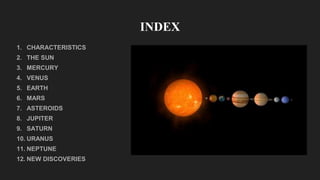
INDEX
1. CHARACTERISTICS
2. THE SUN
3. MERCURY
4. VENUS
5. EARTH
6. MARS
7. ASTEROIDS
8. JUPITER
9. SATURN
10. URANUS
11. NEPTUNE
12. NEW DISCOVERIES
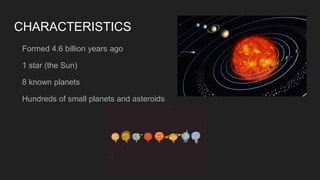
CHARACTERISTICS
Formed 4.6 billion years ago
1 star (the Sun)
8 known planets
Hundreds of small planets and asteroids
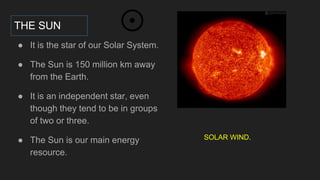
THE SUN
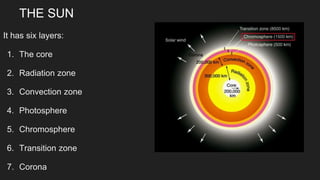
SOLAR WIND.
THE SUN
It has six layers:
1. The core
2. Radiation zone
3. Convection zone
4. Photosphere
5. Chromosphere
6. Transition zone
7. Corona
MERCURY
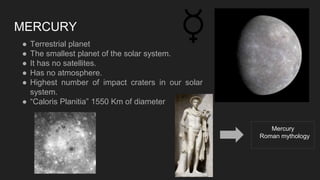
● Terrestrial planet
● The smallest planet of the solar system.
● It has no satellites.
● Has no atmosphere.
● Highest number of impact craters in our solar
system.
● “Caloris Planitia” 1550 Km of diameter
Mercury
Roman mythology
VENUS
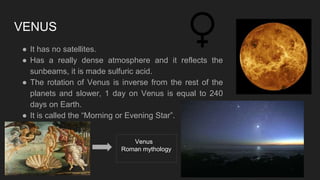
● It has no satellites.
● Has a really dense atmosphere and it reflects the
sunbeams, it is made sulfuric acid.
● The rotation of Venus is inverse from the rest of the
planets and slower, 1 day on Venus is equal to 240
days on Earth.
● It is called the “Morning or Evening Star”.
Venus
Roman mythology
EARTH
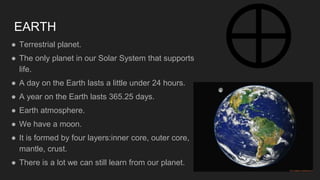
● Terrestrial planet.
● The only planet in our Solar System that supports
life.
● A day on the Earth lasts a little under 24 hours.
● A year on the Earth lasts 365.25 days.
● Earth atmosphere.
● We have a moon.
● It is formed by four layers:inner core, outer core,
mantle, crust.
● There is a lot we can still learn from our planet.
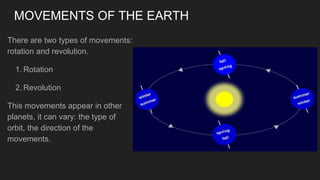
MOVEMENTS OF THE EARTH
There are two types of movements:
rotation and revolution.
1. Rotation
2. Revolution
This movements appear in other
planets, it can vary: the type of
orbit, the direction of the
movements.
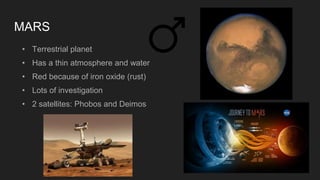
MARS
• Terrestrial planet
• Has a thin atmosphere and water
• Red because of iron oxide (rust)
• Lots of investigation
• 2 satellites: Phobos and Deimos
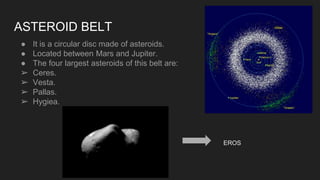
ASTEROID BELT
● It is a circular disc made of asteroids.
● Located between Mars and Jupiter.
● The four largest asteroids of this belt are:
➢ Ceres.
➢ Vesta.
➢ Pallas.
➢ Hygiea.
EROS
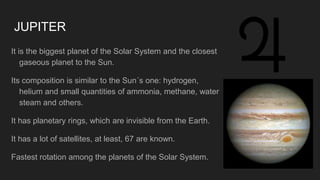
JUPITER
It is the biggest planet of the Solar System and the closest
gaseous planet to the Sun.
Its composition is similar to the Sun´s one: hydrogen,
helium and small quantities of ammonia, methane, water
steam and others.
It has planetary rings, which are invisible from the Earth.
It has a lot of satellites, at least, 67 are known.
Fastest rotation among the planets of the Solar System.
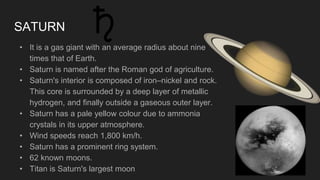
SATURN
• It is a gas giant with an average radius about nine
times that of Earth.
• Saturn is named after the Roman god of agriculture.
• Saturn's interior is composed of iron–nickel and rock.
This core is surrounded by a deep layer of metallic
hydrogen, and finally outside a gaseous outer layer.
• Saturn has a pale yellow colour due to ammonia
crystals in its upper atmosphere.
• Wind speeds reach 1,800 km/h.
• Saturn has a prominent ring system.
• 62 known moons.
• Titan is Saturn's largest moon
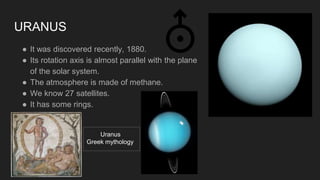
URANUS
● It was discovered recently, 1880.
● Its rotation axis is almost parallel with the plane
of the solar system.
● The atmosphere is made of methane.
● We know 27 satellites.
● It has some rings.
Uranus
Greek mythology
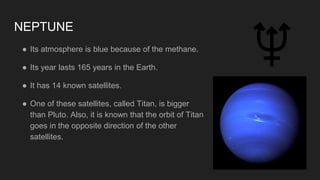
NEPTUNE
● Its atmosphere is blue because of the methane.
● Its year lasts 165 years in the Earth.
● It has 14 known satellites.
● One of these satellites, called Titan, is bigger
than Pluto. Also, it is known that the orbit of Titan
goes in the opposite direction of the other
satellites.
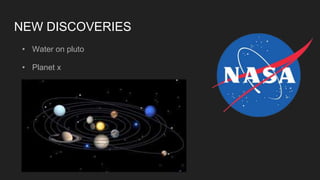
NEW DISCOVERIES
• Water on pluto
• Planet x
THE END
THANK YOU FOR YOUR TIME

Solar system

  • 1.
    SOLAR SYSTEM By Kevin,Eloy and Mario
  • 2.
    INDEX 1. CHARACTERISTICS 2. THESUN 3. MERCURY 4. VENUS 5. EARTH 6. MARS 7. ASTEROIDS 8. JUPITER 9. SATURN 10. URANUS 11. NEPTUNE 12. NEW DISCOVERIES
  • 3.
    CHARACTERISTICS Formed 4.6 billionyears ago 1 star (the Sun) 8 known planets Hundreds of small planets and asteroids
  • 4.
  • 5.
    THE SUN It hassix layers: 1. The core 2. Radiation zone 3. Convection zone 4. Photosphere 5. Chromosphere 6. Transition zone 7. Corona
  • 6.
    MERCURY ● Terrestrial planet ●The smallest planet of the solar system. ● It has no satellites. ● Has no atmosphere. ● Highest number of impact craters in our solar system. ● “Caloris Planitia” 1550 Km of diameter Mercury Roman mythology
  • 7.
    VENUS ● It hasno satellites. ● Has a really dense atmosphere and it reflects the sunbeams, it is made sulfuric acid. ● The rotation of Venus is inverse from the rest of the planets and slower, 1 day on Venus is equal to 240 days on Earth. ● It is called the “Morning or Evening Star”. Venus Roman mythology
  • 8.
    EARTH ● Terrestrial planet. ●The only planet in our Solar System that supports life. ● A day on the Earth lasts a little under 24 hours. ● A year on the Earth lasts 365.25 days. ● Earth atmosphere. ● We have a moon. ● It is formed by four layers:inner core, outer core, mantle, crust. ● There is a lot we can still learn from our planet.
  • 9.
    MOVEMENTS OF THEEARTH There are two types of movements: rotation and revolution. 1. Rotation 2. Revolution This movements appear in other planets, it can vary: the type of orbit, the direction of the movements.
  • 10.
    MARS • Terrestrial planet •Has a thin atmosphere and water • Red because of iron oxide (rust) • Lots of investigation • 2 satellites: Phobos and Deimos
  • 11.
    ASTEROID BELT ● Itis a circular disc made of asteroids. ● Located between Mars and Jupiter. ● The four largest asteroids of this belt are: ➢ Ceres. ➢ Vesta. ➢ Pallas. ➢ Hygiea. EROS
  • 12.
    JUPITER It is thebiggest planet of the Solar System and the closest gaseous planet to the Sun. Its composition is similar to the Sun´s one: hydrogen, helium and small quantities of ammonia, methane, water steam and others. It has planetary rings, which are invisible from the Earth. It has a lot of satellites, at least, 67 are known. Fastest rotation among the planets of the Solar System.
  • 13.
    SATURN • It isa gas giant with an average radius about nine times that of Earth. • Saturn is named after the Roman god of agriculture. • Saturn's interior is composed of iron–nickel and rock. This core is surrounded by a deep layer of metallic hydrogen, and finally outside a gaseous outer layer. • Saturn has a pale yellow colour due to ammonia crystals in its upper atmosphere. • Wind speeds reach 1,800 km/h. • Saturn has a prominent ring system. • 62 known moons. • Titan is Saturn's largest moon
  • 14.
    URANUS ● It wasdiscovered recently, 1880. ● Its rotation axis is almost parallel with the plane of the solar system. ● The atmosphere is made of methane. ● We know 27 satellites. ● It has some rings. Uranus Greek mythology
  • 15.
    NEPTUNE ● Its atmosphereis blue because of the methane. ● Its year lasts 165 years in the Earth. ● It has 14 known satellites. ● One of these satellites, called Titan, is bigger than Pluto. Also, it is known that the orbit of Titan goes in the opposite direction of the other satellites.
  • 16.
    NEW DISCOVERIES • Wateron pluto • Planet x
  • 17.
    THE END THANK YOUFOR YOUR TIME