TIME DILATION
LENGTH CONTRACTION
TWIN PARADOX
   Theory of relativity :

Encompasses two theories
 of Albert Einstein special
 relativity and general
 relativity.
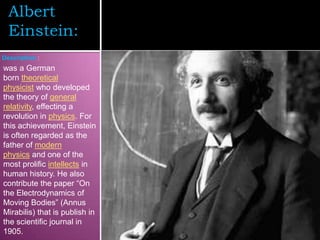
Albert
  Einstein:
Description :
was a German
born theoretical
physicist who developed
the theory of general
relativity, effecting a
revolution in physics. For
this achievement, Einstein
is often regarded as the
father of modern
physics and one of the
most prolific intellects in
human history. He also
contribute the paper “On
the Electrodynamics of
Moving Bodies” (Annus
Mirabilis) that is publish in
the scientific journal in
1905.
   Special Relativity :      General Relativity:
Is a theory of the         Is a theory of gravitation
  structure of space          develop by Einstein in
  time. It was introduce      the year 1907-1915.
  by Albert Einstein’s        the development of
  1905 paper “On the          general relativity
  Electrodynamics of          began with
  Moving Bodies”              equivalence principle
                              under which states of
                              accelerated motion
                              being at rest in
                              gravitational field are
                              physically identical
   The laws of physics are the same for
    all observers in uniform motion relative
    to one another. (Principle of relativity)

   The speed of light in a vacuum is the
    same for all observation, regardless of
    their relative motion or of the motion
    of the source of light.
   Relativity of Simultaneity: two events,
    simultaneous for one observer, may not be
    simultaneous for another observers on relative
    motion.
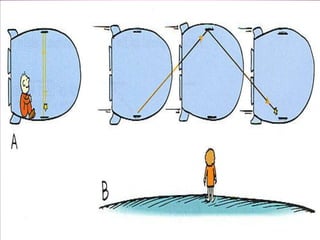
   Time Dilation: moving clocks are measured to
    tick more slowly than an observers stationary
    clock.
   Length contraction: objects are measured to be
    shortened in the direction that they are moving
    with respect to the observer.
   Mass-energy equivalence: E=mc2, energy and
    mass equivalent and transmutation.
   Maximum speed is finite: No physical object,
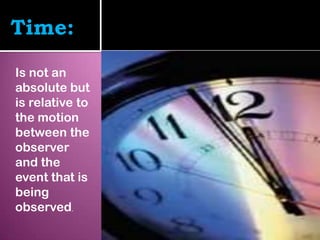
Time:
Is not an
absolute but
is relative to
the motion
between the
observer
and the
event that is
being
observed.
Light
clock:

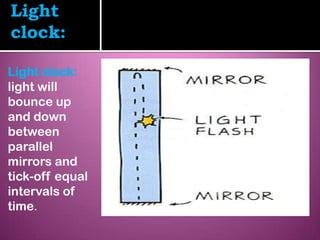
Light clock:
light will
bounce up
and down
between
parallel
mirrors and
tick-off equal
intervals of
time.
“The apparent
 slowing down of
 time for an object
 moving at
 relativistic speeds.”
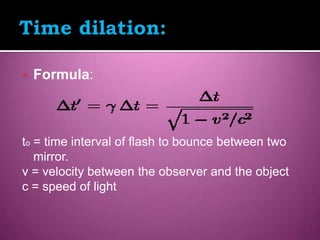
   Formula:


to = time interval of flash to bounce between two
   mirror.
v = velocity between the observer and the object
c = speed of light
 Leo  and Christian are twins. At
 the age of 30, Leo left for a
 round trip to a distant star in a
 spaceship with a speed of
 0.95 c relative to earth. The
 trip took 20 years according to
 the ship.
 Isa experiment in special
 relativity in which a twin makes
 a journey into space in a high-
 speed rocket and returns
 home to find he has aged less
 than his identical twin who
 stayed on earth.       TwinParadox
The apparent
shrinking of an
object moving at
relativistic speed
Lorentz-
 FitzGerald
 contraction


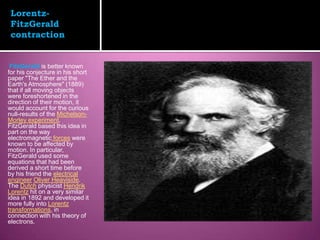
 FitzGerald is better known
for his conjecture in his short
paper "The Ether and the
Earth's Atmosphere" (1889)
that if all moving objects
were foreshortened in the
direction of their motion, it
would account for the curious
null-results of the Michelson-
Morley experiment.
FitzGerald based this idea in
part on the way
electromagnetic forces were
known to be affected by
motion. In particular,
FitzGerald used some
equations that had been
derived a short time before
by his friend the electrical
engineer Oliver Heaviside.
The Dutch physicist Hendrik
Lorentz hit on a very similar
idea in 1892 and developed it
more fully into Lorentz
transformations, in
connection with his theory of
electrons.
Lorentz-
FitzGerald
contraction


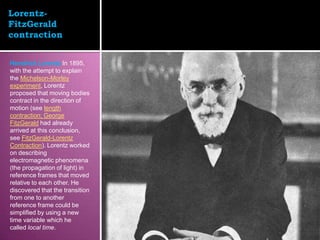
Hendrick Lorentz In 1895,
with the attempt to explain
the Michelson-Morley
experiment, Lorentz
proposed that moving bodies
contract in the direction of
motion (see length
contraction; George
FitzGerald had already
arrived at this conclusion,
see FitzGerald-Lorentz
Contraction). Lorentz worked
on describing
electromagnetic phenomena
(the propagation of light) in
reference frames that moved
relative to each other. He
discovered that the transition
from one to another
reference frame could be
simplified by using a new
time variable which he
called local time.
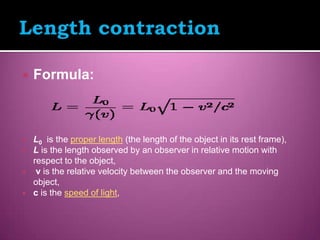
   Formula:


   L0 is the proper length (the length of the object in its rest frame),
   L is the length observed by an observer in relative motion with
    respect to the object,
    v is the relative velocity between the observer and the moving
    object,
   c is the speed of light,
A spaceship travelling at 0.50
 c relative to earth is 45 m
 long as measured by its
 crew. How long is the
 spaceship as measured by
 the mission control in
 Texas?

Relativity (1)

  • 1.
  • 2.
    Theory of relativity : Encompasses two theories of Albert Einstein special relativity and general relativity.
  • 3.
    Albert Einstein: Description: was a German born theoretical physicist who developed the theory of general relativity, effecting a revolution in physics. For this achievement, Einstein is often regarded as the father of modern physics and one of the most prolific intellects in human history. He also contribute the paper “On the Electrodynamics of Moving Bodies” (Annus Mirabilis) that is publish in the scientific journal in 1905.
  • 4.
    Special Relativity :  General Relativity: Is a theory of the Is a theory of gravitation structure of space develop by Einstein in time. It was introduce the year 1907-1915. by Albert Einstein’s the development of 1905 paper “On the general relativity Electrodynamics of began with Moving Bodies” equivalence principle under which states of accelerated motion being at rest in gravitational field are physically identical
  • 5.
    The laws of physics are the same for all observers in uniform motion relative to one another. (Principle of relativity)  The speed of light in a vacuum is the same for all observation, regardless of their relative motion or of the motion of the source of light.
  • 6.
    Relativity of Simultaneity: two events, simultaneous for one observer, may not be simultaneous for another observers on relative motion.  Time Dilation: moving clocks are measured to tick more slowly than an observers stationary clock.  Length contraction: objects are measured to be shortened in the direction that they are moving with respect to the observer.  Mass-energy equivalence: E=mc2, energy and mass equivalent and transmutation.  Maximum speed is finite: No physical object,
  • 7.
    Time: Is not an absolutebut is relative to the motion between the observer and the event that is being observed.
  • 8.
    Light clock: Light clock: light will bounceup and down between parallel mirrors and tick-off equal intervals of time.
  • 9.
    “The apparent slowingdown of time for an object moving at relativistic speeds.”
  • 11.
    Formula: to = time interval of flash to bounce between two mirror. v = velocity between the observer and the object c = speed of light
  • 12.
     Leo and Christian are twins. At the age of 30, Leo left for a round trip to a distant star in a spaceship with a speed of 0.95 c relative to earth. The trip took 20 years according to the ship.
  • 13.
     Isa experimentin special relativity in which a twin makes a journey into space in a high- speed rocket and returns home to find he has aged less than his identical twin who stayed on earth. TwinParadox
  • 14.
    The apparent shrinking ofan object moving at relativistic speed
  • 15.
    Lorentz- FitzGerald contraction FitzGerald is better known for his conjecture in his short paper "The Ether and the Earth's Atmosphere" (1889) that if all moving objects were foreshortened in the direction of their motion, it would account for the curious null-results of the Michelson- Morley experiment. FitzGerald based this idea in part on the way electromagnetic forces were known to be affected by motion. In particular, FitzGerald used some equations that had been derived a short time before by his friend the electrical engineer Oliver Heaviside. The Dutch physicist Hendrik Lorentz hit on a very similar idea in 1892 and developed it more fully into Lorentz transformations, in connection with his theory of electrons.
  • 16.
    Lorentz- FitzGerald contraction Hendrick Lorentz In1895, with the attempt to explain the Michelson-Morley experiment, Lorentz proposed that moving bodies contract in the direction of motion (see length contraction; George FitzGerald had already arrived at this conclusion, see FitzGerald-Lorentz Contraction). Lorentz worked on describing electromagnetic phenomena (the propagation of light) in reference frames that moved relative to each other. He discovered that the transition from one to another reference frame could be simplified by using a new time variable which he called local time.
  • 17.
    Formula:  L0 is the proper length (the length of the object in its rest frame),  L is the length observed by an observer in relative motion with respect to the object,  v is the relative velocity between the observer and the moving object,  c is the speed of light,
  • 18.
    A spaceship travellingat 0.50 c relative to earth is 45 m long as measured by its crew. How long is the spaceship as measured by the mission control in Texas?