5G and Broadcast
Peter Siebert
DVB Head of Technology
IEEE BTS Adcom Member
NEWTEC Satcom Hub at NAB 2019
Motivation for Broadcast and 5G
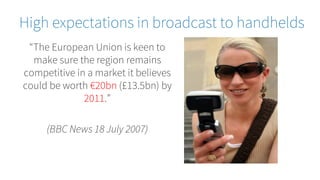
“The European Union is keen to
make sure the region remains
competitive in a market it believes
could be worth €20bn (£13.5bn) by
2011.”
(BBC News 18 July 2007)
High expectations in broadcast to handhelds
• DVB-H
• MediaFLO,
• DVB-SH
• ATSC M/H,
• DVB-NGH,
• ISDB-tmm
• CMMB
Broadcast to handhelds has been tried often
• All high power high tower based schemes (including
satellite) have not been successful:
 Commercial challenges, extra costs for handsets, networks
and content and business models did not compensate for
these costs.
 Technical challenges, restricted indoor reception as compared
to mobile outdoor or rooftop.
Lessons learned for broadcast to handhelds
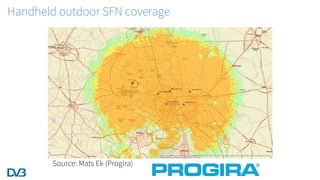
Handheld outdoor SFN coverage
Source: Mats Ek (Progira)
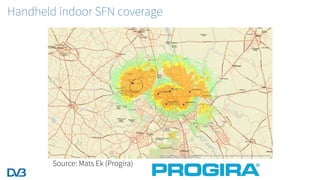
Handheld indoor SFN coverage
Source: Mats Ek (Progira)
Conclusion for broadcast to handhelds
• Handheld indoor reception is a demanding use case.
• Many more transmit sites are required to provide
handheld reception.
• Handheld indoor requires use of a dense cellular
infrastructure.
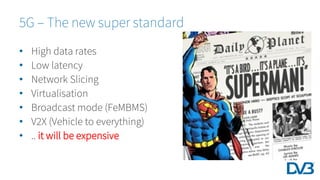
5G – The new super standard
• High data rates
• Low latency
• Network Slicing
• Virtualisation
• Broadcast mode (FeMBMS)
• V2X (Vehicle to everything)
• .. it will be expensive
• eMBMS was specified in Release 11 of 3GPP
• It was not usable for DTT broadcast because of
 small guard intervall (16.7 usec) meaning small SFN cell size
 Only 60% of the carriers within a channel usable for broadcast
• In Release 14 FeMBMS / enTV was specified with improved
broadcast support.
Multimedia Broadcast Multicast Servive (MBMS)
• Release 14 provided major changes:
 Dedicated carriers with up to 100% MBMS allocation
 Increased guard intervall for bigger SFN networks (200 usec)
 Receive mode only for devices without SIM or subscription
 Transport-Only (pass through) MBMS bearer type to support e.g.
MPEG2-TS
• First trials with the new FeMBMS are taking place e.g. in
Germany (see Rohde & Schwarz booth in SL)
MBMS: FeMBMS / enTV
• Potential Release 16 additions:
 15 km ISD (optimized for higher speeds, e.g. car radio)
 50 km ISD (rooftop reception)
 250 km ISD (TBC)
• With the availability of a powerful, improved FeMBMS there is
no need/interest in 3GPP to develop a specific new broadcast
mode for 5G
• FeMBMS / enTV will be the broadcast mode for 5G
Future 5G broadcast developments
5G discussion in DVB
• 5G Study Mission Group (SMG) established
• First step is analyzing scenarios
• Two key scenarios have been identified so far:
• Enable DVB services on 5G connected receivers
• Enhance “DVB Services” using 5G functionalities
• Additional scenarios may be added (e.g. satellite)
• Final report for SB92 (July 2019)
Ongoing Activities
• DVB Services over 5G:
• Use 5G Core and RAN for distribution of DVB services
• 5G RAN supports unicast and broadcast modes
• Connected receivers: mobile/tablet, automotive, possibly TVs,
etc.
• DVB-I as standalone service layer for 5G?
Scenario 1: Enable DVB services on 5G connected
devices
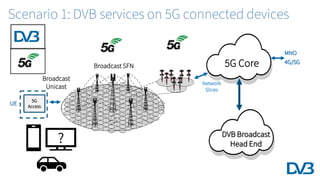
Scenario 1: DVB services on 5G connected devices
5G Core
MNO
4G/5G
DVB Broadcast
Head End
Broadcast SFN
Network
Slices
5G
Access
UE
?
Broadcast
Unicast
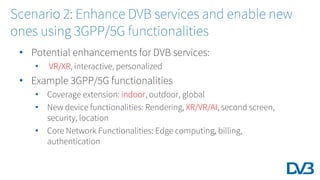
• Potential enhancements for DVB services:
• VR/XR, interactive, personalized
• Example 3GPP/5G functionalities
• Coverage extension: indoor, outdoor, global
• New device functionalities: Rendering, XR/VR/AI, second screen,
security, location
• Core Network Functionalities: Edge computing, billing,
authentication
Scenario 2: Enhance DVB services and enable new
ones using 3GPP/5G functionalities
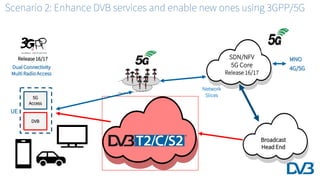
Scenario 2: Enhance DVB services and enable new ones using 3GPP/5G
SDN/NFV
5G Core
Release 16/17
MNO
4G/5G
Broadcast
Head End
Network
Slices5G
Access
DVB
Release 16/17
Dual Connectivity
Multi Radio Access
UE
• Functionalities and services provided by 3GPP/5G can also be relevant
for broadcasters, like e.g. broadcast to handhelds
• DVB has set up a Study Mission Group (SMG) to define DVB's position
towards 3GPP:
 Defining and analyising scenarios of 5G / DVB technology interworking
 Collaboration scenarios between DVB service provider and 5G network
operator
 Cooperation with 3GPP
• Discussions are ongoing and final conclusions have not been
achieved.
• SMG report is expected in July 2019
Summary
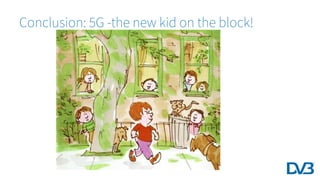
Conclusion: 5G -the new kid on the block!

Newtec SATCOM HUB NAB 2019 - Peter Siebert (DVB Project)

  • 1.
    5G and Broadcast PeterSiebert DVB Head of Technology IEEE BTS Adcom Member NEWTEC Satcom Hub at NAB 2019
  • 2.
  • 3.
    “The European Unionis keen to make sure the region remains competitive in a market it believes could be worth €20bn (£13.5bn) by 2011.” (BBC News 18 July 2007) High expectations in broadcast to handhelds
  • 4.
    • DVB-H • MediaFLO, •DVB-SH • ATSC M/H, • DVB-NGH, • ISDB-tmm • CMMB Broadcast to handhelds has been tried often
  • 5.
    • All highpower high tower based schemes (including satellite) have not been successful:  Commercial challenges, extra costs for handsets, networks and content and business models did not compensate for these costs.  Technical challenges, restricted indoor reception as compared to mobile outdoor or rooftop. Lessons learned for broadcast to handhelds
  • 6.
    Handheld outdoor SFNcoverage Source: Mats Ek (Progira)
  • 7.
    Handheld indoor SFNcoverage Source: Mats Ek (Progira)
  • 8.
    Conclusion for broadcastto handhelds • Handheld indoor reception is a demanding use case. • Many more transmit sites are required to provide handheld reception. • Handheld indoor requires use of a dense cellular infrastructure.
  • 9.
    5G – Thenew super standard • High data rates • Low latency • Network Slicing • Virtualisation • Broadcast mode (FeMBMS) • V2X (Vehicle to everything) • .. it will be expensive
  • 10.
    • eMBMS wasspecified in Release 11 of 3GPP • It was not usable for DTT broadcast because of  small guard intervall (16.7 usec) meaning small SFN cell size  Only 60% of the carriers within a channel usable for broadcast • In Release 14 FeMBMS / enTV was specified with improved broadcast support. Multimedia Broadcast Multicast Servive (MBMS)
  • 11.
    • Release 14provided major changes:  Dedicated carriers with up to 100% MBMS allocation  Increased guard intervall for bigger SFN networks (200 usec)  Receive mode only for devices without SIM or subscription  Transport-Only (pass through) MBMS bearer type to support e.g. MPEG2-TS • First trials with the new FeMBMS are taking place e.g. in Germany (see Rohde & Schwarz booth in SL) MBMS: FeMBMS / enTV
  • 12.
    • Potential Release16 additions:  15 km ISD (optimized for higher speeds, e.g. car radio)  50 km ISD (rooftop reception)  250 km ISD (TBC) • With the availability of a powerful, improved FeMBMS there is no need/interest in 3GPP to develop a specific new broadcast mode for 5G • FeMBMS / enTV will be the broadcast mode for 5G Future 5G broadcast developments
  • 13.
  • 14.
    • 5G StudyMission Group (SMG) established • First step is analyzing scenarios • Two key scenarios have been identified so far: • Enable DVB services on 5G connected receivers • Enhance “DVB Services” using 5G functionalities • Additional scenarios may be added (e.g. satellite) • Final report for SB92 (July 2019) Ongoing Activities
  • 15.
    • DVB Servicesover 5G: • Use 5G Core and RAN for distribution of DVB services • 5G RAN supports unicast and broadcast modes • Connected receivers: mobile/tablet, automotive, possibly TVs, etc. • DVB-I as standalone service layer for 5G? Scenario 1: Enable DVB services on 5G connected devices
  • 16.
    Scenario 1: DVBservices on 5G connected devices 5G Core MNO 4G/5G DVB Broadcast Head End Broadcast SFN Network Slices 5G Access UE ? Broadcast Unicast
  • 17.
    • Potential enhancementsfor DVB services: • VR/XR, interactive, personalized • Example 3GPP/5G functionalities • Coverage extension: indoor, outdoor, global • New device functionalities: Rendering, XR/VR/AI, second screen, security, location • Core Network Functionalities: Edge computing, billing, authentication Scenario 2: Enhance DVB services and enable new ones using 3GPP/5G functionalities
  • 18.
    Scenario 2: EnhanceDVB services and enable new ones using 3GPP/5G SDN/NFV 5G Core Release 16/17 MNO 4G/5G Broadcast Head End Network Slices5G Access DVB Release 16/17 Dual Connectivity Multi Radio Access UE
  • 19.
    • Functionalities andservices provided by 3GPP/5G can also be relevant for broadcasters, like e.g. broadcast to handhelds • DVB has set up a Study Mission Group (SMG) to define DVB's position towards 3GPP:  Defining and analyising scenarios of 5G / DVB technology interworking  Collaboration scenarios between DVB service provider and 5G network operator  Cooperation with 3GPP • Discussions are ongoing and final conclusions have not been achieved. • SMG report is expected in July 2019 Summary
  • 20.
    Conclusion: 5G -thenew kid on the block!