IPTV – A Wholesale Strategy Sean Hartley
The University of London MSc
in Telecom Engineering for BT
IPTV - A
Wholesale
Strategy
Sean Hartley
MSc Dissertation Final Submission. 27/11/2006 Page 1 of 133
IPTV – A Wholesale Strategy Sean Hartley
Contents
CONTENTS....................................................................................................................2
SUMMARY......................................................................................................................5
DECLARATION..............................................................................................................6
ACKNOWLEDGEMENTS..............................................................................................7
ABBREVIATIONS..........................................................................................................8
INTRODUCTION..........................................................................................................10
1 IPTV............................................................................................................................14
2 THE IPTV DISTRIBUTION NETWORK.....................................................................18
3 CASE STUDIES.........................................................................................................31
4 UK MARKET OPPORTUNITIES................................................................................90
5 ADVERTISING.........................................................................................................113
6 CONCLUSIONS AND RECOMMENDATIONS........................................................120
BIBLIOGRAPHY........................................................................................................128
APPENDICES.............................................................................................................130
REFERENCES...........................................................................................................131
Figures
FIGURE 1: THE IPTV VALUE CHAIN...........................................................................15
FIGURE 2: EXAMPLE IPTV NETWORK OVERVIEW..................................................19
FIGURE 3: RELATIVE FREQUENCIES AVERAGED OVER A 5 SECOND WINDOW
FOR CONSTANT QUALITY ENCODING OF A STANDARD DEFINITION VIDEO
SEQUENCE. SOURCE BT............................................................................................21
MSc Dissertation Final Submission. 27/11/2006 Page 2 of 133
IPTV – A Wholesale Strategy Sean Hartley
FIGURE 4: THE SERVICE OVERLAY NETWORK. SOURCE: REDBACK.................25
FIGURE 5: FULLY CONVERGED NETWORK SOURCE: REDBACK........................26
FIGURE 6: PARTIALLY CONVERGED NETWORK. SOURCE: REDBACK...............27
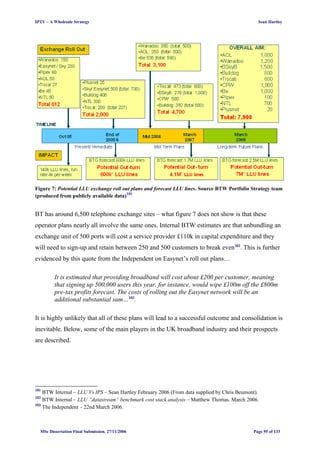
FIGURE 7: POTENTIAL LLU EXCHANGE ROLL OUT PLANS AND FORECAST LLU
LINES. SOURCE BTW PORTFOLIO STRATEGY TEAM (PRODUCED FROM
PUBLICLY AVAILABLE DATA)....................................................................................95
FIGURE 8: 21CN NETWORK OVERVIEW. SOURCE BT..........................................130
MSc Dissertation Final Submission. 27/11/2006 Page 3 of 133
IPTV – A Wholesale Strategy Sean Hartley
Tables
TABLE 1: TOP 10 IPTV MARKETS 2004, BASED ON SUBSCRIBER VOLUMES.
SOURCE INFORMA TELECOMS AND MEDIA............................................................31
TABLE 2: UK BROADBAND MARKET SHARE MARCH 2006. SOURCE BT...........93
TABLE 3: UK ONLINE ADVERTISING REVENUES BY INVENTORY, 2002-2006.
SOURCE ENDERS.......................................................................................................115
MSc Dissertation Final Submission. 27/11/2006 Page 4 of 133
IPTV – A Wholesale Strategy Sean Hartley
Summary
Using Internet Protocol Television (IPTV) as an enabler to drive up revenues from broadband in
the UK will not be an easy task. Over 3001
IPTV services are currently being trialled or have
already launched throughout the world. With the possible exception of PCCW in Hong Kong,
none of these has yet launched at significant scale so there is no proven business model.
In the UK, the TV industry is well established and consumers are already well served with a
multitude of offerings. Much of this is “free” via traditional terrestrial providers, whilst the Pay-
TV sector is dominated by BSkyB with its near stranglehold on key content rights ownership.
Offering more of the same services via a new medium is not enough. To produce demand, IPTV
providers must offer attractive content and pricing. Consumers are interested in content and
what it costs them – they’re not interested in the media that deliver it. But content is not the only
battleground; IPTV providers must also exploit the features and technical possibilities available
in order to differentiate from other media e.g. using the existence of a return path for interactive
TV.
For BT Wholesale, the challenge is to make IPTV available and worthwhile to the Internet
Service Provider (ISP) sector in order to combat the threat from broadband providers using
Local Loop Unbundling. BTW also needs to ensure that it doesn’t set itself up purely as a
conduit and allow all the revenue to flow from the consumer at one end of the value chain to the
content provider at the other end.
A potential method for achieving this is through exploiting the advertising opportunities offered
by the Internet such as the ability to target advertisements at distinct customer segments rather
than the mass market advertising seen on traditional TV channels.
1
IPTV: A Global Analysis – Informa Telecoms and Media, August 2005 – Page 13.
MSc Dissertation Final Submission. 27/11/2006 Page 5 of 133
IPTV – A Wholesale Strategy Sean Hartley
Declaration
This dissertation is a result of my independent investigation. The portions of the report that are
indebted to other sources have been referenced in the normal way.
This dissertation has not already been accepted in substance for any degree and is not being
concurrently submitted in candidature for any degree.
Signed:
Sean Hartley
Date: 26th
November 2006
MSc Dissertation Final Submission. 27/11/2006 Page 6 of 133
IPTV – A Wholesale Strategy Sean Hartley
Acknowledgements
Thank you to my wife Amanda, Beatrice Osborn, and Kim Allen for having the patience to sit
through the early versions of my presentation. The feedback and advice given enabled me to
optimise the content and keep to time. Also for the support they’ve given me throughout the
entire MSc programme.
Thanks also to my former colleagues in the BT Wholesale Portfolio Strategy team where much
of the information on broadband in this dissertation originated.
MSc Dissertation Final Submission. 27/11/2006 Page 7 of 133
IPTV – A Wholesale Strategy Sean Hartley
Abbreviations
3G Third generation of mobile communications technology
ABC American Broadcasting Company (USA)
ADSL Asymetric Digital Subscriber Line
altnet Alternative network provider (as opposed to incumbent)
ANFP Access Network Frequency Plan
AOL America On Line
ARPU Average Revenue per User
ATV Asia Television Limited (Hong Kong)
BBC British Broadcasting Corporation
BRAS Broadband Remote Access Server
BTR BT Retail
BTW BT Wholesale
C&W Cable and Wireless (UK)
CATV Cable Television / Community Access Television
CBC Canadian Broadcasting Corporation
CBS Columbia Broadcasting System (USA)
CEO Chief Executive Officer
CHT Chung Hwa Telecom (Taiwan)
CMT Comisión del Mercado de las Telecomunicaciones (Spain)
CPS Carrier Pre-Selection
CPW Car Phone Warehouse (UK)
CTRC Canadian Radio-television Telecommunications Commission
DISH Digital Information Sky Highway (EchoStar Communications USA)
DSL Digital Subscriber Line
DSLAM Digital Subscriber Line Access Multiplexer
DTH Direct to Home
DTT Digital Terrestrial Television
DVD Digital Versatile Disc / Digital Video Disc
ESPN Entertainment and Sports Programming Network (USA)
EWT/TSS German CATV Provider
FCC Federal Communications Commission (USA)
FT France Telecom
FTA Free to Air
FTTC Fibre to the Cabinet/Kerb
FTTH Fibre to the Home
FTTN Fibre to the Node
FTTP Fibre to the Premises
HBO Home Box Office (USA)
HBOS Halifax Bank of Scotland (UK)
HDTV High Definition Television
HGC Hutchinson Global Communications (Hong Kong)
HKBN Hong Kong Broadband Network
IM Instant Messaging
IP Internet Protocol
IPTV Internet Protocol Television
ISP Internet Service Provider
ITV Independent Television (UK)
KDDI Japanese telco. (Formed through the merger of DDI, KDD, and IDO Corp)
KIT Kingston Interactive Television (UK)
LLU Local Loop Unbundling
M6 Métropole 6 (France)
MSc Dissertation Final Submission. 27/11/2006 Page 8 of 133
IPTV – A Wholesale Strategy Sean Hartley
Mbs Megabit per second
MGM Metro Goldwyn Mayer (USA)
MoD Multimedia-on-Demand
MPEG Moving Picture Expert Group
MPLS Multi Protocol Label Switching
MTS Manitoba Telecom Services (Canada)
NBC National Broadcasting Corporation (USA)
NC Numericable French CATV Operator
NPVR Network Personal Video Recorder
NTL National Transcommunications Limited (UK)
NTT Nippon Telegraph & Telephone Corporation (Japan)
ODTV OnDemand TV (Japan)
OLTV On-Line TV (Japan)
ONO Spanish CATV Operator
PBS Public Broadcasting Service USA)
PC Personal Computer
PCCW Pacific Century Cyber Works (Hong Kong)
PPV Pay per View
PSTN Public Service Telephone Network
PVR Personal Video Recorder
QSC Quality Service Communications (Germany)
RCN Residential Communications Network (USA)
SBC Southwestern Bell Corporation (USA)
SDTV Standard Definition TV
SRC La Société Radio-Canada
STB Set Top Box
telco Telecommunications provider
TF1 Télévision Française 1
TIM Telecom Italia Media
TPS Télévision Par Satellite (France)
TTV Terrestrial Television
TVB Television Broadcasts Limited (Hong Kong)
UPC France United Pan-Europe Communications France
UPN United Paramount Network (USA)
VCR Video Cassette Recorder
VNL Video Networks Limited
VoD Video on Demand
VoIP Voice over Internet Protocol
VPN Virtual Private Network
WBN Wolfe Bank Newspaper (USA)
WiFi Wireless Fidelity (WLAN using the 802.11b protocol)
MSc Dissertation Final Submission. 27/11/2006 Page 9 of 133
IPTV – A Wholesale Strategy Sean Hartley
Introduction
In common with other incumbent telecommunications providers (telcos) BT Wholesale (BTW)
has a major problem. Local Loop Unbundling (LLU) has increased the amount of competition,
revenues from fixed line voice calls are declining as consumers switch to mobile and Voice over
Internet Protocol (VoIP), and although broadband internet access penetration is still rising the
price is falling. Therefore, there is a need to discover, develop, and launch, the services that will
generate new revenue streams. But is IPTV one of those Services?
Bundled offerings of broadband internet, telephony, and TV (often termed triple-play) have
often been seen by telcos as a way of driving broadband growth and encroaching into the
territory of TV broadcasting. However, BSkyB’s acquisition of Easynet turns this the other way
round and allows a TV broadcaster to offer triple-play. And it’s not just any broadcaster; it’s the
one that owns the rights to the majority of key content in the UK – most notably Premiership
football. As long as it can make a Local Loop Unbundling (LLU) business model work, BSkyB
is better positioned than any Telco in the UK for offering consumer desirable packages of triple
play.
Further threats to BTW business come from Broadband providers building their networks out to
local BT exchanges and reaching their consumers via unbundled local loops, and the merger of
Telewest and NTL creating a possible resurgence in the cable (CATV) sector.
The purpose of this dissertation is twofold. Firstly, to establish whether IPTV services are viable
in the UK:
o will they work – can telco networks deliver IPTV services?
o will they sell – do consumers want them and are they willing to pay for them?
o competition – can they compete against other TV media?
o broadband – will they drive growth for the broadband industry in terms of user volumes
and average revenue per user (ARPU)?
Secondly, even if the answers to all these points are positive then how does BTW exploit this to
make IPTV an opportunity and not a threat? This poses another set of questions:
o How can BTW use IPTV services to make its broadband products more attractive to
Internet Service Providers (ISPs) than LLU?
o How can the ISP sector (which includes BT Retail) use these services to compete against
the LLU sector (which includes BSkyB), and the consolidated CATV sector?
MSc Dissertation Final Submission. 27/11/2006 Page 10 of 133
IPTV – A Wholesale Strategy Sean Hartley
o How can the ISP sector compete against other TV Media – some of which e.g. BSkyB
and NTL/Telewest are also broadband competitors (indicating some degree of
convergence between the telco and TV industries already)?
o How can BTW gain revenue from such services? Many internet services involve
payment transactions between consumers and service providers which completely by-
pass the telco providing the broadband service.
My approach to answering these questions was to look at other countries where IPTV services
have already been launched to see if any have been successful and, if so, what the factors were
that have enabled that success. Where services have been successful I found that it was quite
often down to telcos exploiting local market conditions such as: government subsidy of Set Top
Boxes (STBs), densely populated high rise areas making broadband cheap and easy to provide,
dominant Pay TV providers obliged to provide their rivals with premium content at a reasonable
rate, high volumes of consumers with no access to CATV or Direct to Home (DTH) services,
etc. These factors do not apply in the UK.
I then examined the UK TV and broadband markets to establish what opportunities actually did
exist in a TV market where one supplier dominates premium content provision and is ruthless
about exploiting it, and a broadband market which is so competitive that suppliers are (creating
an illusion of) giving it away for free when consumers take other services from them.
But to start this dissertation, it is first necessary to understand what IPTV actually is. In Chapter
1, I’ve done this by describing the TV value chain and the elements – content provision,
aggregation, packaging, distribution, and consumer equipment – that make up the chain.
As we shall see, telcos can move into other segments of the value chain but the natural starting
point is that of distribution since the main differentiator between IPTV and other TV media is in
the way that it is distributed i.e. over a telecommunications network. So, in Chapter 2 I’ve
described the main elements involved in an IPTV enabled network – head end, distribution,
aggregation, access and home network. Depending on requirements and technologies used there
are many different ways of designing a network. Three examples of network design are
described as well as compression standards and multicasting as these have an important role to
play in managing bandwidth requirements.
MSc Dissertation Final Submission. 27/11/2006 Page 11 of 133
IPTV – A Wholesale Strategy Sean Hartley
The case studies (as mentioned previously) are contained in Chapter 3. I looked at the top ten
IPTV markets (in terms of subscriber volumes), nine of which are detailed here (the tenth being
the UK). For each of the countries I have compiled information on the local broadband market,
TV market, IPTV providers, and what I believe to be the outlook for IPTV services.
This leads into Chapter 4 which focuses on the UK. Again, the broadband and TV markets are
analysed although in a greater depth than those covered in the previous chapter. I’ve also
included a section on triple-play; partly because it is a term that can often mean different things
to different people – so there is a need to be clear about what is meant by triple-play in the
context of this dissertation – and partly because the ability to provide “triple-play” will not be
enough to provide success; it’s the quality and commercial wrap of the bundled services within
the triple-play that will determine success or failure. This chapter also examines the options for
BTW in terms of where and how it can play in the various segments of the value chain.
To make IPTV services commercially viable it is important to realise the role that advertising
has to play. This has always been a traditional revenue stream for TV companies worldwide (the
BBC being an obvious exception), and in the days before Pay TV it was often the main or only
source of funding available to TV broadcasters. Advertising is also a key factor in successful
Internet companies, so this dissertation would not be complete without looking at the role
advertising can play in IPTV services; this is dealt with in Chapter 5.
Chapter 6 concludes by making recommendations for the UK broadband industry as a whole,
and recommendations specific to BTW.
Before we move onto the main body of this dissertation I should first explain a bit about myself
and my background. I began working for BT as an apprentice in 1982 – the company was a state
owned monopoly, telephone exchanges were of the electro-mechanical (Strowger) variety and
voice was still the dominant service. As an engineer my duties included exchange construction
(replacing Strowger units with electronic switches which have since been superseded by digital
exchanges), customer apparatus maintenance and repair (in the London Docklands when Canary
Wharf was nothing more than a flat concrete peninsula) and Telecom Red (providing secure
alarm lines via the telephone network).
MSc Dissertation Final Submission. 27/11/2006 Page 12 of 133
IPTV – A Wholesale Strategy Sean Hartley
As a manager I started in Quality Management and put together the QMS (Quality Management
System) that enabled the Network Build division to achieve ISO9001 registration as a stand
alone unit. I have now worked as a product manager in BTW for six years and presently manage
Direct Access (calls terminating on the BT network having originated on another network) and
Number Translation Services (which generally covers telephone numbers beginning with 08 or
09).
MSc Dissertation Final Submission. 27/11/2006 Page 13 of 133
IPTV – A Wholesale Strategy Sean Hartley
1 IPTV
1.1 Introduction
This chapter provides an overview of what IPTV is and describes various types of services that
can be offered using this medium. The TV value chain is explained as is potential telco
involvement in the components of the chain.
1.2 What is IPTV?
Various media are in use for the transmission of television services including: Terrestrial (TTV),
Digital Terrestrial (DTT), Cable (CATV) and Satellite (also known as Direct To Home [DTH]).
IPTV uses Internet Protocol (IP) to transmit television and other video services over broadband
networks. There are two main types of service:
o Broadcast/Multichannel – this is the viewing of content in real-time in the same way as
traditional TV. Programmes may be pre-recorded by the content provider or shown live.
Either way, the viewer has to “tune in” at the time of broadcast and not at a time of their
choosing (although the use of video recorders and recordable DVD players does allow
for later viewing provided they have been set to record at the appropriate time).
o Video on Demand (VoD) – this is the viewing of the viewer’s choice of content at the
viewer’s choice of time. In the same way that a consumer can buy or rent a movie on
video or DVD and watch it at a time convenient to them, they can download content
from the Internet. VoD can take one of two main forms:
• Downloading – where a video file is downloaded from the content provider’s
server onto a hard drive for later viewing;
• Streaming – where a video file is viewed directly from the content provider’s
server so is effectively a live video transmission. The file may or may not be
stored on the consumer’s hard drive for future viewing.
Giving the viewer full control over when they can watch content is a key differentiator from
traditional TV media. In addition, it allows for targeted programming and advertising which will
be explored further in chapter 5.
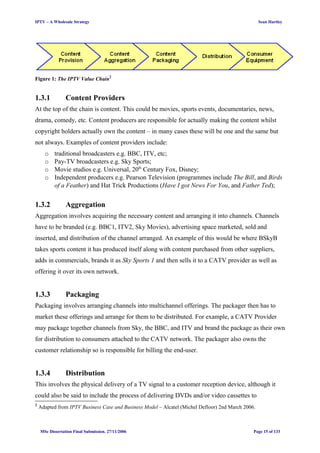
1.3 The TV Value Chain
In order to understand the commercial possibilities of IPTV it is first necessary to understand the
key stages involved in providing TV services. There are five main sections to the value chain:
Content, Aggregation, Packaging, Distribution, and Consumption (consumer apparatus, home
network, etc).
MSc Dissertation Final Submission. 27/11/2006 Page 14 of 133
IPTV – A Wholesale Strategy Sean Hartley
Figure 1: The IPTV Value Chain2
1.3.1 Content Providers
At the top of the chain is content. This could be movies, sports events, documentaries, news,
drama, comedy, etc. Content producers are responsible for actually making the content whilst
copyright holders actually own the content – in many cases these will be one and the same but
not always. Examples of content providers include:
o traditional broadcasters e.g. BBC, ITV, etc;
o Pay-TV broadcasters e.g. Sky Sports;
o Movie studios e.g. Universal, 20th
Century Fox, Disney;
o Independent producers e.g. Pearson Television (programmes include The Bill, and Birds
of a Feather) and Hat Trick Productions (Have I got News For You, and Father Ted);
1.3.2 Aggregation
Aggregation involves acquiring the necessary content and arranging it into channels. Channels
have to be branded (e.g. BBC1, ITV2, Sky Movies), advertising space marketed, sold and
inserted, and distribution of the channel arranged. An example of this would be where BSkyB
takes sports content it has produced itself along with content purchased from other suppliers,
adds in commercials, brands it as Sky Sports 1 and then sells it to a CATV provider as well as
offering it over its own network.
1.3.3 Packaging
Packaging involves arranging channels into multichannel offerings. The packager then has to
market these offerings and arrange for them to be distributed. For example, a CATV Provider
may package together channels from Sky, the BBC, and ITV and brand the package as their own
for distribution to consumers attached to the CATV network. The packager also owns the
customer relationship so is responsible for billing the end-user.
1.3.4 Distribution
This involves the physical delivery of a TV signal to a customer reception device, although it
could also be said to include the process of delivering DVDs and/or video cassettes to
2
Adapted from IPTV Business Case and Business Model – Alcatel (Michel Defloor) 2nd March 2006.
MSc Dissertation Final Submission. 27/11/2006 Page 15 of 133
IPTV – A Wholesale Strategy Sean Hartley
consumers either through retail/rental outlets or via postal services. Distributors are responsible
for providing the network infrastructure and maintaining it. This part of the value chain is where
the differentiation between IPTV and other forms of TV media comes in as it involves using a
telecommunications network.
1.3.5 Consumption
The market here is for the provision of consumer equipment. This includes reception devices
such as Televisions (TVs), Set Top Boxes (STBs), Modems, Video cassette Recorders (VCRs),
and DVD players. It also includes Personal Computers (PCs), as content can be viewed on a PC
(via a modem), and games consoles. Consumers may not wish to view the content on the device
on which it was downloaded so need some form of home network to enable them to transfer
data. Content can be transported between devices in a variety of ways such as WiFi, Powerline,
co-axial cable, phone line, or storage devices such as discs or memory sticks.
1.4 The Role of the Telco
The obvious position in the value chain for Telcos is that of distribution. This is the key
differentiator from other broadcast media as the Telco owns and manages the network(s).
However, Telcos can move up the value chain by aggregating and packaging content and thus
move into what has traditionally been part of the TV industry. They can also exploit the bottom
level of the chain by providing the consumers with the equipment they need to download, store,
and view content. For example, BT Home Computing has provided home computing initiative
schemes to employers including HBOS and United Utilities. These schemes enable
organisations to offer their staff computing packages which come with the benefit of tax relief.
Such schemes could be expanded to include plasma screens or High Definition (HDTV) TV sets
as part of a package (although the removal of tax relief in the 2006 budget makes such schemes
less attractive). Moving into other areas of the value chain will also avoid the pitfall of revenues
flowing from consumer to packager with a minimal return for the network provider.
Telcos can also bundle IPTV services with their telephony and broadband internet access
products to offer “triple-play” bundles. This differentiator gives them an advantage over other,
single-play, TV media.
MSc Dissertation Final Submission. 27/11/2006 Page 16 of 133
IPTV – A Wholesale Strategy Sean Hartley
1.5 Summary and Conclusion
IPTV provides another medium for the transmission of television type services which can be
viewed in real-time and/or on demand. The TV value chain is comprised of the following
segments: Content, Aggregation, Packaging, Distribution, and Consumption.
Telcos have the obvious ability to operate in the distribution segment, but there are opportunities
for moving into segments both up and down the value chain. Telcos need to understand where
the revenue opportunities are; providing a distribution network that allows revenue to flow from
consumers to higher points on the chain may not be the most commercially viable business
model. It will also make it harder to compete with, for example, BSkyB who have an
involvement throughout the value chain. If telcos can move into other parts of the value chain it
will allow enable them to obtain a greater share of the available revenue.
As distribution is the main differentiator between IPTV and other media we now need to
understand more about the distribution network and what telcos need to have in place in order to
provide IPTV services.
MSc Dissertation Final Submission. 27/11/2006 Page 17 of 133
IPTV – A Wholesale Strategy Sean Hartley
2 The IPTV Distribution Network
2.1 Introduction
This chapter gives an overview of the network requirements for providing IPTV. Telco
networks were originally designed to provide voice services and have been enhanced to some
extent to take into account data services. IPTV, which has its own requirements, did not form
part of any design considerations. IPTV puts increased demands on the network requiring high
bandwidth, low latency, availability (resilience) scalability (as consumer demand increases), and
flexibility as requirements change. This chapter examines the high level network components
required for IPTV, architectures, and the higher application requirements and factors to
consider.
2.2 Network Overview
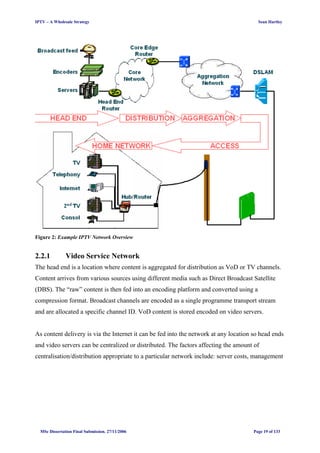
Although architectures for delivering video services vary, I have identified 5 main elements: the
video services network (or head end), the distribution network, the aggregation network, the
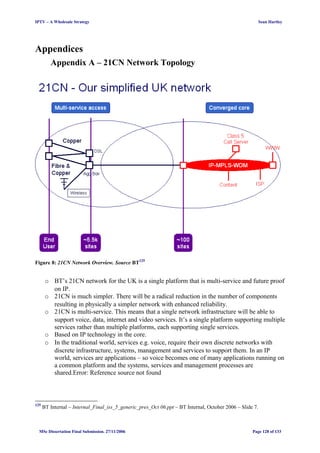
access network, and the home network. I have identified these from BT’s 21CN network
topology (see figure 8) and the network examples identified by Redback (see figures 4-6)
MSc Dissertation Final Submission. 27/11/2006 Page 18 of 133
IPTV – A Wholesale Strategy Sean Hartley
Figure 2: Example IPTV Network Overview
2.2.1 Video Service Network
The head end is a location where content is aggregated for distribution as VoD or TV channels.
Content arrives from various sources using different media such as Direct Broadcast Satellite
(DBS). The “raw” content is then fed into an encoding platform and converted using a
compression format. Broadcast channels are encoded as a single programme transport stream
and are allocated a specific channel ID. VoD content is stored encoded on video servers.
As content delivery is via the Internet it can be fed into the network at any location so head ends
and video servers can be centralized or distributed. The factors affecting the amount of
centralisation/distribution appropriate to a particular network include: server costs, management
MSc Dissertation Final Submission. 27/11/2006 Page 19 of 133
IPTV – A Wholesale Strategy Sean Hartley
complexity (i.e. managing multiple sites instead of one), transport costs, and the amount of
resilience required.
MSc Dissertation Final Submission. 27/11/2006 Page 20 of 133
IPTV – A Wholesale Strategy Sean Hartley
2.2.1.1 Encoding/Compression
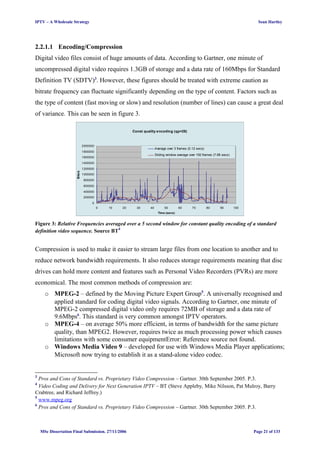
Digital video files consist of huge amounts of data. According to Gartner, one minute of
uncompressed digital video requires 1.3GB of storage and a data rate of 160Mbps for Standard
Definition TV (SDTV)3
. However, these figures should be treated with extreme caution as
bitrate frequency can fluctuate significantly depending on the type of content. Factors such as
the type of content (fast moving or slow) and resolution (number of lines) can cause a great deal
of variance. This can be seen in figure 3.
Const quality encoding (qp=28)
0
200000
400000
600000
800000
1000000
1200000
1400000
1600000
1800000
2000000
0 10 20 30 40 50 60 70 80 90 100
Time (secs)
Bits/s
Average over 3 frames (0.12 secs)
Sliding window average over 192 frames (7.68 secs)
Figure 3: Relative Frequencies averaged over a 5 second window for constant quality encoding of a standard
definition video sequence. Source BT4
Compression is used to make it easier to stream large files from one location to another and to
reduce network bandwidth requirements. It also reduces storage requirements meaning that disc
drives can hold more content and features such as Personal Video Recorders (PVRs) are more
economical. The most common methods of compression are:
o MPEG-2 – defined by the Moving Picture Expert Group5
. A universally recognised and
applied standard for coding digital video signals. According to Gartner, one minute of
MPEG-2 compressed digital video only requires 72MB of storage and a data rate of
9.6Mbps6
. This standard is very common amongst IPTV operators.
o MPEG-4 – on average 50% more efficient, in terms of bandwidth for the same picture
quality, than MPEG2. However, requires twice as much processing power which causes
limitations with some consumer equipmentError: Reference source not found.
o Windows Media Video 9 – developed for use with Windows Media Player applications;
Microsoft now trying to establish it as a stand-alone video codec.
3
Pros and Cons of Standard vs. Proprietary Video Compression – Gartner. 30th September 2005. P.3.
4
Video Coding and Delivery for Next Generation IPTV – BT (Steve Appleby, Mike Nilsson, Pat Mulroy, Barry
Crabtree, and Richard Jeffrey.)
5
www.mpeg.org
6
Pros and Cons of Standard vs. Proprietary Video Compression – Gartner. 30th September 2005. P.3.
MSc Dissertation Final Submission. 27/11/2006 Page 21 of 133
IPTV – A Wholesale Strategy Sean Hartley
o AVS – Proposed Chinese standard.
MSc Dissertation Final Submission. 27/11/2006 Page 22 of 133
IPTV – A Wholesale Strategy Sean Hartley
2.2.2 Distribution and Aggregation
There is no single network design for delivering content from the head end to the appropriate
Digital Subscriber Line Access Multiplexer (DSLAM) or its attached router. Before discussing
some various network designs it is worth having a quick look at multicast.
There are three different address types used to transport IP packets from one computer to
another:
o Unicast addressing is used for communicating between two individual hosts. One copy
of each packet travels across the network connecting the two hosts.
o Broadcast addressing is used for communicating between one host and all other hosts on
the a network simultaneously. The transmitting host uses a destination address that
instructs the network to duplicate each packet and deliver it to every host on the network.
o Multicast addressing is used when a host wants to communicate with a specific subset
of the hosts on a network. The transmitting host uses a class D address which instructs
the network to duplicate each packet and to deliver it to every host with that particular
class D address. An individual host has a “normal” address i.e. class A, B, or C and any
number of class D addresses each identifying it as a member of a particular multicast
group.
Multicasting provides efficient transmission of a data stream where it is being sent to multiple
users. Enabling routers and switches to control the replication and delivery of data streams
reduces the number of connections to the transmission source (as opposed to unicast) and
restricts data forwarding to only those hosts who want or are entitled to it (as opposed to
broadcast). This reduces bandwidth requirements for transmission to a large number of hosts
and reduces server requirements to support streaming data. For example, if a TV channel is
being broadcast to 10,000 users then 10,000 unicast connections would require each packet to be
replicated and sent 10,000 times from the source host. Multicasting enables the host to transmit
the data stream only once with the network duplicating it only where required.
For IPTV, multicasting has obvious benefits for provision of broadcast services and also for
push type VoD services where content is downloaded to multiple users in one transaction (as
with T-Online – see chapter 9.1.5.3.1). The question when designing a network is where should
multicast replication be done, with logic saying it should be the last aggregation point i.e. the
MSc Dissertation Final Submission. 27/11/2006 Page 23 of 133
IPTV – A Wholesale Strategy Sean Hartley
DSLAM to save on bandwidth. However, pushing network intelligence out to such extremities
adds to the cost of the equipment so it’s very much a question of balance.
MSc Dissertation Final Submission. 27/11/2006 Page 24 of 133
IPTV – A Wholesale Strategy Sean Hartley
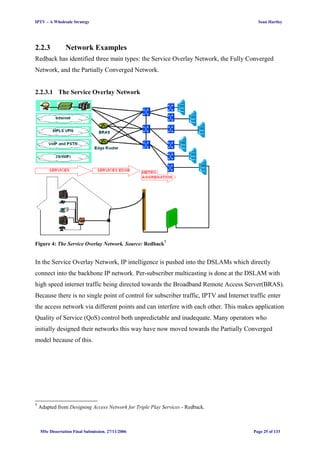
2.2.3 Network Examples
Redback has identified three main types: the Service Overlay Network, the Fully Converged
Network, and the Partially Converged Network.
2.2.3.1 The Service Overlay Network
Figure 4: The Service Overlay Network. Source: Redback7
In the Service Overlay Network, IP intelligence is pushed into the DSLAMs which directly
connect into the backbone IP network. Per-subscriber multicasting is done at the DSLAM with
high speed internet traffic being directed towards the Broadband Remote Access Server(BRAS).
Because there is no single point of control for subscriber traffic, IPTV and Internet traffic enter
the access network via different points and can interfere with each other. This makes application
Quality of Service (QoS) control both unpredictable and inadequate. Many operators who
initially designed their networks this way have now moved towards the Partially Converged
model because of this.
7
Adapted from Designing Access Network for Triple Play Services - Redback.
MSc Dissertation Final Submission. 27/11/2006 Page 25 of 133
IPTV – A Wholesale Strategy Sean Hartley
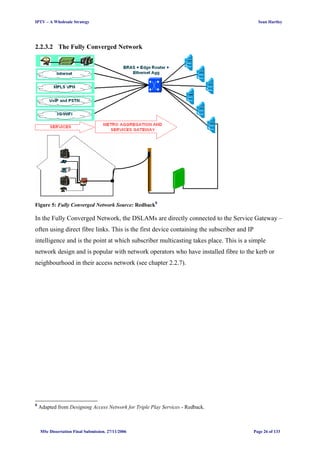
2.2.3.2 The Fully Converged Network
Figure 5: Fully Converged Network Source: Redback8
In the Fully Converged Network, the DSLAMs are directly connected to the Service Gateway –
often using direct fibre links. This is the first device containing the subscriber and IP
intelligence and is the point at which subscriber multicasting takes place. This is a simple
network design and is popular with network operators who have installed fibre to the kerb or
neighbourhood in their access network (see chapter 2.2.7).
8
Adapted from Designing Access Network for Triple Play Services - Redback.
MSc Dissertation Final Submission. 27/11/2006 Page 26 of 133
IPTV – A Wholesale Strategy Sean Hartley
2.2.3.3 The Partially Converged Network
Figure 6: Partially Converged Network. Source: Redback9
In the Partially Converged Network the DSLAM has no IP intelligence. Traffic is aggregated
into a Service Gateway which is a converged edge device implementing full BRAS and Edge
Routing functionality. The Service Gateway is also the first device to contain subscriber and IP
intelligence. This network design is popular with network operators who do not have fibre in
their access network. It should be noted that it is also possible for a network operator to design
and build a combination of a fully converged and a partially converged network based on where
fibre is and isn’t deployed in the access network.
2.2.4 Access Network
The access network links subscribers with their local exchange. The “local loop” may be copper,
fibre (Fibre To The Home [FTTH] or Fibre To The Premises [FTTP]), or a combination of the
two (Fibre To The Cabinet/Kerb [FTTC], Fibre To The Node [FTTN]. Fibre offers far greater
speeds but is very expensive to deploy especially where local copper networks are already in
place and able to deal with the majority of its subscribers needs.
9
Adapted from Designing Access Network for Triple Play Services - Redback.
MSc Dissertation Final Submission. 27/11/2006 Page 27 of 133
IPTV – A Wholesale Strategy Sean Hartley
IPTV consists of high bitrate signals and a telco’s ability to provide as many of its subscribers as
possible with fast broadband speeds depends on a number of factors including:
o the network topology – e.g. copper, FFTH, FTTC, etc;
o the length of the local loop;
o the quality of the loop – i.e. dimensions of the conductors, quality of connections, faults,
etc;
o crosstalk – the amount of crosstalk is directly related to “cable fill”. The higher the
proportion of pairs in a cable carrying Digital Subscriber Lines (DSL), the shorter the
reach. The problem of crosstalk increases with frequency i.e. higher frequencies means a
greater crosstalk problem;
o noise – picked up the environment (e.g. radio interference) and from sources in the home
or the premises;
o Access Network Frequency Plan (ANFP) – how frequencies are allocated to dervices.
o The technology used e.g. type of xDSL, method of compression, equipment vendors.
2.2.5 Home Network
Traditionally, consumer devices have operated in isolation – for example, a TV has an aerial
connected to it and it plugs into the mains, whilst a PC connects to the phone line for Internet
services. However the growth of households with multiple PCs with their peripherals and the
convergence of services – such as IPTV – has created the requirement for home networks.
Physically connecting network elements with wires works fine when they are located close by,
but using cable to string together a modem in one room with an STB in another room is
unsightly and possibly dangerous.
A DSL channel terminates at a subscriber’s premises on a modem. This modem may be built
into the PC or be a separate unit, but either way IPTV content can be viewed on the PC. Should
the subscriber wish to view the content on a TV (as is most likely) the modem will need to be
connected to an STB which in turn needs to be connected to the TV. (N.B some manufacturers
MSc Dissertation Final Submission. 27/11/2006 Page 28 of 133
IPTV – A Wholesale Strategy Sean Hartley
are already producing combined modems/STBs.) Should the subscriber wish to view content on
another TV elsewhere in the premises, it will also need to be connected to the STB. As well as
the unsatisfactory method of physically cabling these devices together, other possibilities
include the use of powerline, co-axial cable, telephone wires, and wireless technologies such as
WiFi.
The merits of these particular technologies are not discussed here, but the question for Telcos is
whether or not they wish to operate in this area of the value chain and to what extent. Broadband
offerings often include routers and/or modems and IPTV offerings usually include the STB as
part of the deal – BT Vision for example offers a hybrid STB that can receive VoD content from
the Internet and broadcast services via DTT.
2.3 Summary and Conclusion
An end-to-end distribution network consists of a head end, distribution, aggregation, access, and
home network elements. In designing a network architecture, consideration must be given to
many factors including: the type of encoding/compression to be used, where subscriber
multicasting should take place, bandwidth requirements, and the present and future make-up of
the access network.
Balancing network investment against consumer demand, to justify that investment, is difficult
to achieve; and is not without risk. For example, pushing fibre into the access network would
enable faster broadband services to be deployed and increase the reach of those services to
consumers who live too far from their local exchange to receive such services at present. But
MSc Dissertation Final Submission. 27/11/2006 Page 29 of 133
IPTV – A Wholesale Strategy Sean Hartley
local access networks are expensive to build which has previously proved to be a barrier to entry
– hence the introduction of LLU. The CATV sector built its own access network but the debt
incurred in doing so has been a burden in its efforts to compete.
Similarly pushing multicasting further out to the network edge will save on bandwidth
requirements but it does increase the cost of the equipment needed. Multicasting from the
DSLAM, for example, will not be cost effective if only a handful of subscribers can be attracted
at each location.
For BT, this suggests an incremental approach to developing services and attracting subscribers.
Where fibre in the access network or multicasting at the network edge can be justified then it
should be. The network must evolve to meet demand rather than have significant investment on
a national scale in the hope that demand will justify it.
We’ve now established what IPTV is and the technology required to provide it. In order to
understand the commercial factors required to make IPTV successful it is necessary to look at
some examples of services that have already launched.
MSc Dissertation Final Submission. 27/11/2006 Page 30 of 133
IPTV – A Wholesale Strategy Sean Hartley
3 Case Studies
3.1 Introduction
This chapter looks at the top 10 IPTV markets (in terms of subscriber volumes) to assess success
so far, and future potential. The “top 10” is based on those identified by Informa Telecoms and
Media on data as at year end 2004. Where more recent data is available it has been included in
the relevant country section. For reasons of brevity only Hong Kong, France, Italy, and Spain
are described with the USA, Canada, Japan, Germany, and Taiwan, included in the appendices
for completeness. The UK is dealt with separately in Chapter 4.
Number of TV
Households (,000)
IPTV Subscribers
(,000)
Penetration of TV
Households (%)
Hong Kong 2,187 475 21.72
USA 109,159 273 0.25
France 22,313 184 0.82
Italy 21,143 174 0.82
Canada 12,316 123 0.99
Japan 43,439 77 0.18
Germany 34,540 67 0.19
Taiwan 6,213 35 0.56
UK 24,711 20 0.08
Spain 13,173 6 0.05
Table 1: Top 10 IPTV Markets 2004, based on subscriber volumes. Source Informa Telecoms and Media10
10
IPTV: A Global Analysis – Informa Telecoms and Media, August 2005 – Page 13.
MSc Dissertation Final Submission. 27/11/2006 Page 31 of 133
IPTV – A Wholesale Strategy Sean Hartley
3.2 Hong Kong
Population 6.9 Million11
Households 2.2 Million12
Broadband Subscribers 1.5 Million13
CATV TV 31.0%
Illegal TV 4.5%
DTH 0.4%14
Broadband TV Penetration 20.0%
Total Pay TV penetration 55.0%
Figures are for 2004
Penetration rates are for Total Households.
Source: Gartner15
(except where stated).
3.2.1 Broadband
The Hong Kong broadband market offers consumers a large range of prices, technologies,
speeds, and services. Broadband has been successful because of its ubiquity, low prices, and the
number of different offerings. The densely populated high rise environment makes fibre an
economic solution for broadband provision; at the end of 2004 there were 580,000 subscribers
connected by this method16
. The main broadband providers are:
o PCCW – former incumbent. Uses a fibre-optic backbone with DSL as the last-mile
connection. It can reach 95% of households and offer speeds of up to 6Mbs. Its stated
goal is to increase speed to 25Mbs.
o Hutchinson Global Communications (HGC) – has a mainly fibred network with a
reach to 50% of households. HGC plan to increase this to 80-90% over the next few
years. Approximately 80% of HGC’s subscribers get access via VDSL or metro
Ethernet. The remainder use ADSL or powerline.
o Cable – operate a hybrid fibre coaxial cable network i.e. a fibre optic trunk connected to
in-building coaxial networks.
o Hong Kong Broadband Network (HKBN) – has a fully fibred network and is in the
process of pushing it out to 80% of households. Planning to launch a 100Mbs and a
1Gbps service.
11
http://www.cia.gov/cia/publications/factbook/geos/hk.html
12
IPTV: A Global Analysis – Informa Telecoms and Media August 2005 Page 16
13
IPTV: A Global Analysis – Informa telecoms and Media. August 2005 Page 77.
14
Hong Kong boosts cable content – from Screen Digest’s Global Media Intelligence issue 408, Page 259
September 2005.
15
Market Focus: Broadband TV Market Booms in Hong Kong – Gartner December 2004. See Table 2-2 and page 7
for cable and illegal figures.
16
IPTV & VoD market analysis – Ovum July 2005. Page 18
MSc Dissertation Final Submission. 27/11/2006 Page 32 of 133
IPTV – A Wholesale Strategy Sean Hartley
3.2.2 TV Market
There are four TTV channels in Honk Kong provided by two commercial broadcasters: TVB
and ATV. DTT is planned to launch in 2007 with analogue switch-off planned for 2012.
Consumers in many Hong Kong buildings are also able to view free channels from Star TV’s
Asian satellite broadcasts. Using a master antenna system, consumers are able to receive Star
TV’s basic channels. This service is not paid for – although tenants are charged for the master
antenna system as part of their building management payments – but by increasing the number
of free to air channels it acts as an inhibiter to the growth of the Pay TV market.
The CATV sector is occupied by a single operator – i-Cable. i-Cable’s network passes
approximately 1.2 million households (55%) and has 682,000 customers. It is also believed that
a further 59,000 consumers illegally tap into i-Cable’s network using pirate decoders17
. i-Cable
revamped its sports offerings in 2004 and acquired rights for the English Premiership football
matches and NBA basketball. At the same time it also launched 22 new channels for inclusion in
its basic premium subscription package, giving it a total offering of 92 channels. However, at
the same time it lost the desirable sports channels ESPN and Star Sports.
DTH is provided by SuperSun which is owned by Galaxy Satellite Broadcasting. SuperSun
launched in August 2003 and offers its 30,000 subscribers 40 television channels18
. It has
recently obtained rights from Yes TV for two 24-hour European football channels. Coverage in
apartment blocks has limited its ability to grow, but it is planning to offer IPTV over the HGC
broadband network to improve its coverage (see below).
3.2.3 IPTV Offerings
IPTV services are presently offered by two providers: PCCW and Hong Kong Broadband. Both
have focussed on providing multichannel Pay TV and are not offering VoD. A third offering is
planned by HGC who intend broadcasting SuperSun TV channels.
17
Market Focus: Broadband TV Market Booms in Hong Kong – Gartner December 2004. Page 7.
18
Hong Kong boosts cable content – from Screen Digest’s Global Media Intelligence issue 408, Page 259
September 2005
MSc Dissertation Final Submission. 27/11/2006 Page 33 of 133
IPTV – A Wholesale Strategy Sean Hartley
3.2.3.1 Now Broadband TV (Owned by PCCW)
PCCW launched Now Broadband TV in September 2003. It was seen as a way of meeting the
threat from i-Cable who had announced the launch of their triple-play strategy. In terms of
household penetration, and penetration of its broadband subscribers, it is the most successful
provider of IPTV over DSL.
Customers must first subscribe to PCCW’s Netvigator broadband service; there is no further
subscription. Subscribers are provided with a free STB which allows access to some low-value
channels (the STB is estimated to cost PCCW US$50-60 per unit19
). Further content is available
on an “a la carte” basis allowing subscribers to select content on a channel by channel and
month by month basis. This method does make it easier to rapidly drive up a subscriber base by
removing the pricing access barrier. However, it also allows consumers to sign up only for small
offerings – perhaps only one or two channels, which has an adverse effect on Average Revenue
Per User (ARPU). So although the claimed number of subscribers may look impressive, it
doesn’t tell the whole story.
The original service had 22 channels including MGM, Hallmark and Discovery. By the start of
2005 this had risen to 70 channels including Nickelodeon, BBC Prime, and channels from
Central China Television. It has since won control of the sports channels ESPN and Star Sports,
the movie channels HBO, Cinemax, and Star Movies, which were all previously owned by i-
Cable. Rights have also been obtained from Star Group to broadcast its 11 movie and
19
IPTV: A Global Analysis – Informa Telecoms and Media Page 78 August 2005.
MSc Dissertation Final Submission. 27/11/2006 Page 34 of 133
IPTV – A Wholesale Strategy Sean Hartley
entertainment channels. PCCW appears to be going head to head with i-Cable for premium
content whilst (at present) undercutting them on price.
Since launch the service has been very successful. 2004 saw spectacular growth with
subscriptions growing by 146% (albeit from a small base). PCCW also appear to have bonded
the relationship between their broadband subscribers and Now Broadband TV with the result
that they claim to have halved their churn rate to less than 1% and increased their broadband
market share20
. At the end of 2004, PCCW announced that it had an installed base of 361,000
subscribers (although 416,000 customers had signed up).
Estimates of paying customers range from 47%21
to 53%22
. This needs to increase for the
business model to work properly although PCCW claim that 85% of all new subscribers use Pay
TV23
. (To try to combat this, PCCW has introduced mini-packs of content and claims a 58%
take-up rate23
.) ARPU for customers who signed up for Pay TV channels increased from US$8
per month to US$13 between March and December23
. (Gartner states US$13.50Error: Reference
source not found.) However, averaging the ARPU across all 361,000 subscribers gives an
average of US$7.22Error: Reference source not found – a decrease.
3.2.3.2 HKBN Digital TV (Owned by City Telecom)
HKBN also provide a free STB, and subscribers receive a multichannel package for $16 month.
IPTV is seen as a value added product to augment its fixed line and Broadband offerings.
HKBN has taken a price competitive approach and has focussed on providing cheap, local
content – the competition is seen as daytime free-to-air TV so it’s positioned as an add on to
TTV.
51 channels are offered over an all-fibre/Ethernet network. This service had attracted 39,000
subscribers24
by the end of March 2005.
20
PCCW’s Now Broadband TV: defensive strategy pays off – Ovum July 2005 P.4
21
PCCW’s Now Broadband TV: defensive strategy pays off – Ovum July 2005 P.3
22
PCCW’s Low-Cost IPTV Entry Strategy Produces Early Encouraging Results – Gartner April 2005 P.3.
23
PCCW’s Now Broadband TV: defensive strategy pays off – Ovum July 2005 P.4
24
IPTV: A Global Analysis – Informa Telecoms & Media August 2005 P.79
MSc Dissertation Final Submission. 27/11/2006 Page 35 of 133
IPTV – A Wholesale Strategy Sean Hartley
3.2.3.3 HGC
HGC have announced that they intend to launch an IPTV service. The plan is to distribute
Galaxy’s SuperSun channels via their network. One of the key shareholders is Hong Kong’s
biggest free-to-air broadcaster TVB and the key differential is thought to be their ability to
utilise and exploit their extensive Chinese language library. SuperSun channels will be bundled
with broadband. Galaxy plans to offer SuperSun on the HGC network at a cheaper rate than on
its DTH platform.
3.2.4 IPTV Outlook
Gartner predicts that the broadband Pay TV market will grow to US$200 million by 2008 and
will flatten out at about US$235 million by 2010. It is expected that VoD will be introduced to
provide another, smaller, revenue stream and will be worth about US$82 million by 2010. The
CATV Pay TV market is worth US$223 million currently, with advertising accounting for 7%
of that25
.
i-Cable is well established in the Pay TV market and is still the biggest player. Having
dominated the Pay TV market for so long, they appear to have been caught out by the rapid rise
of Now Broadband TV. However, they are responding aggressively and have recently launched
a VoIP product as part of a triple-play offering. Although they lost some prime content to
PCCW in 2005 they are still a potent threat.
PCCW has been successful in maintaining its market share and reducing churn. However, it has
not yet seen a growth in ARPU across its total IPTV subscribers. To do this they must increase
the volume of subscribers who take up Pay TV options. It does appear that PCCW has
recognised and is addressing this problem. By the end of 2005, Now Broadband TV had grown
to a subscriber base of 549,000 with a target of reaching 750,000 by the end of 200626
. PCCW
has also become the first operator in Hong Kong to offer quadruple play by acquiring mobile
operator Sunday Communications. They have also concentrated on up-selling services (i.e.
premium content) to existing customers and moving them away from the a la carte and mini-
25
Market Focus: Broadband TV Market Booms in Hong Kong – Gartner December 2004. P.2
26
IPTV Market Analysis – Ovum August 2006 P.18.
MSc Dissertation Final Submission. 27/11/2006 Page 36 of 133
IPTV – A Wholesale Strategy Sean Hartley
packs of content. PCCW is reported to be planning a speed upgrade to 25Mbs27
which will allow
it to enhance its TV services by offering services such as HDTV, PVR, and interactive gaming.
The high level of FTTH means that there will be pressure on the network owners (i.e. HKBN
and HGC) to exploit available capacity so a decent return on investment can be made. Although
HKBN Digital TV also grew in 2005 to 103,000 subscribersError: Reference source not found,
its strategy of targeting the lower end of the TV market is unlikely to provide such a return –
something HGC should take note of. (HGC’s TV Pay Vision service has now launched but
subscriber/revenue figures are not yet available.)
PCCW has used IPTV to drive up its broadband subscriber volume by making it easy and cost
effective for consumers to use the service i.e. there is no subscription fee barrier. As consumers
have grown used to the service they have increased usage and been persuaded to upgrade to
premium content. Further enhancements to the service are now planned. Using its first mover
advantage , this incremental approach has worked well for PCCW. It will be very difficult w for
HGC and HKBN to follow this strategy now that PCCW has gained acceptance for IPTV. They
may find it easier to attract subscribers away from i-Cable.
The Hong Kong Pay TV market is small, saturated, and very competitive. 2005’s content war is
an indicator of things to come as key content rights become available and there is a danger that
SPs could overstretch themselves by paying too much to secure premium content.
27
IPTV & VoD Market Analysis – Ovum July 2005 P.19
MSc Dissertation Final Submission. 27/11/2006 Page 37 of 133
IPTV – A Wholesale Strategy Sean Hartley
3.3 USA
Population 295.7 Million28
Households 111.6 Million
Broadband Subscribers 33.2 Million29
(2004)
TV Households 108.4
Total CATV Penetration 67.0%
Total DTH Penetration 20.3%
Broadband TV Penetration 0.24%30
(2004)
Total Pay TV (Multichannel TV) 87.8%
Penetration Rates are for TV Households
Figures are for 2003
Source: iDate. The World Television Market 200431
(except where stated)
3.3.1 Broadband market
Unusually, CATV modem is the most widespread method of internet access. 60% of the
broadband subscribers in the USA receive service this way. However, the proportion of DSL
connections is increasing and has now reached 11.6 million. A further 0.6 million subscribers
are served by Ethernet LAN/FTTH. The main players are:
o Verizon – the largest US Telco which is incumbent in 13 states and has local access
networks in 14 others. Offers DSL speeds of up to 3Mbs, and 15Mbs over FTTH (which
is only available in the city of Keller, Texas). Verizon has 2.9 Million subscribers.
o SBC – Incumbent in five states in the South West but with acquisitions has now
stretched its footprint to cover 13 states. SBC has over a third of the DSL market with
4.2 million subscribers, and offers speeds of up to 3Mbs.
o BellSouth – business mainly focussed in the nine states in which it is the incumbent. Has
approximately 1.7 million ADSL customers and offers speeds of up to 3Mbps.
3.3.2 TV Market
The USA is the world’s largest TV market; turnover exceeded US$100 billion in 200232
. TTV is
made up of four major networks (ABC, CBS, NBC, and Fox), 2 minor networks (UPN and
WBN), over 1,200 commercial stations, and a public service network (PBS) that serves over 350
stations. Most of the commercial stations are owned by or affiliated to the networks so broadcast
a mixture of the network’s programmes and their own local content. The PBS stations are
28
http://www.cia.gov/cia/publications/factbook/geos/us.html
29
IPTV A Global Analysis – Informa Telecoms &Media August 2005 Page 60
30
IPTV A Global Analysis – Informa Telecoms & Media August 2005 Page 13. 273,000 subscribers taken as a
percentage of TV Households.
31
The World Television Market 2004 – iDate. Table 244 Page 219
32
The World Television Market 2004 – iDate Page 219
MSc Dissertation Final Submission. 27/11/2006 Page 38 of 133
IPTV – A Wholesale Strategy Sean Hartley
owned by local associations, universities, States, and municipalities. The major networks are
also available via CATV and DTH.
DTT launched in 1998 with the aim of providing HDTV. However, the lack of HDTV monitors
with a built in tuner for terrestrial reception has created a low take up.
CATV is the most dominant method of delivery with 97% of households passed by a network.
Of the main players, Comcast is the biggest with almost 30% of the market followed by Time
Warner with about 15%. Charter Communications, Cox Communications, and RCN make up
the rest of the main players. CATV operators are regulatory obliged to broadcast CATV
channels (i.e. channels set up for CATV but not owned by the operators), and charge the channel
owners a monthly fee per subscriber and per channel (the channels rely on advertising for
revenue. Premium channels are an exception to this and charges are based on subscription
revenues.
There are two DTH operators – DirecTV (34% owned by News Corp) and the DISH network
(owned by EchoStar).
3.3.3 IPTV Offerings
CATV operators are required to pay local government franchise right fees which cost the
industry in excess of $2 billion per annum. Whilst the FCC decides on whether IPTV services
should be classified as a CATV service and be subjected to the tax, or not, it is difficult for the
IPTV market to take off. (DTH is exempt.)
3.3.3.1 Verizon
Verizon launched its FiOS (Fibre Optic Services) in September 2005. Originally the service was
only available to residents in Kellor Texas, but has since been rolled out in parts of California,
Florida, Massachusetts, New York, and Virginia. Verizon plans to provide FTTH to 3 million
homes by mid-2006 throughout the states in which it operates so that it can offer the service
wider. Verizon is banking on the capabilities of its FTTP network keeping the company ahead
of the competition for many years33
.
33
IPTV: A Breakthrough for US Telcos – Analysys. 2005. Page 14.
MSc Dissertation Final Submission. 27/11/2006 Page 39 of 133
IPTV – A Wholesale Strategy Sean Hartley
Verizon offers 180 channels plus access to 600 VoD titles for US$39.95 per month (some VoD
content costs extra). Motorola provide the STBs which have DVR functions and also allow
HDTV to be viewed. Triple-play bundles are also available. Although Verizon appear to be
pitching at high income households, an entry level service is also available (which gives
subscribers 35 local and weather channels for US$12.95) and offerings and prices are
competitive when pitched against CATV and DTH34
.
3.3.3.2 SBC
SBC does offer TV services at present but that is through a partnership with DTH operator
EchoStar - not IPTV. SBC has 400,000 such subscribers (mainly in rural areas) so has been
reasonably successful with this35
. However, this is seen as a stop gap offering and SBC has
announced plans for “Project Lightspeed” to deploy fibre in the access network to around 18
million homes by the end of 200736
. SBC are planning to give away the STBs (worth US$125
each) as part of the subscription price and expect to reach 18 million households and generate
revenues of US$500-US$600 by 200837
.
A product launch in San Antonio Texas is expected sometime in 2006.
3.3.3.3 Bell South
Bell South also offers TV services through a partnership with a DTH operator – DirecTV. Using
FTTC, Bell South already passes 1.1 million homes and plans to increase this by 150,000 –
200,000 per year. IPTV trials began in 2005 and a commercial launch is expected sometime in
2006.
3.3.4 IPTV Outlook
At this stage it’s too early to say whether IPTV will be a success in the USA or not. Telcos are
making significant investment in their networks – Lightspeed is costing SBC between US$4 and
US$6 billion dollars whilst Verizon is spending in excess of US$3 billion (at an average cost of
US$1,200 per house passed)38
. These plans certainly sound very ambitious and making a return
34
Verizon Rolls Out FiOS TV – Strategy Analytics Insight Broadband Media and Communications. 28th September
2005
35
IPTV: a breakthrough for US telcos – Analysys. 2005. Page 3
36
SBC – Ovum. March 2005. Page 8
37
IPTV: A Global Analysis – Informa Telecoms & Media. August 2005. Page 60
38
IPTV: a breakthrough for US telcos – Analysys. 2005. Page 3
MSc Dissertation Final Submission. 27/11/2006 Page 40 of 133
IPTV – A Wholesale Strategy Sean Hartley
on this will require a significant amount of growth either through IPTV or something else.
However, whether IPTV can make inroads into CATV’s dominance of the Pay TV market
remains to be seen particularly as the CATV companies fight back with their own triple-play
offerings to their very large and well-established customer base on networks that are already in
place.
MSc Dissertation Final Submission. 27/11/2006 Page 41 of 133
IPTV – A Wholesale Strategy Sean Hartley
3.4 France
Population 60.2 Million
Households 25.5 Million
TV Households 24.7 Million
Broadband Internet Households (excl CATV) 6.3 Million
Digital CATV Penetration 4.34%
Analogue CATV Penetration 14.58%
Total CATV Penetration 14.58%
Total DTH Penetration (pay) 5.09%
Total Analogue Terrestrial Penetration (pay) 9.85%
IPTV Penetration 0.65%
Pay TV Penetration 41.39%
Figures are for 2004.
Penetration rates are for TV Households.
Source: Screen Digest39
3.4.1 Broadband
France is the second biggest broadband market in Europe. Delays in the availability of
unmetered dial-up Internet access and a market competitive enough to stimulate price cuts have
played a major part in this. The main broadband providers are:
o Wanadoo – owned by incumbent operator France Telecom. Largest broadband provider
with 2.9 Million subscribers. By April 2004, 82% of France’s exchanges had been
upgraded to support DSL Coverage with plans to expand this to 100% by 2006.
Wanadoo offers speeds of up to 8Mbs available.
o Free – owned by Iliad. Second largest broadband provider with 106,400 subscribers.
Free bundles telephony, TV and Internet access and offers speeds of up to 20Mbs.
o Neuf Cegetel – formed by a merger between Cegetel (699,000 subscribers) and Neuf
Telecom (440,000 subscribers) in 2005. ADSL services are available nationally but high
speeds (up to 20Mbs) are only available in metropolitan areas.
Subscriber figures are for end of year 200440
3.4.2 TV Market
Many free to air channels are available with providers including the public broadcaster France
Television, TF1, M6, and Canal Plus. Canal Plus also provides a premium channel which can be
received by analogue TTV (as well as other media) provided consumers pay a subscription and
purchase an STB. Subscriptions via this method are declining as consumers migrate to IPTV.
39
European IPTV: Market assessment and forecast – Screen Digest. November 2005. P.49
40
European Broadband pricing networks. Published by Quantum Web Ltd April 2005 Pages 74-78
MSc Dissertation Final Submission. 27/11/2006 Page 42 of 133
IPTV – A Wholesale Strategy Sean Hartley
DTT was launched in March 2005; 14 channels are now available. Initially it was only
obtainable by 30% households but this is expected to increase to 85% by 2007. Pay TV options
are expected to be added in 2006. Initial take-up has been good which is probably due to the low
Pay TV penetration in France. Many households with access to analogue TTV only are able to
increase the number of free channels available for the modest price of an STB.
There are two DTH providers: Canal Satellite (owned by Canal Plus) and TPS which have 2.68
million and 1.35 million subscribers respectively. Although competitors both providers’
offerings are similar. For example, both have access to Hollywood movies and top sports events.
Bidding and allocation for key football rights tends to be a battlefield with the regulator usually
having to intervene.
France has the third lowest CATV penetration in Europe (after Spain and the UK).
Consolidation – forced by strong competition from DTH providers – has produced two main
CATV operators: UPC France and NC Numericable. Neither of these has a triple play offering;
indeed NC Numericable doesn’t even offer telephony. CATV Internet take-up has also been
slow.
3.4.3 IPTV Offerings
France has three operators offering IPTV services. In addition, DTH operators TPS and Canal
Plus Group could also be said to be IPTV providers as they allow their content to be broadcast
via this medium. However, this dissertation focuses on providers of the media.
3.4.3.1 MaLigneTV (France Telecom)
The MaLigneTV platform was launched by FT in December 2003. The service combines VoD
with IPTV packages of Pay TV offerings from Canal Plus, and DTH providers Canal Satellite,
and TPS. FT is also looking to expand into other European markets using its subsidiary,
Wanadoo.
MSc Dissertation Final Submission. 27/11/2006 Page 43 of 133
IPTV – A Wholesale Strategy Sean Hartley
Consumers pay a one off connection fee of €64, plus a monthly subscription fee of €16 for
which they receive an STB and access to the VoD service. Content for VoD is provided through
deals with Canal Plus amongst others. Prices for VoD content range from €0.5 to €5.
FT initially focussed on getting the technical side right and used IPTV as a vehicle for providing
content by third party suppliers. However, to enhance their VoD offering they have since
entered into direct negotiations with Hollywood companies and have concluded a deal with
Warner Brothers.
Pay TV content from Canal Plus, Canal Satellite, or TPS is available through further
subscription fees. Although FT sets the price for MaLigneTV, the content providers set the
subscription rates to their services which are billed separately. So, the consumer receives a bill
from FT for the basic service and a separate bill from the content provider.
Canal Satellite and TPS do not make all their channels available – partly due to technical
limitations and partly as a means to differentiate between IPTV and their own DTH media, but
those that are available are priced the same.
The majority of subscribers are subscribing to a Pay TV package. Less than 1% are taking the
basic VoD service only. Research has shown that 45% of subscribers are new to Pay TV –
therefore the Pay TV package providers (i.e. DTH providers) have been able to grow their
overall subscriber base with only a small proportion migrating from DTH41
.
MaLigneTV and Internet access are separate and consumers do not need to buy both. “Double-
play” packages of VoD, IPTV and broadband Internet access are also available as is a triple-play
offering of MaLigneTV, Broadband Internet, and VoIP is also available. This combination of
41
European IPTV: Market Assessment and Forecast. Published by Screen Digest November 2005. P.63
MSc Dissertation Final Submission. 27/11/2006 Page 44 of 133
IPTV – A Wholesale Strategy Sean Hartley
offerings has given MaLigneTV a subscriber base of FT 116,000 subscribersError: Reference
source not found.
FT is planning to launch a HDTV service in summer 2006 with content again provided by Canal
Plus and TPS.
FT is planning 100% ADSL coverage by 2006. Roll out of ADSL2+ began in Paris in December
2004 offering speeds of up to 18Mbs. A dedicated bandwidth of 4.6Mbs is used for video
signals. Video is encoded in MPEG-2 but MPEG-4 is being investigated for use with HDTV.
In the access network, each DSLAM is dedicated to either of the Pay TV operators. Therefore,
consumers cannot access packages from both providers on the same telephone line.
3.4.3.2 Free Telecom
Free offers triple-play through an integrated Freebox modem and STB for a single flat free. For
€29.99 per month, consumers receive:
o Basic package of 90 digital TV channels
o Broadband Internet
o Free local and National phone callers
o Router and WiFi
Premium packages are available for further subscription between €1.95 and €14.99. Canal
Satellite and Canal Plus Le Bouquet are available; these are at the same rate as on DTH and
MaLigneTV – as with MaLigneTV, billing is taken care of by Canal. Prior to the agreement
with Canal Plus, Free had not really seen Pay TV as a key part of its strategy to attract
customers.
The STB or “Freebox triple-play box” can be plugged directly into the TV set making it cheaper
to deploy than STBs, and enabling all subscribers to sample the TV service. In March 2004,
MSc Dissertation Final Submission. 27/11/2006 Page 45 of 133
IPTV – A Wholesale Strategy Sean Hartley
Free began giving these to all new customers in and in August of the same year began recalling
older Freeboxes from customers. By June 2005 approximately 90% of subscribers possessed a
triple-play box.
Free does not offer a VoD services at present although it does plan to do so. They are
negotiating with content providers but no details have yet been made available.
Free uses unbundled lines with ADSL, and was the first broadband provider to start rolling out
ADSL2+ in October 2004. This allows them to offer speeds of up to 20Mbs. Plans are in place
to upgrade 100% of the network to ADSL2+. IPTV is delivered at 3.5Mbs using MPEG-2
compression.
ADSL2+ enabled Free to trial HDTV broadcasts. There are plans to turn this into a commercial
offering but Free are not saying when. Two HDTV channels are being broadcasting – one using
MPEG-2 compression and one using the MPEG-4 system.
Free’s triple-play or nothing strategy has been successful in reducing churn to below 1%. It
effectively gives away 90 free channels on top of broadband. No other IPTV provider gives
away basic channels for nothing on top of broadband, nor offers triple-play so cheaply. This
strategy has made Free the most successful IPTV operator with 130,000 subscribers42
. However,
in order to maintain progress Free will need to keep innovating so will need new services like
VoD and NPVR in the future.
3.4.3.3 Neuf TV (Neuf telecom)
Neuf ADSL is available for €14.90 per month. Subscribers have the option of taking up Neuf
TV for an additional €6 per month allowing them access to the “Neuf Selection Package” of 40
channels. Further premium packages are available costing between €2 and €11 per month and
individual premium channels between €0.5 and €11 per month.
The low subscription fee indicates that Neuf is positioning the service as a churn reducer. As
well as a triple-play offering options such as broadband only or IPTV plus broadband are
42
European IPTV: Market Assessment and Forecast. Published by Screen Digest November 2005. P.63
MSc Dissertation Final Submission. 27/11/2006 Page 46 of 133
IPTV – A Wholesale Strategy Sean Hartley
available. Although the Neuf triple-play package is more expensive than that of Free, their other
offerings are more cost effective for subscribers who do not want a full triple-play package.
Neuf uses a hybrid STB (included in the €6 price) which also allows access to DTT. Neuf has
been unable to obtain rights for popular commercial channels TF1 and M6 (as the owners of
these channels also own TPS and don’t want to cannibalise their DTH business – although they
are available on DTT). Offering an STB with a DTT receiver enables Neuf to by-pass this
restriction.
Neuf has agreements with Canal Plus and TPS to carry their packages. In common with other
networks, customers are billed separately by the content providers. No VoD service is available
but there are apparently plans to introduce one – no details available at present.
Neuf owns a 22,000km fibre backbone network and use unbundled lines for customer access.
The network is fully IP. ADSL2+ is being rolled out enabling speeds of up to 20Mbs. The
compression method used is MPG-2
By the end of June 2005, Neuf had built up a base of 35,000 subscribers43
. Its bundles are priced
attractively compared to CATV, but will need to come up with a VoD and NPVR offering to
keep its offering attractive. Further growth may be obtained if the IPTV service is extended to
Cegetel’s users with which it merged in 2005.
3.4.4 IPTV Outlook
France continues to be Europe’s most developed IPTV market; at the end of 2005 the total
number of IPTV users had reached 470,00044
.
Threats to further growth include the launch of DTT although it remains to be seen how
attractive its Pay TV packages will be.
By allowing access to their content, the DTH operators appear to be viewing IPTV as a
complementing their media. A lot of potential subscribers in urban areas cannot erect satellite
43
European IPTV: Market Assessment and Forecast. Published by Screen Digest November 2005. P.63
44
IPTV Market Analysis – Ovum. 31st August 2006. P.12
MSc Dissertation Final Submission. 27/11/2006 Page 47 of 133
IPTV – A Wholesale Strategy Sean Hartley
dishes in their apartments. Using IPTV as a distribution method enables DTH operators to reach
these subscribers and compete against CATV companies offering triple-play. However, FT is
already negotiating its own content deals for its VoD service. Should IPTV continue growing at
its present rate then the DTH providers may find that they can be out bid for content by the
providers they’ve helped to grow. Some interesting content battles may lie ahead.
Another future issue may arise should IPTV provision to households barred from DTH reach
saturation point. To continue growing will they then look to attract those who do have the choice
away from DTH?
To further add to this story TPS and Canal have recently announced that they are in the process
of merging – so there will only be one premium content provider. It’s reasonable to assume that
the rapid growth of IPTV, and the launch of DTT, has been a driver behind this. It will also be
interesting to see what the regulatory authorities make of this and whether they force the newly
merged provider to offer their content at a reasonable rate to other TV providers (as in Italy).
IPTV growth has also been helped by CATV: low penetration, little triple-play available, and no
VoD, making CATV a poor competitor. Unless the CATV companies start putting together
some attractive and innovative packages it will remain that way.
The three IPTV providers described in this section are all clearly differentiated and are not
merely following each other: Free with its triple-play one size fits all offering, Neuf with its
hybrid STB and low-cost approach, and MaLigneTV with its VoD up front solution. All appeal
to different niches. Pay TV in France has a low penetration rate which has been seen as an
opportunity for IPTV and there is still plenty of scope for further growth. All three providers
continue to grow but FT has now overtaken Free in terms of subscribers:
o As part of FT’s re-branding strategy, MaLigneTV is now known as “TV by Orange”. Its
subscriber base had reached 229,000 subscribers by March 200645
. FT continues to
develop its content division and now has a large degree of direct involvement in the
higher value segments of the TV value chain (figure 1). Such a strategy lessens FT’s
reliance on TPS and Canal for premium content.
o Free has now offering VoD using Canal Plus’ “CanalPlay”. At the end of 2005, Free had
195,000 users. Impressive growth but is no longer France’s biggest IPTV provider. Its
45
IPTV Market Analysis – Ovum. 31st August 2006. P.14
MSc Dissertation Final Submission. 27/11/2006 Page 48 of 133
IPTV – A Wholesale Strategy Sean Hartley
very attractive packages enabled it to grow its initial subscriber base very rapidly but it
will need to keep innovating if it is to compete with FT.
o Neuf doubled its number of subscribers to 70,000 in 2005. Again impressive, but is in
danger of getting left behind by FT.
Because of the market conditions and the fact that there are three strong IPTV providers
competing against each other, IPTV will continue to grow in France. Whether all three providers
can stay in the market long term remains to be seen. A lot may well depend on the newly
merged TPS/Canal i.e. regulatory conditions placed on them, and their strategy for dealing with
all, or individual, IPTV providers.
MSc Dissertation Final Submission. 27/11/2006 Page 49 of 133
IPTV – A Wholesale Strategy Sean Hartley
3.5 Italy
Population 57.8 million
Households 23.1 million
TV Households 21.9 million
CATV Penetration N/A
DTH Penetration (pay) 14.57%
DTH Penetration (free) 4.39%
DTT Penetration (free) 5.21%
IPTV Penetration 0.77%
Total Pay TV Penetration 15.34%
Figures are for 2004.
Penetration rates are for TV Households.
Source: Screen Digest46
3.5.1 Broadband
Italy is one of Europe’s fastest growing markets. It got off to a slow start mainly due to
conservative adoption attitudes and the high costs involved. However, the introduction of low-
cost subscription-free access has begun to make a difference. Because of the average local loop
length and the high number of local exchanges (11,00047
) ADSL works particularly well in Italy.
The main broadband players are:
o Telecom Italia – former incumbent. ADSL is available to 90% of the population, and
Telecom Italia has 3,115,000 broadband subscribers.
46
European IPTV: Market assessment and forecast – Screen Digest. November 2005. P.81
47
DSL and Cable Modem Services in Europe – Published by Gartner February 2005. P.19
MSc Dissertation Final Submission. 27/11/2006 Page 50 of 133
IPTV – A Wholesale Strategy Sean Hartley
o Wind Telecomunicazione – offers speeds of up to 2Mbs in 170 cities and districts.
Wind has 336,000 subscribers.
o FastWeb – Using direct fibre/cable modem, FastWeb offers speeds of up to 10Mbs.
Available in major cities (Milan, Rome, Turin, Genoa, Naples, Bologna, and Reggio
Emilia) and has a subscriber base of 496,019. Plans to increase its footprint from 27% of
the population to 45% by the end of 200648
.
o Tiscali – 210,000 subscribers. Tiscali offers 10 different ADSL packages with speeds of
up to 12Mbs.
Subscriber figures are for end of year 200449
.
3.5.2 TV Market
Eight free- to-air channels are offered via TTV: three by public broadcaster RAI, three by
Mediaset, and two by Telecom Italia.
Free DTT launched in December 2003 and offers more than 20 channels. To make the service
more attractive the Italian government introduced a subsidy to finance one million STBs capable
of supporting e-government services. Growth of DDT has recently been driven by a Pay Per
View (PPV) soccer service. Mediaset is also planning to introduce similar cards for movies and
events. Analogue is due for switch off in 2006.
Following the merger of Telepiu and Stream to form Sky Italia, there is only one DTH provider.
Sky holds the rights to key sports and movies, but as part of the EC anti-trust waiver that
48
Fastweb: the next steps – Published by Ovum. August 2005. Page 4.
49
European Broadband pricing networks. Published by Quantum Web Ltd April 2005 Pages 74-78
MSc Dissertation Final Submission. 27/11/2006 Page 51 of 133
IPTV – A Wholesale Strategy Sean Hartley
allowed the merger to take place, Sky is obliged to make its channels available to other TV
operators.
There is no CATV sector in Italy.
3.5.3 IPTV Offerings
3.5.3.1 FastWeb
Until recently overtaken by operators in France and Spain, FastWeb was the most successful
IPTV service in Europe. Since 2001, FastWeb has been providing a triple-play of broadband
Internet, telephony and IPTV. The key points of their business model are:
o Single connection offering broadcast IPTV, VoD, voice, and broadband Internet;
o Fast broadband Internet access – FastWeb is currently the only ISP in Italy offering
speeds of up to 4Mbps and 10Mbps. This has been a key part of the company’s strategic
positioning;
o Consumers pay €25 for a “base” package which gives them 150 minutes of voice and
300 minutes of Broadband access. (This is pitched against Telecom Italia who charge
€15 for line rental only)
To access IPTV, consumers have to buy (for €99) or rent (for €7 a month) an STB. STBs are
subsidised by the Italian government at €150 per unit. This is to help drive up digital take-up
and enable analogue switch off. With an STB, the consumer then has access to free-to-air digital
channels, can subscribe to VoD channels, and access Pay TV offerings. (FastWeb retails Sky
MSc Dissertation Final Submission. 27/11/2006 Page 52 of 133
IPTV – A Wholesale Strategy Sean Hartley
Italia’s Pay TV line up). Content packages cost between €5.90 and €46 per month. A virtual
NPVR is available allowing consumers to store, pause, re-wind and fast-forward programmes.
FastWeb has content agreements include those with 20th
Century Fox, and Universal Studios.
They also have access to Serie A and Serie B football rights through Sky Italia.
FastWeb have built a network fully geared up for delivering video. They developed their own IP
based hardware and software using Bitband server technology as none of the IP technology
solutions on the market offered the features and capabilities they were looking for. Middleware
and MPG-2 encoding was put together in house. The network is fully IP and has enabled
FastWeb to make the claim that they were the first operator in the world to offer triple-play. As
of the year end 2004, 61% of customers subscribed to DSL and 39% to fibre50
. The network
delivers 6Mbs; 2Mbs is used for delivering TV and 4Mbs is used for Internet access. The fibre
network delivers 10Mbs.
Affordable broadband and telephony has enabled FastWeb to make general penetration - 20% of
customers take voice and TV without Broadband The lack of a CATV sector and the subsidising
50
IPTV: A Global Analysis – Informa Telecoms and Media August 2005. Page 122
MSc Dissertation Final Submission. 27/11/2006 Page 53 of 133
IPTV – A Wholesale Strategy Sean Hartley
of STBs have also been key drivers. However, all these positive factors alone would not have
enabled FastWeb to be successful; access to Sky Italia’s content and being able to re-sell them
competitively has been key.
In June 2005, subscriptions stood at 190,00051
, but growth does appear to be slowing down.
3.5.3.2 Telecom Italia
Telecom Italia began rolling out IPTV in December 2005. Initially, the service was only offered
in Rome, Milan, Bologna and Palermo, with an aim is to reach 250 cities and towns within the
first twelve months52
. The roll-out followed free trials which began in July 2005.
According to Ovum TI has been astute in not jumping in too soon and letting FastWeb lay the
groundwork for consumer acceptance of IPTV and triple-play, and has also waited for
broadband to start penetrating the mass marketError: Reference source not found. It is too early
to assess whether this statement is true or not.
51
European IPTV: Market Assessment and Forecast – Published by Screen Digest November 2005. P.85
52
The on-demand wave gathers pace as Telecom Italia gets into TV – Ovum Euroview – 30/11/2005
MSc Dissertation Final Submission. 27/11/2006 Page 54 of 133
IPTV – A Wholesale Strategy Sean Hartley
Telecom Italia has concluded deals with major Hollywood companies including Time Warner
and Paramount. The VoD service will start off with 100-150 movies which will increase by 30
each month up to the target number of 600. Through Telecom Italia Media (TIM) – which owns
a stake in MTV Italy – Telecom Italia also has access to the MTV football portfolio so will be
able to offer live Serie A and Serie B football matches.
TIM is also involved in DTT so Telecom Italia will not be competing directly with free-to-air
channels. The strategy would appear to be one of increasing the take-up of premium content.
Telecom Italia’s basic triple-play offering is priced at €45 per month which is more expensive
than FastWeb. With both having access to blockbuster movies and the all important Serie A and
Serie B football it will be interesting to see how Telecom Italia can provide enough
differentiation to justify their more expensive offering.
MSc Dissertation Final Submission. 27/11/2006 Page 55 of 133
IPTV – A Wholesale Strategy Sean Hartley
3.5.4 IPTV Outlook
Pay TV penetration in Italy is still low so there is plenty of market for both FastWeb and
Telecom Italia to go after. With no CATV sector, the only real rival would appear to be Sky
Italia. Wind is rumoured to be launching a VoD service and Tiscali are also tipped to enter the
market. However, the bigger threat is likely to come from DTT. Mediaset (owned by Prime
Minister Burlusconi) are heavily involved in DTT and there is a possibility of political
interference.
Telecom Italia was estimated to have reached 50,000 subscribers as of June 200653
.
FastWeb’s launch of IPTV was well ahead of most of Europe and the company has been seen as
one of the world’s leading providers. On a cautionary note, FastWeb’s Q1 2005 results showed a
fall in ARPU from the previous year in TV/video revenue from €357 to €342 per annum54
. This
prompts Ovum to ask the question “if FastWeb, a definitive leader in the IP TV market, finds it
difficult to grow and even sustain revenue, what hope for less wily players in other markets?” 55
.
FastWeb reported broadband 874,000 customers as of June 2006 with around 160,000 IPTV
subscribers56
. Based on the 2004 figures this suggests that the number of IPTV subscribers has
actually fallen whilst broadband itself has significantly increased; or that the 2004 figures were
inaccurate.
In a further move, FastWeb and Sky Italia announced a tie up which will allow FastWeb to offer
its viewers a more complete offer of Sky programmes than rival Telecom Italia57
. The deal also
allows Sky Italia to offer its subscribers telephony and broadband using FastWeb’s
infrastructure.
What does seem apparent is that to make IPTV work, Pay TV packages are essential – VoD
alone will not produce desired returns. Also, telecoms services such as broadband Internet and
53
IPTV Market Analysis – Ovum – 31/08/2006. P.21
54
Fastweb: on track, despite higher loss, but fall in video contribution – Ovum Euroview – 16/05/2005
55
Italy’s Fastweb, Sky clinch TV programming deal – Reuters 9th October 2006
56
IPTV Market Analysis – Ovum – 31/08/2006. Page 21
57
Italy’s Fastweb, Sky clinch TV programming deal – Reuters 9th October 2006
MSc Dissertation Final Submission. 27/11/2006 Page 56 of 133
IPTV – A Wholesale Strategy Sean Hartley
telephony are likely to generate more revenues. At present, FastWeb’s telecoms margin is 70-75
%, and their video services margin is 50%58
. This probably explains why FastWeb is now
planning to launch a Broadband only product. This will involve unbundling Telecom Italia’s
local loops with Telecom Italia keeping the voice part of the line. This will allow FastWeb to
provide service to consumers who do not wish to have triple play or who live too far from their
local exchange to receive the normal triple play service.
58
Fastweb: the next steps – Published by Ovum. August 2005. Page 4.
MSc Dissertation Final Submission. 27/11/2006 Page 57 of 133
IPTV – A Wholesale Strategy Sean Hartley
3.6 Canada
Population 32.8 Million59
Households 11.9 Million
Broadband Subscribers 5.7 Million60
TV Households 11.8 Million
Total CATV Penetration 66.6%
IPTV Penetration 1.01%61
Total DTH Penetration 25.8%
Total Pay TV Penetration 92.4%
Figures are for 2003
Penetration Rates are for TV Households
Source: iDate. The World Television Market 200462
(except where stated)
3.6.1 Broadband market
The geographical nature of Canada – its division into provinces – has created a telecoms
industry structure largely made up of provincial incumbents with interests elsewhere in the
country from acquisitions. The main broadband players are:
o Bell Canada – the oldest and largest telecoms company in Canada. It is the incumbent
operator in the provinces Ontario and Quebec but has presence throughout the country
through its holdings in companies such as Aliant. Bell Canada has 1.8 million broadband
59
http://www.cia.gov/cia/publications/factbook/geos/ca.html
60
IPTV A Global Analysis – Informa Telecoms & Media August 2005 Page 57
61
IPTV A Global Analysis – Informa Telecoms & Media August 2005 Page 13. 123,000 subscribers taken as a
percentage of TV households.
62
The World Television Market 2004 – iDate. Table 236 Page 213.
MSc Dissertation Final Submission. 27/11/2006 Page 58 of 133
IPTV – A Wholesale Strategy Sean Hartley
subscribers and is already involved in the TV market through its ownership of
ExpressVu and CTV.
o Manitoba Telecom Services (MTS) – incumbent operator in the province of Manitoba
with 104,000 subscribers. The only serious competition it faces is from Shaw cable.
o SaskTel – based in the province of Saskatchewan.
o TELUS - the result of a merger between BC Telecom (incumbent in British Columbia)
and Telus corporation (incumbent in Alberta). TELUS also has a strong presence in
Quebec through its acquisition of QuebecTel. TELUS has 712,000 broadband
subscribers63
.
Source for subscriber figures: Informa Telecoms & Media64
except where stated.
3.6.2 TV Market
Due to the mature nature of the CATV networks and the Pay TV market, only 7.6% of
households rely solely on TTV. Commercial channels are provided by state owned CBC and
SRC which offers English language and French language services respectively. CTV (70%
owned by Bell Canada), Global Television Network, and channels run by Rogers Media and
Shaw Communications make up the rest of this sector. Channels tend not to be available
nationally (many are broadcast only to the respective French and English speaking
communities), but all are available via CATV and DTH.
63
TELUS Internet and Network Services – Published by Gartner. 7th June 2005.
64
IPTV A Global Analysis – Informa Telecoms & Media August 2005. Page 59
MSc Dissertation Final Submission. 27/11/2006 Page 59 of 133
IPTV – A Wholesale Strategy Sean Hartley
The Canadian regulator – Canadian Radio-television Telecommunications Commission (CTRC)
– is encouraging broadcasters to build new transmitters to provide DTT covering the same area
as their analogue transmitters. However, there are no plans as of yet to de-commission analogue.
The CATV sector is well established and very strong. 90% of households are passed by CATV.
As a response to digital offerings from DTH companies, the CATV operators have formed
various alliances and have undertaken major mergers to give them a stronger position in the
switch to digital technology. The two main players are Rogers Media and Shaw
Communications.
DTH began with households subscribing to DTH offerings from the USA which created a
“grey” market. The strong presence of the neighbouring USA DTH offerings and the ubiquity of
CATV has limited the growth of the two Canadian DTH companies: ExpressVu (owned by Bell
Canada) and Star Choice (owned by Shaw Communications). But DTH is digital and this has
helped to lure customers away from CATV – CATV penetration has declined since the
introduction of DTH in 1997.
Through their holdings in various media, Rogers Communications, Shaw Communications, and
Bell Canada Enterprises are the three main players in the Pay TV sector. It should also be noted
MSc Dissertation Final Submission. 27/11/2006 Page 60 of 133
IPTV – A Wholesale Strategy Sean Hartley
that CRTC has set very strict rules on what content any TV provider must offer e.g. limited US
channels and specific levels of Canadian content.
3.6.3 IPTV Offerings
3.6.3.1 Max (SaskTel)
SaskTel launched its Max service in September 2002 and claims to offer the lowest price point
for TV and VoD via DSL. The service is only available in the nine urban areas of Saskatchewan
to existing long-distance or mobile customers.
Max offers 30 TV channels, VoD, and 1.5Mb broadband for C$34.95 per month plus a C$99 set
up charge. Further packages can be added on top up to a maximum of 300 channels for C$99.
The content line-up is similar to what’s available via DTH TV65
.
SaskTel has done deals with major studios including Sony, Warner Brothers, and 20th
Century
Fox, and by the end of 2004 had attracted 25,000 subscribers66
.
3.6.3.2 Manitoba
Manitoba Telecom launched its TV-over-DSL service in January 2003 to its customers in
Winnipeg. It followed this with a VoD service in June 2005. MTS offers 20 channel packages
ranging from C$24.99 a month to C$49.99 a month, with VoD content costing between C$0.99
to C$4.99.
Manitoba Telecom Services (MTS) passes 87% of homes in Winnipeg and has 50,000 subs67
.
Gives it a 20% Pay TV market share in Winnipeg. Three-quarters of these also subscribe to
broadband. SaskTel has 41,500 subs in nine locations in Saskatchewan. 40% Pay TV market in
these locations. Almost all subscribe to broadband which offers speeds of up to 8Mbs to around
200,000 homesError: Reference source not found.
65
Sasktel: blazing a Canadian trail with IPTV – Ovum. November 2004
66
IPTV: AGlobal Analysis – Informa Telecoms and Media. August 2005 Page 57
67
Top Three Issues for Canadian Carriers Reflect Global Trend – Gartner 8th February 2006.
MSc Dissertation Final Submission. 27/11/2006 Page 61 of 133
IPTV – A Wholesale Strategy Sean Hartley
3.6.3.3 Bell Canada
In June 2003 Bell Canada launched Surf and Watch which bundles broadband Intenet with
ExpressVu digital Pay TV services (via DTH) on a single bill. However, Bell has now been
allowed a licence to offer PPV services via DSL and is trialling the service to subscribers in
apartment blocks.
3.6.4 IPTV Outlook
SaskTel and Manitoba have been quite successful so far because they were able to exploit the
advantage of their digital networks against the weaknesses of the CATV companies analogue
networks. They’ve also been successful in very small, local geographic areas. It remains to be
seen whether this can be replicated on a larger footprint.
CATV remains dominant in the Pay TV market and they are fighting back with triple-play
offerings. The largest CATV player – Rogers – is also Canada’s biggest wireless player and able
to offer quadruple play.
MSc Dissertation Final Submission. 27/11/2006 Page 62 of 133
IPTV – A Wholesale Strategy Sean Hartley
It is also not yet apparent how Bell Canada plans to fit IPTV in with its existing TV interests.
For example, will it enable them to reach consumers in apartment blocks that can’t be reached
via DTH, or will it replace DTH?
TELUS is also reported to be planning to launch a VoD service, but as of yet there are no further
details.
MSc Dissertation Final Submission. 27/11/2006 Page 63 of 133
IPTV – A Wholesale Strategy Sean Hartley
3.7 Japan
Population 127.4 Million68
Households 51.5 Million
Broadband Internet Households (excl CATV) 13.2 Million
TV Households 49.0 Million
Total CATV Penetration 36.8%
Total DTH Penetration 31.9%
IPTV Penetration 0.16%69
Total Pay TV Penetration (Multichannel) 68.6%
Figures are for 2003
Penetration Rates are for TV Households
Source: iDate. The World Television Market 200470
(except where stated)
3.7.1 Broadband Market
Japan has over 40 DSL providers. The Japanese government, through its e-Japan project has
made the roll out of broadband a priority and has set the price of access to NTT’s local loops at
US$1.4 per month. Backhaul has also been classified as “special telecommunication equipment”
by the Japanese regulator which has forced NTT to leas out the optical fibre of its backbone
network as well71
. This has lead to a very competitive market with an average performance/price
ratio of 8Mbs for under $US19 per month. As 32% of the population lives in 4.5% of the
country (mainly in apartment buildings) FTTH has proved an optimal way of deploying
broadband. Out of a total of 15.9 million broadband subscribers, 1.4 million are FTTH (and 2.7
million are cable modem)72
. The main players are:
o NTT – the incumbent operator with 4.4 million DSL lines and over 1 million FTTH
connections make NTT the leading broadband provider in Japan. NTT is barred by
regulation from providing broadcast TV over DSL. NTT is divided in NTT West and
NTT East.
o Yahoo! Broadband – the leading shareholder in this company is Softbank which
acquired Japan Telecom in November 2004 making it the leading ISP. In June 2004
Yahoo! Broadband boasted 4.3 million subscribers. Basic services are 8Mbs but to
compete with NTT’s high speeds it has introduced download speeds of 26 Mbps and 45
Mbps.
68
http://www.cia.gov/cia/publications/factbook/geos/ja.html
69
IPTV: A Global Analysis – Informa Telecoms & Media – August 2005. Page 13. 77,000 subscribers taken as a
percentage of TV households.
70
The World Television Market 2004 – iDate. Table 46. Page 49
71
Softbank and Yahoo! BB: Behind the Growth Story – Ovum. July 2005. Page 3
72
Quarter 2 2004. The World Internet Access and Broadband Market – iDate 2004. Table 15 Page 72
MSc Dissertation Final Submission. 27/11/2006 Page 64 of 133
IPTV – A Wholesale Strategy Sean Hartley
o KDDI – operates under the name of DION ADSL. In June 2004 had over 1.2 million
subscribers. Has launched FTTH services in Tokyo and Tovoda-shi with transmission
speeds of up to 100Mbps.
o eAccess – uses NTT’s dark fibre to provide its own fibre metro network and has 1.6
million customers.
Source for figures: iDATE73
3.7.2 TV Market
Terrestrial television is made up of six national networks (NHK, Fuji Television Network,
Nippon Television Network, Tokyo Broadcasting system, Asahi TV and Tokyo TV) and around
350 regional broadcasters, many of which are affiliated to one or other of the network operators
and carry all or part of their content. The first DTT services were launched in Tokyo, Osaka, and
Nagoya in 2003; DTT is expected to be widespread by the end of 2006.
Because Japan is a very mountainous country, CATV TV was launched in 1956 to broadcast
terrestrial channels. There are over 600 operators. CATV networks are in the process of being
updated and digitalised and the operators are going through a period of consolidation led by J-
Com and Mediatti.
73
The World Internet Access and Broadband Market – iDATE 2004. Pages 79-82.
MSc Dissertation Final Submission. 27/11/2006 Page 65 of 133
IPTV – A Wholesale Strategy Sean Hartley
There are two DTH platforms – SkyPerfectTV and PlatOne whose shareholders are mainly
made up of the national terrestrial operators. Two independent premium channels – Wowow and
Star Channel – are available via both CATV and DTH.
3.7.3 IPTV Offerings
Japanese law does not recognise IP as a broadcast medium from the copyright perspective – it is
seen as an on demand medium. Because of this, the broadcast channels are unsure how to work
with IPTV operators and have no real incentive to want to do so. To get round this, carriers have
to find content not already offered by other media in Japan or focus on providing VoD74
.
It should be noted that NTT itself is prevented by regulation from providing broadcast services.
3.7.3.1 Softbank (Yahoo! Broadband)
Softbank has fully exploited the environment created by the Japanese regulator. As NTT is
obliged to allow access to its local loops and backhaul, Softbank built its IP backbone over dark
fibre (leased cheaply from NTT). Together with the low price for unbundled NTT loops,
Softbank was able to become operational at a very low cost.
Softbank began trials of Tokyo in 2004 and its service now comprises of 17 film channels and
1,000 film titles. Softbank has already done deals with Universal and Fox and is believed to be
negotiating with other studios. The TV service costs US$4.2 per month. For this subscribers
receive an STB, one free channel, and access to VoD content. 22 optional channels are available
for an additional fee; on-demand content costs between US$1.25–3.0075
. Softbank has deals
with Fox and Universal and has also acquired Movie Television which is a Japanese maker of
TV dramas.
Softbank mainly uses “high speed” ADSL and has deployed FTTH in some areas. It plans to roll
out FTTH further as its price/performance ratio becomes more attractive.
74
Market Focus: Telecom Carriers in Asia/Pacific and Japan Eye IPTV Prospects – Gartner 25th March 2005.
Page 8
75
Market Focus: Telecom Carriers in Asia/Pacific and Japan Eye IPTV Prospects – Gartner 25th March 2005.
Page 8
MSc Dissertation Final Submission. 27/11/2006 Page 66 of 133
IPTV – A Wholesale Strategy Sean Hartley
3.7.3.2 OnDemand TV (ODTV)
ODTV is a joint venture between Itochu and NTT East and West which launched in 2005.
Originally the service was only available to NTT’s FTTH customers but services are now being
rolled out to all broadband enabled homes. ODTV offers four different packages:
o US$25.00 a month for unlimited VoD plus a 19 channel basic TV package.
o US$16.67 a month for the basic TV package.
o US$16.67 a month for unlimited VoD.
o US$4.58 a month for two PPV VoD titles76
.
ODTV plans to add premium channels and increase its VoD offering from 1,000 to 5,500 titles.
It had set a target of 77,000 subscribers by the end of March 2006.
3.7.3.3 Hikari Plus TV Service (KDDI)
KDDI offers its FTTH subscribers a triple-play service called Hikari Plus TV Service. The
service launched in 2003 and had attracted 68,000 subscribers by the end of 2004. The service
costs US$21.00 a month for 25 Pay TV channels plus three VoD titles. Further VoD is available
and costs between US$0.87-4.38. KDDI has set up a rights deal with Paramount.
76
IPTV: A Global Analysis – Informa Telecoms & Media. August 2005. P.83
MSc Dissertation Final Submission. 27/11/2006 Page 67 of 133
IPTV – A Wholesale Strategy Sean Hartley
3.7.3.4 On-line TV (OLTV)
On-line TV (OLTV) is a content aggregator which launched IPTV services in July 2004. It has
30 basis channels plus 10 “premium” channels. As it does not own a network it is limited to
networks on which it can negotiate carriage for its services.
3.7.4 IPTV Outlook
Japan’s network is already suitable for IPTV. However, it is likely to be inhibited by a number
of factors including:
o the strength of the free to air (FTA) TTV market;
o the regulatory issue of copyright for IPTV;
o the strength of the CATV sector;
o the competitive nature of the Japanese TV industry.
But, the Japanese broadband industry should not be underestimated. Softbank in particular sees
itself as a “lifestyle” provider rather than an infrastructure provider and has certainly worked the
regulatory system to its advantage.
Nippon Television, Japan’s largest broadcaster, is set to move into IPTV with a VoD service.
Fuji Television is also exploring the possibility, so it appears that the main broadcasters are not
dismissing IPTV and see some potential in it.
MSc Dissertation Final Submission. 27/11/2006 Page 68 of 133
IPTV – A Wholesale Strategy Sean Hartley
3.8 Germany
Key Statistics
Population 82.5 Million
Households 39.2 Million
TV Households 38.4 Million
Broadband Internet Households (excl CATV) 7.8 Million
Digital CATV Penetration 0.67%
Analogue CATV Penetration 57.18%
Total CATV Penetration 57.84%
Total DTH Penetration (pay) 3.89%
Total DTH Penetration (free) 36.42%
DTT penetration (free) 2.35%
CATV Premium 4.57%
IPTV Penetration 0.04%
Pay TV Penetration 61.78%
Figures are for 2004.
Penetration rates are for TV Households.
Source: Screen Digest77
3.8.1 Broadband Market
Germany is the largest broadband market in Europe. Because there was a lack of unmetered
dial-up Internet services, businesses and consumers wanting a low-cost more predictable service
had no alternative but to take a broadband offering. Deutsche Telekom was not forced to offer a
Wholesale DSL product until 2005, although Germany was one of the first countries in Europe
to unbundle the local loop. The German CATV network is poor largely due to Deutsche
Telekoms previous control of it, and its unwillingness to develop a competitor to its DSL
offerings. Main broadband providers are:
o Deutsche Telekom – largest single operator of broadband services in Europe (second
only to Korea Telecom worldwide). DSL and SDSL services are available to 90% of the
country. Top speed available is 6Mbs. Deutsche Telekom boasts 5.54 million broadband
subscribers.
o Arcor – owned by Vodafone. ADSL and SDSL services are available in over 200 cities.
Arcor has 180,000 subscribers.
o QSC – offers services of up to 3Mbs, available in 40 cities (through partners and
resellers) and has 143,000 subscribers.
o EWT/TSS Cable Group/Chello – Presently only offers services in Berlin, and uses
cable modem.
o HanseNet – owned by Telecom Italia. Originated as a city network operator in Hamburg
and also serves other major cities through LLU. HanseNet has 93,000 subscribers.
77
European IPTV: Market assessment and forecast – Screen Digest. November 2005. Page 65
MSc Dissertation Final Submission. 27/11/2006 Page 69 of 133
IPTV – A Wholesale Strategy Sean Hartley
o Kabel Deutschland – offers cable modem service available in Berlin, Bayreuth,
Leipzig, Munich, and Saarbruecken.
Subscriber figures are for end of year 2004. 78
3.8.2 TV Market
Germany has many free-to-air TV channels available via different media. Because there are so
many free CATV and DTH channels available, only 5% of German households rely solely on
analogue TTV. The volume of both free and low price channels has hindered the development
of Pay TV (30 free channels on DTH alone) with the German market reluctant to pay for
premium content.
DTT was launched in 2002 and take-up has been quite good – over 1 Million users –
considering the low number of households relying solely on TTV. The majority of users appear
to have migrated from TTV rather than from CATV or DTH making the introduction of Pay TV
services on the platform unlikely.
Premiere is the only premium platform and its packages are available via DTH and CATV.
Despite holding the key movie and sports rights it has long had difficulty in recruiting
78
European Broadband pricing networks – Quantum Web Ltd April 2005. Pages 80-84.
MSc Dissertation Final Submission. 27/11/2006 Page 70 of 133
IPTV – A Wholesale Strategy Sean Hartley
subscribers due to the market in which it is operating. Total penetration stands at 8.46%. A good
example of the market is the fact that BSkyB and Canal pay twice as much for the football rights
in their respective countries as Premiere were paying for rights to the BundesLiga.
CATV ownership is fragmented and, because of this, Germany is believed to have the least
developed CATV network in Western Europe. Lack of integration has made investment
difficult. However, consolidating is beginning to take place but it will be a number of years
before CATV is able to come up with attractive triple-play offerings.
3.8.3 IPTV Offerings
Two IP VoD services have launched in Germany but as yet there is no broadcast IPTV service.
3.8.3.1 T-Online Vision (Deutshe Telekom)
T-Online, a subsidiary of Deutshe Telekom, is Europe’s biggest ISP. T-Online Vision is
available to their DSL subscribers. The service was launched in December 2003 and can be
viewed on both TVs and PCs.
Subscribers have to register but there are no subscription fees. However, they are required to
purchase an STB with prices ranging from €399 to €1099 although these all come equipped with
MSc Dissertation Final Submission. 27/11/2006 Page 71 of 133
IPTV – A Wholesale Strategy Sean Hartley
either a built-in DTH or CATV receiver. 350 movie titles are available for between €3 and €5
and payment can be made via MicroMoney (check), T-Pay charge card (check) or via the
Deutshe Telekom phone bill. Movie rights have been agreed with a number of Hollywood
studios – including MGM, Universal, and 20th
Century Fox – German distributors, and TV
companies.
The originally service was a “push” to the STB – 10 to 15 blockbuster movies would be
downloaded to the STB each night for playback as required. This method is very network
efficient, but it requires the STB to be equipped with hard-disks making it too expensive for
mass market take-up. VoD is now available via streaming.
ADSL is used to provide 6Mbs on a nationwide basis. Deutshe Telekom are running projects in
a number of cities involving ADSL2+ (up to 16Mbs) and VDSL (up to 25Mbs) with plans to
roll-out on a wider scale throughout 2006. This has allowed them to trial HDTV in Hamburg
and Stuttgart with full services due to launch in 2005. HDTV content is streamed at rates
between 8Mbs and 10Mbs.
T-Online won’t publish the number of users the services has, although as access requires
consumers to purchase an STB and there are no subscription fees providing an accurate figure
would be difficult. T-Online did claim that 72,000 movies were sold (excluding adult) in June
2005. It has been estimated that there are 25,000 users79
.
3.8.3.2 Alice Movie (Hansenet – owned by Telecom Italia)
Hansenet originated as a city network operator in Hamburg; it now also operates local
unbundled networks in many German cities. The Alice Movie service is available as an add-on
to Hansenet 2Mbts and 6Mbts ADSL Internet services in the Hamburg area (plans are in place
to roll out to other major cities). Subscribers pay a monthly fee of €4.90 which gives them an
STB and access to around 700 movies and documentaries. Content prices vary between €3.00
and €6.00 per title.
79
European IPTV: Market Assessment and Forecast – Screen Digest. November 2005 Page 70
MSc Dissertation Final Submission. 27/11/2006 Page 72 of 133
IPTV – A Wholesale Strategy Sean Hartley
Options with bundled telephony are also available. Hansenet claims that it does plan on
launching a broadcast service but no details are available as they will not comment on how or
what this service will be like.
Hansenet rely on ADSL2+ technology using a dedicated bandwidth of 1.5Mbs and MPEG-1
compression.
1,100 users have signed up to the service with a buy rate of about 0.45 items pre month80
. The
low take-up indicates that the service is probably being used by Hansenet as a method of
reducing churn rather than a growth driver.
3.8.4 IPTV Outlook
In December 2005 an announcement was made on the rights for German football. Premiere,
which had previously held them, lost out to a consortium made up of the CATV companies and
Deutsche Telekom. The deal allows live football matches to be broadcast over the Internet to T-
Online Vision subscribers81
.
80
European IPTV: Market Assessment and Forecast – Screen Digest. November 2005 Page 72
81
German Football rejects Premiere – Financial Times. 22nd December 2005
MSc Dissertation Final Submission. 27/11/2006 Page 73 of 133
IPTV – A Wholesale Strategy Sean Hartley
Prior to this deal, Premiere was the main player in the premium Pay TV market. Premiere shares
dropped 45% on the news which gives an indication of the size of the blow.
Up until now, Deutsche Telekom has focussed on the VoD market which appears to be a
reasonable safe strategy considering the market conditions. Having obtained premium sports
content, they can now push out into the broadcast arena. There is still the problem of convincing
a public to pay for content that they have been reluctant to pay for on other media – the market
itself hasn’t changed. However, there may be an opportunity if it is offered as part of an
attractive triple-play bundle. More affordable STBs would help as well.
However, winning the rights to the Bundesliga appears to have been the easy bit as Deutshe
Telekom is having difficulty launching its T-Home (i.e. broadcast) service. It should have
launched in August 2006 – in time for the football season – but is now unlikely to launch until
October 2006 at the earliest82
.
82
Deutsche Telekom IPTV Launch: some time in autumn – Ovum. 11th August 2006.
MSc Dissertation Final Submission. 27/11/2006 Page 74 of 133
IPTV – A Wholesale Strategy Sean Hartley
The CATV companies were already offering triple play using premiere content. As they have
now obtained partial rights to football it will be interesting to see how it alters the balance of
power between the DTH and CATV media.
Hansenet has recently announced an agreement with Telefónica which it claims will allow it to
expand much more quickly and reach out to 50% of the market with Alice83
. At present their
IPTV service has limited appeal and they are in danger of becoming a second rate player behind
Deutsche Telekom.
83
Hansenet plans expansion throughout Germany – Financial Times Deutschland. 18th January 2006.
MSc Dissertation Final Submission. 27/11/2006 Page 75 of 133
IPTV – A Wholesale Strategy Sean Hartley
3.9 Taiwan
Population 22.9 Million84
Broadband Subscribers 3.7 Million85
TV Households 6.5 Million
CATV penetration 77.8% (4.9 Million)
DTH penetration <1% (0.03 Million)
IPTV Penetration <1% (0.03 Million) 86
Total Pay TV penetration (Multichannel) 76%
Figures are for 2004
Penetration rates are for Total Households.
Source: iDate. The World Television Market 200487
(except where stated)
3.9.1 Broadband Market
The ITU ranks Taiwan fifth globally with 13% of all inhabitants subscribing to a broadband
Internet service88
(although the figures above point to a figure nearer 16%). Chungwa
Telecommunications (CHT) is the dominant provider. Their 3,169,000 subscribers account for
97% of the DSL market and 83% of the entire broadband market. CHT control the local loop
and is under no obligation to allow any other operators access. The rest of the market is filled by
New Century Infocomm (Sparq), Eastern Broadband Telecom, and Taiwan Fixed network.
84
http://www.cia.gov/cia/publications/factbook/geos/tw.html
85
IPTV: A Global Analysis – Informa Telecoms and Media August 2005. Page 96
86
IPTV: A Global Analysis – Informa Telecoms and Media August 2005. Page 95
87
IPTV: A Global Analysis – Informa Telecoms and Media August 2005. Page 16
88
IPTV: A Global Analysis – Informa Telecoms and Media August 2005. Page 94
MSc Dissertation Final Submission. 27/11/2006 Page 76 of 133
IPTV – A Wholesale Strategy Sean Hartley
3.9.2 TV Market
At nearly 80%, Taiwan is Asia/Pacific’s leading Pay TV market when ranked by household
penetration89
; and this is more than 99% served by CATV operators.
3.9.3 IPTV Offerings
Although CATV penetration is high, the majority of broadband customers take an ADSL service
from CHT. Nevertheless, with such a high level of penetration to the home, CHT needed to meet
the threat from Taiwan's CATV industry to their broadband access dominance. Though CHT has
launched its Multimedia-on-Demand (MoD) service primarily with Pay TV, their main
differentiator from the CATV companies is VoD90
.
89
Market Focus: Telecom Carriers in Asia/Pacific and Japan Eye IPTV Prospects – Gartner. 25th March 2005.
90
Incumbents are finally moving toward triple-play services – Gartner. 1st September 2004. Page 7
MSc Dissertation Final Submission. 27/11/2006 Page 77 of 133
IPTV – A Wholesale Strategy Sean Hartley
MoD is only available in the cities of Taipei, Hsinchu, Keelung, and Taoyuan.
The basic package consists of 18 channels and costs approximately US$5 a month91
. VoD and
premium channels, which are on an a la carte basis, incur extra charges. The STB is provided
free but there is an installation fee of around US$27.
By the end of 2004, 28,400 subscribers had signed up (this had increased to 37,000 by March
2005)92
. This was well below CHTs target of 100,000 for 2004. Their present target is now 1
million by the end of 2006. CHT blamed STB supply for the initial slow take-up and cut their
prices to try and grow the service
CHT has had trouble obtaining content as suppliers have close links with the CATV operators –
many own stakes in CATV – so have been unwilling to allow a competitor access to their
content.
3.9.4 IPTV Outlook
Although VoD gives CHT’s MoD service differentiation from CATV company offerings, it
really needs to resolve the content issue (with the CATV companies) if it is going to
successfully take them on in the Pay TV arena. However, it was reported in January that
Chunghwa had called time on a €100 million investment in IPTV services which had produced
revenues of just €1.25 million in the 21 months since its launch. Chunghwa had set a target of
300,000 subscribers for its Great TV service; In December 2005 it had 70,000.
Chunghwa has not abandoned the project entirely - the company will continue with some
interactive TV and video on demand - but it has suspended a 30-channel IPTV programme. A
licensing dispute with competing CATV operators is partly to blame, but Chunghwa said it had
hit a series of operating problems with the technology as well as marketing agents93
.
This is a major setback and it remains to be seen whether MoD now remains a purely VoD
service or can recover and become a serious player in Pay TV.
91
Incumbents are finally moving toward triple-play services – Gartner. 1st September 2004. Page 7
92
IPTV: A Global Analysis – Informa Telecoms and Media August 2005. Page 95
93
Analysis: IPTV Services: Rearguard action – Total Telecom Magazine. January 6th 2006.
MSc Dissertation Final Submission. 27/11/2006 Page 78 of 133
IPTV – A Wholesale Strategy Sean Hartley
3.10 Spain
Population 42.7 Million
Households 14.0 Million
TV Households 13.3 Million
Broadband Internet Households (excl CATV) 2.6 Million
Digital CATV Penetration 4.02%
Analogue CATV Penetration 5.01%
Total CATV Penetration 9.02%
Total DTH Penetration (pay) 12.44%
Total DTH Penetration (free) 4.47%
IPTV Penetration 0.05%
Pay TV Penetration 24.17%
Figures are for 2004.
Penetration rates are for TV Households.
Source: Screen Digest94
3.10.1 Broadband Market
Spain’s Internet penetration rate is below the European average. LLU is not seen as viable but
Telefónica does provide DSL to other carriers. CATV services were not introduced until 1998
and this has contributed to a slow – in terms of availability and speed – rollout of broadband.
Main providers include:
o Telefónica – former incumbent which as well as serving 1,470,000 broadband
consumers offers DSL to other providers. ADSL speeds of up to 4Mbs from 86% of its
exchanges.
94
European IPTV: Market assessment and forecast – Screen Digest. November 2005. P.113
MSc Dissertation Final Submission. 27/11/2006 Page 79 of 133
IPTV – A Wholesale Strategy Sean Hartley
o ONO – one of the two main CATV operators in Spain. Speeds of up to 1Mbs via cable
modem are available and broadband has been taken up by 235,000 subscribers.
o Aunacable – the second CATV operator. Services are available in Seville and
Andalusia.
o Wannado – The FT owned operator offers speeds of up to 512Kbs and has 244,000
subscribers.
o Tiscali – Italian owned offering up to 4Mbs to its 27,000 subscribers.
o Ya.com (T-Online) – German owned operator with 100,000 subscribers.
Penetration rates are for TV Households.
Source: Screen Digest – European IPTV: Market assessment and forecast. November
2005.
Subscriber figures are for end of year 200495
.
95
European Broadband pricing networks – Published by Quantum Web Ltd April 2005 Pages 139-142
MSc Dissertation Final Submission. 27/11/2006 Page 80 of 133
IPTV – A Wholesale Strategy Sean Hartley
3.10.2 TV Market
70% of Spanish households rely solely on Analogue TTV reception. Free TV via DTH is
available but not very common. A DTT service – Queiero TV – was launched in 2000. It was a
Pay TV service only and which lasted only two years before going out of business. Although the
licences have been re-allocated, Spain has no formally organised digital platform.
Following the merger of Canal Satellite and Via Digital in 2003 the DTH sector has only one
player - Digital Plus. Through its ownership of Imagenio (see below) Telefónica has a 24%
holding in Digital Plus. Since the merger, Digital Plus has been losing subscribers but now
appears to have reversed the trend. As is common in many European TV markets the DTH
operator holds the key movie and sports rights for Pay TV. Spanish Primera Liga football is
offered on a PPV basis.
CATV didn’t launch in Spain until 1998 making it the youngest CATV market in Europe. There
are two main CATV operators – Auna and ONO – although there is a strong chance these will
MSc Dissertation Final Submission. 27/11/2006 Page 81 of 133
IPTV – A Wholesale Strategy Sean Hartley
merge. As the network is new it’s relatively advanced; 90% of the network being two-way
capable which has allowed the CATV companies to offer triple-play. Auna has announced that it
will launch an IPTV service using its DSL network.
3.10.3 IPTV Offerings
3.10.3.1 Imagenio (Telefónica)
Telefónica’s IPTV service was launched in 2004 as a response to the CATV operators’ triple
play offerings. By April 2005 it was available to 24% of households with Telefónica planning to
extend reach to 50% by 2008. Originally the service was only available in Madrid, Barcelona
and Alicante but has since been rolled out to cover 104 cities and is available in all 52 Spanish
provinces.
Until Q1 of 2005, Telefónica had been prevented from offering triple play bundles by the
Spanish regulator, CMT. That restriction has now been lifted enabling Imegenio to offer Pay
TV, PPV, VoD, and broadband Internet.
MSc Dissertation Final Submission. 27/11/2006 Page 82 of 133
IPTV – A Wholesale Strategy Sean Hartley
Imagenio is available for €12 per month to customers with an ADSL line and for €19 to those
who haven’t. There is also a €6 per month rental fee for the STB. Subscribers get access to 48
channels, and to Videoclub’s VoD. Videoclub has 300 movies available and content is priced
between €0.50 and €4.50. A rights deal has been agreed with Buena Vista.
Imagenio also offers a football PPV service. 85% of subscribers also subscribe to Internet
services and 63% use the soccer PPV or the VoD options.
The service uses a 6Mbs connection – 1Mbs for broadband Internet leaving enough bandwidth
for one stream of content. More would be required should Telefónica wish to offer HDTV.
Telefónica is in the process of upgrading its network to ADSL2+ technology. (It had previously
made a commitment to build fibre networks but has since replaced this strategy with ADSL2+
roll-out)
By the end of the first year of operation, Imagenio had attracted 6,000 subscribers. Telefónica
followed this with a much more aggressive marketing campaign and by end of June 2005 had
MSc Dissertation Final Submission. 27/11/2006 Page 83 of 133
IPTV – A Wholesale Strategy Sean Hartley
increased subscriptions to 57,490. Telefónica were aiming for 200,000 by end of 2005 which
would put them ahead of FastWeb.
3.10.4 IPTV Outlook
The low level of Pay TV penetration in the Spanish market suggests that there is plenty of
potential for growth. Imagenio is already available to a large number of households; as the
incumbent, Telefónica has established relationships with more than 2 million ADSL customers
and many more telephony customers. The CATV companies have already shown that there is a
triple-play market – but CATV doesn’t pass many homes. Telefónica, with its mobile arm, also
has the potential to offer quadruple play.
However, the CATV operators’ triple-play offerings are strong. Merging would, in theory,
strengthen the sector. Because the CATV networks are modern they are already capable of
offering HDTV and faster broadband speeds. Telefónica will need to upgrade its network to be
MSc Dissertation Final Submission. 27/11/2006 Page 84 of 133
IPTV – A Wholesale Strategy Sean Hartley
able to compete with these. Auna is already planning to offer services to households beyond the
reach of its network by offering ADSL over unbundled lines.
Imagenio’s recent growth has been very impressive – by December 2005 it could boast 260,000
subscribers96
. Although improving, Imagenio’s channel line up is also not as strong as that of the
CATV operators or Digital Plus. The likely scenario of there being three Pay TV platforms with
a dominant player for each one means that this is a problem they will have to address. Recent
IPTV launches from Jazztel and Wannadoo pose another threat although neither exceeds more
than a few thousand subscribers97
. (Whether either of them can match Imagenio’s recent growth
rate remains to be seen.) As previously stated, there is plenty of room for growth in the Pay TV
market; growth cannot take place unless the content is right.
96
IPTV Market Analysis - Ovum. 31st August 2006 Page 29
97
IPTV Market Analysis – Ovum. 31st August 2006. Page 30
MSc Dissertation Final Submission. 27/11/2006 Page 85 of 133
IPTV – A Wholesale Strategy Sean Hartley
3.11 Summary and Conclusion
There are almost 300 services or trials of IPTV currently underway. However, very few of these
have launched at scale98
, and there is still no proven business model for mass market penetration
IPTV. The penetration figures for Hong Kong seem pretty impressive, but IPTV has done
nothing to improve ARPU.
Some European operators have had limited success in that they have been able to build up small
but significant subscriber volumes. But, this has been because they have been able to exploit
local market conditions – conditions that cannot be found in the UK. For example, FastWeb’s
success has been helped by government subsidies of STBs, regulation providing cost effective
premium content from Italy’s sole DTH provider, and shorter local loops making provision of
high speed broadband easier. In France IPTV has been used to provide premium content to
consumers with no access to DTH or CATV services – in the UK the number of TV homes that
cannot receive DTH or CATV services is estimated at only 2-3 million99
.
It’s also worth noting that the alternative network providers (altnets) – Iliad, FastWeb, Neuf, etc
– have been quickest off the mark as opposed to the incumbents (although the rapid growth
98
IPTV Services February 2006 – Achieving Commercial Success – Page 4
99
UK TV Video-on-Demand – Enders Analysis. December 2005. Page 24
MSc Dissertation Final Submission. 27/11/2006 Page 86 of 133
IPTV – A Wholesale Strategy Sean Hartley
experienced by Telefónica in 2005 would seem to contradict this). This could be explained by
altnets being able to focus on specific services and market sectors whilst incumbents are dealing
with many issues at present and in some cases have still not recovered from the dotcom bubble
bursting. However, Telecom Italia, France Telecom and even BT are beginning to get into
position which is likely to slow down the early successes achieved by altnets.
The strength of other TV media should not be discounted. Having a virtual monopoly in the
Taiwanese broadband market and an investment of €100 million was not enough for CHT to
compete in Asia’s largest pay TV market. The dominance of the CATV sector and the difficulty
in obtaining content due to that dominance are barriers CHT has, so far, not overcome.
The USA, Canada, and Japan also have very strong CATV sectors. Operators in the USA are
making substantial network investments which appear very risky when viewed against the well
established CATV sector, particularly as the FCC has yet to rule on whether IPTV services
should be subject to the same local government franchise fees as CATV. Spending US$1,200
per house passed will require Verizon to achieve a high consumer take up and retention rate
and/or a high ARPU from those consumers.
MSc Dissertation Final Submission. 27/11/2006 Page 87 of 133
IPTV – A Wholesale Strategy Sean Hartley
Canadian operators have been able to exploit the advantages of their digital networks, but only
in certain localised areas which shows the advantage of targeted network investment. Whether
these services will be commercially viable on a wider geographic spread remains to be seen. In
chapter 2.3, I spoke about the risky nature of network investment and the need to target it
carefully.
Japan already has the networks in place but has not yet found a way to overcome the problems
of strong existing TV media and the copyright issues surrounding the use of IP as a broadcast
medium. If these hurdles cannot be cleared then the Japanese telco industry will need to find
some other use for its high speed broadband services.
Germany has a slightly different problem in that consumers are reluctant to pay for content.
Although that means there is no dominant Pay TV provider and/or media to overcome it also
means it has to develop a market that no other media has yet managed to do. However, this has
MSc Dissertation Final Submission. 27/11/2006 Page 88 of 133
IPTV – A Wholesale Strategy Sean Hartley
enabled Deutshe Telekom to obtain the rights to show its national league football matches at a
price far lower than would be possible in any other of the major European TV markets.
As the UK market conditions are different BT cannot follow any of the strategies used by the
leading and, so far, most successful IPTV providers so it is necessary to search for strategies
which have the potential to work in the UK broadband and TV markets. To do this we now need
to examine those markets.
MSc Dissertation Final Submission. 27/11/2006 Page 89 of 133
IPTV – A Wholesale Strategy Sean Hartley
4 UK Market Opportunities
4.1 Introduction
Before a Telco introduces IPTV services, it first needs to understand why it’s introducing them
and what it’s trying to achieve. The high level reasons are:
o Defensive - being seen as a way of differentiating against other service providers
broadband offerings, and/or reducing churn;
o Growth - being seen as a way to drive broadband growth and providing replacement
revenue streams for shrinking traditional revenue streams;
o Move into another industry - being seen as an enabler to becoming a serious player in
the Pay TV market and thus becoming a broadcaster as well as (or instead of) a
traditional Telco.
This chapter starts by looking at the UK Broadband market to understand the key factors
affecting it. This is followed by a similar look at the UK TV market and concludes by pulling
MSc Dissertation Final Submission. 27/11/2006 Page 90 of 133
IPTV – A Wholesale Strategy Sean Hartley
together some potential strategies for BTW. But before that it is first necessary to understand the
structure of BT and how it fits into these markets.
4.1.1 BT Structure
BT is divided into a number of different lines of business. For the purposes of this dissertation
we need only concentrate on three of them: Wholesale (BTW), Retail (BTR), and Openreach.
BTW has responsibility for the entire BT network except for the local access network (or local
loop) which is managed by Openreach. Openreach trades with other BT divisions on the same
terms and conditions as it does with other telcos. ISPs have two main options: they can either:
build their own networks out to BT’s local exchanges and rent local loops from Openreach to
connect to their consumers, or they can purchase BTW’s broadband products which (with the
MSc Dissertation Final Submission. 27/11/2006 Page 91 of 133
IPTV – A Wholesale Strategy Sean Hartley
local loop included) will allow them to provide full end to end service. BTR provides services to
consumers in this way and is treated as any other ISP by BTW. ISPs purchasing local loops only
are generally known as LLU Operators.
The CATV sector i.e NTL/Telewest has its own access network so in that sense is a separate
entity. However, NTL/Telewest could use LLU to provide services to consumers in non CATV
areas.
MSc Dissertation Final Submission. 27/11/2006 Page 92 of 133
IPTV – A Wholesale Strategy Sean Hartley
4.2 UK Broadband Market
The market structure in the UK is different to other European countries described in this paper
in that BT – as the incumbent operator – does not dominate the retail market. More than 100
ISPs re-sell BTW’s broadband products although this Wholesale market is now under threat
from SPs utilising the opportunities provided by LLU.
Subscribers (m)
BT Retail 2.584 24.7%
AOL 1.350 12.9%
Orange (Formely Wanadoo) 0.986 9.4%
Tiscali 1.084 10.4%
Others 1.647 15.7%
Total DSL 7.591 72.5%
NTL/Telewest 2.822 26.9%
Total CATV 2.822 27.0%
Total 10.413 100%
Table 2: UK Broadband Market Share March 2006. Source BT100
.
100
BT Internal. bbsectorshare2 (available via Intellact)
MSc Dissertation Final Submission. 27/11/2006 Page 93 of 133
IPTV – A Wholesale Strategy Sean Hartley
Following Ofcom’s Strategic Review of Telecoms Market, and a number of agreements made
between BT and the regulator to prevent the company being broken up, the price of unbundling
local loops has been reduced – making it a more attractive business model for ISPs. This has led
to a number of SPs announcing LLU roll-out plans which are summarised in Figure 7.
Competitors are implementing LLU to reduce costs, improve functionality and enter the triple
play space with many SPs promising ever faster speeds and ever lower prices with something of
a speed and price war breaking out. The best example of this is was the Carphone Warehouse
(CPW) announcement that for a connection charge of £29.99 (Plus VAT) their consumers would
enjoy broadband for no monthly fee. This offer is dependent on consumers taking other services
and, as always with such offers, the true cost can be found in the small print. However, it was
certainly successful in grabbing headlines, generating consumer interest, and causing alarm
amongst competitors.
MSc Dissertation Final Submission. 27/11/2006 Page 94 of 133
IPTV – A Wholesale Strategy Sean Hartley
Figure 7: Potential LLU exchange roll out plans and forecast LLU lines. Source BTW Portfolio Strategy team
(produced from publicly available data)101
BT has around 6,500 telephone exchange sites – what figure 7 does not show is that these
operator plans nearly all involve the same ones. Internal BTW estimates are that unbundling an
exchange unit of 500 ports will cost a service provider £110k in capital expenditure and they
will need to sign-up and retain between 250 and 500 customers to break even102
. This is further
evidenced by this quote from the Independent on Easynet’s roll out plans…
It is estimated that providing broadband will cost about £200 per customer, meaning
that signing up 500,000 users this year, for instance, would wipe £100m off the £800m
pre-tax profits forecast. The costs of rolling out the Easynet network will be an
additional substantial sum…103
.
It is highly unlikely that all of these plans will lead to a successful outcome and consolidation is
inevitable. Below, some of the main players in the UK broadband industry and their prospects
are described.
101
BTW Internal – LLU Vs IPS – Sean Hartley February 2006 (From data supplied by Chris Beumont).
102
BTW Internal – LLU “datastream” benchmark cost stack analysis – Matthew Thomas. March 2006.
103
The Independent – 22nd March 2006.
MSc Dissertation Final Submission. 27/11/2006 Page 95 of 133
IPTV – A Wholesale Strategy Sean Hartley
4.2.1 NTL/Telewest
NTL/Telewest is could be described as the best provider of triple-play services as nearly a third
of their customers take all three services of telephony, broadband Internet access and TV, and
73% taking two or more services. The merger with Virgin has enabled them to announce the
launch of the UK’s first quadruple-play service by adding mobile to the package.
Originally set up as direct competition for fixed line telephony – before mobile and the internet
became ubiquitous, NTL/Telewest has a limited addressable market as it is restrained by its
CATV footprint. They could attempt to reach consumers in non-CATV areas either through
BTW’s DSL products pr via LLU but has not as yet announced any plans to do so.
Within its CATV footprint NTL/Telewest is quite dominant. But this footprint covers the urban,
most densely populated areas of the UK – precisely the exchange areas that LLU operators are
targeting. However, the bigger threat from LLU in these areas is still to BT because
MSc Dissertation Final Submission. 27/11/2006 Page 96 of 133
IPTV – A Wholesale Strategy Sean Hartley
NTL/Telewest are under no obligation to unbundled their own loops, and LLU has been set up
to encourage migration from BT; any CATV customer wishing to take up service from an LLU
provider would need to take up service from BT first. This barrier provides some protection to
NTL/Telewest’s market share, but they do have a track record of high prices and poor customer
service and are not immune from the present price/speed war. Protecting their consumer base
may require discounting their services which may prove difficult given that they are going
through one merger process and about to embark on a second.
4.2.2 Carphone Warehouse (CPW)
CPW is the third largest residential telephony provider after BT and NTL/Telewest. In part this
has been achieved by buying its closest competitors namely Onetel and Tele2 UK. CPW’s
strategy is to use LLU as a means to expand its broadband customer base by providing a double
play of broadband Internet access and telephony to this customer base. CPW’s headline offer of
“free” broadband is certainly proving attractive to consumers. However, this attempt at grabbing
as many consumers as possible is dependent on roll out plans proceeding on time to allow their
cost model to become effective (at present they are using BTW DSL where LLU is not yet
available), and – having seen the cost to operators of rolling out LLU – whether the present
price structure is sustainable. In the short term however, it will be difficult for other operators to
compete with and may succeed in building up a sizeable share of the broadband market before it
becomes fully saturated and before LLU consolidation kicks in.
4.2.3 Orange (formerly Wannadoo)
Orange is FT’s international commercial brand. It has almost 1 million broadband customers
and plans to unbundle 500 exchanges by mid 2006. At present, Orange does not appear to be
offering anything new so could struggle to retain market share. However, it does have a large
mobile subscriber base and could leverage this in a similar way to CPW. It’s also worth noting
that FT is one of the most successful IPTV providers to date in its home market and could utilise
this expertise, along with its experience in other broadband markets throughout the world, in the
UK.
MSc Dissertation Final Submission. 27/11/2006 Page 97 of 133
IPTV – A Wholesale Strategy Sean Hartley
4.2.4 AOL
AOL is the largest global ISP with over 24 million subscribers in the USA and Europe104
. In the
UK it has 1.35 million subscribers. AOL doesn’t have the same flexibility and capability to
bundle products together and offer “free broadband” in the way that CPW can for example. This
makes it difficult for AOL to compete and this combined with a strategic review of its European
operations has lead to speculation that it could withdraw from Europe altogetherError:
Reference source not found. So, although there are plans to unbundle 300 exchanges AOL is
being tipped as a potential take-over target.
4.2.5 BSkyB/Easynet
As described in the next chapter, BSkyB already has a strong brand, owns key content rights and
is already in the homes of 8 million DTH customers – this makes it a very dangerous competitor
to all players in the broadband market. BSkyB has already moved into the telephony sector
utilising BTWs Carrier Pre-Selection (CPS) products. However, its acquisition of Easynet
signals that it is now looking to move on to the next stage and use LLU broadband to protect its
Pay TV business against the threat from IPTV (and to some extent the newly merged CATV
sector). However – as we shall see in chapter 4.4 – bundled service offerings are only as good as
the individual services that make them up. BSkyS may have the Pay TV market sewn up, but
making LLU work will require a lot of high risk investment. But despite this, BSkyB poses a
very significant threat.
104
AOL – Ovum. August 11th
2006.
MSc Dissertation Final Submission. 27/11/2006 Page 98 of 133
IPTV – A Wholesale Strategy Sean Hartley
4.2.6 BT Retail
BT Retail is the primary target of the competition. In broadband terms that has resulted in a 23%
market share loss over the past three years105
. With LLU hotting up, BT Retail will remain the
main target for unbundlers. Many consumers already willing to churn have already done so, but
an escalation of the speed and price war will tempt others. To enable LLU to become
established, BTR is also required to maintain its prices until 1.5 million lines have been
unbundled. (This figure is predicted to be reached in Spring 2007.) Even then BT’s position as
incumbent prevents it from copying the predatory tactics being favoured by some competitors.
This leaves BTR in a position of having to compete on non-price differentials such as services
offered, customer service, QoS, etc. BT Retail is planning to launch its own IPTV service – BT
Vision – in Autumn 2006.
105
Broadband Bloodbath? Latest Developments in UK Residential Telecoms – Enders Analysis / BT Intellact. 17th
May 2006. P.39
MSc Dissertation Final Submission. 27/11/2006 Page 99 of 133
IPTV – A Wholesale Strategy Sean Hartley
4.3 UK TV Market
Key Statistics:
Population 60.2 Million
Households 26.5 Million
TV Households 25.7 Million
Broadband Internet Households (excl CATV) 4.2 Million
Digital CATV Penetration 9.79%
Analogue CATV Penetration 3.07%
Total CATV Penetration 12.86%
Total DTH Penetration (pay) 28.28%
Total DTH Penetration (free) 1.69%
DTT penetration (free) 17.88%
DTT penetration (pay) 0.56%
DTT penetration (total) 18.45%
IPTV Penetration 0.08%
Pay TV Penetration 41.78%
Figures are for 2004.
Penetration rates are for TV Households.
Source: Screen Digest106
106
European IPTV: Market assessment and forecast – Screen Digest. November 2005. Page 137
MSc Dissertation Final Submission. 27/11/2006 Page 100 of 133
IPTV – A Wholesale Strategy Sean Hartley
4.3.1 DTH – and its dominance of Pay TV
Pay TV in the UK is dominated by the sole DTH supplier BSkyB. This has been achieved by
obtaining exclusive ownership of key content rights – most notably premiership football. Prior
to the introduction of “Pay TV” in 1989, all TV content was effectively free – except for the
licence fee. Having enjoyed “free” TV for over sixty years, the questions of why would anyone
want to pay for it, and would anyone be willing to pay for it were obvious. Rupert Murdoch was
fully aware from the start that to make Sky profitable he needed to secure exclusive rights to
show live football. This is best summed up by Chris Horrie:
“Murdoch’s strategy for Sky was simple from the start. He wanted the rights to show live
football exclusively on the system. His experience of pay TV in America, alongside endless
detailed market research reports, showed that anywhere in the world there were only three
things that people would pay to watch on television: pornography, ‘hot’ live sport and recent
Hollywood movies. In the UK porn was out for regulatory reasons. Murdoch had bought a huge
number of Hollywood films, and the few people who had signed up for sky had done so mainly
to watch the films. But in Britain alone films could not do the trick. The UK had the largest
number of video recorders of any country in the world. If people wanted to watch a film on TV
they tended to pop down to the local video hire shop rather than pay a much bigger sum up-
front for a satellite movie channel. That left sport. And in England sport meant league
football.”107
107
Premiership. Chris Horrie. Pocket Books. 2002. Page 66
MSc Dissertation Final Submission. 27/11/2006 Page 101 of 133
IPTV – A Wholesale Strategy Sean Hartley
BSkyB fought a very public battle with ITV for the rights to show live matches from the newly
formed Premiership in 1992, and won. Subscriptions to the service rocketed. If BSkyB had lost
the rights battle it would almost certainly have gone out of business. Having obtained this
advantage BSkyB has been ruthless in exploiting it and ensuring that it remains the dominant
Pay TV provider.
According to the Yankee Group. BSkyB’s success is founded on four principles:108
o Sharp focus: Sky has been able to focus entirely on TV entertainment. Unlike a CATV
operator or a Telco, it has not had to worry about a wider portfolio of products.
(However, that is changing with its acquisition of Easynet and its move into Broadband.)
o Premium content: Sky has been able to invest early and heavily in prime content. In
particular, their control of the English Premiership football rights. It has been able to
control the market in the content that actually drives people to purchase Pay TV. Other
TV providers can purchase this content from Sky, but it does put them at a disadvantage.
o Subsidized equipment costs: Sky has carried part or all of the cost of dishes and STBs
which lowered the cost of entry for subscribers. It also didn’t have to carry out expensive
network upgrades like the CATV operators had to do and has thus carried lower levels of
debt.
108 Game Over: Sky Dominance of U.K. Digital TV Market Is A Lesson For All
. The Yankee Group. 2nd September 2003.
MSc Dissertation Final Submission. 27/11/2006 Page 102 of 133
IPTV – A Wholesale Strategy Sean Hartley
o Careful packaging: Packages are designed to encourage consumers to buy higher-priced
premium products that include the most-wanted content.
This is further evidenced by the rest of this chapter (4.3).
4.3.2 CATV
When CATV services were first launched in the UK there were over 20 suppliers. Consolidation
saw the number reduce down to 2 – Telewest and NTL – by 1999. 2006 has now seen these two
providers merge to fully consolidate the sector. CATV has long struggled to attract subscribers
mainly due to its television offerings being seen as inferior to BSkyB. CATV packages have
fewer channels and even by re-selling some of BSkyB’s packages (showing the all important
key content) Telewest and NTL have never managed to appeal to viewers in the same way.
4.3.3 IPTV
The UK is Europe’s oldest IPTV market, but a highly competitive market has so far prevented it
from growing into a major medium.
4.3.3.1 Kingston Interactive Television (KIT)
Kingston Communications first launched IPTV services in 1999 – the first in Europe to do so. It
offered a full broadcast Pay TV service and access to VoD but, in common with NTL and
Telewest, it was dependent on BSkyB for premium content. KIT was a very localised service
only available to 10,000 homes in the Hull area and there was never any intention of further
expansion. With subscriber figures hovering around 4,000 the decision was made to close the
service in 2006.
KIT had backing from the BBC who invested £25m in the project. Local material was available
including a popular local news service. But as one writer commented on KIT’s closure “while
local news seemed to be popular, there is only so much local news you can gather in Hull.”109
.
As well as competition from BSkyB it is also obvious that KIT lacked scale and at best could
only ever be a niche provider.
109
Farewell KIT, a flight of fancy too far – Marketing (Haymarket www.haymarketgroup.com ). 5th April 2006
MSc Dissertation Final Submission. 27/11/2006 Page 103 of 133
IPTV – A Wholesale Strategy Sean Hartley
4.3.3.2 Homechoice (Video Networks Limited)
Homechoice’s IPTV service is received through a combined modem/STB which is plugged into
the TV and PC. Consumers get Internet access, a calls package, and a choice from three
different TV packages:
o The Base Pack – from €26.70 per month (dependant on required broadband speed) with
35 channels.
o The Big Pack – from €41.50 per month for 50 channels.
o The Max pack – from €56.40 per month for 70 channels.
These can then be topped up for additional subscriptions from a selection of premium
packages110
. Homechoice also has a partnership with BSkyB which enables it to offer a number
of BSkyB packages and VoD is available to big pack and max pack subscribers – Video
Networks Limited (VNL) has rights deals with a number of Hollywood studios.
VNL was founded in 1992 by ex-Microsoft founder Chris Larsson. Homechoice was launched
in 2000 and has since burnt through a great deal of Larsson’s total investment which is
estimated at £300m. Homechoice is only available at present in the London area although it
reportedly does have plans for expanding its services beyond the M25 and into the North of
England. These expansion plans require an investment of £100m and, after plunging £46.5m
into the red in 2005, it is struggling to find that investment111
. In January 2006, Homechoice was
reported to be up for sale at a price of £200million112
.
4.3.4 DTT
4.3.4.1 Ondigital
Ondigital was a service launched in 1998 by ITV on the DTT platform. In 1999 it spent £315m
on acquiring the rights to the Nationwide Football League (i.e. second rate English football) but
was never unable to attract enough subscriptions to make this the service viable. ONdigital
110
European IPTV: Market assessment and forecast – Screen Digest. November 2005. Page 141.
111
Various:
o European IPTV – Market Assessment and Forecast November 2005
o Video Networks running short of cash – Daily Telegraph October 27th 2005
o Video Networks mulls putting Homechoice up for sale - Brand Republic January 26th 2006
o Video Networks in hunt for Homechoice suitor - Broadcast February 17th 2006
o How Homechoice got ahead of the curve - Broadcast October 21st 2005
o Homechoice owner ponders sale instead of refinancing - Financial Times January 25th 2006
112
Reuters. January 22nd 2006
MSc Dissertation Final Submission. 27/11/2006 Page 104 of 133
IPTV – A Wholesale Strategy Sean Hartley
crashed in 2002 – proving the difficulty of making a Pay TV model work without the right
content.
4.3.4.2 Freeview
Following the demise of Ondigital, a consortium was formed by the BBC, BSkyB, and National
Grid Wireless to take over the DTT franchise. The intention was to use DTT as a “no frills”
platform which would encourage the take up of digital TV in the UK in preparation for the
switch off of analogue services in 2012. ITV have re-committed to DTT by purchasing a licence
and Top Up TV has added a bolt-on range of Pay TV services. For the purchase price of an STB
– available for less than £30 – Freeview consumers have access to:
o Over 30 TV channels (including BBC3, ITV2, Sky3, More 4, etc);
o Over 20 Radio channels;
o Top Up TV for £7.50 per month (including Discovery, UK Gold, etc).
Take up of Freeview has been rapid with Ofcom announcing that, at the end of March 2006, 7.1
million homes had Freeview (compared with 7.7 million subscribers to BSkyB)113
. Although
lacking in premium content, Freeview has been cited as a factor in KIT’s decline and even a
possible threat to BSkyB. (BSkyB’s entry level packages cost €20–€30 per month and offer little
that’s not available via Freeview). This contradicts the statements made earlier in this report
about ownership of premium content being vital to the success of Pay TV services, so it’s
important to understand the main factors that have contributed to that success:
o Freeview is not perceived as a Pay TV service. Top-Up TV appeals to some consumers
as, although channels are limited, it is reasonably priced in comparison to other Pay TV
services. Most consumers see Freeview as a way of gaining a greater selection of free
channels for the small purchase price of a simple piece of equipment i.e. the STB.
113
Freeview digital TV leaves analogue era in the shade – The Daily Telegraph, Thursday June 8th, 2006
MSc Dissertation Final Submission. 27/11/2006 Page 105 of 133
IPTV – A Wholesale Strategy Sean Hartley
o Consumers will have to buy an STB or a new television receiver at some point for when
the analogue switch off takes place.
o It allows traditional TV broadcasters a chance to offer viewers more channels for a
minimum outlay. The BBC would see this as giving licence fee payers greater choice,
with the commercial companies gaining more channels on which to show adverts.
o Consumer attitudes towards BSkyB – Charles Dunstone (Carphone Warehouse) may
have been right when he said “I don’t think people love Sky…Everyone feels a little bit
blackmailed by them. Their prices go up every year and you can’t get football unless you
pay their price”114
.
However, the fact that so many households already have an STB means that there is potential for
using this as a form of Trojan Horse. Pay TV services could be expanded and consumers who
initially bought the STB on the premise that programmes were free, could be persuaded to take
them up. For example, some people may be willing to PPV for individual sports events that
appeal to them, without having to pay a subscription fee for all year round access which they
rarely use.
This could leave IPTV in the position of struggling to find a place in the UK TV market as
BSkyB dominating the premium level of the market and Freeview dominating the value end.
114
The Jane Martinson Interview: Charles Dunstone’s just a little guy with a few shops…The Guardian. December
23rd 2005.
MSc Dissertation Final Submission. 27/11/2006 Page 106 of 133
IPTV – A Wholesale Strategy Sean Hartley
4.4 Triple-Play
Triple-Play is a much used term which is normally taken to mean a package consisting of
Broadband Internet Access, Telephony, and IPTV services. In theory, by bundling these services
together it will enable telcos to provide them, and consumers to buy them, at a cheaper rate than
buying each individually. As we have seen previously, FastWeb and Free offer only offer
Triple-Play offerings and this has worked very well for them – so far.
However, service providers need to look beyond merely bundling services together and selling
them a bit cheaper. Consumers may already be receiving all three services from different
suppliers and will only be persuaded to change as long as they can see real tangible benefits. For
example, if a consumer gets their broadband service from a particular supplier because it’s the
fastest available and they perceive speed as being a key service differential they are unlikely to
change. Similarly, if premium content is their key differentiator for television services then they
are likely to remain with BSkyB. A triple-play package is only as good as the quality of the
individual services that make the package up.
Triple-play has been seen as a way of enabling Telcos to encroach into the territory of the TV
broadcasters. However, BSkyB’s acquisition of broadband provider Easynet enables a TV
broadcaster to move into the telcos’ market. As we’ve already seen BSkyB is already the
dominant player in the Pay TV market, so if they can get the LLU and triple play business
model right they will provide a very significant threat to the telco sector.
Therefore service providers must look to exploit the differences between IPTV and other media
such as:
MSc Dissertation Final Submission. 27/11/2006 Page 107 of 133
IPTV – A Wholesale Strategy Sean Hartley
o Internet control – this can be used to allow people to set up their PVRs remotely. If you
forget to set your PVR to record a programme before going out to work you have a
chance to rectify it if you have access to the Internet.
o “Amigo TV” – this is a service provided by Alcatel which allows individuals watching a
programme from different locations to send Instant Messages to each other, or use
avatars to send individualistic messages.
o Two-way communication – the nature of the Internet offers far greater opportunities for
communities to share locally made content e.g. local sports events, local news, special
interest groups, etc.
o Niche broadcasting - Something which can support an audience of several thousand
viewers will never have prime-time, mainstream appeal. IPTV could provide
opportunities to develop such revenue streams and serve markets previously not
provided for. The success of YouTube – a video sharing site – goes some way to
showing the potential here.
o Regulation – controls over IPTV are not as strict as for other TV media. For example,
mainstream TV channels are monitored to ensure that they do not favour any political
parties by giving them more airtime or more favourable coverage. This restriction does
not apply to IPTV services.
4.5 Options for BT Wholesale
In determining what options are available I’ve used the value chain (figure 1) as my starting
point. As stated previously distribution is the natural segment in the chain for Telcos. Further
options have then been generated by making logical moves into other areas of the chain or even
keeping out altogether.
4.5.1 Keep Out
BTW could take the view that IPTV is overhyped and that mainstream TV services will
continue to be the preserve of traditional media. Investing in IPTV capabilities is both expensive
and risky so why not leave TV to the broadcasters and remain as a Telco. However, in taking
this route BTW will still have to identify the services that will drive the growth and use of
broadband. Its traditional revenue streams will continue to decline and it will still have to find
replacements.
It should also be noted that if the TTV operators had known how much BSkyB was going to be
able to dominate the UK TV market then they may well have fought a bit harder to obtain the
English Premiership rights in 1992 which would have killed off BSkyB altogether. Instead,
BSkyB proved that a new television medium can take hold.
MSc Dissertation Final Submission. 27/11/2006 Page 108 of 133
IPTV – A Wholesale Strategy Sean Hartley
4.5.2 Focus on Distribution
BTW could focus purely on ensuring that the network is up to scratch so that its ISPs can offer
services. The key issue would be the point at which subscriber multicasting as done. This would
leave the packaging and perhaps aggregation to the ISPs. This could even provide an outlet for
independent content distributors. The risk for BTW is minimal – as would be the returns; it
would also leave the ISP sector to carry the fight and there would be more benefit to BTW in
giving the ISP sector more support to keep it innovative and enable it to compete against LLU
providers.
4.5.3 Aggregate, Package, and Distribute
This would involve BTW providing broadcast and/or VoD services that ISPs could forward sell
to their end users. This could be sold separately or even as part of a wholesale triple-play
package. One way of doing this might be to take the content to be offered by BT Retail as part
of its BT Vision offering and offer this to ISPs (although this would require agreement from the
content owners). Such a scenario would make BT Retail the aggregator and packager, with
Wholesale being the distributer. Another possibility would be to partner with ISPs in the areas
of aggregation and packaging. It should be remembered that many ISPs are small scale in nature
and will have difficulty it trying to set up deals with major content providers who are looking
for mass scale distribution.
4.5.4 Become a serious player in the TV market
This would involve BT bidding for key content i.e. premiership football in an effort to establish
IPTV as the medium for premium content Pay TV. This could involve partnering with ISPs, the
newly merged CATV sector, and/or a major broadcaster such as the BBC or ITV. This strategy
was recently followed by Deutsch Telekom (see chapter 9.1.5.4) and enabled them to capture
rights to the Bundesliga (the German equivalent of the premier League).
In essence this strategy would be an attack on BSkyB’s dominant position and would be both
expensive and risky. There is a danger that this could lead to a bidding war which could cause
one or other party to pay more than the rights are actually worth.
MSc Dissertation Final Submission. 27/11/2006 Page 109 of 133
IPTV – A Wholesale Strategy Sean Hartley
4.5.5 Go for the Home Network
As well as moving up the value chain, there is also the option of moving down into the
consumer equipment component of the chain. Many ISPs have small customer bases. Therefore
they cannot purchase consumer equipment to sell on to their end users at a sufficient scale, so
the home network is not profitable for them. If BTW together with the ISP sector were to put
together a joint set of specifications for Home hubs, STBs, etc, and the method of connecting
home equipment together (e.g. WiFi, Bluetooth, etc) if may be possible for BTW to purchase
such equipment at scale and sell complete triple-play packages to SPs including home
equipment. BT could even use its engineers to install and set up the equipment. BT’s home
computing division could even be expanded to include televisions and other domestic equipment
which could be made available to SPs and their consumers.
4.6 Summary and Conclusion
The UK CATV sector began with over 20 providers, allocated franchises on a geographical
basis, in the belief that this was the best way of ending BT’s domination of the UK telecoms
market. In the same way that making railway operators compete against each other rather than
recognising that the railways as a whole need to compete against other modes of transport, the
fact that one or two strong national CATV providers would provide stronger competition was
missed.
Figure 7 detailed the LLU roll out plans of the major UK broadband providers – many providers
appear to be chasing the same consumers in the same densely populated areas making
consolidation inevitable. The following recent events detail the start of this process:
o Cable & Wireless have pulled the plug on their Bulldog retail broadband offerings. As
quoted in the Independent Bulldog has pulled out of a race many expected it to lose.
With the retail heavyweights Carphone Warehouse and Orange already offering free
broadband, and BSkyB and NTL gearing up to compete in the space, Bulldog looked
likely to struggle;”115
115
Bulldog loses bark as C&W quits consumer broadband market – Independent 9th June 2006.
MSc Dissertation Final Submission. 27/11/2006 Page 110 of 133
IPTV – A Wholesale Strategy Sean Hartley
o CPW have acquired AOL making it the third biggest broadband provider in the UK;
o Tiscali have taken over VNL.
The likely outcome of this is that the LLU sector will consolidate down to one, or possibly two,
main players in the same way that the CATV sector did. This sets up a future broadband market
with competition based on technology i.e. CATV vs LLU vs BTW.
The intensity of competition is illustrated by the sight of broadband providers giving away, or
rather providing the illusion of giving away, services for free or at a significantly reduced rate:
o CPW’s “free broadband” – consumers are keen but major problems with delivery and
customer service have alienated many potential customers. CPW also has the problem of
relying on BTW’s broadband products whilst it completes its LLU roll out plans making
provision expensive;
o NTL/Telewest/Virgin’s “Quadplay” for £40 – enabling the marketing line of 4 for 40;
o BSkyB offering free broadband to subscribers of its premium TV packages.
o BT Retail’s “Home Hub” – the WiFi hub and services such as Fusion (a combined fixed
and mobile service) are included in broadband packages.
Before embarking on an IPTV strategy BTW needs to decide whether that strategy is defensive,
is for growth, or is an attempt to move into the role of TV broadcaster. The Broadband market is
very competitive with a lot of focus being put on speed and price. The growth of LLU is a very
real threat to BTW, with CPW in particular being very aggressive, there is a real need to keep
the ISPs on the BTW network. The Pay TV market is dominated by BSkyB but that may be
starting to come under threat from the low entry cost of Freeview; although in turn BSkyB’s
acquisition of Easynet allows a broadcaster to get into the Broadband market. Any IPTV
provider needs to focus on the differentials provided by IPTV over other media if they are to be
successful. BTW has the options of ignoring IPTV altogether, acting purely as a distributor,
getting involved in aggregation and packaging, or going all out to win key content and taking on
BSkyB.
MSc Dissertation Final Submission. 27/11/2006 Page 111 of 133
IPTV – A Wholesale Strategy Sean Hartley
We’ve now looked at the UK market for IPTV. However, subscriptions and PPV are not the
only revenue streams available. This dissertation would not be complete without a look at the
role advertising plays in funding both TV and Internet services.
MSc Dissertation Final Submission. 27/11/2006 Page 112 of 133
IPTV – A Wholesale Strategy Sean Hartley
5 Advertising
5.1 Introduction
A major source of revenue to the TV industry is that of advertising. The Internet is also heavily
funded by advertising revenue as the example of Google (below) shows. IPTV could be seen as
the coming together of TV and the Internet so advertising will certainly by a key revenue stream
for providers.
5.2 TV Advertising in the UK
With the exception of the BBC – funded by the licence fee – TV broadcasters rely on
advertising revenue whether or not they are FTA or Pay TV (BSkyB customers may pay in
excess of £40 per month subscription fees but they are still subjected to advertisements). Up
until the launch of Channel 4 in 1982, Independent Television (ITV) enjoyed a monopoly of all
TV advertising in the UK. During that era consumers were passive recipients of advertising.
They had no control over the type or length of adverts and the only way of avoiding them was to
switch off or change channels to the BBC at the risk of missing part of their programme.
Because consumers had limited choices for media consumption they were relatively easy to
reach. TV audiences for popular prime time programmes could exceed 20 million – which is
pretty much saturation considering the number of TV households in the UK today stands at 25.7
million.
However, competition from VCRs, DVDs, other FTA broadcasters, DTH, CATV, and DTT
channels means that viewers are now spread more thinly making audience figures for individual
programmes smaller which in turn impacts on the revenue available from advertising – it’s now
much more difficult to reach mass consumers.
ITV1 - the original commercial channel - has steadily lost audience share at the rate of 1.5
percentage points per annum for the past 13 years116
.
5.3 Internet Advertising.
A good example of how advertising can work on the Internet can be seen by looking at how it’s
worked for Google.
116
UK TV Market Trends – Enders Analysis. January 2006. Page 24.
MSc Dissertation Final Submission. 27/11/2006 Page 113 of 133
IPTV – A Wholesale Strategy Sean Hartley
Google’s first advertising programme was called Premium Sponsorships. This was launched in
2000. It worked by delivering targeted advertising which was based on a user’s search query.
Rather than advertisers paying an up front fee for their adverts to be displayed, charges were
based on the number of times their advert(s) was displayed. Google followed this with AdWords
– an online application making it easier for advertisers to bid for keywords. In 2002 a “pay per
click” revenue model was introduced. This provided a much more flexible approach and opened
up the market to smaller businesses who had found the costs of the previous web-based
advertising market too expensive.
Googles next step was AdSense for Search. This created a network of website owners displaying
Google’s search engine and its sponsored results on their web pages with the site owners
receiving a share of the click-through revenue. Advertising revenues from AdWords and
AdSense make up 99% of Google’s revenues117
. This comes about because Google is not a
content provider as such –it is a platform to enable content providers to reach consumers.
The Internet is now an established advertising medium. In 2004, global internet advertisement
spending was nearly $10 billion118
. The following table shows how online advertising spend has
grown, and also breaks this down into the type of advertising used:
200
2
200
3
200
4
200
5
2006
Total online ad revenues (€m) 300 500 625 750 940
Of which:
Banner (%) 60 50 45 40 35
Rich media (%) 15 15 15 20 25
Search (%) 25 35 40 40 40
Table 3: UK online advertising revenues by inventory, 2002-2006. Source Enders119
5.3.1 Advantages of Internet Advertising over TV
Online advertising allows advertisers to target specific segments, and reach out to them with
well matched marketing messages.
An example of this is Viral Marketing, which used to spread marketing messages via “word of
mouth”. However, many people now communicate via e-mail, Instant Messaging (IM), chat
117
Google (Vendor Analysis) – Angela Ashenden; OVUM. 15th December 2005.
118
The Changing Face of Advertising in the Digital Age – Parks Associates. Q4 2005. Page 14.
119
Online Advertising Europe 2004 – Enders Analysis. July 2004. Page 7.
MSc Dissertation Final Submission. 27/11/2006 Page 114 of 133
IPTV – A Wholesale Strategy Sean Hartley
rooms, etc. This allows for rapid information dissemination and has been exploited by
techniques such as releasing ads via e-mail which consumers then forward on to their friends
and acquaintances who then do the same; thus setting up a chain letter effect. Another technique
is to invite interested parties via email to access a web page with the expectation that if they like
what they see they’ll tell their friends who will access the site.
Parks quotes this interesting example:
One of the most successful ”viral campaigns”, Beer.com’s “Virtual Bartender” began
with only ten email invitations on day one, without any other forms of advertising. By
day six the Web site had registered more than 500,000 visits, and by day 28, the number
of visitors had topped 10 million120
.
5.3.2 What This Means For IPTV
On-demand programming changes the game for broadcasters. Consumers can control their own
viewing schedule by watching what they want when they want rather than being forced to watch
a programme (and the advertisements that go with it) at a specific time. Consumers can also fast
forward and rewind content. IPTV allows such behaviour to be captured by STBs and
aggregated at the head-end server. (Broadcasters have only market research to rely on)
Making adverts relevant to consumers is difficult. Advertisers need to know what different types
of consumers want certain products and services. Interactive advertisements require consumers
to take some form of action such as clicking on a mouse, or filling out a form or questionnaire.
This allows an advertiser to pick up clues about consumers, and can provide sales leads and
some form of measuring the effectiveness of the advert. Because of this advertisers are willing
to pay more121
.This gives this type an advert an advantage over traditional forms of push type
advertising, which in turn gives interactive media platforms e.g. the Internet, IPTV, etc, an
advantage over traditional broadcast TV.
There is also evidence that future marketing “must be permission-based, non-intrusive, and
highly relevant to consumers. These subjective standards require advertisers to walk a thin line
between actively conveying to consumers branding and promotional messages and minimizing
the danger of their messages being perceived as offensive, annoying, and timewasting”122
.
120
The Changing Face of Advertising in the Digital Age – Parks Associates. Q4 2005. Page 18.
121
The Changing Face of Advertising in the Digital Age – Parks Associates. Q4 2005. Page 13.
122
The Changing Face of Advertising in the Digital Age – Parks Associates. Q4 2005. Page 34.
MSc Dissertation Final Submission. 27/11/2006 Page 115 of 133
IPTV – A Wholesale Strategy Sean Hartley
Consumers may wish for advert free VoD content but this would push the cost up so for
economic reasons they are likely to accept it. Advertising subsidises the cost for the consumer
so there is a need to get the balance right between revenue from advertising and subscription
fees. If adverts can be tailored for specific audiences, or even individual consumers, it will also
make them more acceptable to consumers. For example, a consumer may be quite happy to have
to watch car adverts as part his/her content choice but might not be so happy at being forced to
watch adverts for washing powder.
Technologies are already available for inserting digital adverts into VoD programmes and
broadcast IPTV programmes. There are two main formats:
o Embedded – this is similar to traditional TV advertising but can be customised to the
content being viewed. For example, a programme on fashion could include adverts for
clothes shops or boutiques.
o Showcase – this is more interactive and requires the consumer to initiate viewing by
clicking on the screen (a title, logo, etc). The advert may be viewed entirely, shortened,
or even elongated to provide further information on the product or service if required.
Although the use of Internet/IPTV technology opens up new possibilities for advertisers, it
should also be remembered that Internet advertising has previously been hampered by
technologies such as “Pop-up blockers”, “cookie busters”, and anti-spyware applications. This
has allowed consumers to filter out adverts and also undermines attempts to track audience
behaviour.
However, it is in the industry’s interest to accept that advertising provides a lot of revenue and
it’s better to work with advertisers than against them. An example of this is TiVo who updated
its DVR hardware to provide advertisers with an interactive advertising solution for content
recorded in TiVo boxes. Consumers are able to click on a smart tag on the screen and view
showcase formatted programmed adverts.
30-second TV adverts used to be the standard. However, users’ ability to skip adverts means that
adverts need to be more attention grabbing in the first place, and the length of advert is believed
to be key.
MSc Dissertation Final Submission. 27/11/2006 Page 116 of 133
IPTV – A Wholesale Strategy Sean Hartley
5.4 Summary and Conclusion
The amount of choice offered to consumers means that individual audience figures for
programmes are much lower making it more difficult to reach mass consumer groups. On-
demand programming gives viewers more control over the adverts being pushed at them and
there is also evidence that consumers are becoming fussier about the adverting they are being
forced to watch. The Internet has opened up advertising options for smaller businesses looking
to reach segmented rather than mass markets – a result of this being that advertising accounts for
99% of Google’s revenues. Interactive advertisements allow an advertiser to gather information
about consumers making their adverts more effective. All this points to adverts needing to be
more tailored towards the specific audience they are being targeted at. Advertising is a key part
of any TV service business so getting this side of the business model right means that
subscription fees can be lower making services more attractive to consumers.
MSc Dissertation Final Submission. 27/11/2006 Page 117 of 133
IPTV – A Wholesale Strategy Sean Hartley
6 Conclusions and Recommendations
6.1 Introduction
Referring to the case studies in Chapter 3, its worth looking at the factors behind services that
have succeeded:
o PCCW (Hong Kong) – densely populated; makes deployment of fibre in the network
relatively cost effective. DTH almost non-existent.
o MaLigneTV (France)– Low Pay TV penetration. DTH and CATV unavailable to
consumers in apartment blocks.
o Free Telecom (France)– Low Pay TV penetration. DTH and CATV unavailable to
consumers in apartment blocks.
o FastWeb (Italy)– relatively short local loops. STBs subsidised by the Italian
Government. No CATV sector and only one DTH provider who is obliged to provide
content at a competitive price.
o Telefónica (Italy) – Low Pay TV penetration. Young CATV network with little
penetration
None of these factors apply in the UK. In addition, any Pay TV offering in the UK has to find a
way of competing against BSkyB’s unrivalled content provision (and the lack of any political
will to change it due to the perception of successive Governments’ that the backing of the
proprietors’ newspapers is necessary to win general elections).IPTV providers would also be
entering a well-established market as BSkyB, and to some extent CATV, have had many years
of being able to sign up subscribers interested in Pay TV services.
This chapter looks first at what the UK broadband industry as whole needs to do to achieve
growth. It then looks at specific requirements for BTW and concludes by looking at what the
sector would need to do to become a major part of the TV industry.
6.2 UK Broadband Industry Recommendations
Chapter 4.1 states that Telcos need to understand whether introducing IPTV services is to
defend their broadband market share, to grow it, or to provide a way of entering the TV
industry. For BTW to do any of this, it has to encourage growth across the sector. A BT only
strategy will encourage SPs to migrate to LLU. Encouraging and enabling lots of SPs to provide
IPTV services will stimulate innovation, provide consumer choice, and will help BTW’s
wholesale product offerings to thrive and grow. The broadband market (as seen in chapter 4.2) is
very competitive and SPs who opt for a “defensive only” strategy will find it difficult to survive
the present price war. It is in the interests of all players that the broadband market grows.
MSc Dissertation Final Submission. 27/11/2006 Page 118 of 133
IPTV – A Wholesale Strategy Sean Hartley
6.2.1 Continue to Drive Broadband Penetration
As described in chapter 4.3.4, Freeview may have rapidly gained subscribers in recent years but
this service has been taken up by people who are either unlikely to take up a Pay TV service in
the first place or are taking it up in addition to a Pay TV service; it is not a substitute. However,
there is the potential to use this as a Trojan Horse and encourage take up of Pay TV by initially
providing consumers with a cheap and cheerful starter kit. As broadband penetration increases
the UK broadband industry must use broadband as its own Trojan Horse with which to establish
IPTV.
In addition, major rights holders are only interested in distribution platforms that give them
volume. Broadband is not yet at that level of maturity, but a high penetration rate with the ability
to provide IPTV services will stimulate interest in the Content Aggregation and Content
Provision components of the value chain (Figure 1)
6.2.2 Bring Broadband to the TV
Consumers will not want to watch TV programmes on their computer screens. This means that
the home network is a vital part of the end-to-end delivery. PCs, STBs, modems, TV screens,
etc, need to be easy to use and link together. Utilising the best method of connecting these up is
also important as trailing wires are both unsightly and dangerous. The UK broadband industry
must look at the option of providing and/or installing such equipment as part of a bundled
service and make broadband the delivery mechanism for a complete range of home
entertainment. This sort of service tends to be quite expensive to provide as it involves sending
engineers to consumer premises. However, it will appeal to certain market segments and the
industry should cater for this.
6.2.3 Get Single Play Right
For triple-play (or even quadruple-play) strategies to work, the individual services must be at
least as could as those available separately elsewhere. Providing bundles of services can be a
good strategy provided that services are packaged and targeted at the right market segments.
Consumers will not accept a second rate TV service just because it comes combined with
telephony and Internet. The UK broadband industry must ensure that IPTV can stand up in its
own right against other media.
MSc Dissertation Final Submission. 27/11/2006 Page 119 of 133
IPTV – A Wholesale Strategy Sean Hartley
SPs also need to keep track of the ARPU each service is generating and not each subscriber. We
saw a good example of this in Chapter 3.2. where IPTV has enabled PCCW to increase its
broadband subscribers and reduce churn to below 1% but does produces a lower ARPU than
broadband. FastWeb (chapter 3.4), having gone for a triple-play only strategy, now plans to
offer a broadband Internet only service as they too have produced greater levels of ARPU from
broadband than IPTV. Lower ARPU maybe acceptable for SPs looking to defend their market
share or even for short term growth, but long term success will not be achieved if IPTV is
always going to require subsidies from other services.
However, the fact that telcos are in a position to offer triple-play does give them an advantage
over traditional TV broadcasters (although BSkyB are encroaching from the broadcasters’ side)
and should be exploited once the above recommendations are met.
6.2.4 Exploit the Differentiators IPTV Offers
More of the same via another medium will only provide limited consumer interest – unless
expensive and exclusive premium content can be obtained which would be a risky strategy to
pursue this early in the life cycle. Chapter 4.4 listed some of the features IPTV enables making it
different from other media, such as media control, two-way communication, etc.
One of the benefits of the Internet is that it allows communities of special interest groups (i.e.
non mainstream or mass market activities) to thrive. Chapter 4.4 also talks about the
opportunities for minority sports to be available.
The broadband industry must exploit and establish these features in service offerings. It must get
these features right so that it can make IPTV a better and richer experience than traditional TV
offerings and then make it a mass consumer offering.
6.2.5 Monitor and Counter Unauthorised Usage of Content
The music industry has battled hard against illegal downloading and sharing of music files,
which has given the Internet a reputation as a medium that encourages intellectual piracy.
Should piracy of IPTV become widespread it will lead to revenue reductions throughout the
value chain.
MSc Dissertation Final Submission. 27/11/2006 Page 120 of 133
IPTV – A Wholesale Strategy Sean Hartley
6.3 BT Wholesale Recommendations
As the broadband market grows BTW needs to ensure that the ISP sector (i.e. it’s customer
base) is in a position to obtain at least its fair share and preferably a lot more. BTW also has to
ensure that it does not create a market that allows revenue to flow from consumers directly to
players further up the value chain.
6.3.1 Look Beyond the Distribution Segment of the Value Chain
Chapter 4.5 list some possible options for BTW. The first of these “Keep out” is not a real
option; broadband services will continue to evolve whatever, and if they cannot be provide via
the BTW network then ISPs will simply migrate to other networks. The second of these “Focus
on Distribution” should also be dismissed. Allowing other players to own the consumer
relationships, advertising content and distribution rights, etc, also allows them to control the
majority of the revenues. Don’t be a pure distributor – the next two sub-options develop this
further.
6.3.2 Offer Packaging
The role of a packager was explained in chapter 1.3.3. This would give BTW some control over
the content. BTW could act as a middle man between aggregators and ISPs. Many ISPs are
small and do not have the size scale or clout to deal directly with content providers or
aggregators. BTW would be in the position of offering ISPs content packages specifically
tailored for their market segments. This would also allow BTW to control the advertising and
hence exploit this revenue stream (see chapter 5). Branding may be an issue; ISPs are
competitors to BT (as well as customers of BTR) and are unlikely to want to offer their
consumers content with a BT stamped on it. However, this is a minor issue that can be relatively
easily solved.
6.3.3 Offer Home Network Solutions
This option was described in chapter 4.5.5. Combining this with option the previous option
would put BTW in a position to offer ISPs a complete end-to-end Wholesale service. This
would allow them to offer their consumers packages combining all or any of the triple-play
elements plus the home equipment to make use of the services offered.
MSc Dissertation Final Submission. 27/11/2006 Page 121 of 133
IPTV – A Wholesale Strategy Sean Hartley
These packages would appeal to supermarket chains for example, who are keen to offer their
customers all types of products and services. It can only be a matter of time before “TescoTV”
is made available in some form or another – re-branding a BTW end to end package and pushing
it via their many retail outlets could be a very successful business model.
6.3.4 Exploit Network Advantages
The BTW network has the ability to provide broadband to 99.5% of the UK population123
. As
we have seen in chapter 4.2, LLU is an expensive and risky business for ISPs and is only
economical from a limited number of exchanges. This means that where an ISP wishes to reach
consumers outside of their LLU footprint they are reliant on BTW’s broadband products. For
ISPs this means two different customer processes, two business models, etc. Although BTW
cannot fully exploit this advantage due to regulatory constraints, it should at least use it to limit
the threat it faces from LLU. This dovetails with the previous option in that the packages offered
would be available across the UK and not restricted to specific geographic regions.
Although ubiquitous coverage is an advantage it should also be realised that consumers in more
densely populated areas i.e where LLU and/or CATV are available, are going to be offered more
choice and services. BTW needs to help its ISPs to be able to compete in these localities as well
and should look to exploit shorter local loops, or even push fibre into the local network so that
services such as HDTV can be offered. Urban areas must not be surrendered to the competition
on the basis of offering equal services to the entire population.
6.3.5 Exploit the Advertising Potential of the Platform
Chapter 5 described the changing role of advertising in TV and its growing and more relevant
use on the Internet. BTW needs to avoid the scenario of the majority of revenue flowing from
one end of the value chain to the other and bypassing BTW. One way of doing this would be to
manage and control the advertising that’s added at the packaging stage. BTW would be able to
offer advertisers access to consumers across the entire ISP sector – something individual ISPs
could not. Revenue from advertising would be split between individual ISPs and BTW.
Google has managed to do this in its role as a middle-man between content providers and
consumers searching for that content. Acting as an aggregator offers similar opportunities.
123
Internal – BTW portfolio strategy team.
MSc Dissertation Final Submission. 27/11/2006 Page 122 of 133
IPTV – A Wholesale Strategy Sean Hartley
6.4 Making IPTV the Top TV Media
Rusolf Fischer – CEO at Telecom Austria is on record as saying:
"IPTV will be driven by telcos for 5-8 years and then we'll see these services delivered
by content companies. Studios like MGM and Universal are still struggling to work out
how they should be involved, and all that (uncertainty) will continue out until about
2010.”124
If the previous recommendations are carried out and are successful then IPTV could give
content providers a relatively easy channel to market. This has already happened with the music
industry where artists can make their music available on-line – no need for recording deals or
the process of producing discs which may or may not sell. There’s no reason why video content
cannot go the same way.
But for any telco to really move into the broadcasters’ traditional space will require a move into
unfamiliar territory. As previously stated, to become a main player in the UK Pay TV market
requires ownership of key sporting rights. Deutsch Telekom’s purchase of the rights to the
Bundesliga shows that it is possible for a telco to do this – although the different market
conditions in Germany have played a part in this (see Appendix 1, chapter 9.5). It should be also
noted that Deutsch Telekom achieved this as part of a consortium including a FTA and a CATV
provider.
The bidding and allocation of the UK Premiership Football rights for 2007-2010 has recently
taken place. Once again BSkyB has come out on top winning five of the six available packages
(the sixth was won by Irish DTH company Setanta). Five was the maximum number any one
broadcaster could win – which appears to be a half-hearted attempt at preventing a monopoly
over the rights allocation.
6.4.1 Aim for the “Sky”
The Premiership rights next come up for renewal in 2009. This gives the broadband industry
three years to get the technology for IPTV in place and working. BTW should put together a
consortium, similar to the one put together by Deutsch Telecom, with the aim of securing a
significant proportion of these rights. This would have to involve one of the main FTA
broadcasters, possibly NTL/Telewest, and possibly even representatives from the ISP sector.
124
IPTV Services: The next hurdle – Total Telecom Magazine. Saturday April 1st, 2006.
MSc Dissertation Final Submission. 27/11/2006 Page 123 of 133
IPTV – A Wholesale Strategy Sean Hartley
If the technology is working, if the broadband penetration rates are high enough, and if the rest
of the TV sector plus the telco sector have the willingness, there is the potential take on BSkyB.
At the very least the increased competition would force BSkyB to pay more than they would
have to in the current climate BUT, there is a need to ensure that the consortium does not get
into a bidding war and overpay for the rights; the example of Ondigital should not be forgotten.
There is a potential threat from the regulatory bodies. Having spent so long trying to break BTs
domination of the UK telecoms market the regulatory bodies may not be too keen on BT
developing significant market power in the UK Pay TV market.
6.5 Summary and Conclusion
The UK broadband industry must grow the broadband market rather than churning it through
speed and price wars. Broadband must be evolved into a service that utilises consumers TV
screens and not be exclusive to their PCs. Triple-Play or bundled packages must be constructed
from services that have the ability to stand alone in their own right. IPTV must not become just
another medium for TV – the differentiators and opportunities it provides must be exploited to
make it a far richer TV experience. Content must be protected from piracy.
BTW must break out of the distribution element of the supply chain. It must package content
and provide home network solutions so that it can offer complete end-to-end bundled packages
to the ISP sector. BTW must use the unrivalled reach of its network to keep ISPs on it, and
tempt them away from LLU. BTW should also look to take control of advertising on its network
so that it can control a greater share of the revenue being generated.
Get all this right and BTW should form a consortium to bid for the Premiership football rights in
2009.
But the story doesn’t end there. For reasons of brevity, this dissertation has not examined mobile
TV. Still in its infancy (at this stage it’s not known which technology(s) will prevail) it is
difficult to predict the future impact it will have on the TV market. Watching TV on a, small,
mobile device is a different experience for the consumer. For example, trying to follow the ball
in a tennis match is unlikely to be satisfactory experience. This means that content has to be
created specifically for small screens by using camera angles that provide enough detail or
MSc Dissertation Final Submission. 27/11/2006 Page 124 of 133
IPTV – A Wholesale Strategy Sean Hartley
larger graphics than standard TV – as well as realising that some types of content just won’t
work on a small screen.
Virgin has recently launched its Virgin Mobile TV service which broadcasts a number of
mainstream channels including BBC1 and ITV1. Such services could prove popular with
subscribers who are travelling home late and don’t want to miss the start of their favourite soap
opera or want to catch up on the news. If consumers can view the content on a laptop rather than
a handset then commuters watching TV on the train home of an evening could become a
common sight. However, Mobile TV is likely to supplement other forms of TV in that it will be
used where other media is unavailable rather than become a full substitute.
Finally, in a deal resembling the heady days of the dotcom boom, Google has purchased the
YouTube for a reported £886m. YouTube allows consumers to upload their own movies and
view those of other users. In order to make money from a video sharing website, Google plan to
run adverts alongside the content.
MSc Dissertation Final Submission. 27/11/2006 Page 125 of 133
IPTV – A Wholesale Strategy Sean Hartley
Bibliography
AOL – Kate Fenton. Published by Ovum 11/08/2006.
An Introduction to IPTV (Television via Internet Protocol). Published by Gartner. 19/10/2005
Asia/Pacific (Excluding Japan) Broadband Access Services 2005-2009 Forecast and Analysis. – Tim Crowley.
Published by the International Data Corporation July 2005.
Bell Canada Internet and Network Services – Donald A. Stuart. Published by Gartner. 12th April 2005.
Broadband Bloodbath? Latest Developments in UK Residential Telecoms – Enders Analysis / BT Intellact. 17th
May 2006.
Competitors Converge on Telefonica in Spain’s Booming Broadband Market – Published by Strategy Analytics.
August 2005.
Designing Access Network for Triple Play Services – Redback
Deutch Telekom – Dan Bieler. Published by Ovum 24th January 2006
DSL and Cable Modem Services in Europe – Donald A Stuart, Kiran Bhalla. Published by Gartner. 22nd February
2005.
European Broadband pricing networks. Published by Quantum Web Ltd April 2005
European IPTV: Market Assessment and Forecast. – Daniel Schmitt. Published by Screen Digest November 2005.
Fastweb: on track, despite higher loss, but fall in video contribution – Ovum Euroview – 16/05/2005
FastWeb: the next steps – Charlie Davies. Published by Ovum. August 2005.
Game Over: Sky Dominance of U.K. Digital TV Market Is A Lesson For All. The Yankee Group. September 2,
2003.
Google (Vendor Analysis) – Angela Ashenden; Ovum. 15th December 2005.
How to Succeed in Mobile TV – Carolina Milanesi. Published by Gartner. 10th
May 2006.
Incumbents are finally moving toward triple-play services – Gartner. 1st September 2004.
IPTV & VoD Market Analysis. – Charlie Davies and John Delaney. Published by Ovum 29th July 2005.
IPTV: A Breakthrough for US Telcos. Michael Kende and Ada Shulman. Published by Analysy. 2005.
IPTV: A Global Analysis. – Adam Thomas. Published by Informa Telecoms and Media August 2005.
IPTV Market Analysis. – Annelise Berendt and Aleksandra Bosnjak. Published by Ovum. 31st August 2006.
Market Focus: Broadband TV Market Booms in Hong Kong. – Andrew Chetham. Published by Gartner 22nd
December 2004.
Market Focus: Telecom Carriers in Asia/Pacific and Japan Eye IPTV Prospects – Andrew Chetham. Published by
Gartner 25th March 2005.
Multiple Options Hinder the Rise of Wireline Home Networks – Peter Middleton. Published by Gartner 24th June
2005.
Network and Internet Services and Service Providers in Taiwan – Jayashri Dasupta. Published by Gartner. 7th
February 2006.
Online Advertising Europe 2004 – Enders Analysis. July 2004.
PCCW – Kevin Lee Ka Wa. Published by Ovum. 4th May 2006.
PCCW’s Low-Cost IPTV Entry Strategy Produces Early Encouraging Results – Andrew Chetham. Published by
Gartner. 1st April 2005.
PCCW’s Now Broadband TV: defensive strategy pays off – Brigid Wilson. Published by Ovum July 2005
Premiership. Chris Horrie. Pocket Books. 2002.
Pros and Cons of Standard vs. Proprietary Video Compression – Gartner. 30th September 2005.
MSc Dissertation Final Submission. 27/11/2006 Page 126 of 133
IPTV – A Wholesale Strategy Sean Hartley
Quarter 2 2004. The World Internet Access and Broadband Market – iDate 2004.
Sasktel: blazing a Canadian Trail with IPTV – John Delaney. Published by Ovum. November 2004.
SBC – Jan Dawson. Published by Ovum. March 2005.
Softbank and Yahoo! BB: Behind the Growth Story – Nathan Burley. Published by Ovum July 2005.
Sports Content and the Internet – Published by Ovum John Delany November 2004
TELUS Internet and Network Services – Donald A Stuart. Published by Gartner. 7th June 2005.
The Changing Face of Advertising in the Digital Age – Parks Associates. Q4 2005.
The Entertainment Marketing Revolution: Bringing the Moguls, the Media, and the Magic to the World. Al
Lieberman, Patricia Esgate 01/05/2002
The Essential Guide to Telecommunications, Third Edition. Annabel Z Dodd. Published by Prentice Hall PTR.
12/09/2001
The on-demand wave gathers pace as Telecom Italia gets into TV – Ovum Euroview – 30/11/2005
The World Internet Access and Broadband Market – iDATE 2004.
The World Television Market 2004 – iDate.
Top Three Issues for Canadian Carriers reflect Global Trend – Elroy Jopling. Published by Gartner. 8th February
2006.
Triple Play: A North American Case Study, MTS – Elroy Jopling. Published by Gartner. 30th January 2004.
UK TV Market Trends – Enders Analysis. January 2006.
UK TV Video-on-Demand – Enders Analysis. December 2005.
Verizon – Jan Dawson. Published by Ovum. 19th October 2005.
Verizon Rolls Out FiOS TV – Strategy Analytics Insight Broadband Media and Communications. 28th September
2005
Video Coding and Delivery for Next Generation IPTV – BT (Steve Appleby, Mike Nilsson, Pat Mulroy, Barry
Crabtree, and Richard Jeffrey.
Video Over DSL Architecture – Alcatel. February 2001.
MSc Dissertation Final Submission. 27/11/2006 Page 127 of 133
IPTV – A Wholesale Strategy Sean Hartley
Appendices
Appendix A – 21CN Network Topology
Figure 8: 21CN Network Overview. Source BT125
o BT’s 21CN network for the UK is a single platform that is multi-service and future proof
on IP.
o 21CN is much simpler. There will be a radical reduction in the number of components
resulting in physically a simpler network with enhanced reliability.
o 21CN is multi-service. This means that a single network infrastructure will be able to
support voice, data, internet and video services. It’s a single platform supporting multiple
services rather than multiple platforms, each supporting single services.
o Based on IP technology in the core.
o In the traditional world, services e.g. voice, require their own discrete networks with
discrete infrastructure, systems, management and services to support them. In an IP
world, services are applications – so voice becomes one of many applications running on
a common platform and the systems, services and management processes are
shared.Error: Reference source not found
125
BT Internal – Internal_Final_iss_5_generic_pres_Oct 06.ppt – BT Internal, October 2006 – Slide 7.
MSc Dissertation Final Submission. 27/11/2006 Page 128 of 133
IPTV – A Wholesale Strategy Sean Hartley
References
1 IPTV: A Global Analysis – Informa Telecoms and Media, August 2005 – Page 13.
2 Adapted from IPTV Business Case and Business Model – Alcatel (Michel Defloor) 2nd March 2006.
3 Pros and Cons of Standard vs. Proprietary Video Compression – Gartner. 30th September 2005. P.3.
4 Video Coding and Delivery for Next Generation IPTV – BT (Steve Appleby, Mike Nilsson, Pat Mulroy,
Barry Crabtree, and Richard Jeffrey.)
5 www.mpeg.org
6 Pros and Cons of Standard vs. Proprietary Video Compression – Gartner. 30th September 2005. P.3.
7 Adapted from Designing Access Network for Triple Play Services - Redback.
8 Adapted from Designing Access Network for Triple Play Services - Redback.
9 Adapted from Designing Access Network for Triple Play Services - Redback.
10 IPTV: A Global Analysis – Informa Telecoms and Media, August 2005 – Page 13.
11 http://www.cia.gov/cia/publications/factbook/geos/hk.html
12 IPTV: A Global Analysis – Informa Telecoms and Media August 2005 Page 16
13 IPTV: A Global Analysis – Informa telecoms and Media. August 2005 Page 77.
14 Hong Kong boosts cable content – from Screen Digest’s Global Media Intelligence issue 408, Page 259
September 2005.
15 Market Focus: Broadband TV Market Booms in Hong Kong – Gartner December 2004. See Table 2-2 and
page 7 for cable and illegal figures.
16 IPTV & VoD market analysis – Ovum July 2005. Page 18
17 Market Focus: Broadband TV Market Booms in Hong Kong – Gartner December 2004. Page 7.
18 Hong Kong boosts cable content – from Screen Digest’s Global Media Intelligence issue 408, Page 259
September 2005
19 IPTV: A Global Analysis – Informa Telecoms and Media Page 78 August 2005.
20 PCCW’s Now Broadband TV: defensive strategy pays off – Ovum July 2005 P.4
21 PCCW’s Now Broadband TV: defensive strategy pays off – Ovum July 2005 P.3
22 PCCW’s Low-Cost IPTV Entry Strategy Produces Early Encouraging Results – Gartner April 2005 P.3.
23 PCCW’s Now Broadband TV: defensive strategy pays off – Ovum July 2005 P.4
24 IPTV: A Global Analysis – Informa Telecoms & Media August 2005 P.79
25 Market Focus: Broadband TV Market Booms in Hong Kong – Gartner December 2004. P.2
26 IPTV Market Analysis – Ovum August 2006 P.18.
27 IPTV & VoD Market Analysis – Ovum July 2005 P.19
28 http://www.cia.gov/cia/publications/factbook/geos/us.html
29 IPTV A Global Analysis – Informa Telecoms &Media August 2005 Page 60
30 IPTV A Global Analysis – Informa Telecoms & Media August 2005 Page 13. 273,000 subscribers taken as
a percentage of TV Households.
31 The World Television Market 2004 – iDate. Table 244 Page 219
32 The World Television Market 2004 – iDate Page 219
33 IPTV: A Breakthrough for US Telcos – Analysys. 2005. Page 14.
34 Verizon Rolls Out FiOS TV – Strategy Analytics Insight Broadband Media and Communications. 28th
September 2005
35 IPTV: a breakthrough for US telcos – Analysys. 2005. Page 3
36 SBC – Ovum. March 2005. Page 8
37 IPTV: A Global Analysis – Informa Telecoms & Media. August 2005. Page 60
38 IPTV: a breakthrough for US telcos – Analysys. 2005. Page 3
39 European IPTV: Market assessment and forecast – Screen Digest. November 2005. P.49
40 European Broadband pricing networks. Published by Quantum Web Ltd April 2005 Pages 74-78
41 European IPTV: Market Assessment and Forecast. Published by Screen Digest November 2005. P.63
42 European IPTV: Market Assessment and Forecast. Published by Screen Digest November 2005. P.63
43 European IPTV: Market Assessment and Forecast. Published by Screen Digest November 2005. P.63
44 IPTV Market Analysis – Ovum. 31st August 2006. P.12
45 IPTV Market Analysis – Ovum. 31st August 2006. P.14
46 European IPTV: Market assessment and forecast – Screen Digest. November 2005. P.81
47 DSL and Cable Modem Services in Europe – Published by Gartner February 2005. P.19
48 Fastweb: the next steps – Published by Ovum. August 2005. Page 4.
MSc Dissertation Final Submission. 27/11/2006 Page 129 of 133
IPTV – A Wholesale Strategy Sean Hartley
49 European Broadband pricing networks. Published by Quantum Web Ltd April 2005 Pages 74-78
50 IPTV: A Global Analysis – Informa Telecoms and Media August 2005. Page 122
51 European IPTV: Market Assessment and Forecast – Published by Screen Digest November 2005. P.85
52 The on-demand wave gathers pace as Telecom Italia gets into TV – Ovum Euroview – 30/11/2005
53 IPTV Market Analysis – Ovum – 31/08/2006. P.21
54 Fastweb: on track, despite higher loss, but fall in video contribution – Ovum Euroview – 16/05/2005
55 Italy’s Fastweb, Sky clinch TV programming deal – Reuters 9th October 2006
56 IPTV Market Analysis – Ovum – 31/08/2006. Page 21
57 Italy’s Fastweb, Sky clinch TV programming deal – Reuters 9th October 2006
58 Fastweb: the next steps – Published by Ovum. August 2005. Page 4.
59 http://www.cia.gov/cia/publications/factbook/geos/ca.html
60 IPTV A Global Analysis – Informa Telecoms & Media August 2005 Page 57
61 IPTV A Global Analysis – Informa Telecoms & Media August 2005 Page 13. 123,000 subscribers taken as
a percentage of TV households.
62 The World Television Market 2004 – iDate. Table 236 Page 213.
63 TELUS Internet and Network Services – Published by Gartner. 7th June 2005.
64 IPTV A Global Analysis – Informa Telecoms & Media August 2005. Page 59
65 Sasktel: blazing a Canadian trail with IPTV – Ovum. November 2004
66 IPTV: AGlobal Analysis – Informa Telecoms and Media. August 2005 Page 57
67 Top Three Issues for Canadian Carriers Reflect Global Trend – Gartner 8th February 2006.
68 http://www.cia.gov/cia/publications/factbook/geos/ja.html
69 IPTV: A Global Analysis – Informa Telecoms & Media – August 2005. Page 13. 77,000 subscribers taken
as a percentage of TV households.
70 The World Television Market 2004 – iDate. Table 46. Page 49
71 Softbank and Yahoo! BB: Behind the Growth Story – Ovum. July 2005. Page 3
72 Quarter 2 2004. The World Internet Access and Broadband Market – iDate 2004. Table 15 Page 72
73 The World Internet Access and Broadband Market – iDATE 2004. Pages 79-82.
74 Market Focus: Telecom Carriers in Asia/Pacific and Japan Eye IPTV Prospects – Gartner 25th March
2005. Page 8
75 Market Focus: Telecom Carriers in Asia/Pacific and Japan Eye IPTV Prospects – Gartner 25th March
2005. Page 8
76 IPTV: A Global Analysis – Informa Telecoms & Media. August 2005. P.83
77 European IPTV: Market assessment and forecast – Screen Digest. November 2005. Page 65
78 European Broadband pricing networks – Quantum Web Ltd April 2005. Pages 80-84.
79 European IPTV: Market Assessment and Forecast – Screen Digest. November 2005 Page 70
80 European IPTV: Market Assessment and Forecast – Screen Digest. November 2005 Page 72
81 German Football rejects Premiere – Financial Times. 22nd December 2005
82 Deutsche Telekom IPTV Launch: some time in autumn – Ovum. 11th August 2006.
83 Hansenet plans expansion throughout Germany – Financial Times Deutschland. 18th January 2006.
84 http://www.cia.gov/cia/publications/factbook/geos/tw.html
85 IPTV: A Global Analysis – Informa Telecoms and Media August 2005. Page 96
86 IPTV: A Global Analysis – Informa Telecoms and Media August 2005. Page 95
87 IPTV: A Global Analysis – Informa Telecoms and Media August 2005. Page 16
88 IPTV: A Global Analysis – Informa Telecoms and Media August 2005. Page 94
89 Market Focus: Telecom Carriers in Asia/Pacific and Japan Eye IPTV Prospects – Gartner. 25th March
2005.
90 Incumbents are finally moving toward triple-play services – Gartner. 1st September 2004. Page 7
91 Incumbents are finally moving toward triple-play services – Gartner. 1st September 2004. Page 7
92 IPTV: A Global Analysis – Informa Telecoms and Media August 2005. Page 95
93 Analysis: IPTV Services: Rearguard action – Total Telecom Magazine. January 6th 2006.
94 European IPTV: Market assessment and forecast – Screen Digest. November 2005. P.113
95 European Broadband pricing networks – Published by Quantum Web Ltd April 2005 Pages 139-142
96 IPTV Market Analysis - Ovum. 31st August 2006 Page 29
97 IPTV Market Analysis – Ovum. 31st August 2006. Page 30
98 IPTV Services February 2006 – Achieving Commercial Success – Page 4
99 UK TV Video-on-Demand – Enders Analysis. December 2005. Page 24
100 BT Internal. bbsectorshare2 (available via Intellact)
101 BTW Internal – LLU Vs IPS – Sean Hartley February 2006 (From data supplied by Chris Beumont).
102 BTW Internal – LLU “datastream” benchmark cost stack analysis – Matthew Thomas. March 2006.
MSc Dissertation Final Submission. 27/11/2006 Page 130 of 133
IPTV – A Wholesale Strategy Sean Hartley
103 The Independent – 22nd March 2006.
104 AOL – Ovum. August 11th
2006.
105 Broadband Bloodbath? Latest Developments in UK Residential Telecoms – Enders Analysis / BT Intellact.
17th May 2006. P.39
106 European IPTV: Market assessment and forecast – Screen Digest. November 2005. Page 137
107 Premiership. Chris Horrie. Pocket Books. 2002. Page 66
108 Game Over: Sky Dominance of U.K. Digital TV Market Is A Lesson For All. The Yankee Group. 2nd
September 2003.
109 Farewell KIT, a flight of fancy too far – Marketing (Haymarket www.haymarketgroup.com ). 5th April
2006
110 European IPTV: Market assessment and forecast – Screen Digest. November 2005. Page 141.
111 Various:
o European IPTV – Market Assessment and Forecast November 2005
o Video Networks running short of cash – Daily Telegraph October 27th 2005
o Video Networks mulls putting Homechoice up for sale - Brand Republic January 26th 2006
o Video Networks in hunt for Homechoice suitor - Broadcast February 17th 2006
o How Homechoice got ahead of the curve - Broadcast October 21st 2005
o Homechoice owner ponders sale instead of refinancing - Financial Times January 25th 2006
112 Reuters. January 22nd 2006
113 Freeview digital TV leaves analogue era in the shade – The Daily Telegraph, Thursday June 8th, 2006
114 The Jane Martinson Interview: Charles Dunstone’s just a little guy with a few shops…The Guardian.
December 23rd 2005.
115 Bulldog loses bark as C&W quits consumer broadband market – Independent 9th June 2006.
116 UK TV Market Trends – Enders Analysis. January 2006. Page 24.
117 Google (Vendor Analysis) – Angela Ashenden; OVUM. 15th December 2005.
118 The Changing Face of Advertising in the Digital Age – Parks Associates. Q4 2005. Page 14.
119 Online Advertising Europe 2004 – Enders Analysis. July 2004. Page 7.
120 The Changing Face of Advertising in the Digital Age – Parks Associates. Q4 2005. Page 18.
121 The Changing Face of Advertising in the Digital Age – Parks Associates. Q4 2005. Page 13.
122 The Changing Face of Advertising in the Digital Age – Parks Associates. Q4 2005. Page 34.
123 Internal – BTW portfolio strategy team.
124 IPTV Services: The next hurdle – Total Telecom Magazine. Saturday April 1st, 2006.
125 BT Internal – Internal_Final_iss_5_generic_pres_Oct 06.ppt – BT Internal, October 2006 – Slide 7.
MSc Dissertation Final Submission. 27/11/2006 Page 131 of 131
IPTV_issue1
IPTV_issue1

IPTV_issue1

  • 1.
    IPTV – AWholesale Strategy Sean Hartley The University of London MSc in Telecom Engineering for BT IPTV - A Wholesale Strategy Sean Hartley MSc Dissertation Final Submission. 27/11/2006 Page 1 of 133
  • 2.
    IPTV – AWholesale Strategy Sean Hartley Contents CONTENTS....................................................................................................................2 SUMMARY......................................................................................................................5 DECLARATION..............................................................................................................6 ACKNOWLEDGEMENTS..............................................................................................7 ABBREVIATIONS..........................................................................................................8 INTRODUCTION..........................................................................................................10 1 IPTV............................................................................................................................14 2 THE IPTV DISTRIBUTION NETWORK.....................................................................18 3 CASE STUDIES.........................................................................................................31 4 UK MARKET OPPORTUNITIES................................................................................90 5 ADVERTISING.........................................................................................................113 6 CONCLUSIONS AND RECOMMENDATIONS........................................................120 BIBLIOGRAPHY........................................................................................................128 APPENDICES.............................................................................................................130 REFERENCES...........................................................................................................131 Figures FIGURE 1: THE IPTV VALUE CHAIN...........................................................................15 FIGURE 2: EXAMPLE IPTV NETWORK OVERVIEW..................................................19 FIGURE 3: RELATIVE FREQUENCIES AVERAGED OVER A 5 SECOND WINDOW FOR CONSTANT QUALITY ENCODING OF A STANDARD DEFINITION VIDEO SEQUENCE. SOURCE BT............................................................................................21 MSc Dissertation Final Submission. 27/11/2006 Page 2 of 133
  • 3.
    IPTV – AWholesale Strategy Sean Hartley FIGURE 4: THE SERVICE OVERLAY NETWORK. SOURCE: REDBACK.................25 FIGURE 5: FULLY CONVERGED NETWORK SOURCE: REDBACK........................26 FIGURE 6: PARTIALLY CONVERGED NETWORK. SOURCE: REDBACK...............27 FIGURE 7: POTENTIAL LLU EXCHANGE ROLL OUT PLANS AND FORECAST LLU LINES. SOURCE BTW PORTFOLIO STRATEGY TEAM (PRODUCED FROM PUBLICLY AVAILABLE DATA)....................................................................................95 FIGURE 8: 21CN NETWORK OVERVIEW. SOURCE BT..........................................130 MSc Dissertation Final Submission. 27/11/2006 Page 3 of 133
  • 4.
    IPTV – AWholesale Strategy Sean Hartley Tables TABLE 1: TOP 10 IPTV MARKETS 2004, BASED ON SUBSCRIBER VOLUMES. SOURCE INFORMA TELECOMS AND MEDIA............................................................31 TABLE 2: UK BROADBAND MARKET SHARE MARCH 2006. SOURCE BT...........93 TABLE 3: UK ONLINE ADVERTISING REVENUES BY INVENTORY, 2002-2006. SOURCE ENDERS.......................................................................................................115 MSc Dissertation Final Submission. 27/11/2006 Page 4 of 133
  • 5.
    IPTV – AWholesale Strategy Sean Hartley Summary Using Internet Protocol Television (IPTV) as an enabler to drive up revenues from broadband in the UK will not be an easy task. Over 3001 IPTV services are currently being trialled or have already launched throughout the world. With the possible exception of PCCW in Hong Kong, none of these has yet launched at significant scale so there is no proven business model. In the UK, the TV industry is well established and consumers are already well served with a multitude of offerings. Much of this is “free” via traditional terrestrial providers, whilst the Pay- TV sector is dominated by BSkyB with its near stranglehold on key content rights ownership. Offering more of the same services via a new medium is not enough. To produce demand, IPTV providers must offer attractive content and pricing. Consumers are interested in content and what it costs them – they’re not interested in the media that deliver it. But content is not the only battleground; IPTV providers must also exploit the features and technical possibilities available in order to differentiate from other media e.g. using the existence of a return path for interactive TV. For BT Wholesale, the challenge is to make IPTV available and worthwhile to the Internet Service Provider (ISP) sector in order to combat the threat from broadband providers using Local Loop Unbundling. BTW also needs to ensure that it doesn’t set itself up purely as a conduit and allow all the revenue to flow from the consumer at one end of the value chain to the content provider at the other end. A potential method for achieving this is through exploiting the advertising opportunities offered by the Internet such as the ability to target advertisements at distinct customer segments rather than the mass market advertising seen on traditional TV channels. 1 IPTV: A Global Analysis – Informa Telecoms and Media, August 2005 – Page 13. MSc Dissertation Final Submission. 27/11/2006 Page 5 of 133
  • 6.
    IPTV – AWholesale Strategy Sean Hartley Declaration This dissertation is a result of my independent investigation. The portions of the report that are indebted to other sources have been referenced in the normal way. This dissertation has not already been accepted in substance for any degree and is not being concurrently submitted in candidature for any degree. Signed: Sean Hartley Date: 26th November 2006 MSc Dissertation Final Submission. 27/11/2006 Page 6 of 133
  • 7.
    IPTV – AWholesale Strategy Sean Hartley Acknowledgements Thank you to my wife Amanda, Beatrice Osborn, and Kim Allen for having the patience to sit through the early versions of my presentation. The feedback and advice given enabled me to optimise the content and keep to time. Also for the support they’ve given me throughout the entire MSc programme. Thanks also to my former colleagues in the BT Wholesale Portfolio Strategy team where much of the information on broadband in this dissertation originated. MSc Dissertation Final Submission. 27/11/2006 Page 7 of 133
  • 8.
    IPTV – AWholesale Strategy Sean Hartley Abbreviations 3G Third generation of mobile communications technology ABC American Broadcasting Company (USA) ADSL Asymetric Digital Subscriber Line altnet Alternative network provider (as opposed to incumbent) ANFP Access Network Frequency Plan AOL America On Line ARPU Average Revenue per User ATV Asia Television Limited (Hong Kong) BBC British Broadcasting Corporation BRAS Broadband Remote Access Server BTR BT Retail BTW BT Wholesale C&W Cable and Wireless (UK) CATV Cable Television / Community Access Television CBC Canadian Broadcasting Corporation CBS Columbia Broadcasting System (USA) CEO Chief Executive Officer CHT Chung Hwa Telecom (Taiwan) CMT Comisión del Mercado de las Telecomunicaciones (Spain) CPS Carrier Pre-Selection CPW Car Phone Warehouse (UK) CTRC Canadian Radio-television Telecommunications Commission DISH Digital Information Sky Highway (EchoStar Communications USA) DSL Digital Subscriber Line DSLAM Digital Subscriber Line Access Multiplexer DTH Direct to Home DTT Digital Terrestrial Television DVD Digital Versatile Disc / Digital Video Disc ESPN Entertainment and Sports Programming Network (USA) EWT/TSS German CATV Provider FCC Federal Communications Commission (USA) FT France Telecom FTA Free to Air FTTC Fibre to the Cabinet/Kerb FTTH Fibre to the Home FTTN Fibre to the Node FTTP Fibre to the Premises HBO Home Box Office (USA) HBOS Halifax Bank of Scotland (UK) HDTV High Definition Television HGC Hutchinson Global Communications (Hong Kong) HKBN Hong Kong Broadband Network IM Instant Messaging IP Internet Protocol IPTV Internet Protocol Television ISP Internet Service Provider ITV Independent Television (UK) KDDI Japanese telco. (Formed through the merger of DDI, KDD, and IDO Corp) KIT Kingston Interactive Television (UK) LLU Local Loop Unbundling M6 Métropole 6 (France) MSc Dissertation Final Submission. 27/11/2006 Page 8 of 133
  • 9.
    IPTV – AWholesale Strategy Sean Hartley Mbs Megabit per second MGM Metro Goldwyn Mayer (USA) MoD Multimedia-on-Demand MPEG Moving Picture Expert Group MPLS Multi Protocol Label Switching MTS Manitoba Telecom Services (Canada) NBC National Broadcasting Corporation (USA) NC Numericable French CATV Operator NPVR Network Personal Video Recorder NTL National Transcommunications Limited (UK) NTT Nippon Telegraph & Telephone Corporation (Japan) ODTV OnDemand TV (Japan) OLTV On-Line TV (Japan) ONO Spanish CATV Operator PBS Public Broadcasting Service USA) PC Personal Computer PCCW Pacific Century Cyber Works (Hong Kong) PPV Pay per View PSTN Public Service Telephone Network PVR Personal Video Recorder QSC Quality Service Communications (Germany) RCN Residential Communications Network (USA) SBC Southwestern Bell Corporation (USA) SDTV Standard Definition TV SRC La Société Radio-Canada STB Set Top Box telco Telecommunications provider TF1 Télévision Française 1 TIM Telecom Italia Media TPS Télévision Par Satellite (France) TTV Terrestrial Television TVB Television Broadcasts Limited (Hong Kong) UPC France United Pan-Europe Communications France UPN United Paramount Network (USA) VCR Video Cassette Recorder VNL Video Networks Limited VoD Video on Demand VoIP Voice over Internet Protocol VPN Virtual Private Network WBN Wolfe Bank Newspaper (USA) WiFi Wireless Fidelity (WLAN using the 802.11b protocol) MSc Dissertation Final Submission. 27/11/2006 Page 9 of 133
  • 10.
    IPTV – AWholesale Strategy Sean Hartley Introduction In common with other incumbent telecommunications providers (telcos) BT Wholesale (BTW) has a major problem. Local Loop Unbundling (LLU) has increased the amount of competition, revenues from fixed line voice calls are declining as consumers switch to mobile and Voice over Internet Protocol (VoIP), and although broadband internet access penetration is still rising the price is falling. Therefore, there is a need to discover, develop, and launch, the services that will generate new revenue streams. But is IPTV one of those Services? Bundled offerings of broadband internet, telephony, and TV (often termed triple-play) have often been seen by telcos as a way of driving broadband growth and encroaching into the territory of TV broadcasting. However, BSkyB’s acquisition of Easynet turns this the other way round and allows a TV broadcaster to offer triple-play. And it’s not just any broadcaster; it’s the one that owns the rights to the majority of key content in the UK – most notably Premiership football. As long as it can make a Local Loop Unbundling (LLU) business model work, BSkyB is better positioned than any Telco in the UK for offering consumer desirable packages of triple play. Further threats to BTW business come from Broadband providers building their networks out to local BT exchanges and reaching their consumers via unbundled local loops, and the merger of Telewest and NTL creating a possible resurgence in the cable (CATV) sector. The purpose of this dissertation is twofold. Firstly, to establish whether IPTV services are viable in the UK: o will they work – can telco networks deliver IPTV services? o will they sell – do consumers want them and are they willing to pay for them? o competition – can they compete against other TV media? o broadband – will they drive growth for the broadband industry in terms of user volumes and average revenue per user (ARPU)? Secondly, even if the answers to all these points are positive then how does BTW exploit this to make IPTV an opportunity and not a threat? This poses another set of questions: o How can BTW use IPTV services to make its broadband products more attractive to Internet Service Providers (ISPs) than LLU? o How can the ISP sector (which includes BT Retail) use these services to compete against the LLU sector (which includes BSkyB), and the consolidated CATV sector? MSc Dissertation Final Submission. 27/11/2006 Page 10 of 133
  • 11.
    IPTV – AWholesale Strategy Sean Hartley o How can the ISP sector compete against other TV Media – some of which e.g. BSkyB and NTL/Telewest are also broadband competitors (indicating some degree of convergence between the telco and TV industries already)? o How can BTW gain revenue from such services? Many internet services involve payment transactions between consumers and service providers which completely by- pass the telco providing the broadband service. My approach to answering these questions was to look at other countries where IPTV services have already been launched to see if any have been successful and, if so, what the factors were that have enabled that success. Where services have been successful I found that it was quite often down to telcos exploiting local market conditions such as: government subsidy of Set Top Boxes (STBs), densely populated high rise areas making broadband cheap and easy to provide, dominant Pay TV providers obliged to provide their rivals with premium content at a reasonable rate, high volumes of consumers with no access to CATV or Direct to Home (DTH) services, etc. These factors do not apply in the UK. I then examined the UK TV and broadband markets to establish what opportunities actually did exist in a TV market where one supplier dominates premium content provision and is ruthless about exploiting it, and a broadband market which is so competitive that suppliers are (creating an illusion of) giving it away for free when consumers take other services from them. But to start this dissertation, it is first necessary to understand what IPTV actually is. In Chapter 1, I’ve done this by describing the TV value chain and the elements – content provision, aggregation, packaging, distribution, and consumer equipment – that make up the chain. As we shall see, telcos can move into other segments of the value chain but the natural starting point is that of distribution since the main differentiator between IPTV and other TV media is in the way that it is distributed i.e. over a telecommunications network. So, in Chapter 2 I’ve described the main elements involved in an IPTV enabled network – head end, distribution, aggregation, access and home network. Depending on requirements and technologies used there are many different ways of designing a network. Three examples of network design are described as well as compression standards and multicasting as these have an important role to play in managing bandwidth requirements. MSc Dissertation Final Submission. 27/11/2006 Page 11 of 133
  • 12.
    IPTV – AWholesale Strategy Sean Hartley The case studies (as mentioned previously) are contained in Chapter 3. I looked at the top ten IPTV markets (in terms of subscriber volumes), nine of which are detailed here (the tenth being the UK). For each of the countries I have compiled information on the local broadband market, TV market, IPTV providers, and what I believe to be the outlook for IPTV services. This leads into Chapter 4 which focuses on the UK. Again, the broadband and TV markets are analysed although in a greater depth than those covered in the previous chapter. I’ve also included a section on triple-play; partly because it is a term that can often mean different things to different people – so there is a need to be clear about what is meant by triple-play in the context of this dissertation – and partly because the ability to provide “triple-play” will not be enough to provide success; it’s the quality and commercial wrap of the bundled services within the triple-play that will determine success or failure. This chapter also examines the options for BTW in terms of where and how it can play in the various segments of the value chain. To make IPTV services commercially viable it is important to realise the role that advertising has to play. This has always been a traditional revenue stream for TV companies worldwide (the BBC being an obvious exception), and in the days before Pay TV it was often the main or only source of funding available to TV broadcasters. Advertising is also a key factor in successful Internet companies, so this dissertation would not be complete without looking at the role advertising can play in IPTV services; this is dealt with in Chapter 5. Chapter 6 concludes by making recommendations for the UK broadband industry as a whole, and recommendations specific to BTW. Before we move onto the main body of this dissertation I should first explain a bit about myself and my background. I began working for BT as an apprentice in 1982 – the company was a state owned monopoly, telephone exchanges were of the electro-mechanical (Strowger) variety and voice was still the dominant service. As an engineer my duties included exchange construction (replacing Strowger units with electronic switches which have since been superseded by digital exchanges), customer apparatus maintenance and repair (in the London Docklands when Canary Wharf was nothing more than a flat concrete peninsula) and Telecom Red (providing secure alarm lines via the telephone network). MSc Dissertation Final Submission. 27/11/2006 Page 12 of 133
  • 13.
    IPTV – AWholesale Strategy Sean Hartley As a manager I started in Quality Management and put together the QMS (Quality Management System) that enabled the Network Build division to achieve ISO9001 registration as a stand alone unit. I have now worked as a product manager in BTW for six years and presently manage Direct Access (calls terminating on the BT network having originated on another network) and Number Translation Services (which generally covers telephone numbers beginning with 08 or 09). MSc Dissertation Final Submission. 27/11/2006 Page 13 of 133
  • 14.
    IPTV – AWholesale Strategy Sean Hartley 1 IPTV 1.1 Introduction This chapter provides an overview of what IPTV is and describes various types of services that can be offered using this medium. The TV value chain is explained as is potential telco involvement in the components of the chain. 1.2 What is IPTV? Various media are in use for the transmission of television services including: Terrestrial (TTV), Digital Terrestrial (DTT), Cable (CATV) and Satellite (also known as Direct To Home [DTH]). IPTV uses Internet Protocol (IP) to transmit television and other video services over broadband networks. There are two main types of service: o Broadcast/Multichannel – this is the viewing of content in real-time in the same way as traditional TV. Programmes may be pre-recorded by the content provider or shown live. Either way, the viewer has to “tune in” at the time of broadcast and not at a time of their choosing (although the use of video recorders and recordable DVD players does allow for later viewing provided they have been set to record at the appropriate time). o Video on Demand (VoD) – this is the viewing of the viewer’s choice of content at the viewer’s choice of time. In the same way that a consumer can buy or rent a movie on video or DVD and watch it at a time convenient to them, they can download content from the Internet. VoD can take one of two main forms: • Downloading – where a video file is downloaded from the content provider’s server onto a hard drive for later viewing; • Streaming – where a video file is viewed directly from the content provider’s server so is effectively a live video transmission. The file may or may not be stored on the consumer’s hard drive for future viewing. Giving the viewer full control over when they can watch content is a key differentiator from traditional TV media. In addition, it allows for targeted programming and advertising which will be explored further in chapter 5. 1.3 The TV Value Chain In order to understand the commercial possibilities of IPTV it is first necessary to understand the key stages involved in providing TV services. There are five main sections to the value chain: Content, Aggregation, Packaging, Distribution, and Consumption (consumer apparatus, home network, etc). MSc Dissertation Final Submission. 27/11/2006 Page 14 of 133
  • 15.
    IPTV – AWholesale Strategy Sean Hartley Figure 1: The IPTV Value Chain2 1.3.1 Content Providers At the top of the chain is content. This could be movies, sports events, documentaries, news, drama, comedy, etc. Content producers are responsible for actually making the content whilst copyright holders actually own the content – in many cases these will be one and the same but not always. Examples of content providers include: o traditional broadcasters e.g. BBC, ITV, etc; o Pay-TV broadcasters e.g. Sky Sports; o Movie studios e.g. Universal, 20th Century Fox, Disney; o Independent producers e.g. Pearson Television (programmes include The Bill, and Birds of a Feather) and Hat Trick Productions (Have I got News For You, and Father Ted); 1.3.2 Aggregation Aggregation involves acquiring the necessary content and arranging it into channels. Channels have to be branded (e.g. BBC1, ITV2, Sky Movies), advertising space marketed, sold and inserted, and distribution of the channel arranged. An example of this would be where BSkyB takes sports content it has produced itself along with content purchased from other suppliers, adds in commercials, brands it as Sky Sports 1 and then sells it to a CATV provider as well as offering it over its own network. 1.3.3 Packaging Packaging involves arranging channels into multichannel offerings. The packager then has to market these offerings and arrange for them to be distributed. For example, a CATV Provider may package together channels from Sky, the BBC, and ITV and brand the package as their own for distribution to consumers attached to the CATV network. The packager also owns the customer relationship so is responsible for billing the end-user. 1.3.4 Distribution This involves the physical delivery of a TV signal to a customer reception device, although it could also be said to include the process of delivering DVDs and/or video cassettes to 2 Adapted from IPTV Business Case and Business Model – Alcatel (Michel Defloor) 2nd March 2006. MSc Dissertation Final Submission. 27/11/2006 Page 15 of 133
  • 16.
    IPTV – AWholesale Strategy Sean Hartley consumers either through retail/rental outlets or via postal services. Distributors are responsible for providing the network infrastructure and maintaining it. This part of the value chain is where the differentiation between IPTV and other forms of TV media comes in as it involves using a telecommunications network. 1.3.5 Consumption The market here is for the provision of consumer equipment. This includes reception devices such as Televisions (TVs), Set Top Boxes (STBs), Modems, Video cassette Recorders (VCRs), and DVD players. It also includes Personal Computers (PCs), as content can be viewed on a PC (via a modem), and games consoles. Consumers may not wish to view the content on the device on which it was downloaded so need some form of home network to enable them to transfer data. Content can be transported between devices in a variety of ways such as WiFi, Powerline, co-axial cable, phone line, or storage devices such as discs or memory sticks. 1.4 The Role of the Telco The obvious position in the value chain for Telcos is that of distribution. This is the key differentiator from other broadcast media as the Telco owns and manages the network(s). However, Telcos can move up the value chain by aggregating and packaging content and thus move into what has traditionally been part of the TV industry. They can also exploit the bottom level of the chain by providing the consumers with the equipment they need to download, store, and view content. For example, BT Home Computing has provided home computing initiative schemes to employers including HBOS and United Utilities. These schemes enable organisations to offer their staff computing packages which come with the benefit of tax relief. Such schemes could be expanded to include plasma screens or High Definition (HDTV) TV sets as part of a package (although the removal of tax relief in the 2006 budget makes such schemes less attractive). Moving into other areas of the value chain will also avoid the pitfall of revenues flowing from consumer to packager with a minimal return for the network provider. Telcos can also bundle IPTV services with their telephony and broadband internet access products to offer “triple-play” bundles. This differentiator gives them an advantage over other, single-play, TV media. MSc Dissertation Final Submission. 27/11/2006 Page 16 of 133
  • 17.
    IPTV – AWholesale Strategy Sean Hartley 1.5 Summary and Conclusion IPTV provides another medium for the transmission of television type services which can be viewed in real-time and/or on demand. The TV value chain is comprised of the following segments: Content, Aggregation, Packaging, Distribution, and Consumption. Telcos have the obvious ability to operate in the distribution segment, but there are opportunities for moving into segments both up and down the value chain. Telcos need to understand where the revenue opportunities are; providing a distribution network that allows revenue to flow from consumers to higher points on the chain may not be the most commercially viable business model. It will also make it harder to compete with, for example, BSkyB who have an involvement throughout the value chain. If telcos can move into other parts of the value chain it will allow enable them to obtain a greater share of the available revenue. As distribution is the main differentiator between IPTV and other media we now need to understand more about the distribution network and what telcos need to have in place in order to provide IPTV services. MSc Dissertation Final Submission. 27/11/2006 Page 17 of 133
  • 18.
    IPTV – AWholesale Strategy Sean Hartley 2 The IPTV Distribution Network 2.1 Introduction This chapter gives an overview of the network requirements for providing IPTV. Telco networks were originally designed to provide voice services and have been enhanced to some extent to take into account data services. IPTV, which has its own requirements, did not form part of any design considerations. IPTV puts increased demands on the network requiring high bandwidth, low latency, availability (resilience) scalability (as consumer demand increases), and flexibility as requirements change. This chapter examines the high level network components required for IPTV, architectures, and the higher application requirements and factors to consider. 2.2 Network Overview Although architectures for delivering video services vary, I have identified 5 main elements: the video services network (or head end), the distribution network, the aggregation network, the access network, and the home network. I have identified these from BT’s 21CN network topology (see figure 8) and the network examples identified by Redback (see figures 4-6) MSc Dissertation Final Submission. 27/11/2006 Page 18 of 133
  • 19.
    IPTV – AWholesale Strategy Sean Hartley Figure 2: Example IPTV Network Overview 2.2.1 Video Service Network The head end is a location where content is aggregated for distribution as VoD or TV channels. Content arrives from various sources using different media such as Direct Broadcast Satellite (DBS). The “raw” content is then fed into an encoding platform and converted using a compression format. Broadcast channels are encoded as a single programme transport stream and are allocated a specific channel ID. VoD content is stored encoded on video servers. As content delivery is via the Internet it can be fed into the network at any location so head ends and video servers can be centralized or distributed. The factors affecting the amount of centralisation/distribution appropriate to a particular network include: server costs, management MSc Dissertation Final Submission. 27/11/2006 Page 19 of 133
  • 20.
    IPTV – AWholesale Strategy Sean Hartley complexity (i.e. managing multiple sites instead of one), transport costs, and the amount of resilience required. MSc Dissertation Final Submission. 27/11/2006 Page 20 of 133
  • 21.
    IPTV – AWholesale Strategy Sean Hartley 2.2.1.1 Encoding/Compression Digital video files consist of huge amounts of data. According to Gartner, one minute of uncompressed digital video requires 1.3GB of storage and a data rate of 160Mbps for Standard Definition TV (SDTV)3 . However, these figures should be treated with extreme caution as bitrate frequency can fluctuate significantly depending on the type of content. Factors such as the type of content (fast moving or slow) and resolution (number of lines) can cause a great deal of variance. This can be seen in figure 3. Const quality encoding (qp=28) 0 200000 400000 600000 800000 1000000 1200000 1400000 1600000 1800000 2000000 0 10 20 30 40 50 60 70 80 90 100 Time (secs) Bits/s Average over 3 frames (0.12 secs) Sliding window average over 192 frames (7.68 secs) Figure 3: Relative Frequencies averaged over a 5 second window for constant quality encoding of a standard definition video sequence. Source BT4 Compression is used to make it easier to stream large files from one location to another and to reduce network bandwidth requirements. It also reduces storage requirements meaning that disc drives can hold more content and features such as Personal Video Recorders (PVRs) are more economical. The most common methods of compression are: o MPEG-2 – defined by the Moving Picture Expert Group5 . A universally recognised and applied standard for coding digital video signals. According to Gartner, one minute of MPEG-2 compressed digital video only requires 72MB of storage and a data rate of 9.6Mbps6 . This standard is very common amongst IPTV operators. o MPEG-4 – on average 50% more efficient, in terms of bandwidth for the same picture quality, than MPEG2. However, requires twice as much processing power which causes limitations with some consumer equipmentError: Reference source not found. o Windows Media Video 9 – developed for use with Windows Media Player applications; Microsoft now trying to establish it as a stand-alone video codec. 3 Pros and Cons of Standard vs. Proprietary Video Compression – Gartner. 30th September 2005. P.3. 4 Video Coding and Delivery for Next Generation IPTV – BT (Steve Appleby, Mike Nilsson, Pat Mulroy, Barry Crabtree, and Richard Jeffrey.) 5 www.mpeg.org 6 Pros and Cons of Standard vs. Proprietary Video Compression – Gartner. 30th September 2005. P.3. MSc Dissertation Final Submission. 27/11/2006 Page 21 of 133
  • 22.
    IPTV – AWholesale Strategy Sean Hartley o AVS – Proposed Chinese standard. MSc Dissertation Final Submission. 27/11/2006 Page 22 of 133
  • 23.
    IPTV – AWholesale Strategy Sean Hartley 2.2.2 Distribution and Aggregation There is no single network design for delivering content from the head end to the appropriate Digital Subscriber Line Access Multiplexer (DSLAM) or its attached router. Before discussing some various network designs it is worth having a quick look at multicast. There are three different address types used to transport IP packets from one computer to another: o Unicast addressing is used for communicating between two individual hosts. One copy of each packet travels across the network connecting the two hosts. o Broadcast addressing is used for communicating between one host and all other hosts on the a network simultaneously. The transmitting host uses a destination address that instructs the network to duplicate each packet and deliver it to every host on the network. o Multicast addressing is used when a host wants to communicate with a specific subset of the hosts on a network. The transmitting host uses a class D address which instructs the network to duplicate each packet and to deliver it to every host with that particular class D address. An individual host has a “normal” address i.e. class A, B, or C and any number of class D addresses each identifying it as a member of a particular multicast group. Multicasting provides efficient transmission of a data stream where it is being sent to multiple users. Enabling routers and switches to control the replication and delivery of data streams reduces the number of connections to the transmission source (as opposed to unicast) and restricts data forwarding to only those hosts who want or are entitled to it (as opposed to broadcast). This reduces bandwidth requirements for transmission to a large number of hosts and reduces server requirements to support streaming data. For example, if a TV channel is being broadcast to 10,000 users then 10,000 unicast connections would require each packet to be replicated and sent 10,000 times from the source host. Multicasting enables the host to transmit the data stream only once with the network duplicating it only where required. For IPTV, multicasting has obvious benefits for provision of broadcast services and also for push type VoD services where content is downloaded to multiple users in one transaction (as with T-Online – see chapter 9.1.5.3.1). The question when designing a network is where should multicast replication be done, with logic saying it should be the last aggregation point i.e. the MSc Dissertation Final Submission. 27/11/2006 Page 23 of 133
  • 24.
    IPTV – AWholesale Strategy Sean Hartley DSLAM to save on bandwidth. However, pushing network intelligence out to such extremities adds to the cost of the equipment so it’s very much a question of balance. MSc Dissertation Final Submission. 27/11/2006 Page 24 of 133
  • 25.
    IPTV – AWholesale Strategy Sean Hartley 2.2.3 Network Examples Redback has identified three main types: the Service Overlay Network, the Fully Converged Network, and the Partially Converged Network. 2.2.3.1 The Service Overlay Network Figure 4: The Service Overlay Network. Source: Redback7 In the Service Overlay Network, IP intelligence is pushed into the DSLAMs which directly connect into the backbone IP network. Per-subscriber multicasting is done at the DSLAM with high speed internet traffic being directed towards the Broadband Remote Access Server(BRAS). Because there is no single point of control for subscriber traffic, IPTV and Internet traffic enter the access network via different points and can interfere with each other. This makes application Quality of Service (QoS) control both unpredictable and inadequate. Many operators who initially designed their networks this way have now moved towards the Partially Converged model because of this. 7 Adapted from Designing Access Network for Triple Play Services - Redback. MSc Dissertation Final Submission. 27/11/2006 Page 25 of 133
  • 26.
    IPTV – AWholesale Strategy Sean Hartley 2.2.3.2 The Fully Converged Network Figure 5: Fully Converged Network Source: Redback8 In the Fully Converged Network, the DSLAMs are directly connected to the Service Gateway – often using direct fibre links. This is the first device containing the subscriber and IP intelligence and is the point at which subscriber multicasting takes place. This is a simple network design and is popular with network operators who have installed fibre to the kerb or neighbourhood in their access network (see chapter 2.2.7). 8 Adapted from Designing Access Network for Triple Play Services - Redback. MSc Dissertation Final Submission. 27/11/2006 Page 26 of 133
  • 27.
    IPTV – AWholesale Strategy Sean Hartley 2.2.3.3 The Partially Converged Network Figure 6: Partially Converged Network. Source: Redback9 In the Partially Converged Network the DSLAM has no IP intelligence. Traffic is aggregated into a Service Gateway which is a converged edge device implementing full BRAS and Edge Routing functionality. The Service Gateway is also the first device to contain subscriber and IP intelligence. This network design is popular with network operators who do not have fibre in their access network. It should be noted that it is also possible for a network operator to design and build a combination of a fully converged and a partially converged network based on where fibre is and isn’t deployed in the access network. 2.2.4 Access Network The access network links subscribers with their local exchange. The “local loop” may be copper, fibre (Fibre To The Home [FTTH] or Fibre To The Premises [FTTP]), or a combination of the two (Fibre To The Cabinet/Kerb [FTTC], Fibre To The Node [FTTN]. Fibre offers far greater speeds but is very expensive to deploy especially where local copper networks are already in place and able to deal with the majority of its subscribers needs. 9 Adapted from Designing Access Network for Triple Play Services - Redback. MSc Dissertation Final Submission. 27/11/2006 Page 27 of 133
  • 28.
    IPTV – AWholesale Strategy Sean Hartley IPTV consists of high bitrate signals and a telco’s ability to provide as many of its subscribers as possible with fast broadband speeds depends on a number of factors including: o the network topology – e.g. copper, FFTH, FTTC, etc; o the length of the local loop; o the quality of the loop – i.e. dimensions of the conductors, quality of connections, faults, etc; o crosstalk – the amount of crosstalk is directly related to “cable fill”. The higher the proportion of pairs in a cable carrying Digital Subscriber Lines (DSL), the shorter the reach. The problem of crosstalk increases with frequency i.e. higher frequencies means a greater crosstalk problem; o noise – picked up the environment (e.g. radio interference) and from sources in the home or the premises; o Access Network Frequency Plan (ANFP) – how frequencies are allocated to dervices. o The technology used e.g. type of xDSL, method of compression, equipment vendors. 2.2.5 Home Network Traditionally, consumer devices have operated in isolation – for example, a TV has an aerial connected to it and it plugs into the mains, whilst a PC connects to the phone line for Internet services. However the growth of households with multiple PCs with their peripherals and the convergence of services – such as IPTV – has created the requirement for home networks. Physically connecting network elements with wires works fine when they are located close by, but using cable to string together a modem in one room with an STB in another room is unsightly and possibly dangerous. A DSL channel terminates at a subscriber’s premises on a modem. This modem may be built into the PC or be a separate unit, but either way IPTV content can be viewed on the PC. Should the subscriber wish to view the content on a TV (as is most likely) the modem will need to be connected to an STB which in turn needs to be connected to the TV. (N.B some manufacturers MSc Dissertation Final Submission. 27/11/2006 Page 28 of 133
  • 29.
    IPTV – AWholesale Strategy Sean Hartley are already producing combined modems/STBs.) Should the subscriber wish to view content on another TV elsewhere in the premises, it will also need to be connected to the STB. As well as the unsatisfactory method of physically cabling these devices together, other possibilities include the use of powerline, co-axial cable, telephone wires, and wireless technologies such as WiFi. The merits of these particular technologies are not discussed here, but the question for Telcos is whether or not they wish to operate in this area of the value chain and to what extent. Broadband offerings often include routers and/or modems and IPTV offerings usually include the STB as part of the deal – BT Vision for example offers a hybrid STB that can receive VoD content from the Internet and broadcast services via DTT. 2.3 Summary and Conclusion An end-to-end distribution network consists of a head end, distribution, aggregation, access, and home network elements. In designing a network architecture, consideration must be given to many factors including: the type of encoding/compression to be used, where subscriber multicasting should take place, bandwidth requirements, and the present and future make-up of the access network. Balancing network investment against consumer demand, to justify that investment, is difficult to achieve; and is not without risk. For example, pushing fibre into the access network would enable faster broadband services to be deployed and increase the reach of those services to consumers who live too far from their local exchange to receive such services at present. But MSc Dissertation Final Submission. 27/11/2006 Page 29 of 133
  • 30.
    IPTV – AWholesale Strategy Sean Hartley local access networks are expensive to build which has previously proved to be a barrier to entry – hence the introduction of LLU. The CATV sector built its own access network but the debt incurred in doing so has been a burden in its efforts to compete. Similarly pushing multicasting further out to the network edge will save on bandwidth requirements but it does increase the cost of the equipment needed. Multicasting from the DSLAM, for example, will not be cost effective if only a handful of subscribers can be attracted at each location. For BT, this suggests an incremental approach to developing services and attracting subscribers. Where fibre in the access network or multicasting at the network edge can be justified then it should be. The network must evolve to meet demand rather than have significant investment on a national scale in the hope that demand will justify it. We’ve now established what IPTV is and the technology required to provide it. In order to understand the commercial factors required to make IPTV successful it is necessary to look at some examples of services that have already launched. MSc Dissertation Final Submission. 27/11/2006 Page 30 of 133
  • 31.
    IPTV – AWholesale Strategy Sean Hartley 3 Case Studies 3.1 Introduction This chapter looks at the top 10 IPTV markets (in terms of subscriber volumes) to assess success so far, and future potential. The “top 10” is based on those identified by Informa Telecoms and Media on data as at year end 2004. Where more recent data is available it has been included in the relevant country section. For reasons of brevity only Hong Kong, France, Italy, and Spain are described with the USA, Canada, Japan, Germany, and Taiwan, included in the appendices for completeness. The UK is dealt with separately in Chapter 4. Number of TV Households (,000) IPTV Subscribers (,000) Penetration of TV Households (%) Hong Kong 2,187 475 21.72 USA 109,159 273 0.25 France 22,313 184 0.82 Italy 21,143 174 0.82 Canada 12,316 123 0.99 Japan 43,439 77 0.18 Germany 34,540 67 0.19 Taiwan 6,213 35 0.56 UK 24,711 20 0.08 Spain 13,173 6 0.05 Table 1: Top 10 IPTV Markets 2004, based on subscriber volumes. Source Informa Telecoms and Media10 10 IPTV: A Global Analysis – Informa Telecoms and Media, August 2005 – Page 13. MSc Dissertation Final Submission. 27/11/2006 Page 31 of 133
  • 32.
    IPTV – AWholesale Strategy Sean Hartley 3.2 Hong Kong Population 6.9 Million11 Households 2.2 Million12 Broadband Subscribers 1.5 Million13 CATV TV 31.0% Illegal TV 4.5% DTH 0.4%14 Broadband TV Penetration 20.0% Total Pay TV penetration 55.0% Figures are for 2004 Penetration rates are for Total Households. Source: Gartner15 (except where stated). 3.2.1 Broadband The Hong Kong broadband market offers consumers a large range of prices, technologies, speeds, and services. Broadband has been successful because of its ubiquity, low prices, and the number of different offerings. The densely populated high rise environment makes fibre an economic solution for broadband provision; at the end of 2004 there were 580,000 subscribers connected by this method16 . The main broadband providers are: o PCCW – former incumbent. Uses a fibre-optic backbone with DSL as the last-mile connection. It can reach 95% of households and offer speeds of up to 6Mbs. Its stated goal is to increase speed to 25Mbs. o Hutchinson Global Communications (HGC) – has a mainly fibred network with a reach to 50% of households. HGC plan to increase this to 80-90% over the next few years. Approximately 80% of HGC’s subscribers get access via VDSL or metro Ethernet. The remainder use ADSL or powerline. o Cable – operate a hybrid fibre coaxial cable network i.e. a fibre optic trunk connected to in-building coaxial networks. o Hong Kong Broadband Network (HKBN) – has a fully fibred network and is in the process of pushing it out to 80% of households. Planning to launch a 100Mbs and a 1Gbps service. 11 http://www.cia.gov/cia/publications/factbook/geos/hk.html 12 IPTV: A Global Analysis – Informa Telecoms and Media August 2005 Page 16 13 IPTV: A Global Analysis – Informa telecoms and Media. August 2005 Page 77. 14 Hong Kong boosts cable content – from Screen Digest’s Global Media Intelligence issue 408, Page 259 September 2005. 15 Market Focus: Broadband TV Market Booms in Hong Kong – Gartner December 2004. See Table 2-2 and page 7 for cable and illegal figures. 16 IPTV & VoD market analysis – Ovum July 2005. Page 18 MSc Dissertation Final Submission. 27/11/2006 Page 32 of 133
  • 33.
    IPTV – AWholesale Strategy Sean Hartley 3.2.2 TV Market There are four TTV channels in Honk Kong provided by two commercial broadcasters: TVB and ATV. DTT is planned to launch in 2007 with analogue switch-off planned for 2012. Consumers in many Hong Kong buildings are also able to view free channels from Star TV’s Asian satellite broadcasts. Using a master antenna system, consumers are able to receive Star TV’s basic channels. This service is not paid for – although tenants are charged for the master antenna system as part of their building management payments – but by increasing the number of free to air channels it acts as an inhibiter to the growth of the Pay TV market. The CATV sector is occupied by a single operator – i-Cable. i-Cable’s network passes approximately 1.2 million households (55%) and has 682,000 customers. It is also believed that a further 59,000 consumers illegally tap into i-Cable’s network using pirate decoders17 . i-Cable revamped its sports offerings in 2004 and acquired rights for the English Premiership football matches and NBA basketball. At the same time it also launched 22 new channels for inclusion in its basic premium subscription package, giving it a total offering of 92 channels. However, at the same time it lost the desirable sports channels ESPN and Star Sports. DTH is provided by SuperSun which is owned by Galaxy Satellite Broadcasting. SuperSun launched in August 2003 and offers its 30,000 subscribers 40 television channels18 . It has recently obtained rights from Yes TV for two 24-hour European football channels. Coverage in apartment blocks has limited its ability to grow, but it is planning to offer IPTV over the HGC broadband network to improve its coverage (see below). 3.2.3 IPTV Offerings IPTV services are presently offered by two providers: PCCW and Hong Kong Broadband. Both have focussed on providing multichannel Pay TV and are not offering VoD. A third offering is planned by HGC who intend broadcasting SuperSun TV channels. 17 Market Focus: Broadband TV Market Booms in Hong Kong – Gartner December 2004. Page 7. 18 Hong Kong boosts cable content – from Screen Digest’s Global Media Intelligence issue 408, Page 259 September 2005 MSc Dissertation Final Submission. 27/11/2006 Page 33 of 133
  • 34.
    IPTV – AWholesale Strategy Sean Hartley 3.2.3.1 Now Broadband TV (Owned by PCCW) PCCW launched Now Broadband TV in September 2003. It was seen as a way of meeting the threat from i-Cable who had announced the launch of their triple-play strategy. In terms of household penetration, and penetration of its broadband subscribers, it is the most successful provider of IPTV over DSL. Customers must first subscribe to PCCW’s Netvigator broadband service; there is no further subscription. Subscribers are provided with a free STB which allows access to some low-value channels (the STB is estimated to cost PCCW US$50-60 per unit19 ). Further content is available on an “a la carte” basis allowing subscribers to select content on a channel by channel and month by month basis. This method does make it easier to rapidly drive up a subscriber base by removing the pricing access barrier. However, it also allows consumers to sign up only for small offerings – perhaps only one or two channels, which has an adverse effect on Average Revenue Per User (ARPU). So although the claimed number of subscribers may look impressive, it doesn’t tell the whole story. The original service had 22 channels including MGM, Hallmark and Discovery. By the start of 2005 this had risen to 70 channels including Nickelodeon, BBC Prime, and channels from Central China Television. It has since won control of the sports channels ESPN and Star Sports, the movie channels HBO, Cinemax, and Star Movies, which were all previously owned by i- Cable. Rights have also been obtained from Star Group to broadcast its 11 movie and 19 IPTV: A Global Analysis – Informa Telecoms and Media Page 78 August 2005. MSc Dissertation Final Submission. 27/11/2006 Page 34 of 133
  • 35.
    IPTV – AWholesale Strategy Sean Hartley entertainment channels. PCCW appears to be going head to head with i-Cable for premium content whilst (at present) undercutting them on price. Since launch the service has been very successful. 2004 saw spectacular growth with subscriptions growing by 146% (albeit from a small base). PCCW also appear to have bonded the relationship between their broadband subscribers and Now Broadband TV with the result that they claim to have halved their churn rate to less than 1% and increased their broadband market share20 . At the end of 2004, PCCW announced that it had an installed base of 361,000 subscribers (although 416,000 customers had signed up). Estimates of paying customers range from 47%21 to 53%22 . This needs to increase for the business model to work properly although PCCW claim that 85% of all new subscribers use Pay TV23 . (To try to combat this, PCCW has introduced mini-packs of content and claims a 58% take-up rate23 .) ARPU for customers who signed up for Pay TV channels increased from US$8 per month to US$13 between March and December23 . (Gartner states US$13.50Error: Reference source not found.) However, averaging the ARPU across all 361,000 subscribers gives an average of US$7.22Error: Reference source not found – a decrease. 3.2.3.2 HKBN Digital TV (Owned by City Telecom) HKBN also provide a free STB, and subscribers receive a multichannel package for $16 month. IPTV is seen as a value added product to augment its fixed line and Broadband offerings. HKBN has taken a price competitive approach and has focussed on providing cheap, local content – the competition is seen as daytime free-to-air TV so it’s positioned as an add on to TTV. 51 channels are offered over an all-fibre/Ethernet network. This service had attracted 39,000 subscribers24 by the end of March 2005. 20 PCCW’s Now Broadband TV: defensive strategy pays off – Ovum July 2005 P.4 21 PCCW’s Now Broadband TV: defensive strategy pays off – Ovum July 2005 P.3 22 PCCW’s Low-Cost IPTV Entry Strategy Produces Early Encouraging Results – Gartner April 2005 P.3. 23 PCCW’s Now Broadband TV: defensive strategy pays off – Ovum July 2005 P.4 24 IPTV: A Global Analysis – Informa Telecoms & Media August 2005 P.79 MSc Dissertation Final Submission. 27/11/2006 Page 35 of 133
  • 36.
    IPTV – AWholesale Strategy Sean Hartley 3.2.3.3 HGC HGC have announced that they intend to launch an IPTV service. The plan is to distribute Galaxy’s SuperSun channels via their network. One of the key shareholders is Hong Kong’s biggest free-to-air broadcaster TVB and the key differential is thought to be their ability to utilise and exploit their extensive Chinese language library. SuperSun channels will be bundled with broadband. Galaxy plans to offer SuperSun on the HGC network at a cheaper rate than on its DTH platform. 3.2.4 IPTV Outlook Gartner predicts that the broadband Pay TV market will grow to US$200 million by 2008 and will flatten out at about US$235 million by 2010. It is expected that VoD will be introduced to provide another, smaller, revenue stream and will be worth about US$82 million by 2010. The CATV Pay TV market is worth US$223 million currently, with advertising accounting for 7% of that25 . i-Cable is well established in the Pay TV market and is still the biggest player. Having dominated the Pay TV market for so long, they appear to have been caught out by the rapid rise of Now Broadband TV. However, they are responding aggressively and have recently launched a VoIP product as part of a triple-play offering. Although they lost some prime content to PCCW in 2005 they are still a potent threat. PCCW has been successful in maintaining its market share and reducing churn. However, it has not yet seen a growth in ARPU across its total IPTV subscribers. To do this they must increase the volume of subscribers who take up Pay TV options. It does appear that PCCW has recognised and is addressing this problem. By the end of 2005, Now Broadband TV had grown to a subscriber base of 549,000 with a target of reaching 750,000 by the end of 200626 . PCCW has also become the first operator in Hong Kong to offer quadruple play by acquiring mobile operator Sunday Communications. They have also concentrated on up-selling services (i.e. premium content) to existing customers and moving them away from the a la carte and mini- 25 Market Focus: Broadband TV Market Booms in Hong Kong – Gartner December 2004. P.2 26 IPTV Market Analysis – Ovum August 2006 P.18. MSc Dissertation Final Submission. 27/11/2006 Page 36 of 133
  • 37.
    IPTV – AWholesale Strategy Sean Hartley packs of content. PCCW is reported to be planning a speed upgrade to 25Mbs27 which will allow it to enhance its TV services by offering services such as HDTV, PVR, and interactive gaming. The high level of FTTH means that there will be pressure on the network owners (i.e. HKBN and HGC) to exploit available capacity so a decent return on investment can be made. Although HKBN Digital TV also grew in 2005 to 103,000 subscribersError: Reference source not found, its strategy of targeting the lower end of the TV market is unlikely to provide such a return – something HGC should take note of. (HGC’s TV Pay Vision service has now launched but subscriber/revenue figures are not yet available.) PCCW has used IPTV to drive up its broadband subscriber volume by making it easy and cost effective for consumers to use the service i.e. there is no subscription fee barrier. As consumers have grown used to the service they have increased usage and been persuaded to upgrade to premium content. Further enhancements to the service are now planned. Using its first mover advantage , this incremental approach has worked well for PCCW. It will be very difficult w for HGC and HKBN to follow this strategy now that PCCW has gained acceptance for IPTV. They may find it easier to attract subscribers away from i-Cable. The Hong Kong Pay TV market is small, saturated, and very competitive. 2005’s content war is an indicator of things to come as key content rights become available and there is a danger that SPs could overstretch themselves by paying too much to secure premium content. 27 IPTV & VoD Market Analysis – Ovum July 2005 P.19 MSc Dissertation Final Submission. 27/11/2006 Page 37 of 133
  • 38.
    IPTV – AWholesale Strategy Sean Hartley 3.3 USA Population 295.7 Million28 Households 111.6 Million Broadband Subscribers 33.2 Million29 (2004) TV Households 108.4 Total CATV Penetration 67.0% Total DTH Penetration 20.3% Broadband TV Penetration 0.24%30 (2004) Total Pay TV (Multichannel TV) 87.8% Penetration Rates are for TV Households Figures are for 2003 Source: iDate. The World Television Market 200431 (except where stated) 3.3.1 Broadband market Unusually, CATV modem is the most widespread method of internet access. 60% of the broadband subscribers in the USA receive service this way. However, the proportion of DSL connections is increasing and has now reached 11.6 million. A further 0.6 million subscribers are served by Ethernet LAN/FTTH. The main players are: o Verizon – the largest US Telco which is incumbent in 13 states and has local access networks in 14 others. Offers DSL speeds of up to 3Mbs, and 15Mbs over FTTH (which is only available in the city of Keller, Texas). Verizon has 2.9 Million subscribers. o SBC – Incumbent in five states in the South West but with acquisitions has now stretched its footprint to cover 13 states. SBC has over a third of the DSL market with 4.2 million subscribers, and offers speeds of up to 3Mbs. o BellSouth – business mainly focussed in the nine states in which it is the incumbent. Has approximately 1.7 million ADSL customers and offers speeds of up to 3Mbps. 3.3.2 TV Market The USA is the world’s largest TV market; turnover exceeded US$100 billion in 200232 . TTV is made up of four major networks (ABC, CBS, NBC, and Fox), 2 minor networks (UPN and WBN), over 1,200 commercial stations, and a public service network (PBS) that serves over 350 stations. Most of the commercial stations are owned by or affiliated to the networks so broadcast a mixture of the network’s programmes and their own local content. The PBS stations are 28 http://www.cia.gov/cia/publications/factbook/geos/us.html 29 IPTV A Global Analysis – Informa Telecoms &Media August 2005 Page 60 30 IPTV A Global Analysis – Informa Telecoms & Media August 2005 Page 13. 273,000 subscribers taken as a percentage of TV Households. 31 The World Television Market 2004 – iDate. Table 244 Page 219 32 The World Television Market 2004 – iDate Page 219 MSc Dissertation Final Submission. 27/11/2006 Page 38 of 133
  • 39.
    IPTV – AWholesale Strategy Sean Hartley owned by local associations, universities, States, and municipalities. The major networks are also available via CATV and DTH. DTT launched in 1998 with the aim of providing HDTV. However, the lack of HDTV monitors with a built in tuner for terrestrial reception has created a low take up. CATV is the most dominant method of delivery with 97% of households passed by a network. Of the main players, Comcast is the biggest with almost 30% of the market followed by Time Warner with about 15%. Charter Communications, Cox Communications, and RCN make up the rest of the main players. CATV operators are regulatory obliged to broadcast CATV channels (i.e. channels set up for CATV but not owned by the operators), and charge the channel owners a monthly fee per subscriber and per channel (the channels rely on advertising for revenue. Premium channels are an exception to this and charges are based on subscription revenues. There are two DTH operators – DirecTV (34% owned by News Corp) and the DISH network (owned by EchoStar). 3.3.3 IPTV Offerings CATV operators are required to pay local government franchise right fees which cost the industry in excess of $2 billion per annum. Whilst the FCC decides on whether IPTV services should be classified as a CATV service and be subjected to the tax, or not, it is difficult for the IPTV market to take off. (DTH is exempt.) 3.3.3.1 Verizon Verizon launched its FiOS (Fibre Optic Services) in September 2005. Originally the service was only available to residents in Kellor Texas, but has since been rolled out in parts of California, Florida, Massachusetts, New York, and Virginia. Verizon plans to provide FTTH to 3 million homes by mid-2006 throughout the states in which it operates so that it can offer the service wider. Verizon is banking on the capabilities of its FTTP network keeping the company ahead of the competition for many years33 . 33 IPTV: A Breakthrough for US Telcos – Analysys. 2005. Page 14. MSc Dissertation Final Submission. 27/11/2006 Page 39 of 133
  • 40.
    IPTV – AWholesale Strategy Sean Hartley Verizon offers 180 channels plus access to 600 VoD titles for US$39.95 per month (some VoD content costs extra). Motorola provide the STBs which have DVR functions and also allow HDTV to be viewed. Triple-play bundles are also available. Although Verizon appear to be pitching at high income households, an entry level service is also available (which gives subscribers 35 local and weather channels for US$12.95) and offerings and prices are competitive when pitched against CATV and DTH34 . 3.3.3.2 SBC SBC does offer TV services at present but that is through a partnership with DTH operator EchoStar - not IPTV. SBC has 400,000 such subscribers (mainly in rural areas) so has been reasonably successful with this35 . However, this is seen as a stop gap offering and SBC has announced plans for “Project Lightspeed” to deploy fibre in the access network to around 18 million homes by the end of 200736 . SBC are planning to give away the STBs (worth US$125 each) as part of the subscription price and expect to reach 18 million households and generate revenues of US$500-US$600 by 200837 . A product launch in San Antonio Texas is expected sometime in 2006. 3.3.3.3 Bell South Bell South also offers TV services through a partnership with a DTH operator – DirecTV. Using FTTC, Bell South already passes 1.1 million homes and plans to increase this by 150,000 – 200,000 per year. IPTV trials began in 2005 and a commercial launch is expected sometime in 2006. 3.3.4 IPTV Outlook At this stage it’s too early to say whether IPTV will be a success in the USA or not. Telcos are making significant investment in their networks – Lightspeed is costing SBC between US$4 and US$6 billion dollars whilst Verizon is spending in excess of US$3 billion (at an average cost of US$1,200 per house passed)38 . These plans certainly sound very ambitious and making a return 34 Verizon Rolls Out FiOS TV – Strategy Analytics Insight Broadband Media and Communications. 28th September 2005 35 IPTV: a breakthrough for US telcos – Analysys. 2005. Page 3 36 SBC – Ovum. March 2005. Page 8 37 IPTV: A Global Analysis – Informa Telecoms & Media. August 2005. Page 60 38 IPTV: a breakthrough for US telcos – Analysys. 2005. Page 3 MSc Dissertation Final Submission. 27/11/2006 Page 40 of 133
  • 41.
    IPTV – AWholesale Strategy Sean Hartley on this will require a significant amount of growth either through IPTV or something else. However, whether IPTV can make inroads into CATV’s dominance of the Pay TV market remains to be seen particularly as the CATV companies fight back with their own triple-play offerings to their very large and well-established customer base on networks that are already in place. MSc Dissertation Final Submission. 27/11/2006 Page 41 of 133
  • 42.
    IPTV – AWholesale Strategy Sean Hartley 3.4 France Population 60.2 Million Households 25.5 Million TV Households 24.7 Million Broadband Internet Households (excl CATV) 6.3 Million Digital CATV Penetration 4.34% Analogue CATV Penetration 14.58% Total CATV Penetration 14.58% Total DTH Penetration (pay) 5.09% Total Analogue Terrestrial Penetration (pay) 9.85% IPTV Penetration 0.65% Pay TV Penetration 41.39% Figures are for 2004. Penetration rates are for TV Households. Source: Screen Digest39 3.4.1 Broadband France is the second biggest broadband market in Europe. Delays in the availability of unmetered dial-up Internet access and a market competitive enough to stimulate price cuts have played a major part in this. The main broadband providers are: o Wanadoo – owned by incumbent operator France Telecom. Largest broadband provider with 2.9 Million subscribers. By April 2004, 82% of France’s exchanges had been upgraded to support DSL Coverage with plans to expand this to 100% by 2006. Wanadoo offers speeds of up to 8Mbs available. o Free – owned by Iliad. Second largest broadband provider with 106,400 subscribers. Free bundles telephony, TV and Internet access and offers speeds of up to 20Mbs. o Neuf Cegetel – formed by a merger between Cegetel (699,000 subscribers) and Neuf Telecom (440,000 subscribers) in 2005. ADSL services are available nationally but high speeds (up to 20Mbs) are only available in metropolitan areas. Subscriber figures are for end of year 200440 3.4.2 TV Market Many free to air channels are available with providers including the public broadcaster France Television, TF1, M6, and Canal Plus. Canal Plus also provides a premium channel which can be received by analogue TTV (as well as other media) provided consumers pay a subscription and purchase an STB. Subscriptions via this method are declining as consumers migrate to IPTV. 39 European IPTV: Market assessment and forecast – Screen Digest. November 2005. P.49 40 European Broadband pricing networks. Published by Quantum Web Ltd April 2005 Pages 74-78 MSc Dissertation Final Submission. 27/11/2006 Page 42 of 133
  • 43.
    IPTV – AWholesale Strategy Sean Hartley DTT was launched in March 2005; 14 channels are now available. Initially it was only obtainable by 30% households but this is expected to increase to 85% by 2007. Pay TV options are expected to be added in 2006. Initial take-up has been good which is probably due to the low Pay TV penetration in France. Many households with access to analogue TTV only are able to increase the number of free channels available for the modest price of an STB. There are two DTH providers: Canal Satellite (owned by Canal Plus) and TPS which have 2.68 million and 1.35 million subscribers respectively. Although competitors both providers’ offerings are similar. For example, both have access to Hollywood movies and top sports events. Bidding and allocation for key football rights tends to be a battlefield with the regulator usually having to intervene. France has the third lowest CATV penetration in Europe (after Spain and the UK). Consolidation – forced by strong competition from DTH providers – has produced two main CATV operators: UPC France and NC Numericable. Neither of these has a triple play offering; indeed NC Numericable doesn’t even offer telephony. CATV Internet take-up has also been slow. 3.4.3 IPTV Offerings France has three operators offering IPTV services. In addition, DTH operators TPS and Canal Plus Group could also be said to be IPTV providers as they allow their content to be broadcast via this medium. However, this dissertation focuses on providers of the media. 3.4.3.1 MaLigneTV (France Telecom) The MaLigneTV platform was launched by FT in December 2003. The service combines VoD with IPTV packages of Pay TV offerings from Canal Plus, and DTH providers Canal Satellite, and TPS. FT is also looking to expand into other European markets using its subsidiary, Wanadoo. MSc Dissertation Final Submission. 27/11/2006 Page 43 of 133
  • 44.
    IPTV – AWholesale Strategy Sean Hartley Consumers pay a one off connection fee of €64, plus a monthly subscription fee of €16 for which they receive an STB and access to the VoD service. Content for VoD is provided through deals with Canal Plus amongst others. Prices for VoD content range from €0.5 to €5. FT initially focussed on getting the technical side right and used IPTV as a vehicle for providing content by third party suppliers. However, to enhance their VoD offering they have since entered into direct negotiations with Hollywood companies and have concluded a deal with Warner Brothers. Pay TV content from Canal Plus, Canal Satellite, or TPS is available through further subscription fees. Although FT sets the price for MaLigneTV, the content providers set the subscription rates to their services which are billed separately. So, the consumer receives a bill from FT for the basic service and a separate bill from the content provider. Canal Satellite and TPS do not make all their channels available – partly due to technical limitations and partly as a means to differentiate between IPTV and their own DTH media, but those that are available are priced the same. The majority of subscribers are subscribing to a Pay TV package. Less than 1% are taking the basic VoD service only. Research has shown that 45% of subscribers are new to Pay TV – therefore the Pay TV package providers (i.e. DTH providers) have been able to grow their overall subscriber base with only a small proportion migrating from DTH41 . MaLigneTV and Internet access are separate and consumers do not need to buy both. “Double- play” packages of VoD, IPTV and broadband Internet access are also available as is a triple-play offering of MaLigneTV, Broadband Internet, and VoIP is also available. This combination of 41 European IPTV: Market Assessment and Forecast. Published by Screen Digest November 2005. P.63 MSc Dissertation Final Submission. 27/11/2006 Page 44 of 133
  • 45.
    IPTV – AWholesale Strategy Sean Hartley offerings has given MaLigneTV a subscriber base of FT 116,000 subscribersError: Reference source not found. FT is planning to launch a HDTV service in summer 2006 with content again provided by Canal Plus and TPS. FT is planning 100% ADSL coverage by 2006. Roll out of ADSL2+ began in Paris in December 2004 offering speeds of up to 18Mbs. A dedicated bandwidth of 4.6Mbs is used for video signals. Video is encoded in MPEG-2 but MPEG-4 is being investigated for use with HDTV. In the access network, each DSLAM is dedicated to either of the Pay TV operators. Therefore, consumers cannot access packages from both providers on the same telephone line. 3.4.3.2 Free Telecom Free offers triple-play through an integrated Freebox modem and STB for a single flat free. For €29.99 per month, consumers receive: o Basic package of 90 digital TV channels o Broadband Internet o Free local and National phone callers o Router and WiFi Premium packages are available for further subscription between €1.95 and €14.99. Canal Satellite and Canal Plus Le Bouquet are available; these are at the same rate as on DTH and MaLigneTV – as with MaLigneTV, billing is taken care of by Canal. Prior to the agreement with Canal Plus, Free had not really seen Pay TV as a key part of its strategy to attract customers. The STB or “Freebox triple-play box” can be plugged directly into the TV set making it cheaper to deploy than STBs, and enabling all subscribers to sample the TV service. In March 2004, MSc Dissertation Final Submission. 27/11/2006 Page 45 of 133
  • 46.
    IPTV – AWholesale Strategy Sean Hartley Free began giving these to all new customers in and in August of the same year began recalling older Freeboxes from customers. By June 2005 approximately 90% of subscribers possessed a triple-play box. Free does not offer a VoD services at present although it does plan to do so. They are negotiating with content providers but no details have yet been made available. Free uses unbundled lines with ADSL, and was the first broadband provider to start rolling out ADSL2+ in October 2004. This allows them to offer speeds of up to 20Mbs. Plans are in place to upgrade 100% of the network to ADSL2+. IPTV is delivered at 3.5Mbs using MPEG-2 compression. ADSL2+ enabled Free to trial HDTV broadcasts. There are plans to turn this into a commercial offering but Free are not saying when. Two HDTV channels are being broadcasting – one using MPEG-2 compression and one using the MPEG-4 system. Free’s triple-play or nothing strategy has been successful in reducing churn to below 1%. It effectively gives away 90 free channels on top of broadband. No other IPTV provider gives away basic channels for nothing on top of broadband, nor offers triple-play so cheaply. This strategy has made Free the most successful IPTV operator with 130,000 subscribers42 . However, in order to maintain progress Free will need to keep innovating so will need new services like VoD and NPVR in the future. 3.4.3.3 Neuf TV (Neuf telecom) Neuf ADSL is available for €14.90 per month. Subscribers have the option of taking up Neuf TV for an additional €6 per month allowing them access to the “Neuf Selection Package” of 40 channels. Further premium packages are available costing between €2 and €11 per month and individual premium channels between €0.5 and €11 per month. The low subscription fee indicates that Neuf is positioning the service as a churn reducer. As well as a triple-play offering options such as broadband only or IPTV plus broadband are 42 European IPTV: Market Assessment and Forecast. Published by Screen Digest November 2005. P.63 MSc Dissertation Final Submission. 27/11/2006 Page 46 of 133
  • 47.
    IPTV – AWholesale Strategy Sean Hartley available. Although the Neuf triple-play package is more expensive than that of Free, their other offerings are more cost effective for subscribers who do not want a full triple-play package. Neuf uses a hybrid STB (included in the €6 price) which also allows access to DTT. Neuf has been unable to obtain rights for popular commercial channels TF1 and M6 (as the owners of these channels also own TPS and don’t want to cannibalise their DTH business – although they are available on DTT). Offering an STB with a DTT receiver enables Neuf to by-pass this restriction. Neuf has agreements with Canal Plus and TPS to carry their packages. In common with other networks, customers are billed separately by the content providers. No VoD service is available but there are apparently plans to introduce one – no details available at present. Neuf owns a 22,000km fibre backbone network and use unbundled lines for customer access. The network is fully IP. ADSL2+ is being rolled out enabling speeds of up to 20Mbs. The compression method used is MPG-2 By the end of June 2005, Neuf had built up a base of 35,000 subscribers43 . Its bundles are priced attractively compared to CATV, but will need to come up with a VoD and NPVR offering to keep its offering attractive. Further growth may be obtained if the IPTV service is extended to Cegetel’s users with which it merged in 2005. 3.4.4 IPTV Outlook France continues to be Europe’s most developed IPTV market; at the end of 2005 the total number of IPTV users had reached 470,00044 . Threats to further growth include the launch of DTT although it remains to be seen how attractive its Pay TV packages will be. By allowing access to their content, the DTH operators appear to be viewing IPTV as a complementing their media. A lot of potential subscribers in urban areas cannot erect satellite 43 European IPTV: Market Assessment and Forecast. Published by Screen Digest November 2005. P.63 44 IPTV Market Analysis – Ovum. 31st August 2006. P.12 MSc Dissertation Final Submission. 27/11/2006 Page 47 of 133
  • 48.
    IPTV – AWholesale Strategy Sean Hartley dishes in their apartments. Using IPTV as a distribution method enables DTH operators to reach these subscribers and compete against CATV companies offering triple-play. However, FT is already negotiating its own content deals for its VoD service. Should IPTV continue growing at its present rate then the DTH providers may find that they can be out bid for content by the providers they’ve helped to grow. Some interesting content battles may lie ahead. Another future issue may arise should IPTV provision to households barred from DTH reach saturation point. To continue growing will they then look to attract those who do have the choice away from DTH? To further add to this story TPS and Canal have recently announced that they are in the process of merging – so there will only be one premium content provider. It’s reasonable to assume that the rapid growth of IPTV, and the launch of DTT, has been a driver behind this. It will also be interesting to see what the regulatory authorities make of this and whether they force the newly merged provider to offer their content at a reasonable rate to other TV providers (as in Italy). IPTV growth has also been helped by CATV: low penetration, little triple-play available, and no VoD, making CATV a poor competitor. Unless the CATV companies start putting together some attractive and innovative packages it will remain that way. The three IPTV providers described in this section are all clearly differentiated and are not merely following each other: Free with its triple-play one size fits all offering, Neuf with its hybrid STB and low-cost approach, and MaLigneTV with its VoD up front solution. All appeal to different niches. Pay TV in France has a low penetration rate which has been seen as an opportunity for IPTV and there is still plenty of scope for further growth. All three providers continue to grow but FT has now overtaken Free in terms of subscribers: o As part of FT’s re-branding strategy, MaLigneTV is now known as “TV by Orange”. Its subscriber base had reached 229,000 subscribers by March 200645 . FT continues to develop its content division and now has a large degree of direct involvement in the higher value segments of the TV value chain (figure 1). Such a strategy lessens FT’s reliance on TPS and Canal for premium content. o Free has now offering VoD using Canal Plus’ “CanalPlay”. At the end of 2005, Free had 195,000 users. Impressive growth but is no longer France’s biggest IPTV provider. Its 45 IPTV Market Analysis – Ovum. 31st August 2006. P.14 MSc Dissertation Final Submission. 27/11/2006 Page 48 of 133
  • 49.
    IPTV – AWholesale Strategy Sean Hartley very attractive packages enabled it to grow its initial subscriber base very rapidly but it will need to keep innovating if it is to compete with FT. o Neuf doubled its number of subscribers to 70,000 in 2005. Again impressive, but is in danger of getting left behind by FT. Because of the market conditions and the fact that there are three strong IPTV providers competing against each other, IPTV will continue to grow in France. Whether all three providers can stay in the market long term remains to be seen. A lot may well depend on the newly merged TPS/Canal i.e. regulatory conditions placed on them, and their strategy for dealing with all, or individual, IPTV providers. MSc Dissertation Final Submission. 27/11/2006 Page 49 of 133
  • 50.
    IPTV – AWholesale Strategy Sean Hartley 3.5 Italy Population 57.8 million Households 23.1 million TV Households 21.9 million CATV Penetration N/A DTH Penetration (pay) 14.57% DTH Penetration (free) 4.39% DTT Penetration (free) 5.21% IPTV Penetration 0.77% Total Pay TV Penetration 15.34% Figures are for 2004. Penetration rates are for TV Households. Source: Screen Digest46 3.5.1 Broadband Italy is one of Europe’s fastest growing markets. It got off to a slow start mainly due to conservative adoption attitudes and the high costs involved. However, the introduction of low- cost subscription-free access has begun to make a difference. Because of the average local loop length and the high number of local exchanges (11,00047 ) ADSL works particularly well in Italy. The main broadband players are: o Telecom Italia – former incumbent. ADSL is available to 90% of the population, and Telecom Italia has 3,115,000 broadband subscribers. 46 European IPTV: Market assessment and forecast – Screen Digest. November 2005. P.81 47 DSL and Cable Modem Services in Europe – Published by Gartner February 2005. P.19 MSc Dissertation Final Submission. 27/11/2006 Page 50 of 133
  • 51.
    IPTV – AWholesale Strategy Sean Hartley o Wind Telecomunicazione – offers speeds of up to 2Mbs in 170 cities and districts. Wind has 336,000 subscribers. o FastWeb – Using direct fibre/cable modem, FastWeb offers speeds of up to 10Mbs. Available in major cities (Milan, Rome, Turin, Genoa, Naples, Bologna, and Reggio Emilia) and has a subscriber base of 496,019. Plans to increase its footprint from 27% of the population to 45% by the end of 200648 . o Tiscali – 210,000 subscribers. Tiscali offers 10 different ADSL packages with speeds of up to 12Mbs. Subscriber figures are for end of year 200449 . 3.5.2 TV Market Eight free- to-air channels are offered via TTV: three by public broadcaster RAI, three by Mediaset, and two by Telecom Italia. Free DTT launched in December 2003 and offers more than 20 channels. To make the service more attractive the Italian government introduced a subsidy to finance one million STBs capable of supporting e-government services. Growth of DDT has recently been driven by a Pay Per View (PPV) soccer service. Mediaset is also planning to introduce similar cards for movies and events. Analogue is due for switch off in 2006. Following the merger of Telepiu and Stream to form Sky Italia, there is only one DTH provider. Sky holds the rights to key sports and movies, but as part of the EC anti-trust waiver that 48 Fastweb: the next steps – Published by Ovum. August 2005. Page 4. 49 European Broadband pricing networks. Published by Quantum Web Ltd April 2005 Pages 74-78 MSc Dissertation Final Submission. 27/11/2006 Page 51 of 133
  • 52.
    IPTV – AWholesale Strategy Sean Hartley allowed the merger to take place, Sky is obliged to make its channels available to other TV operators. There is no CATV sector in Italy. 3.5.3 IPTV Offerings 3.5.3.1 FastWeb Until recently overtaken by operators in France and Spain, FastWeb was the most successful IPTV service in Europe. Since 2001, FastWeb has been providing a triple-play of broadband Internet, telephony and IPTV. The key points of their business model are: o Single connection offering broadcast IPTV, VoD, voice, and broadband Internet; o Fast broadband Internet access – FastWeb is currently the only ISP in Italy offering speeds of up to 4Mbps and 10Mbps. This has been a key part of the company’s strategic positioning; o Consumers pay €25 for a “base” package which gives them 150 minutes of voice and 300 minutes of Broadband access. (This is pitched against Telecom Italia who charge €15 for line rental only) To access IPTV, consumers have to buy (for €99) or rent (for €7 a month) an STB. STBs are subsidised by the Italian government at €150 per unit. This is to help drive up digital take-up and enable analogue switch off. With an STB, the consumer then has access to free-to-air digital channels, can subscribe to VoD channels, and access Pay TV offerings. (FastWeb retails Sky MSc Dissertation Final Submission. 27/11/2006 Page 52 of 133
  • 53.
    IPTV – AWholesale Strategy Sean Hartley Italia’s Pay TV line up). Content packages cost between €5.90 and €46 per month. A virtual NPVR is available allowing consumers to store, pause, re-wind and fast-forward programmes. FastWeb has content agreements include those with 20th Century Fox, and Universal Studios. They also have access to Serie A and Serie B football rights through Sky Italia. FastWeb have built a network fully geared up for delivering video. They developed their own IP based hardware and software using Bitband server technology as none of the IP technology solutions on the market offered the features and capabilities they were looking for. Middleware and MPG-2 encoding was put together in house. The network is fully IP and has enabled FastWeb to make the claim that they were the first operator in the world to offer triple-play. As of the year end 2004, 61% of customers subscribed to DSL and 39% to fibre50 . The network delivers 6Mbs; 2Mbs is used for delivering TV and 4Mbs is used for Internet access. The fibre network delivers 10Mbs. Affordable broadband and telephony has enabled FastWeb to make general penetration - 20% of customers take voice and TV without Broadband The lack of a CATV sector and the subsidising 50 IPTV: A Global Analysis – Informa Telecoms and Media August 2005. Page 122 MSc Dissertation Final Submission. 27/11/2006 Page 53 of 133
  • 54.
    IPTV – AWholesale Strategy Sean Hartley of STBs have also been key drivers. However, all these positive factors alone would not have enabled FastWeb to be successful; access to Sky Italia’s content and being able to re-sell them competitively has been key. In June 2005, subscriptions stood at 190,00051 , but growth does appear to be slowing down. 3.5.3.2 Telecom Italia Telecom Italia began rolling out IPTV in December 2005. Initially, the service was only offered in Rome, Milan, Bologna and Palermo, with an aim is to reach 250 cities and towns within the first twelve months52 . The roll-out followed free trials which began in July 2005. According to Ovum TI has been astute in not jumping in too soon and letting FastWeb lay the groundwork for consumer acceptance of IPTV and triple-play, and has also waited for broadband to start penetrating the mass marketError: Reference source not found. It is too early to assess whether this statement is true or not. 51 European IPTV: Market Assessment and Forecast – Published by Screen Digest November 2005. P.85 52 The on-demand wave gathers pace as Telecom Italia gets into TV – Ovum Euroview – 30/11/2005 MSc Dissertation Final Submission. 27/11/2006 Page 54 of 133
  • 55.
    IPTV – AWholesale Strategy Sean Hartley Telecom Italia has concluded deals with major Hollywood companies including Time Warner and Paramount. The VoD service will start off with 100-150 movies which will increase by 30 each month up to the target number of 600. Through Telecom Italia Media (TIM) – which owns a stake in MTV Italy – Telecom Italia also has access to the MTV football portfolio so will be able to offer live Serie A and Serie B football matches. TIM is also involved in DTT so Telecom Italia will not be competing directly with free-to-air channels. The strategy would appear to be one of increasing the take-up of premium content. Telecom Italia’s basic triple-play offering is priced at €45 per month which is more expensive than FastWeb. With both having access to blockbuster movies and the all important Serie A and Serie B football it will be interesting to see how Telecom Italia can provide enough differentiation to justify their more expensive offering. MSc Dissertation Final Submission. 27/11/2006 Page 55 of 133
  • 56.
    IPTV – AWholesale Strategy Sean Hartley 3.5.4 IPTV Outlook Pay TV penetration in Italy is still low so there is plenty of market for both FastWeb and Telecom Italia to go after. With no CATV sector, the only real rival would appear to be Sky Italia. Wind is rumoured to be launching a VoD service and Tiscali are also tipped to enter the market. However, the bigger threat is likely to come from DTT. Mediaset (owned by Prime Minister Burlusconi) are heavily involved in DTT and there is a possibility of political interference. Telecom Italia was estimated to have reached 50,000 subscribers as of June 200653 . FastWeb’s launch of IPTV was well ahead of most of Europe and the company has been seen as one of the world’s leading providers. On a cautionary note, FastWeb’s Q1 2005 results showed a fall in ARPU from the previous year in TV/video revenue from €357 to €342 per annum54 . This prompts Ovum to ask the question “if FastWeb, a definitive leader in the IP TV market, finds it difficult to grow and even sustain revenue, what hope for less wily players in other markets?” 55 . FastWeb reported broadband 874,000 customers as of June 2006 with around 160,000 IPTV subscribers56 . Based on the 2004 figures this suggests that the number of IPTV subscribers has actually fallen whilst broadband itself has significantly increased; or that the 2004 figures were inaccurate. In a further move, FastWeb and Sky Italia announced a tie up which will allow FastWeb to offer its viewers a more complete offer of Sky programmes than rival Telecom Italia57 . The deal also allows Sky Italia to offer its subscribers telephony and broadband using FastWeb’s infrastructure. What does seem apparent is that to make IPTV work, Pay TV packages are essential – VoD alone will not produce desired returns. Also, telecoms services such as broadband Internet and 53 IPTV Market Analysis – Ovum – 31/08/2006. P.21 54 Fastweb: on track, despite higher loss, but fall in video contribution – Ovum Euroview – 16/05/2005 55 Italy’s Fastweb, Sky clinch TV programming deal – Reuters 9th October 2006 56 IPTV Market Analysis – Ovum – 31/08/2006. Page 21 57 Italy’s Fastweb, Sky clinch TV programming deal – Reuters 9th October 2006 MSc Dissertation Final Submission. 27/11/2006 Page 56 of 133
  • 57.
    IPTV – AWholesale Strategy Sean Hartley telephony are likely to generate more revenues. At present, FastWeb’s telecoms margin is 70-75 %, and their video services margin is 50%58 . This probably explains why FastWeb is now planning to launch a Broadband only product. This will involve unbundling Telecom Italia’s local loops with Telecom Italia keeping the voice part of the line. This will allow FastWeb to provide service to consumers who do not wish to have triple play or who live too far from their local exchange to receive the normal triple play service. 58 Fastweb: the next steps – Published by Ovum. August 2005. Page 4. MSc Dissertation Final Submission. 27/11/2006 Page 57 of 133
  • 58.
    IPTV – AWholesale Strategy Sean Hartley 3.6 Canada Population 32.8 Million59 Households 11.9 Million Broadband Subscribers 5.7 Million60 TV Households 11.8 Million Total CATV Penetration 66.6% IPTV Penetration 1.01%61 Total DTH Penetration 25.8% Total Pay TV Penetration 92.4% Figures are for 2003 Penetration Rates are for TV Households Source: iDate. The World Television Market 200462 (except where stated) 3.6.1 Broadband market The geographical nature of Canada – its division into provinces – has created a telecoms industry structure largely made up of provincial incumbents with interests elsewhere in the country from acquisitions. The main broadband players are: o Bell Canada – the oldest and largest telecoms company in Canada. It is the incumbent operator in the provinces Ontario and Quebec but has presence throughout the country through its holdings in companies such as Aliant. Bell Canada has 1.8 million broadband 59 http://www.cia.gov/cia/publications/factbook/geos/ca.html 60 IPTV A Global Analysis – Informa Telecoms & Media August 2005 Page 57 61 IPTV A Global Analysis – Informa Telecoms & Media August 2005 Page 13. 123,000 subscribers taken as a percentage of TV households. 62 The World Television Market 2004 – iDate. Table 236 Page 213. MSc Dissertation Final Submission. 27/11/2006 Page 58 of 133
  • 59.
    IPTV – AWholesale Strategy Sean Hartley subscribers and is already involved in the TV market through its ownership of ExpressVu and CTV. o Manitoba Telecom Services (MTS) – incumbent operator in the province of Manitoba with 104,000 subscribers. The only serious competition it faces is from Shaw cable. o SaskTel – based in the province of Saskatchewan. o TELUS - the result of a merger between BC Telecom (incumbent in British Columbia) and Telus corporation (incumbent in Alberta). TELUS also has a strong presence in Quebec through its acquisition of QuebecTel. TELUS has 712,000 broadband subscribers63 . Source for subscriber figures: Informa Telecoms & Media64 except where stated. 3.6.2 TV Market Due to the mature nature of the CATV networks and the Pay TV market, only 7.6% of households rely solely on TTV. Commercial channels are provided by state owned CBC and SRC which offers English language and French language services respectively. CTV (70% owned by Bell Canada), Global Television Network, and channels run by Rogers Media and Shaw Communications make up the rest of this sector. Channels tend not to be available nationally (many are broadcast only to the respective French and English speaking communities), but all are available via CATV and DTH. 63 TELUS Internet and Network Services – Published by Gartner. 7th June 2005. 64 IPTV A Global Analysis – Informa Telecoms & Media August 2005. Page 59 MSc Dissertation Final Submission. 27/11/2006 Page 59 of 133
  • 60.
    IPTV – AWholesale Strategy Sean Hartley The Canadian regulator – Canadian Radio-television Telecommunications Commission (CTRC) – is encouraging broadcasters to build new transmitters to provide DTT covering the same area as their analogue transmitters. However, there are no plans as of yet to de-commission analogue. The CATV sector is well established and very strong. 90% of households are passed by CATV. As a response to digital offerings from DTH companies, the CATV operators have formed various alliances and have undertaken major mergers to give them a stronger position in the switch to digital technology. The two main players are Rogers Media and Shaw Communications. DTH began with households subscribing to DTH offerings from the USA which created a “grey” market. The strong presence of the neighbouring USA DTH offerings and the ubiquity of CATV has limited the growth of the two Canadian DTH companies: ExpressVu (owned by Bell Canada) and Star Choice (owned by Shaw Communications). But DTH is digital and this has helped to lure customers away from CATV – CATV penetration has declined since the introduction of DTH in 1997. Through their holdings in various media, Rogers Communications, Shaw Communications, and Bell Canada Enterprises are the three main players in the Pay TV sector. It should also be noted MSc Dissertation Final Submission. 27/11/2006 Page 60 of 133
  • 61.
    IPTV – AWholesale Strategy Sean Hartley that CRTC has set very strict rules on what content any TV provider must offer e.g. limited US channels and specific levels of Canadian content. 3.6.3 IPTV Offerings 3.6.3.1 Max (SaskTel) SaskTel launched its Max service in September 2002 and claims to offer the lowest price point for TV and VoD via DSL. The service is only available in the nine urban areas of Saskatchewan to existing long-distance or mobile customers. Max offers 30 TV channels, VoD, and 1.5Mb broadband for C$34.95 per month plus a C$99 set up charge. Further packages can be added on top up to a maximum of 300 channels for C$99. The content line-up is similar to what’s available via DTH TV65 . SaskTel has done deals with major studios including Sony, Warner Brothers, and 20th Century Fox, and by the end of 2004 had attracted 25,000 subscribers66 . 3.6.3.2 Manitoba Manitoba Telecom launched its TV-over-DSL service in January 2003 to its customers in Winnipeg. It followed this with a VoD service in June 2005. MTS offers 20 channel packages ranging from C$24.99 a month to C$49.99 a month, with VoD content costing between C$0.99 to C$4.99. Manitoba Telecom Services (MTS) passes 87% of homes in Winnipeg and has 50,000 subs67 . Gives it a 20% Pay TV market share in Winnipeg. Three-quarters of these also subscribe to broadband. SaskTel has 41,500 subs in nine locations in Saskatchewan. 40% Pay TV market in these locations. Almost all subscribe to broadband which offers speeds of up to 8Mbs to around 200,000 homesError: Reference source not found. 65 Sasktel: blazing a Canadian trail with IPTV – Ovum. November 2004 66 IPTV: AGlobal Analysis – Informa Telecoms and Media. August 2005 Page 57 67 Top Three Issues for Canadian Carriers Reflect Global Trend – Gartner 8th February 2006. MSc Dissertation Final Submission. 27/11/2006 Page 61 of 133
  • 62.
    IPTV – AWholesale Strategy Sean Hartley 3.6.3.3 Bell Canada In June 2003 Bell Canada launched Surf and Watch which bundles broadband Intenet with ExpressVu digital Pay TV services (via DTH) on a single bill. However, Bell has now been allowed a licence to offer PPV services via DSL and is trialling the service to subscribers in apartment blocks. 3.6.4 IPTV Outlook SaskTel and Manitoba have been quite successful so far because they were able to exploit the advantage of their digital networks against the weaknesses of the CATV companies analogue networks. They’ve also been successful in very small, local geographic areas. It remains to be seen whether this can be replicated on a larger footprint. CATV remains dominant in the Pay TV market and they are fighting back with triple-play offerings. The largest CATV player – Rogers – is also Canada’s biggest wireless player and able to offer quadruple play. MSc Dissertation Final Submission. 27/11/2006 Page 62 of 133
  • 63.
    IPTV – AWholesale Strategy Sean Hartley It is also not yet apparent how Bell Canada plans to fit IPTV in with its existing TV interests. For example, will it enable them to reach consumers in apartment blocks that can’t be reached via DTH, or will it replace DTH? TELUS is also reported to be planning to launch a VoD service, but as of yet there are no further details. MSc Dissertation Final Submission. 27/11/2006 Page 63 of 133
  • 64.
    IPTV – AWholesale Strategy Sean Hartley 3.7 Japan Population 127.4 Million68 Households 51.5 Million Broadband Internet Households (excl CATV) 13.2 Million TV Households 49.0 Million Total CATV Penetration 36.8% Total DTH Penetration 31.9% IPTV Penetration 0.16%69 Total Pay TV Penetration (Multichannel) 68.6% Figures are for 2003 Penetration Rates are for TV Households Source: iDate. The World Television Market 200470 (except where stated) 3.7.1 Broadband Market Japan has over 40 DSL providers. The Japanese government, through its e-Japan project has made the roll out of broadband a priority and has set the price of access to NTT’s local loops at US$1.4 per month. Backhaul has also been classified as “special telecommunication equipment” by the Japanese regulator which has forced NTT to leas out the optical fibre of its backbone network as well71 . This has lead to a very competitive market with an average performance/price ratio of 8Mbs for under $US19 per month. As 32% of the population lives in 4.5% of the country (mainly in apartment buildings) FTTH has proved an optimal way of deploying broadband. Out of a total of 15.9 million broadband subscribers, 1.4 million are FTTH (and 2.7 million are cable modem)72 . The main players are: o NTT – the incumbent operator with 4.4 million DSL lines and over 1 million FTTH connections make NTT the leading broadband provider in Japan. NTT is barred by regulation from providing broadcast TV over DSL. NTT is divided in NTT West and NTT East. o Yahoo! Broadband – the leading shareholder in this company is Softbank which acquired Japan Telecom in November 2004 making it the leading ISP. In June 2004 Yahoo! Broadband boasted 4.3 million subscribers. Basic services are 8Mbs but to compete with NTT’s high speeds it has introduced download speeds of 26 Mbps and 45 Mbps. 68 http://www.cia.gov/cia/publications/factbook/geos/ja.html 69 IPTV: A Global Analysis – Informa Telecoms & Media – August 2005. Page 13. 77,000 subscribers taken as a percentage of TV households. 70 The World Television Market 2004 – iDate. Table 46. Page 49 71 Softbank and Yahoo! BB: Behind the Growth Story – Ovum. July 2005. Page 3 72 Quarter 2 2004. The World Internet Access and Broadband Market – iDate 2004. Table 15 Page 72 MSc Dissertation Final Submission. 27/11/2006 Page 64 of 133
  • 65.
    IPTV – AWholesale Strategy Sean Hartley o KDDI – operates under the name of DION ADSL. In June 2004 had over 1.2 million subscribers. Has launched FTTH services in Tokyo and Tovoda-shi with transmission speeds of up to 100Mbps. o eAccess – uses NTT’s dark fibre to provide its own fibre metro network and has 1.6 million customers. Source for figures: iDATE73 3.7.2 TV Market Terrestrial television is made up of six national networks (NHK, Fuji Television Network, Nippon Television Network, Tokyo Broadcasting system, Asahi TV and Tokyo TV) and around 350 regional broadcasters, many of which are affiliated to one or other of the network operators and carry all or part of their content. The first DTT services were launched in Tokyo, Osaka, and Nagoya in 2003; DTT is expected to be widespread by the end of 2006. Because Japan is a very mountainous country, CATV TV was launched in 1956 to broadcast terrestrial channels. There are over 600 operators. CATV networks are in the process of being updated and digitalised and the operators are going through a period of consolidation led by J- Com and Mediatti. 73 The World Internet Access and Broadband Market – iDATE 2004. Pages 79-82. MSc Dissertation Final Submission. 27/11/2006 Page 65 of 133
  • 66.
    IPTV – AWholesale Strategy Sean Hartley There are two DTH platforms – SkyPerfectTV and PlatOne whose shareholders are mainly made up of the national terrestrial operators. Two independent premium channels – Wowow and Star Channel – are available via both CATV and DTH. 3.7.3 IPTV Offerings Japanese law does not recognise IP as a broadcast medium from the copyright perspective – it is seen as an on demand medium. Because of this, the broadcast channels are unsure how to work with IPTV operators and have no real incentive to want to do so. To get round this, carriers have to find content not already offered by other media in Japan or focus on providing VoD74 . It should be noted that NTT itself is prevented by regulation from providing broadcast services. 3.7.3.1 Softbank (Yahoo! Broadband) Softbank has fully exploited the environment created by the Japanese regulator. As NTT is obliged to allow access to its local loops and backhaul, Softbank built its IP backbone over dark fibre (leased cheaply from NTT). Together with the low price for unbundled NTT loops, Softbank was able to become operational at a very low cost. Softbank began trials of Tokyo in 2004 and its service now comprises of 17 film channels and 1,000 film titles. Softbank has already done deals with Universal and Fox and is believed to be negotiating with other studios. The TV service costs US$4.2 per month. For this subscribers receive an STB, one free channel, and access to VoD content. 22 optional channels are available for an additional fee; on-demand content costs between US$1.25–3.0075 . Softbank has deals with Fox and Universal and has also acquired Movie Television which is a Japanese maker of TV dramas. Softbank mainly uses “high speed” ADSL and has deployed FTTH in some areas. It plans to roll out FTTH further as its price/performance ratio becomes more attractive. 74 Market Focus: Telecom Carriers in Asia/Pacific and Japan Eye IPTV Prospects – Gartner 25th March 2005. Page 8 75 Market Focus: Telecom Carriers in Asia/Pacific and Japan Eye IPTV Prospects – Gartner 25th March 2005. Page 8 MSc Dissertation Final Submission. 27/11/2006 Page 66 of 133
  • 67.
    IPTV – AWholesale Strategy Sean Hartley 3.7.3.2 OnDemand TV (ODTV) ODTV is a joint venture between Itochu and NTT East and West which launched in 2005. Originally the service was only available to NTT’s FTTH customers but services are now being rolled out to all broadband enabled homes. ODTV offers four different packages: o US$25.00 a month for unlimited VoD plus a 19 channel basic TV package. o US$16.67 a month for the basic TV package. o US$16.67 a month for unlimited VoD. o US$4.58 a month for two PPV VoD titles76 . ODTV plans to add premium channels and increase its VoD offering from 1,000 to 5,500 titles. It had set a target of 77,000 subscribers by the end of March 2006. 3.7.3.3 Hikari Plus TV Service (KDDI) KDDI offers its FTTH subscribers a triple-play service called Hikari Plus TV Service. The service launched in 2003 and had attracted 68,000 subscribers by the end of 2004. The service costs US$21.00 a month for 25 Pay TV channels plus three VoD titles. Further VoD is available and costs between US$0.87-4.38. KDDI has set up a rights deal with Paramount. 76 IPTV: A Global Analysis – Informa Telecoms & Media. August 2005. P.83 MSc Dissertation Final Submission. 27/11/2006 Page 67 of 133
  • 68.
    IPTV – AWholesale Strategy Sean Hartley 3.7.3.4 On-line TV (OLTV) On-line TV (OLTV) is a content aggregator which launched IPTV services in July 2004. It has 30 basis channels plus 10 “premium” channels. As it does not own a network it is limited to networks on which it can negotiate carriage for its services. 3.7.4 IPTV Outlook Japan’s network is already suitable for IPTV. However, it is likely to be inhibited by a number of factors including: o the strength of the free to air (FTA) TTV market; o the regulatory issue of copyright for IPTV; o the strength of the CATV sector; o the competitive nature of the Japanese TV industry. But, the Japanese broadband industry should not be underestimated. Softbank in particular sees itself as a “lifestyle” provider rather than an infrastructure provider and has certainly worked the regulatory system to its advantage. Nippon Television, Japan’s largest broadcaster, is set to move into IPTV with a VoD service. Fuji Television is also exploring the possibility, so it appears that the main broadcasters are not dismissing IPTV and see some potential in it. MSc Dissertation Final Submission. 27/11/2006 Page 68 of 133
  • 69.
    IPTV – AWholesale Strategy Sean Hartley 3.8 Germany Key Statistics Population 82.5 Million Households 39.2 Million TV Households 38.4 Million Broadband Internet Households (excl CATV) 7.8 Million Digital CATV Penetration 0.67% Analogue CATV Penetration 57.18% Total CATV Penetration 57.84% Total DTH Penetration (pay) 3.89% Total DTH Penetration (free) 36.42% DTT penetration (free) 2.35% CATV Premium 4.57% IPTV Penetration 0.04% Pay TV Penetration 61.78% Figures are for 2004. Penetration rates are for TV Households. Source: Screen Digest77 3.8.1 Broadband Market Germany is the largest broadband market in Europe. Because there was a lack of unmetered dial-up Internet services, businesses and consumers wanting a low-cost more predictable service had no alternative but to take a broadband offering. Deutsche Telekom was not forced to offer a Wholesale DSL product until 2005, although Germany was one of the first countries in Europe to unbundle the local loop. The German CATV network is poor largely due to Deutsche Telekoms previous control of it, and its unwillingness to develop a competitor to its DSL offerings. Main broadband providers are: o Deutsche Telekom – largest single operator of broadband services in Europe (second only to Korea Telecom worldwide). DSL and SDSL services are available to 90% of the country. Top speed available is 6Mbs. Deutsche Telekom boasts 5.54 million broadband subscribers. o Arcor – owned by Vodafone. ADSL and SDSL services are available in over 200 cities. Arcor has 180,000 subscribers. o QSC – offers services of up to 3Mbs, available in 40 cities (through partners and resellers) and has 143,000 subscribers. o EWT/TSS Cable Group/Chello – Presently only offers services in Berlin, and uses cable modem. o HanseNet – owned by Telecom Italia. Originated as a city network operator in Hamburg and also serves other major cities through LLU. HanseNet has 93,000 subscribers. 77 European IPTV: Market assessment and forecast – Screen Digest. November 2005. Page 65 MSc Dissertation Final Submission. 27/11/2006 Page 69 of 133
  • 70.
    IPTV – AWholesale Strategy Sean Hartley o Kabel Deutschland – offers cable modem service available in Berlin, Bayreuth, Leipzig, Munich, and Saarbruecken. Subscriber figures are for end of year 2004. 78 3.8.2 TV Market Germany has many free-to-air TV channels available via different media. Because there are so many free CATV and DTH channels available, only 5% of German households rely solely on analogue TTV. The volume of both free and low price channels has hindered the development of Pay TV (30 free channels on DTH alone) with the German market reluctant to pay for premium content. DTT was launched in 2002 and take-up has been quite good – over 1 Million users – considering the low number of households relying solely on TTV. The majority of users appear to have migrated from TTV rather than from CATV or DTH making the introduction of Pay TV services on the platform unlikely. Premiere is the only premium platform and its packages are available via DTH and CATV. Despite holding the key movie and sports rights it has long had difficulty in recruiting 78 European Broadband pricing networks – Quantum Web Ltd April 2005. Pages 80-84. MSc Dissertation Final Submission. 27/11/2006 Page 70 of 133
  • 71.
    IPTV – AWholesale Strategy Sean Hartley subscribers due to the market in which it is operating. Total penetration stands at 8.46%. A good example of the market is the fact that BSkyB and Canal pay twice as much for the football rights in their respective countries as Premiere were paying for rights to the BundesLiga. CATV ownership is fragmented and, because of this, Germany is believed to have the least developed CATV network in Western Europe. Lack of integration has made investment difficult. However, consolidating is beginning to take place but it will be a number of years before CATV is able to come up with attractive triple-play offerings. 3.8.3 IPTV Offerings Two IP VoD services have launched in Germany but as yet there is no broadcast IPTV service. 3.8.3.1 T-Online Vision (Deutshe Telekom) T-Online, a subsidiary of Deutshe Telekom, is Europe’s biggest ISP. T-Online Vision is available to their DSL subscribers. The service was launched in December 2003 and can be viewed on both TVs and PCs. Subscribers have to register but there are no subscription fees. However, they are required to purchase an STB with prices ranging from €399 to €1099 although these all come equipped with MSc Dissertation Final Submission. 27/11/2006 Page 71 of 133
  • 72.
    IPTV – AWholesale Strategy Sean Hartley either a built-in DTH or CATV receiver. 350 movie titles are available for between €3 and €5 and payment can be made via MicroMoney (check), T-Pay charge card (check) or via the Deutshe Telekom phone bill. Movie rights have been agreed with a number of Hollywood studios – including MGM, Universal, and 20th Century Fox – German distributors, and TV companies. The originally service was a “push” to the STB – 10 to 15 blockbuster movies would be downloaded to the STB each night for playback as required. This method is very network efficient, but it requires the STB to be equipped with hard-disks making it too expensive for mass market take-up. VoD is now available via streaming. ADSL is used to provide 6Mbs on a nationwide basis. Deutshe Telekom are running projects in a number of cities involving ADSL2+ (up to 16Mbs) and VDSL (up to 25Mbs) with plans to roll-out on a wider scale throughout 2006. This has allowed them to trial HDTV in Hamburg and Stuttgart with full services due to launch in 2005. HDTV content is streamed at rates between 8Mbs and 10Mbs. T-Online won’t publish the number of users the services has, although as access requires consumers to purchase an STB and there are no subscription fees providing an accurate figure would be difficult. T-Online did claim that 72,000 movies were sold (excluding adult) in June 2005. It has been estimated that there are 25,000 users79 . 3.8.3.2 Alice Movie (Hansenet – owned by Telecom Italia) Hansenet originated as a city network operator in Hamburg; it now also operates local unbundled networks in many German cities. The Alice Movie service is available as an add-on to Hansenet 2Mbts and 6Mbts ADSL Internet services in the Hamburg area (plans are in place to roll out to other major cities). Subscribers pay a monthly fee of €4.90 which gives them an STB and access to around 700 movies and documentaries. Content prices vary between €3.00 and €6.00 per title. 79 European IPTV: Market Assessment and Forecast – Screen Digest. November 2005 Page 70 MSc Dissertation Final Submission. 27/11/2006 Page 72 of 133
  • 73.
    IPTV – AWholesale Strategy Sean Hartley Options with bundled telephony are also available. Hansenet claims that it does plan on launching a broadcast service but no details are available as they will not comment on how or what this service will be like. Hansenet rely on ADSL2+ technology using a dedicated bandwidth of 1.5Mbs and MPEG-1 compression. 1,100 users have signed up to the service with a buy rate of about 0.45 items pre month80 . The low take-up indicates that the service is probably being used by Hansenet as a method of reducing churn rather than a growth driver. 3.8.4 IPTV Outlook In December 2005 an announcement was made on the rights for German football. Premiere, which had previously held them, lost out to a consortium made up of the CATV companies and Deutsche Telekom. The deal allows live football matches to be broadcast over the Internet to T- Online Vision subscribers81 . 80 European IPTV: Market Assessment and Forecast – Screen Digest. November 2005 Page 72 81 German Football rejects Premiere – Financial Times. 22nd December 2005 MSc Dissertation Final Submission. 27/11/2006 Page 73 of 133
  • 74.
    IPTV – AWholesale Strategy Sean Hartley Prior to this deal, Premiere was the main player in the premium Pay TV market. Premiere shares dropped 45% on the news which gives an indication of the size of the blow. Up until now, Deutsche Telekom has focussed on the VoD market which appears to be a reasonable safe strategy considering the market conditions. Having obtained premium sports content, they can now push out into the broadcast arena. There is still the problem of convincing a public to pay for content that they have been reluctant to pay for on other media – the market itself hasn’t changed. However, there may be an opportunity if it is offered as part of an attractive triple-play bundle. More affordable STBs would help as well. However, winning the rights to the Bundesliga appears to have been the easy bit as Deutshe Telekom is having difficulty launching its T-Home (i.e. broadcast) service. It should have launched in August 2006 – in time for the football season – but is now unlikely to launch until October 2006 at the earliest82 . 82 Deutsche Telekom IPTV Launch: some time in autumn – Ovum. 11th August 2006. MSc Dissertation Final Submission. 27/11/2006 Page 74 of 133
  • 75.
    IPTV – AWholesale Strategy Sean Hartley The CATV companies were already offering triple play using premiere content. As they have now obtained partial rights to football it will be interesting to see how it alters the balance of power between the DTH and CATV media. Hansenet has recently announced an agreement with Telefónica which it claims will allow it to expand much more quickly and reach out to 50% of the market with Alice83 . At present their IPTV service has limited appeal and they are in danger of becoming a second rate player behind Deutsche Telekom. 83 Hansenet plans expansion throughout Germany – Financial Times Deutschland. 18th January 2006. MSc Dissertation Final Submission. 27/11/2006 Page 75 of 133
  • 76.
    IPTV – AWholesale Strategy Sean Hartley 3.9 Taiwan Population 22.9 Million84 Broadband Subscribers 3.7 Million85 TV Households 6.5 Million CATV penetration 77.8% (4.9 Million) DTH penetration <1% (0.03 Million) IPTV Penetration <1% (0.03 Million) 86 Total Pay TV penetration (Multichannel) 76% Figures are for 2004 Penetration rates are for Total Households. Source: iDate. The World Television Market 200487 (except where stated) 3.9.1 Broadband Market The ITU ranks Taiwan fifth globally with 13% of all inhabitants subscribing to a broadband Internet service88 (although the figures above point to a figure nearer 16%). Chungwa Telecommunications (CHT) is the dominant provider. Their 3,169,000 subscribers account for 97% of the DSL market and 83% of the entire broadband market. CHT control the local loop and is under no obligation to allow any other operators access. The rest of the market is filled by New Century Infocomm (Sparq), Eastern Broadband Telecom, and Taiwan Fixed network. 84 http://www.cia.gov/cia/publications/factbook/geos/tw.html 85 IPTV: A Global Analysis – Informa Telecoms and Media August 2005. Page 96 86 IPTV: A Global Analysis – Informa Telecoms and Media August 2005. Page 95 87 IPTV: A Global Analysis – Informa Telecoms and Media August 2005. Page 16 88 IPTV: A Global Analysis – Informa Telecoms and Media August 2005. Page 94 MSc Dissertation Final Submission. 27/11/2006 Page 76 of 133
  • 77.
    IPTV – AWholesale Strategy Sean Hartley 3.9.2 TV Market At nearly 80%, Taiwan is Asia/Pacific’s leading Pay TV market when ranked by household penetration89 ; and this is more than 99% served by CATV operators. 3.9.3 IPTV Offerings Although CATV penetration is high, the majority of broadband customers take an ADSL service from CHT. Nevertheless, with such a high level of penetration to the home, CHT needed to meet the threat from Taiwan's CATV industry to their broadband access dominance. Though CHT has launched its Multimedia-on-Demand (MoD) service primarily with Pay TV, their main differentiator from the CATV companies is VoD90 . 89 Market Focus: Telecom Carriers in Asia/Pacific and Japan Eye IPTV Prospects – Gartner. 25th March 2005. 90 Incumbents are finally moving toward triple-play services – Gartner. 1st September 2004. Page 7 MSc Dissertation Final Submission. 27/11/2006 Page 77 of 133
  • 78.
    IPTV – AWholesale Strategy Sean Hartley MoD is only available in the cities of Taipei, Hsinchu, Keelung, and Taoyuan. The basic package consists of 18 channels and costs approximately US$5 a month91 . VoD and premium channels, which are on an a la carte basis, incur extra charges. The STB is provided free but there is an installation fee of around US$27. By the end of 2004, 28,400 subscribers had signed up (this had increased to 37,000 by March 2005)92 . This was well below CHTs target of 100,000 for 2004. Their present target is now 1 million by the end of 2006. CHT blamed STB supply for the initial slow take-up and cut their prices to try and grow the service CHT has had trouble obtaining content as suppliers have close links with the CATV operators – many own stakes in CATV – so have been unwilling to allow a competitor access to their content. 3.9.4 IPTV Outlook Although VoD gives CHT’s MoD service differentiation from CATV company offerings, it really needs to resolve the content issue (with the CATV companies) if it is going to successfully take them on in the Pay TV arena. However, it was reported in January that Chunghwa had called time on a €100 million investment in IPTV services which had produced revenues of just €1.25 million in the 21 months since its launch. Chunghwa had set a target of 300,000 subscribers for its Great TV service; In December 2005 it had 70,000. Chunghwa has not abandoned the project entirely - the company will continue with some interactive TV and video on demand - but it has suspended a 30-channel IPTV programme. A licensing dispute with competing CATV operators is partly to blame, but Chunghwa said it had hit a series of operating problems with the technology as well as marketing agents93 . This is a major setback and it remains to be seen whether MoD now remains a purely VoD service or can recover and become a serious player in Pay TV. 91 Incumbents are finally moving toward triple-play services – Gartner. 1st September 2004. Page 7 92 IPTV: A Global Analysis – Informa Telecoms and Media August 2005. Page 95 93 Analysis: IPTV Services: Rearguard action – Total Telecom Magazine. January 6th 2006. MSc Dissertation Final Submission. 27/11/2006 Page 78 of 133
  • 79.
    IPTV – AWholesale Strategy Sean Hartley 3.10 Spain Population 42.7 Million Households 14.0 Million TV Households 13.3 Million Broadband Internet Households (excl CATV) 2.6 Million Digital CATV Penetration 4.02% Analogue CATV Penetration 5.01% Total CATV Penetration 9.02% Total DTH Penetration (pay) 12.44% Total DTH Penetration (free) 4.47% IPTV Penetration 0.05% Pay TV Penetration 24.17% Figures are for 2004. Penetration rates are for TV Households. Source: Screen Digest94 3.10.1 Broadband Market Spain’s Internet penetration rate is below the European average. LLU is not seen as viable but Telefónica does provide DSL to other carriers. CATV services were not introduced until 1998 and this has contributed to a slow – in terms of availability and speed – rollout of broadband. Main providers include: o Telefónica – former incumbent which as well as serving 1,470,000 broadband consumers offers DSL to other providers. ADSL speeds of up to 4Mbs from 86% of its exchanges. 94 European IPTV: Market assessment and forecast – Screen Digest. November 2005. P.113 MSc Dissertation Final Submission. 27/11/2006 Page 79 of 133
  • 80.
    IPTV – AWholesale Strategy Sean Hartley o ONO – one of the two main CATV operators in Spain. Speeds of up to 1Mbs via cable modem are available and broadband has been taken up by 235,000 subscribers. o Aunacable – the second CATV operator. Services are available in Seville and Andalusia. o Wannado – The FT owned operator offers speeds of up to 512Kbs and has 244,000 subscribers. o Tiscali – Italian owned offering up to 4Mbs to its 27,000 subscribers. o Ya.com (T-Online) – German owned operator with 100,000 subscribers. Penetration rates are for TV Households. Source: Screen Digest – European IPTV: Market assessment and forecast. November 2005. Subscriber figures are for end of year 200495 . 95 European Broadband pricing networks – Published by Quantum Web Ltd April 2005 Pages 139-142 MSc Dissertation Final Submission. 27/11/2006 Page 80 of 133
  • 81.
    IPTV – AWholesale Strategy Sean Hartley 3.10.2 TV Market 70% of Spanish households rely solely on Analogue TTV reception. Free TV via DTH is available but not very common. A DTT service – Queiero TV – was launched in 2000. It was a Pay TV service only and which lasted only two years before going out of business. Although the licences have been re-allocated, Spain has no formally organised digital platform. Following the merger of Canal Satellite and Via Digital in 2003 the DTH sector has only one player - Digital Plus. Through its ownership of Imagenio (see below) Telefónica has a 24% holding in Digital Plus. Since the merger, Digital Plus has been losing subscribers but now appears to have reversed the trend. As is common in many European TV markets the DTH operator holds the key movie and sports rights for Pay TV. Spanish Primera Liga football is offered on a PPV basis. CATV didn’t launch in Spain until 1998 making it the youngest CATV market in Europe. There are two main CATV operators – Auna and ONO – although there is a strong chance these will MSc Dissertation Final Submission. 27/11/2006 Page 81 of 133
  • 82.
    IPTV – AWholesale Strategy Sean Hartley merge. As the network is new it’s relatively advanced; 90% of the network being two-way capable which has allowed the CATV companies to offer triple-play. Auna has announced that it will launch an IPTV service using its DSL network. 3.10.3 IPTV Offerings 3.10.3.1 Imagenio (Telefónica) Telefónica’s IPTV service was launched in 2004 as a response to the CATV operators’ triple play offerings. By April 2005 it was available to 24% of households with Telefónica planning to extend reach to 50% by 2008. Originally the service was only available in Madrid, Barcelona and Alicante but has since been rolled out to cover 104 cities and is available in all 52 Spanish provinces. Until Q1 of 2005, Telefónica had been prevented from offering triple play bundles by the Spanish regulator, CMT. That restriction has now been lifted enabling Imegenio to offer Pay TV, PPV, VoD, and broadband Internet. MSc Dissertation Final Submission. 27/11/2006 Page 82 of 133
  • 83.
    IPTV – AWholesale Strategy Sean Hartley Imagenio is available for €12 per month to customers with an ADSL line and for €19 to those who haven’t. There is also a €6 per month rental fee for the STB. Subscribers get access to 48 channels, and to Videoclub’s VoD. Videoclub has 300 movies available and content is priced between €0.50 and €4.50. A rights deal has been agreed with Buena Vista. Imagenio also offers a football PPV service. 85% of subscribers also subscribe to Internet services and 63% use the soccer PPV or the VoD options. The service uses a 6Mbs connection – 1Mbs for broadband Internet leaving enough bandwidth for one stream of content. More would be required should Telefónica wish to offer HDTV. Telefónica is in the process of upgrading its network to ADSL2+ technology. (It had previously made a commitment to build fibre networks but has since replaced this strategy with ADSL2+ roll-out) By the end of the first year of operation, Imagenio had attracted 6,000 subscribers. Telefónica followed this with a much more aggressive marketing campaign and by end of June 2005 had MSc Dissertation Final Submission. 27/11/2006 Page 83 of 133
  • 84.
    IPTV – AWholesale Strategy Sean Hartley increased subscriptions to 57,490. Telefónica were aiming for 200,000 by end of 2005 which would put them ahead of FastWeb. 3.10.4 IPTV Outlook The low level of Pay TV penetration in the Spanish market suggests that there is plenty of potential for growth. Imagenio is already available to a large number of households; as the incumbent, Telefónica has established relationships with more than 2 million ADSL customers and many more telephony customers. The CATV companies have already shown that there is a triple-play market – but CATV doesn’t pass many homes. Telefónica, with its mobile arm, also has the potential to offer quadruple play. However, the CATV operators’ triple-play offerings are strong. Merging would, in theory, strengthen the sector. Because the CATV networks are modern they are already capable of offering HDTV and faster broadband speeds. Telefónica will need to upgrade its network to be MSc Dissertation Final Submission. 27/11/2006 Page 84 of 133
  • 85.
    IPTV – AWholesale Strategy Sean Hartley able to compete with these. Auna is already planning to offer services to households beyond the reach of its network by offering ADSL over unbundled lines. Imagenio’s recent growth has been very impressive – by December 2005 it could boast 260,000 subscribers96 . Although improving, Imagenio’s channel line up is also not as strong as that of the CATV operators or Digital Plus. The likely scenario of there being three Pay TV platforms with a dominant player for each one means that this is a problem they will have to address. Recent IPTV launches from Jazztel and Wannadoo pose another threat although neither exceeds more than a few thousand subscribers97 . (Whether either of them can match Imagenio’s recent growth rate remains to be seen.) As previously stated, there is plenty of room for growth in the Pay TV market; growth cannot take place unless the content is right. 96 IPTV Market Analysis - Ovum. 31st August 2006 Page 29 97 IPTV Market Analysis – Ovum. 31st August 2006. Page 30 MSc Dissertation Final Submission. 27/11/2006 Page 85 of 133
  • 86.
    IPTV – AWholesale Strategy Sean Hartley 3.11 Summary and Conclusion There are almost 300 services or trials of IPTV currently underway. However, very few of these have launched at scale98 , and there is still no proven business model for mass market penetration IPTV. The penetration figures for Hong Kong seem pretty impressive, but IPTV has done nothing to improve ARPU. Some European operators have had limited success in that they have been able to build up small but significant subscriber volumes. But, this has been because they have been able to exploit local market conditions – conditions that cannot be found in the UK. For example, FastWeb’s success has been helped by government subsidies of STBs, regulation providing cost effective premium content from Italy’s sole DTH provider, and shorter local loops making provision of high speed broadband easier. In France IPTV has been used to provide premium content to consumers with no access to DTH or CATV services – in the UK the number of TV homes that cannot receive DTH or CATV services is estimated at only 2-3 million99 . It’s also worth noting that the alternative network providers (altnets) – Iliad, FastWeb, Neuf, etc – have been quickest off the mark as opposed to the incumbents (although the rapid growth 98 IPTV Services February 2006 – Achieving Commercial Success – Page 4 99 UK TV Video-on-Demand – Enders Analysis. December 2005. Page 24 MSc Dissertation Final Submission. 27/11/2006 Page 86 of 133
  • 87.
    IPTV – AWholesale Strategy Sean Hartley experienced by Telefónica in 2005 would seem to contradict this). This could be explained by altnets being able to focus on specific services and market sectors whilst incumbents are dealing with many issues at present and in some cases have still not recovered from the dotcom bubble bursting. However, Telecom Italia, France Telecom and even BT are beginning to get into position which is likely to slow down the early successes achieved by altnets. The strength of other TV media should not be discounted. Having a virtual monopoly in the Taiwanese broadband market and an investment of €100 million was not enough for CHT to compete in Asia’s largest pay TV market. The dominance of the CATV sector and the difficulty in obtaining content due to that dominance are barriers CHT has, so far, not overcome. The USA, Canada, and Japan also have very strong CATV sectors. Operators in the USA are making substantial network investments which appear very risky when viewed against the well established CATV sector, particularly as the FCC has yet to rule on whether IPTV services should be subject to the same local government franchise fees as CATV. Spending US$1,200 per house passed will require Verizon to achieve a high consumer take up and retention rate and/or a high ARPU from those consumers. MSc Dissertation Final Submission. 27/11/2006 Page 87 of 133
  • 88.
    IPTV – AWholesale Strategy Sean Hartley Canadian operators have been able to exploit the advantages of their digital networks, but only in certain localised areas which shows the advantage of targeted network investment. Whether these services will be commercially viable on a wider geographic spread remains to be seen. In chapter 2.3, I spoke about the risky nature of network investment and the need to target it carefully. Japan already has the networks in place but has not yet found a way to overcome the problems of strong existing TV media and the copyright issues surrounding the use of IP as a broadcast medium. If these hurdles cannot be cleared then the Japanese telco industry will need to find some other use for its high speed broadband services. Germany has a slightly different problem in that consumers are reluctant to pay for content. Although that means there is no dominant Pay TV provider and/or media to overcome it also means it has to develop a market that no other media has yet managed to do. However, this has MSc Dissertation Final Submission. 27/11/2006 Page 88 of 133
  • 89.
    IPTV – AWholesale Strategy Sean Hartley enabled Deutshe Telekom to obtain the rights to show its national league football matches at a price far lower than would be possible in any other of the major European TV markets. As the UK market conditions are different BT cannot follow any of the strategies used by the leading and, so far, most successful IPTV providers so it is necessary to search for strategies which have the potential to work in the UK broadband and TV markets. To do this we now need to examine those markets. MSc Dissertation Final Submission. 27/11/2006 Page 89 of 133
  • 90.
    IPTV – AWholesale Strategy Sean Hartley 4 UK Market Opportunities 4.1 Introduction Before a Telco introduces IPTV services, it first needs to understand why it’s introducing them and what it’s trying to achieve. The high level reasons are: o Defensive - being seen as a way of differentiating against other service providers broadband offerings, and/or reducing churn; o Growth - being seen as a way to drive broadband growth and providing replacement revenue streams for shrinking traditional revenue streams; o Move into another industry - being seen as an enabler to becoming a serious player in the Pay TV market and thus becoming a broadcaster as well as (or instead of) a traditional Telco. This chapter starts by looking at the UK Broadband market to understand the key factors affecting it. This is followed by a similar look at the UK TV market and concludes by pulling MSc Dissertation Final Submission. 27/11/2006 Page 90 of 133
  • 91.
    IPTV – AWholesale Strategy Sean Hartley together some potential strategies for BTW. But before that it is first necessary to understand the structure of BT and how it fits into these markets. 4.1.1 BT Structure BT is divided into a number of different lines of business. For the purposes of this dissertation we need only concentrate on three of them: Wholesale (BTW), Retail (BTR), and Openreach. BTW has responsibility for the entire BT network except for the local access network (or local loop) which is managed by Openreach. Openreach trades with other BT divisions on the same terms and conditions as it does with other telcos. ISPs have two main options: they can either: build their own networks out to BT’s local exchanges and rent local loops from Openreach to connect to their consumers, or they can purchase BTW’s broadband products which (with the MSc Dissertation Final Submission. 27/11/2006 Page 91 of 133
  • 92.
    IPTV – AWholesale Strategy Sean Hartley local loop included) will allow them to provide full end to end service. BTR provides services to consumers in this way and is treated as any other ISP by BTW. ISPs purchasing local loops only are generally known as LLU Operators. The CATV sector i.e NTL/Telewest has its own access network so in that sense is a separate entity. However, NTL/Telewest could use LLU to provide services to consumers in non CATV areas. MSc Dissertation Final Submission. 27/11/2006 Page 92 of 133
  • 93.
    IPTV – AWholesale Strategy Sean Hartley 4.2 UK Broadband Market The market structure in the UK is different to other European countries described in this paper in that BT – as the incumbent operator – does not dominate the retail market. More than 100 ISPs re-sell BTW’s broadband products although this Wholesale market is now under threat from SPs utilising the opportunities provided by LLU. Subscribers (m) BT Retail 2.584 24.7% AOL 1.350 12.9% Orange (Formely Wanadoo) 0.986 9.4% Tiscali 1.084 10.4% Others 1.647 15.7% Total DSL 7.591 72.5% NTL/Telewest 2.822 26.9% Total CATV 2.822 27.0% Total 10.413 100% Table 2: UK Broadband Market Share March 2006. Source BT100 . 100 BT Internal. bbsectorshare2 (available via Intellact) MSc Dissertation Final Submission. 27/11/2006 Page 93 of 133
  • 94.
    IPTV – AWholesale Strategy Sean Hartley Following Ofcom’s Strategic Review of Telecoms Market, and a number of agreements made between BT and the regulator to prevent the company being broken up, the price of unbundling local loops has been reduced – making it a more attractive business model for ISPs. This has led to a number of SPs announcing LLU roll-out plans which are summarised in Figure 7. Competitors are implementing LLU to reduce costs, improve functionality and enter the triple play space with many SPs promising ever faster speeds and ever lower prices with something of a speed and price war breaking out. The best example of this is was the Carphone Warehouse (CPW) announcement that for a connection charge of £29.99 (Plus VAT) their consumers would enjoy broadband for no monthly fee. This offer is dependent on consumers taking other services and, as always with such offers, the true cost can be found in the small print. However, it was certainly successful in grabbing headlines, generating consumer interest, and causing alarm amongst competitors. MSc Dissertation Final Submission. 27/11/2006 Page 94 of 133
  • 95.
    IPTV – AWholesale Strategy Sean Hartley Figure 7: Potential LLU exchange roll out plans and forecast LLU lines. Source BTW Portfolio Strategy team (produced from publicly available data)101 BT has around 6,500 telephone exchange sites – what figure 7 does not show is that these operator plans nearly all involve the same ones. Internal BTW estimates are that unbundling an exchange unit of 500 ports will cost a service provider £110k in capital expenditure and they will need to sign-up and retain between 250 and 500 customers to break even102 . This is further evidenced by this quote from the Independent on Easynet’s roll out plans… It is estimated that providing broadband will cost about £200 per customer, meaning that signing up 500,000 users this year, for instance, would wipe £100m off the £800m pre-tax profits forecast. The costs of rolling out the Easynet network will be an additional substantial sum…103 . It is highly unlikely that all of these plans will lead to a successful outcome and consolidation is inevitable. Below, some of the main players in the UK broadband industry and their prospects are described. 101 BTW Internal – LLU Vs IPS – Sean Hartley February 2006 (From data supplied by Chris Beumont). 102 BTW Internal – LLU “datastream” benchmark cost stack analysis – Matthew Thomas. March 2006. 103 The Independent – 22nd March 2006. MSc Dissertation Final Submission. 27/11/2006 Page 95 of 133
  • 96.
    IPTV – AWholesale Strategy Sean Hartley 4.2.1 NTL/Telewest NTL/Telewest is could be described as the best provider of triple-play services as nearly a third of their customers take all three services of telephony, broadband Internet access and TV, and 73% taking two or more services. The merger with Virgin has enabled them to announce the launch of the UK’s first quadruple-play service by adding mobile to the package. Originally set up as direct competition for fixed line telephony – before mobile and the internet became ubiquitous, NTL/Telewest has a limited addressable market as it is restrained by its CATV footprint. They could attempt to reach consumers in non-CATV areas either through BTW’s DSL products pr via LLU but has not as yet announced any plans to do so. Within its CATV footprint NTL/Telewest is quite dominant. But this footprint covers the urban, most densely populated areas of the UK – precisely the exchange areas that LLU operators are targeting. However, the bigger threat from LLU in these areas is still to BT because MSc Dissertation Final Submission. 27/11/2006 Page 96 of 133
  • 97.
    IPTV – AWholesale Strategy Sean Hartley NTL/Telewest are under no obligation to unbundled their own loops, and LLU has been set up to encourage migration from BT; any CATV customer wishing to take up service from an LLU provider would need to take up service from BT first. This barrier provides some protection to NTL/Telewest’s market share, but they do have a track record of high prices and poor customer service and are not immune from the present price/speed war. Protecting their consumer base may require discounting their services which may prove difficult given that they are going through one merger process and about to embark on a second. 4.2.2 Carphone Warehouse (CPW) CPW is the third largest residential telephony provider after BT and NTL/Telewest. In part this has been achieved by buying its closest competitors namely Onetel and Tele2 UK. CPW’s strategy is to use LLU as a means to expand its broadband customer base by providing a double play of broadband Internet access and telephony to this customer base. CPW’s headline offer of “free” broadband is certainly proving attractive to consumers. However, this attempt at grabbing as many consumers as possible is dependent on roll out plans proceeding on time to allow their cost model to become effective (at present they are using BTW DSL where LLU is not yet available), and – having seen the cost to operators of rolling out LLU – whether the present price structure is sustainable. In the short term however, it will be difficult for other operators to compete with and may succeed in building up a sizeable share of the broadband market before it becomes fully saturated and before LLU consolidation kicks in. 4.2.3 Orange (formerly Wannadoo) Orange is FT’s international commercial brand. It has almost 1 million broadband customers and plans to unbundle 500 exchanges by mid 2006. At present, Orange does not appear to be offering anything new so could struggle to retain market share. However, it does have a large mobile subscriber base and could leverage this in a similar way to CPW. It’s also worth noting that FT is one of the most successful IPTV providers to date in its home market and could utilise this expertise, along with its experience in other broadband markets throughout the world, in the UK. MSc Dissertation Final Submission. 27/11/2006 Page 97 of 133
  • 98.
    IPTV – AWholesale Strategy Sean Hartley 4.2.4 AOL AOL is the largest global ISP with over 24 million subscribers in the USA and Europe104 . In the UK it has 1.35 million subscribers. AOL doesn’t have the same flexibility and capability to bundle products together and offer “free broadband” in the way that CPW can for example. This makes it difficult for AOL to compete and this combined with a strategic review of its European operations has lead to speculation that it could withdraw from Europe altogetherError: Reference source not found. So, although there are plans to unbundle 300 exchanges AOL is being tipped as a potential take-over target. 4.2.5 BSkyB/Easynet As described in the next chapter, BSkyB already has a strong brand, owns key content rights and is already in the homes of 8 million DTH customers – this makes it a very dangerous competitor to all players in the broadband market. BSkyB has already moved into the telephony sector utilising BTWs Carrier Pre-Selection (CPS) products. However, its acquisition of Easynet signals that it is now looking to move on to the next stage and use LLU broadband to protect its Pay TV business against the threat from IPTV (and to some extent the newly merged CATV sector). However – as we shall see in chapter 4.4 – bundled service offerings are only as good as the individual services that make them up. BSkyS may have the Pay TV market sewn up, but making LLU work will require a lot of high risk investment. But despite this, BSkyB poses a very significant threat. 104 AOL – Ovum. August 11th 2006. MSc Dissertation Final Submission. 27/11/2006 Page 98 of 133
  • 99.
    IPTV – AWholesale Strategy Sean Hartley 4.2.6 BT Retail BT Retail is the primary target of the competition. In broadband terms that has resulted in a 23% market share loss over the past three years105 . With LLU hotting up, BT Retail will remain the main target for unbundlers. Many consumers already willing to churn have already done so, but an escalation of the speed and price war will tempt others. To enable LLU to become established, BTR is also required to maintain its prices until 1.5 million lines have been unbundled. (This figure is predicted to be reached in Spring 2007.) Even then BT’s position as incumbent prevents it from copying the predatory tactics being favoured by some competitors. This leaves BTR in a position of having to compete on non-price differentials such as services offered, customer service, QoS, etc. BT Retail is planning to launch its own IPTV service – BT Vision – in Autumn 2006. 105 Broadband Bloodbath? Latest Developments in UK Residential Telecoms – Enders Analysis / BT Intellact. 17th May 2006. P.39 MSc Dissertation Final Submission. 27/11/2006 Page 99 of 133
  • 100.
    IPTV – AWholesale Strategy Sean Hartley 4.3 UK TV Market Key Statistics: Population 60.2 Million Households 26.5 Million TV Households 25.7 Million Broadband Internet Households (excl CATV) 4.2 Million Digital CATV Penetration 9.79% Analogue CATV Penetration 3.07% Total CATV Penetration 12.86% Total DTH Penetration (pay) 28.28% Total DTH Penetration (free) 1.69% DTT penetration (free) 17.88% DTT penetration (pay) 0.56% DTT penetration (total) 18.45% IPTV Penetration 0.08% Pay TV Penetration 41.78% Figures are for 2004. Penetration rates are for TV Households. Source: Screen Digest106 106 European IPTV: Market assessment and forecast – Screen Digest. November 2005. Page 137 MSc Dissertation Final Submission. 27/11/2006 Page 100 of 133
  • 101.
    IPTV – AWholesale Strategy Sean Hartley 4.3.1 DTH – and its dominance of Pay TV Pay TV in the UK is dominated by the sole DTH supplier BSkyB. This has been achieved by obtaining exclusive ownership of key content rights – most notably premiership football. Prior to the introduction of “Pay TV” in 1989, all TV content was effectively free – except for the licence fee. Having enjoyed “free” TV for over sixty years, the questions of why would anyone want to pay for it, and would anyone be willing to pay for it were obvious. Rupert Murdoch was fully aware from the start that to make Sky profitable he needed to secure exclusive rights to show live football. This is best summed up by Chris Horrie: “Murdoch’s strategy for Sky was simple from the start. He wanted the rights to show live football exclusively on the system. His experience of pay TV in America, alongside endless detailed market research reports, showed that anywhere in the world there were only three things that people would pay to watch on television: pornography, ‘hot’ live sport and recent Hollywood movies. In the UK porn was out for regulatory reasons. Murdoch had bought a huge number of Hollywood films, and the few people who had signed up for sky had done so mainly to watch the films. But in Britain alone films could not do the trick. The UK had the largest number of video recorders of any country in the world. If people wanted to watch a film on TV they tended to pop down to the local video hire shop rather than pay a much bigger sum up- front for a satellite movie channel. That left sport. And in England sport meant league football.”107 107 Premiership. Chris Horrie. Pocket Books. 2002. Page 66 MSc Dissertation Final Submission. 27/11/2006 Page 101 of 133
  • 102.
    IPTV – AWholesale Strategy Sean Hartley BSkyB fought a very public battle with ITV for the rights to show live matches from the newly formed Premiership in 1992, and won. Subscriptions to the service rocketed. If BSkyB had lost the rights battle it would almost certainly have gone out of business. Having obtained this advantage BSkyB has been ruthless in exploiting it and ensuring that it remains the dominant Pay TV provider. According to the Yankee Group. BSkyB’s success is founded on four principles:108 o Sharp focus: Sky has been able to focus entirely on TV entertainment. Unlike a CATV operator or a Telco, it has not had to worry about a wider portfolio of products. (However, that is changing with its acquisition of Easynet and its move into Broadband.) o Premium content: Sky has been able to invest early and heavily in prime content. In particular, their control of the English Premiership football rights. It has been able to control the market in the content that actually drives people to purchase Pay TV. Other TV providers can purchase this content from Sky, but it does put them at a disadvantage. o Subsidized equipment costs: Sky has carried part or all of the cost of dishes and STBs which lowered the cost of entry for subscribers. It also didn’t have to carry out expensive network upgrades like the CATV operators had to do and has thus carried lower levels of debt. 108 Game Over: Sky Dominance of U.K. Digital TV Market Is A Lesson For All . The Yankee Group. 2nd September 2003. MSc Dissertation Final Submission. 27/11/2006 Page 102 of 133
  • 103.
    IPTV – AWholesale Strategy Sean Hartley o Careful packaging: Packages are designed to encourage consumers to buy higher-priced premium products that include the most-wanted content. This is further evidenced by the rest of this chapter (4.3). 4.3.2 CATV When CATV services were first launched in the UK there were over 20 suppliers. Consolidation saw the number reduce down to 2 – Telewest and NTL – by 1999. 2006 has now seen these two providers merge to fully consolidate the sector. CATV has long struggled to attract subscribers mainly due to its television offerings being seen as inferior to BSkyB. CATV packages have fewer channels and even by re-selling some of BSkyB’s packages (showing the all important key content) Telewest and NTL have never managed to appeal to viewers in the same way. 4.3.3 IPTV The UK is Europe’s oldest IPTV market, but a highly competitive market has so far prevented it from growing into a major medium. 4.3.3.1 Kingston Interactive Television (KIT) Kingston Communications first launched IPTV services in 1999 – the first in Europe to do so. It offered a full broadcast Pay TV service and access to VoD but, in common with NTL and Telewest, it was dependent on BSkyB for premium content. KIT was a very localised service only available to 10,000 homes in the Hull area and there was never any intention of further expansion. With subscriber figures hovering around 4,000 the decision was made to close the service in 2006. KIT had backing from the BBC who invested £25m in the project. Local material was available including a popular local news service. But as one writer commented on KIT’s closure “while local news seemed to be popular, there is only so much local news you can gather in Hull.”109 . As well as competition from BSkyB it is also obvious that KIT lacked scale and at best could only ever be a niche provider. 109 Farewell KIT, a flight of fancy too far – Marketing (Haymarket www.haymarketgroup.com ). 5th April 2006 MSc Dissertation Final Submission. 27/11/2006 Page 103 of 133
  • 104.
    IPTV – AWholesale Strategy Sean Hartley 4.3.3.2 Homechoice (Video Networks Limited) Homechoice’s IPTV service is received through a combined modem/STB which is plugged into the TV and PC. Consumers get Internet access, a calls package, and a choice from three different TV packages: o The Base Pack – from €26.70 per month (dependant on required broadband speed) with 35 channels. o The Big Pack – from €41.50 per month for 50 channels. o The Max pack – from €56.40 per month for 70 channels. These can then be topped up for additional subscriptions from a selection of premium packages110 . Homechoice also has a partnership with BSkyB which enables it to offer a number of BSkyB packages and VoD is available to big pack and max pack subscribers – Video Networks Limited (VNL) has rights deals with a number of Hollywood studios. VNL was founded in 1992 by ex-Microsoft founder Chris Larsson. Homechoice was launched in 2000 and has since burnt through a great deal of Larsson’s total investment which is estimated at £300m. Homechoice is only available at present in the London area although it reportedly does have plans for expanding its services beyond the M25 and into the North of England. These expansion plans require an investment of £100m and, after plunging £46.5m into the red in 2005, it is struggling to find that investment111 . In January 2006, Homechoice was reported to be up for sale at a price of £200million112 . 4.3.4 DTT 4.3.4.1 Ondigital Ondigital was a service launched in 1998 by ITV on the DTT platform. In 1999 it spent £315m on acquiring the rights to the Nationwide Football League (i.e. second rate English football) but was never unable to attract enough subscriptions to make this the service viable. ONdigital 110 European IPTV: Market assessment and forecast – Screen Digest. November 2005. Page 141. 111 Various: o European IPTV – Market Assessment and Forecast November 2005 o Video Networks running short of cash – Daily Telegraph October 27th 2005 o Video Networks mulls putting Homechoice up for sale - Brand Republic January 26th 2006 o Video Networks in hunt for Homechoice suitor - Broadcast February 17th 2006 o How Homechoice got ahead of the curve - Broadcast October 21st 2005 o Homechoice owner ponders sale instead of refinancing - Financial Times January 25th 2006 112 Reuters. January 22nd 2006 MSc Dissertation Final Submission. 27/11/2006 Page 104 of 133
  • 105.
    IPTV – AWholesale Strategy Sean Hartley crashed in 2002 – proving the difficulty of making a Pay TV model work without the right content. 4.3.4.2 Freeview Following the demise of Ondigital, a consortium was formed by the BBC, BSkyB, and National Grid Wireless to take over the DTT franchise. The intention was to use DTT as a “no frills” platform which would encourage the take up of digital TV in the UK in preparation for the switch off of analogue services in 2012. ITV have re-committed to DTT by purchasing a licence and Top Up TV has added a bolt-on range of Pay TV services. For the purchase price of an STB – available for less than £30 – Freeview consumers have access to: o Over 30 TV channels (including BBC3, ITV2, Sky3, More 4, etc); o Over 20 Radio channels; o Top Up TV for £7.50 per month (including Discovery, UK Gold, etc). Take up of Freeview has been rapid with Ofcom announcing that, at the end of March 2006, 7.1 million homes had Freeview (compared with 7.7 million subscribers to BSkyB)113 . Although lacking in premium content, Freeview has been cited as a factor in KIT’s decline and even a possible threat to BSkyB. (BSkyB’s entry level packages cost €20–€30 per month and offer little that’s not available via Freeview). This contradicts the statements made earlier in this report about ownership of premium content being vital to the success of Pay TV services, so it’s important to understand the main factors that have contributed to that success: o Freeview is not perceived as a Pay TV service. Top-Up TV appeals to some consumers as, although channels are limited, it is reasonably priced in comparison to other Pay TV services. Most consumers see Freeview as a way of gaining a greater selection of free channels for the small purchase price of a simple piece of equipment i.e. the STB. 113 Freeview digital TV leaves analogue era in the shade – The Daily Telegraph, Thursday June 8th, 2006 MSc Dissertation Final Submission. 27/11/2006 Page 105 of 133
  • 106.
    IPTV – AWholesale Strategy Sean Hartley o Consumers will have to buy an STB or a new television receiver at some point for when the analogue switch off takes place. o It allows traditional TV broadcasters a chance to offer viewers more channels for a minimum outlay. The BBC would see this as giving licence fee payers greater choice, with the commercial companies gaining more channels on which to show adverts. o Consumer attitudes towards BSkyB – Charles Dunstone (Carphone Warehouse) may have been right when he said “I don’t think people love Sky…Everyone feels a little bit blackmailed by them. Their prices go up every year and you can’t get football unless you pay their price”114 . However, the fact that so many households already have an STB means that there is potential for using this as a form of Trojan Horse. Pay TV services could be expanded and consumers who initially bought the STB on the premise that programmes were free, could be persuaded to take them up. For example, some people may be willing to PPV for individual sports events that appeal to them, without having to pay a subscription fee for all year round access which they rarely use. This could leave IPTV in the position of struggling to find a place in the UK TV market as BSkyB dominating the premium level of the market and Freeview dominating the value end. 114 The Jane Martinson Interview: Charles Dunstone’s just a little guy with a few shops…The Guardian. December 23rd 2005. MSc Dissertation Final Submission. 27/11/2006 Page 106 of 133
  • 107.
    IPTV – AWholesale Strategy Sean Hartley 4.4 Triple-Play Triple-Play is a much used term which is normally taken to mean a package consisting of Broadband Internet Access, Telephony, and IPTV services. In theory, by bundling these services together it will enable telcos to provide them, and consumers to buy them, at a cheaper rate than buying each individually. As we have seen previously, FastWeb and Free offer only offer Triple-Play offerings and this has worked very well for them – so far. However, service providers need to look beyond merely bundling services together and selling them a bit cheaper. Consumers may already be receiving all three services from different suppliers and will only be persuaded to change as long as they can see real tangible benefits. For example, if a consumer gets their broadband service from a particular supplier because it’s the fastest available and they perceive speed as being a key service differential they are unlikely to change. Similarly, if premium content is their key differentiator for television services then they are likely to remain with BSkyB. A triple-play package is only as good as the quality of the individual services that make the package up. Triple-play has been seen as a way of enabling Telcos to encroach into the territory of the TV broadcasters. However, BSkyB’s acquisition of broadband provider Easynet enables a TV broadcaster to move into the telcos’ market. As we’ve already seen BSkyB is already the dominant player in the Pay TV market, so if they can get the LLU and triple play business model right they will provide a very significant threat to the telco sector. Therefore service providers must look to exploit the differences between IPTV and other media such as: MSc Dissertation Final Submission. 27/11/2006 Page 107 of 133
  • 108.
    IPTV – AWholesale Strategy Sean Hartley o Internet control – this can be used to allow people to set up their PVRs remotely. If you forget to set your PVR to record a programme before going out to work you have a chance to rectify it if you have access to the Internet. o “Amigo TV” – this is a service provided by Alcatel which allows individuals watching a programme from different locations to send Instant Messages to each other, or use avatars to send individualistic messages. o Two-way communication – the nature of the Internet offers far greater opportunities for communities to share locally made content e.g. local sports events, local news, special interest groups, etc. o Niche broadcasting - Something which can support an audience of several thousand viewers will never have prime-time, mainstream appeal. IPTV could provide opportunities to develop such revenue streams and serve markets previously not provided for. The success of YouTube – a video sharing site – goes some way to showing the potential here. o Regulation – controls over IPTV are not as strict as for other TV media. For example, mainstream TV channels are monitored to ensure that they do not favour any political parties by giving them more airtime or more favourable coverage. This restriction does not apply to IPTV services. 4.5 Options for BT Wholesale In determining what options are available I’ve used the value chain (figure 1) as my starting point. As stated previously distribution is the natural segment in the chain for Telcos. Further options have then been generated by making logical moves into other areas of the chain or even keeping out altogether. 4.5.1 Keep Out BTW could take the view that IPTV is overhyped and that mainstream TV services will continue to be the preserve of traditional media. Investing in IPTV capabilities is both expensive and risky so why not leave TV to the broadcasters and remain as a Telco. However, in taking this route BTW will still have to identify the services that will drive the growth and use of broadband. Its traditional revenue streams will continue to decline and it will still have to find replacements. It should also be noted that if the TTV operators had known how much BSkyB was going to be able to dominate the UK TV market then they may well have fought a bit harder to obtain the English Premiership rights in 1992 which would have killed off BSkyB altogether. Instead, BSkyB proved that a new television medium can take hold. MSc Dissertation Final Submission. 27/11/2006 Page 108 of 133
  • 109.
    IPTV – AWholesale Strategy Sean Hartley 4.5.2 Focus on Distribution BTW could focus purely on ensuring that the network is up to scratch so that its ISPs can offer services. The key issue would be the point at which subscriber multicasting as done. This would leave the packaging and perhaps aggregation to the ISPs. This could even provide an outlet for independent content distributors. The risk for BTW is minimal – as would be the returns; it would also leave the ISP sector to carry the fight and there would be more benefit to BTW in giving the ISP sector more support to keep it innovative and enable it to compete against LLU providers. 4.5.3 Aggregate, Package, and Distribute This would involve BTW providing broadcast and/or VoD services that ISPs could forward sell to their end users. This could be sold separately or even as part of a wholesale triple-play package. One way of doing this might be to take the content to be offered by BT Retail as part of its BT Vision offering and offer this to ISPs (although this would require agreement from the content owners). Such a scenario would make BT Retail the aggregator and packager, with Wholesale being the distributer. Another possibility would be to partner with ISPs in the areas of aggregation and packaging. It should be remembered that many ISPs are small scale in nature and will have difficulty it trying to set up deals with major content providers who are looking for mass scale distribution. 4.5.4 Become a serious player in the TV market This would involve BT bidding for key content i.e. premiership football in an effort to establish IPTV as the medium for premium content Pay TV. This could involve partnering with ISPs, the newly merged CATV sector, and/or a major broadcaster such as the BBC or ITV. This strategy was recently followed by Deutsch Telekom (see chapter 9.1.5.4) and enabled them to capture rights to the Bundesliga (the German equivalent of the premier League). In essence this strategy would be an attack on BSkyB’s dominant position and would be both expensive and risky. There is a danger that this could lead to a bidding war which could cause one or other party to pay more than the rights are actually worth. MSc Dissertation Final Submission. 27/11/2006 Page 109 of 133
  • 110.
    IPTV – AWholesale Strategy Sean Hartley 4.5.5 Go for the Home Network As well as moving up the value chain, there is also the option of moving down into the consumer equipment component of the chain. Many ISPs have small customer bases. Therefore they cannot purchase consumer equipment to sell on to their end users at a sufficient scale, so the home network is not profitable for them. If BTW together with the ISP sector were to put together a joint set of specifications for Home hubs, STBs, etc, and the method of connecting home equipment together (e.g. WiFi, Bluetooth, etc) if may be possible for BTW to purchase such equipment at scale and sell complete triple-play packages to SPs including home equipment. BT could even use its engineers to install and set up the equipment. BT’s home computing division could even be expanded to include televisions and other domestic equipment which could be made available to SPs and their consumers. 4.6 Summary and Conclusion The UK CATV sector began with over 20 providers, allocated franchises on a geographical basis, in the belief that this was the best way of ending BT’s domination of the UK telecoms market. In the same way that making railway operators compete against each other rather than recognising that the railways as a whole need to compete against other modes of transport, the fact that one or two strong national CATV providers would provide stronger competition was missed. Figure 7 detailed the LLU roll out plans of the major UK broadband providers – many providers appear to be chasing the same consumers in the same densely populated areas making consolidation inevitable. The following recent events detail the start of this process: o Cable & Wireless have pulled the plug on their Bulldog retail broadband offerings. As quoted in the Independent Bulldog has pulled out of a race many expected it to lose. With the retail heavyweights Carphone Warehouse and Orange already offering free broadband, and BSkyB and NTL gearing up to compete in the space, Bulldog looked likely to struggle;”115 115 Bulldog loses bark as C&W quits consumer broadband market – Independent 9th June 2006. MSc Dissertation Final Submission. 27/11/2006 Page 110 of 133
  • 111.
    IPTV – AWholesale Strategy Sean Hartley o CPW have acquired AOL making it the third biggest broadband provider in the UK; o Tiscali have taken over VNL. The likely outcome of this is that the LLU sector will consolidate down to one, or possibly two, main players in the same way that the CATV sector did. This sets up a future broadband market with competition based on technology i.e. CATV vs LLU vs BTW. The intensity of competition is illustrated by the sight of broadband providers giving away, or rather providing the illusion of giving away, services for free or at a significantly reduced rate: o CPW’s “free broadband” – consumers are keen but major problems with delivery and customer service have alienated many potential customers. CPW also has the problem of relying on BTW’s broadband products whilst it completes its LLU roll out plans making provision expensive; o NTL/Telewest/Virgin’s “Quadplay” for £40 – enabling the marketing line of 4 for 40; o BSkyB offering free broadband to subscribers of its premium TV packages. o BT Retail’s “Home Hub” – the WiFi hub and services such as Fusion (a combined fixed and mobile service) are included in broadband packages. Before embarking on an IPTV strategy BTW needs to decide whether that strategy is defensive, is for growth, or is an attempt to move into the role of TV broadcaster. The Broadband market is very competitive with a lot of focus being put on speed and price. The growth of LLU is a very real threat to BTW, with CPW in particular being very aggressive, there is a real need to keep the ISPs on the BTW network. The Pay TV market is dominated by BSkyB but that may be starting to come under threat from the low entry cost of Freeview; although in turn BSkyB’s acquisition of Easynet allows a broadcaster to get into the Broadband market. Any IPTV provider needs to focus on the differentials provided by IPTV over other media if they are to be successful. BTW has the options of ignoring IPTV altogether, acting purely as a distributor, getting involved in aggregation and packaging, or going all out to win key content and taking on BSkyB. MSc Dissertation Final Submission. 27/11/2006 Page 111 of 133
  • 112.
    IPTV – AWholesale Strategy Sean Hartley We’ve now looked at the UK market for IPTV. However, subscriptions and PPV are not the only revenue streams available. This dissertation would not be complete without a look at the role advertising plays in funding both TV and Internet services. MSc Dissertation Final Submission. 27/11/2006 Page 112 of 133
  • 113.
    IPTV – AWholesale Strategy Sean Hartley 5 Advertising 5.1 Introduction A major source of revenue to the TV industry is that of advertising. The Internet is also heavily funded by advertising revenue as the example of Google (below) shows. IPTV could be seen as the coming together of TV and the Internet so advertising will certainly by a key revenue stream for providers. 5.2 TV Advertising in the UK With the exception of the BBC – funded by the licence fee – TV broadcasters rely on advertising revenue whether or not they are FTA or Pay TV (BSkyB customers may pay in excess of £40 per month subscription fees but they are still subjected to advertisements). Up until the launch of Channel 4 in 1982, Independent Television (ITV) enjoyed a monopoly of all TV advertising in the UK. During that era consumers were passive recipients of advertising. They had no control over the type or length of adverts and the only way of avoiding them was to switch off or change channels to the BBC at the risk of missing part of their programme. Because consumers had limited choices for media consumption they were relatively easy to reach. TV audiences for popular prime time programmes could exceed 20 million – which is pretty much saturation considering the number of TV households in the UK today stands at 25.7 million. However, competition from VCRs, DVDs, other FTA broadcasters, DTH, CATV, and DTT channels means that viewers are now spread more thinly making audience figures for individual programmes smaller which in turn impacts on the revenue available from advertising – it’s now much more difficult to reach mass consumers. ITV1 - the original commercial channel - has steadily lost audience share at the rate of 1.5 percentage points per annum for the past 13 years116 . 5.3 Internet Advertising. A good example of how advertising can work on the Internet can be seen by looking at how it’s worked for Google. 116 UK TV Market Trends – Enders Analysis. January 2006. Page 24. MSc Dissertation Final Submission. 27/11/2006 Page 113 of 133
  • 114.
    IPTV – AWholesale Strategy Sean Hartley Google’s first advertising programme was called Premium Sponsorships. This was launched in 2000. It worked by delivering targeted advertising which was based on a user’s search query. Rather than advertisers paying an up front fee for their adverts to be displayed, charges were based on the number of times their advert(s) was displayed. Google followed this with AdWords – an online application making it easier for advertisers to bid for keywords. In 2002 a “pay per click” revenue model was introduced. This provided a much more flexible approach and opened up the market to smaller businesses who had found the costs of the previous web-based advertising market too expensive. Googles next step was AdSense for Search. This created a network of website owners displaying Google’s search engine and its sponsored results on their web pages with the site owners receiving a share of the click-through revenue. Advertising revenues from AdWords and AdSense make up 99% of Google’s revenues117 . This comes about because Google is not a content provider as such –it is a platform to enable content providers to reach consumers. The Internet is now an established advertising medium. In 2004, global internet advertisement spending was nearly $10 billion118 . The following table shows how online advertising spend has grown, and also breaks this down into the type of advertising used: 200 2 200 3 200 4 200 5 2006 Total online ad revenues (€m) 300 500 625 750 940 Of which: Banner (%) 60 50 45 40 35 Rich media (%) 15 15 15 20 25 Search (%) 25 35 40 40 40 Table 3: UK online advertising revenues by inventory, 2002-2006. Source Enders119 5.3.1 Advantages of Internet Advertising over TV Online advertising allows advertisers to target specific segments, and reach out to them with well matched marketing messages. An example of this is Viral Marketing, which used to spread marketing messages via “word of mouth”. However, many people now communicate via e-mail, Instant Messaging (IM), chat 117 Google (Vendor Analysis) – Angela Ashenden; OVUM. 15th December 2005. 118 The Changing Face of Advertising in the Digital Age – Parks Associates. Q4 2005. Page 14. 119 Online Advertising Europe 2004 – Enders Analysis. July 2004. Page 7. MSc Dissertation Final Submission. 27/11/2006 Page 114 of 133
  • 115.
    IPTV – AWholesale Strategy Sean Hartley rooms, etc. This allows for rapid information dissemination and has been exploited by techniques such as releasing ads via e-mail which consumers then forward on to their friends and acquaintances who then do the same; thus setting up a chain letter effect. Another technique is to invite interested parties via email to access a web page with the expectation that if they like what they see they’ll tell their friends who will access the site. Parks quotes this interesting example: One of the most successful ”viral campaigns”, Beer.com’s “Virtual Bartender” began with only ten email invitations on day one, without any other forms of advertising. By day six the Web site had registered more than 500,000 visits, and by day 28, the number of visitors had topped 10 million120 . 5.3.2 What This Means For IPTV On-demand programming changes the game for broadcasters. Consumers can control their own viewing schedule by watching what they want when they want rather than being forced to watch a programme (and the advertisements that go with it) at a specific time. Consumers can also fast forward and rewind content. IPTV allows such behaviour to be captured by STBs and aggregated at the head-end server. (Broadcasters have only market research to rely on) Making adverts relevant to consumers is difficult. Advertisers need to know what different types of consumers want certain products and services. Interactive advertisements require consumers to take some form of action such as clicking on a mouse, or filling out a form or questionnaire. This allows an advertiser to pick up clues about consumers, and can provide sales leads and some form of measuring the effectiveness of the advert. Because of this advertisers are willing to pay more121 .This gives this type an advert an advantage over traditional forms of push type advertising, which in turn gives interactive media platforms e.g. the Internet, IPTV, etc, an advantage over traditional broadcast TV. There is also evidence that future marketing “must be permission-based, non-intrusive, and highly relevant to consumers. These subjective standards require advertisers to walk a thin line between actively conveying to consumers branding and promotional messages and minimizing the danger of their messages being perceived as offensive, annoying, and timewasting”122 . 120 The Changing Face of Advertising in the Digital Age – Parks Associates. Q4 2005. Page 18. 121 The Changing Face of Advertising in the Digital Age – Parks Associates. Q4 2005. Page 13. 122 The Changing Face of Advertising in the Digital Age – Parks Associates. Q4 2005. Page 34. MSc Dissertation Final Submission. 27/11/2006 Page 115 of 133
  • 116.
    IPTV – AWholesale Strategy Sean Hartley Consumers may wish for advert free VoD content but this would push the cost up so for economic reasons they are likely to accept it. Advertising subsidises the cost for the consumer so there is a need to get the balance right between revenue from advertising and subscription fees. If adverts can be tailored for specific audiences, or even individual consumers, it will also make them more acceptable to consumers. For example, a consumer may be quite happy to have to watch car adverts as part his/her content choice but might not be so happy at being forced to watch adverts for washing powder. Technologies are already available for inserting digital adverts into VoD programmes and broadcast IPTV programmes. There are two main formats: o Embedded – this is similar to traditional TV advertising but can be customised to the content being viewed. For example, a programme on fashion could include adverts for clothes shops or boutiques. o Showcase – this is more interactive and requires the consumer to initiate viewing by clicking on the screen (a title, logo, etc). The advert may be viewed entirely, shortened, or even elongated to provide further information on the product or service if required. Although the use of Internet/IPTV technology opens up new possibilities for advertisers, it should also be remembered that Internet advertising has previously been hampered by technologies such as “Pop-up blockers”, “cookie busters”, and anti-spyware applications. This has allowed consumers to filter out adverts and also undermines attempts to track audience behaviour. However, it is in the industry’s interest to accept that advertising provides a lot of revenue and it’s better to work with advertisers than against them. An example of this is TiVo who updated its DVR hardware to provide advertisers with an interactive advertising solution for content recorded in TiVo boxes. Consumers are able to click on a smart tag on the screen and view showcase formatted programmed adverts. 30-second TV adverts used to be the standard. However, users’ ability to skip adverts means that adverts need to be more attention grabbing in the first place, and the length of advert is believed to be key. MSc Dissertation Final Submission. 27/11/2006 Page 116 of 133
  • 117.
    IPTV – AWholesale Strategy Sean Hartley 5.4 Summary and Conclusion The amount of choice offered to consumers means that individual audience figures for programmes are much lower making it more difficult to reach mass consumer groups. On- demand programming gives viewers more control over the adverts being pushed at them and there is also evidence that consumers are becoming fussier about the adverting they are being forced to watch. The Internet has opened up advertising options for smaller businesses looking to reach segmented rather than mass markets – a result of this being that advertising accounts for 99% of Google’s revenues. Interactive advertisements allow an advertiser to gather information about consumers making their adverts more effective. All this points to adverts needing to be more tailored towards the specific audience they are being targeted at. Advertising is a key part of any TV service business so getting this side of the business model right means that subscription fees can be lower making services more attractive to consumers. MSc Dissertation Final Submission. 27/11/2006 Page 117 of 133
  • 118.
    IPTV – AWholesale Strategy Sean Hartley 6 Conclusions and Recommendations 6.1 Introduction Referring to the case studies in Chapter 3, its worth looking at the factors behind services that have succeeded: o PCCW (Hong Kong) – densely populated; makes deployment of fibre in the network relatively cost effective. DTH almost non-existent. o MaLigneTV (France)– Low Pay TV penetration. DTH and CATV unavailable to consumers in apartment blocks. o Free Telecom (France)– Low Pay TV penetration. DTH and CATV unavailable to consumers in apartment blocks. o FastWeb (Italy)– relatively short local loops. STBs subsidised by the Italian Government. No CATV sector and only one DTH provider who is obliged to provide content at a competitive price. o Telefónica (Italy) – Low Pay TV penetration. Young CATV network with little penetration None of these factors apply in the UK. In addition, any Pay TV offering in the UK has to find a way of competing against BSkyB’s unrivalled content provision (and the lack of any political will to change it due to the perception of successive Governments’ that the backing of the proprietors’ newspapers is necessary to win general elections).IPTV providers would also be entering a well-established market as BSkyB, and to some extent CATV, have had many years of being able to sign up subscribers interested in Pay TV services. This chapter looks first at what the UK broadband industry as whole needs to do to achieve growth. It then looks at specific requirements for BTW and concludes by looking at what the sector would need to do to become a major part of the TV industry. 6.2 UK Broadband Industry Recommendations Chapter 4.1 states that Telcos need to understand whether introducing IPTV services is to defend their broadband market share, to grow it, or to provide a way of entering the TV industry. For BTW to do any of this, it has to encourage growth across the sector. A BT only strategy will encourage SPs to migrate to LLU. Encouraging and enabling lots of SPs to provide IPTV services will stimulate innovation, provide consumer choice, and will help BTW’s wholesale product offerings to thrive and grow. The broadband market (as seen in chapter 4.2) is very competitive and SPs who opt for a “defensive only” strategy will find it difficult to survive the present price war. It is in the interests of all players that the broadband market grows. MSc Dissertation Final Submission. 27/11/2006 Page 118 of 133
  • 119.
    IPTV – AWholesale Strategy Sean Hartley 6.2.1 Continue to Drive Broadband Penetration As described in chapter 4.3.4, Freeview may have rapidly gained subscribers in recent years but this service has been taken up by people who are either unlikely to take up a Pay TV service in the first place or are taking it up in addition to a Pay TV service; it is not a substitute. However, there is the potential to use this as a Trojan Horse and encourage take up of Pay TV by initially providing consumers with a cheap and cheerful starter kit. As broadband penetration increases the UK broadband industry must use broadband as its own Trojan Horse with which to establish IPTV. In addition, major rights holders are only interested in distribution platforms that give them volume. Broadband is not yet at that level of maturity, but a high penetration rate with the ability to provide IPTV services will stimulate interest in the Content Aggregation and Content Provision components of the value chain (Figure 1) 6.2.2 Bring Broadband to the TV Consumers will not want to watch TV programmes on their computer screens. This means that the home network is a vital part of the end-to-end delivery. PCs, STBs, modems, TV screens, etc, need to be easy to use and link together. Utilising the best method of connecting these up is also important as trailing wires are both unsightly and dangerous. The UK broadband industry must look at the option of providing and/or installing such equipment as part of a bundled service and make broadband the delivery mechanism for a complete range of home entertainment. This sort of service tends to be quite expensive to provide as it involves sending engineers to consumer premises. However, it will appeal to certain market segments and the industry should cater for this. 6.2.3 Get Single Play Right For triple-play (or even quadruple-play) strategies to work, the individual services must be at least as could as those available separately elsewhere. Providing bundles of services can be a good strategy provided that services are packaged and targeted at the right market segments. Consumers will not accept a second rate TV service just because it comes combined with telephony and Internet. The UK broadband industry must ensure that IPTV can stand up in its own right against other media. MSc Dissertation Final Submission. 27/11/2006 Page 119 of 133
  • 120.
    IPTV – AWholesale Strategy Sean Hartley SPs also need to keep track of the ARPU each service is generating and not each subscriber. We saw a good example of this in Chapter 3.2. where IPTV has enabled PCCW to increase its broadband subscribers and reduce churn to below 1% but does produces a lower ARPU than broadband. FastWeb (chapter 3.4), having gone for a triple-play only strategy, now plans to offer a broadband Internet only service as they too have produced greater levels of ARPU from broadband than IPTV. Lower ARPU maybe acceptable for SPs looking to defend their market share or even for short term growth, but long term success will not be achieved if IPTV is always going to require subsidies from other services. However, the fact that telcos are in a position to offer triple-play does give them an advantage over traditional TV broadcasters (although BSkyB are encroaching from the broadcasters’ side) and should be exploited once the above recommendations are met. 6.2.4 Exploit the Differentiators IPTV Offers More of the same via another medium will only provide limited consumer interest – unless expensive and exclusive premium content can be obtained which would be a risky strategy to pursue this early in the life cycle. Chapter 4.4 listed some of the features IPTV enables making it different from other media, such as media control, two-way communication, etc. One of the benefits of the Internet is that it allows communities of special interest groups (i.e. non mainstream or mass market activities) to thrive. Chapter 4.4 also talks about the opportunities for minority sports to be available. The broadband industry must exploit and establish these features in service offerings. It must get these features right so that it can make IPTV a better and richer experience than traditional TV offerings and then make it a mass consumer offering. 6.2.5 Monitor and Counter Unauthorised Usage of Content The music industry has battled hard against illegal downloading and sharing of music files, which has given the Internet a reputation as a medium that encourages intellectual piracy. Should piracy of IPTV become widespread it will lead to revenue reductions throughout the value chain. MSc Dissertation Final Submission. 27/11/2006 Page 120 of 133
  • 121.
    IPTV – AWholesale Strategy Sean Hartley 6.3 BT Wholesale Recommendations As the broadband market grows BTW needs to ensure that the ISP sector (i.e. it’s customer base) is in a position to obtain at least its fair share and preferably a lot more. BTW also has to ensure that it does not create a market that allows revenue to flow from consumers directly to players further up the value chain. 6.3.1 Look Beyond the Distribution Segment of the Value Chain Chapter 4.5 list some possible options for BTW. The first of these “Keep out” is not a real option; broadband services will continue to evolve whatever, and if they cannot be provide via the BTW network then ISPs will simply migrate to other networks. The second of these “Focus on Distribution” should also be dismissed. Allowing other players to own the consumer relationships, advertising content and distribution rights, etc, also allows them to control the majority of the revenues. Don’t be a pure distributor – the next two sub-options develop this further. 6.3.2 Offer Packaging The role of a packager was explained in chapter 1.3.3. This would give BTW some control over the content. BTW could act as a middle man between aggregators and ISPs. Many ISPs are small and do not have the size scale or clout to deal directly with content providers or aggregators. BTW would be in the position of offering ISPs content packages specifically tailored for their market segments. This would also allow BTW to control the advertising and hence exploit this revenue stream (see chapter 5). Branding may be an issue; ISPs are competitors to BT (as well as customers of BTR) and are unlikely to want to offer their consumers content with a BT stamped on it. However, this is a minor issue that can be relatively easily solved. 6.3.3 Offer Home Network Solutions This option was described in chapter 4.5.5. Combining this with option the previous option would put BTW in a position to offer ISPs a complete end-to-end Wholesale service. This would allow them to offer their consumers packages combining all or any of the triple-play elements plus the home equipment to make use of the services offered. MSc Dissertation Final Submission. 27/11/2006 Page 121 of 133
  • 122.
    IPTV – AWholesale Strategy Sean Hartley These packages would appeal to supermarket chains for example, who are keen to offer their customers all types of products and services. It can only be a matter of time before “TescoTV” is made available in some form or another – re-branding a BTW end to end package and pushing it via their many retail outlets could be a very successful business model. 6.3.4 Exploit Network Advantages The BTW network has the ability to provide broadband to 99.5% of the UK population123 . As we have seen in chapter 4.2, LLU is an expensive and risky business for ISPs and is only economical from a limited number of exchanges. This means that where an ISP wishes to reach consumers outside of their LLU footprint they are reliant on BTW’s broadband products. For ISPs this means two different customer processes, two business models, etc. Although BTW cannot fully exploit this advantage due to regulatory constraints, it should at least use it to limit the threat it faces from LLU. This dovetails with the previous option in that the packages offered would be available across the UK and not restricted to specific geographic regions. Although ubiquitous coverage is an advantage it should also be realised that consumers in more densely populated areas i.e where LLU and/or CATV are available, are going to be offered more choice and services. BTW needs to help its ISPs to be able to compete in these localities as well and should look to exploit shorter local loops, or even push fibre into the local network so that services such as HDTV can be offered. Urban areas must not be surrendered to the competition on the basis of offering equal services to the entire population. 6.3.5 Exploit the Advertising Potential of the Platform Chapter 5 described the changing role of advertising in TV and its growing and more relevant use on the Internet. BTW needs to avoid the scenario of the majority of revenue flowing from one end of the value chain to the other and bypassing BTW. One way of doing this would be to manage and control the advertising that’s added at the packaging stage. BTW would be able to offer advertisers access to consumers across the entire ISP sector – something individual ISPs could not. Revenue from advertising would be split between individual ISPs and BTW. Google has managed to do this in its role as a middle-man between content providers and consumers searching for that content. Acting as an aggregator offers similar opportunities. 123 Internal – BTW portfolio strategy team. MSc Dissertation Final Submission. 27/11/2006 Page 122 of 133
  • 123.
    IPTV – AWholesale Strategy Sean Hartley 6.4 Making IPTV the Top TV Media Rusolf Fischer – CEO at Telecom Austria is on record as saying: "IPTV will be driven by telcos for 5-8 years and then we'll see these services delivered by content companies. Studios like MGM and Universal are still struggling to work out how they should be involved, and all that (uncertainty) will continue out until about 2010.”124 If the previous recommendations are carried out and are successful then IPTV could give content providers a relatively easy channel to market. This has already happened with the music industry where artists can make their music available on-line – no need for recording deals or the process of producing discs which may or may not sell. There’s no reason why video content cannot go the same way. But for any telco to really move into the broadcasters’ traditional space will require a move into unfamiliar territory. As previously stated, to become a main player in the UK Pay TV market requires ownership of key sporting rights. Deutsch Telekom’s purchase of the rights to the Bundesliga shows that it is possible for a telco to do this – although the different market conditions in Germany have played a part in this (see Appendix 1, chapter 9.5). It should be also noted that Deutsch Telekom achieved this as part of a consortium including a FTA and a CATV provider. The bidding and allocation of the UK Premiership Football rights for 2007-2010 has recently taken place. Once again BSkyB has come out on top winning five of the six available packages (the sixth was won by Irish DTH company Setanta). Five was the maximum number any one broadcaster could win – which appears to be a half-hearted attempt at preventing a monopoly over the rights allocation. 6.4.1 Aim for the “Sky” The Premiership rights next come up for renewal in 2009. This gives the broadband industry three years to get the technology for IPTV in place and working. BTW should put together a consortium, similar to the one put together by Deutsch Telecom, with the aim of securing a significant proportion of these rights. This would have to involve one of the main FTA broadcasters, possibly NTL/Telewest, and possibly even representatives from the ISP sector. 124 IPTV Services: The next hurdle – Total Telecom Magazine. Saturday April 1st, 2006. MSc Dissertation Final Submission. 27/11/2006 Page 123 of 133
  • 124.
    IPTV – AWholesale Strategy Sean Hartley If the technology is working, if the broadband penetration rates are high enough, and if the rest of the TV sector plus the telco sector have the willingness, there is the potential take on BSkyB. At the very least the increased competition would force BSkyB to pay more than they would have to in the current climate BUT, there is a need to ensure that the consortium does not get into a bidding war and overpay for the rights; the example of Ondigital should not be forgotten. There is a potential threat from the regulatory bodies. Having spent so long trying to break BTs domination of the UK telecoms market the regulatory bodies may not be too keen on BT developing significant market power in the UK Pay TV market. 6.5 Summary and Conclusion The UK broadband industry must grow the broadband market rather than churning it through speed and price wars. Broadband must be evolved into a service that utilises consumers TV screens and not be exclusive to their PCs. Triple-Play or bundled packages must be constructed from services that have the ability to stand alone in their own right. IPTV must not become just another medium for TV – the differentiators and opportunities it provides must be exploited to make it a far richer TV experience. Content must be protected from piracy. BTW must break out of the distribution element of the supply chain. It must package content and provide home network solutions so that it can offer complete end-to-end bundled packages to the ISP sector. BTW must use the unrivalled reach of its network to keep ISPs on it, and tempt them away from LLU. BTW should also look to take control of advertising on its network so that it can control a greater share of the revenue being generated. Get all this right and BTW should form a consortium to bid for the Premiership football rights in 2009. But the story doesn’t end there. For reasons of brevity, this dissertation has not examined mobile TV. Still in its infancy (at this stage it’s not known which technology(s) will prevail) it is difficult to predict the future impact it will have on the TV market. Watching TV on a, small, mobile device is a different experience for the consumer. For example, trying to follow the ball in a tennis match is unlikely to be satisfactory experience. This means that content has to be created specifically for small screens by using camera angles that provide enough detail or MSc Dissertation Final Submission. 27/11/2006 Page 124 of 133
  • 125.
    IPTV – AWholesale Strategy Sean Hartley larger graphics than standard TV – as well as realising that some types of content just won’t work on a small screen. Virgin has recently launched its Virgin Mobile TV service which broadcasts a number of mainstream channels including BBC1 and ITV1. Such services could prove popular with subscribers who are travelling home late and don’t want to miss the start of their favourite soap opera or want to catch up on the news. If consumers can view the content on a laptop rather than a handset then commuters watching TV on the train home of an evening could become a common sight. However, Mobile TV is likely to supplement other forms of TV in that it will be used where other media is unavailable rather than become a full substitute. Finally, in a deal resembling the heady days of the dotcom boom, Google has purchased the YouTube for a reported £886m. YouTube allows consumers to upload their own movies and view those of other users. In order to make money from a video sharing website, Google plan to run adverts alongside the content. MSc Dissertation Final Submission. 27/11/2006 Page 125 of 133
  • 126.
    IPTV – AWholesale Strategy Sean Hartley Bibliography AOL – Kate Fenton. Published by Ovum 11/08/2006. An Introduction to IPTV (Television via Internet Protocol). Published by Gartner. 19/10/2005 Asia/Pacific (Excluding Japan) Broadband Access Services 2005-2009 Forecast and Analysis. – Tim Crowley. Published by the International Data Corporation July 2005. Bell Canada Internet and Network Services – Donald A. Stuart. Published by Gartner. 12th April 2005. Broadband Bloodbath? Latest Developments in UK Residential Telecoms – Enders Analysis / BT Intellact. 17th May 2006. Competitors Converge on Telefonica in Spain’s Booming Broadband Market – Published by Strategy Analytics. August 2005. Designing Access Network for Triple Play Services – Redback Deutch Telekom – Dan Bieler. Published by Ovum 24th January 2006 DSL and Cable Modem Services in Europe – Donald A Stuart, Kiran Bhalla. Published by Gartner. 22nd February 2005. European Broadband pricing networks. Published by Quantum Web Ltd April 2005 European IPTV: Market Assessment and Forecast. – Daniel Schmitt. Published by Screen Digest November 2005. Fastweb: on track, despite higher loss, but fall in video contribution – Ovum Euroview – 16/05/2005 FastWeb: the next steps – Charlie Davies. Published by Ovum. August 2005. Game Over: Sky Dominance of U.K. Digital TV Market Is A Lesson For All. The Yankee Group. September 2, 2003. Google (Vendor Analysis) – Angela Ashenden; Ovum. 15th December 2005. How to Succeed in Mobile TV – Carolina Milanesi. Published by Gartner. 10th May 2006. Incumbents are finally moving toward triple-play services – Gartner. 1st September 2004. IPTV & VoD Market Analysis. – Charlie Davies and John Delaney. Published by Ovum 29th July 2005. IPTV: A Breakthrough for US Telcos. Michael Kende and Ada Shulman. Published by Analysy. 2005. IPTV: A Global Analysis. – Adam Thomas. Published by Informa Telecoms and Media August 2005. IPTV Market Analysis. – Annelise Berendt and Aleksandra Bosnjak. Published by Ovum. 31st August 2006. Market Focus: Broadband TV Market Booms in Hong Kong. – Andrew Chetham. Published by Gartner 22nd December 2004. Market Focus: Telecom Carriers in Asia/Pacific and Japan Eye IPTV Prospects – Andrew Chetham. Published by Gartner 25th March 2005. Multiple Options Hinder the Rise of Wireline Home Networks – Peter Middleton. Published by Gartner 24th June 2005. Network and Internet Services and Service Providers in Taiwan – Jayashri Dasupta. Published by Gartner. 7th February 2006. Online Advertising Europe 2004 – Enders Analysis. July 2004. PCCW – Kevin Lee Ka Wa. Published by Ovum. 4th May 2006. PCCW’s Low-Cost IPTV Entry Strategy Produces Early Encouraging Results – Andrew Chetham. Published by Gartner. 1st April 2005. PCCW’s Now Broadband TV: defensive strategy pays off – Brigid Wilson. Published by Ovum July 2005 Premiership. Chris Horrie. Pocket Books. 2002. Pros and Cons of Standard vs. Proprietary Video Compression – Gartner. 30th September 2005. MSc Dissertation Final Submission. 27/11/2006 Page 126 of 133
  • 127.
    IPTV – AWholesale Strategy Sean Hartley Quarter 2 2004. The World Internet Access and Broadband Market – iDate 2004. Sasktel: blazing a Canadian Trail with IPTV – John Delaney. Published by Ovum. November 2004. SBC – Jan Dawson. Published by Ovum. March 2005. Softbank and Yahoo! BB: Behind the Growth Story – Nathan Burley. Published by Ovum July 2005. Sports Content and the Internet – Published by Ovum John Delany November 2004 TELUS Internet and Network Services – Donald A Stuart. Published by Gartner. 7th June 2005. The Changing Face of Advertising in the Digital Age – Parks Associates. Q4 2005. The Entertainment Marketing Revolution: Bringing the Moguls, the Media, and the Magic to the World. Al Lieberman, Patricia Esgate 01/05/2002 The Essential Guide to Telecommunications, Third Edition. Annabel Z Dodd. Published by Prentice Hall PTR. 12/09/2001 The on-demand wave gathers pace as Telecom Italia gets into TV – Ovum Euroview – 30/11/2005 The World Internet Access and Broadband Market – iDATE 2004. The World Television Market 2004 – iDate. Top Three Issues for Canadian Carriers reflect Global Trend – Elroy Jopling. Published by Gartner. 8th February 2006. Triple Play: A North American Case Study, MTS – Elroy Jopling. Published by Gartner. 30th January 2004. UK TV Market Trends – Enders Analysis. January 2006. UK TV Video-on-Demand – Enders Analysis. December 2005. Verizon – Jan Dawson. Published by Ovum. 19th October 2005. Verizon Rolls Out FiOS TV – Strategy Analytics Insight Broadband Media and Communications. 28th September 2005 Video Coding and Delivery for Next Generation IPTV – BT (Steve Appleby, Mike Nilsson, Pat Mulroy, Barry Crabtree, and Richard Jeffrey. Video Over DSL Architecture – Alcatel. February 2001. MSc Dissertation Final Submission. 27/11/2006 Page 127 of 133
  • 128.
    IPTV – AWholesale Strategy Sean Hartley Appendices Appendix A – 21CN Network Topology Figure 8: 21CN Network Overview. Source BT125 o BT’s 21CN network for the UK is a single platform that is multi-service and future proof on IP. o 21CN is much simpler. There will be a radical reduction in the number of components resulting in physically a simpler network with enhanced reliability. o 21CN is multi-service. This means that a single network infrastructure will be able to support voice, data, internet and video services. It’s a single platform supporting multiple services rather than multiple platforms, each supporting single services. o Based on IP technology in the core. o In the traditional world, services e.g. voice, require their own discrete networks with discrete infrastructure, systems, management and services to support them. In an IP world, services are applications – so voice becomes one of many applications running on a common platform and the systems, services and management processes are shared.Error: Reference source not found 125 BT Internal – Internal_Final_iss_5_generic_pres_Oct 06.ppt – BT Internal, October 2006 – Slide 7. MSc Dissertation Final Submission. 27/11/2006 Page 128 of 133
  • 129.
    IPTV – AWholesale Strategy Sean Hartley References 1 IPTV: A Global Analysis – Informa Telecoms and Media, August 2005 – Page 13. 2 Adapted from IPTV Business Case and Business Model – Alcatel (Michel Defloor) 2nd March 2006. 3 Pros and Cons of Standard vs. Proprietary Video Compression – Gartner. 30th September 2005. P.3. 4 Video Coding and Delivery for Next Generation IPTV – BT (Steve Appleby, Mike Nilsson, Pat Mulroy, Barry Crabtree, and Richard Jeffrey.) 5 www.mpeg.org 6 Pros and Cons of Standard vs. Proprietary Video Compression – Gartner. 30th September 2005. P.3. 7 Adapted from Designing Access Network for Triple Play Services - Redback. 8 Adapted from Designing Access Network for Triple Play Services - Redback. 9 Adapted from Designing Access Network for Triple Play Services - Redback. 10 IPTV: A Global Analysis – Informa Telecoms and Media, August 2005 – Page 13. 11 http://www.cia.gov/cia/publications/factbook/geos/hk.html 12 IPTV: A Global Analysis – Informa Telecoms and Media August 2005 Page 16 13 IPTV: A Global Analysis – Informa telecoms and Media. August 2005 Page 77. 14 Hong Kong boosts cable content – from Screen Digest’s Global Media Intelligence issue 408, Page 259 September 2005. 15 Market Focus: Broadband TV Market Booms in Hong Kong – Gartner December 2004. See Table 2-2 and page 7 for cable and illegal figures. 16 IPTV & VoD market analysis – Ovum July 2005. Page 18 17 Market Focus: Broadband TV Market Booms in Hong Kong – Gartner December 2004. Page 7. 18 Hong Kong boosts cable content – from Screen Digest’s Global Media Intelligence issue 408, Page 259 September 2005 19 IPTV: A Global Analysis – Informa Telecoms and Media Page 78 August 2005. 20 PCCW’s Now Broadband TV: defensive strategy pays off – Ovum July 2005 P.4 21 PCCW’s Now Broadband TV: defensive strategy pays off – Ovum July 2005 P.3 22 PCCW’s Low-Cost IPTV Entry Strategy Produces Early Encouraging Results – Gartner April 2005 P.3. 23 PCCW’s Now Broadband TV: defensive strategy pays off – Ovum July 2005 P.4 24 IPTV: A Global Analysis – Informa Telecoms & Media August 2005 P.79 25 Market Focus: Broadband TV Market Booms in Hong Kong – Gartner December 2004. P.2 26 IPTV Market Analysis – Ovum August 2006 P.18. 27 IPTV & VoD Market Analysis – Ovum July 2005 P.19 28 http://www.cia.gov/cia/publications/factbook/geos/us.html 29 IPTV A Global Analysis – Informa Telecoms &Media August 2005 Page 60 30 IPTV A Global Analysis – Informa Telecoms & Media August 2005 Page 13. 273,000 subscribers taken as a percentage of TV Households. 31 The World Television Market 2004 – iDate. Table 244 Page 219 32 The World Television Market 2004 – iDate Page 219 33 IPTV: A Breakthrough for US Telcos – Analysys. 2005. Page 14. 34 Verizon Rolls Out FiOS TV – Strategy Analytics Insight Broadband Media and Communications. 28th September 2005 35 IPTV: a breakthrough for US telcos – Analysys. 2005. Page 3 36 SBC – Ovum. March 2005. Page 8 37 IPTV: A Global Analysis – Informa Telecoms & Media. August 2005. Page 60 38 IPTV: a breakthrough for US telcos – Analysys. 2005. Page 3 39 European IPTV: Market assessment and forecast – Screen Digest. November 2005. P.49 40 European Broadband pricing networks. Published by Quantum Web Ltd April 2005 Pages 74-78 41 European IPTV: Market Assessment and Forecast. Published by Screen Digest November 2005. P.63 42 European IPTV: Market Assessment and Forecast. Published by Screen Digest November 2005. P.63 43 European IPTV: Market Assessment and Forecast. Published by Screen Digest November 2005. P.63 44 IPTV Market Analysis – Ovum. 31st August 2006. P.12 45 IPTV Market Analysis – Ovum. 31st August 2006. P.14 46 European IPTV: Market assessment and forecast – Screen Digest. November 2005. P.81 47 DSL and Cable Modem Services in Europe – Published by Gartner February 2005. P.19 48 Fastweb: the next steps – Published by Ovum. August 2005. Page 4. MSc Dissertation Final Submission. 27/11/2006 Page 129 of 133
  • 130.
    IPTV – AWholesale Strategy Sean Hartley 49 European Broadband pricing networks. Published by Quantum Web Ltd April 2005 Pages 74-78 50 IPTV: A Global Analysis – Informa Telecoms and Media August 2005. Page 122 51 European IPTV: Market Assessment and Forecast – Published by Screen Digest November 2005. P.85 52 The on-demand wave gathers pace as Telecom Italia gets into TV – Ovum Euroview – 30/11/2005 53 IPTV Market Analysis – Ovum – 31/08/2006. P.21 54 Fastweb: on track, despite higher loss, but fall in video contribution – Ovum Euroview – 16/05/2005 55 Italy’s Fastweb, Sky clinch TV programming deal – Reuters 9th October 2006 56 IPTV Market Analysis – Ovum – 31/08/2006. Page 21 57 Italy’s Fastweb, Sky clinch TV programming deal – Reuters 9th October 2006 58 Fastweb: the next steps – Published by Ovum. August 2005. Page 4. 59 http://www.cia.gov/cia/publications/factbook/geos/ca.html 60 IPTV A Global Analysis – Informa Telecoms & Media August 2005 Page 57 61 IPTV A Global Analysis – Informa Telecoms & Media August 2005 Page 13. 123,000 subscribers taken as a percentage of TV households. 62 The World Television Market 2004 – iDate. Table 236 Page 213. 63 TELUS Internet and Network Services – Published by Gartner. 7th June 2005. 64 IPTV A Global Analysis – Informa Telecoms & Media August 2005. Page 59 65 Sasktel: blazing a Canadian trail with IPTV – Ovum. November 2004 66 IPTV: AGlobal Analysis – Informa Telecoms and Media. August 2005 Page 57 67 Top Three Issues for Canadian Carriers Reflect Global Trend – Gartner 8th February 2006. 68 http://www.cia.gov/cia/publications/factbook/geos/ja.html 69 IPTV: A Global Analysis – Informa Telecoms & Media – August 2005. Page 13. 77,000 subscribers taken as a percentage of TV households. 70 The World Television Market 2004 – iDate. Table 46. Page 49 71 Softbank and Yahoo! BB: Behind the Growth Story – Ovum. July 2005. Page 3 72 Quarter 2 2004. The World Internet Access and Broadband Market – iDate 2004. Table 15 Page 72 73 The World Internet Access and Broadband Market – iDATE 2004. Pages 79-82. 74 Market Focus: Telecom Carriers in Asia/Pacific and Japan Eye IPTV Prospects – Gartner 25th March 2005. Page 8 75 Market Focus: Telecom Carriers in Asia/Pacific and Japan Eye IPTV Prospects – Gartner 25th March 2005. Page 8 76 IPTV: A Global Analysis – Informa Telecoms & Media. August 2005. P.83 77 European IPTV: Market assessment and forecast – Screen Digest. November 2005. Page 65 78 European Broadband pricing networks – Quantum Web Ltd April 2005. Pages 80-84. 79 European IPTV: Market Assessment and Forecast – Screen Digest. November 2005 Page 70 80 European IPTV: Market Assessment and Forecast – Screen Digest. November 2005 Page 72 81 German Football rejects Premiere – Financial Times. 22nd December 2005 82 Deutsche Telekom IPTV Launch: some time in autumn – Ovum. 11th August 2006. 83 Hansenet plans expansion throughout Germany – Financial Times Deutschland. 18th January 2006. 84 http://www.cia.gov/cia/publications/factbook/geos/tw.html 85 IPTV: A Global Analysis – Informa Telecoms and Media August 2005. Page 96 86 IPTV: A Global Analysis – Informa Telecoms and Media August 2005. Page 95 87 IPTV: A Global Analysis – Informa Telecoms and Media August 2005. Page 16 88 IPTV: A Global Analysis – Informa Telecoms and Media August 2005. Page 94 89 Market Focus: Telecom Carriers in Asia/Pacific and Japan Eye IPTV Prospects – Gartner. 25th March 2005. 90 Incumbents are finally moving toward triple-play services – Gartner. 1st September 2004. Page 7 91 Incumbents are finally moving toward triple-play services – Gartner. 1st September 2004. Page 7 92 IPTV: A Global Analysis – Informa Telecoms and Media August 2005. Page 95 93 Analysis: IPTV Services: Rearguard action – Total Telecom Magazine. January 6th 2006. 94 European IPTV: Market assessment and forecast – Screen Digest. November 2005. P.113 95 European Broadband pricing networks – Published by Quantum Web Ltd April 2005 Pages 139-142 96 IPTV Market Analysis - Ovum. 31st August 2006 Page 29 97 IPTV Market Analysis – Ovum. 31st August 2006. Page 30 98 IPTV Services February 2006 – Achieving Commercial Success – Page 4 99 UK TV Video-on-Demand – Enders Analysis. December 2005. Page 24 100 BT Internal. bbsectorshare2 (available via Intellact) 101 BTW Internal – LLU Vs IPS – Sean Hartley February 2006 (From data supplied by Chris Beumont). 102 BTW Internal – LLU “datastream” benchmark cost stack analysis – Matthew Thomas. March 2006. MSc Dissertation Final Submission. 27/11/2006 Page 130 of 133
  • 131.
    IPTV – AWholesale Strategy Sean Hartley 103 The Independent – 22nd March 2006. 104 AOL – Ovum. August 11th 2006. 105 Broadband Bloodbath? Latest Developments in UK Residential Telecoms – Enders Analysis / BT Intellact. 17th May 2006. P.39 106 European IPTV: Market assessment and forecast – Screen Digest. November 2005. Page 137 107 Premiership. Chris Horrie. Pocket Books. 2002. Page 66 108 Game Over: Sky Dominance of U.K. Digital TV Market Is A Lesson For All. The Yankee Group. 2nd September 2003. 109 Farewell KIT, a flight of fancy too far – Marketing (Haymarket www.haymarketgroup.com ). 5th April 2006 110 European IPTV: Market assessment and forecast – Screen Digest. November 2005. Page 141. 111 Various: o European IPTV – Market Assessment and Forecast November 2005 o Video Networks running short of cash – Daily Telegraph October 27th 2005 o Video Networks mulls putting Homechoice up for sale - Brand Republic January 26th 2006 o Video Networks in hunt for Homechoice suitor - Broadcast February 17th 2006 o How Homechoice got ahead of the curve - Broadcast October 21st 2005 o Homechoice owner ponders sale instead of refinancing - Financial Times January 25th 2006 112 Reuters. January 22nd 2006 113 Freeview digital TV leaves analogue era in the shade – The Daily Telegraph, Thursday June 8th, 2006 114 The Jane Martinson Interview: Charles Dunstone’s just a little guy with a few shops…The Guardian. December 23rd 2005. 115 Bulldog loses bark as C&W quits consumer broadband market – Independent 9th June 2006. 116 UK TV Market Trends – Enders Analysis. January 2006. Page 24. 117 Google (Vendor Analysis) – Angela Ashenden; OVUM. 15th December 2005. 118 The Changing Face of Advertising in the Digital Age – Parks Associates. Q4 2005. Page 14. 119 Online Advertising Europe 2004 – Enders Analysis. July 2004. Page 7. 120 The Changing Face of Advertising in the Digital Age – Parks Associates. Q4 2005. Page 18. 121 The Changing Face of Advertising in the Digital Age – Parks Associates. Q4 2005. Page 13. 122 The Changing Face of Advertising in the Digital Age – Parks Associates. Q4 2005. Page 34. 123 Internal – BTW portfolio strategy team. 124 IPTV Services: The next hurdle – Total Telecom Magazine. Saturday April 1st, 2006. 125 BT Internal – Internal_Final_iss_5_generic_pres_Oct 06.ppt – BT Internal, October 2006 – Slide 7. MSc Dissertation Final Submission. 27/11/2006 Page 131 of 131