By
Mrs. Pooja Rani
DEFINITION
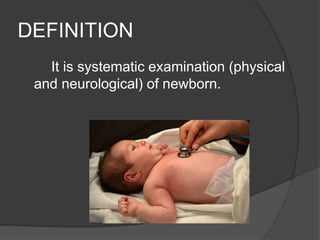
It is systematic examination (physical
and neurological) of newborn.
OBJECTIVES
1. To assess need for resuscitation
2. To ascertain the gestational age
3. To detect presence of any congenital
anomalies
INDICATIONS
 First examination: within 24 hrs of birth.
 Second examination: within 2 weeks of
age.
 Third examination: within 4-6 weeks of
age.
ARTICLES REQUIRED
 TPR Tray
 A tray containing:
1. Inch tape
2. Stethoscope
3. Torch
4. Weighing machine
5. Clean gloves
INITIAL ASSESSMENT OF
NEWBORN
1. IDENTIFICATION
 Check and identify the sex of the infant
and verify the records with the correct
name, sex and registration number.
2. GESTATIONAL AGE
FULL TERM/ PRE-TERM/ POST- TERM
FIRST DAY EXAMINATION
It should be done within 24 hours of birth.
VITAL SIGNS
a) RESPIRATION: normal value of respiration is 30-
60 breaths/min.
b) HEART RATE: normal value of heart rate is 120-
160 beats/min.
c) TEMPERATURE: normal value of temperature is
36.5-37.5 degree Celsius.
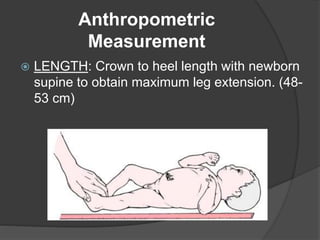
Anthropometric
Measurement
 LENGTH: Crown to heel length with newborn
supine to obtain maximum leg extension. (48-
53 cm)
Cont..
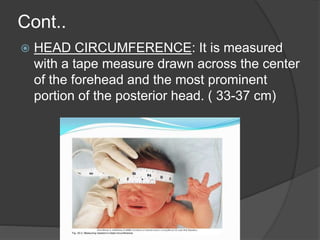
 HEAD CIRCUMFERENCE: It is measured
with a tape measure drawn across the center
of the forehead and the most prominent
portion of the posterior head. ( 33-37 cm)
Cont..
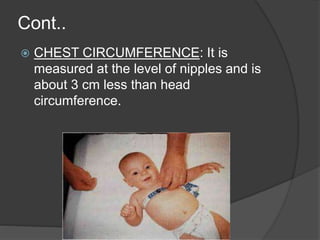
 CHEST CIRCUMFERENCE: It is
measured at the level of nipples and is
about 3 cm less than head
circumference.
Cont..
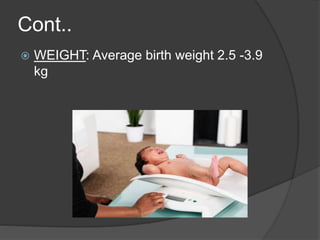
 WEIGHT: Average birth weight 2.5 -3.9
kg
General Examination
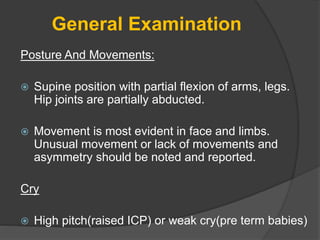
Posture And Movements:
 Supine position with partial flexion of arms, legs.
Hip joints are partially abducted.
 Movement is most evident in face and limbs.
Unusual movement or lack of movements and
asymmetry should be noted and reported.
Cry
 High pitch(raised ICP) or weak cry(pre term babies)
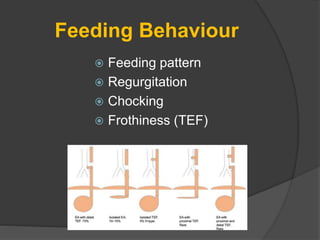
Feeding Behaviour
 Feeding pattern
 Regurgitation
 Chocking
 Frothiness (TEF)
SKIN
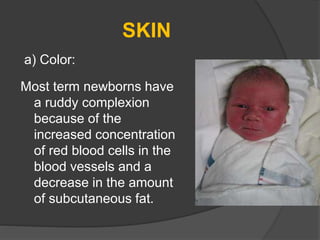
a) Color:
Most term newborns have
a ruddy complexion
because of the
increased concentration
of red blood cells in the
blood vessels and a
decrease in the amount
of subcutaneous fat.
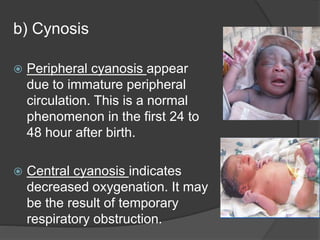
b) Cynosis
 Peripheral cyanosis appear
due to immature peripheral
circulation. This is a normal
phenomenon in the first 24 to
48 hour after birth.
 Central cyanosis indicates
decreased oxygenation. It may
be the result of temporary
respiratory obstruction.
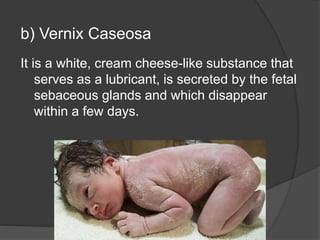
b) Vernix Caseosa
It is a white, cream cheese-like substance that
serves as a lubricant, is secreted by the fetal
sebaceous glands and which disappear
within a few days.
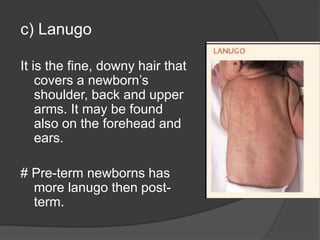
c) Lanugo
It is the fine, downy hair that
covers a newborn’s
shoulder, back and upper
arms. It may be found
also on the forehead and
ears.
# Pre-term newborns has
more lanugo then post-
term.
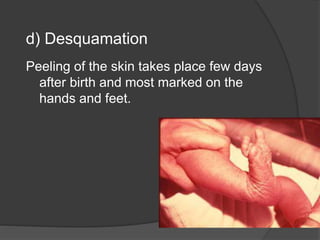
d) Desquamation
Peeling of the skin takes place few days
after birth and most marked on the
hands and feet.
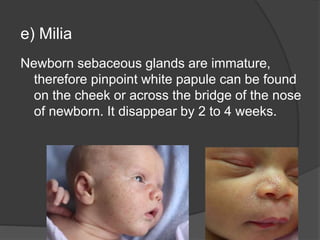
e) Milia
Newborn sebaceous glands are immature,
therefore pinpoint white papule can be found
on the cheek or across the bridge of the nose
of newborn. It disappear by 2 to 4 weeks.
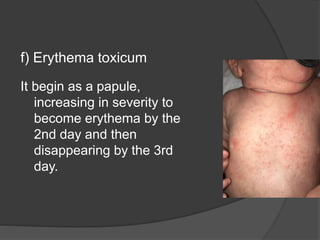
f) Erythema toxicum
It begin as a papule,
increasing in severity to
become erythema by the
2nd day and then
disappearing by the 3rd
day.
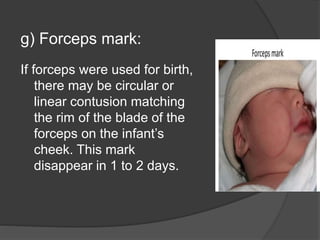
g) Forceps mark:
If forceps were used for birth,
there may be circular or
linear contusion matching
the rim of the blade of the
forceps on the infant’s
cheek. This mark
disappear in 1 to 2 days.
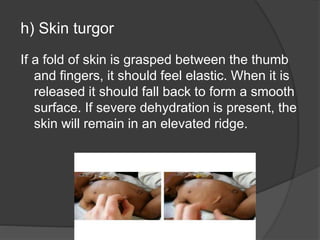
h) Skin turgor
If a fold of skin is grasped between the thumb
and fingers, it should feel elastic. When it is
released it should fall back to form a smooth
surface. If severe dehydration is present, the
skin will remain in an elevated ridge.
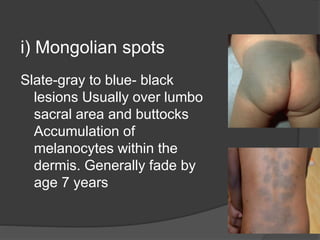
i) Mongolian spots
Slate-gray to blue- black
lesions Usually over lumbo
sacral area and buttocks
Accumulation of
melanocytes within the
dermis. Generally fade by
age 7 years
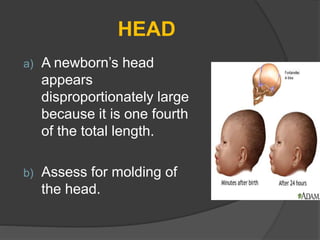
HEAD
a) A newborn’s head
appears
disproportionately large
because it is one fourth
of the total length.
b) Assess for molding of
the head.
Cont..
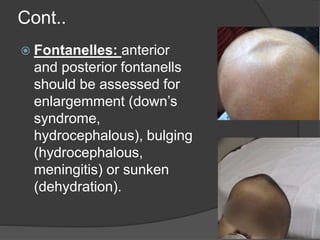
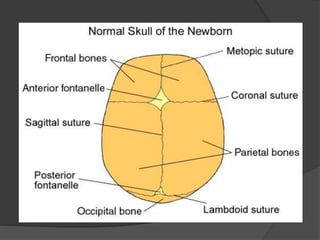
 Fontanelles: anterior
and posterior fontanells
should be assessed for
enlargemment (down’s
syndrome,
hydrocephalous), bulging
(hydrocephalous,
meningitis) or sunken
(dehydration).
Cont..
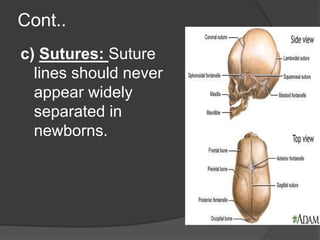
c) Sutures: Suture
lines should never
appear widely
separated in
newborns.
Cont..
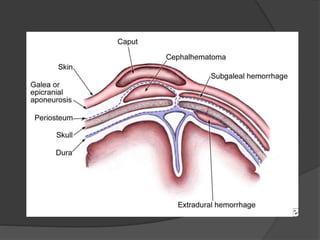
d) CAPUT
SUCCEDANEUM
Swelling or edema
of the presenting
portion of scalp.
Goes away few
days.
e) CEPHALHEMATOMA
Bleeding between the
skull and
periosteum of
newborn baby .
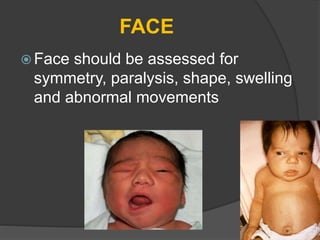
FACE
 Face should be assessed for
symmetry, paralysis, shape, swelling
and abnormal movements
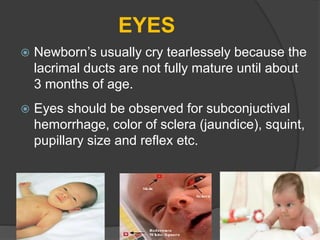
EYES
 Newborn’s usually cry tearlessely because the
lacrimal ducts are not fully mature until about
3 months of age.
 Eyes should be observed for subconjuctival
hemorrhage, color of sclera (jaundice), squint,
pupillary size and reflex etc.
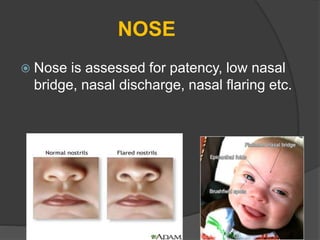
NOSE
 Nose is assessed for patency, low nasal
bridge, nasal discharge, nasal flaring etc.
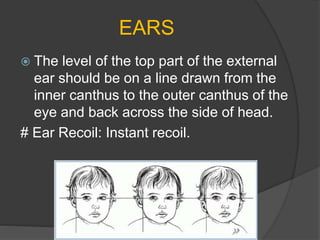
EARS
 The level of the top part of the external
ear should be on a line drawn from the
inner canthus to the outer canthus of the
eye and back across the side of head.
# Ear Recoil: Instant recoil.
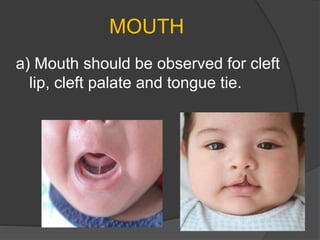
MOUTH
a) Mouth should be observed for cleft
lip, cleft palate and tongue tie.
Cont..
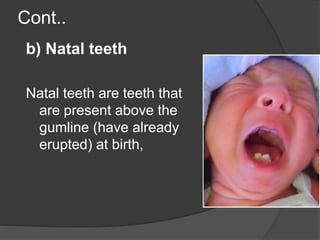
b) Natal teeth
Natal teeth are teeth that
are present above the
gumline (have already
erupted) at birth,
Cont..
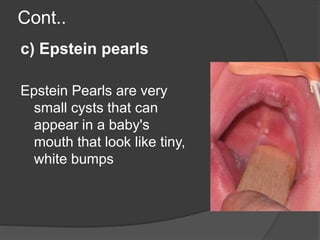
c) Epstein pearls
Epstein Pearls are very
small cysts that can
appear in a baby's
mouth that look like tiny,
white bumps
Cont..
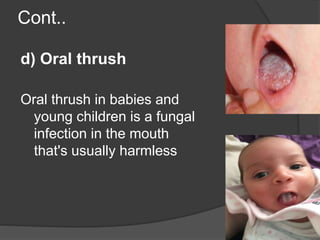
d) Oral thrush
Oral thrush in babies and
young children is a fungal
infection in the mouth
that's usually harmless
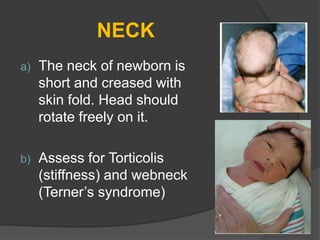
NECK
a) The neck of newborn is
short and creased with
skin fold. Head should
rotate freely on it.
b) Assess for Torticolis
(stiffness) and webneck
(Terner’s syndrome)
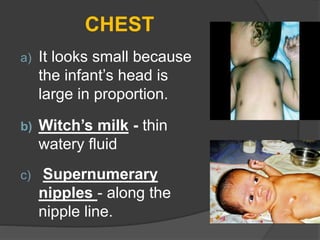
CHEST
a) It looks small because
the infant’s head is
large in proportion.
b) Witch’s milk - thin
watery fluid
c) Supernumerary
nipples - along the
nipple line.
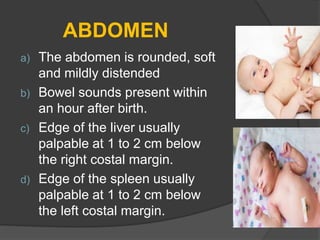
ABDOMEN
a) The abdomen is rounded, soft
and mildly distended
b) Bowel sounds present within
an hour after birth.
c) Edge of the liver usually
palpable at 1 to 2 cm below
the right costal margin.
d) Edge of the spleen usually
palpable at 1 to 2 cm below
the left costal margin.
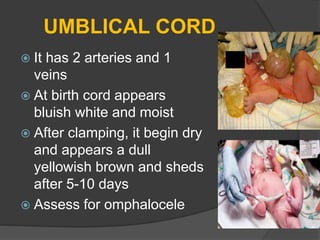
UMBLICAL CORD
 It has 2 arteries and 1
veins
 At birth cord appears
bluish white and moist
 After clamping, it begin dry
and appears a dull
yellowish brown and sheds
after 5-10 days
 Assess for omphalocele
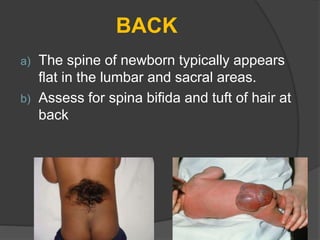
BACK
a) The spine of newborn typically appears
flat in the lumbar and sacral areas.
b) Assess for spina bifida and tuft of hair at
back
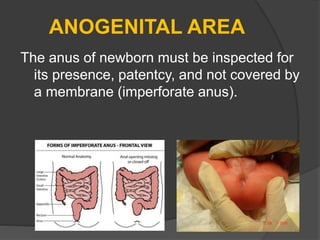
ANOGENITAL AREA
The anus of newborn must be inspected for
its presence, patentcy, and not covered by
a membrane (imperforate anus).
Cont..
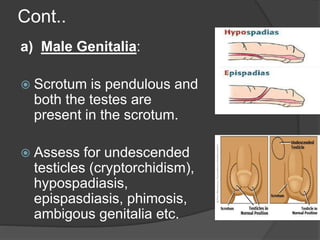
a) Male Genitalia:
 Scrotum is pendulous and
both the testes are
present in the scrotum.
 Assess for undescended
testicles (cryptorchidism),
hypospadiasis,
epispasdiasis, phimosis,
ambigous genitalia etc.
Cont..
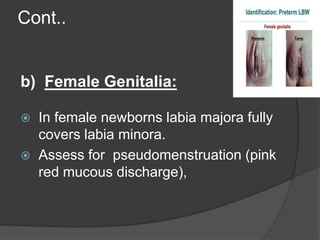
b) Female Genitalia:
 In female newborns labia majora fully
covers labia minora.
 Assess for pseudomenstruation (pink
red mucous discharge),
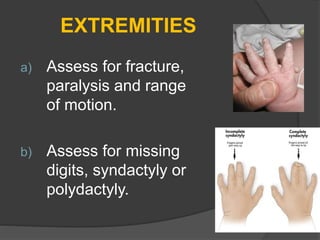
EXTREMITIES
a) Assess for fracture,
paralysis and range
of motion.
b) Assess for missing
digits, syndactyly or
polydactyly.
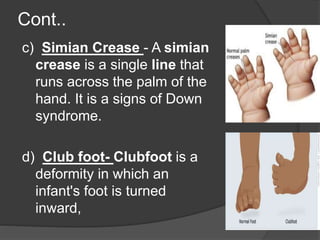
Cont..
c) Simian Crease - A simian
crease is a single line that
runs across the palm of the
hand. It is a signs of Down
syndrome.
d) Club foot- Clubfoot is a
deformity in which an
infant's foot is turned
inward,
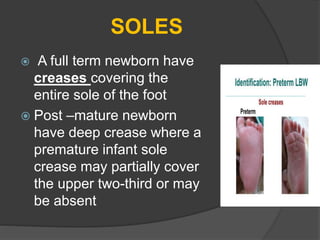
SOLES
 A full term newborn have
creases covering the
entire sole of the foot
 Post –mature newborn
have deep crease where a
premature infant sole
crease may partially cover
the upper two-third or may
be absent
URINE & STOOLS
MECONIUM
 It is the first fecal
material, is a
sticky, odorless
material, greenish
black to brownish
green which is
passed within 24
hours after birth
URINE
 The first urine is
diluted because of
immaturity of the
kidneys and lack of
ability to
concentrate urine.
NEONATAL REFLEXES
Protective
1. Blinking
2. Sneezing/ coughing
3. Extrusion
4. Gagging
5. Glabellar
Primitive
1. Rooting
2. Sucking
3. Moro’s/ startle
4. Tonic neck
5. Stepping/ dancing
6. Palmer grasp
7. Babinski
8. Doll’s eye
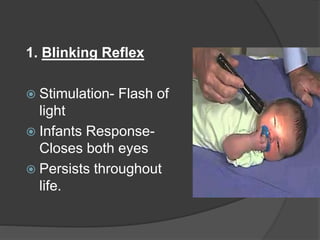
1. Blinking Reflex
 Stimulation- Flash of
light
 Infants Response-
Closes both eyes
 Persists throughout
life.
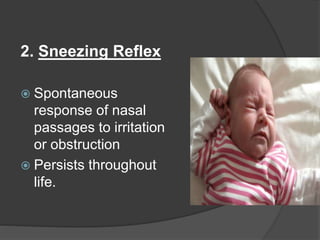
2. Sneezing Reflex
 Spontaneous
response of nasal
passages to irritation
or obstruction
 Persists throughout
life.
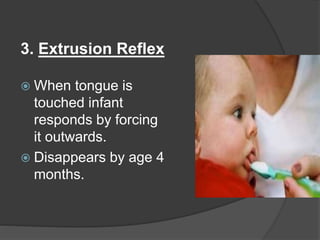
3. Extrusion Reflex
 When tongue is
touched infant
responds by forcing
it outwards.
 Disappears by age 4
months.
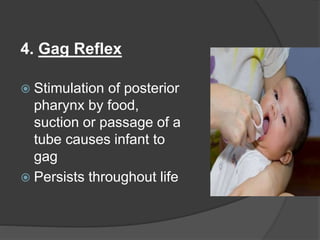
4. Gag Reflex
 Stimulation of posterior
pharynx by food,
suction or passage of a
tube causes infant to
gag
 Persists throughout life
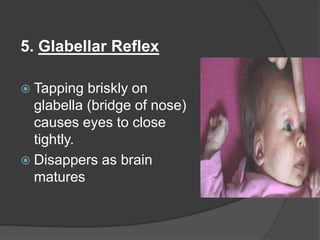
5. Glabellar Reflex
 Tapping briskly on
glabella (bridge of nose)
causes eyes to close
tightly.
 Disappers as brain
matures
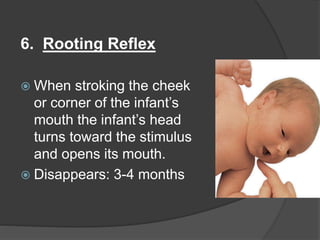
6. Rooting Reflex
 When stroking the cheek
or corner of the infant’s
mouth the infant’s head
turns toward the stimulus
and opens its mouth.
 Disappears: 3-4 months
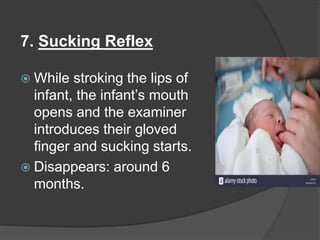
7. Sucking Reflex
 While stroking the lips of
infant, the infant’s mouth
opens and the examiner
introduces their gloved
finger and sucking starts.
 Disappears: around 6
months.
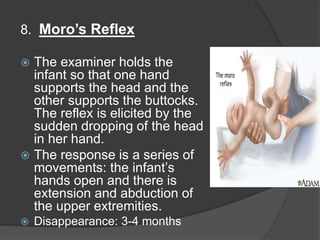
8. Moro’s Reflex
 The examiner holds the
infant so that one hand
supports the head and the
other supports the buttocks.
The reflex is elicited by the
sudden dropping of the head
in her hand.
 The response is a series of
movements: the infant’s
hands open and there is
extension and abduction of
the upper extremities.
 Disappearance: 3-4 months
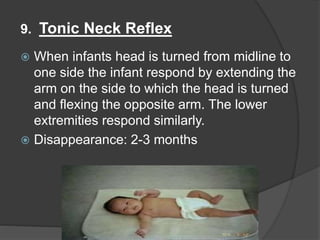
9. Tonic Neck Reflex
 When infants head is turned from midline to
one side the infant respond by extending the
arm on the side to which the head is turned
and flexing the opposite arm. The lower
extremities respond similarly.
 Disappearance: 2-3 months
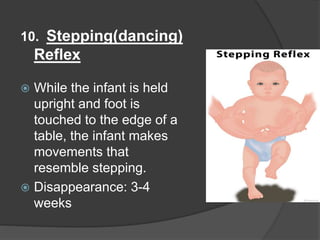
10. Stepping(dancing)
Reflex
 While the infant is held
upright and foot is
touched to the edge of a
table, the infant makes
movements that
resemble stepping.
 Disappearance: 3-4
weeks
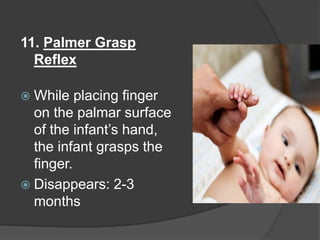
11. Palmer Grasp
Reflex
 While placing finger
on the palmar surface
of the infant’s hand,
the infant grasps the
finger.
 Disappears: 2-3
months
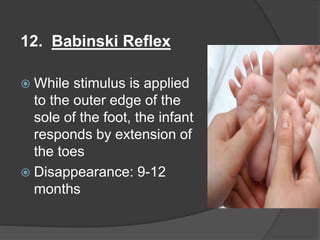
12. Babinski Reflex
 While stimulus is applied
to the outer edge of the
sole of the foot, the infant
responds by extension of
the toes
 Disappearance: 9-12
months
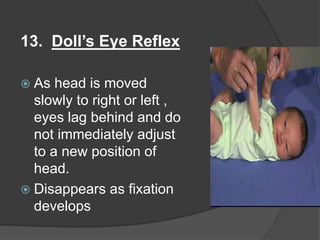
13. Doll’s Eye Reflex
 As head is moved
slowly to right or left ,
eyes lag behind and do
not immediately adjust
to a new position of
head.
 Disappears as fixation
develops
Daily Observation
The neonates should e daily observed for
danger signs,
1. Poor feeding, sucking and swallowing
reflex
2. Cold to touch and having rise in body
temperature
3. Poor activity
4. Excessive crying and irritability
5. Rapid respiration, >60 per minute
Cont..
6. Central Cynosis
7. Drooling of saliva or chocking during
feeding or frothiness
8. Laboured respiration or absence of
respiration
9. Jaundice appears within 24 hours
10. No urine or meconium within 48 hours
11. Convulsions or abnormal movements
Cont..
12. Bleeding from any site
13. Umbilical discharge
14. Any superficial infections
15. Diarrhea, vomiting and abdominal
distension
Newborn Assessment

Newborn Assessment

  • 1.
  • 2.
    DEFINITION It is systematicexamination (physical and neurological) of newborn.
  • 3.
    OBJECTIVES 1. To assessneed for resuscitation 2. To ascertain the gestational age 3. To detect presence of any congenital anomalies
  • 4.
    INDICATIONS  First examination:within 24 hrs of birth.  Second examination: within 2 weeks of age.  Third examination: within 4-6 weeks of age.
  • 5.
    ARTICLES REQUIRED  TPRTray  A tray containing: 1. Inch tape 2. Stethoscope 3. Torch 4. Weighing machine 5. Clean gloves
  • 6.
    INITIAL ASSESSMENT OF NEWBORN 1.IDENTIFICATION  Check and identify the sex of the infant and verify the records with the correct name, sex and registration number. 2. GESTATIONAL AGE FULL TERM/ PRE-TERM/ POST- TERM
  • 7.
    FIRST DAY EXAMINATION Itshould be done within 24 hours of birth. VITAL SIGNS a) RESPIRATION: normal value of respiration is 30- 60 breaths/min. b) HEART RATE: normal value of heart rate is 120- 160 beats/min. c) TEMPERATURE: normal value of temperature is 36.5-37.5 degree Celsius.
  • 8.
    Anthropometric Measurement  LENGTH: Crownto heel length with newborn supine to obtain maximum leg extension. (48- 53 cm)
  • 9.
    Cont..  HEAD CIRCUMFERENCE:It is measured with a tape measure drawn across the center of the forehead and the most prominent portion of the posterior head. ( 33-37 cm)
  • 10.
    Cont..  CHEST CIRCUMFERENCE:It is measured at the level of nipples and is about 3 cm less than head circumference.
  • 11.
    Cont..  WEIGHT: Averagebirth weight 2.5 -3.9 kg
  • 12.
    General Examination Posture AndMovements:  Supine position with partial flexion of arms, legs. Hip joints are partially abducted.  Movement is most evident in face and limbs. Unusual movement or lack of movements and asymmetry should be noted and reported. Cry  High pitch(raised ICP) or weak cry(pre term babies)
  • 13.
    Feeding Behaviour  Feedingpattern  Regurgitation  Chocking  Frothiness (TEF)
  • 14.
    SKIN a) Color: Most termnewborns have a ruddy complexion because of the increased concentration of red blood cells in the blood vessels and a decrease in the amount of subcutaneous fat.
  • 15.
    b) Cynosis  Peripheralcyanosis appear due to immature peripheral circulation. This is a normal phenomenon in the first 24 to 48 hour after birth.  Central cyanosis indicates decreased oxygenation. It may be the result of temporary respiratory obstruction.
  • 16.
    b) Vernix Caseosa Itis a white, cream cheese-like substance that serves as a lubricant, is secreted by the fetal sebaceous glands and which disappear within a few days.
  • 17.
    c) Lanugo It isthe fine, downy hair that covers a newborn’s shoulder, back and upper arms. It may be found also on the forehead and ears. # Pre-term newborns has more lanugo then post- term.
  • 18.
    d) Desquamation Peeling ofthe skin takes place few days after birth and most marked on the hands and feet.
  • 19.
    e) Milia Newborn sebaceousglands are immature, therefore pinpoint white papule can be found on the cheek or across the bridge of the nose of newborn. It disappear by 2 to 4 weeks.
  • 20.
    f) Erythema toxicum Itbegin as a papule, increasing in severity to become erythema by the 2nd day and then disappearing by the 3rd day.
  • 21.
    g) Forceps mark: Ifforceps were used for birth, there may be circular or linear contusion matching the rim of the blade of the forceps on the infant’s cheek. This mark disappear in 1 to 2 days.
  • 22.
    h) Skin turgor Ifa fold of skin is grasped between the thumb and fingers, it should feel elastic. When it is released it should fall back to form a smooth surface. If severe dehydration is present, the skin will remain in an elevated ridge.
  • 23.
    i) Mongolian spots Slate-grayto blue- black lesions Usually over lumbo sacral area and buttocks Accumulation of melanocytes within the dermis. Generally fade by age 7 years
  • 24.
    HEAD a) A newborn’shead appears disproportionately large because it is one fourth of the total length. b) Assess for molding of the head.
  • 25.
    Cont..  Fontanelles: anterior andposterior fontanells should be assessed for enlargemment (down’s syndrome, hydrocephalous), bulging (hydrocephalous, meningitis) or sunken (dehydration).
  • 26.
    Cont.. c) Sutures: Suture linesshould never appear widely separated in newborns.
  • 28.
    Cont.. d) CAPUT SUCCEDANEUM Swelling oredema of the presenting portion of scalp. Goes away few days. e) CEPHALHEMATOMA Bleeding between the skull and periosteum of newborn baby .
  • 30.
    FACE  Face shouldbe assessed for symmetry, paralysis, shape, swelling and abnormal movements
  • 31.
    EYES  Newborn’s usuallycry tearlessely because the lacrimal ducts are not fully mature until about 3 months of age.  Eyes should be observed for subconjuctival hemorrhage, color of sclera (jaundice), squint, pupillary size and reflex etc.
  • 32.
    NOSE  Nose isassessed for patency, low nasal bridge, nasal discharge, nasal flaring etc.
  • 33.
    EARS  The levelof the top part of the external ear should be on a line drawn from the inner canthus to the outer canthus of the eye and back across the side of head. # Ear Recoil: Instant recoil.
  • 34.
    MOUTH a) Mouth shouldbe observed for cleft lip, cleft palate and tongue tie.
  • 35.
    Cont.. b) Natal teeth Natalteeth are teeth that are present above the gumline (have already erupted) at birth,
  • 36.
    Cont.. c) Epstein pearls EpsteinPearls are very small cysts that can appear in a baby's mouth that look like tiny, white bumps
  • 37.
    Cont.. d) Oral thrush Oralthrush in babies and young children is a fungal infection in the mouth that's usually harmless
  • 38.
    NECK a) The neckof newborn is short and creased with skin fold. Head should rotate freely on it. b) Assess for Torticolis (stiffness) and webneck (Terner’s syndrome)
  • 39.
    CHEST a) It lookssmall because the infant’s head is large in proportion. b) Witch’s milk - thin watery fluid c) Supernumerary nipples - along the nipple line.
  • 40.
    ABDOMEN a) The abdomenis rounded, soft and mildly distended b) Bowel sounds present within an hour after birth. c) Edge of the liver usually palpable at 1 to 2 cm below the right costal margin. d) Edge of the spleen usually palpable at 1 to 2 cm below the left costal margin.
  • 41.
    UMBLICAL CORD  Ithas 2 arteries and 1 veins  At birth cord appears bluish white and moist  After clamping, it begin dry and appears a dull yellowish brown and sheds after 5-10 days  Assess for omphalocele
  • 42.
    BACK a) The spineof newborn typically appears flat in the lumbar and sacral areas. b) Assess for spina bifida and tuft of hair at back
  • 43.
    ANOGENITAL AREA The anusof newborn must be inspected for its presence, patentcy, and not covered by a membrane (imperforate anus).
  • 44.
    Cont.. a) Male Genitalia: Scrotum is pendulous and both the testes are present in the scrotum.  Assess for undescended testicles (cryptorchidism), hypospadiasis, epispasdiasis, phimosis, ambigous genitalia etc.
  • 45.
    Cont.. b) Female Genitalia: In female newborns labia majora fully covers labia minora.  Assess for pseudomenstruation (pink red mucous discharge),
  • 46.
    EXTREMITIES a) Assess forfracture, paralysis and range of motion. b) Assess for missing digits, syndactyly or polydactyly.
  • 47.
    Cont.. c) Simian Crease- A simian crease is a single line that runs across the palm of the hand. It is a signs of Down syndrome. d) Club foot- Clubfoot is a deformity in which an infant's foot is turned inward,
  • 48.
    SOLES  A fullterm newborn have creases covering the entire sole of the foot  Post –mature newborn have deep crease where a premature infant sole crease may partially cover the upper two-third or may be absent
  • 49.
    URINE & STOOLS MECONIUM It is the first fecal material, is a sticky, odorless material, greenish black to brownish green which is passed within 24 hours after birth URINE  The first urine is diluted because of immaturity of the kidneys and lack of ability to concentrate urine.
  • 50.
    NEONATAL REFLEXES Protective 1. Blinking 2.Sneezing/ coughing 3. Extrusion 4. Gagging 5. Glabellar Primitive 1. Rooting 2. Sucking 3. Moro’s/ startle 4. Tonic neck 5. Stepping/ dancing 6. Palmer grasp 7. Babinski 8. Doll’s eye
  • 51.
    1. Blinking Reflex Stimulation- Flash of light  Infants Response- Closes both eyes  Persists throughout life.
  • 52.
    2. Sneezing Reflex Spontaneous response of nasal passages to irritation or obstruction  Persists throughout life.
  • 53.
    3. Extrusion Reflex When tongue is touched infant responds by forcing it outwards.  Disappears by age 4 months.
  • 54.
    4. Gag Reflex Stimulation of posterior pharynx by food, suction or passage of a tube causes infant to gag  Persists throughout life
  • 55.
    5. Glabellar Reflex Tapping briskly on glabella (bridge of nose) causes eyes to close tightly.  Disappers as brain matures
  • 56.
    6. Rooting Reflex When stroking the cheek or corner of the infant’s mouth the infant’s head turns toward the stimulus and opens its mouth.  Disappears: 3-4 months
  • 57.
    7. Sucking Reflex While stroking the lips of infant, the infant’s mouth opens and the examiner introduces their gloved finger and sucking starts.  Disappears: around 6 months.
  • 58.
    8. Moro’s Reflex The examiner holds the infant so that one hand supports the head and the other supports the buttocks. The reflex is elicited by the sudden dropping of the head in her hand.  The response is a series of movements: the infant’s hands open and there is extension and abduction of the upper extremities.  Disappearance: 3-4 months
  • 59.
    9. Tonic NeckReflex  When infants head is turned from midline to one side the infant respond by extending the arm on the side to which the head is turned and flexing the opposite arm. The lower extremities respond similarly.  Disappearance: 2-3 months
  • 60.
    10. Stepping(dancing) Reflex  Whilethe infant is held upright and foot is touched to the edge of a table, the infant makes movements that resemble stepping.  Disappearance: 3-4 weeks
  • 61.
    11. Palmer Grasp Reflex While placing finger on the palmar surface of the infant’s hand, the infant grasps the finger.  Disappears: 2-3 months
  • 62.
    12. Babinski Reflex While stimulus is applied to the outer edge of the sole of the foot, the infant responds by extension of the toes  Disappearance: 9-12 months
  • 63.
    13. Doll’s EyeReflex  As head is moved slowly to right or left , eyes lag behind and do not immediately adjust to a new position of head.  Disappears as fixation develops
  • 64.
    Daily Observation The neonatesshould e daily observed for danger signs, 1. Poor feeding, sucking and swallowing reflex 2. Cold to touch and having rise in body temperature 3. Poor activity 4. Excessive crying and irritability 5. Rapid respiration, >60 per minute
  • 65.
    Cont.. 6. Central Cynosis 7.Drooling of saliva or chocking during feeding or frothiness 8. Laboured respiration or absence of respiration 9. Jaundice appears within 24 hours 10. No urine or meconium within 48 hours 11. Convulsions or abnormal movements
  • 66.
    Cont.. 12. Bleeding fromany site 13. Umbilical discharge 14. Any superficial infections 15. Diarrhea, vomiting and abdominal distension