
 To identify normal characteristics in the
newborn.
 To identify existing abnormalities, if any
 To carry out immediate action if there is any
deviation.
 To establish a baseline for future physiological
changes.
 Keep your hands clean, dry and warm.
 Keep your nails short and free of nail polish.
 Do not expose the baby unnecessary.
 Do not expose the baby to drafts and chills.
 Examine the baby swiftly not more than 8 to 10
minutes.
 If newborn is irritable/crying during examination
allow him to suck on a nipple.
 Inform mother about outcome of examination.
 Take temperature: (37˚C ± 0.5˚C)
 Count heart rate: 120-160 beats/minute
 Count respiratory rate: 30-60 breaths /minute
 Weight: 2.7 kg (with a variation of 2.5-3.9 kg or more)
 Length: 50 cm (with the range of 48-53cm)
 Head Circumference: 33-35.5 cm
 Chest Circumference: 30.5-33 cm
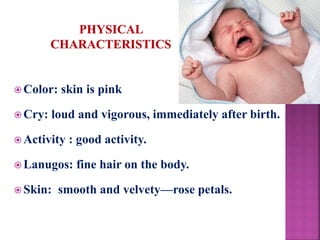
 Color: skin is pink
 Cry: loud and vigorous, immediately after birth.
 Activity : good activity.
 Lanugos: fine hair on the body.
 Skin: smooth and velvety—rose petals.
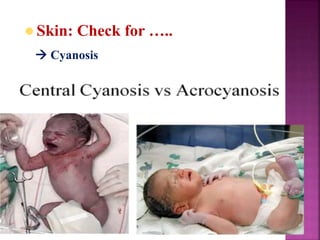
 Cyanosis
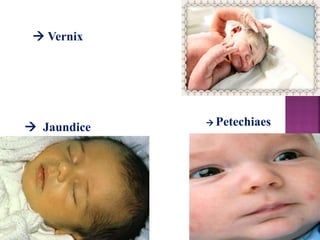
 Skin: Check for …..
 Petechiaes Jaundice
 Vernix
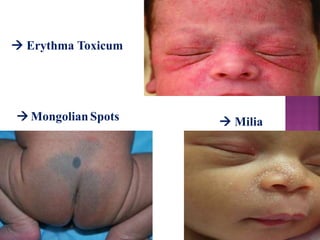
 Erythma Toxicum
 Milia Mongolian Spots
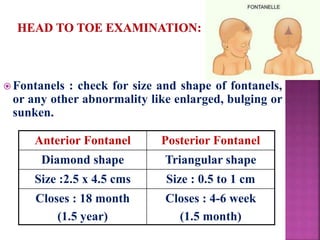
 Fontanels : check for size and shape of fontanels,
or any other abnormality like enlarged, bulging or
sunken.
Anterior Fontanel Posterior Fontanel
Diamond shape Triangular shape
Size :2.5 x 4.5 cms Size : 0.5 to 1 cm
Closes : 18 month
(1.5 year)
Closes : 4-6 week
(1.5 month)
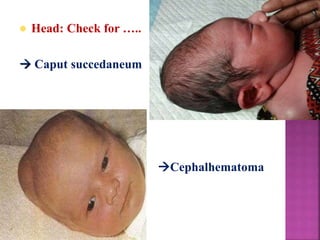
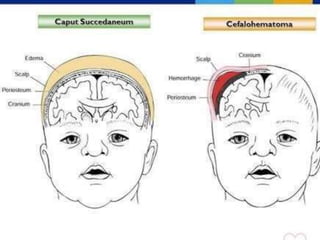
 Head: Check for …..
 Caput succedaneum
Cephalhematoma
 Molding
 Hydrocephalus
 Anencephaly
 Encephelocele
 Over riding of cranial suture etc.
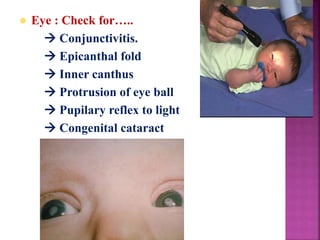
 Eye : Check for…..
 Conjunctivitis.
 Epicanthal fold
 Inner canthus
 Protrusion of eye ball
 Pupilary reflex to light
 Congenital cataract
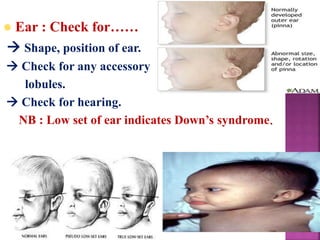
 Ear : Check for……
 Shape, position of ear.
 Check for any accessory
lobules.
 Check for hearing.
NB : Low set of ear indicates Down’s syndrome.
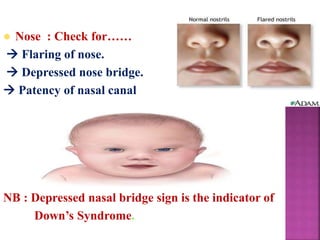
 Nose : Check for……
 Flaring of nose.
 Depressed nose bridge.
 Patency of nasal canal
NB : Depressed nasal bridge sign is the indicator of
Down’s Syndrome.
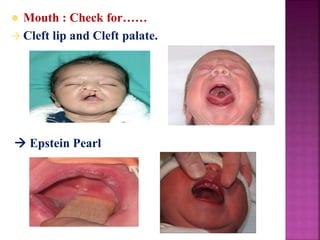
 Mouth : Check for……
 Cleft lip and Cleft palate.
 Epstein Pearl
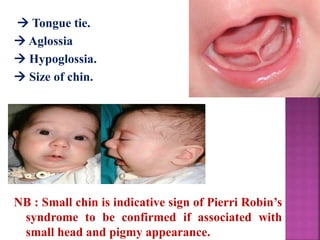
 Tongue tie.
 Aglossia
 Hypoglossia.
 Size of chin.
NB : Small chin is indicative sign of Pierri Robin’s
syndrome to be confirmed if associated with
small head and pigmy appearance.
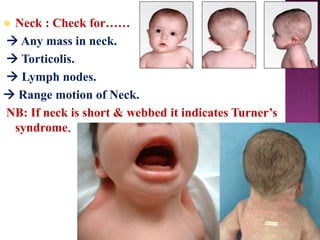
 Neck : Check for……
 Any mass in neck.
 Torticolis.
 Lymph nodes.
 Range motion of Neck.
NB: If neck is short & webbed it indicates Turner’s
syndrome.
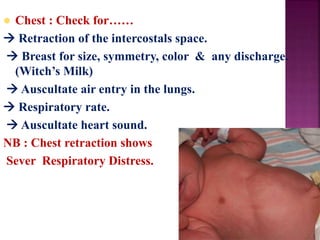
 Chest : Check for……
 Retraction of the intercostals space.
 Breast for size, symmetry, color & any discharge.
(Witch’s Milk)
 Auscultate air entry in the lungs.
 Respiratory rate.
 Auscultate heart sound.
NB : Chest retraction shows
Sever Respiratory Distress.
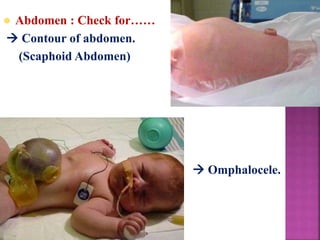
 Abdomen : Check for……
 Contour of abdomen.
(Scaphoid Abdomen)
 Omphalocele.
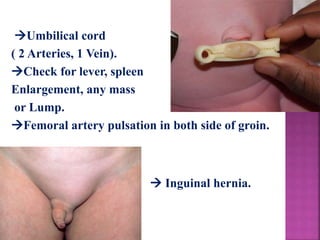
Umbilical cord
( 2 Arteries, 1 Vein).
Check for lever, spleen
Enlargement, any mass
or Lump.
Femoral artery pulsation in both side of groin.
 Inguinal hernia.
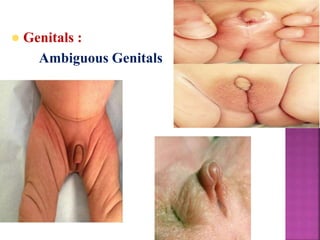
 Genitals :
Ambiguous Genitals
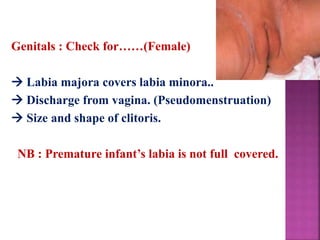
Genitals : Check for……(Female)
 Labia majora covers labia minora..
 Discharge from vagina. (Pseudomenstruation)
 Size and shape of clitoris.
NB : Premature infant’s labia is not full covered.
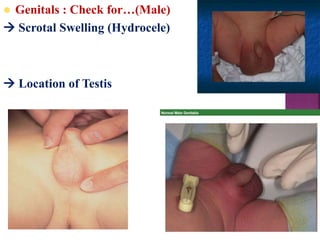
 Genitals : Check for…(Male)
 Scrotal Swelling (Hydrocele)
 Location of Testis
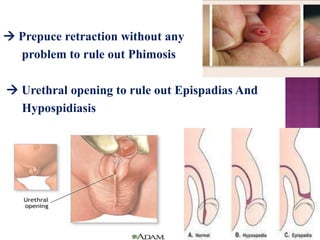
 Prepuce retraction without any
problem to rule out Phimosis
 Urethral opening to rule out Epispadias And
Hypospidiasis
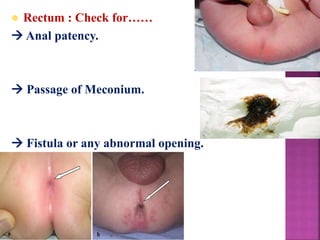
 Rectum : Check for……
 Anal patency.
 Passage of Meconium.
 Fistula or any abnormal opening.
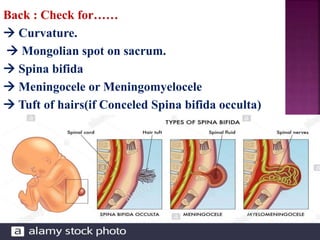
Back : Check for……
 Curvature.
 Mongolian spot on sacrum.
 Spina bifida
 Meningocele or Meningomyelocele
 Tuft of hairs(if Conceled Spina bifida occulta)
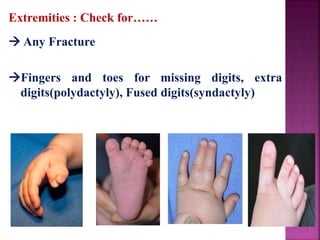
Extremities : Check for……
 Any Fracture
Fingers and toes for missing digits, extra
digits(polydactyly), Fused digits(syndactyly)
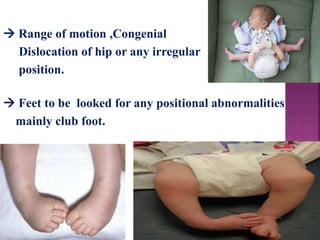
 Feet to be looked for any positional abnormalities
mainly club foot.
 Range of motion ,Congenial
Dislocation of hip or any irregular
position.
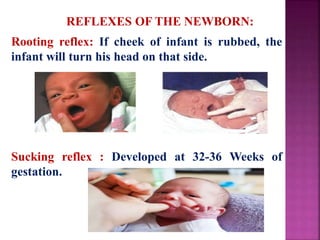
REFLEXES OF THE NEWBORN:
Rooting reflex: If cheek of infant is rubbed, the
infant will turn his head on that side.
Sucking reflex : Developed at 32-36 Weeks of
gestation.
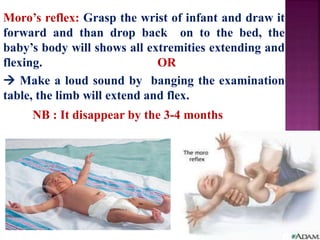
Moro’s reflex: Grasp the wrist of infant and draw it
forward and than drop back on to the bed, the
baby’s body will shows all extremities extending and
flexing. OR
 Make a loud sound by banging the examination
table, the limb will extend and flex.
NB : It disappear by the 3-4 months
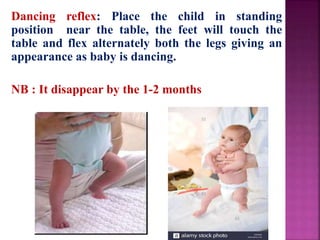
Dancing reflex: Place the child in standing
position near the table, the feet will touch the
table and flex alternately both the legs giving an
appearance as baby is dancing.
NB : It disappear by the 1-2 months
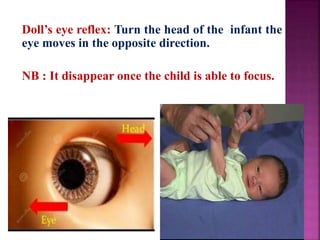
Doll’s eye reflex: Turn the head of the infant the
eye moves in the opposite direction.
NB : It disappear once the child is able to focus.
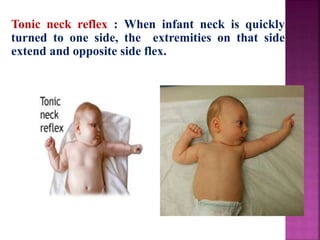
Tonic neck reflex : When infant neck is quickly
turned to one side, the extremities on that side
extend and opposite side flex.
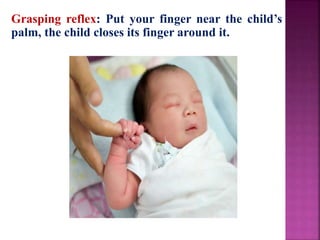
Grasping reflex: Put your finger near the child’s
palm, the child closes its finger around it.
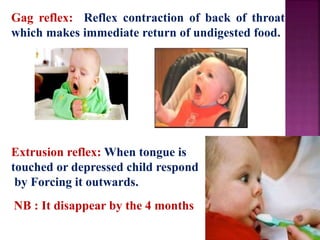
Gag reflex: Reflex contraction of back of throat
which makes immediate return of undigested food.
Extrusion reflex: When tongue is
touched or depressed child respond
by Forcing it outwards.
NB : It disappear by the 4 months
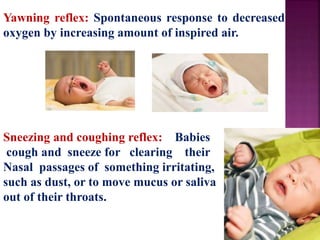
Yawning reflex: Spontaneous response to decreased
oxygen by increasing amount of inspired air.
Sneezing and coughing reflex: Babies
cough and sneeze for clearing their
Nasal passages of something irritating,
such as dust, or to move mucus or saliva
out of their throats.
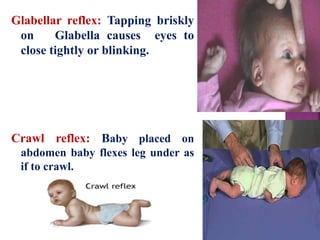
Glabellar reflex: Tapping briskly
on Glabella causes eyes to
close tightly or blinking.
Crawl reflex: Baby placed on
abdomen baby flexes leg under as
if to crawl.
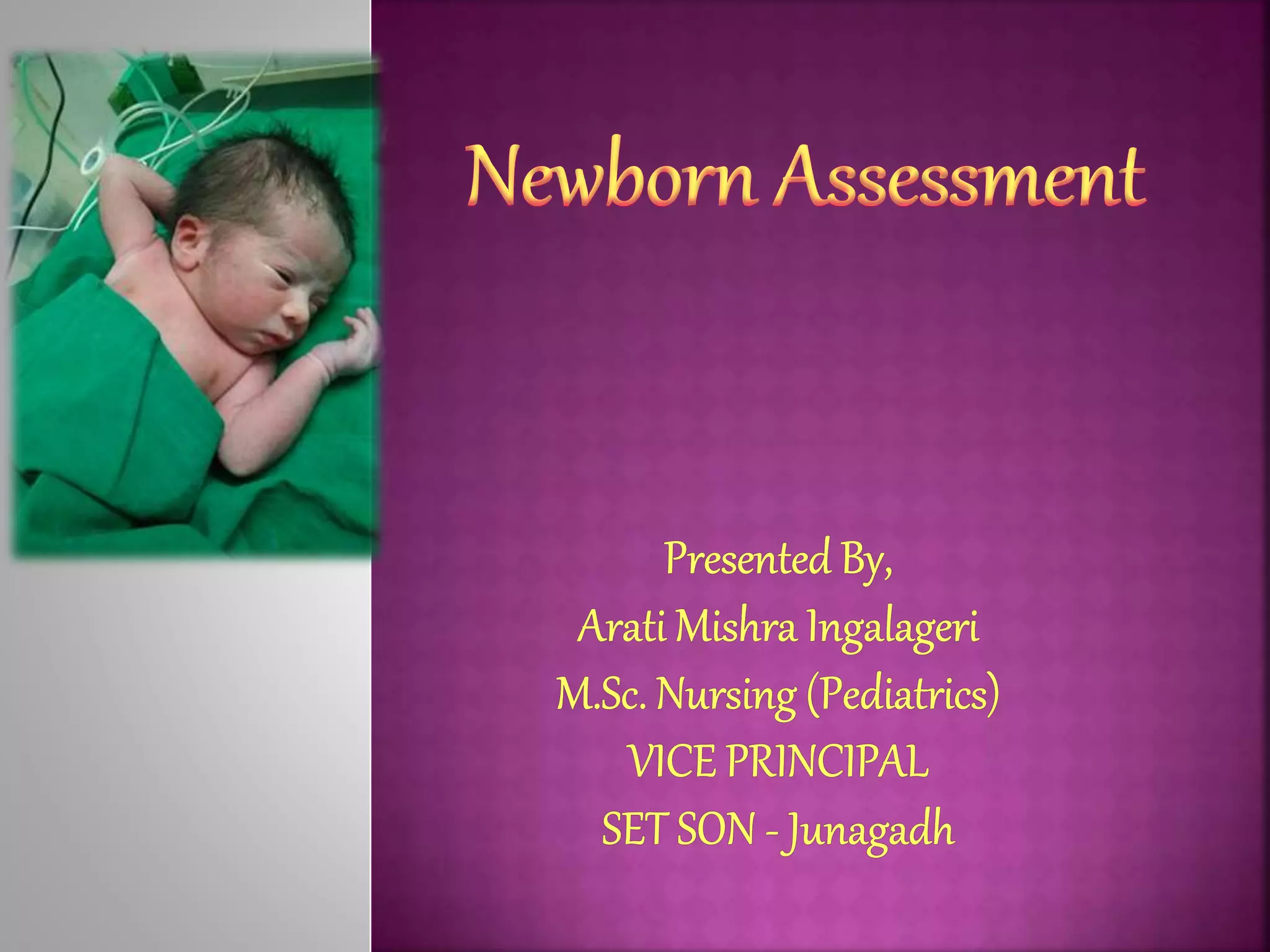
Newborn Assessment

Newborn Assessment

  • 2.
     To identifynormal characteristics in the newborn.  To identify existing abnormalities, if any  To carry out immediate action if there is any deviation.  To establish a baseline for future physiological changes.
  • 3.
     Keep yourhands clean, dry and warm.  Keep your nails short and free of nail polish.  Do not expose the baby unnecessary.  Do not expose the baby to drafts and chills.  Examine the baby swiftly not more than 8 to 10 minutes.  If newborn is irritable/crying during examination allow him to suck on a nipple.  Inform mother about outcome of examination.
  • 4.
     Take temperature:(37˚C ± 0.5˚C)  Count heart rate: 120-160 beats/minute  Count respiratory rate: 30-60 breaths /minute
  • 5.
     Weight: 2.7kg (with a variation of 2.5-3.9 kg or more)  Length: 50 cm (with the range of 48-53cm)  Head Circumference: 33-35.5 cm  Chest Circumference: 30.5-33 cm
  • 6.
     Color: skinis pink  Cry: loud and vigorous, immediately after birth.  Activity : good activity.  Lanugos: fine hair on the body.  Skin: smooth and velvety—rose petals.
  • 7.
     Cyanosis  Skin:Check for …..
  • 8.
  • 9.
     Erythma Toxicum Milia Mongolian Spots
  • 10.
     Fontanels :check for size and shape of fontanels, or any other abnormality like enlarged, bulging or sunken. Anterior Fontanel Posterior Fontanel Diamond shape Triangular shape Size :2.5 x 4.5 cms Size : 0.5 to 1 cm Closes : 18 month (1.5 year) Closes : 4-6 week (1.5 month)
  • 11.
     Head: Checkfor …..  Caput succedaneum Cephalhematoma
  • 13.
     Molding  Hydrocephalus Anencephaly  Encephelocele  Over riding of cranial suture etc.
  • 14.
     Eye :Check for…..  Conjunctivitis.  Epicanthal fold  Inner canthus  Protrusion of eye ball  Pupilary reflex to light  Congenital cataract
  • 15.
     Ear :Check for……  Shape, position of ear.  Check for any accessory lobules.  Check for hearing. NB : Low set of ear indicates Down’s syndrome.
  • 16.
     Nose :Check for……  Flaring of nose.  Depressed nose bridge.  Patency of nasal canal NB : Depressed nasal bridge sign is the indicator of Down’s Syndrome.
  • 17.
     Mouth :Check for……  Cleft lip and Cleft palate.  Epstein Pearl
  • 18.
     Tongue tie. Aglossia  Hypoglossia.  Size of chin. NB : Small chin is indicative sign of Pierri Robin’s syndrome to be confirmed if associated with small head and pigmy appearance.
  • 19.
     Neck :Check for……  Any mass in neck.  Torticolis.  Lymph nodes.  Range motion of Neck. NB: If neck is short & webbed it indicates Turner’s syndrome.
  • 20.
     Chest :Check for……  Retraction of the intercostals space.  Breast for size, symmetry, color & any discharge. (Witch’s Milk)  Auscultate air entry in the lungs.  Respiratory rate.  Auscultate heart sound. NB : Chest retraction shows Sever Respiratory Distress.
  • 21.
     Abdomen :Check for……  Contour of abdomen. (Scaphoid Abdomen)  Omphalocele.
  • 22.
    Umbilical cord ( 2Arteries, 1 Vein). Check for lever, spleen Enlargement, any mass or Lump. Femoral artery pulsation in both side of groin.  Inguinal hernia.
  • 23.
  • 24.
    Genitals : Checkfor……(Female)  Labia majora covers labia minora..  Discharge from vagina. (Pseudomenstruation)  Size and shape of clitoris. NB : Premature infant’s labia is not full covered.
  • 25.
     Genitals :Check for…(Male)  Scrotal Swelling (Hydrocele)  Location of Testis
  • 26.
     Prepuce retractionwithout any problem to rule out Phimosis  Urethral opening to rule out Epispadias And Hypospidiasis
  • 27.
     Rectum :Check for……  Anal patency.  Passage of Meconium.  Fistula or any abnormal opening.
  • 28.
    Back : Checkfor……  Curvature.  Mongolian spot on sacrum.  Spina bifida  Meningocele or Meningomyelocele  Tuft of hairs(if Conceled Spina bifida occulta)
  • 29.
    Extremities : Checkfor……  Any Fracture Fingers and toes for missing digits, extra digits(polydactyly), Fused digits(syndactyly)
  • 30.
     Feet tobe looked for any positional abnormalities mainly club foot.  Range of motion ,Congenial Dislocation of hip or any irregular position.
  • 31.
    REFLEXES OF THENEWBORN: Rooting reflex: If cheek of infant is rubbed, the infant will turn his head on that side. Sucking reflex : Developed at 32-36 Weeks of gestation.
  • 32.
    Moro’s reflex: Graspthe wrist of infant and draw it forward and than drop back on to the bed, the baby’s body will shows all extremities extending and flexing. OR  Make a loud sound by banging the examination table, the limb will extend and flex. NB : It disappear by the 3-4 months
  • 33.
    Dancing reflex: Placethe child in standing position near the table, the feet will touch the table and flex alternately both the legs giving an appearance as baby is dancing. NB : It disappear by the 1-2 months
  • 34.
    Doll’s eye reflex:Turn the head of the infant the eye moves in the opposite direction. NB : It disappear once the child is able to focus.
  • 35.
    Tonic neck reflex: When infant neck is quickly turned to one side, the extremities on that side extend and opposite side flex.
  • 36.
    Grasping reflex: Putyour finger near the child’s palm, the child closes its finger around it.
  • 37.
    Gag reflex: Reflexcontraction of back of throat which makes immediate return of undigested food. Extrusion reflex: When tongue is touched or depressed child respond by Forcing it outwards. NB : It disappear by the 4 months
  • 38.
    Yawning reflex: Spontaneousresponse to decreased oxygen by increasing amount of inspired air. Sneezing and coughing reflex: Babies cough and sneeze for clearing their Nasal passages of something irritating, such as dust, or to move mucus or saliva out of their throats.
  • 39.
    Glabellar reflex: Tappingbriskly on Glabella causes eyes to close tightly or blinking. Crawl reflex: Baby placed on abdomen baby flexes leg under as if to crawl.