Raymond premium styling comes to your
doorsteps


                                                            The Indian consumer comes in all
shapes and sizes and thus longs for a perfect fit when it comes to clothing. While the
readymade garments industry has failed to tap into this unique consumer need, players in the
tailor-made or custom made apparels business are fast creating a following of loyal
consumers with personalised offerings. Homegrown apparel brand Raymond happens to be
one such player that has taken the concept of custom made apparels to an all new level with
Made to Measure (MTM). Furthermore, the company has gone a step ahead of competition in
directly engaging consumers with experiential marketing initiatives and creating a new
category of potential buyers for the MTM offering.
Driving brand experience
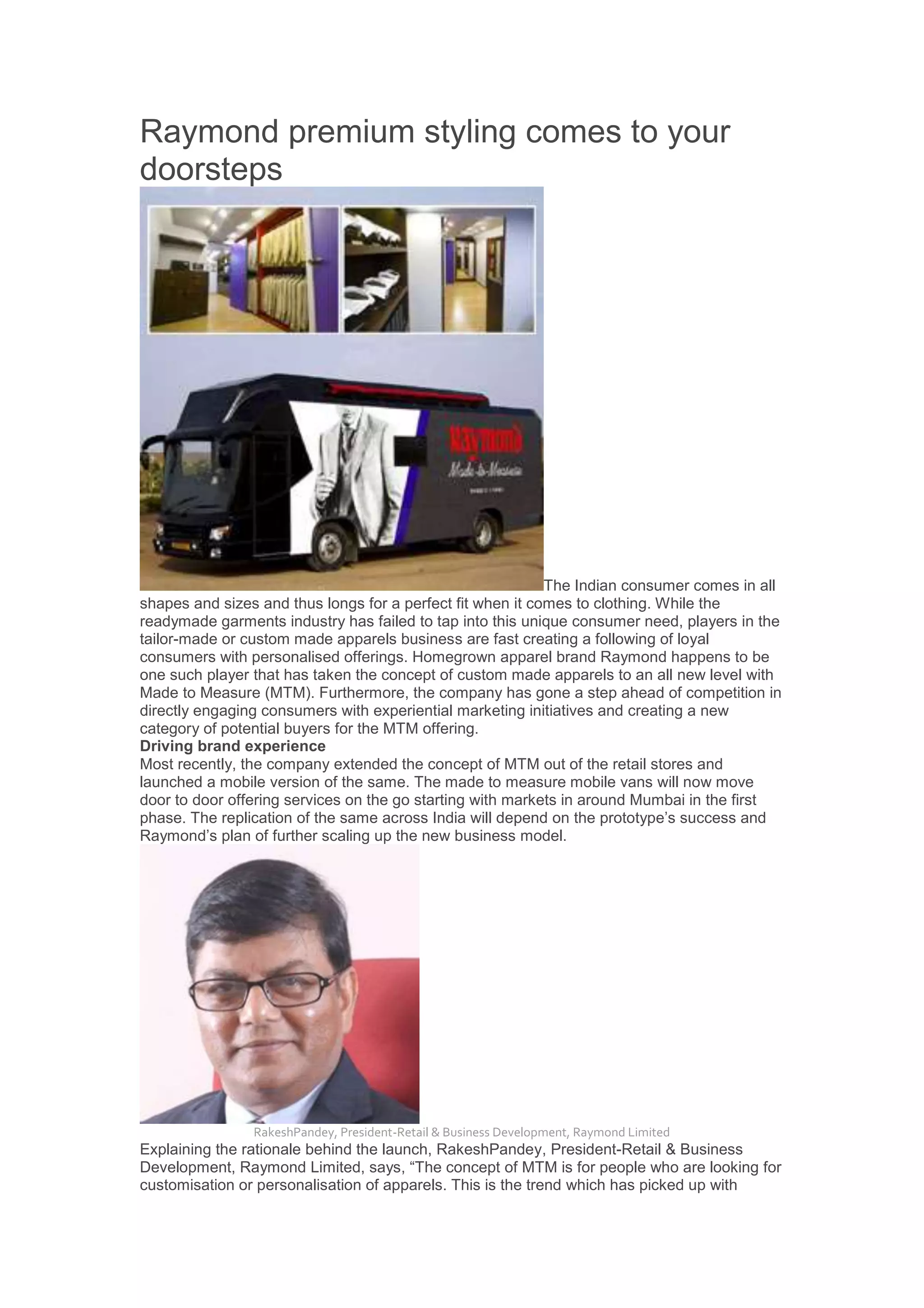
Most recently, the company extended the concept of MTM out of the retail stores and
launched a mobile version of the same. The made to measure mobile vans will now move
door to door offering services on the go starting with markets in around Mumbai in the first
phase. The replication of the same across India will depend on the prototype‟s success and
Raymond‟s plan of further scaling up the new business model.


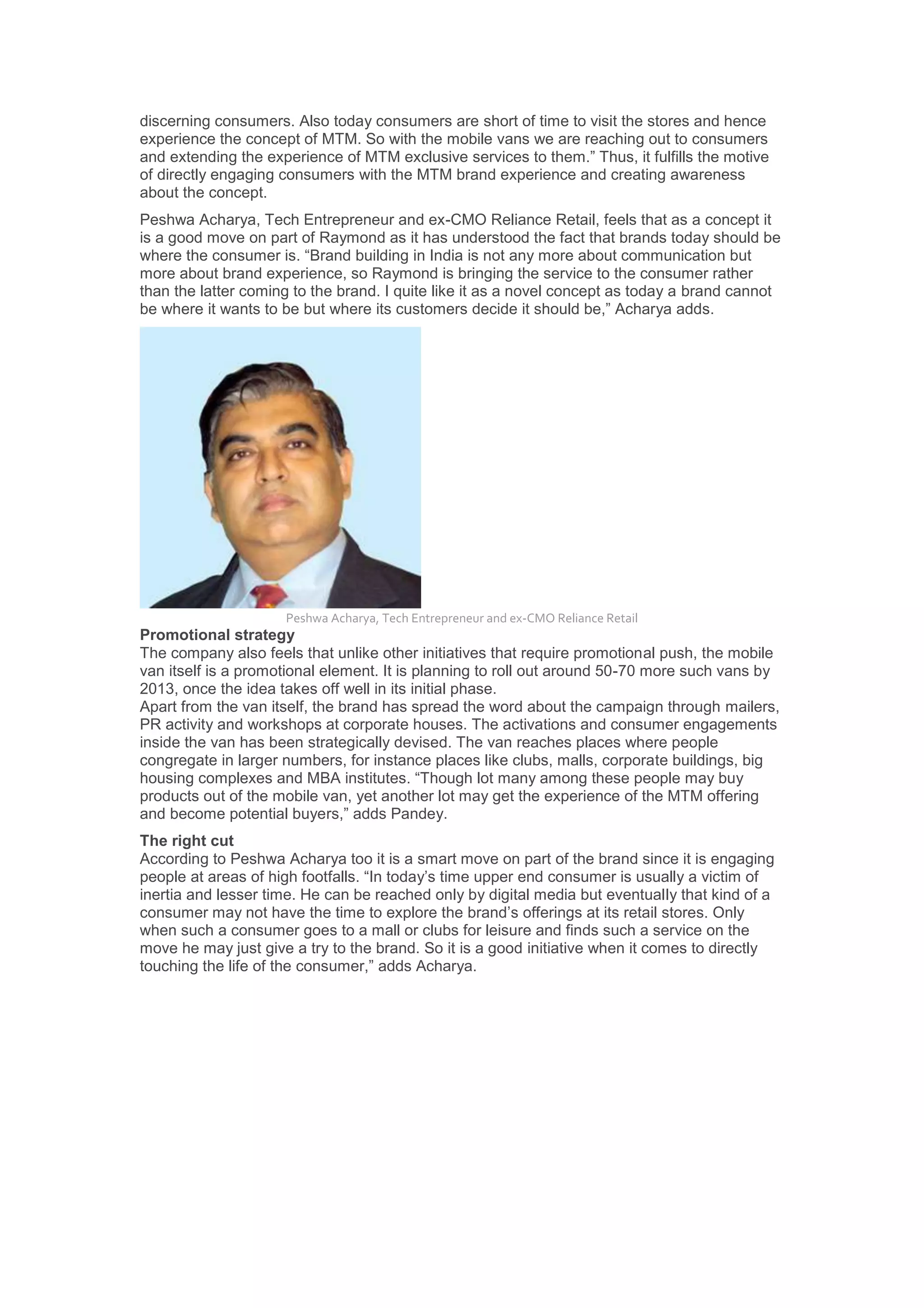
                RakeshPandey, President-Retail & Business Development, Raymond Limited
Explaining the rationale behind the launch, RakeshPandey, President-Retail & Business
Development, Raymond Limited, says, “The concept of MTM is for people who are looking for
customisation or personalisation of apparels. This is the trend which has picked up with
discerning consumers. Also today consumers are short of time to visit the stores and hence
experience the concept of MTM. So with the mobile vans we are reaching out to consumers
and extending the experience of MTM exclusive services to them.” Thus, it fulfills the motive
of directly engaging consumers with the MTM brand experience and creating awareness
about the concept.
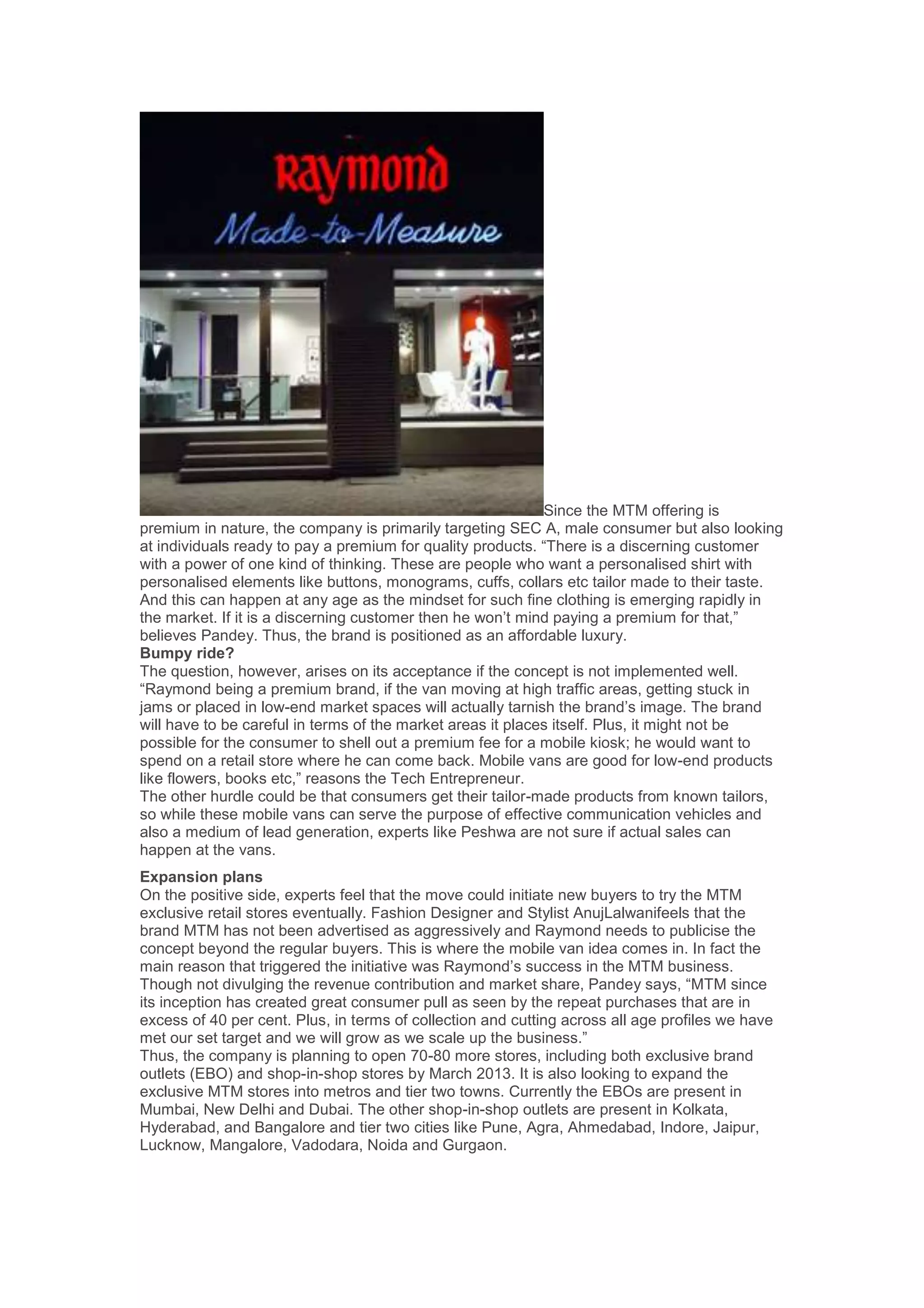
Peshwa Acharya, Tech Entrepreneur and ex-CMO Reliance Retail, feels that as a concept it
is a good move on part of Raymond as it has understood the fact that brands today should be
where the consumer is. “Brand building in India is not any more about communication but
more about brand experience, so Raymond is bringing the service to the consumer rather
than the latter coming to the brand. I quite like it as a novel concept as today a brand cannot
be where it wants to be but where its customers decide it should be,” Acharya adds.


                     Peshwa Acharya, Tech Entrepreneur and ex-CMO Reliance Retail
Promotional strategy
The company also feels that unlike other initiatives that require promotional push, the mobile
van itself is a promotional element. It is planning to roll out around 50-70 more such vans by
2013, once the idea takes off well in its initial phase.
Apart from the van itself, the brand has spread the word about the campaign through mailers,
PR activity and workshops at corporate houses. The activations and consumer engagements
inside the van has been strategically devised. The van reaches places where people
congregate in larger numbers, for instance places like clubs, malls, corporate buildings, big
housing complexes and MBA institutes. “Though lot many among these people may buy
products out of the mobile van, yet another lot may get the experience of the MTM offering
and become potential buyers,” adds Pandey.
The right cut
According to Peshwa Acharya too it is a smart move on part of the brand since it is engaging
people at areas of high footfalls. “In today‟s time upper end consumer is usually a victim of
inertia and lesser time. He can be reached only by digital media but eventually that kind of a
consumer may not have the time to explore the brand‟s offerings at its retail stores. Only
when such a consumer goes to a mall or clubs for leisure and finds such a service on the
move he may just give a try to the brand. So it is a good initiative when it comes to directly
touching the life of the consumer,” adds Acharya.
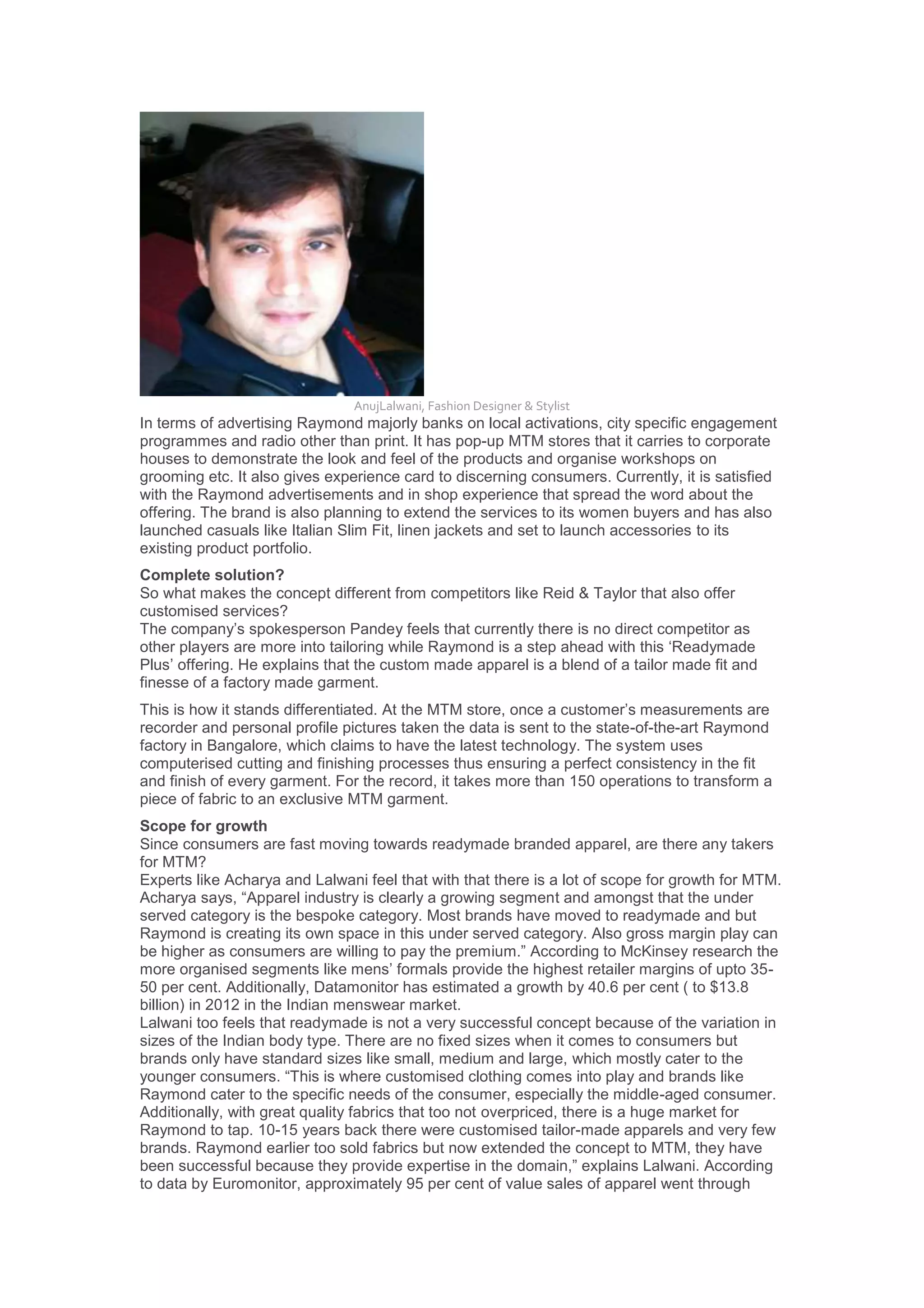
Since the MTM offering is
premium in nature, the company is primarily targeting SEC A, male consumer but also looking
at individuals ready to pay a premium for quality products. “There is a discerning customer
with a power of one kind of thinking. These are people who want a personalised shirt with
personalised elements like buttons, monograms, cuffs, collars etc tailor made to their taste.
And this can happen at any age as the mindset for such fine clothing is emerging rapidly in
the market. If it is a discerning customer then he won‟t mind paying a premium for that,”
believes Pandey. Thus, the brand is positioned as an affordable luxury.
Bumpy ride?
The question, however, arises on its acceptance if the concept is not implemented well.
“Raymond being a premium brand, if the van moving at high traffic areas, getting stuck in
jams or placed in low-end market spaces will actually tarnish the brand‟s image. The brand
will have to be careful in terms of the market areas it places itself. Plus, it might not be
possible for the consumer to shell out a premium fee for a mobile kiosk; he would want to
spend on a retail store where he can come back. Mobile vans are good for low-end products
like flowers, books etc,” reasons the Tech Entrepreneur.
The other hurdle could be that consumers get their tailor-made products from known tailors,
so while these mobile vans can serve the purpose of effective communication vehicles and
also a medium of lead generation, experts like Peshwa are not sure if actual sales can
happen at the vans.
Expansion plans
On the positive side, experts feel that the move could initiate new buyers to try the MTM
exclusive retail stores eventually. Fashion Designer and Stylist AnujLalwanifeels that the
brand MTM has not been advertised as aggressively and Raymond needs to publicise the
concept beyond the regular buyers. This is where the mobile van idea comes in. In fact the
main reason that triggered the initiative was Raymond‟s success in the MTM business.
Though not divulging the revenue contribution and market share, Pandey says, “MTM since
its inception has created great consumer pull as seen by the repeat purchases that are in
excess of 40 per cent. Plus, in terms of collection and cutting across all age profiles we have
met our set target and we will grow as we scale up the business.”
Thus, the company is planning to open 70-80 more stores, including both exclusive brand
outlets (EBO) and shop-in-shop stores by March 2013. It is also looking to expand the
exclusive MTM stores into metros and tier two towns. Currently the EBOs are present in
Mumbai, New Delhi and Dubai. The other shop-in-shop outlets are present in Kolkata,
Hyderabad, and Bangalore and tier two cities like Pune, Agra, Ahmedabad, Indore, Jaipur,
Lucknow, Mangalore, Vadodara, Noida and Gurgaon.
AnujLalwani, Fashion Designer & Stylist
In terms of advertising Raymond majorly banks on local activations, city specific engagement
programmes and radio other than print. It has pop-up MTM stores that it carries to corporate
houses to demonstrate the look and feel of the products and organise workshops on
grooming etc. It also gives experience card to discerning consumers. Currently, it is satisfied
with the Raymond advertisements and in shop experience that spread the word about the
offering. The brand is also planning to extend the services to its women buyers and has also
launched casuals like Italian Slim Fit, linen jackets and set to launch accessories to its
existing product portfolio.
Complete solution?
So what makes the concept different from competitors like Reid & Taylor that also offer
customised services?
The company‟s spokesperson Pandey feels that currently there is no direct competitor as
other players are more into tailoring while Raymond is a step ahead with this „Readymade
Plus‟ offering. He explains that the custom made apparel is a blend of a tailor made fit and
finesse of a factory made garment.
This is how it stands differentiated. At the MTM store, once a customer‟s measurements are
recorder and personal profile pictures taken the data is sent to the state-of-the-art Raymond
factory in Bangalore, which claims to have the latest technology. The system uses
computerised cutting and finishing processes thus ensuring a perfect consistency in the fit
and finish of every garment. For the record, it takes more than 150 operations to transform a
piece of fabric to an exclusive MTM garment.
Scope for growth
Since consumers are fast moving towards readymade branded apparel, are there any takers
for MTM?
Experts like Acharya and Lalwani feel that with that there is a lot of scope for growth for MTM.
Acharya says, “Apparel industry is clearly a growing segment and amongst that the under
served category is the bespoke category. Most brands have moved to readymade and but
Raymond is creating its own space in this under served category. Also gross margin play can
be higher as consumers are willing to pay the premium.” According to McKinsey research the
more organised segments like mens‟ formals provide the highest retailer margins of upto 35-
50 per cent. Additionally, Datamonitor has estimated a growth by 40.6 per cent ( to $13.8
billion) in 2012 in the Indian menswear market.
Lalwani too feels that readymade is not a very successful concept because of the variation in
sizes of the Indian body type. There are no fixed sizes when it comes to consumers but
brands only have standard sizes like small, medium and large, which mostly cater to the
younger consumers. “This is where customised clothing comes into play and brands like
Raymond cater to the specific needs of the consumer, especially the middle-aged consumer.
Additionally, with great quality fabrics that too not overpriced, there is a huge market for
Raymond to tap. 10-15 years back there were customised tailor-made apparels and very few
brands. Raymond earlier too sold fabrics but now extended the concept to MTM, they have
been successful because they provide expertise in the domain,” explains Lalwani. According
to data by Euromonitor, approximately 95 per cent of value sales of apparel went through
clothing and footwear specialist retailers in 2011, with exclusive brand outlets and specialist
clothing stores the main channel for consumers to shop for apparel.
However, while the company may think it has no direct competition the fashion stylist feels
that it may come from young designers if not from corporate brands. On the other hand,
Acharya feels that Reliance trends and all the other local dealers/shops/ outlets in each city
like Ghulam Mohammed in Kolkata, are its major competitors.

New ways of reaching consumers

  • 1.
    Raymond premium stylingcomes to your doorsteps The Indian consumer comes in all shapes and sizes and thus longs for a perfect fit when it comes to clothing. While the readymade garments industry has failed to tap into this unique consumer need, players in the tailor-made or custom made apparels business are fast creating a following of loyal consumers with personalised offerings. Homegrown apparel brand Raymond happens to be one such player that has taken the concept of custom made apparels to an all new level with Made to Measure (MTM). Furthermore, the company has gone a step ahead of competition in directly engaging consumers with experiential marketing initiatives and creating a new category of potential buyers for the MTM offering. Driving brand experience Most recently, the company extended the concept of MTM out of the retail stores and launched a mobile version of the same. The made to measure mobile vans will now move door to door offering services on the go starting with markets in around Mumbai in the first phase. The replication of the same across India will depend on the prototype‟s success and Raymond‟s plan of further scaling up the new business model. RakeshPandey, President-Retail & Business Development, Raymond Limited Explaining the rationale behind the launch, RakeshPandey, President-Retail & Business Development, Raymond Limited, says, “The concept of MTM is for people who are looking for customisation or personalisation of apparels. This is the trend which has picked up with
  • 2.
    discerning consumers. Alsotoday consumers are short of time to visit the stores and hence experience the concept of MTM. So with the mobile vans we are reaching out to consumers and extending the experience of MTM exclusive services to them.” Thus, it fulfills the motive of directly engaging consumers with the MTM brand experience and creating awareness about the concept. Peshwa Acharya, Tech Entrepreneur and ex-CMO Reliance Retail, feels that as a concept it is a good move on part of Raymond as it has understood the fact that brands today should be where the consumer is. “Brand building in India is not any more about communication but more about brand experience, so Raymond is bringing the service to the consumer rather than the latter coming to the brand. I quite like it as a novel concept as today a brand cannot be where it wants to be but where its customers decide it should be,” Acharya adds. Peshwa Acharya, Tech Entrepreneur and ex-CMO Reliance Retail Promotional strategy The company also feels that unlike other initiatives that require promotional push, the mobile van itself is a promotional element. It is planning to roll out around 50-70 more such vans by 2013, once the idea takes off well in its initial phase. Apart from the van itself, the brand has spread the word about the campaign through mailers, PR activity and workshops at corporate houses. The activations and consumer engagements inside the van has been strategically devised. The van reaches places where people congregate in larger numbers, for instance places like clubs, malls, corporate buildings, big housing complexes and MBA institutes. “Though lot many among these people may buy products out of the mobile van, yet another lot may get the experience of the MTM offering and become potential buyers,” adds Pandey. The right cut According to Peshwa Acharya too it is a smart move on part of the brand since it is engaging people at areas of high footfalls. “In today‟s time upper end consumer is usually a victim of inertia and lesser time. He can be reached only by digital media but eventually that kind of a consumer may not have the time to explore the brand‟s offerings at its retail stores. Only when such a consumer goes to a mall or clubs for leisure and finds such a service on the move he may just give a try to the brand. So it is a good initiative when it comes to directly touching the life of the consumer,” adds Acharya.
  • 3.
    Since the MTMoffering is premium in nature, the company is primarily targeting SEC A, male consumer but also looking at individuals ready to pay a premium for quality products. “There is a discerning customer with a power of one kind of thinking. These are people who want a personalised shirt with personalised elements like buttons, monograms, cuffs, collars etc tailor made to their taste. And this can happen at any age as the mindset for such fine clothing is emerging rapidly in the market. If it is a discerning customer then he won‟t mind paying a premium for that,” believes Pandey. Thus, the brand is positioned as an affordable luxury. Bumpy ride? The question, however, arises on its acceptance if the concept is not implemented well. “Raymond being a premium brand, if the van moving at high traffic areas, getting stuck in jams or placed in low-end market spaces will actually tarnish the brand‟s image. The brand will have to be careful in terms of the market areas it places itself. Plus, it might not be possible for the consumer to shell out a premium fee for a mobile kiosk; he would want to spend on a retail store where he can come back. Mobile vans are good for low-end products like flowers, books etc,” reasons the Tech Entrepreneur. The other hurdle could be that consumers get their tailor-made products from known tailors, so while these mobile vans can serve the purpose of effective communication vehicles and also a medium of lead generation, experts like Peshwa are not sure if actual sales can happen at the vans. Expansion plans On the positive side, experts feel that the move could initiate new buyers to try the MTM exclusive retail stores eventually. Fashion Designer and Stylist AnujLalwanifeels that the brand MTM has not been advertised as aggressively and Raymond needs to publicise the concept beyond the regular buyers. This is where the mobile van idea comes in. In fact the main reason that triggered the initiative was Raymond‟s success in the MTM business. Though not divulging the revenue contribution and market share, Pandey says, “MTM since its inception has created great consumer pull as seen by the repeat purchases that are in excess of 40 per cent. Plus, in terms of collection and cutting across all age profiles we have met our set target and we will grow as we scale up the business.” Thus, the company is planning to open 70-80 more stores, including both exclusive brand outlets (EBO) and shop-in-shop stores by March 2013. It is also looking to expand the exclusive MTM stores into metros and tier two towns. Currently the EBOs are present in Mumbai, New Delhi and Dubai. The other shop-in-shop outlets are present in Kolkata, Hyderabad, and Bangalore and tier two cities like Pune, Agra, Ahmedabad, Indore, Jaipur, Lucknow, Mangalore, Vadodara, Noida and Gurgaon.
  • 4.
    AnujLalwani, Fashion Designer& Stylist In terms of advertising Raymond majorly banks on local activations, city specific engagement programmes and radio other than print. It has pop-up MTM stores that it carries to corporate houses to demonstrate the look and feel of the products and organise workshops on grooming etc. It also gives experience card to discerning consumers. Currently, it is satisfied with the Raymond advertisements and in shop experience that spread the word about the offering. The brand is also planning to extend the services to its women buyers and has also launched casuals like Italian Slim Fit, linen jackets and set to launch accessories to its existing product portfolio. Complete solution? So what makes the concept different from competitors like Reid & Taylor that also offer customised services? The company‟s spokesperson Pandey feels that currently there is no direct competitor as other players are more into tailoring while Raymond is a step ahead with this „Readymade Plus‟ offering. He explains that the custom made apparel is a blend of a tailor made fit and finesse of a factory made garment. This is how it stands differentiated. At the MTM store, once a customer‟s measurements are recorder and personal profile pictures taken the data is sent to the state-of-the-art Raymond factory in Bangalore, which claims to have the latest technology. The system uses computerised cutting and finishing processes thus ensuring a perfect consistency in the fit and finish of every garment. For the record, it takes more than 150 operations to transform a piece of fabric to an exclusive MTM garment. Scope for growth Since consumers are fast moving towards readymade branded apparel, are there any takers for MTM? Experts like Acharya and Lalwani feel that with that there is a lot of scope for growth for MTM. Acharya says, “Apparel industry is clearly a growing segment and amongst that the under served category is the bespoke category. Most brands have moved to readymade and but Raymond is creating its own space in this under served category. Also gross margin play can be higher as consumers are willing to pay the premium.” According to McKinsey research the more organised segments like mens‟ formals provide the highest retailer margins of upto 35- 50 per cent. Additionally, Datamonitor has estimated a growth by 40.6 per cent ( to $13.8 billion) in 2012 in the Indian menswear market. Lalwani too feels that readymade is not a very successful concept because of the variation in sizes of the Indian body type. There are no fixed sizes when it comes to consumers but brands only have standard sizes like small, medium and large, which mostly cater to the younger consumers. “This is where customised clothing comes into play and brands like Raymond cater to the specific needs of the consumer, especially the middle-aged consumer. Additionally, with great quality fabrics that too not overpriced, there is a huge market for Raymond to tap. 10-15 years back there were customised tailor-made apparels and very few brands. Raymond earlier too sold fabrics but now extended the concept to MTM, they have been successful because they provide expertise in the domain,” explains Lalwani. According to data by Euromonitor, approximately 95 per cent of value sales of apparel went through
  • 5.
    clothing and footwearspecialist retailers in 2011, with exclusive brand outlets and specialist clothing stores the main channel for consumers to shop for apparel. However, while the company may think it has no direct competition the fashion stylist feels that it may come from young designers if not from corporate brands. On the other hand, Acharya feels that Reliance trends and all the other local dealers/shops/ outlets in each city like Ghulam Mohammed in Kolkata, are its major competitors.