Semeste
r Project
Submitted By:
Deepanshu Bhatia
MBA-3
UID-2019-1106-0001-
0005
SECTOR
INFORMATION• India’s textiles sector is one of the oldest industries in Indian economy dating back several centuries.
India's overall textile exports during FY 2017-18 stood at US$ 39.2 billion in FY18 and is expected to
increase to US$ 82.00 billion by 2021 from US$ 31.65 billion in FY19 (up to Jan 19).
• The Indian Textile & apparel industry is one of the largest in the world. The apparel
industry contributes for 5% of the country's Gross Domestic Product (GDP).
• Worldwide Textile & Apparel Industry Contribution to the World Economy is 2%.
22%
36%
42%
Indian Apparael Industry Segmentation
Childern wear Menswear Womenswear
CONT
.
• The Indian textile and apparel market was worth US$ 102.2 Billion in 2018. The market is further projected to reach
US$ 225.7 Billion by 2024, growing at a CAGR of 14.2% during 2019-2024.
• Today, the textile and apparel market has become a vital contributor to the Indian economy. This can be attributed to
the abundant availability of raw materials used for manufacturing apparel such as cotton, silk, wool, etc
0
5
10
15
20
25
30
2005 2006 2007 2008 2009
India's textile market size (US$
Billion)
CAGR-8.7%
18
22
24
26
28
2005 2006 2007 2008 2009
$Billion
Year
Growth of Indian Apparel Retail
Industry
REASONS FOR GROWTH:
Robust Demand: Rise in income levels is expected to drive demand in textile industry. Growth in building
and construction will continue to raise demand for non-clothing textiles.
Competitive Advantage: India has an abundant availability of raw materials such as cotton, wool, silk and
jute. It also enjoys a competitive advantage in terms of skilled manpower and in cost of production.
Policy Support: 100 percent FDI (automatic route) is allowed in the Indian textile sector. To boost exports,
free trade with ASEAN is allowed.
Increasing Investments: Huge investments are being made by Government under scheme for Integrated
Textile Parks (SITP) and Technology Upgradation Fund Scheme to encourage more private equity and to
train workforce.
Supplier
Power –
Low
Threat of New
Entry –
Moderate
Competitive
Rivalry –
Low to
Moderate
Threat of
Substitution
-
Moder
ate
Buyer
Power - Low
PORTER’S 5
FORCES MODEL
• High demand for apparels and
home textiles in Us and India
markets.
• Product differences and brand
identity are quite high.
• Buyer concentration is very low.
• Buyer volume is generally low.
• Buyer information is high.
Threat of Substitutes (Moderate)
• Low barriers in the domestic market.
• Economies of scale are high.
• Brand identity of a company in this industry is high.
Threat of New Entrants (Moderate)
Buyer Power (Low)
• Fixed costs are high in this
industry.
• Product differences are high.
• Brand identity is high.
• Exit barriers are also high for the
national level operations.
• High availability of cotton.
• Low cost of labour.
• Differentiation of input is pretty low.
• Presence of substitute inputs to
cotton like polyester ,wool, lycra etc
are present.
• Importance of volume to suppliers is
very high.
•
• Competition from low cost producing nations like
• Pakistan and Bangladesh.
• The threat of substitution from the garments provided by the
unorganized sector is high.
Bargaining Power of Supplier (Low) Rivalry Competition (Low-Mod)
Porter’s
5
Forces
COMPANY
OVERVIEW• ITC Limited is an Indian multinational conglomerate company
headquartered in Kolkata, West Bengal.
• Established in 1910 as the 'Imperial Tobacco Company of India Limited',
the company was renamed as the 'India Tobacco Company Limited' in 1970
and later to 'I.T.C. Limited' in 1974.
• ITC is one of India's foremost private sector companies and a diversified
conglomerate with businesses spanning Fast Moving Consumer Goods,
Hotels, Paperboards and Packaging, Agri Business and Information
Technology.
• The Company is acknowledged as one of India's most valuable business
corporations with a market capitalization of around US$ 50 billion and a
gross sales value of nearly US$ 10.8 billion. ITC was ranked as India's most
admired company, according to a survey conducted by Fortune India, in
association with Hay Group.
SWOT ANALYSIS
Strengths
1. ITC has a strong and experienced management
2. Strong brand presence, excellent products advertising
3. Diversified product and services portfolio which includes FMCG, Hotel chains, paper &
packaging and agri-business
Weakness
1. ITC is still dependent on its tobacco revenues and people have cheaper substitutes and
other brands
2.Hotel industry has not been able to create a huge market share
Opportunity
1. Tap rural markets and increase penetration in urban areas
2. Mergers and acquisitions to strengthen the brand
3. Increasing purchasing power of people thereby increasing demand
4. More publicity of hotel chains to increase market share
Threat
1. Strict govt regulations and policies regarding cigarettes
2. Intense and increasing competition amongst other FMCG companies and hotel chains
3. FDI in retail thereby allowing international brands
PRODUCT
PROFILE
COMPANY
NEWS• “Reliance Industries Ltd said on 29 March 2019 its unit Reliance Retail Ltd (RRL) has acquired consumer goods company
ITC Ltd's menswear brand John Players.”
• ITC to invest Rs 700 cr in food park in Madhya Pradesh:The company also said the land for the proposed food
processing unit is already with the company and it will soon commence operations.
• ITC Ltd posts highest-ever quarterly profit in July-Sept quarter: with standalone net profit growing by a record 36.2% at
Rs 4023.1 crore due to fall in tax expenses and tax credit.
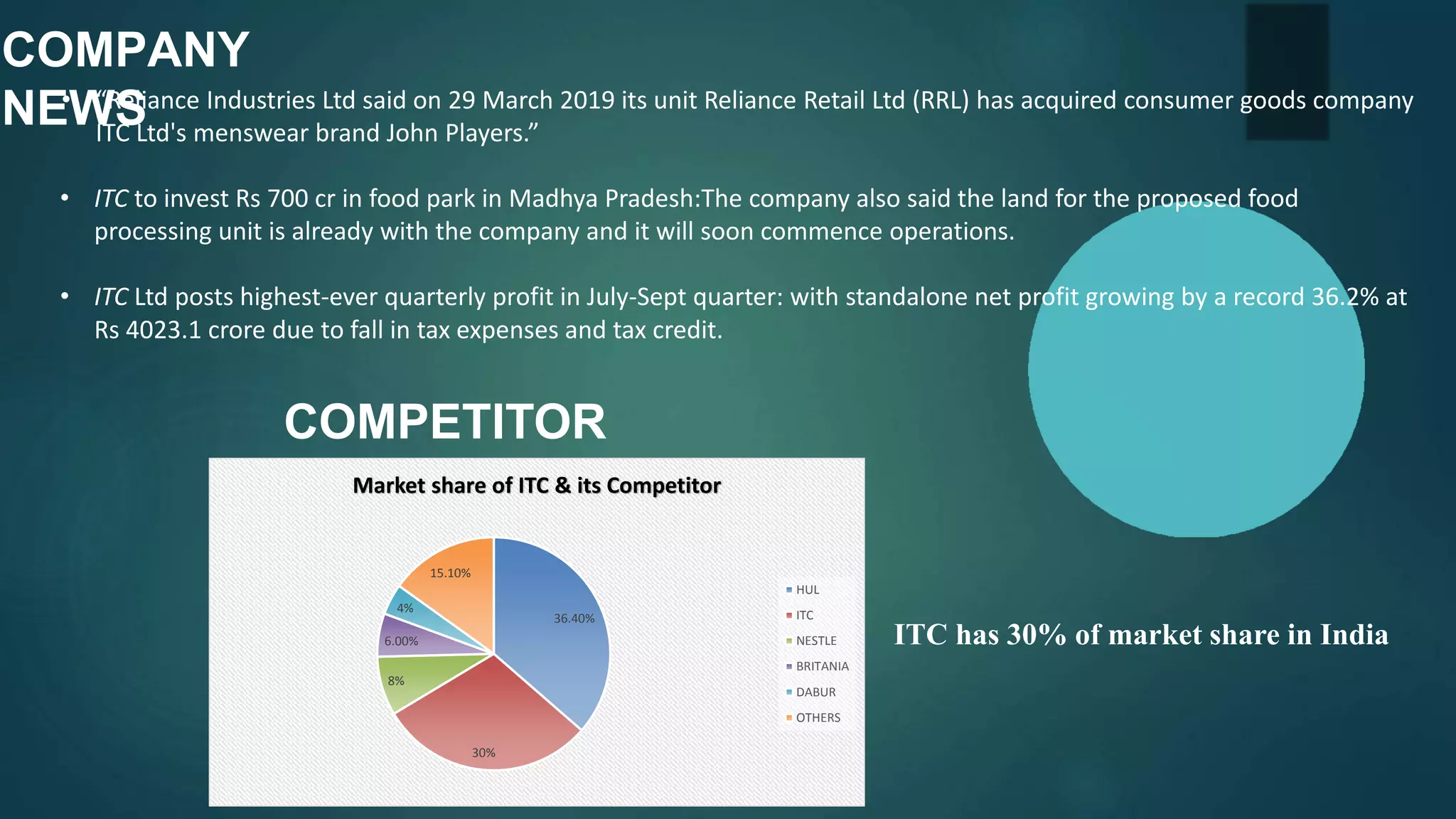
COMPETITOR
ANALYSIS
36.40%
30%
8%
6.00%
4%
15.10%
Market share of ITC & its Competitor
HUL
ITC
NESTLE
BRITANIA
DABUR
OTHERS
ITC has 30% of market share in India
PRODUCT
INFORMATION
• ITC has already soft launched the John Players range in India in Bangalore. AV Birla group's Peter
England is the largest selling mid-priced apparel brand in India. ITC created its lifestyle retailing
business division with the launch of Wills Sport apparel brand in 2000.
• John Players offers a complete fashion wardrobe to the male youth of today. The brand stands for style,
charisma and attitude and brings them into your wardrobe with its vibrant yet relaxed collection.
• Incorporating the most contemporary trends with a splash of youthful energy, playful styling & trendy
collections, John Players knows the pulse of the youth and offers clothing for the discerning youth.
• John Players offers complete range in men's apparel with the coolness quotient being an inseparable part
of its genes. Offering vibrant wardrobe essentials spanning across Formal wear, Casual wear, Party wear,
Jeans & Accessories, John Players has everything that appeals to the new generation.
• Loyalty of employees due to decentralization
• Being MNC company, it has ability to attract large customers as compared to local companies
• Owns 550 stores across 200 cities in India and overseas.
• Strong R&D for product innovations like dress shirts, shirting's, jeans wear, tailored clothing.
• Loyalty of customers and high product quality
Strengths
• Weak supply chain management
• Inconsistent execution
• Switching cost is low for customers since Indian and international firms offers large to customers
• Global penetration is limited as compared to other international brands.
Weaknesses
• Special offers for corporates and business institutions
• Global expansion would give more opportunity for brand to grow
• Collaboration with foreign players because of a national brand
Opportunities
• Changing rules and regulations in the fabric industry
• Increase in competition in domestic market due to large number of formal wearbrands coming up
• Regional trade alliances – All major players in the industry are competing with eachother not only on
low price but better quality.
• Increase in social and ecological awareness, company will be in constant pressure to follow labor laws and
environmental laws.
Threats
SWOT Analysis of JOHN PLAYERS
MARKETING MIX OF JOHN PLAYERS
PRODUCT:
John players is product of ITC Ltd. This product have these variables :-
• Quality: - ITC is always been famous for their best quality delivering. So, we will continue this believe of customer with our new
product.
• Features: - Features of a product could give a competitive edge to our product.
• Some of the features of our watches could be.
• Excellent Style
• Trendy colours
• Brand name: - Brand name is the most essential part of any new product. John Players is a well-known brand in Life style
Retailing.
PRICE:
• The price of john players will be according to target market Middle income group
• List price: - List price of product is in two different ranges-
• 800-1500
• 1500-3000
• 3000-10000 & Depending upon customer choice
PLACE:
• The place will include various aspects like :-
• The place of manufacturing.
• The place for warehouse.
• The place for showcasing.
• The place for online (Amazon, Myntra etc.)
• It should also be easily available to the distribution channels-
MANUFACTURERS
CONSUMERS DISTRIBUTORS
SHOWROOM
PROMOTION:
Promotion is the way to communicate a product to the prospective buyers. For our product, SO
different aspects for promotion strategies.
CRITERIA FOR PROMOTION -
• Awareness
• Knowledge
• Preference
• Purchasing
• Liking
MAIN SOURCE OF PROMOTION
• Electronic media
• Print media
• Bill boards
• Hoardings
• SOCIAL MEDIA
• DIRECT & Indirect Marketing
SegmentingTargeting
Positi
oning
Geographic Demographic Behavioural
 India
 Urban
 Metro Cities
 Tier I
 Sub-urban
 Tier II Cities
 Rural
 Tier III
 Age: 15 and above
 Gender: Unisex
 Income: ₹20,000/-
month and above
 Education: Any
 Occupation: Any
 Frequency of
Buying: Once a
week (Depends)
 Usage Rate: Daily
 Attitude towards
Product: Positive
 Loyalty Status:
Medium
Targeting:
All those Outgoing, readiness to try new products, brand-conscious middle & upper-middle income level people
in Indian Tier I metro cities and Tier II cities especially males.
Positioning:
John Players is positioned as a brand with a cool attitude. It is positioned as " Style with a Playful Side"
exemplified in its tagline " Play It Cool".
Product Life
Cycle• JOHN PLAYERS is in the Maturity stage.
Introduction Growth Maturity Decline
• A slowdown in sales growth because the product has achieved acceptance
by most potential buyers.
• Profits stabilize/ decline because of increased competition.
Sales
Costs
Profits
Marketing Objectives
Product
Price
Peak sales
Low cost per customer
High profits
Maximize profit while defending
market share
Diversify brand and models
Price to match or best
competitors
Distribution Build more intensive distribution
Advertising Stress brand differences and
benefits
JOHN PLAYERS AT MATURITY STAGE OF PLC
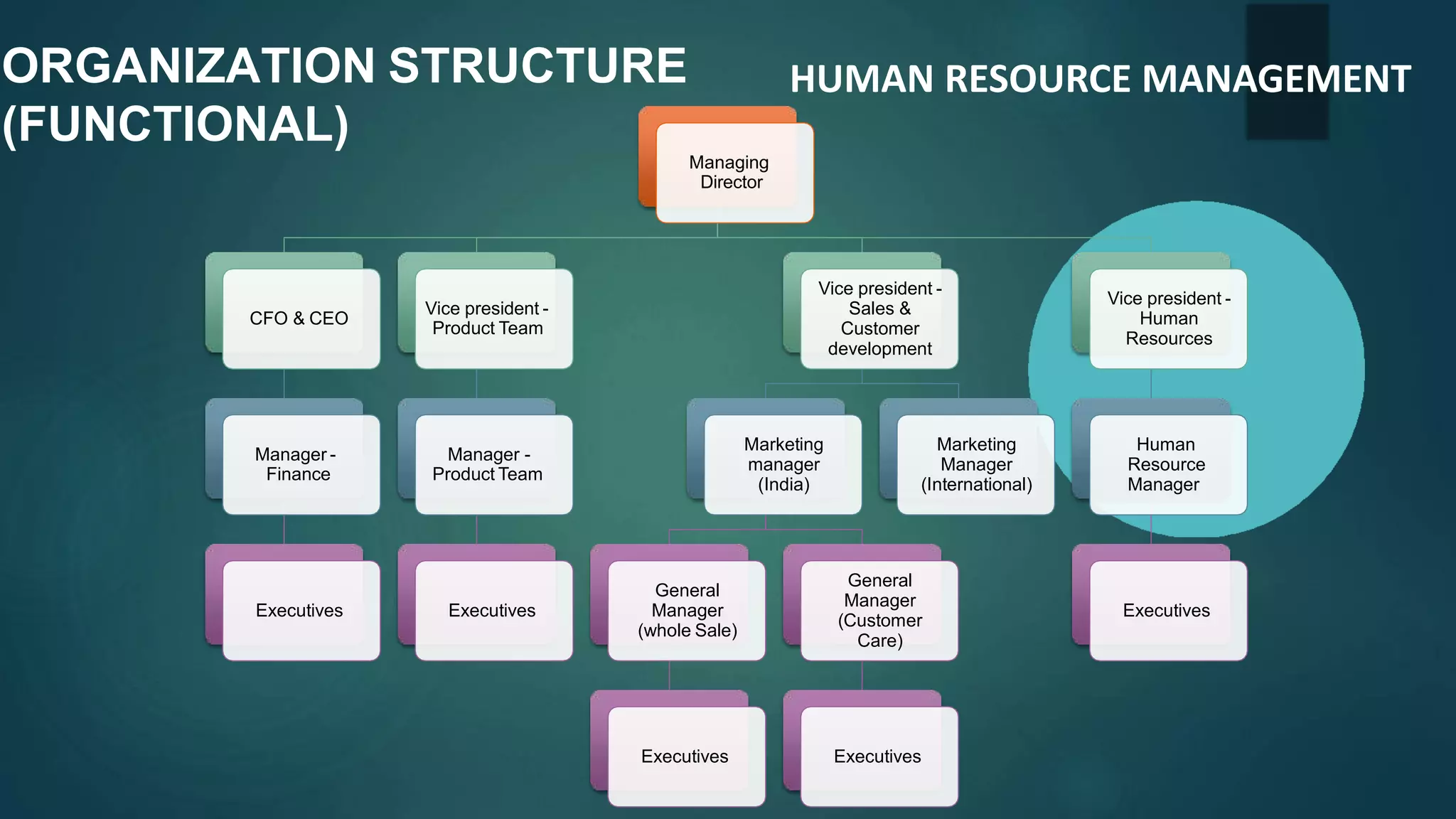
ORGANIZATION STRUCTURE
(FUNCTIONAL)
Managing
Director
Vice president -
Human
Resources
Human
Resource
Manager
Executives
Vice president -
Sales &
Customer
development
Marketing
Manager
(International)
Marketing
manager
(India)
General
Manager
(Customer
Care)
Executives
General
Manager
(whole Sale)
Executives
Vice president -
Product Team
Manager -
Product Team
Executives
CFO & CEO
Manager -
Finance
Executives
HUMAN RESOURCE MANAGEMENT
JOB DESCRIPTION & JOB
SPECIFICATION1. Marketing 2. Finance 3. Human Resource
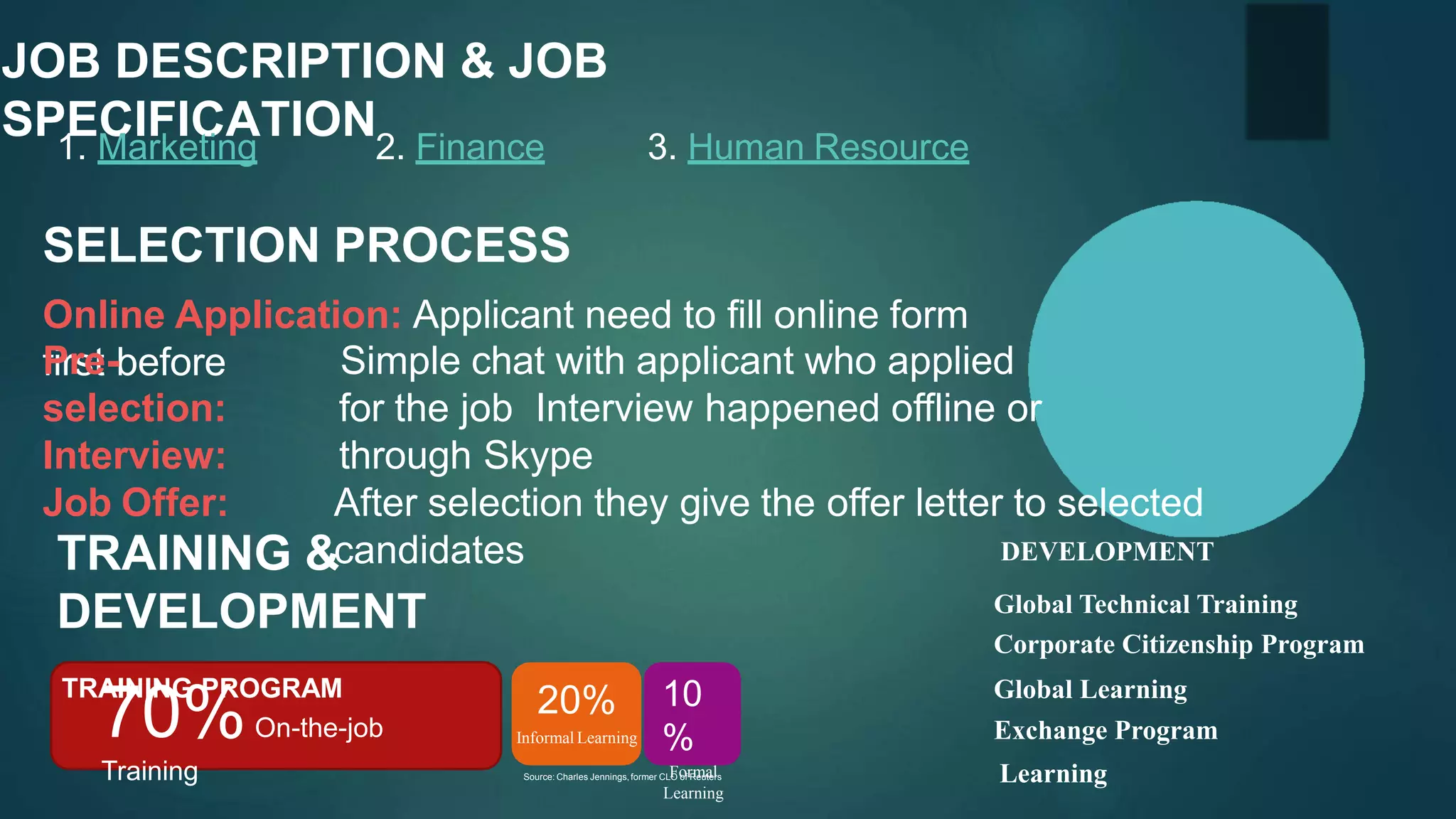
SELECTION PROCESS
Online Application: Applicant need to fill online form
first beforePre-
selection:
Interview:
Job Offer:
Simple chat with applicant who applied
for the job Interview happened offline or
through Skype
After selection they give the offer letter to selected
candidates
70%On-the-job
Training
20%
Informal Learning
10
%
Formal
Learning
Source: Charles Jennings, former CLO of Reuters
TRAINING &
DEVELOPMENT
TRAINING PROGRAM Global Learning
Global Technical Training
Corporate Citizenship Program
Exchange Program
DEVELOPMENT
Learning
PERFORMANCE APPRAISAL
PROGRAM
Recruitment
Learning and
development
Performance
management
Engagement
and
recognition
ORGANIZATION CULTURE (VIEW)
• Great place to work! "Open" environment, nice people and fun brands!
Personally I would like to work there for all of my life
Risk
Management
Compliance
and reporting
CAREER
PLANNING
Separation
/
Retirement
• 360 Degree Appraisal
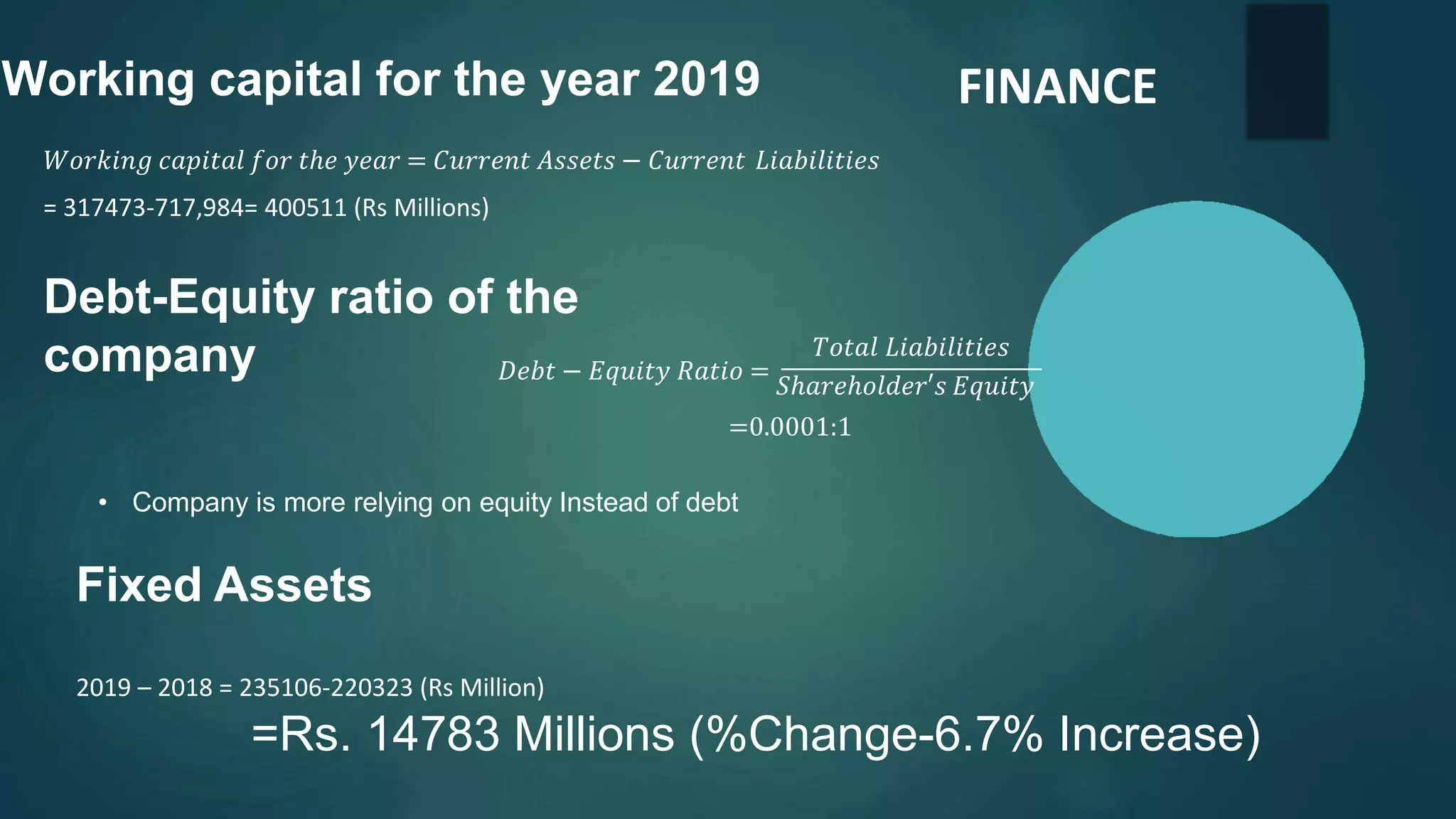
Working capital for the year 2019
𝑊𝑜𝑟𝑘𝑖𝑛𝑔 𝑐𝑎𝑝𝑖𝑡𝑎𝑙 𝑓𝑜𝑟 𝑡ℎ𝑒 𝑦𝑒𝑎𝑟 = 𝐶𝑢𝑟𝑟𝑒𝑛𝑡 𝐴𝑠𝑠𝑒𝑡𝑠 − 𝐶𝑢𝑟𝑟𝑒𝑛𝑡 𝐿𝑖𝑎𝑏𝑖𝑙𝑖𝑡𝑖𝑒𝑠
= 317473-717,984= 400511 (Rs Millions)
Debt-Equity ratio of the
company 𝑇𝑜𝑡𝑎𝑙 𝐿𝑖𝑎𝑏𝑖𝑙𝑖𝑡𝑖𝑒𝑠
𝐷𝑒𝑏𝑡 − 𝐸𝑞𝑢𝑖𝑡𝑦 𝑅𝑎𝑡𝑖𝑜 =
𝑆ℎ𝑎𝑟𝑒ℎ𝑜𝑙𝑑𝑒𝑟′𝑠 𝐸𝑞𝑢𝑖𝑡𝑦
=0.0001:1
• Company is more relying on equity Instead of debt
Fixed Assets
2019 – 2018 = 235106-220323 (Rs Million)
=Rs. 14783 Millions (%Change-6.7% Increase)
FINANCE
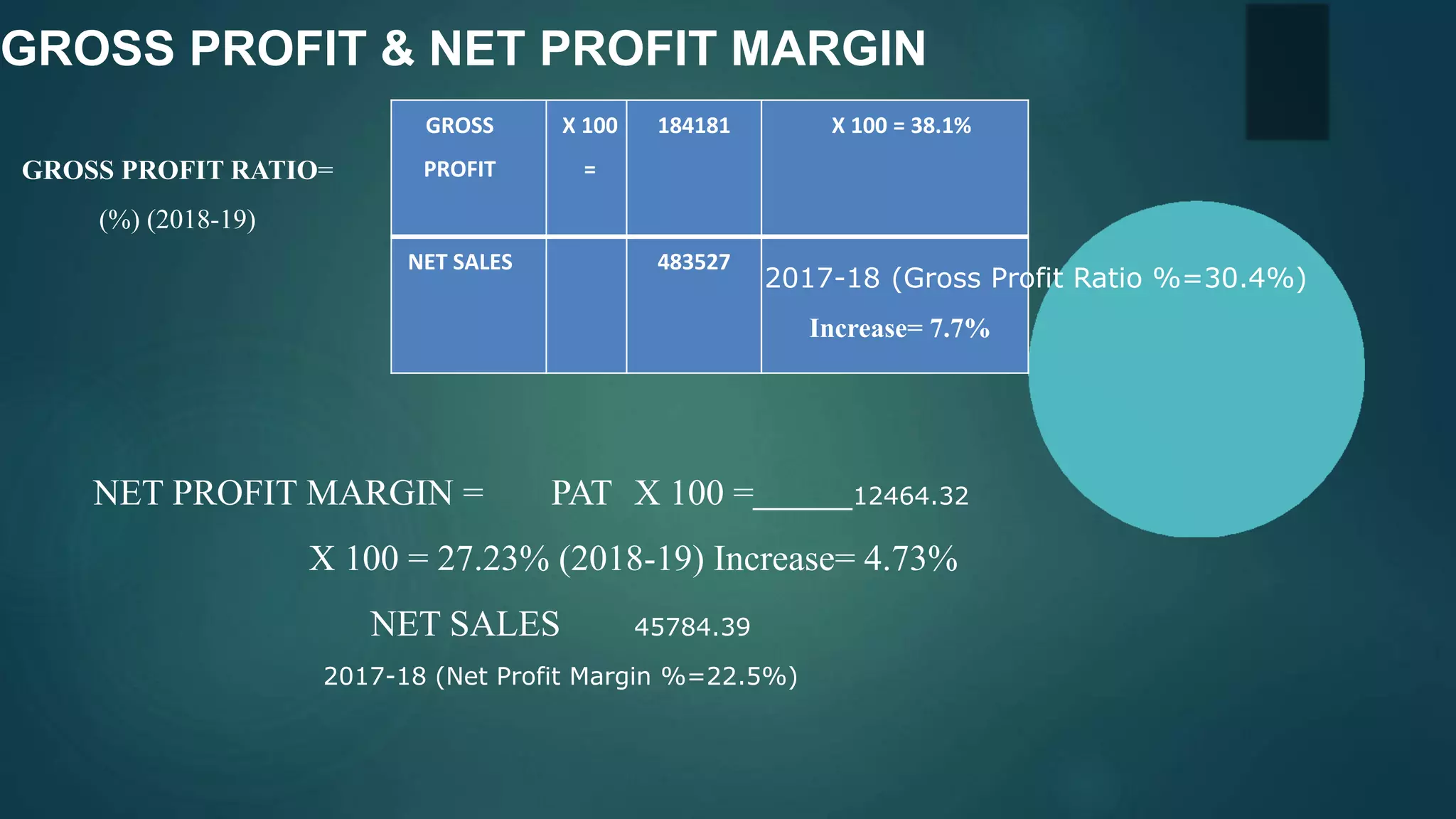
GROSS PROFIT & NET PROFIT MARGIN
GROSS
PROFIT
X 100
=
184181 X 100 = 38.1%
NET SALES 483527
NET PROFIT MARGIN = PAT X 100 = 12464.32
X 100 = 27.23% (2018-19) Increase= 4.73%
NET SALES 45784.39
2017-18 (Net Profit Margin %=22.5%)
GROSS PROFIT RATIO=
(%) (2018-19)
2017-18 (Gross Profit Ratio %=30.4%)
Increase= 7.7%
John players project Presentation

John players project Presentation

  • 1.
    Semeste r Project Submitted By: DeepanshuBhatia MBA-3 UID-2019-1106-0001- 0005
  • 2.
    SECTOR INFORMATION• India’s textilessector is one of the oldest industries in Indian economy dating back several centuries. India's overall textile exports during FY 2017-18 stood at US$ 39.2 billion in FY18 and is expected to increase to US$ 82.00 billion by 2021 from US$ 31.65 billion in FY19 (up to Jan 19). • The Indian Textile & apparel industry is one of the largest in the world. The apparel industry contributes for 5% of the country's Gross Domestic Product (GDP). • Worldwide Textile & Apparel Industry Contribution to the World Economy is 2%. 22% 36% 42% Indian Apparael Industry Segmentation Childern wear Menswear Womenswear
  • 3.
    CONT . • The Indiantextile and apparel market was worth US$ 102.2 Billion in 2018. The market is further projected to reach US$ 225.7 Billion by 2024, growing at a CAGR of 14.2% during 2019-2024. • Today, the textile and apparel market has become a vital contributor to the Indian economy. This can be attributed to the abundant availability of raw materials used for manufacturing apparel such as cotton, silk, wool, etc 0 5 10 15 20 25 30 2005 2006 2007 2008 2009 India's textile market size (US$ Billion) CAGR-8.7% 18 22 24 26 28 2005 2006 2007 2008 2009 $Billion Year Growth of Indian Apparel Retail Industry
  • 4.
    REASONS FOR GROWTH: RobustDemand: Rise in income levels is expected to drive demand in textile industry. Growth in building and construction will continue to raise demand for non-clothing textiles. Competitive Advantage: India has an abundant availability of raw materials such as cotton, wool, silk and jute. It also enjoys a competitive advantage in terms of skilled manpower and in cost of production. Policy Support: 100 percent FDI (automatic route) is allowed in the Indian textile sector. To boost exports, free trade with ASEAN is allowed. Increasing Investments: Huge investments are being made by Government under scheme for Integrated Textile Parks (SITP) and Technology Upgradation Fund Scheme to encourage more private equity and to train workforce.
  • 5.
    Supplier Power – Low Threat ofNew Entry – Moderate Competitive Rivalry – Low to Moderate Threat of Substitution - Moder ate Buyer Power - Low PORTER’S 5 FORCES MODEL
  • 6.
    • High demandfor apparels and home textiles in Us and India markets. • Product differences and brand identity are quite high. • Buyer concentration is very low. • Buyer volume is generally low. • Buyer information is high. Threat of Substitutes (Moderate) • Low barriers in the domestic market. • Economies of scale are high. • Brand identity of a company in this industry is high. Threat of New Entrants (Moderate) Buyer Power (Low) • Fixed costs are high in this industry. • Product differences are high. • Brand identity is high. • Exit barriers are also high for the national level operations. • High availability of cotton. • Low cost of labour. • Differentiation of input is pretty low. • Presence of substitute inputs to cotton like polyester ,wool, lycra etc are present. • Importance of volume to suppliers is very high. • • Competition from low cost producing nations like • Pakistan and Bangladesh. • The threat of substitution from the garments provided by the unorganized sector is high. Bargaining Power of Supplier (Low) Rivalry Competition (Low-Mod) Porter’s 5 Forces
  • 7.
    COMPANY OVERVIEW• ITC Limitedis an Indian multinational conglomerate company headquartered in Kolkata, West Bengal. • Established in 1910 as the 'Imperial Tobacco Company of India Limited', the company was renamed as the 'India Tobacco Company Limited' in 1970 and later to 'I.T.C. Limited' in 1974. • ITC is one of India's foremost private sector companies and a diversified conglomerate with businesses spanning Fast Moving Consumer Goods, Hotels, Paperboards and Packaging, Agri Business and Information Technology. • The Company is acknowledged as one of India's most valuable business corporations with a market capitalization of around US$ 50 billion and a gross sales value of nearly US$ 10.8 billion. ITC was ranked as India's most admired company, according to a survey conducted by Fortune India, in association with Hay Group.
  • 8.
    SWOT ANALYSIS Strengths 1. ITChas a strong and experienced management 2. Strong brand presence, excellent products advertising 3. Diversified product and services portfolio which includes FMCG, Hotel chains, paper & packaging and agri-business Weakness 1. ITC is still dependent on its tobacco revenues and people have cheaper substitutes and other brands 2.Hotel industry has not been able to create a huge market share Opportunity 1. Tap rural markets and increase penetration in urban areas 2. Mergers and acquisitions to strengthen the brand 3. Increasing purchasing power of people thereby increasing demand 4. More publicity of hotel chains to increase market share Threat 1. Strict govt regulations and policies regarding cigarettes 2. Intense and increasing competition amongst other FMCG companies and hotel chains 3. FDI in retail thereby allowing international brands
  • 9.
  • 10.
    COMPANY NEWS• “Reliance IndustriesLtd said on 29 March 2019 its unit Reliance Retail Ltd (RRL) has acquired consumer goods company ITC Ltd's menswear brand John Players.” • ITC to invest Rs 700 cr in food park in Madhya Pradesh:The company also said the land for the proposed food processing unit is already with the company and it will soon commence operations. • ITC Ltd posts highest-ever quarterly profit in July-Sept quarter: with standalone net profit growing by a record 36.2% at Rs 4023.1 crore due to fall in tax expenses and tax credit. COMPETITOR ANALYSIS 36.40% 30% 8% 6.00% 4% 15.10% Market share of ITC & its Competitor HUL ITC NESTLE BRITANIA DABUR OTHERS ITC has 30% of market share in India
  • 11.
    PRODUCT INFORMATION • ITC hasalready soft launched the John Players range in India in Bangalore. AV Birla group's Peter England is the largest selling mid-priced apparel brand in India. ITC created its lifestyle retailing business division with the launch of Wills Sport apparel brand in 2000. • John Players offers a complete fashion wardrobe to the male youth of today. The brand stands for style, charisma and attitude and brings them into your wardrobe with its vibrant yet relaxed collection. • Incorporating the most contemporary trends with a splash of youthful energy, playful styling & trendy collections, John Players knows the pulse of the youth and offers clothing for the discerning youth. • John Players offers complete range in men's apparel with the coolness quotient being an inseparable part of its genes. Offering vibrant wardrobe essentials spanning across Formal wear, Casual wear, Party wear, Jeans & Accessories, John Players has everything that appeals to the new generation.
  • 12.
    • Loyalty ofemployees due to decentralization • Being MNC company, it has ability to attract large customers as compared to local companies • Owns 550 stores across 200 cities in India and overseas. • Strong R&D for product innovations like dress shirts, shirting's, jeans wear, tailored clothing. • Loyalty of customers and high product quality Strengths • Weak supply chain management • Inconsistent execution • Switching cost is low for customers since Indian and international firms offers large to customers • Global penetration is limited as compared to other international brands. Weaknesses • Special offers for corporates and business institutions • Global expansion would give more opportunity for brand to grow • Collaboration with foreign players because of a national brand Opportunities • Changing rules and regulations in the fabric industry • Increase in competition in domestic market due to large number of formal wearbrands coming up • Regional trade alliances – All major players in the industry are competing with eachother not only on low price but better quality. • Increase in social and ecological awareness, company will be in constant pressure to follow labor laws and environmental laws. Threats SWOT Analysis of JOHN PLAYERS
  • 13.
    MARKETING MIX OFJOHN PLAYERS PRODUCT: John players is product of ITC Ltd. This product have these variables :- • Quality: - ITC is always been famous for their best quality delivering. So, we will continue this believe of customer with our new product. • Features: - Features of a product could give a competitive edge to our product. • Some of the features of our watches could be. • Excellent Style • Trendy colours • Brand name: - Brand name is the most essential part of any new product. John Players is a well-known brand in Life style Retailing. PRICE: • The price of john players will be according to target market Middle income group • List price: - List price of product is in two different ranges- • 800-1500 • 1500-3000 • 3000-10000 & Depending upon customer choice
  • 14.
    PLACE: • The placewill include various aspects like :- • The place of manufacturing. • The place for warehouse. • The place for showcasing. • The place for online (Amazon, Myntra etc.) • It should also be easily available to the distribution channels- MANUFACTURERS CONSUMERS DISTRIBUTORS SHOWROOM
  • 15.
    PROMOTION: Promotion is theway to communicate a product to the prospective buyers. For our product, SO different aspects for promotion strategies. CRITERIA FOR PROMOTION - • Awareness • Knowledge • Preference • Purchasing • Liking MAIN SOURCE OF PROMOTION • Electronic media • Print media • Bill boards • Hoardings • SOCIAL MEDIA • DIRECT & Indirect Marketing
  • 16.
    SegmentingTargeting Positi oning Geographic Demographic Behavioural India  Urban  Metro Cities  Tier I  Sub-urban  Tier II Cities  Rural  Tier III  Age: 15 and above  Gender: Unisex  Income: ₹20,000/- month and above  Education: Any  Occupation: Any  Frequency of Buying: Once a week (Depends)  Usage Rate: Daily  Attitude towards Product: Positive  Loyalty Status: Medium Targeting: All those Outgoing, readiness to try new products, brand-conscious middle & upper-middle income level people in Indian Tier I metro cities and Tier II cities especially males. Positioning: John Players is positioned as a brand with a cool attitude. It is positioned as " Style with a Playful Side" exemplified in its tagline " Play It Cool".
  • 17.
    Product Life Cycle• JOHNPLAYERS is in the Maturity stage. Introduction Growth Maturity Decline • A slowdown in sales growth because the product has achieved acceptance by most potential buyers. • Profits stabilize/ decline because of increased competition.
  • 18.
    Sales Costs Profits Marketing Objectives Product Price Peak sales Lowcost per customer High profits Maximize profit while defending market share Diversify brand and models Price to match or best competitors Distribution Build more intensive distribution Advertising Stress brand differences and benefits JOHN PLAYERS AT MATURITY STAGE OF PLC
  • 19.
    ORGANIZATION STRUCTURE (FUNCTIONAL) Managing Director Vice president- Human Resources Human Resource Manager Executives Vice president - Sales & Customer development Marketing Manager (International) Marketing manager (India) General Manager (Customer Care) Executives General Manager (whole Sale) Executives Vice president - Product Team Manager - Product Team Executives CFO & CEO Manager - Finance Executives HUMAN RESOURCE MANAGEMENT
  • 20.
    JOB DESCRIPTION &JOB SPECIFICATION1. Marketing 2. Finance 3. Human Resource SELECTION PROCESS Online Application: Applicant need to fill online form first beforePre- selection: Interview: Job Offer: Simple chat with applicant who applied for the job Interview happened offline or through Skype After selection they give the offer letter to selected candidates 70%On-the-job Training 20% Informal Learning 10 % Formal Learning Source: Charles Jennings, former CLO of Reuters TRAINING & DEVELOPMENT TRAINING PROGRAM Global Learning Global Technical Training Corporate Citizenship Program Exchange Program DEVELOPMENT Learning
  • 21.
    PERFORMANCE APPRAISAL PROGRAM Recruitment Learning and development Performance management Engagement and recognition ORGANIZATIONCULTURE (VIEW) • Great place to work! "Open" environment, nice people and fun brands! Personally I would like to work there for all of my life Risk Management Compliance and reporting CAREER PLANNING Separation / Retirement • 360 Degree Appraisal
  • 22.
    Working capital forthe year 2019 𝑊𝑜𝑟𝑘𝑖𝑛𝑔 𝑐𝑎𝑝𝑖𝑡𝑎𝑙 𝑓𝑜𝑟 𝑡ℎ𝑒 𝑦𝑒𝑎𝑟 = 𝐶𝑢𝑟𝑟𝑒𝑛𝑡 𝐴𝑠𝑠𝑒𝑡𝑠 − 𝐶𝑢𝑟𝑟𝑒𝑛𝑡 𝐿𝑖𝑎𝑏𝑖𝑙𝑖𝑡𝑖𝑒𝑠 = 317473-717,984= 400511 (Rs Millions) Debt-Equity ratio of the company 𝑇𝑜𝑡𝑎𝑙 𝐿𝑖𝑎𝑏𝑖𝑙𝑖𝑡𝑖𝑒𝑠 𝐷𝑒𝑏𝑡 − 𝐸𝑞𝑢𝑖𝑡𝑦 𝑅𝑎𝑡𝑖𝑜 = 𝑆ℎ𝑎𝑟𝑒ℎ𝑜𝑙𝑑𝑒𝑟′𝑠 𝐸𝑞𝑢𝑖𝑡𝑦 =0.0001:1 • Company is more relying on equity Instead of debt Fixed Assets 2019 – 2018 = 235106-220323 (Rs Million) =Rs. 14783 Millions (%Change-6.7% Increase) FINANCE
  • 23.
    GROSS PROFIT &NET PROFIT MARGIN GROSS PROFIT X 100 = 184181 X 100 = 38.1% NET SALES 483527 NET PROFIT MARGIN = PAT X 100 = 12464.32 X 100 = 27.23% (2018-19) Increase= 4.73% NET SALES 45784.39 2017-18 (Net Profit Margin %=22.5%) GROSS PROFIT RATIO= (%) (2018-19) 2017-18 (Gross Profit Ratio %=30.4%) Increase= 7.7%