Migraine
Management Guidelines
Dr. Rahi kiran. B
SR Neurology
GMC Kota
British Association for the Study of Headache September 2010
AAFP Guidelines 2011
Indian Medicine APICON update 2008- migraine therapy
The American Headache Society 2016
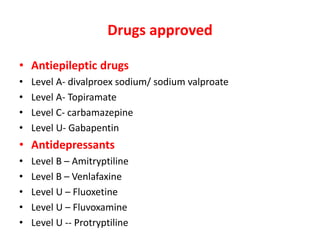
Drugs approved
• Antiepileptic drugs
• Level A- divalproex sodium/ sodium valproate
• Level A- Topiramate
• Level C- carbamazepine
• Level U- Gabapentin
• Antidepressants
• Level B – Amitryptiline
• Level B – Venlafaxine
• Level U – Fluoxetine
• Level U – Fluvoxamine
• Level U -- Protryptiline
Drugs approved
• B-Blockers
• Level A- Propranolol
• Level A- Metoprolol
• Level A- Timolol
• Calcium-channel blockers
• Verapamil- level U
• Nimodipine- Level U
• Diltiazem- Level U
Level B- Atenolol
Level C- Nebivolol
Level U- Bisoprolol
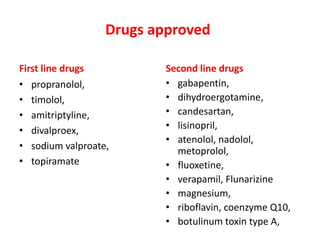
Drugs approved
First line drugs
• propranolol,
• timolol,
• amitriptyline,
• divalproex,
• sodium valproate,
• topiramate
Second line drugs
• gabapentin,
• dihydroergotamine,
• candesartan,
• lisinopril,
• atenolol, nadolol,
metoprolol,
• fluoxetine,
• verapamil, Flunarizine
• magnesium,
• riboflavin, coenzyme Q10,
• botulinum toxin type A,
Severity of attacks
• mild -can continue his or her usual activities with only
minimal disruption
• moderate -activities are significantly impaired
• severe -unable to continue his or her normal activities and
can function only with severe discomfort and impaired
efficiency
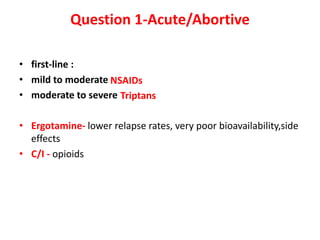
Question 1-Acute/Abortive
• first-line :
• mild to moderate
• moderate to severe
• Ergotamine- lower relapse rates, very poor bioavailability,side
effects
• C/I - opioids
Triptans
NSAIDs
Question 2-When to start treatment?
1. Recurring migraines, significantly interfere with ADL, despite
acute treatment (e.g., two or more attacks a month or
infrequent but produce profound disability)
2. Frequent headaches (more than 2 a week) or a pattern of
increasing attacks over time.
3. Contraindication or failure or Adverse events or overuse of
acute therapies
4. Patient preference
5. Presence of uncommon migraine conditions, including
hemiplegic migraine, basilar migraine, migraine with
prolonged aura, or migrainous infarctions
Question 3-What treatment to start?
• Initiate therapy with medications that have the highest level
of evidence-based efficacy with the lowest effective dose.
• Increase it slowly and give each drug an adequate trial of 2 to
3 months to achieve clinical benefit.
Question 4-Treatment of relapse
• Treatment of relapse within the same attack after initial effi
cacy-
• repeat same drug-if still- naproxen 500mg or tolfenamic acid
200mg
• Patients who consistently experience relapse-
• use drugs with less relapse rate - Naratriptan, eletriptan,
frovatriptan , Ergotamine, Naproxen, tolfenamic acid
Question 5 - Non responders
• Drug should be
tried in three attacks
Given for 6-8 weeks without side-effects
dose titrated before it is rejected for lack of efficacy
• Step one: simple oral analgesic ± anti-emetic
• Step two: rectal analgesic ± anti-emetic
• Step three: specific anti-migraine drugs
• Step four: combinations- 1 + 3 f/b 2 + 3
Other drugs used in prophylaxis
• limited or uncertain efficacy
• OnabotulinumtoxinA - licensed for prophylaxis of patients
with more than 15 headache days per month, of which at
least eight days are with migraine.
• Clonidine
• Verapamil MR 120-240mg bd
• Fluoxetine 20 - 40mg od
• co-enzyme Q10
• Transcranial magnetic stimulation
Question 6 - When to stop treatment?
• If after 3 to 6 months headaches are well controlled, consider
tapering or discontinuing treatment.
• Withdrawal is best achieved by tapering the dose over 2-3
weeks.
Question 7 - If complications occur?
• Patients with nausea and vomiting -sumatriptan
subcutaneously or as a nasal spray. (1/2 cc = 6 mg)
Question 7 - Dosages
• sumatriptan - 25 mg orally, increase the dose in increments of
50 mg to a maximum of 300 mg per day
• NSAIDs - aspirin 600-900mg, • ibuprofen 400-600mg
naproxen 750-825mg, • diclofenac-potassium 50-100mg
Dosages
• Drugs Dose in adults (mg/d)
• Amitryptyline 10-50
• Divalproex /Valproate 500-1000
• Propranolol 80-240
• Topiramate 50-100
Question 8 - medication-induced
(rebound) headache
• use of triptans on 10 or more days a month or analgesics on
15 or more days a month is inappropriate for migraine and is
associated with a clear risk
• Taper the drug over weeks and use alternative
Question 9 - Status migranosus
• Fluids
• NSAIDs - Acetaminophen 1 gm IV, Naproxen , diclofenac 50 im,
ketorolac 30mgiv,
• Triptans- sumatriptan 6mg sc-best studied
• DHE - 1mg iv/im-
• Antidopaminergic Agents- iv metoclopramide, Prochlorperazine
and chlorpromazine (Level B)
• Corticosteroids-dexamethasone- should be offered to these
patients to prevent recurrence of headache (Should offer—Level B)
• Opioids- only to pregnant patients who are refractory to all
• Magnesium, propofol – unknown
• Lignocaine, opioid, octreotide - avoid
Question 10 - Contraindications
• Triptans - during the aura phase, within 24 hours of the
administration of DHE, cardiac risk factors, cardiac disease or
uncontrolled hypertension, pregnant
• Beta-blockers - asthma, chronic obstructive pulmonary
disease, insulin-dependent diabetes mellitus, heart block or
failure, or peripheral vascular disease.
• Calcium-channel -pregnant patients, hypotension, congestive
heart failure or arrhythmia
• Amitryptiline -severe cardiac, glaucoma, hypotension, seizure
disorder and use of a monoamine oxidase inhibitor.
Question 11 - Special situations
• Co-morbidity Drug
• Hypertension β blockers
• Angina Calcium channel blockers
• Depression Tricyclic antidepressants
• Insomnia Tricyclic antidepressants
• Under weight Tricyclic antidepressants
• Epilepsy Sodium valproate
• Mania Sodium valproate
Question 12 - Special situations
• Co-morbidity Drugs to be avoided
• Epilepsy Tricyclic antidepressants
• Depression β blockers
• Obesity Tricyclic antidepressants,
valproate
Question 13 - Pregnancy
• Avoid ergot, valproate, lisinopril and candesartan
• beta blockers, propranolol, topiramate, amitriptyline and
gabapentin (relative)
• Triptans- limited knowledge, so better to avoid
Children
• Trigger avoidance and simple analgesics
• No response-then-Propranolol-effective and approved
• Others-unknown
Question 14 - Menstrual migraine
• Acute - Same as for nonmenstrual attacks
• there is no concern regarding medication overuse unless used >
15days/ month
• Prophylaxis - tried for a minimum of three cycles at maximum
dose before it is deemed ineffective.
• Mefenamic acid 500mg tds - from the onset of menstruation
until the last day of bleeding.
• frovatriptan for 6 days (5mg bd on day 1; 2.5mg bd on days 2-6)
• Transdermal estrogen 7-day patch(50μg)
Question 15 - Migraine and hormones
• Combined hormonal contraceptives- contraindication
• Progestogen-only contraception is acceptable- no thrombotic risk
• HRT in menopause not contraindicated- no evidence that risk of
stroke is elevated or reduced by the use of HRT
Question 16 - Diet and triggers
Question 17 - Non-pharmacologic therapy
• may be combined with preventive therapy
• Behavioral treatments –
– relaxation training,
– cognitive-behavioral training (stress-management
training).
• Physical treatment –
– acupuncture,
– cervical manipulation,
– mobilization therapy
Recent drugs
• CGRP antagonist – 2018 FDA approved – for prophylaxis
• ERENUMAB - 70mg sc monthly
• Fremanezumab - 225mg sc monthly
• Gepants – oral 100mg for acute attack- not approved.
Flow chart showing pharmacologic
prophylaxis of migraine
Thank you
• who have one or more of the following characteristics:
– Patient preference for nonpharmacologic interventions
– Poor tolerance to specific pharmacologic treatments
– Medical contraindications for specific pharmacologic
treatments
– Insufficient or no response to pharmacologic treatment
– Pregnancy, planned pregnancy, or nursing
– History of long-term, frequent, or excessive use of
analgesic or acute medications that can aggravate
headache problems (or lead to decreased responsiveness
to other pharmacotherapies)
– Significant stress or deficient stress-coping skills
Question 9- Non-pharmacologic therapy

migraine management guidelines )

  • 1.
    Migraine Management Guidelines Dr. Rahikiran. B SR Neurology GMC Kota British Association for the Study of Headache September 2010 AAFP Guidelines 2011 Indian Medicine APICON update 2008- migraine therapy The American Headache Society 2016
  • 2.
    Drugs approved • Antiepilepticdrugs • Level A- divalproex sodium/ sodium valproate • Level A- Topiramate • Level C- carbamazepine • Level U- Gabapentin • Antidepressants • Level B – Amitryptiline • Level B – Venlafaxine • Level U – Fluoxetine • Level U – Fluvoxamine • Level U -- Protryptiline
  • 3.
    Drugs approved • B-Blockers •Level A- Propranolol • Level A- Metoprolol • Level A- Timolol • Calcium-channel blockers • Verapamil- level U • Nimodipine- Level U • Diltiazem- Level U Level B- Atenolol Level C- Nebivolol Level U- Bisoprolol
  • 4.
    Drugs approved First linedrugs • propranolol, • timolol, • amitriptyline, • divalproex, • sodium valproate, • topiramate Second line drugs • gabapentin, • dihydroergotamine, • candesartan, • lisinopril, • atenolol, nadolol, metoprolol, • fluoxetine, • verapamil, Flunarizine • magnesium, • riboflavin, coenzyme Q10, • botulinum toxin type A,
  • 5.
    Severity of attacks •mild -can continue his or her usual activities with only minimal disruption • moderate -activities are significantly impaired • severe -unable to continue his or her normal activities and can function only with severe discomfort and impaired efficiency
  • 6.
    Question 1-Acute/Abortive • first-line: • mild to moderate • moderate to severe • Ergotamine- lower relapse rates, very poor bioavailability,side effects • C/I - opioids Triptans NSAIDs
  • 7.
    Question 2-When tostart treatment? 1. Recurring migraines, significantly interfere with ADL, despite acute treatment (e.g., two or more attacks a month or infrequent but produce profound disability) 2. Frequent headaches (more than 2 a week) or a pattern of increasing attacks over time. 3. Contraindication or failure or Adverse events or overuse of acute therapies 4. Patient preference 5. Presence of uncommon migraine conditions, including hemiplegic migraine, basilar migraine, migraine with prolonged aura, or migrainous infarctions
  • 8.
    Question 3-What treatmentto start? • Initiate therapy with medications that have the highest level of evidence-based efficacy with the lowest effective dose. • Increase it slowly and give each drug an adequate trial of 2 to 3 months to achieve clinical benefit.
  • 9.
    Question 4-Treatment ofrelapse • Treatment of relapse within the same attack after initial effi cacy- • repeat same drug-if still- naproxen 500mg or tolfenamic acid 200mg • Patients who consistently experience relapse- • use drugs with less relapse rate - Naratriptan, eletriptan, frovatriptan , Ergotamine, Naproxen, tolfenamic acid
  • 10.
    Question 5 -Non responders • Drug should be tried in three attacks Given for 6-8 weeks without side-effects dose titrated before it is rejected for lack of efficacy • Step one: simple oral analgesic ± anti-emetic • Step two: rectal analgesic ± anti-emetic • Step three: specific anti-migraine drugs • Step four: combinations- 1 + 3 f/b 2 + 3
  • 11.
    Other drugs usedin prophylaxis • limited or uncertain efficacy • OnabotulinumtoxinA - licensed for prophylaxis of patients with more than 15 headache days per month, of which at least eight days are with migraine. • Clonidine • Verapamil MR 120-240mg bd • Fluoxetine 20 - 40mg od • co-enzyme Q10 • Transcranial magnetic stimulation
  • 12.
    Question 6 -When to stop treatment? • If after 3 to 6 months headaches are well controlled, consider tapering or discontinuing treatment. • Withdrawal is best achieved by tapering the dose over 2-3 weeks.
  • 13.
    Question 7 -If complications occur? • Patients with nausea and vomiting -sumatriptan subcutaneously or as a nasal spray. (1/2 cc = 6 mg)
  • 14.
    Question 7 -Dosages • sumatriptan - 25 mg orally, increase the dose in increments of 50 mg to a maximum of 300 mg per day • NSAIDs - aspirin 600-900mg, • ibuprofen 400-600mg naproxen 750-825mg, • diclofenac-potassium 50-100mg
  • 15.
    Dosages • Drugs Dosein adults (mg/d) • Amitryptyline 10-50 • Divalproex /Valproate 500-1000 • Propranolol 80-240 • Topiramate 50-100
  • 16.
    Question 8 -medication-induced (rebound) headache • use of triptans on 10 or more days a month or analgesics on 15 or more days a month is inappropriate for migraine and is associated with a clear risk • Taper the drug over weeks and use alternative
  • 17.
    Question 9 -Status migranosus • Fluids • NSAIDs - Acetaminophen 1 gm IV, Naproxen , diclofenac 50 im, ketorolac 30mgiv, • Triptans- sumatriptan 6mg sc-best studied • DHE - 1mg iv/im- • Antidopaminergic Agents- iv metoclopramide, Prochlorperazine and chlorpromazine (Level B) • Corticosteroids-dexamethasone- should be offered to these patients to prevent recurrence of headache (Should offer—Level B) • Opioids- only to pregnant patients who are refractory to all • Magnesium, propofol – unknown • Lignocaine, opioid, octreotide - avoid
  • 18.
    Question 10 -Contraindications • Triptans - during the aura phase, within 24 hours of the administration of DHE, cardiac risk factors, cardiac disease or uncontrolled hypertension, pregnant • Beta-blockers - asthma, chronic obstructive pulmonary disease, insulin-dependent diabetes mellitus, heart block or failure, or peripheral vascular disease. • Calcium-channel -pregnant patients, hypotension, congestive heart failure or arrhythmia • Amitryptiline -severe cardiac, glaucoma, hypotension, seizure disorder and use of a monoamine oxidase inhibitor.
  • 19.
    Question 11 -Special situations • Co-morbidity Drug • Hypertension β blockers • Angina Calcium channel blockers • Depression Tricyclic antidepressants • Insomnia Tricyclic antidepressants • Under weight Tricyclic antidepressants • Epilepsy Sodium valproate • Mania Sodium valproate
  • 20.
    Question 12 -Special situations • Co-morbidity Drugs to be avoided • Epilepsy Tricyclic antidepressants • Depression β blockers • Obesity Tricyclic antidepressants, valproate
  • 21.
    Question 13 -Pregnancy • Avoid ergot, valproate, lisinopril and candesartan • beta blockers, propranolol, topiramate, amitriptyline and gabapentin (relative) • Triptans- limited knowledge, so better to avoid Children • Trigger avoidance and simple analgesics • No response-then-Propranolol-effective and approved • Others-unknown
  • 22.
    Question 14 -Menstrual migraine • Acute - Same as for nonmenstrual attacks • there is no concern regarding medication overuse unless used > 15days/ month • Prophylaxis - tried for a minimum of three cycles at maximum dose before it is deemed ineffective. • Mefenamic acid 500mg tds - from the onset of menstruation until the last day of bleeding. • frovatriptan for 6 days (5mg bd on day 1; 2.5mg bd on days 2-6) • Transdermal estrogen 7-day patch(50μg)
  • 23.
    Question 15 -Migraine and hormones • Combined hormonal contraceptives- contraindication • Progestogen-only contraception is acceptable- no thrombotic risk • HRT in menopause not contraindicated- no evidence that risk of stroke is elevated or reduced by the use of HRT
  • 24.
    Question 16 -Diet and triggers
  • 25.
    Question 17 -Non-pharmacologic therapy • may be combined with preventive therapy • Behavioral treatments – – relaxation training, – cognitive-behavioral training (stress-management training). • Physical treatment – – acupuncture, – cervical manipulation, – mobilization therapy
  • 26.
    Recent drugs • CGRPantagonist – 2018 FDA approved – for prophylaxis • ERENUMAB - 70mg sc monthly • Fremanezumab - 225mg sc monthly • Gepants – oral 100mg for acute attack- not approved.
  • 27.
    Flow chart showingpharmacologic prophylaxis of migraine
  • 28.
  • 29.
    • who haveone or more of the following characteristics: – Patient preference for nonpharmacologic interventions – Poor tolerance to specific pharmacologic treatments – Medical contraindications for specific pharmacologic treatments – Insufficient or no response to pharmacologic treatment – Pregnancy, planned pregnancy, or nursing – History of long-term, frequent, or excessive use of analgesic or acute medications that can aggravate headache problems (or lead to decreased responsiveness to other pharmacotherapies) – Significant stress or deficient stress-coping skills Question 9- Non-pharmacologic therapy