PRESENTED BY:- GUIDED BY:-
MR.N.P.SAWADADKAR MR.V.J.CHAWARE
B.PHARM M.PHARM
Recent strategies to treat
Epilepsy
Content
ļ‚— Introduction
ļ‚— Classification of Seizures
ļ‚— Causes of Epilepsy
ļ‚— Conventional Antiepileptic Drugs
ļ‚— Combination Therapy for antiepileptic Drugs
ļ‚— Newer Antiepileptic Drugs.
ļ‚— Other current prospectus to treat epilepsy.
ļ‚— References.
ļ‚— Epilepsy is the CNS disorder having recurrent seizures
that originate in the brain.
ļ‚— The brain is made up of billions of cells which process
information from our senses, thoughts, emotions,
memories and actions.
ļ‚— Seizures are the manifestation of an abnormal, hyper
synchronous discharge of a population of cortical
neurons
ļ‚— Seizures are the result of a brief, temporary disruption
of the usual activity of the brain.
Introduction
• Such disruptions occur for a variety of reasons, not all of
which can be identified.
• Reasons can include brain damage, scarring, chemical
or hormonal imbalance, or tumours.
• Incidence of epilepsy in developed countries is
approximately 50 per 100,000 while that of developing
countries, it is 100 per 100,000.
Causes Of Epilepsy
There is no single cause of Epilepsy. Many factors can
injure the nerve cells in the brain. Which includes :-
ļ‚— Head injury.
ļ‚— Trauma at birth, or high fever.
ļ‚— Excessively rough handling or shaking of infants.
ļ‚— Certain drugs or toxic substances when administered in
large doses.
ļ‚— Interruption of blood flow to the brain.
According to ā€œAmerican society of Epilepsyā€ the seizure
are classified as
ļ‚— Primary generalised seizures
ļ‚— Partial seizures
ļ‚— Secondarily generalised seizures
Classification of seizure
Primary generalised seizures
ļ‚— The whole brain is affected by the disruption to its usual activity
and consciousness is lost. Seizures in this category include:
 Absences – the person looks blank for a few seconds and may
not respond when spoken to or realise they have had a seizure.
 Tonic-clonic – the person stiffens, loses consciousness,
convulses and may fall.
 Tonic and atonic seizures, or drop attacks – the person may
stiffen and fall heavily or lose muscle tone and crumple to the
ground.
 Myoclonic – rhythmic, shock-like muscle jerks that can affect
the whole body and can be strong enough to throw the person to
the ground.
Partial seizures
Only part of the brain is affected and consciousness may
be altered but not lost. Seizures in this category include
ļ‚§ Simple partial seizure – the person may experience
unusual sensations and/or movement in one part of the
body, e.g. tingling or twitching.
ļ‚§ Complex partial seizures – awareness is disturbed or
lost and the person may experience unusual feelings.
Secondarily generalised seizures
ļ‚— The disruption starts in one part of the brain and
spreads to the whole brain.
ļ‚— Some seizures don’t fit into these categories and are
known as unclassified seizures.
Conventional antiepileptic drugs
ļ‚— Long-term antiepileptic drug therapy is necessary for the
majority of patients with epilepsy.
ļ‚— Around 75-80% of epileptic patients may be provided
with adequate seizure control with the help of
conventional antiepileptic drugs.
ļ‚— phenobarbital, phenytoin , valproate , Carbamazepine,
ethosuximide, are the most frequently used conventional
antiepileptics.
ļ‚— The therapeutic failure in 20-25% of patients has
stimulated intensive research on novel antiepileptic
drugs.
ļ‚— Approximately 30–40% of patients do not achieve
seizure control with a single antiepileptic drug
(AED).
ļ‚— most of the drugs have been developed and licensed
mainly as add-on treatment in patients poorly
responding to conventional therapy.
ļ‚— Those patients who do not respond to single-agent
therapy, multiple antiepileptic agents is required.
Combianations of antiepileptic Drugs
ļ‚— Deckers et al. Carried out a clinical trial of 130
adult-onset epilepsy patients.
ļ‚— comparing CBZ monotherapy to a combination of
CBZ/VPA.
ļ‚— The authors hypothesized that the combination of
low doses of CBZ and VPA would have fewer side
effects than CBZ monotherapy.
ļ‚— No statistical difference between the two treatments
was found for seizure frequency or drug toxicity.
ļ‚— Few other systematic studies are carried out for
examining comparative effectiveness of polytherapy
in humans.
ļ‚— The study found that most common combinations
were Lamotrigine + Valporic acid, Lamotrigine +
Leveteracetam, CBZ + VPA , Leveteracetam +VPA,
and Topiramate + VPA .
ļ‚— PHT+ PB , PHT + TPM was found to be potentially
ineffective.
Newer Anti-epileptic Drugs
ļ‚— New antiepileptic drugs are available for the
treatment of various forms of seizures and the
epilepsy syndromes.
ļ‚— Lamotrigine and Topiramate are effective as initial
monotherapy for generalized seizures.
ļ‚— Topiramate,Lamotrigine, Oxcarbazepine and
Gababentin for partial seizures.
ļ‚— Zonisamide is effective as an add-on therapy for
patients with partial seizures.
ļ‚— Newer AEDs such as Pregabalin and Retigabine have
been shown to be effective against seizures and are
currently undergoing further clinical trials.
ļ‚— Fosephenytoin, a Phenytoin is useful particularly in the
treatment of status epilepticus.
ļ‚— The newer formulation of intravenous Valproate has been
approved for use in patients for whom oral administration
is temporarily not feasible.
ļ‚— There are many chemical compounds have been tested
as antiepileptic agents.
ļ‚— The drugs in most advanced development (including
clinical studies) are: atipamezole, BIA-2-093,
fluorofelbamate, NPS 1776, pregabalin, retigabine,
safinamide, stiripentol, talampanel, ucb 34714 and
valrocemide.
ļ‚— Part of them is chemical derivative from marketed
AEDs,
Other current prospectus for
treatment of epilepsy
ļ‚— Ketogenic diet-
 Keto –Ketone , Genic-Producing
 a highly fat, low carbohydrate diet developed with
the advent of effective anticonvulsants.
 The mechanism of action is not well known.
It is used mainly in the treatment of children with
severe, medically intractable epilepsies.
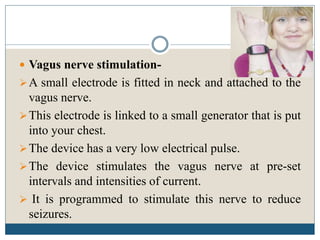
ļ‚— Vagus nerve stimulation-
A small electrode is fitted in neck and attached to the
vagus nerve.
This electrode is linked to a small generator that is put
into your chest.
The device has a very low electrical pulse.
The device stimulates the vagus nerve at pre-set
intervals and intensities of current.
 It is programmed to stimulate this nerve to reduce
seizures.
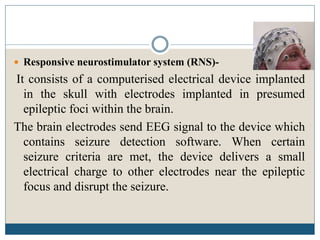
ļ‚— Responsive neurostimulator system (RNS)-
It consists of a computerised electrical device implanted
in the skull with electrodes implanted in presumed
epileptic foci within the brain.
The brain electrodes send EEG signal to the device which
contains seizure detection software. When certain
seizure criteria are met, the device delivers a small
electrical charge to other electrodes near the epileptic
focus and disrupt the seizure.
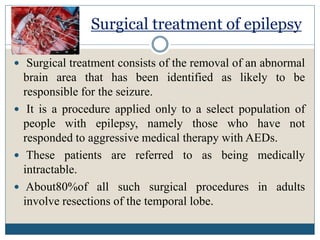
Surgical treatment of epilepsy
ļ‚— Surgical treatment consists of the removal of an abnormal
brain area that has been identified as likely to be
responsible for the seizure.
ļ‚— It is a procedure applied only to a select population of
people with epilepsy, namely those who have not
responded to aggressive medical therapy with AEDs.
ļ‚— These patients are referred to as being medically
intractable.
ļ‚— About80%of all such surgical procedures in adults
involve resections of the temporal lobe.
References
ļ‚— Hart L. Clinical Pharmacy and Therapeutics. Williun and
Wilkins Press, Baltimore, USA, 2004,118-30.
ļ‚— Clinical epilepsy, American epilepsy society,USA, c-4.
ļ‚— Rout S.K., A review on antiepileptic agents, current research
and future prospectus on conventional and traditional drugs,
IJPSRR,2010,2, Article 004.
ļ‚— Lee J ,Dworetzky B, Rational Polytherapy with Antiepileptic
Drugs, Pharmaceuticals, 2014, 3, 2362-2379.
ļ‚— Boon P, Raedt R, Herdt V; Electrical Stimulation for the
Treatment of Epilepsy; Neurotherapeutics;2009;3;214-220.
ļ‚— Ben-Menachem E. Vagus-nerve stimulation for the
treatment of epilepsy. Lancet Neurol 2002;1:477– 482.
ļ‚— Stefan H, Wang Y, Pauli E, et al. A new approach in anti-
epileptic drug evaluation. European Journal of Neurology
2004; 11:467-73.
ļ‚— www.epilepsyscotland.org.uk.
THANK YOU

recent seminar topic for m.pharm

  • 1.
    PRESENTED BY:- GUIDEDBY:- MR.N.P.SAWADADKAR MR.V.J.CHAWARE B.PHARM M.PHARM Recent strategies to treat Epilepsy
  • 2.
    Content ļ‚— Introduction ļ‚— Classificationof Seizures ļ‚— Causes of Epilepsy ļ‚— Conventional Antiepileptic Drugs ļ‚— Combination Therapy for antiepileptic Drugs ļ‚— Newer Antiepileptic Drugs. ļ‚— Other current prospectus to treat epilepsy. ļ‚— References.
  • 3.
    ļ‚— Epilepsy isthe CNS disorder having recurrent seizures that originate in the brain. ļ‚— The brain is made up of billions of cells which process information from our senses, thoughts, emotions, memories and actions. ļ‚— Seizures are the manifestation of an abnormal, hyper synchronous discharge of a population of cortical neurons ļ‚— Seizures are the result of a brief, temporary disruption of the usual activity of the brain. Introduction
  • 4.
    • Such disruptionsoccur for a variety of reasons, not all of which can be identified. • Reasons can include brain damage, scarring, chemical or hormonal imbalance, or tumours. • Incidence of epilepsy in developed countries is approximately 50 per 100,000 while that of developing countries, it is 100 per 100,000.
  • 5.
    Causes Of Epilepsy Thereis no single cause of Epilepsy. Many factors can injure the nerve cells in the brain. Which includes :- ļ‚— Head injury. ļ‚— Trauma at birth, or high fever. ļ‚— Excessively rough handling or shaking of infants. ļ‚— Certain drugs or toxic substances when administered in large doses. ļ‚— Interruption of blood flow to the brain.
  • 6.
    According to ā€œAmericansociety of Epilepsyā€ the seizure are classified as ļ‚— Primary generalised seizures ļ‚— Partial seizures ļ‚— Secondarily generalised seizures Classification of seizure
  • 7.
    Primary generalised seizures ļ‚—The whole brain is affected by the disruption to its usual activity and consciousness is lost. Seizures in this category include:  Absences – the person looks blank for a few seconds and may not respond when spoken to or realise they have had a seizure.  Tonic-clonic – the person stiffens, loses consciousness, convulses and may fall.  Tonic and atonic seizures, or drop attacks – the person may stiffen and fall heavily or lose muscle tone and crumple to the ground.  Myoclonic – rhythmic, shock-like muscle jerks that can affect the whole body and can be strong enough to throw the person to the ground.
  • 8.
    Partial seizures Only partof the brain is affected and consciousness may be altered but not lost. Seizures in this category include ļ‚§ Simple partial seizure – the person may experience unusual sensations and/or movement in one part of the body, e.g. tingling or twitching. ļ‚§ Complex partial seizures – awareness is disturbed or lost and the person may experience unusual feelings.
  • 9.
    Secondarily generalised seizures ļ‚—The disruption starts in one part of the brain and spreads to the whole brain. ļ‚— Some seizures don’t fit into these categories and are known as unclassified seizures.
  • 10.
    Conventional antiepileptic drugs ļ‚—Long-term antiepileptic drug therapy is necessary for the majority of patients with epilepsy. ļ‚— Around 75-80% of epileptic patients may be provided with adequate seizure control with the help of conventional antiepileptic drugs. ļ‚— phenobarbital, phenytoin , valproate , Carbamazepine, ethosuximide, are the most frequently used conventional antiepileptics. ļ‚— The therapeutic failure in 20-25% of patients has stimulated intensive research on novel antiepileptic drugs.
  • 11.
    ļ‚— Approximately 30–40%of patients do not achieve seizure control with a single antiepileptic drug (AED). ļ‚— most of the drugs have been developed and licensed mainly as add-on treatment in patients poorly responding to conventional therapy. ļ‚— Those patients who do not respond to single-agent therapy, multiple antiepileptic agents is required. Combianations of antiepileptic Drugs
  • 12.
    ļ‚— Deckers etal. Carried out a clinical trial of 130 adult-onset epilepsy patients. ļ‚— comparing CBZ monotherapy to a combination of CBZ/VPA. ļ‚— The authors hypothesized that the combination of low doses of CBZ and VPA would have fewer side effects than CBZ monotherapy. ļ‚— No statistical difference between the two treatments was found for seizure frequency or drug toxicity.
  • 13.
    ļ‚— Few othersystematic studies are carried out for examining comparative effectiveness of polytherapy in humans. ļ‚— The study found that most common combinations were Lamotrigine + Valporic acid, Lamotrigine + Leveteracetam, CBZ + VPA , Leveteracetam +VPA, and Topiramate + VPA . ļ‚— PHT+ PB , PHT + TPM was found to be potentially ineffective.
  • 14.
    Newer Anti-epileptic Drugs ļ‚—New antiepileptic drugs are available for the treatment of various forms of seizures and the epilepsy syndromes. ļ‚— Lamotrigine and Topiramate are effective as initial monotherapy for generalized seizures. ļ‚— Topiramate,Lamotrigine, Oxcarbazepine and Gababentin for partial seizures. ļ‚— Zonisamide is effective as an add-on therapy for patients with partial seizures.
  • 15.
    ļ‚— Newer AEDssuch as Pregabalin and Retigabine have been shown to be effective against seizures and are currently undergoing further clinical trials. ļ‚— Fosephenytoin, a Phenytoin is useful particularly in the treatment of status epilepticus. ļ‚— The newer formulation of intravenous Valproate has been approved for use in patients for whom oral administration is temporarily not feasible.
  • 16.
    ļ‚— There aremany chemical compounds have been tested as antiepileptic agents. ļ‚— The drugs in most advanced development (including clinical studies) are: atipamezole, BIA-2-093, fluorofelbamate, NPS 1776, pregabalin, retigabine, safinamide, stiripentol, talampanel, ucb 34714 and valrocemide. ļ‚— Part of them is chemical derivative from marketed AEDs,
  • 17.
    Other current prospectusfor treatment of epilepsy ļ‚— Ketogenic diet-  Keto –Ketone , Genic-Producing  a highly fat, low carbohydrate diet developed with the advent of effective anticonvulsants.  The mechanism of action is not well known. It is used mainly in the treatment of children with severe, medically intractable epilepsies.
  • 18.
    ļ‚— Vagus nervestimulation- A small electrode is fitted in neck and attached to the vagus nerve. This electrode is linked to a small generator that is put into your chest. The device has a very low electrical pulse. The device stimulates the vagus nerve at pre-set intervals and intensities of current.  It is programmed to stimulate this nerve to reduce seizures.
  • 19.
    ļ‚— Responsive neurostimulatorsystem (RNS)- It consists of a computerised electrical device implanted in the skull with electrodes implanted in presumed epileptic foci within the brain. The brain electrodes send EEG signal to the device which contains seizure detection software. When certain seizure criteria are met, the device delivers a small electrical charge to other electrodes near the epileptic focus and disrupt the seizure.
  • 20.
    Surgical treatment ofepilepsy ļ‚— Surgical treatment consists of the removal of an abnormal brain area that has been identified as likely to be responsible for the seizure. ļ‚— It is a procedure applied only to a select population of people with epilepsy, namely those who have not responded to aggressive medical therapy with AEDs. ļ‚— These patients are referred to as being medically intractable. ļ‚— About80%of all such surgical procedures in adults involve resections of the temporal lobe.
  • 21.
    References ļ‚— Hart L.Clinical Pharmacy and Therapeutics. Williun and Wilkins Press, Baltimore, USA, 2004,118-30. ļ‚— Clinical epilepsy, American epilepsy society,USA, c-4. ļ‚— Rout S.K., A review on antiepileptic agents, current research and future prospectus on conventional and traditional drugs, IJPSRR,2010,2, Article 004. ļ‚— Lee J ,Dworetzky B, Rational Polytherapy with Antiepileptic Drugs, Pharmaceuticals, 2014, 3, 2362-2379. ļ‚— Boon P, Raedt R, Herdt V; Electrical Stimulation for the Treatment of Epilepsy; Neurotherapeutics;2009;3;214-220.
  • 22.
    ļ‚— Ben-Menachem E.Vagus-nerve stimulation for the treatment of epilepsy. Lancet Neurol 2002;1:477– 482. ļ‚— Stefan H, Wang Y, Pauli E, et al. A new approach in anti- epileptic drug evaluation. European Journal of Neurology 2004; 11:467-73. ļ‚— www.epilepsyscotland.org.uk.
  • 23.