FACTI
Recommendations
supplementing BEPS
2.0 –Way Forward
@LylaALatif
Finance, Governance & Development
Law Specialist
2021 IFF Conference, AFRODAD
Digital tax
“It’s not easy. Shall we deliver by mid-2021? I
don’t know. It depends on many factors which are
both technical and political.” Pascal Saint-Amans,
OECD
Lyla Latif, 2021
“Everything that is yellow
is not gold”
Welsh proverb
Do the FACTI
Recommendations
aid action towards
consensus building
on digital tax?
OECD BEPS measures on
targeting tax from
digitalisation
FACTI value add to OECD
BEPS 2.0
Outcome Evaluation
The new taxing right
under Pillar One and the
global minimum tax
under Pillar Two do not
entirely replace the
existing international tax
system but simply overlay
it. The PE threshold and
the separate entity arm’s
length principle live on in
various ways.
BEPS has to deal with the
new digital taxing rights
based on a new set of
sourcing rules applied on
an MNE as a group and
also have to rework the
DTA regime which
defaults to the separate
entity regime
3B: Improve tax
transparency by having all
private MNE publish
accounting and financial
information on a country-
by-country basis
14A: Establish an inclusive
and legitimate global
coordination mechanism
at UN ECOSOC to address
financial integrity on a
systemic level
Value based approach
grounded in
accountability, legitimacy,
transparency and fairness
Information on user
participation, value
creation and monetised
data
Values need to be
implemented through a
coherent ecosystem of
institutions, nationally
(RA), regionally (EAC, AU,
EU) and internationally
(OECD, UN Tax
Committee)
Global coordination
International rules and
standards to promote
financial integrity
Facilitate global exchange
of financial information to
strengthen enforcement
Lyla Latif, 2021
OECD BEPS measures on
targeting tax from
digitalisation
FACTI value add to OECD
BEPS 2.0
Outcome Outcome
Problem under Pillar Two is
on calculating how much
profit and tax belongs with a
particular country due to the
choice of jurisdictional
blending, which is necessary
to have a minimum effective
tax rate.
As such traditional concepts
such as sourcing rules based
on separate entity residence,
PE and TP will need to be
brought back – will be quite
difficult to calculate the tax
because this approach will
bring in tensions between
group and separate entity
taxation
4A: Taxpayers, especially
MNC should pay their fair
share of taxes. Taxation must
be equitably applied on
services delivered digitally.
This requires taxing MNC
based on group global profit
– reflects Pillar 1
4C: Create fairer rules and
stronger incentives to
combat tax competition, tax
avoidance and tax evasion,
starting with an agreement
on a global minimum
corporate tax – reflects Pillar
2
Recommendation 3B to
assist with information
gathering under Pillar 2 on
minimum level of corporate
tax by:
• Access to financial
accounts of MNEs to
determine income from a
taxing jurisdiction and
address differences
between tax and financial
accounting
• Access to financial
information adjusting
intra-group payments to
address low tax income so
that deductions can be
disallowed
Implementation of 3B would
assist in ending information
asymmetries in relation to
data on taxation.
Addressed through the
Global Pact on improving
multilateral and national
governance proposed
through a
UN Tax Convention
Intergovernmental body on
tax matters
Lyla Latif, 2021
FACTI Recommendation FACTI proposed way
forward
FACTI value add to OECD
BEPS
Outcome
8A: End information
sharing asymmetries in
relation to information
shared for tax purposes,
so that all countries can
receive information.
11A: Establish a Centre
for Monitoring Taxing
Rights to collect and
disseminate national
aggregate and detailed
data about taxation and
tax cooperation on a
global basis
Value based approach
grounded in
accountability, legitimacy,
transparency and fairness
Information asymmetries
result in difficulties in
resolving tax disputes.
Proposals at OECD for
addressing taxation of the
digitalised economy also
introduces mandatory
binding arbitration. FACTI
proposals under 8A and
11A
These recommendations
if implemented will assist
in solving tax disputes
around imposing and
assessing digital tax which
are currently limited to
mutual agreement
procedures and binding
arbitration. It enables
adjudication by countries
and their courts. Protects
countries sovereignty to
enforce tax rules and
taxpayer’s desire for
certainty
Lyla Latif, 2021
FACTI recommendations on capturing digitally
enabled revenue generation
Key recommendations
• Global Pact under a UN Tax
Convention under the auspices of
an inclusive intergovernmental
body on tax matters under the UN
• Tax transparency based on
publication of accounting and
financial information on a country-
by-country basis
• Global coordination mechanism at
UN-ECOSOC to address financial
integrity on a systemic level
Contributions towards efforts undertaken
on tax reforms to include digitalisation
• A global consolidation regime and
common sourcing rules for all
income overlaid by a minimum tax
can provide a clearer solution to
taxing digital business models
Lyla Latif, 2021

UN FACTI Panel Recommendations supplementing BEPS 2.0

  • 1.
    FACTI Recommendations supplementing BEPS 2.0 –WayForward @LylaALatif Finance, Governance & Development Law Specialist 2021 IFF Conference, AFRODAD
  • 2.
    Digital tax “It’s noteasy. Shall we deliver by mid-2021? I don’t know. It depends on many factors which are both technical and political.” Pascal Saint-Amans, OECD Lyla Latif, 2021 “Everything that is yellow is not gold” Welsh proverb
  • 3.
    Do the FACTI Recommendations aidaction towards consensus building on digital tax?
  • 5.
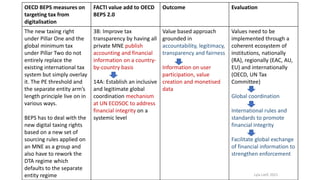
    OECD BEPS measureson targeting tax from digitalisation FACTI value add to OECD BEPS 2.0 Outcome Evaluation The new taxing right under Pillar One and the global minimum tax under Pillar Two do not entirely replace the existing international tax system but simply overlay it. The PE threshold and the separate entity arm’s length principle live on in various ways. BEPS has to deal with the new digital taxing rights based on a new set of sourcing rules applied on an MNE as a group and also have to rework the DTA regime which defaults to the separate entity regime 3B: Improve tax transparency by having all private MNE publish accounting and financial information on a country- by-country basis 14A: Establish an inclusive and legitimate global coordination mechanism at UN ECOSOC to address financial integrity on a systemic level Value based approach grounded in accountability, legitimacy, transparency and fairness Information on user participation, value creation and monetised data Values need to be implemented through a coherent ecosystem of institutions, nationally (RA), regionally (EAC, AU, EU) and internationally (OECD, UN Tax Committee) Global coordination International rules and standards to promote financial integrity Facilitate global exchange of financial information to strengthen enforcement Lyla Latif, 2021
  • 6.
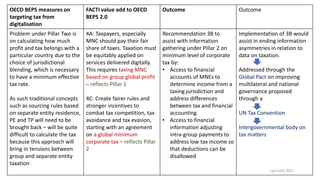
    OECD BEPS measureson targeting tax from digitalisation FACTI value add to OECD BEPS 2.0 Outcome Outcome Problem under Pillar Two is on calculating how much profit and tax belongs with a particular country due to the choice of jurisdictional blending, which is necessary to have a minimum effective tax rate. As such traditional concepts such as sourcing rules based on separate entity residence, PE and TP will need to be brought back – will be quite difficult to calculate the tax because this approach will bring in tensions between group and separate entity taxation 4A: Taxpayers, especially MNC should pay their fair share of taxes. Taxation must be equitably applied on services delivered digitally. This requires taxing MNC based on group global profit – reflects Pillar 1 4C: Create fairer rules and stronger incentives to combat tax competition, tax avoidance and tax evasion, starting with an agreement on a global minimum corporate tax – reflects Pillar 2 Recommendation 3B to assist with information gathering under Pillar 2 on minimum level of corporate tax by: • Access to financial accounts of MNEs to determine income from a taxing jurisdiction and address differences between tax and financial accounting • Access to financial information adjusting intra-group payments to address low tax income so that deductions can be disallowed Implementation of 3B would assist in ending information asymmetries in relation to data on taxation. Addressed through the Global Pact on improving multilateral and national governance proposed through a UN Tax Convention Intergovernmental body on tax matters Lyla Latif, 2021
  • 7.
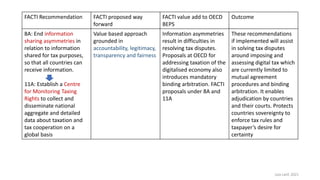
    FACTI Recommendation FACTIproposed way forward FACTI value add to OECD BEPS Outcome 8A: End information sharing asymmetries in relation to information shared for tax purposes, so that all countries can receive information. 11A: Establish a Centre for Monitoring Taxing Rights to collect and disseminate national aggregate and detailed data about taxation and tax cooperation on a global basis Value based approach grounded in accountability, legitimacy, transparency and fairness Information asymmetries result in difficulties in resolving tax disputes. Proposals at OECD for addressing taxation of the digitalised economy also introduces mandatory binding arbitration. FACTI proposals under 8A and 11A These recommendations if implemented will assist in solving tax disputes around imposing and assessing digital tax which are currently limited to mutual agreement procedures and binding arbitration. It enables adjudication by countries and their courts. Protects countries sovereignty to enforce tax rules and taxpayer’s desire for certainty Lyla Latif, 2021
  • 8.
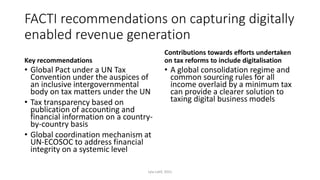
    FACTI recommendations oncapturing digitally enabled revenue generation Key recommendations • Global Pact under a UN Tax Convention under the auspices of an inclusive intergovernmental body on tax matters under the UN • Tax transparency based on publication of accounting and financial information on a country- by-country basis • Global coordination mechanism at UN-ECOSOC to address financial integrity on a systemic level Contributions towards efforts undertaken on tax reforms to include digitalisation • A global consolidation regime and common sourcing rules for all income overlaid by a minimum tax can provide a clearer solution to taxing digital business models Lyla Latif, 2021

Editor's Notes

  • #7 Pillar 1 – how to tax companies’ digital activities carried out where the firms don’t have a physical presence – target consumer facing firms with a significant footprint around the globe assessed at EUR750 million and specific revenue thresholds of sales in each country Pillar 2 – 4 rules to ensure a minimum level of corporate taxation worldwide