New Leader Onboarding:
Best Practices for Success
David Brookmire, President
Corporate Performance Strategies
www.cpstrat.com

Copyright © 2013, Corporate Performance Strategies, Inc., All Rights Reserved

1
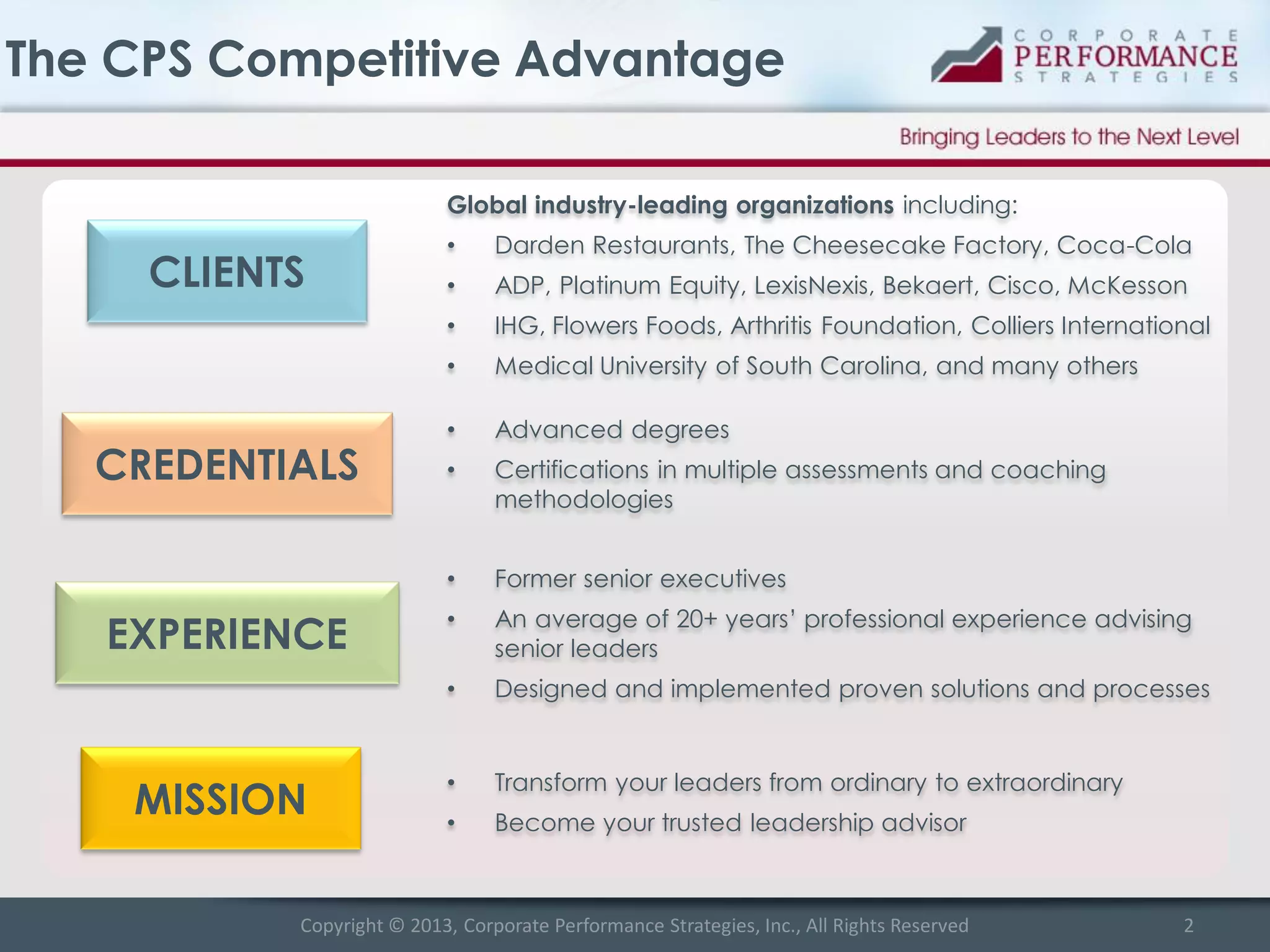
The CPS Competitive Advantage
Global industry-leading organizations including:

IHG, Flowers Foods, Arthritis Foundation, Colliers International
Medical University of South Carolina, and many others

•

Advanced degrees

•

Certifications in multiple assessments and coaching
methodologies
Former senior executives

•

An average of 20+ years’ professional experience advising
senior leaders

•

MISSION

ADP, Platinum Equity, LexisNexis, Bekaert, Cisco, McKesson

•

EXPERIENCE

•
•

CREDENTIALS

Darden Restaurants, The Cheesecake Factory, Coca-Cola

•

CLIENTS

•

Designed and implemented proven solutions and processes

•

Transform your leaders from ordinary to extraordinary

•

Become your trusted leadership advisor

Copyright © 2013, Corporate Performance Strategies, Inc., All Rights Reserved

2
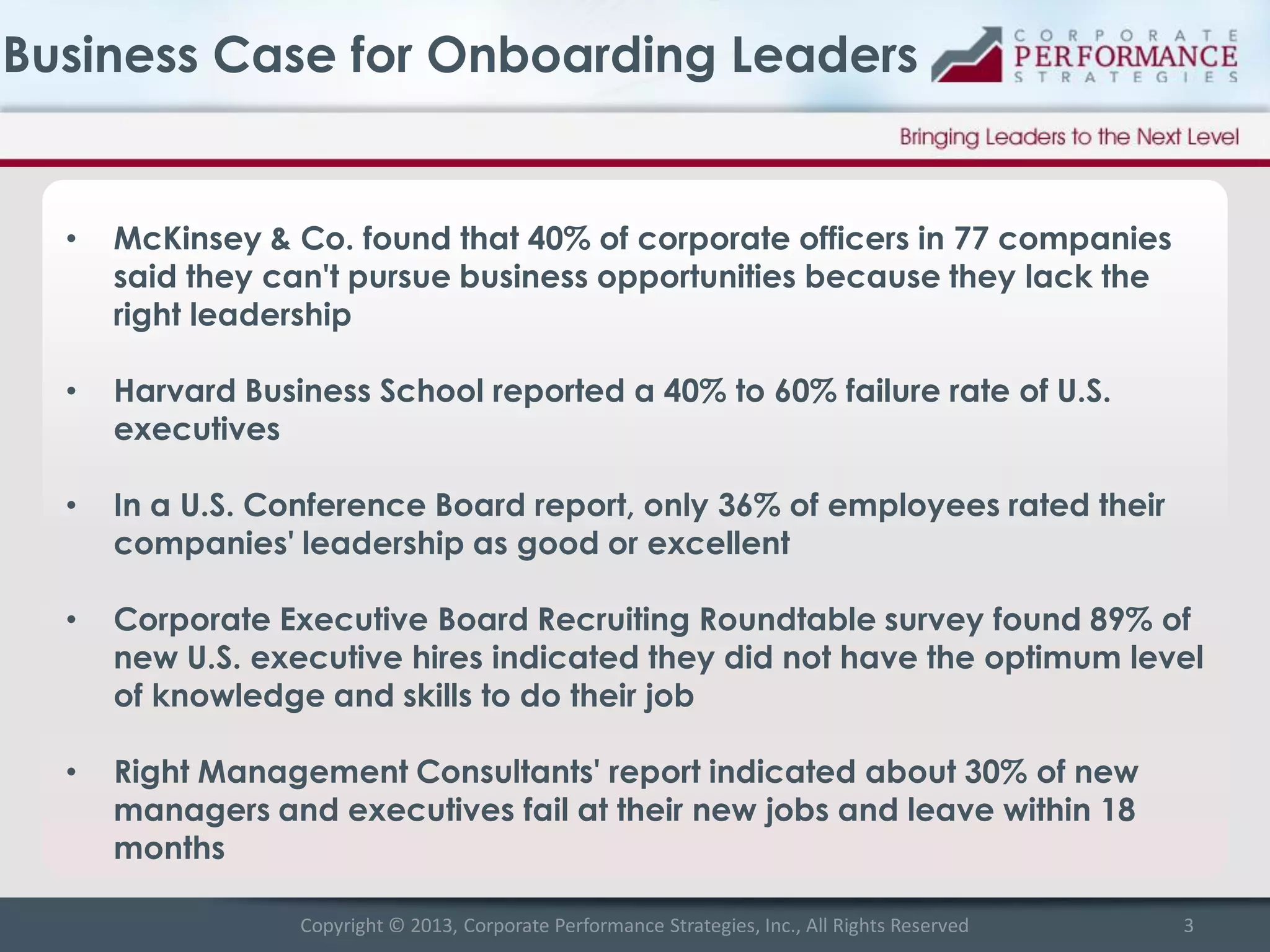
Business Case for Onboarding Leaders

•

McKinsey & Co. found that 40% of corporate officers in 77 companies
said they can't pursue business opportunities because they lack the
right leadership

•

Harvard Business School reported a 40% to 60% failure rate of U.S.
executives

•

In a U.S. Conference Board report, only 36% of employees rated their
companies' leadership as good or excellent

•

Corporate Executive Board Recruiting Roundtable survey found 89% of
new U.S. executive hires indicated they did not have the optimum level
of knowledge and skills to do their job

•

Right Management Consultants' report indicated about 30% of new
managers and executives fail at their new jobs and leave within 18
months
Copyright © 2013, Corporate Performance Strategies, Inc., All Rights Reserved

3
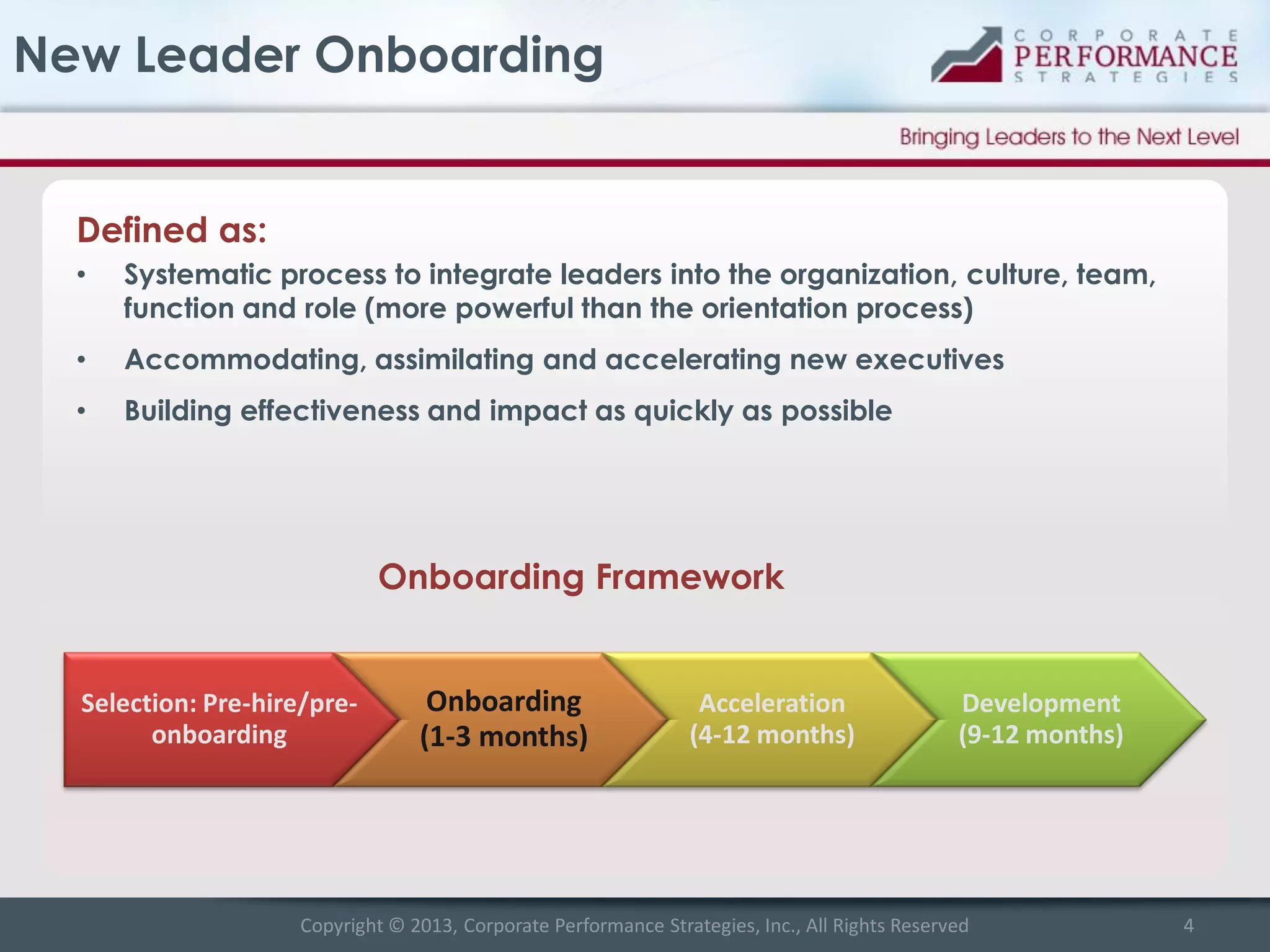
New Leader Onboarding

Defined as:
•

Systematic process to integrate leaders into the organization, culture, team,
function and role (more powerful than the orientation process)

•

Accommodating, assimilating and accelerating new executives

•

Building effectiveness and impact as quickly as possible

Onboarding Framework

Selection: Pre-hire/preonboarding

Onboarding
(1-3 months)

Acceleration
(4-12 months)

Development
(9-12 months)

Copyright © 2013, Corporate Performance Strategies, Inc., All Rights Reserved

4
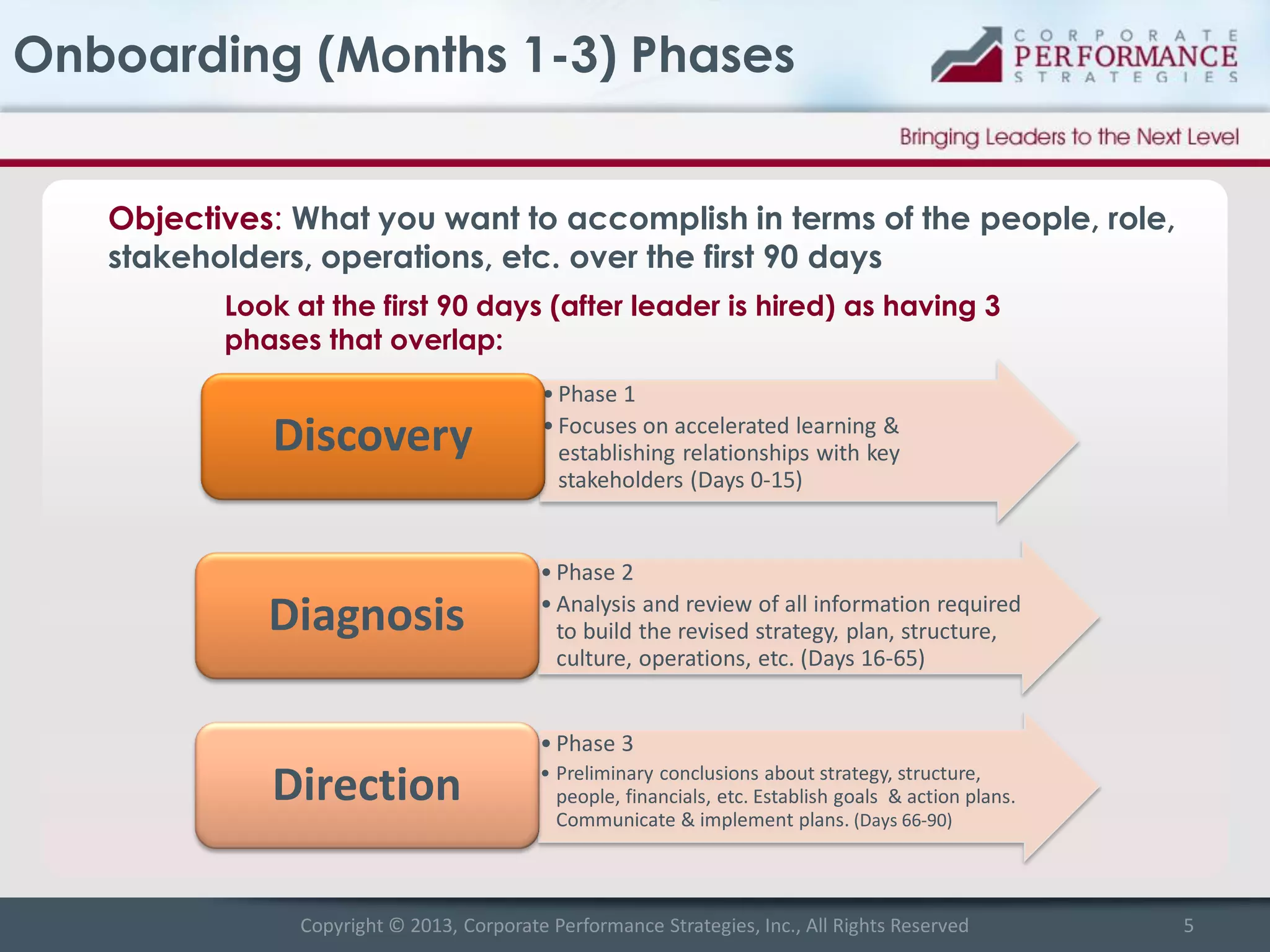
Onboarding (Months 1-3) Phases
Objectives: What you want to accomplish in terms of the people, role,
stakeholders, operations, etc. over the first 90 days
Look at the first 90 days (after leader is hired) as having 3
phases that overlap:

Discovery

• Phase 1
• Focuses on accelerated learning &
establishing relationships with key
stakeholders (Days 0-15)

Diagnosis

• Phase 2
• Analysis and review of all information required
to build the revised strategy, plan, structure,
culture, operations, etc. (Days 16-65)

• Phase 3

Direction

• Preliminary conclusions about strategy, structure,
people, financials, etc. Establish goals & action plans.
Communicate & implement plans. (Days 66-90)

Copyright © 2013, Corporate Performance Strategies, Inc., All Rights Reserved

5
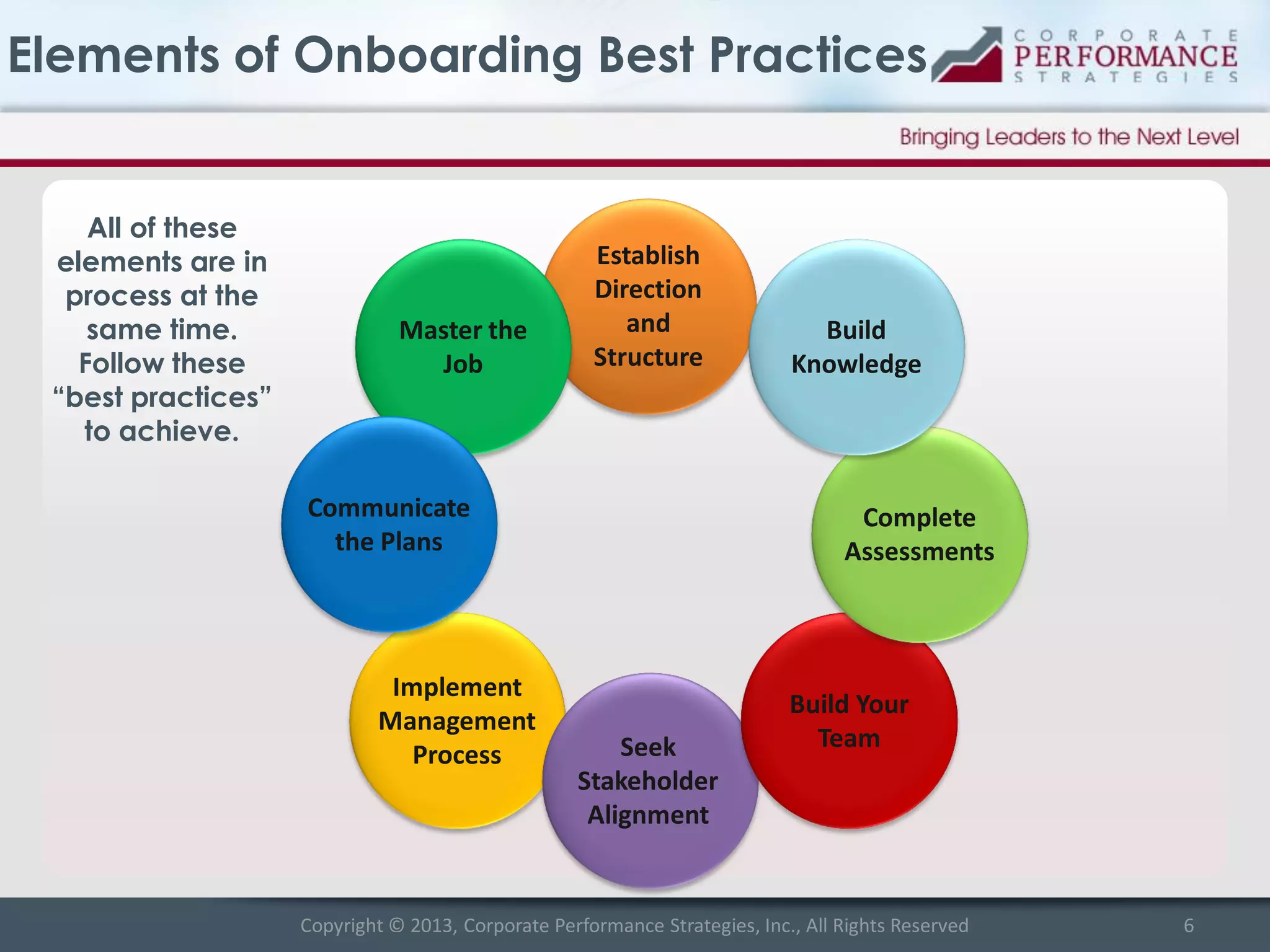
Elements of Onboarding Best Practices

All of these
elements are in
process at the
same time.
Follow these
“best practices”
to achieve.

Master the
Job

Establish
Direction
and
Structure

Communicate
the Plans

Implement
Management
Process

Build
Knowledge

Complete
Assessments

Seek
Stakeholder
Alignment

Build Your
Team

Copyright © 2013, Corporate Performance Strategies, Inc., All Rights Reserved

6
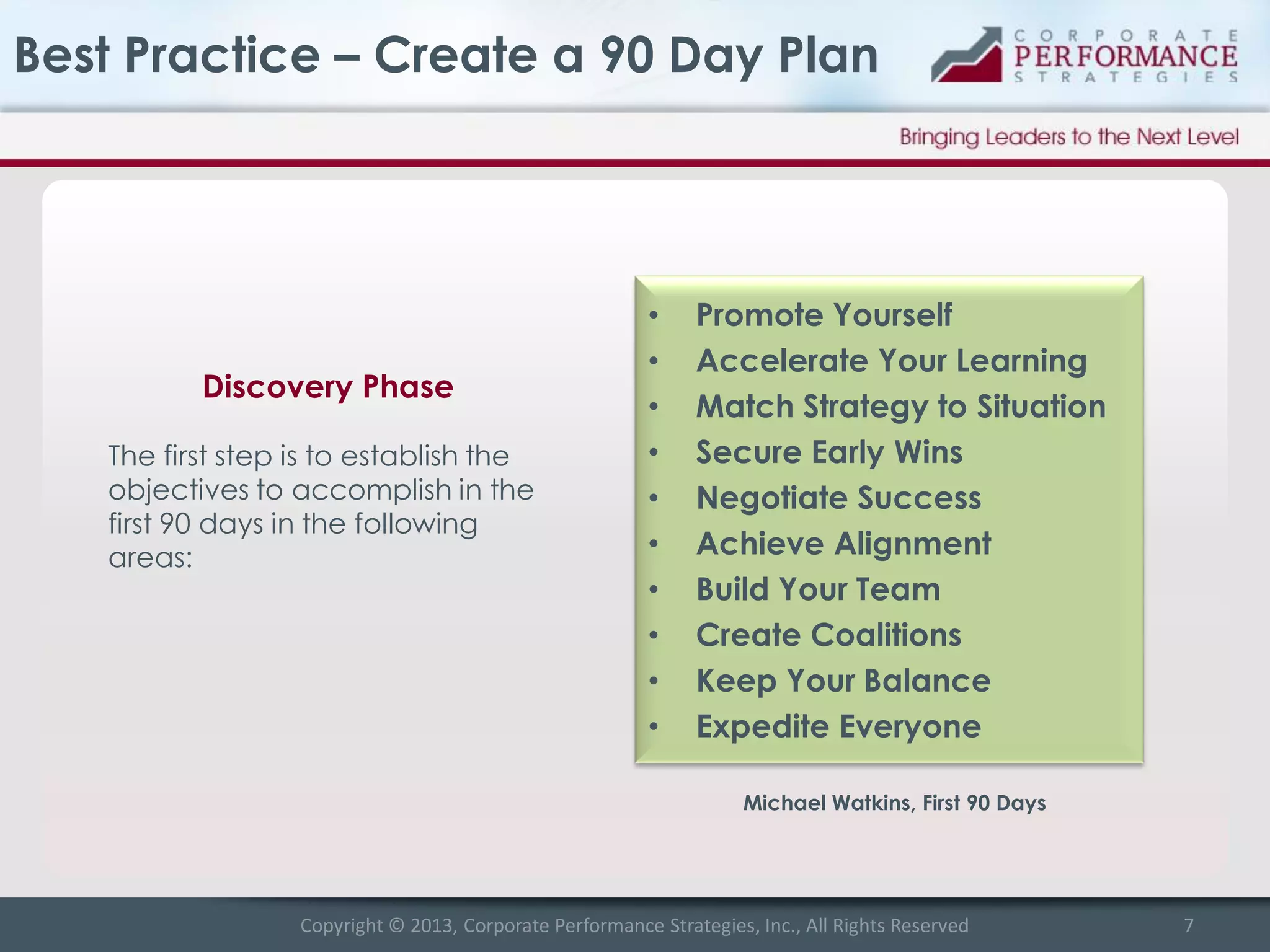
Best Practice – Create a 90 Day Plan

Discovery Phase
The first step is to establish the
objectives to accomplish in the
first 90 days in the following
areas:

•
•
•
•
•
•
•
•
•
•

Promote Yourself
Accelerate Your Learning
Match Strategy to Situation
Secure Early Wins
Negotiate Success
Achieve Alignment
Build Your Team
Create Coalitions
Keep Your Balance
Expedite Everyone
Michael Watkins, First 90 Days

Copyright © 2013, Corporate Performance Strategies, Inc., All Rights Reserved

7
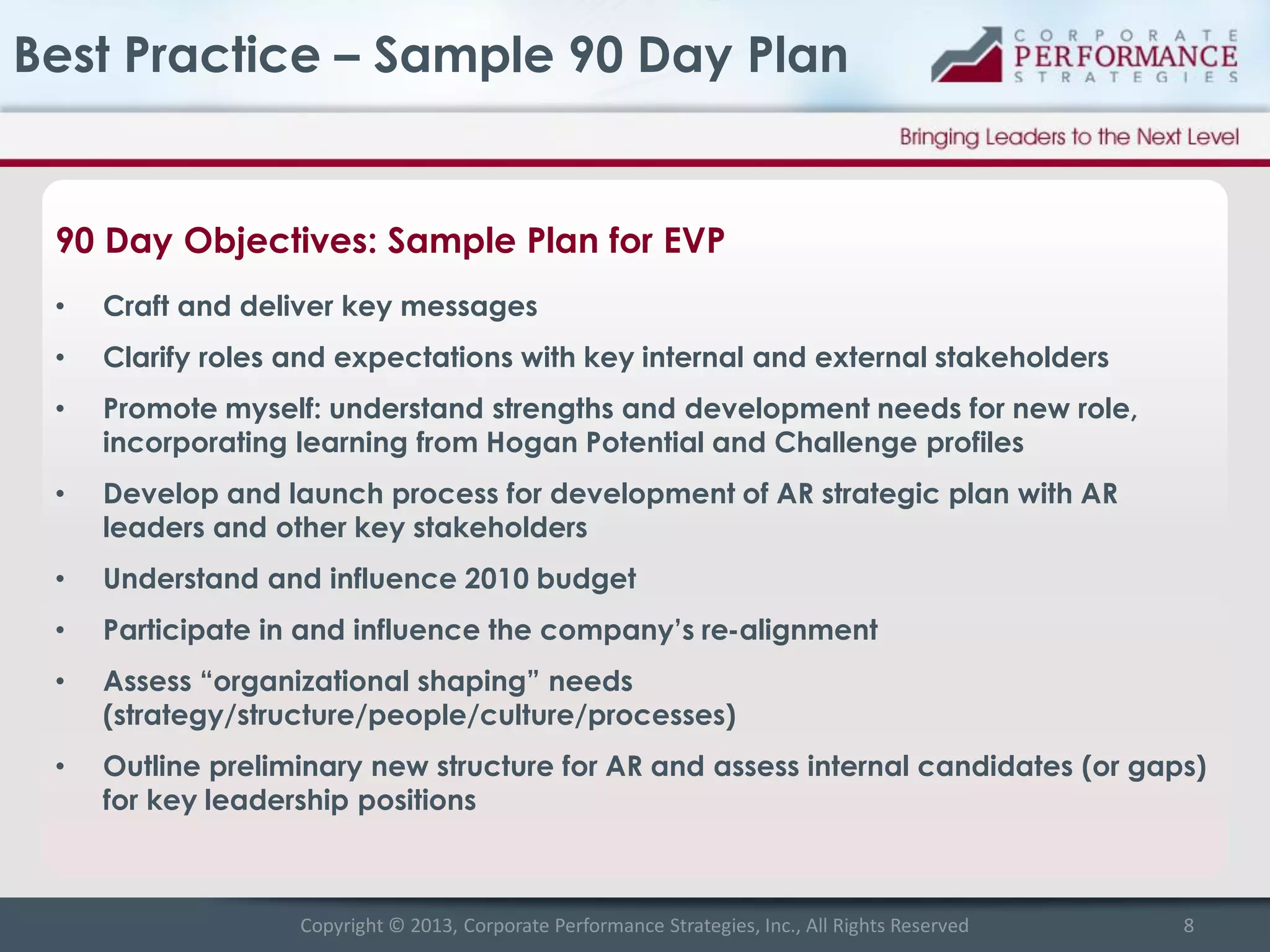
Best Practice – Sample 90 Day Plan

90 Day Objectives: Sample Plan for EVP
•

Craft and deliver key messages

•

Clarify roles and expectations with key internal and external stakeholders

•

Promote myself: understand strengths and development needs for new role,
incorporating learning from Hogan Potential and Challenge profiles

•

Develop and launch process for development of AR strategic plan with AR
leaders and other key stakeholders

•

Understand and influence 2010 budget

•

Participate in and influence the company’s re-alignment

•

Assess “organizational shaping” needs
(strategy/structure/people/culture/processes)

•

Outline preliminary new structure for AR and assess internal candidates (or gaps)
for key leadership positions

Copyright © 2013, Corporate Performance Strategies, Inc., All Rights Reserved

8
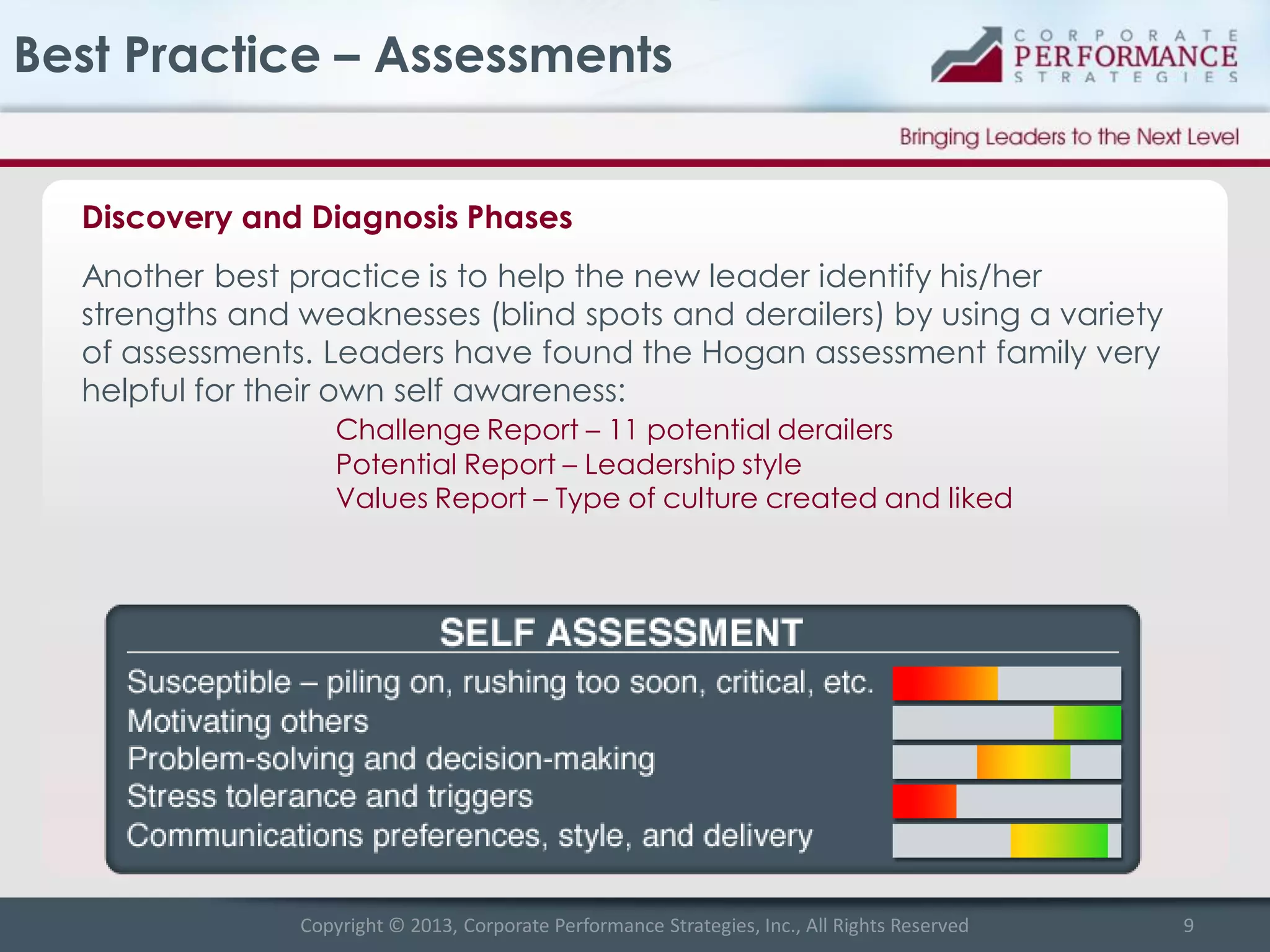
Best Practice – Assessments
Discovery and Diagnosis Phases
Another best practice is to help the new leader identify his/her
strengths and weaknesses (blind spots and derailers) by using a variety
of assessments. Leaders have found the Hogan assessment family very
helpful for their own self awareness:
Challenge Report – 11 potential derailers
Potential Report – Leadership style
Values Report – Type of culture created and liked

Copyright © 2013, Corporate Performance Strategies, Inc., All Rights Reserved

9
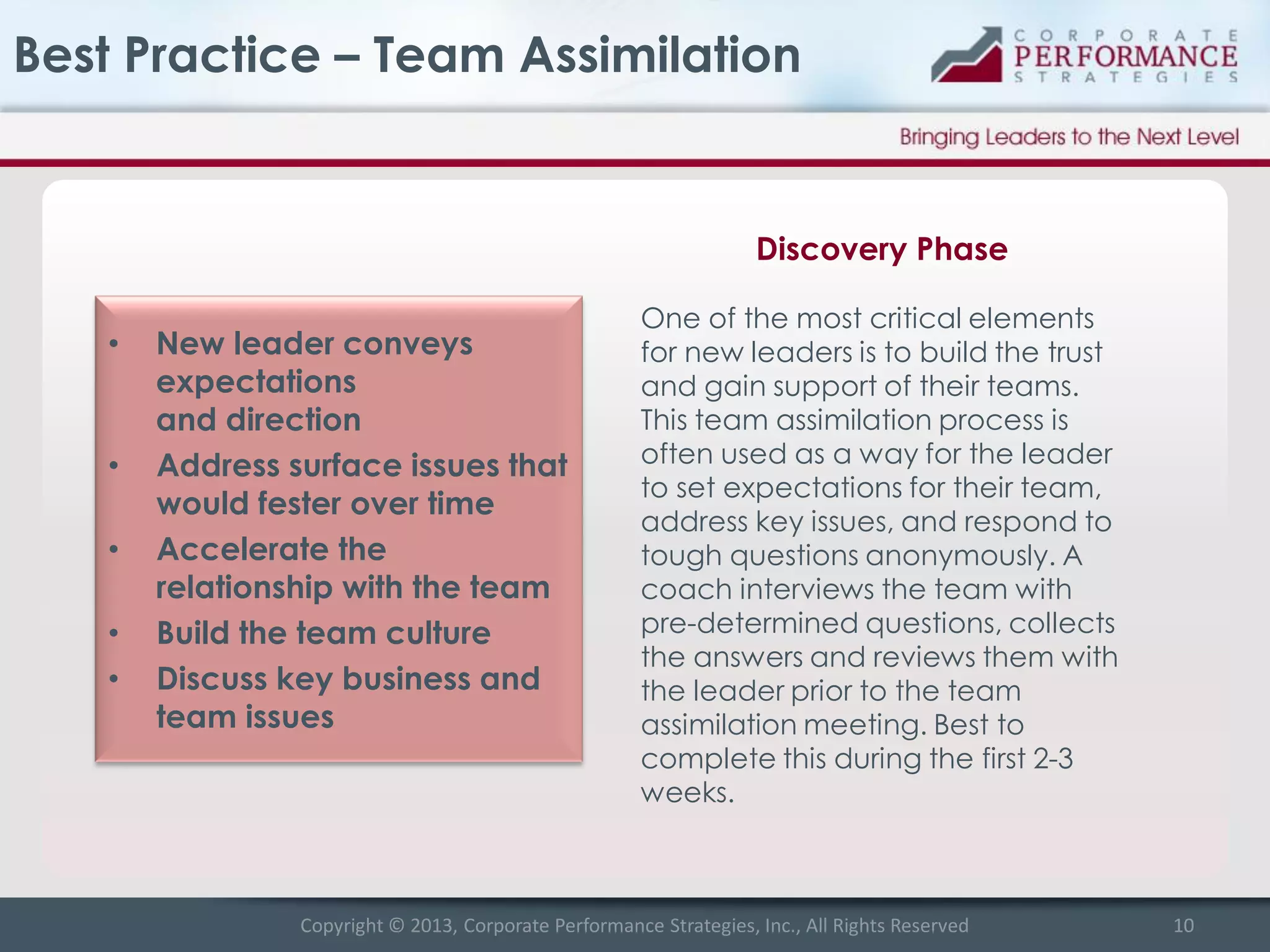
Best Practice – Team Assimilation

Discovery Phase
•

•
•
•
•

New leader conveys
expectations
and direction
Address surface issues that
would fester over time
Accelerate the
relationship with the team
Build the team culture
Discuss key business and
team issues

One of the most critical elements
for new leaders is to build the trust
and gain support of their teams.
This team assimilation process is
often used as a way for the leader
to set expectations for their team,
address key issues, and respond to
tough questions anonymously. A
coach interviews the team with
pre-determined questions, collects
the answers and reviews them with
the leader prior to the team
assimilation meeting. Best to
complete this during the first 2-3
weeks.

Copyright © 2013, Corporate Performance Strategies, Inc., All Rights Reserved

10
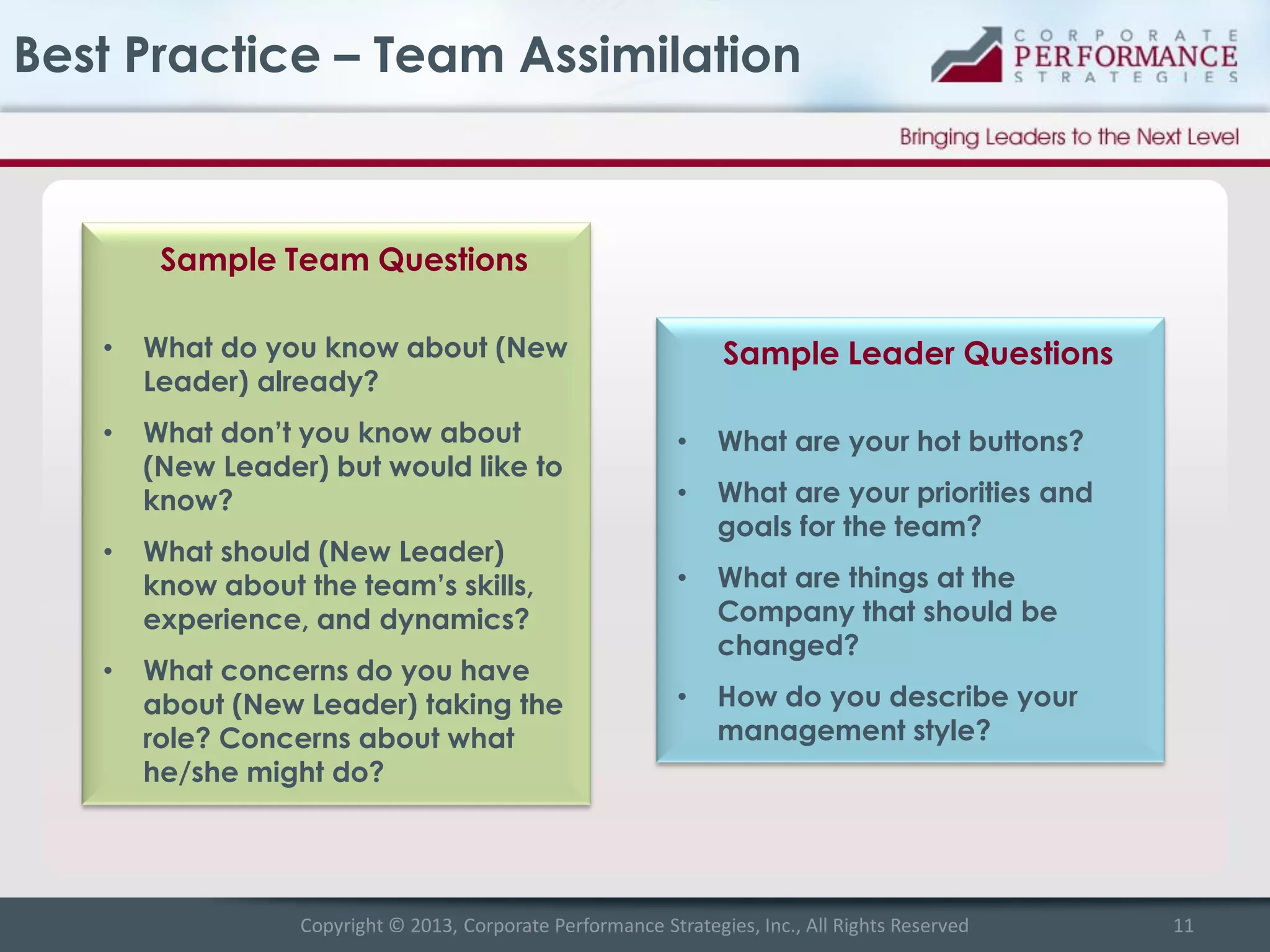
Best Practice – Team Assimilation

Sample Team Questions
•

What do you know about (New
Leader) already?

•

What don’t you know about
(New Leader) but would like to
know?

•

What should (New Leader)
know about the team’s skills,
experience, and dynamics?

•

What concerns do you have
about (New Leader) taking the
role? Concerns about what
he/she might do?

Sample Leader Questions
•

What are your hot buttons?

•

What are your priorities and
goals for the team?

•

What are things at the
Company that should be
changed?

•

How do you describe your
management style?

Copyright © 2013, Corporate Performance Strategies, Inc., All Rights Reserved

11
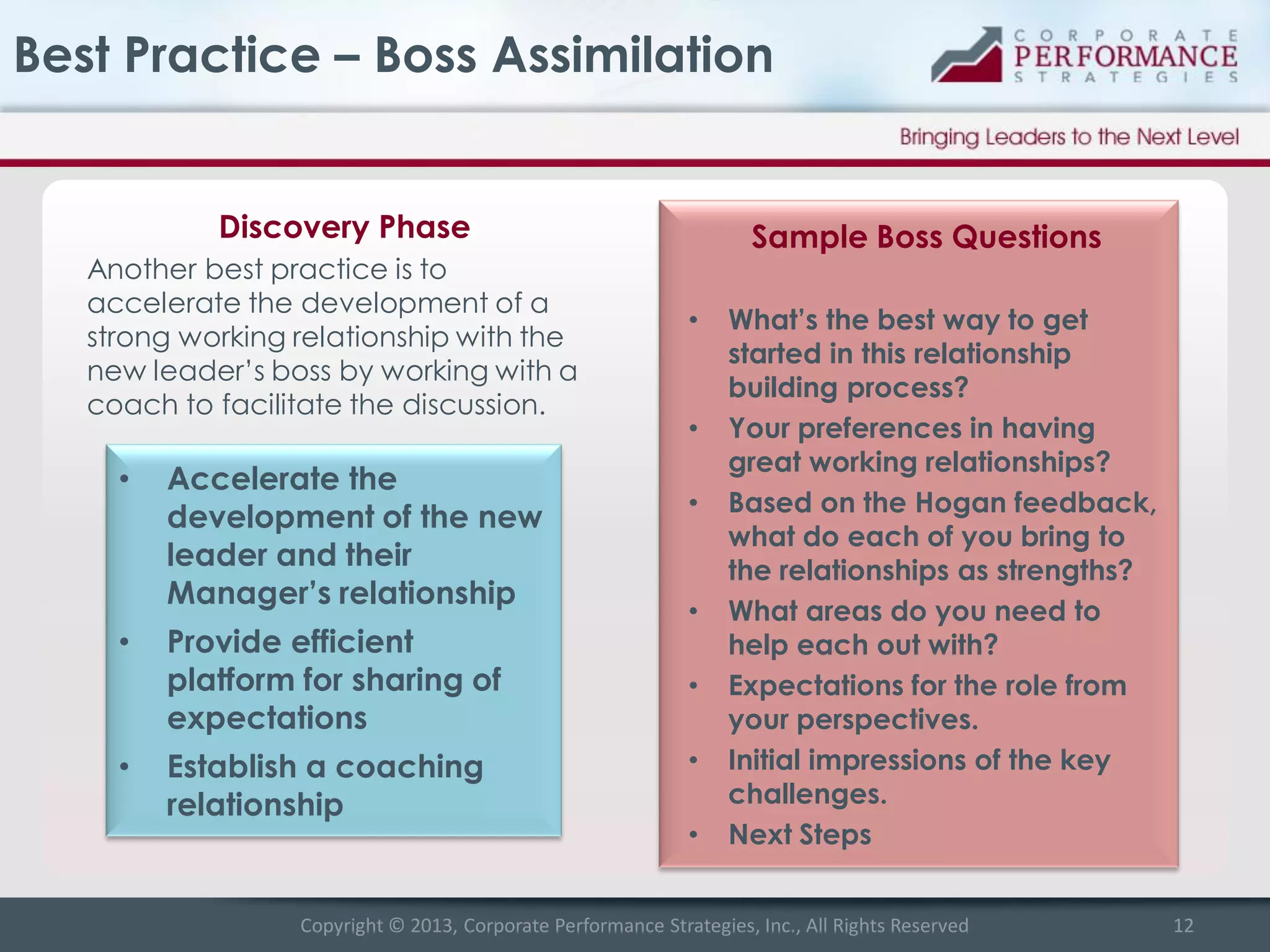
Best Practice – Boss Assimilation
Discovery Phase
Another best practice is to
accelerate the development of a
strong working relationship with the
new leader’s boss by working with a
coach to facilitate the discussion.

•

•

•

Accelerate the
development of the new
leader and their
Manager’s relationship
Provide efficient
platform for sharing of
expectations
Establish a coaching
relationship

Sample Boss Questions
•

•
•

•
•

•
•

What’s the best way to get
started in this relationship
building process?
Your preferences in having
great working relationships?
Based on the Hogan feedback,
what do each of you bring to
the relationships as strengths?
What areas do you need to
help each out with?
Expectations for the role from
your perspectives.
Initial impressions of the key
challenges.
Next Steps

Copyright © 2013, Corporate Performance Strategies, Inc., All Rights Reserved

12
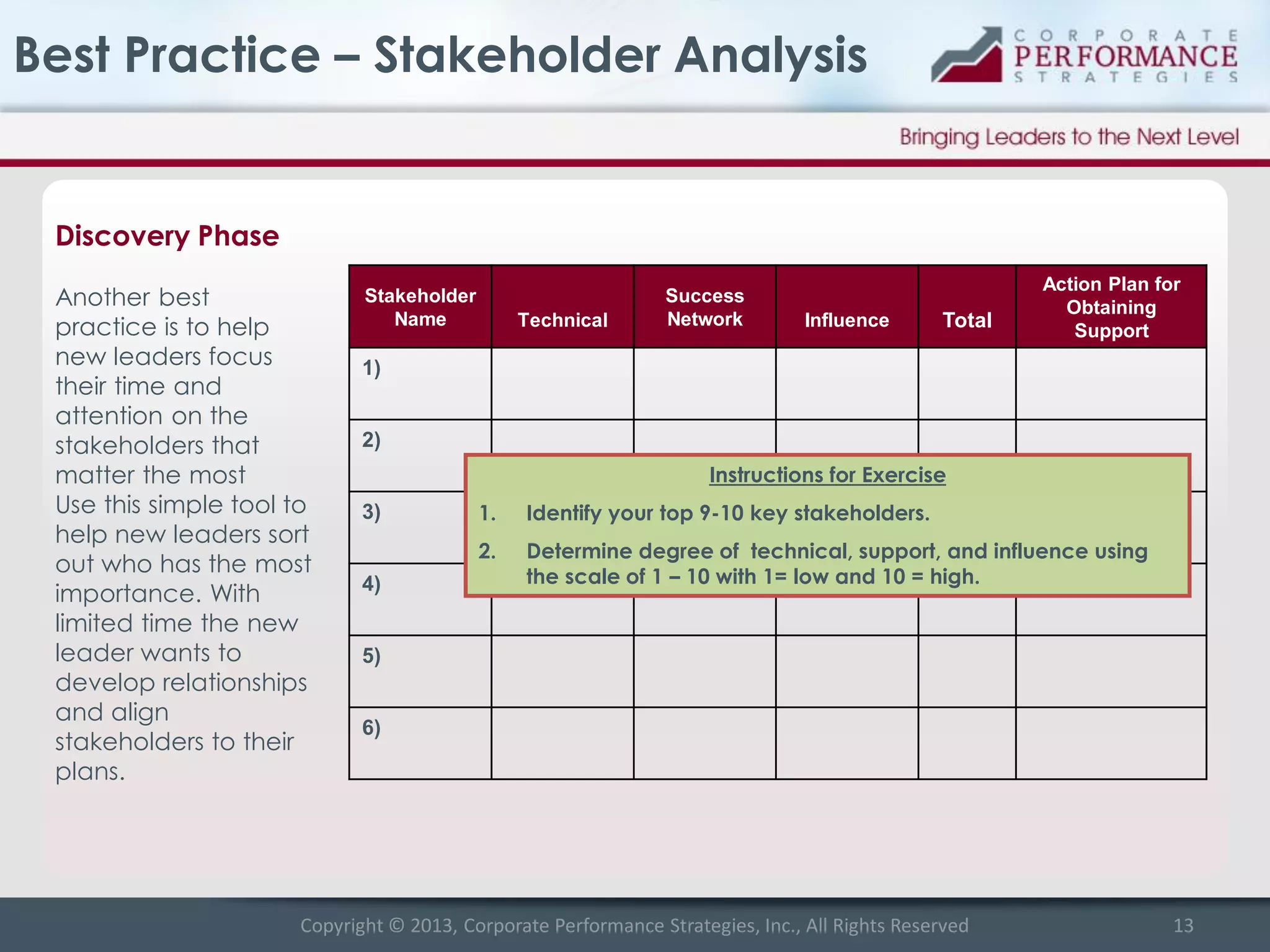
Best Practice – Stakeholder Analysis

Discovery Phase
Another best
practice is to help
new leaders focus
their time and
attention on the
stakeholders that
matter the most
Use this simple tool to
help new leaders sort
out who has the most
importance. With
limited time the new
leader wants to
develop relationships
and align
stakeholders to their
plans.

Stakeholder
Name

Technical

Success
Network

Influence

Total

Action Plan for
Obtaining
Support

1)

2)
Instructions for Exercise

4)

1.

Identify your top 9-10 key stakeholders.

2.

3)

Determine degree of technical, support, and influence using
the scale of 1 – 10 with 1= low and 10 = high.

5)
6)

Copyright © 2013, Corporate Performance Strategies, Inc., All Rights Reserved

13
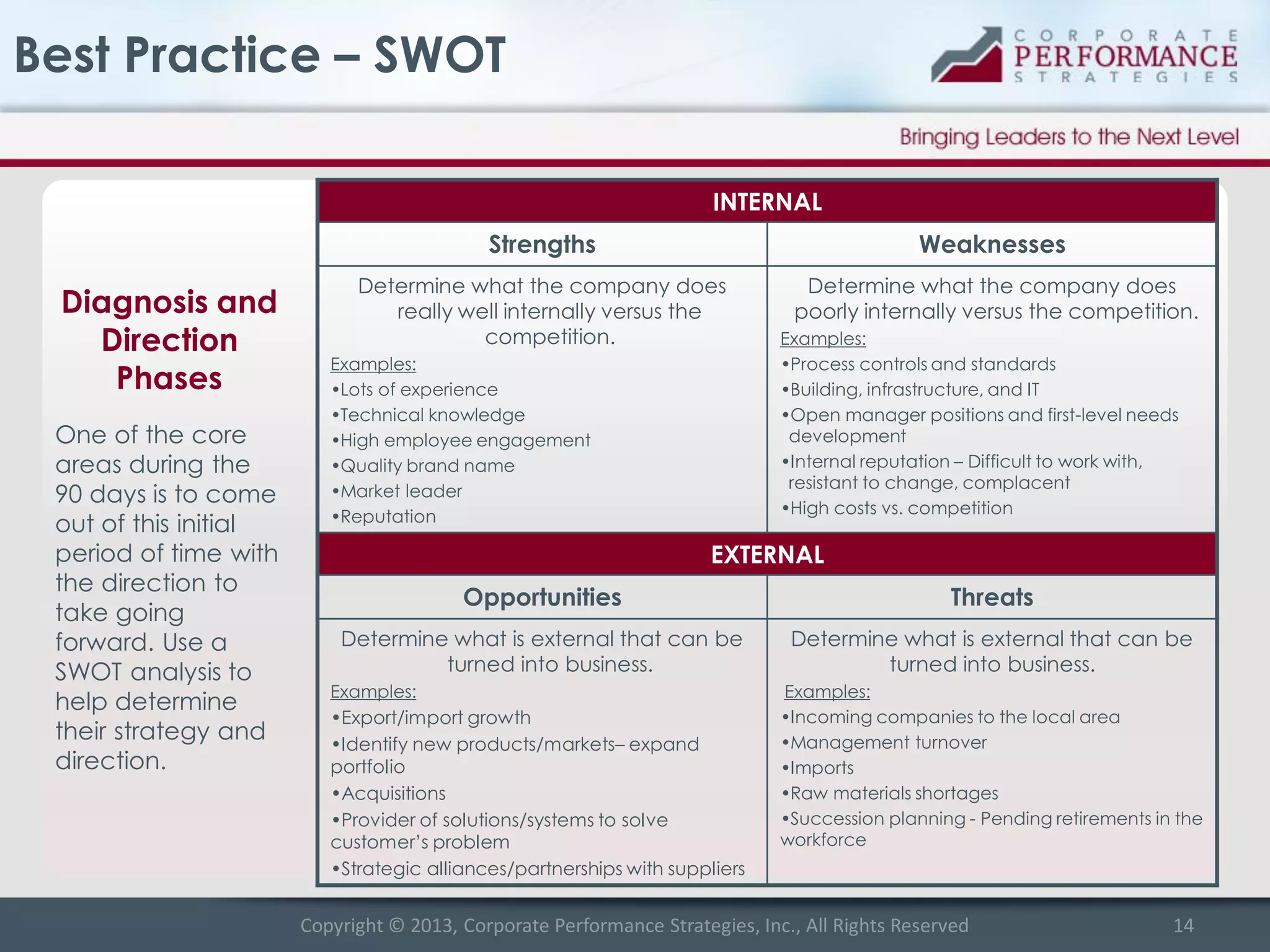
Best Practice – SWOT
INTERNAL

Strengths

Diagnosis and
Direction
Phases
One of the core
areas during the
90 days is to come
out of this initial
period of time with
the direction to
take going
forward. Use a
SWOT analysis to
help determine
their strategy and
direction.

Weaknesses

Determine what the company does
really well internally versus the
competition.

Determine what the company does
poorly internally versus the competition.

Examples:
•Lots of experience
•Technical knowledge
•High employee engagement
•Quality brand name
•Market leader
•Reputation

Examples:
•Process controls and standards
•Building, infrastructure, and IT
•Open manager positions and first-level needs
development
•Internal reputation – Difficult to work with,
resistant to change, complacent
•High costs vs. competition

EXTERNAL
Opportunities

Threats

Determine what is external that can be
turned into business.

Determine what is external that can be
turned into business.

Examples:
•Export/import growth
•Identify new products/markets– expand
portfolio
•Acquisitions
•Provider of solutions/systems to solve
customer’s problem
•Strategic alliances/partnerships with suppliers

Examples:
•Incoming companies to the local area
•Management turnover
•Imports
•Raw materials shortages
•Succession planning - Pending retirements in the
workforce

Copyright © 2013, Corporate Performance Strategies, Inc., All Rights Reserved

14
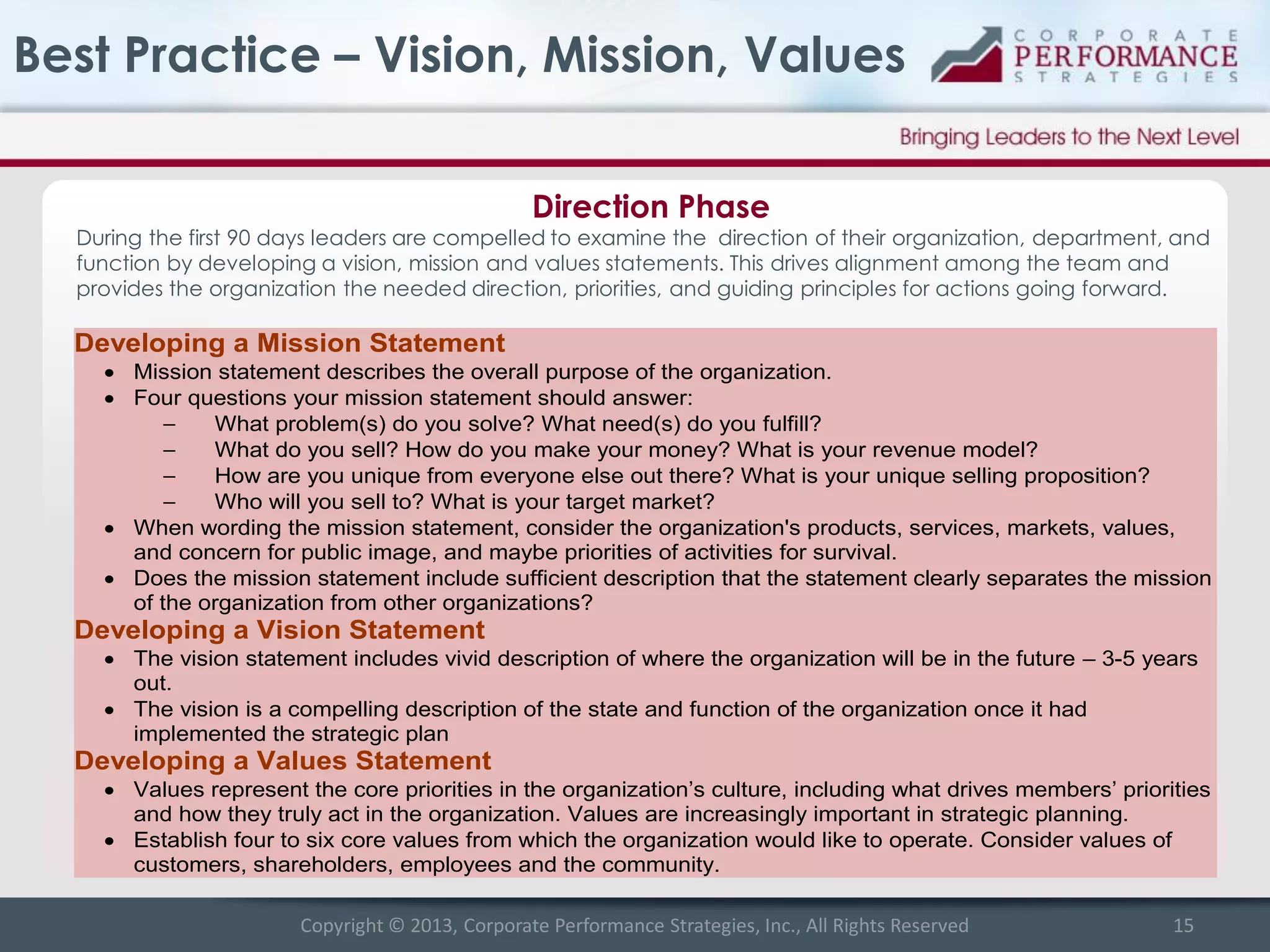
Best Practice – Vision, Mission, Values
Direction Phase

During the first 90 days leaders are compelled to examine the direction of their organization, department, and
function by developing a vision, mission and values statements. This drives alignment among the team and
provides the organization the needed direction, priorities, and guiding principles for actions going forward.

Developing a Mission Statement
 Mission statement describes the overall purpose of the organization.
 Four questions your mission statement should answer:
–
What problem(s) do you solve? What need(s) do you fulfill?
–
What do you sell? How do you make your money? What is your revenue model?
–
How are you unique from everyone else out there? What is your unique selling proposition?
–
Who will you sell to? What is your target market?
 When wording the mission statement, consider the organization's products, services, markets, values,
and concern for public image, and maybe priorities of activities for survival.
 Does the mission statement include sufficient description that the statement clearly separates the mission
of the organization from other organizations?

Developing a Vision Statement
 The vision statement includes vivid description of where the organization will be in the future – 3-5 years
out.
 The vision is a compelling description of the state and function of the organization once it had
implemented the strategic plan

Developing a Values Statement
 Values represent the core priorities in the organization’s culture, including what drives members’ priorities
and how they truly act in the organization. Values are increasingly important in strategic planning.
 Establish four to six core values from which the organization would like to operate. Consider values of
customers, shareholders, employees and the community.
Copyright © 2013, Corporate Performance Strategies, Inc., All Rights Reserved

15
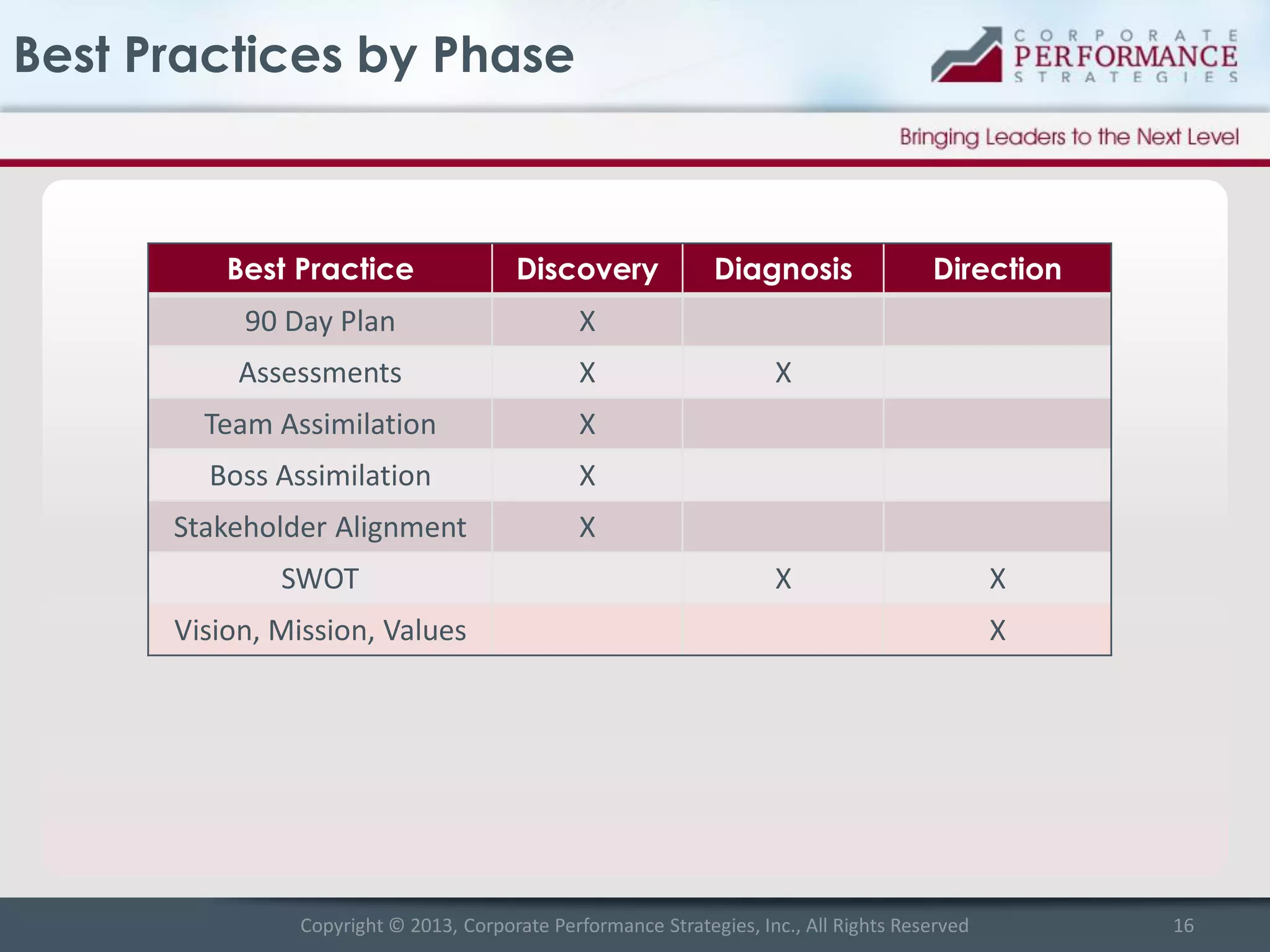
Best Practices by Phase

Best Practice

Discovery

90 Day Plan

X

Assessments

X

Team Assimilation

X

Boss Assimilation

X

Stakeholder Alignment

X

SWOT

Diagnosis

Direction

X

X

Vision, Mission, Values

Copyright © 2013, Corporate Performance Strategies, Inc., All Rights Reserved

X

X

16
Action Steps

Ask yourself these 3 questions
1. What improvements can you make to your
current leader onboarding process?
2. What are the key barriers to success?

3. What 2-3 tangible steps can you take on the
job?

Copyright © 2013, Corporate Performance Strategies, Inc., All Rights Reserved

17
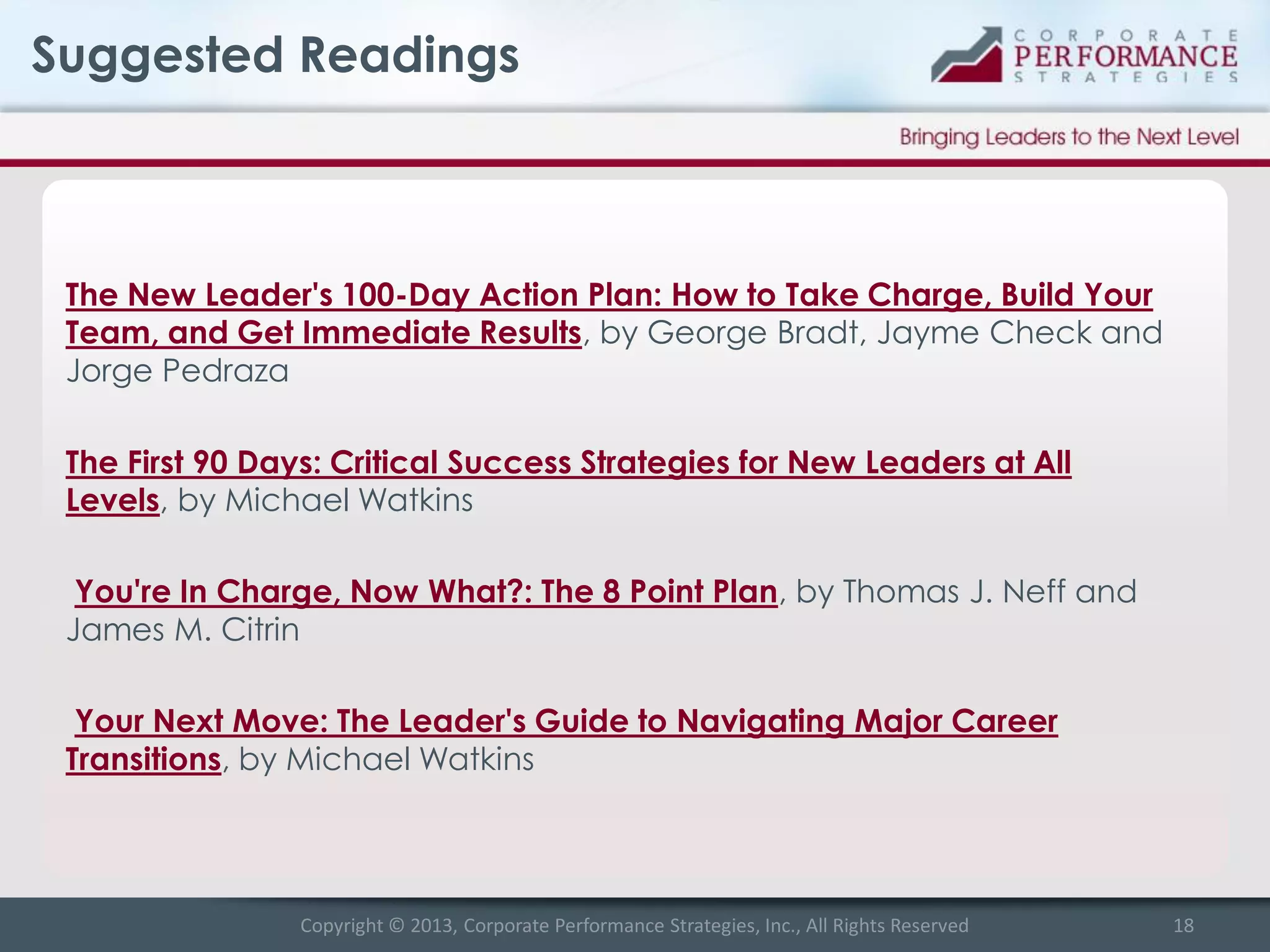
Suggested Readings

The New Leader's 100-Day Action Plan: How to Take Charge, Build Your
Team, and Get Immediate Results, by George Bradt, Jayme Check and
Jorge Pedraza
The First 90 Days: Critical Success Strategies for New Leaders at All
Levels, by Michael Watkins
You're In Charge, Now What?: The 8 Point Plan, by Thomas J. Neff and
James M. Citrin

Your Next Move: The Leader's Guide to Navigating Major Career
Transitions, by Michael Watkins

Copyright © 2013, Corporate Performance Strategies, Inc., All Rights Reserved

18
Please contact me at:
Dave Brookmire, Ph.D.
770-587-2265
dbrookmire@cpstrat.com

CPS transforms teams, leaders and organizations by increasing
operational efficiencies from 60% to 96%, improving employee
engagement scores by up to 25%, and building leadership
performance effectiveness by 36%. Our practical and customized
solutions offer real results for a proven track record of success.

Copyright © 2013, Corporate Performance Strategies, Inc., All Rights Reserved

19

New leader onboarding best practices

  • 1.
    New Leader Onboarding: BestPractices for Success David Brookmire, President Corporate Performance Strategies www.cpstrat.com Copyright © 2013, Corporate Performance Strategies, Inc., All Rights Reserved 1
  • 2.
    The CPS CompetitiveAdvantage Global industry-leading organizations including: IHG, Flowers Foods, Arthritis Foundation, Colliers International Medical University of South Carolina, and many others • Advanced degrees • Certifications in multiple assessments and coaching methodologies Former senior executives • An average of 20+ years’ professional experience advising senior leaders • MISSION ADP, Platinum Equity, LexisNexis, Bekaert, Cisco, McKesson • EXPERIENCE • • CREDENTIALS Darden Restaurants, The Cheesecake Factory, Coca-Cola • CLIENTS • Designed and implemented proven solutions and processes • Transform your leaders from ordinary to extraordinary • Become your trusted leadership advisor Copyright © 2013, Corporate Performance Strategies, Inc., All Rights Reserved 2
  • 3.
    Business Case forOnboarding Leaders • McKinsey & Co. found that 40% of corporate officers in 77 companies said they can't pursue business opportunities because they lack the right leadership • Harvard Business School reported a 40% to 60% failure rate of U.S. executives • In a U.S. Conference Board report, only 36% of employees rated their companies' leadership as good or excellent • Corporate Executive Board Recruiting Roundtable survey found 89% of new U.S. executive hires indicated they did not have the optimum level of knowledge and skills to do their job • Right Management Consultants' report indicated about 30% of new managers and executives fail at their new jobs and leave within 18 months Copyright © 2013, Corporate Performance Strategies, Inc., All Rights Reserved 3
  • 4.
    New Leader Onboarding Definedas: • Systematic process to integrate leaders into the organization, culture, team, function and role (more powerful than the orientation process) • Accommodating, assimilating and accelerating new executives • Building effectiveness and impact as quickly as possible Onboarding Framework Selection: Pre-hire/preonboarding Onboarding (1-3 months) Acceleration (4-12 months) Development (9-12 months) Copyright © 2013, Corporate Performance Strategies, Inc., All Rights Reserved 4
  • 5.
    Onboarding (Months 1-3)Phases Objectives: What you want to accomplish in terms of the people, role, stakeholders, operations, etc. over the first 90 days Look at the first 90 days (after leader is hired) as having 3 phases that overlap: Discovery • Phase 1 • Focuses on accelerated learning & establishing relationships with key stakeholders (Days 0-15) Diagnosis • Phase 2 • Analysis and review of all information required to build the revised strategy, plan, structure, culture, operations, etc. (Days 16-65) • Phase 3 Direction • Preliminary conclusions about strategy, structure, people, financials, etc. Establish goals & action plans. Communicate & implement plans. (Days 66-90) Copyright © 2013, Corporate Performance Strategies, Inc., All Rights Reserved 5
  • 6.
    Elements of OnboardingBest Practices All of these elements are in process at the same time. Follow these “best practices” to achieve. Master the Job Establish Direction and Structure Communicate the Plans Implement Management Process Build Knowledge Complete Assessments Seek Stakeholder Alignment Build Your Team Copyright © 2013, Corporate Performance Strategies, Inc., All Rights Reserved 6
  • 7.
    Best Practice –Create a 90 Day Plan Discovery Phase The first step is to establish the objectives to accomplish in the first 90 days in the following areas: • • • • • • • • • • Promote Yourself Accelerate Your Learning Match Strategy to Situation Secure Early Wins Negotiate Success Achieve Alignment Build Your Team Create Coalitions Keep Your Balance Expedite Everyone Michael Watkins, First 90 Days Copyright © 2013, Corporate Performance Strategies, Inc., All Rights Reserved 7
  • 8.
    Best Practice –Sample 90 Day Plan 90 Day Objectives: Sample Plan for EVP • Craft and deliver key messages • Clarify roles and expectations with key internal and external stakeholders • Promote myself: understand strengths and development needs for new role, incorporating learning from Hogan Potential and Challenge profiles • Develop and launch process for development of AR strategic plan with AR leaders and other key stakeholders • Understand and influence 2010 budget • Participate in and influence the company’s re-alignment • Assess “organizational shaping” needs (strategy/structure/people/culture/processes) • Outline preliminary new structure for AR and assess internal candidates (or gaps) for key leadership positions Copyright © 2013, Corporate Performance Strategies, Inc., All Rights Reserved 8
  • 9.
    Best Practice –Assessments Discovery and Diagnosis Phases Another best practice is to help the new leader identify his/her strengths and weaknesses (blind spots and derailers) by using a variety of assessments. Leaders have found the Hogan assessment family very helpful for their own self awareness: Challenge Report – 11 potential derailers Potential Report – Leadership style Values Report – Type of culture created and liked Copyright © 2013, Corporate Performance Strategies, Inc., All Rights Reserved 9
  • 10.
    Best Practice –Team Assimilation Discovery Phase • • • • • New leader conveys expectations and direction Address surface issues that would fester over time Accelerate the relationship with the team Build the team culture Discuss key business and team issues One of the most critical elements for new leaders is to build the trust and gain support of their teams. This team assimilation process is often used as a way for the leader to set expectations for their team, address key issues, and respond to tough questions anonymously. A coach interviews the team with pre-determined questions, collects the answers and reviews them with the leader prior to the team assimilation meeting. Best to complete this during the first 2-3 weeks. Copyright © 2013, Corporate Performance Strategies, Inc., All Rights Reserved 10
  • 11.
    Best Practice –Team Assimilation Sample Team Questions • What do you know about (New Leader) already? • What don’t you know about (New Leader) but would like to know? • What should (New Leader) know about the team’s skills, experience, and dynamics? • What concerns do you have about (New Leader) taking the role? Concerns about what he/she might do? Sample Leader Questions • What are your hot buttons? • What are your priorities and goals for the team? • What are things at the Company that should be changed? • How do you describe your management style? Copyright © 2013, Corporate Performance Strategies, Inc., All Rights Reserved 11
  • 12.
    Best Practice –Boss Assimilation Discovery Phase Another best practice is to accelerate the development of a strong working relationship with the new leader’s boss by working with a coach to facilitate the discussion. • • • Accelerate the development of the new leader and their Manager’s relationship Provide efficient platform for sharing of expectations Establish a coaching relationship Sample Boss Questions • • • • • • • What’s the best way to get started in this relationship building process? Your preferences in having great working relationships? Based on the Hogan feedback, what do each of you bring to the relationships as strengths? What areas do you need to help each out with? Expectations for the role from your perspectives. Initial impressions of the key challenges. Next Steps Copyright © 2013, Corporate Performance Strategies, Inc., All Rights Reserved 12
  • 13.
    Best Practice –Stakeholder Analysis Discovery Phase Another best practice is to help new leaders focus their time and attention on the stakeholders that matter the most Use this simple tool to help new leaders sort out who has the most importance. With limited time the new leader wants to develop relationships and align stakeholders to their plans. Stakeholder Name Technical Success Network Influence Total Action Plan for Obtaining Support 1) 2) Instructions for Exercise 4) 1. Identify your top 9-10 key stakeholders. 2. 3) Determine degree of technical, support, and influence using the scale of 1 – 10 with 1= low and 10 = high. 5) 6) Copyright © 2013, Corporate Performance Strategies, Inc., All Rights Reserved 13
  • 14.
    Best Practice –SWOT INTERNAL Strengths Diagnosis and Direction Phases One of the core areas during the 90 days is to come out of this initial period of time with the direction to take going forward. Use a SWOT analysis to help determine their strategy and direction. Weaknesses Determine what the company does really well internally versus the competition. Determine what the company does poorly internally versus the competition. Examples: •Lots of experience •Technical knowledge •High employee engagement •Quality brand name •Market leader •Reputation Examples: •Process controls and standards •Building, infrastructure, and IT •Open manager positions and first-level needs development •Internal reputation – Difficult to work with, resistant to change, complacent •High costs vs. competition EXTERNAL Opportunities Threats Determine what is external that can be turned into business. Determine what is external that can be turned into business. Examples: •Export/import growth •Identify new products/markets– expand portfolio •Acquisitions •Provider of solutions/systems to solve customer’s problem •Strategic alliances/partnerships with suppliers Examples: •Incoming companies to the local area •Management turnover •Imports •Raw materials shortages •Succession planning - Pending retirements in the workforce Copyright © 2013, Corporate Performance Strategies, Inc., All Rights Reserved 14
  • 15.
    Best Practice –Vision, Mission, Values Direction Phase During the first 90 days leaders are compelled to examine the direction of their organization, department, and function by developing a vision, mission and values statements. This drives alignment among the team and provides the organization the needed direction, priorities, and guiding principles for actions going forward. Developing a Mission Statement  Mission statement describes the overall purpose of the organization.  Four questions your mission statement should answer: – What problem(s) do you solve? What need(s) do you fulfill? – What do you sell? How do you make your money? What is your revenue model? – How are you unique from everyone else out there? What is your unique selling proposition? – Who will you sell to? What is your target market?  When wording the mission statement, consider the organization's products, services, markets, values, and concern for public image, and maybe priorities of activities for survival.  Does the mission statement include sufficient description that the statement clearly separates the mission of the organization from other organizations? Developing a Vision Statement  The vision statement includes vivid description of where the organization will be in the future – 3-5 years out.  The vision is a compelling description of the state and function of the organization once it had implemented the strategic plan Developing a Values Statement  Values represent the core priorities in the organization’s culture, including what drives members’ priorities and how they truly act in the organization. Values are increasingly important in strategic planning.  Establish four to six core values from which the organization would like to operate. Consider values of customers, shareholders, employees and the community. Copyright © 2013, Corporate Performance Strategies, Inc., All Rights Reserved 15
  • 16.
    Best Practices byPhase Best Practice Discovery 90 Day Plan X Assessments X Team Assimilation X Boss Assimilation X Stakeholder Alignment X SWOT Diagnosis Direction X X Vision, Mission, Values Copyright © 2013, Corporate Performance Strategies, Inc., All Rights Reserved X X 16
  • 17.
    Action Steps Ask yourselfthese 3 questions 1. What improvements can you make to your current leader onboarding process? 2. What are the key barriers to success? 3. What 2-3 tangible steps can you take on the job? Copyright © 2013, Corporate Performance Strategies, Inc., All Rights Reserved 17
  • 18.
    Suggested Readings The NewLeader's 100-Day Action Plan: How to Take Charge, Build Your Team, and Get Immediate Results, by George Bradt, Jayme Check and Jorge Pedraza The First 90 Days: Critical Success Strategies for New Leaders at All Levels, by Michael Watkins You're In Charge, Now What?: The 8 Point Plan, by Thomas J. Neff and James M. Citrin Your Next Move: The Leader's Guide to Navigating Major Career Transitions, by Michael Watkins Copyright © 2013, Corporate Performance Strategies, Inc., All Rights Reserved 18
  • 19.
    Please contact meat: Dave Brookmire, Ph.D. 770-587-2265 dbrookmire@cpstrat.com CPS transforms teams, leaders and organizations by increasing operational efficiencies from 60% to 96%, improving employee engagement scores by up to 25%, and building leadership performance effectiveness by 36%. Our practical and customized solutions offer real results for a proven track record of success. Copyright © 2013, Corporate Performance Strategies, Inc., All Rights Reserved 19