Choosing the Best Leadership Coach
And Maximizing Results

David Brookmire, President
Corporate Performance Strategies
www.cpstrat.com

Copyright 2013 Corporate Performance Strategies. All rights reserved.

1
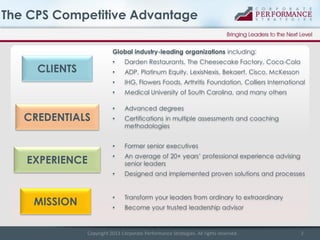
The CPS Competitive Advantage
Global industry-leading organizations including:
•

•

•

Advanced degrees

•

Certifications in multiple assessments and coaching
methodologies
Former senior executives

•

An average of 20+ years’ professional experience advising
senior leaders

•

MISSION

Medical University of South Carolina, and many others

•

Designed and implemented proven solutions and processes

•

Transform your leaders from ordinary to extraordinary

•

EXPERIENCE

IHG, Flowers Foods, Arthritis Foundation, Colliers International

•

CREDENTIALS

ADP, Platinum Equity, LexisNexis, Bekaert, Cisco, McKesson

•

CLIENTS

Darden Restaurants, The Cheesecake Factory, Coca-Cola

Become your trusted leadership advisor

Copyright 2013 Corporate Performance Strategies. All rights reserved.

2
Business Case for Executive Coaching

•

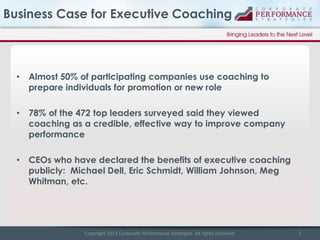
Almost 50% of participating companies use coaching to
prepare individuals for promotion or new role

•

78% of the 472 top leaders surveyed said they viewed
coaching as a credible, effective way to improve company
performance

•

CEOs who have declared the benefits of executive coaching
publicly: Michael Dell, Eric Schmidt, William Johnson, Meg
Whitman, etc.

Copyright 2013 Corporate Performance Strategies. All rights reserved.

3
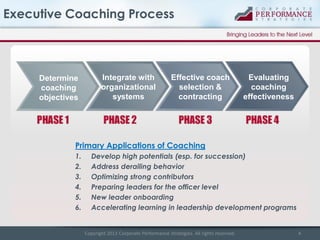
Executive Coaching Process

Determine
coaching
objectives

Integrate with
organizational
systems

Effective coach
selection &
contracting

Evaluating
coaching
effectiveness

Primary Applications of Coaching
1.
2.
3.
4.
5.
6.

Develop high potentials (esp. for succession)
Address derailing behavior
Optimizing strong contributors
Preparing leaders for the officer level
New leader onboarding
Accelerating learning in leadership development programs

Copyright 2013 Corporate Performance Strategies. All rights reserved.

4
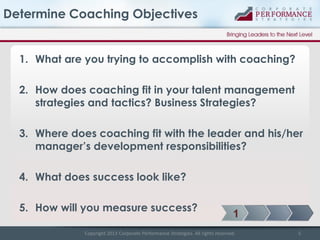
Determine Coaching Objectives

1. What are you trying to accomplish with coaching?
2. How does coaching fit in your talent management
strategies and tactics? Business Strategies?
3. Where does coaching fit with the leader and his/her
manager’s development responsibilities?
4. What does success look like?

5. How will you measure success?

1

Copyright 2013 Corporate Performance Strategies. All rights reserved.

5
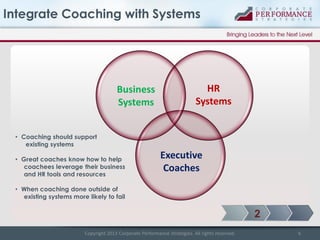
Integrate Coaching with Systems

Business
Systems

HR
Systems

• Coaching should support
existing systems
• Great coaches know how to help
coachees leverage their business
and HR tools and resources

Executive
Coaches

• When coaching done outside of
existing systems more likely to fail

2
Copyright 2013 Corporate Performance Strategies. All rights reserved.

6
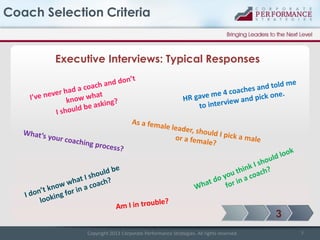
Coach Selection Criteria

Executive Interviews: Typical Responses

3
Copyright 2013 Corporate Performance Strategies. All rights reserved.

7
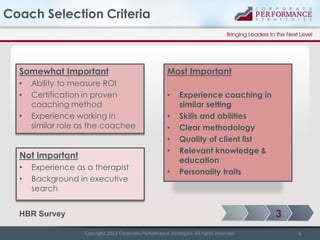
Coach Selection Criteria

Somewhat Important
•
•
•

Ability to measure ROI
Certification in proven
coaching method
Experience working in
similar role as the coachee

Not important
•
•

Experience as a therapist
Background in executive
search

Most Important
•
•
•
•
•
•

Experience coaching in
similar setting
Skills and abilities
Clear methodology
Quality of client list
Relevant knowledge &
education
Personality traits

3

HBR Survey
Copyright 2013 Corporate Performance Strategies. All rights reserved.

8
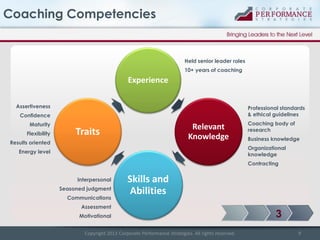
Coaching Competencies

Held senior leader roles
10+ years of coaching

Experience
Assertiveness

Professional standards
& ethical guidelines

Confidence
Maturity

Flexibility

Relevant
Knowledge

Traits

Results oriented

Coaching body of
research
Business knowledge

Organizational
knowledge

Energy level

Contracting
Interpersonal
Seasoned judgment

Communications

Skills and
Abilities

Assessment
Motivational
Copyright 2013 Corporate Performance Strategies. All rights reserved.

3
9
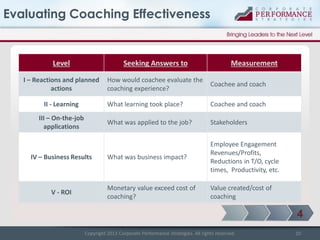
Evaluating Coaching Effectiveness

Level

Seeking Answers to

I – Reactions and planned
actions

How would coachee evaluate the
coaching experience?

Coachee and coach

What learning took place?

Coachee and coach

What was applied to the job?

Stakeholders

What was business impact?

Employee Engagement
Revenues/Profits,
Reductions in T/O, cycle
times, Productivity, etc.

Monetary value exceed cost of
coaching?

Value created/cost of
coaching

II - Learning
III – On-the-job
applications

IV – Business Results

V - ROI

Measurement

4
Copyright 2013 Corporate Performance Strategies. All rights reserved.

10
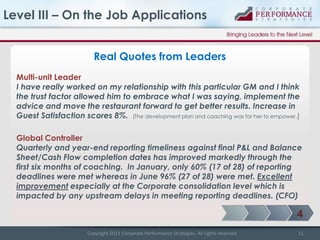
Level III – On the Job Applications
Real Quotes from Leaders
Multi-unit Leader
I have really worked on my relationship with this particular GM and I think
the trust factor allowed him to embrace what I was saying, implement the
advice and move the restaurant forward to get better results. Increase in
Guest Satisfaction scores 8%. (The development plan and coaching was for her to empower.)
Global Controller
Quarterly and year-end reporting timeliness against final P&L and Balance
Sheet/Cash Flow completion dates has improved markedly through the
first six months of coaching. In January, only 60% (17 of 28) of reporting
deadlines were met whereas in June 96% (27 of 28) were met. Excellent
improvement especially at the Corporate consolidation level which is
impacted by any upstream delays in meeting reporting deadlines. (CFO)

4
Copyright 2013 Corporate Performance Strategies. All rights reserved.

11
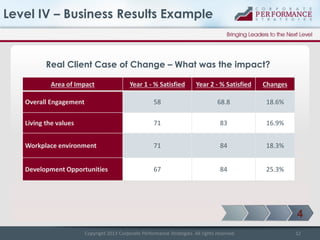
Level IV – Business Results Example

Real Client Case of Change – What was the impact?
Area of Impact

Year 1 - % Satisfied

Year 2 - % Satisfied

Changes

Overall Engagement

58

68.8

18.6%

Living the values

71

83

16.9%

Workplace environment

71

84

18.3%

Development Opportunities

67

84

25.3%

4
Copyright 2013 Corporate Performance Strategies. All rights reserved.

12
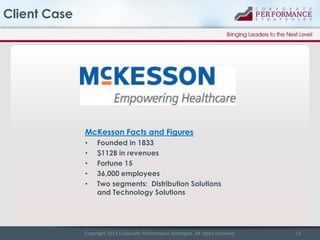
Client Case

McKesson Facts and Figures
•
•
•
•
•

Founded in 1833
$112B in revenues
Fortune 15
36,000 employees
Two segments: Distribution Solutions
and Technology Solutions

Copyright 2013 Corporate Performance Strategies. All rights reserved.

13
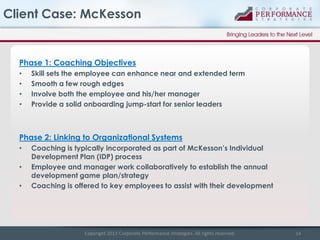
Client Case: McKesson

Phase 1: Coaching Objectives
•
•
•
•

Skill sets the employee can enhance near and extended term
Smooth a few rough edges
Involve both the employee and his/her manager
Provide a solid onboarding jump-start for senior leaders

Phase 2: Linking to Organizational Systems
•
•
•

Coaching is typically incorporated as part of McKesson’s Individual
Development Plan (IDP) process
Employee and manager work collaboratively to establish the annual
development game plan/strategy
Coaching is offered to key employees to assist with their development

Copyright 2013 Corporate Performance Strategies. All rights reserved.

14
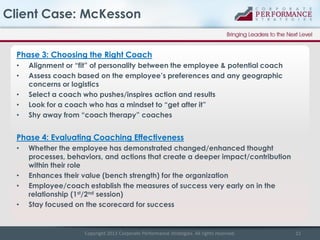
Client Case: McKesson
Phase 3: Choosing the Right Coach
•
•
•
•
•

Alignment or “fit” of personality between the employee & potential coach
Assess coach based on the employee’s preferences and any geographic
concerns or logistics
Select a coach who pushes/inspires action and results
Look for a coach who has a mindset to “get after it”
Shy away from “coach therapy” coaches

Phase 4: Evaluating Coaching Effectiveness
•

•
•

•

Whether the employee has demonstrated changed/enhanced thought
processes, behaviors, and actions that create a deeper impact/contribution
within their role
Enhances their value (bench strength) for the organization
Employee/coach establish the measures of success very early on in the
relationship (1st/2nd session)
Stay focused on the scorecard for success

Copyright 2013 Corporate Performance Strategies. All rights reserved.

15
Suggested Resources

For additional information and research on Choosing the Right Executive
Coach, please see the following resources:
Using Your Executive Coach, CCL Press, 2001, E. Wayne Hart and Karen
Kirkland
The CCL Handbook of Coaching: A Guide for the Leader Coach, JosseyBass, 2006, Editors: Sharon Ting and Peter Scisco
Leadership Coaching: When It's Right and When You're Ready, CCL
Press, 2008, Douglas Riddle
Coaching for Leadership: The Practice of Leadership Coaching from the
World's Greatest Coaches, 2ed, Pfeiffer, 2005, Marshall Goldsmith &
Laurence S. Lyons (Editors)
International Coaching Federation offers coaching competencies,
codes of ethics, credentialing programs, etc.

Copyright 2013 Corporate Performance Strategies. All rights reserved.

16
Please contact me at:
Dave Brookmire, Ph.D.
770-587-2265
dbrookmire@cpstrat.com

CPS transforms teams, leaders and organizations by increasing
operational efficiencies from 60% to 96%, improving employee
engagement scores by up to 25%, and building leadership
performance effectiveness by 36%. Our practical and customized
solutions offer real results for a proven track record of success.

Copyright 2013 Corporate Performance Strategies. All rights reserved.

17

Choose the Right Leadership Coach for You

  • 1.
    Choosing the BestLeadership Coach And Maximizing Results David Brookmire, President Corporate Performance Strategies www.cpstrat.com Copyright 2013 Corporate Performance Strategies. All rights reserved. 1
  • 2.
    The CPS CompetitiveAdvantage Global industry-leading organizations including: • • • Advanced degrees • Certifications in multiple assessments and coaching methodologies Former senior executives • An average of 20+ years’ professional experience advising senior leaders • MISSION Medical University of South Carolina, and many others • Designed and implemented proven solutions and processes • Transform your leaders from ordinary to extraordinary • EXPERIENCE IHG, Flowers Foods, Arthritis Foundation, Colliers International • CREDENTIALS ADP, Platinum Equity, LexisNexis, Bekaert, Cisco, McKesson • CLIENTS Darden Restaurants, The Cheesecake Factory, Coca-Cola Become your trusted leadership advisor Copyright 2013 Corporate Performance Strategies. All rights reserved. 2
  • 3.
    Business Case forExecutive Coaching • Almost 50% of participating companies use coaching to prepare individuals for promotion or new role • 78% of the 472 top leaders surveyed said they viewed coaching as a credible, effective way to improve company performance • CEOs who have declared the benefits of executive coaching publicly: Michael Dell, Eric Schmidt, William Johnson, Meg Whitman, etc. Copyright 2013 Corporate Performance Strategies. All rights reserved. 3
  • 4.
    Executive Coaching Process Determine coaching objectives Integratewith organizational systems Effective coach selection & contracting Evaluating coaching effectiveness Primary Applications of Coaching 1. 2. 3. 4. 5. 6. Develop high potentials (esp. for succession) Address derailing behavior Optimizing strong contributors Preparing leaders for the officer level New leader onboarding Accelerating learning in leadership development programs Copyright 2013 Corporate Performance Strategies. All rights reserved. 4
  • 5.
    Determine Coaching Objectives 1.What are you trying to accomplish with coaching? 2. How does coaching fit in your talent management strategies and tactics? Business Strategies? 3. Where does coaching fit with the leader and his/her manager’s development responsibilities? 4. What does success look like? 5. How will you measure success? 1 Copyright 2013 Corporate Performance Strategies. All rights reserved. 5
  • 6.
    Integrate Coaching withSystems Business Systems HR Systems • Coaching should support existing systems • Great coaches know how to help coachees leverage their business and HR tools and resources Executive Coaches • When coaching done outside of existing systems more likely to fail 2 Copyright 2013 Corporate Performance Strategies. All rights reserved. 6
  • 7.
    Coach Selection Criteria ExecutiveInterviews: Typical Responses 3 Copyright 2013 Corporate Performance Strategies. All rights reserved. 7
  • 8.
    Coach Selection Criteria SomewhatImportant • • • Ability to measure ROI Certification in proven coaching method Experience working in similar role as the coachee Not important • • Experience as a therapist Background in executive search Most Important • • • • • • Experience coaching in similar setting Skills and abilities Clear methodology Quality of client list Relevant knowledge & education Personality traits 3 HBR Survey Copyright 2013 Corporate Performance Strategies. All rights reserved. 8
  • 9.
    Coaching Competencies Held seniorleader roles 10+ years of coaching Experience Assertiveness Professional standards & ethical guidelines Confidence Maturity Flexibility Relevant Knowledge Traits Results oriented Coaching body of research Business knowledge Organizational knowledge Energy level Contracting Interpersonal Seasoned judgment Communications Skills and Abilities Assessment Motivational Copyright 2013 Corporate Performance Strategies. All rights reserved. 3 9
  • 10.
    Evaluating Coaching Effectiveness Level SeekingAnswers to I – Reactions and planned actions How would coachee evaluate the coaching experience? Coachee and coach What learning took place? Coachee and coach What was applied to the job? Stakeholders What was business impact? Employee Engagement Revenues/Profits, Reductions in T/O, cycle times, Productivity, etc. Monetary value exceed cost of coaching? Value created/cost of coaching II - Learning III – On-the-job applications IV – Business Results V - ROI Measurement 4 Copyright 2013 Corporate Performance Strategies. All rights reserved. 10
  • 11.
    Level III –On the Job Applications Real Quotes from Leaders Multi-unit Leader I have really worked on my relationship with this particular GM and I think the trust factor allowed him to embrace what I was saying, implement the advice and move the restaurant forward to get better results. Increase in Guest Satisfaction scores 8%. (The development plan and coaching was for her to empower.) Global Controller Quarterly and year-end reporting timeliness against final P&L and Balance Sheet/Cash Flow completion dates has improved markedly through the first six months of coaching. In January, only 60% (17 of 28) of reporting deadlines were met whereas in June 96% (27 of 28) were met. Excellent improvement especially at the Corporate consolidation level which is impacted by any upstream delays in meeting reporting deadlines. (CFO) 4 Copyright 2013 Corporate Performance Strategies. All rights reserved. 11
  • 12.
    Level IV –Business Results Example Real Client Case of Change – What was the impact? Area of Impact Year 1 - % Satisfied Year 2 - % Satisfied Changes Overall Engagement 58 68.8 18.6% Living the values 71 83 16.9% Workplace environment 71 84 18.3% Development Opportunities 67 84 25.3% 4 Copyright 2013 Corporate Performance Strategies. All rights reserved. 12
  • 13.
    Client Case McKesson Factsand Figures • • • • • Founded in 1833 $112B in revenues Fortune 15 36,000 employees Two segments: Distribution Solutions and Technology Solutions Copyright 2013 Corporate Performance Strategies. All rights reserved. 13
  • 14.
    Client Case: McKesson Phase1: Coaching Objectives • • • • Skill sets the employee can enhance near and extended term Smooth a few rough edges Involve both the employee and his/her manager Provide a solid onboarding jump-start for senior leaders Phase 2: Linking to Organizational Systems • • • Coaching is typically incorporated as part of McKesson’s Individual Development Plan (IDP) process Employee and manager work collaboratively to establish the annual development game plan/strategy Coaching is offered to key employees to assist with their development Copyright 2013 Corporate Performance Strategies. All rights reserved. 14
  • 15.
    Client Case: McKesson Phase3: Choosing the Right Coach • • • • • Alignment or “fit” of personality between the employee & potential coach Assess coach based on the employee’s preferences and any geographic concerns or logistics Select a coach who pushes/inspires action and results Look for a coach who has a mindset to “get after it” Shy away from “coach therapy” coaches Phase 4: Evaluating Coaching Effectiveness • • • • Whether the employee has demonstrated changed/enhanced thought processes, behaviors, and actions that create a deeper impact/contribution within their role Enhances their value (bench strength) for the organization Employee/coach establish the measures of success very early on in the relationship (1st/2nd session) Stay focused on the scorecard for success Copyright 2013 Corporate Performance Strategies. All rights reserved. 15
  • 16.
    Suggested Resources For additionalinformation and research on Choosing the Right Executive Coach, please see the following resources: Using Your Executive Coach, CCL Press, 2001, E. Wayne Hart and Karen Kirkland The CCL Handbook of Coaching: A Guide for the Leader Coach, JosseyBass, 2006, Editors: Sharon Ting and Peter Scisco Leadership Coaching: When It's Right and When You're Ready, CCL Press, 2008, Douglas Riddle Coaching for Leadership: The Practice of Leadership Coaching from the World's Greatest Coaches, 2ed, Pfeiffer, 2005, Marshall Goldsmith & Laurence S. Lyons (Editors) International Coaching Federation offers coaching competencies, codes of ethics, credentialing programs, etc. Copyright 2013 Corporate Performance Strategies. All rights reserved. 16
  • 17.
    Please contact meat: Dave Brookmire, Ph.D. 770-587-2265 dbrookmire@cpstrat.com CPS transforms teams, leaders and organizations by increasing operational efficiencies from 60% to 96%, improving employee engagement scores by up to 25%, and building leadership performance effectiveness by 36%. Our practical and customized solutions offer real results for a proven track record of success. Copyright 2013 Corporate Performance Strategies. All rights reserved. 17