90 Day Leadership Plan
90 Day Leadership Plan Execution
A framework with directs, peers and stakeholders that
facilitates:

• Assessment of current state of xxx business: Sustain
success, Turnaround, Realign, Start-up
• Accelerated learning: Climb the organizational & geographic
learning curve quickly through a programmatic approach
• Alignment of strategy to situation through input:
   • People: Understand the team; perceptions of key stakeholders, identify quick wins and
     assemble a plan to build and motivate a high performing team based on the current state.
   • Customer & Partner: Understand xxxxxxs’ customer & partner lifecycle, build a plan to
     deliver the most rewarding engagement and highest satisfaction.
   • Operations: Identify current execution challenges, seek quick improvement wins and what
     is needed to get to the most efficient and predictable state.
   • Growth Plan: Understand existing strategy, evolve or build a multi-year plan that spans
     individual contributors and mgmt team to drive xxxxxxs’ xxx growth
   • Execution of plan: Full stakeholder review at 30, 60, 90 days to achieve ongoing insight
     and alignment
People
        Goal: Ascertain morale, status of the teams/people, past performance, culture and seek quick wins

        • Introduction to the xxxxxxs xxx business.
30/60      • All hands introduction (multiple to accommodate time zones if required)
           • Field tour: 1:1 introduction/Q&A with each team (geographic considerations) & departing leader to seek direct feedback, get the pulse of
             the team: morale, common themes (positive & negative), sense of urgency, speed of cultural change.
           • Skip level connection meetings to begin building trust and to seek input
        • Implement vitality curve review with mgmt team mapped by performance and tenure
           • Identification of high potentials, performance issues, potential change agents.
           • Identify key hiring issues and review recruitment plan
        • Execute 1:1s with direct reports reviewing past/present performance, career path, motivation, morale, goal setting.
           • Partner with HR and the departing leader to build management team vitality curve (tenure, performance).
           • Review succession plans.
           • Execute external assessment (i.e. Predictive index) to facilitate initial team building and understanding of team dynamics.
        • Identify key relationships in xxxxxxs (product support, partner groups, selling partners).
           • Organize networking 1:1s across organization (90 day timeline)
        • Assessment of existing communications vehicles and culture to facilitate ongoing bi-directional flow
           • Example: Monday morning mail, weekly/quarterly calls, blogs, etc)
        • Review existing rewards (i.e. Compensation, incentives) and recognition (i.e. Celebrating wins, birthdays) systems/culture
        • Engage HR partner for full review:
           • Existing budgets (training, morale), training programs (LMS, etc), performance tools, new hire on-boarding, mentor programs.
           • Current state review of top & bottom (i.e. Identified high potentials, performance issues) and review how xxxxxxs measures work health
             (management feedback, employee opinion polls)

        Formalize the high performing xxx plan
  90    • Implementation of key xxx themes (i.e. Net attractor of talent, great team, cross group) aligned with corporate vision and values
        • Understand team rhythm to people reviews, performance management, high potential management, communications model (1:1s at all
          levels, skip level pulse 1:1s, portals, email, voicemail, etc.)
        • Identification of changes that will lead to the highest of performing teams while delivering momentum building wins
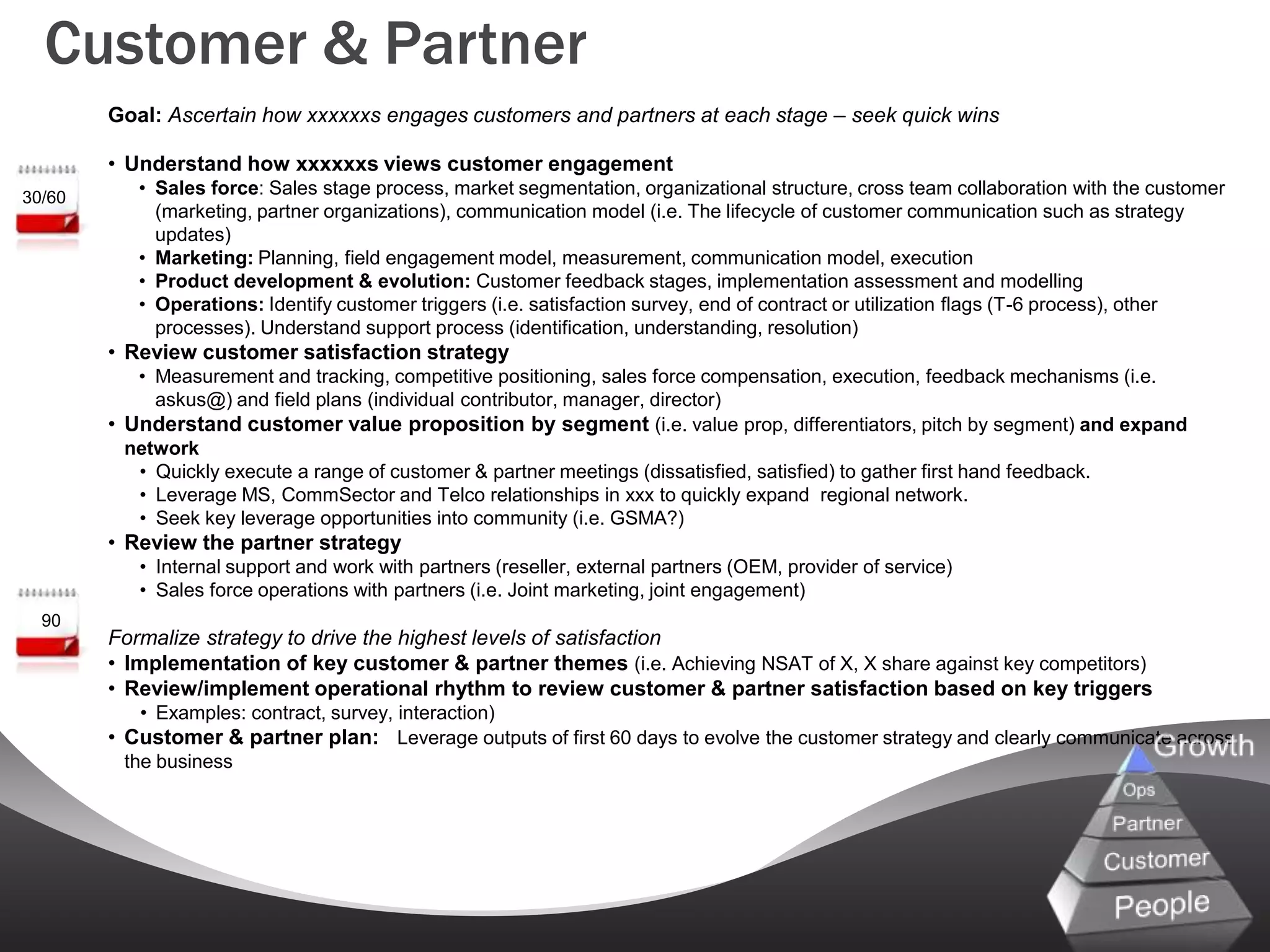
Customer & Partner
        Goal: Ascertain how xxxxxxs engages customers and partners at each stage – seek quick wins

        • Understand how xxxxxxs views customer engagement
30/60
           • Sales force: Sales stage process, market segmentation, organizational structure, cross team collaboration with the customer
             (marketing, partner organizations), communication model (i.e. The lifecycle of customer communication such as strategy
             updates)
           • Marketing: Planning, field engagement model, measurement, communication model, execution
           • Product development & evolution: Customer feedback stages, implementation assessment and modelling
           • Operations: Identify customer triggers (i.e. satisfaction survey, end of contract or utilization flags (T-6 process), other
             processes). Understand support process (identification, understanding, resolution)
        • Review customer satisfaction strategy
           • Measurement and tracking, competitive positioning, sales force compensation, execution, feedback mechanisms (i.e.
             askus@) and field plans (individual contributor, manager, director)
        • Understand customer value proposition by segment (i.e. value prop, differentiators, pitch by segment) and expand
          network
           • Quickly execute a range of customer & partner meetings (dissatisfied, satisfied) to gather first hand feedback.
           • Leverage MS, CommSector and Telco relationships in xxx to quickly expand regional network.
           • Seek key leverage opportunities into community (i.e. GSMA?)
        • Review the partner strategy
           • Internal support and work with partners (reseller, external partners (OEM, provider of service)
           • Sales force operations with partners (i.e. Joint marketing, joint engagement)
  90
        Formalize strategy to drive the highest levels of satisfaction
        • Implementation of key customer & partner themes (i.e. Achieving NSAT of X, X share against key competitors)
        • Review/implement operational rhythm to review customer & partner satisfaction based on key triggers
            • Examples: contract, survey, interaction)
        • Customer & partner plan: Leverage outputs of first 60 days to evolve the customer strategy and clearly communicate across
          the business
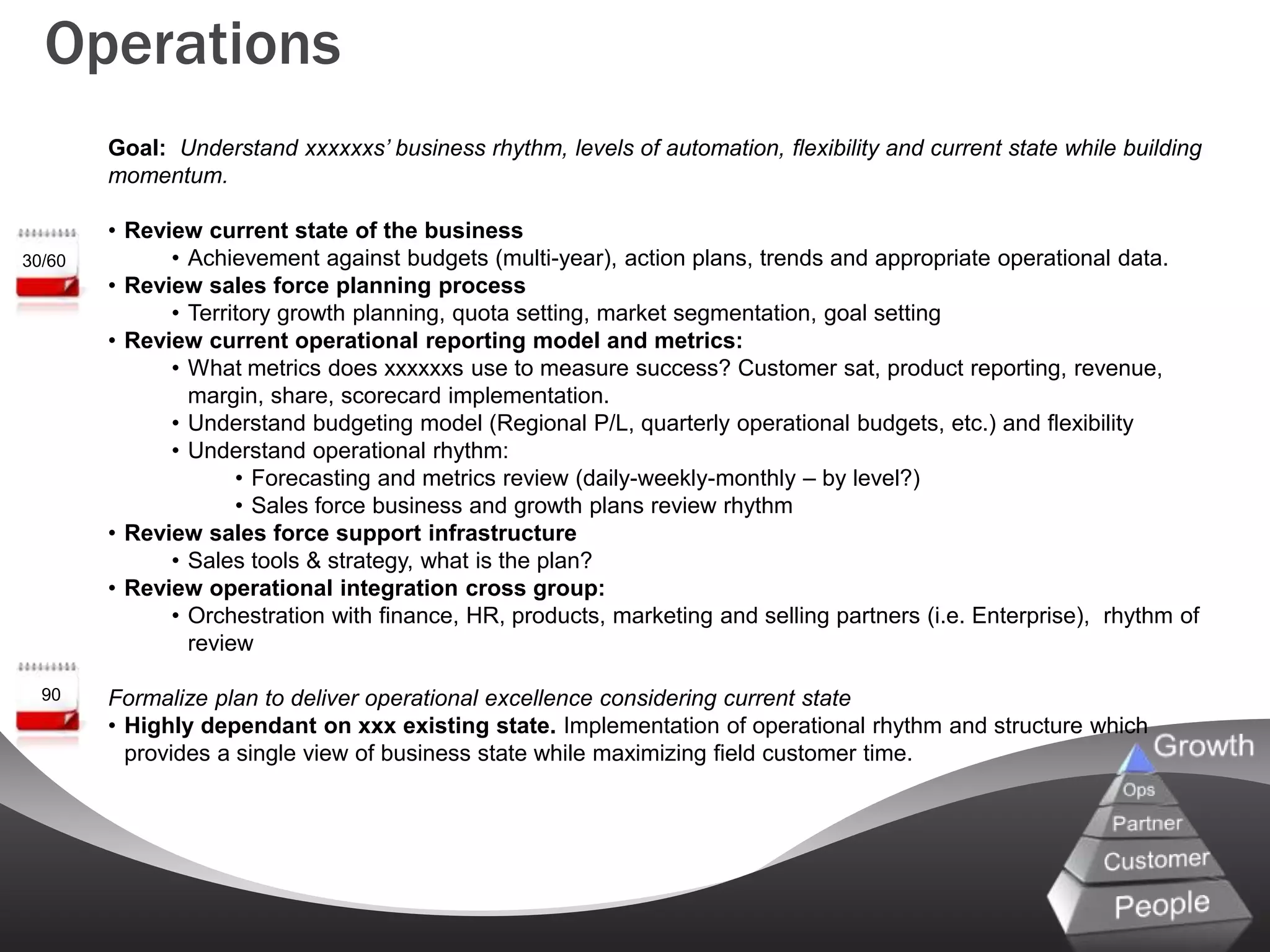
Operations
        Goal: Understand xxxxxxs’ business rhythm, levels of automation, flexibility and current state while building
        momentum.

        • Review current state of the business
30/60         • Achievement against budgets (multi-year), action plans, trends and appropriate operational data.
        • Review sales force planning process
              • Territory growth planning, quota setting, market segmentation, goal setting
        • Review current operational reporting model and metrics:
              • What metrics does xxxxxxs use to measure success? Customer sat, product reporting, revenue,
                margin, share, scorecard implementation.
              • Understand budgeting model (Regional P/L, quarterly operational budgets, etc.) and flexibility
              • Understand operational rhythm:
                     • Forecasting and metrics review (daily-weekly-monthly – by level?)
                     • Sales force business and growth plans review rhythm
        • Review sales force support infrastructure
              • Sales tools & strategy, what is the plan?
        • Review operational integration cross group:
              • Orchestration with finance, HR, products, marketing and selling partners (i.e. Enterprise), rhythm of
                review

  90    Formalize plan to deliver operational excellence considering current state
        • Highly dependant on xxx existing state. Implementation of operational rhythm and structure which
          provides a single view of business state while maximizing field customer time.
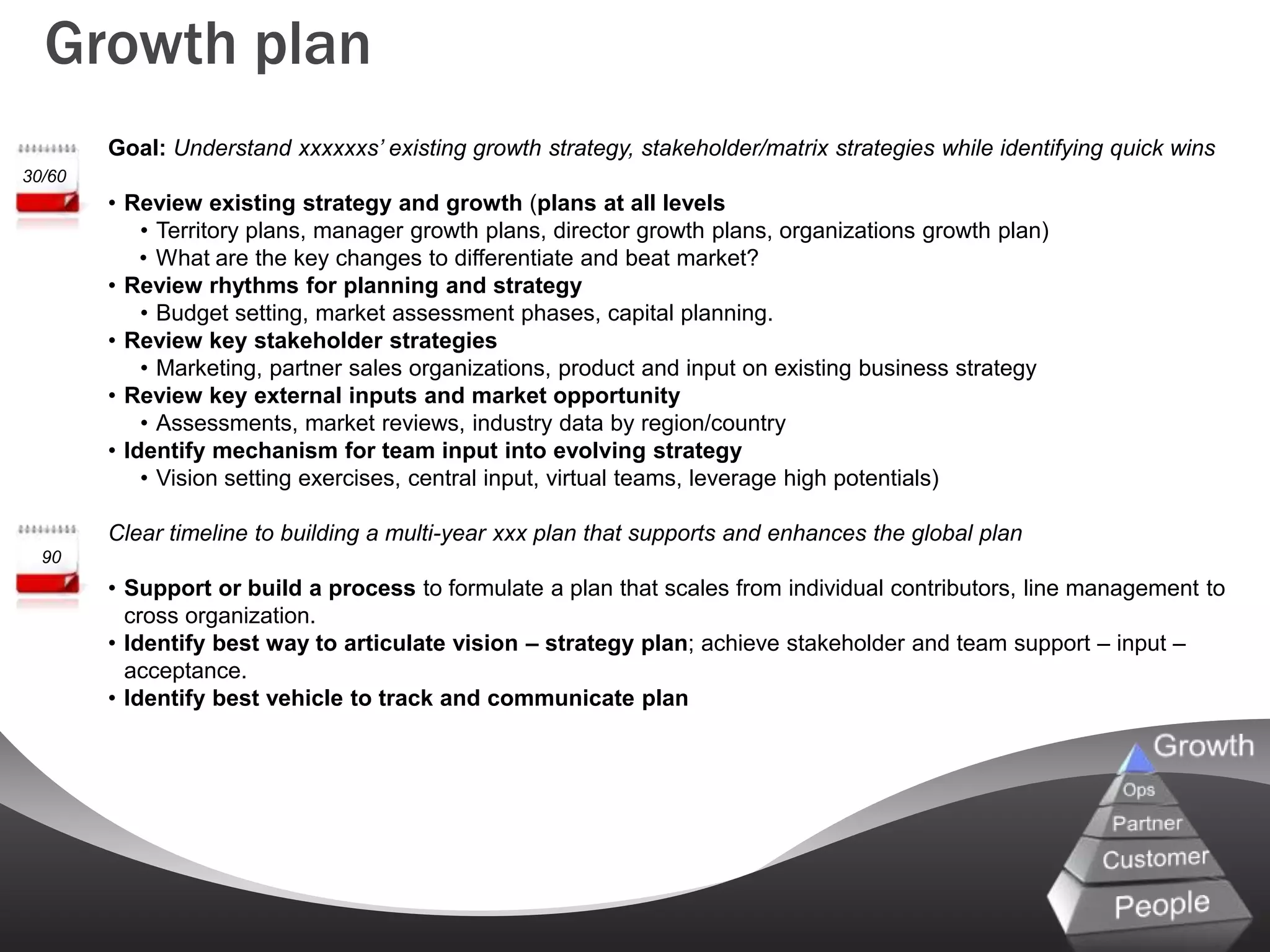
Growth plan
        Goal: Understand xxxxxxs’ existing growth strategy, stakeholder/matrix strategies while identifying quick wins
30/60
        • Review existing strategy and growth (plans at all levels
            • Territory plans, manager growth plans, director growth plans, organizations growth plan)
            • What are the key changes to differentiate and beat market?
        • Review rhythms for planning and strategy
            • Budget setting, market assessment phases, capital planning.
        • Review key stakeholder strategies
            • Marketing, partner sales organizations, product and input on existing business strategy
        • Review key external inputs and market opportunity
            • Assessments, market reviews, industry data by region/country
        • Identify mechanism for team input into evolving strategy
            • Vision setting exercises, central input, virtual teams, leverage high potentials)

        Clear timeline to building a multi-year xxx plan that supports and enhances the global plan
  90
        • Support or build a process to formulate a plan that scales from individual contributors, line management to
          cross organization.
        • Identify best way to articulate vision – strategy plan; achieve stakeholder and team support – input –
          acceptance.
        • Identify best vehicle to track and communicate plan
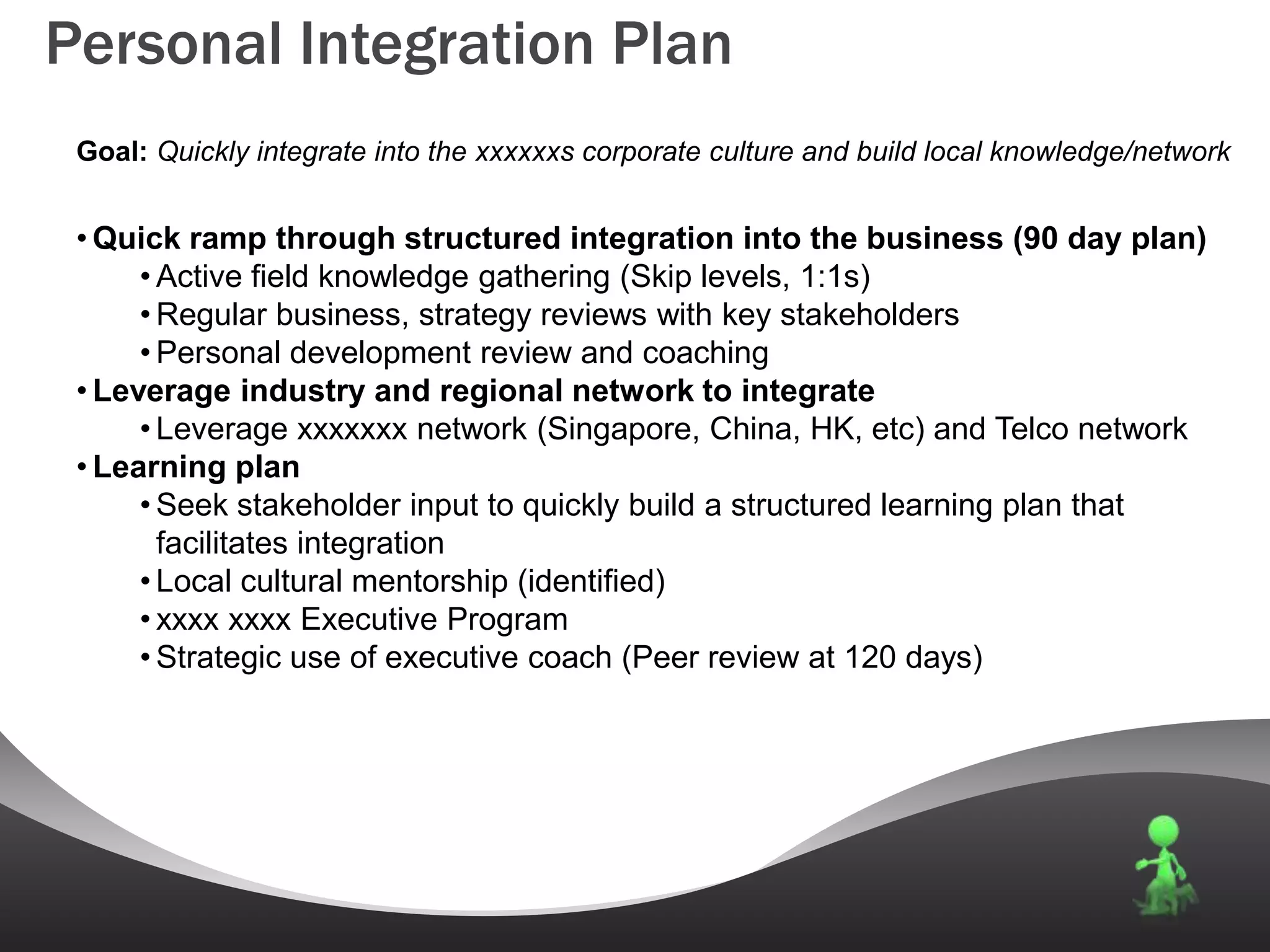
Personal Integration Plan
 Goal: Quickly integrate into the xxxxxxs corporate culture and build local knowledge/network


 • Quick ramp through structured integration into the business (90 day plan)
      • Active field knowledge gathering (Skip levels, 1:1s)
      • Regular business, strategy reviews with key stakeholders
      • Personal development review and coaching
 • Leverage industry and regional network to integrate
      • Leverage xxxxxxx network (Singapore, China, HK, etc) and Telco network
 • Learning plan
      • Seek stakeholder input to quickly build a structured learning plan that
        facilitates integration
      • Local cultural mentorship (identified)
      • xxxx xxxx Executive Program
      • Strategic use of executive coach (Peer review at 120 days)
Uploaded in support of
http://leadingasalestransformation.com

LeadingAST.com - Sample 90 day leadership plan

  • 1.
  • 2.
    90 Day LeadershipPlan Execution A framework with directs, peers and stakeholders that facilitates: • Assessment of current state of xxx business: Sustain success, Turnaround, Realign, Start-up • Accelerated learning: Climb the organizational & geographic learning curve quickly through a programmatic approach • Alignment of strategy to situation through input: • People: Understand the team; perceptions of key stakeholders, identify quick wins and assemble a plan to build and motivate a high performing team based on the current state. • Customer & Partner: Understand xxxxxxs’ customer & partner lifecycle, build a plan to deliver the most rewarding engagement and highest satisfaction. • Operations: Identify current execution challenges, seek quick improvement wins and what is needed to get to the most efficient and predictable state. • Growth Plan: Understand existing strategy, evolve or build a multi-year plan that spans individual contributors and mgmt team to drive xxxxxxs’ xxx growth • Execution of plan: Full stakeholder review at 30, 60, 90 days to achieve ongoing insight and alignment
  • 3.
    People Goal: Ascertain morale, status of the teams/people, past performance, culture and seek quick wins • Introduction to the xxxxxxs xxx business. 30/60 • All hands introduction (multiple to accommodate time zones if required) • Field tour: 1:1 introduction/Q&A with each team (geographic considerations) & departing leader to seek direct feedback, get the pulse of the team: morale, common themes (positive & negative), sense of urgency, speed of cultural change. • Skip level connection meetings to begin building trust and to seek input • Implement vitality curve review with mgmt team mapped by performance and tenure • Identification of high potentials, performance issues, potential change agents. • Identify key hiring issues and review recruitment plan • Execute 1:1s with direct reports reviewing past/present performance, career path, motivation, morale, goal setting. • Partner with HR and the departing leader to build management team vitality curve (tenure, performance). • Review succession plans. • Execute external assessment (i.e. Predictive index) to facilitate initial team building and understanding of team dynamics. • Identify key relationships in xxxxxxs (product support, partner groups, selling partners). • Organize networking 1:1s across organization (90 day timeline) • Assessment of existing communications vehicles and culture to facilitate ongoing bi-directional flow • Example: Monday morning mail, weekly/quarterly calls, blogs, etc) • Review existing rewards (i.e. Compensation, incentives) and recognition (i.e. Celebrating wins, birthdays) systems/culture • Engage HR partner for full review: • Existing budgets (training, morale), training programs (LMS, etc), performance tools, new hire on-boarding, mentor programs. • Current state review of top & bottom (i.e. Identified high potentials, performance issues) and review how xxxxxxs measures work health (management feedback, employee opinion polls) Formalize the high performing xxx plan 90 • Implementation of key xxx themes (i.e. Net attractor of talent, great team, cross group) aligned with corporate vision and values • Understand team rhythm to people reviews, performance management, high potential management, communications model (1:1s at all levels, skip level pulse 1:1s, portals, email, voicemail, etc.) • Identification of changes that will lead to the highest of performing teams while delivering momentum building wins
  • 4.
    Customer & Partner Goal: Ascertain how xxxxxxs engages customers and partners at each stage – seek quick wins • Understand how xxxxxxs views customer engagement 30/60 • Sales force: Sales stage process, market segmentation, organizational structure, cross team collaboration with the customer (marketing, partner organizations), communication model (i.e. The lifecycle of customer communication such as strategy updates) • Marketing: Planning, field engagement model, measurement, communication model, execution • Product development & evolution: Customer feedback stages, implementation assessment and modelling • Operations: Identify customer triggers (i.e. satisfaction survey, end of contract or utilization flags (T-6 process), other processes). Understand support process (identification, understanding, resolution) • Review customer satisfaction strategy • Measurement and tracking, competitive positioning, sales force compensation, execution, feedback mechanisms (i.e. askus@) and field plans (individual contributor, manager, director) • Understand customer value proposition by segment (i.e. value prop, differentiators, pitch by segment) and expand network • Quickly execute a range of customer & partner meetings (dissatisfied, satisfied) to gather first hand feedback. • Leverage MS, CommSector and Telco relationships in xxx to quickly expand regional network. • Seek key leverage opportunities into community (i.e. GSMA?) • Review the partner strategy • Internal support and work with partners (reseller, external partners (OEM, provider of service) • Sales force operations with partners (i.e. Joint marketing, joint engagement) 90 Formalize strategy to drive the highest levels of satisfaction • Implementation of key customer & partner themes (i.e. Achieving NSAT of X, X share against key competitors) • Review/implement operational rhythm to review customer & partner satisfaction based on key triggers • Examples: contract, survey, interaction) • Customer & partner plan: Leverage outputs of first 60 days to evolve the customer strategy and clearly communicate across the business
  • 5.
    Operations Goal: Understand xxxxxxs’ business rhythm, levels of automation, flexibility and current state while building momentum. • Review current state of the business 30/60 • Achievement against budgets (multi-year), action plans, trends and appropriate operational data. • Review sales force planning process • Territory growth planning, quota setting, market segmentation, goal setting • Review current operational reporting model and metrics: • What metrics does xxxxxxs use to measure success? Customer sat, product reporting, revenue, margin, share, scorecard implementation. • Understand budgeting model (Regional P/L, quarterly operational budgets, etc.) and flexibility • Understand operational rhythm: • Forecasting and metrics review (daily-weekly-monthly – by level?) • Sales force business and growth plans review rhythm • Review sales force support infrastructure • Sales tools & strategy, what is the plan? • Review operational integration cross group: • Orchestration with finance, HR, products, marketing and selling partners (i.e. Enterprise), rhythm of review 90 Formalize plan to deliver operational excellence considering current state • Highly dependant on xxx existing state. Implementation of operational rhythm and structure which provides a single view of business state while maximizing field customer time.
  • 6.
    Growth plan Goal: Understand xxxxxxs’ existing growth strategy, stakeholder/matrix strategies while identifying quick wins 30/60 • Review existing strategy and growth (plans at all levels • Territory plans, manager growth plans, director growth plans, organizations growth plan) • What are the key changes to differentiate and beat market? • Review rhythms for planning and strategy • Budget setting, market assessment phases, capital planning. • Review key stakeholder strategies • Marketing, partner sales organizations, product and input on existing business strategy • Review key external inputs and market opportunity • Assessments, market reviews, industry data by region/country • Identify mechanism for team input into evolving strategy • Vision setting exercises, central input, virtual teams, leverage high potentials) Clear timeline to building a multi-year xxx plan that supports and enhances the global plan 90 • Support or build a process to formulate a plan that scales from individual contributors, line management to cross organization. • Identify best way to articulate vision – strategy plan; achieve stakeholder and team support – input – acceptance. • Identify best vehicle to track and communicate plan
  • 7.
    Personal Integration Plan Goal: Quickly integrate into the xxxxxxs corporate culture and build local knowledge/network • Quick ramp through structured integration into the business (90 day plan) • Active field knowledge gathering (Skip levels, 1:1s) • Regular business, strategy reviews with key stakeholders • Personal development review and coaching • Leverage industry and regional network to integrate • Leverage xxxxxxx network (Singapore, China, HK, etc) and Telco network • Learning plan • Seek stakeholder input to quickly build a structured learning plan that facilitates integration • Local cultural mentorship (identified) • xxxx xxxx Executive Program • Strategic use of executive coach (Peer review at 120 days)
  • 8.
    Uploaded in supportof http://leadingasalestransformation.com