Women’s Rights

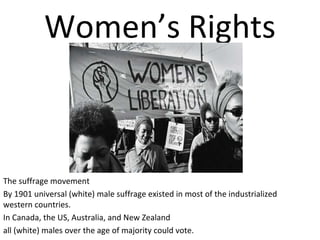
The suffrage movement
By 1901 universal (white) male suffrage existed in most of the industrialized
western countries.
In Canada, the US, Australia, and New Zealand
all (white) males over the age of majority could vote.
Women’s Suffrage

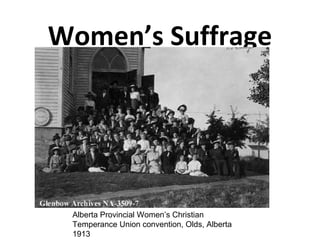
Alberta Provincial Women’s Christian
Temperance Union convention, Olds, Alberta
1913
The Woman’s movement pre
1900
• 1874 The Women’s Christian Temperance Union:
Formed originally to promote the prohibition of
alcohol later joined forces with the Canadian
Suffrage Association
• 1893 National Council of Women of Canada: Focused
on the needs of women and children
• 1897 Adelaide Hunter-Hoodless started the first
Woman’s institute promoting social reform and
better education for women
The affect of WWI on Women’s rights
• During World War I there was a conscription crisis.
This means that there was a shortage of soldiers
willing to fight in the war voluntarily
• 1917: The Military voters Act took the vote away
from conscientious objectors and allowed all men
and women in the armed forces to vote in any riding
they chose
• This was followed by the Wartime Elections Act
which gave the vote to the widows, wives, mothers
and adult daughters and sisters of Canadian men
serving overseas.
Women’s Rights
• January 26, 1916 Nellie Mc Clung, Francis Beynon,
Lillian Thomas along with many other women won
the right to vote in Manitoba
• Saskatchewan followed two months later
• Alberta in April
• BC in 1917
• Ontario 1917
• On May 24, 1918 all female citizens over the age of
21 received the right to vote in federal elections.
• Witness speaks about Nellie McLung's Mock Parlia
Beyond WWI
• The following year, the women's suffrage
movement made great advances and women
became eligible for election to the House of
Commons. In 1921, Agnes Macphail became
the first woman to be elected to the House.
More voting information
• The First World War brought the greatest changes to the
federal franchise. In 1915, the right to vote by mail was
granted to military electors in active service. In 1917,
Parliament passed the Wartime Elections Act and the Military
Voters Act. The right to vote was extended to all British
subjects, male or female, who were active or retired
members of the armed forces, including Indians (as defined
by the Indian Act) and persons under 21. Some 2,000 military
nurses, the "Bluebirds" became the first Canadian women to
use this right. Civilian men who were not landowners, but
who had a son or grandson in the armed forces, were also
temporarily granted the franchise, as were women with a
close relative serving, then or previously, in the Canadian
Forces.
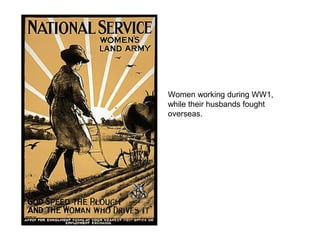
Women working during WW1,
while their husbands fought
overseas.
The Person’s Case
Emily Murphy was at the centre of one of Canada’s
most famous cases regarding the rights of women.
This is known as the Persons case
Emily was appointed magistrate of the police court
in Edmonton.
Making her the first female judge in the British
Empire.
She was challenged by a defence lawyer on the
grounds that she could not stand in judgment
against anyone as under the terms of the Canadian
Constitution Emily Murphy was not legally a person,
because she was a woman.
The Fight
• Legally this was true. In 1920, however the supreme Court of
Alberta ruled that every woman had the right to be a judge.
• This inspired a group of women to petition Prime Minister
Robert Borden for a woman to be appointed to the Senate.
They were refused on the grounds that women were not
persons under the B.N.A act and were therefore not eligible
for the Senate. By law any group of five citizens can petition
the Supreme court of Canada for the interpretation of a point
in the B.N.A act. A group of women who would become
known as the “Famous Five” or the “Alberta Five” petitioned
Ottawa to determine if under the Act women were persons.
Persons Under the Law
• The decision of the courts was that: Under
British common law the status of women is
this… “Women are persons in matters of pains
and penalties, but are not persons in matters
of rights and privileges” After weeks of
deliberating the Supreme Court delivered a
unanimous ruling. Since women did not have
the vote in 1867, they were not eligible to
become senators. So women were not
considered “qualified persons”
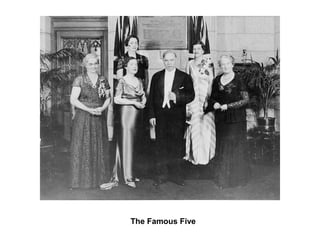
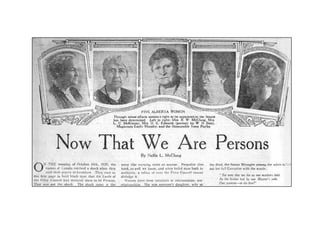
The Famous Five
Continuing the fight
• Discouraged but not defeated Emily
Murphy and the “Famous Five”
(Nellie McClung, Louise Mc Kinney,
Henrietta Edwards and Irene Parlby)
decided to appeal the decision to the
Privy Council in London.
Victory
• In October 1929, the Privy Council in London
(the highest court of appeal in Canada at that
time) reversed the decision of Canada’s
Supreme court by declaring that “the word
persons includes members of the male and
female sex… and that women are eligible to
be summoned and become members of the
Senate of Canada.” The ruling noted that
excluding women from the term person was a
“relic of days more barbarous than ours”
Royal Commission on the Status of
Women
• The Royal Commission on the Status of
Women
• A Canadian Royal Commission to examine the
status of women in Canada
• It was designed to recommend steps that the
federal government could take to ensure
equal opportunities between men and women
in all aspects of Canadian society.
Reproductive Rights
• Abortion was illegal in Canada until 1969
• Between 1969 and 1988 abortions were only
performed under very restrictive circumstances and
remained a part of the criminal code
• The abortion issue was taken to the Supreme Court of
Canada by Henry Morgantaler, a doctor who wanted
to establish abortion clinics.
• In the R. v. Morgantaler case in 1988, Canada's
abortion law was struck down by the Supreme Court
using the right to life, liberty and security of the person
section of the Charter of Rights and Freedoms
Time Line: The Road to political rights for
Women in Canada
 1916 Women win the right to vote and hold political office in Manitoba,
Saskatchewan and Alberta
 1917 Nurses serving in WWI and wives, widows, mothers, sisters and
daughters of soldiers extended the right to vote. Women win the right to
vote in BC and Ontario
 1918 Women who are over 21 and are British subjects win the right to vote in
Nova Scotia and federal elections
 1920 Dominion Elections Act allows women to run for election to parliament
 1921 Agnes Macphail elected first female MP
 1922 Women get the right to vote in PEI
 1925 Women get the right to vote in Newfoundland
 1928 Supreme Court of Canada rules unanimously that women are not
persons under the BNA act.
 1929 British Privy Council overturns Supreme Court ruling and recognizes
women to be persons under the law
 1930 Carnie Wilson first woman appointed to the Senate
 1940 women over 21 get the right to vote in Québec
 1960 the Aboriginal peoples of Canada gain the right to vote in Federal
Elections.
 1970 Royal Commission on the Status of Women

6.3 women’s rights website

  • 1.
    Women’s Rights The suffragemovement By 1901 universal (white) male suffrage existed in most of the industrialized western countries. In Canada, the US, Australia, and New Zealand all (white) males over the age of majority could vote.
  • 3.
    Women’s Suffrage Alberta ProvincialWomen’s Christian Temperance Union convention, Olds, Alberta 1913
  • 4.
    The Woman’s movementpre 1900 • 1874 The Women’s Christian Temperance Union: Formed originally to promote the prohibition of alcohol later joined forces with the Canadian Suffrage Association • 1893 National Council of Women of Canada: Focused on the needs of women and children • 1897 Adelaide Hunter-Hoodless started the first Woman’s institute promoting social reform and better education for women
  • 5.
    The affect ofWWI on Women’s rights • During World War I there was a conscription crisis. This means that there was a shortage of soldiers willing to fight in the war voluntarily • 1917: The Military voters Act took the vote away from conscientious objectors and allowed all men and women in the armed forces to vote in any riding they chose • This was followed by the Wartime Elections Act which gave the vote to the widows, wives, mothers and adult daughters and sisters of Canadian men serving overseas.
  • 6.
    Women’s Rights • January26, 1916 Nellie Mc Clung, Francis Beynon, Lillian Thomas along with many other women won the right to vote in Manitoba • Saskatchewan followed two months later • Alberta in April • BC in 1917 • Ontario 1917 • On May 24, 1918 all female citizens over the age of 21 received the right to vote in federal elections.
  • 7.
    • Witness speaksabout Nellie McLung's Mock Parlia
  • 8.
    Beyond WWI • Thefollowing year, the women's suffrage movement made great advances and women became eligible for election to the House of Commons. In 1921, Agnes Macphail became the first woman to be elected to the House.
  • 9.
    More voting information •The First World War brought the greatest changes to the federal franchise. In 1915, the right to vote by mail was granted to military electors in active service. In 1917, Parliament passed the Wartime Elections Act and the Military Voters Act. The right to vote was extended to all British subjects, male or female, who were active or retired members of the armed forces, including Indians (as defined by the Indian Act) and persons under 21. Some 2,000 military nurses, the "Bluebirds" became the first Canadian women to use this right. Civilian men who were not landowners, but who had a son or grandson in the armed forces, were also temporarily granted the franchise, as were women with a close relative serving, then or previously, in the Canadian Forces.
  • 10.
    Women working duringWW1, while their husbands fought overseas.
  • 11.
    The Person’s Case EmilyMurphy was at the centre of one of Canada’s most famous cases regarding the rights of women. This is known as the Persons case Emily was appointed magistrate of the police court in Edmonton. Making her the first female judge in the British Empire. She was challenged by a defence lawyer on the grounds that she could not stand in judgment against anyone as under the terms of the Canadian Constitution Emily Murphy was not legally a person, because she was a woman.
  • 12.
    The Fight • Legallythis was true. In 1920, however the supreme Court of Alberta ruled that every woman had the right to be a judge. • This inspired a group of women to petition Prime Minister Robert Borden for a woman to be appointed to the Senate. They were refused on the grounds that women were not persons under the B.N.A act and were therefore not eligible for the Senate. By law any group of five citizens can petition the Supreme court of Canada for the interpretation of a point in the B.N.A act. A group of women who would become known as the “Famous Five” or the “Alberta Five” petitioned Ottawa to determine if under the Act women were persons.
  • 13.
    Persons Under theLaw • The decision of the courts was that: Under British common law the status of women is this… “Women are persons in matters of pains and penalties, but are not persons in matters of rights and privileges” After weeks of deliberating the Supreme Court delivered a unanimous ruling. Since women did not have the vote in 1867, they were not eligible to become senators. So women were not considered “qualified persons”
  • 14.
  • 15.
    Continuing the fight •Discouraged but not defeated Emily Murphy and the “Famous Five” (Nellie McClung, Louise Mc Kinney, Henrietta Edwards and Irene Parlby) decided to appeal the decision to the Privy Council in London.
  • 16.
    Victory • In October1929, the Privy Council in London (the highest court of appeal in Canada at that time) reversed the decision of Canada’s Supreme court by declaring that “the word persons includes members of the male and female sex… and that women are eligible to be summoned and become members of the Senate of Canada.” The ruling noted that excluding women from the term person was a “relic of days more barbarous than ours”
  • 18.
    Royal Commission onthe Status of Women • The Royal Commission on the Status of Women • A Canadian Royal Commission to examine the status of women in Canada • It was designed to recommend steps that the federal government could take to ensure equal opportunities between men and women in all aspects of Canadian society.
  • 19.
    Reproductive Rights • Abortionwas illegal in Canada until 1969 • Between 1969 and 1988 abortions were only performed under very restrictive circumstances and remained a part of the criminal code • The abortion issue was taken to the Supreme Court of Canada by Henry Morgantaler, a doctor who wanted to establish abortion clinics. • In the R. v. Morgantaler case in 1988, Canada's abortion law was struck down by the Supreme Court using the right to life, liberty and security of the person section of the Charter of Rights and Freedoms
  • 20.
    Time Line: TheRoad to political rights for Women in Canada  1916 Women win the right to vote and hold political office in Manitoba, Saskatchewan and Alberta  1917 Nurses serving in WWI and wives, widows, mothers, sisters and daughters of soldiers extended the right to vote. Women win the right to vote in BC and Ontario  1918 Women who are over 21 and are British subjects win the right to vote in Nova Scotia and federal elections  1920 Dominion Elections Act allows women to run for election to parliament  1921 Agnes Macphail elected first female MP  1922 Women get the right to vote in PEI  1925 Women get the right to vote in Newfoundland  1928 Supreme Court of Canada rules unanimously that women are not persons under the BNA act.  1929 British Privy Council overturns Supreme Court ruling and recognizes women to be persons under the law  1930 Carnie Wilson first woman appointed to the Senate  1940 women over 21 get the right to vote in Québec  1960 the Aboriginal peoples of Canada gain the right to vote in Federal Elections.  1970 Royal Commission on the Status of Women