The Great Depression
       Part Two
The Beginning
• The economic contraction that began with the
  Great Crash triggered the most severe economic
  downturn in the nation’s history—the Great
  Depression
• The Great Depression lasted from 1929 until the
  United States entered World War II in 1941
• The stock market crash of 1929 did not cause the
  Great Depression. Rather, both the Great Crash
  and the Depression were the result of deep
  underlying problems with the country’s economy

                         X
X
Hoover’s Response
• To protect domestic industries, Congress passed the
  Hawley-Smoot tariff, the highest import tax in history.
  European countries also raised their tariffs, and
  international trade suffered a slowdown
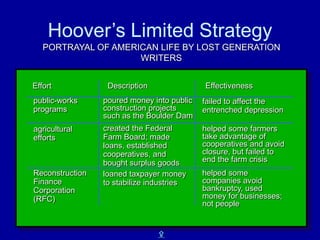
• Hoover set up the Reconstruction Finance Corporation
  (RFC), which gave government credit to banks, industries,
  railroads, and insurance companies. The theory was that
  prosperity at the top would help the economy as a whole.
  Americans saw it as helping bankers and businessmen,
  while ordinary people went hungry
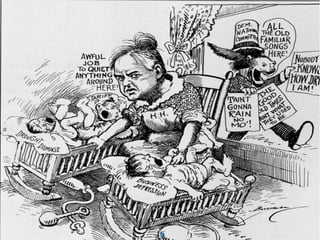
• Hoover did not support federal public assistance because
  he believed it would destroy people’s self-respect and
  create a large bureaucracy
• Finally, public opinion soured for Hoover when he called
  the United States Army to disband a protest of 20,000
  unemployed World War I veterans called the Bonus Army
                             X
Hoover’s Limited Strategy
   PORTRAYAL OF AMERICAN LIFE BY LOST GENERATION
                     WRITERS


Effort            Description               Effectiveness
public-works     poured money into public   failed to affect the
programs         construction projects      entrenched depression
                 such as the Boulder Dam
agricultural     created the Federal        helped some farmers
efforts          Farm Board; made           take advantage of
                 loans, established         cooperatives and avoid
                 cooperatives, and          closure, but failed to
                 bought surplus goods       end the farm crisis
Reconstruction   loaned taxpayer money      helped some
Finance          to stabilize industries    companies avoid
Corporation                                 bankruptcy, used
(RFC)                                       money for businesses;
                                            not people


                                X
X
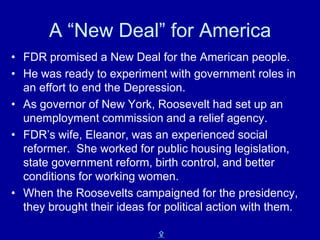
A ―New Deal‖ for America
• FDR promised a New Deal for the American people.
• He was ready to experiment with government roles in
  an effort to end the Depression.
• As governor of New York, Roosevelt had set up an
  unemployment commission and a relief agency.
• FDR’s wife, Eleanor, was an experienced social
  reformer. She worked for public housing legislation,
  state government reform, birth control, and better
  conditions for working women.
• When the Roosevelts campaigned for the presidency,
  they brought their ideas for political action with them.

                             X
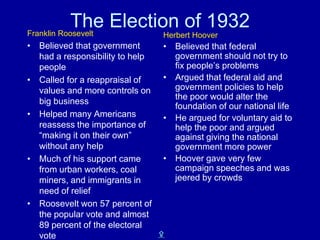
The Election of 1932
Franklin Roosevelt              Herbert Hoover
• Believed that government      •   Believed that federal
  had a responsibility to help      government should not try to
  people                            fix people’s problems
• Called for a reappraisal of   •   Argued that federal aid and
  values and more controls on       government policies to help
                                    the poor would alter the
  big business
                                    foundation of our national life
• Helped many Americans         •   He argued for voluntary aid to
  reassess the importance of        help the poor and argued
  ―making it on their own‖          against giving the national
  without any help                  government more power
• Much of his support came      •   Hoover gave very few
  from urban workers, coal          campaign speeches and was
  miners, and immigrants in         jeered by crowds
  need of relief
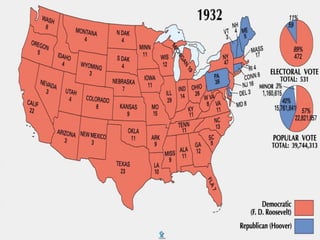
• Roosevelt won 57 percent of
  the popular vote and almost
  89 percent of the electoral
  vote                         X
X
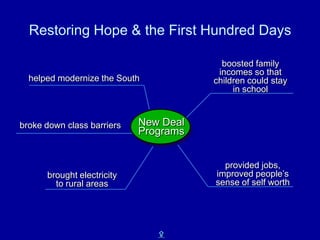
Restoring Hope & the First Hundred Days

                                         boosted family
                                        incomes so that
  helped modernize the South           children could stay
                                            in school


broke down class barriers   New Deal
                            Programs


                                         provided jobs,
      brought electricity              improved people’s
        to rural areas                 sense of self worth


                               X
Areas of New Deal Reform

Stabilizing   FDR wanted to restore public confidence in the nation’s banks.
Financial     Congress passed the Emergency Banking Act, which authorized the
Institu-      government to inspect the financial health of all banks.
tions         Congress also passed the Glass-Steagall Banking Act of 1933. This act
              established a Federal Deposit Insurance Corporation (FDIC) to insure
              bank deposits.


Providing     FDR persuaded Congress to establish the Federal Emergency Relief
Relief        Administration (FERA). FERA put money into public works programs,
and           government-funded projects to build public facilities and create jobs.
Creating      One public works program was the Civilian Conservation Corps
Jobs          (CCC). The CCC put more then 2.5 million men to work maintaining
              forests, beaches, and parks.

                                             X
Areas of New Deal Reform
Regulating   In 1933, Congress passed the National Industrial Recovery Act (NIRA). NIRA
the          established the National Recovery Administration (NRA), which tried to balance
Economy      the unstable economy through extensive planning.
             The NRA established codes for fair business practices. These codes regulated
             wages, working conditions, production, and prices, and set a minimum wage.

Assisting    The Federal Housing Administration (FHA) worked to improve housing
Home-        standards and conditions, and insure mortgages.
owners and   The Agricultural Adjustment Administration (AAA) raised farm prices through
Farmers      subsidies. They paid farmers not to raise certain crops and livestock, hoping
             that lower production would cause prices to rise.
             The Tennessee Valley Authority (TVA) provided jobs, hydroelectric power, flood
             control, and recreational opportunities to farmers in the underdeveloped
             Tennessee Valley.


                                            X
Work Programs
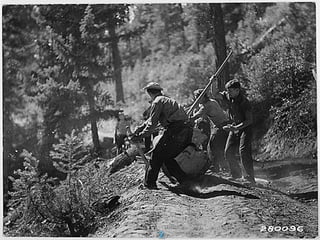
• The Civilian Conservation Corps
   – CCC = relieve unemployment & poverty
   – 250,000 young men, 17-24 yrs = Nat’l parks, etc.
   – $30/month + food, shelter, clothing & education
• Modest Gains for Labor
   – NIRA: monitoring BIG business
   – 1938: Fair Labor Stand. Act = ended child labor,
     established min. wage, overtime pay
• Praise for the New Deal
   – Roosevelt's received thousands of fan mail with
     requests for soap, money, and clothing

                           X
X
Key Players in the New Deal
• FDR was the first President to appoint a woman to a
  Cabinet post. Frances Perkins, a former Progressive,
  was the Secretary of Labor until 1945
• FDR also broke new ground by hiring African
  Americans in more than a hundred policymaking posts
• Eleanor Roosevelt was one of FDR’s most important
  colleagues. Occasionally the First Lady took stands
  that embarrassed her husband. For example, she
  protested the Jim Crow laws at a meeting of the
  Southern Conference for Human Welfare in
  Birmingham, Alabama.

                          X

The great depression powerpoint

  • 1.
  • 2.
    The Beginning • Theeconomic contraction that began with the Great Crash triggered the most severe economic downturn in the nation’s history—the Great Depression • The Great Depression lasted from 1929 until the United States entered World War II in 1941 • The stock market crash of 1929 did not cause the Great Depression. Rather, both the Great Crash and the Depression were the result of deep underlying problems with the country’s economy X
  • 3.
  • 5.
    Hoover’s Response • Toprotect domestic industries, Congress passed the Hawley-Smoot tariff, the highest import tax in history. European countries also raised their tariffs, and international trade suffered a slowdown • Hoover set up the Reconstruction Finance Corporation (RFC), which gave government credit to banks, industries, railroads, and insurance companies. The theory was that prosperity at the top would help the economy as a whole. Americans saw it as helping bankers and businessmen, while ordinary people went hungry • Hoover did not support federal public assistance because he believed it would destroy people’s self-respect and create a large bureaucracy • Finally, public opinion soured for Hoover when he called the United States Army to disband a protest of 20,000 unemployed World War I veterans called the Bonus Army X
  • 7.
    Hoover’s Limited Strategy PORTRAYAL OF AMERICAN LIFE BY LOST GENERATION WRITERS Effort Description Effectiveness public-works poured money into public failed to affect the programs construction projects entrenched depression such as the Boulder Dam agricultural created the Federal helped some farmers efforts Farm Board; made take advantage of loans, established cooperatives and avoid cooperatives, and closure, but failed to bought surplus goods end the farm crisis Reconstruction loaned taxpayer money helped some Finance to stabilize industries companies avoid Corporation bankruptcy, used (RFC) money for businesses; not people X
  • 8.
  • 9.
    A ―New Deal‖for America • FDR promised a New Deal for the American people. • He was ready to experiment with government roles in an effort to end the Depression. • As governor of New York, Roosevelt had set up an unemployment commission and a relief agency. • FDR’s wife, Eleanor, was an experienced social reformer. She worked for public housing legislation, state government reform, birth control, and better conditions for working women. • When the Roosevelts campaigned for the presidency, they brought their ideas for political action with them. X
  • 10.
    The Election of1932 Franklin Roosevelt Herbert Hoover • Believed that government • Believed that federal had a responsibility to help government should not try to people fix people’s problems • Called for a reappraisal of • Argued that federal aid and values and more controls on government policies to help the poor would alter the big business foundation of our national life • Helped many Americans • He argued for voluntary aid to reassess the importance of help the poor and argued ―making it on their own‖ against giving the national without any help government more power • Much of his support came • Hoover gave very few from urban workers, coal campaign speeches and was miners, and immigrants in jeered by crowds need of relief • Roosevelt won 57 percent of the popular vote and almost 89 percent of the electoral vote X
  • 11.
  • 12.
    Restoring Hope &the First Hundred Days boosted family incomes so that helped modernize the South children could stay in school broke down class barriers New Deal Programs provided jobs, brought electricity improved people’s to rural areas sense of self worth X
  • 13.
    Areas of NewDeal Reform Stabilizing FDR wanted to restore public confidence in the nation’s banks. Financial Congress passed the Emergency Banking Act, which authorized the Institu- government to inspect the financial health of all banks. tions Congress also passed the Glass-Steagall Banking Act of 1933. This act established a Federal Deposit Insurance Corporation (FDIC) to insure bank deposits. Providing FDR persuaded Congress to establish the Federal Emergency Relief Relief Administration (FERA). FERA put money into public works programs, and government-funded projects to build public facilities and create jobs. Creating One public works program was the Civilian Conservation Corps Jobs (CCC). The CCC put more then 2.5 million men to work maintaining forests, beaches, and parks. X
  • 15.
    Areas of NewDeal Reform Regulating In 1933, Congress passed the National Industrial Recovery Act (NIRA). NIRA the established the National Recovery Administration (NRA), which tried to balance Economy the unstable economy through extensive planning. The NRA established codes for fair business practices. These codes regulated wages, working conditions, production, and prices, and set a minimum wage. Assisting The Federal Housing Administration (FHA) worked to improve housing Home- standards and conditions, and insure mortgages. owners and The Agricultural Adjustment Administration (AAA) raised farm prices through Farmers subsidies. They paid farmers not to raise certain crops and livestock, hoping that lower production would cause prices to rise. The Tennessee Valley Authority (TVA) provided jobs, hydroelectric power, flood control, and recreational opportunities to farmers in the underdeveloped Tennessee Valley. X
  • 17.
    Work Programs • TheCivilian Conservation Corps – CCC = relieve unemployment & poverty – 250,000 young men, 17-24 yrs = Nat’l parks, etc. – $30/month + food, shelter, clothing & education • Modest Gains for Labor – NIRA: monitoring BIG business – 1938: Fair Labor Stand. Act = ended child labor, established min. wage, overtime pay • Praise for the New Deal – Roosevelt's received thousands of fan mail with requests for soap, money, and clothing X
  • 18.
  • 19.
    Key Players inthe New Deal • FDR was the first President to appoint a woman to a Cabinet post. Frances Perkins, a former Progressive, was the Secretary of Labor until 1945 • FDR also broke new ground by hiring African Americans in more than a hundred policymaking posts • Eleanor Roosevelt was one of FDR’s most important colleagues. Occasionally the First Lady took stands that embarrassed her husband. For example, she protested the Jim Crow laws at a meeting of the Southern Conference for Human Welfare in Birmingham, Alabama. X