


NEW BUSINESS
SKILLS BOOTCAMP
1. THE INITIAL CONTACT
2. RESEARCHING THE OPPORTUNITY
3. METHODICAL ANALYSIS
4. CRITERIA FOR PROCEEDING
5. VALUE OF THOROUGH PREPARATION
6. WARMING UP THE PROSPECT
7. GETTING THE TONE RIGHT
8. THE TEAM
9. CREDENTIALS
10. THE PRESENTATION
1. THE INITIAL CONTACT
Inbound
• They know roughly who you are – or do they?
• Need to establish how much they know
• Take nothing for granted
• What stage are they at in their search for an
agency?
• What is their style like?
• What channel did they use to get in touch?
• What is the best channel through which to respond?
• How did they hear of the agency?
• Can you trace that trail back and piece other
interesting information together?
Outbound
• The onus is on you to have something to say
• What exactly are you going to say?
• Rehearse your approach first
• Why should they listen to you?
• Why should they take a meeting?
• Do you really know anything about them?
• What is an issue for them at the moment?
• Be able to articulate yourself within thirty seconds
2. RESEARCHING THE
OPPORTUNITY
Inbound
• Are they well known and respected?
• Are they viable?
• Do they have a history of commissioning good
work?
• Are they time wasters?
• Are you basing your opinion on real information or
just hearsay?
• Get informed before you recommend a course of
action or decide on one
Outbound
• Do the desk research first
• Supplement the facts with qualitative detail – ring
round to ask for opinion
• Match the potential opportunity to agency
experience – what is the common ground?
• What do you do if there honestly isn’t much?
• Don’t get carried away and fool yourself that there is
an opportunity when there isn’t
Deciding whether to proceed
• Remember, at this stage, we are deciding whether
to meet and discuss, not whether to pitch
• Inspired and informed questions are as interesting
to clients as statements about the agency
• Discuss with colleagues
• Take a little time, if you have that luxury.
• The overnight test is desirable for a more balanced
response
3. METHODICAL ANALYSIS
Analysis checklist
Start with the sector
• Does it suit the agency?
• Do we know it?
• Could we get to know it?
• How quickly?
Look at the competition
• Is this the best brand in the category or can we do
better?
Analysis checklist
Scrutinise the budget
• What have they spent over the last few years?
• Is that viable?
Visibility
• Does this client or project have good potential for
the agency?
• Will people enjoy working on it?
• Could it make an excellent case history?
• Does it have the potential to win an award?
Analysis checklist
Look at their people
• Are they our style?
• Would we get on well?
• What are their backgrounds?
Look at our people
• Will we gel with the above?
• Will our CVs do the trick?
4. CRITERIA FOR PROCEEDING
Criteria
• All new business prospects should be screened for
three criteria – good work, viability, and fun.
• Good work could mean highly creative, or brand
new to the industry, or award winning, or pioneering,
or a new subject matter for the agency, or an area
that the agency knows a lot about.
• Viable means profit making.
• Fun means everybody wants to work on it, or
somebody specific does.
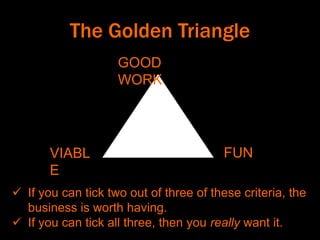
The Golden Triangle
VIABL
E
GOOD
WORK
FUN
 If you can tick two out of three of these criteria, the
business is worth having.
 If you can tick all three, then you really want it.
5. THE VALUE OF THOROUGH
PREPARATION
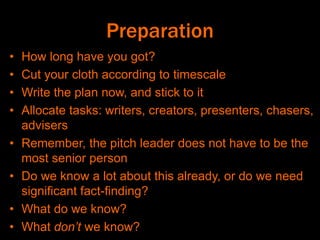
Preparation
• How long have you got?
• Cut your cloth according to timescale
• Write the plan now, and stick to it
• Allocate tasks: writers, creators, presenters, chasers,
advisers
• Remember, the pitch leader does not have to be the
most senior person
• Do we know a lot about this already, or do we need
significant fact-finding?
• What do we know?
• What don’t we know?
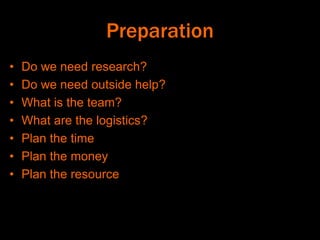
Preparation
• Do we need research?
• Do we need outside help?
• What is the team?
• What are the logistics?
• Plan the time
• Plan the money
• Plan the resource
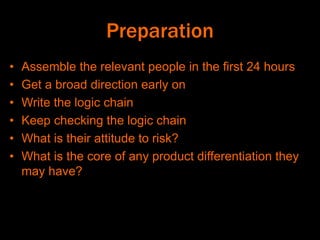
Preparation
• Assemble the relevant people in the first 24 hours
• Get a broad direction early on
• Write the logic chain
• Keep checking the logic chain
• What is their attitude to risk?
• What is the core of any product differentiation they
may have?
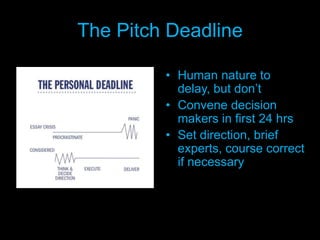
The Pitch Deadline
• Human nature to
delay, but don’t
• Convene decision
makers in first 24 hrs
• Set direction, brief
experts, course correct
if necessary
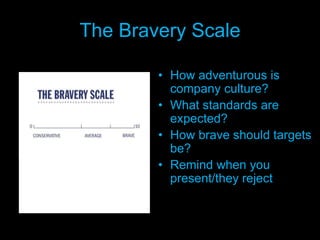
The Bravery Scale
• How adventurous is
company culture?
• What standards are
expected?
• How brave should targets
be?
• Remind when you
present/they reject
6. WARMING UP THE PROSPECT
Warming up prospects
• Draw up a proper contact strategy
• What will you communicate to whom, and how often,
before the day?
• Who are the people who will be making the
decision?
• Are there others that you haven’t been told about?
• How can you find out about them?
• What can you do to promote the agency before the
day?
• Convey enthusiasm, without over-pestering
Warming up prospects
• What questions do you have? Get the balance right
• Remember that the level of intelligence conveyed in
your questions says a lot about the agency’s quality.
Do not leave questions to the last minute and collect
them as a random selection
• What is the culture of the prospect like?
• Will they appreciate hospitality or proof of rigorous
process?
• Who knows who? Can you capitalise on a friendship
or acquaintance?
Warming up prospects
• Keep checking back on the contact strategy – are
you actually doing it, or are you off course?
• Try asking the prospect open-ended questions such
as How are we doing?
• Consider offering references so that the client can
call other clients and discover what it will be like
working with your agency
• Better still, pretend you have already won the
account and create the conditions in which they can
tell what it will be like working with you, because
they effectively already are
7. GETTING THE TONE RIGHT
Getting the tone right
• What is the agency’s tone or culture?
• What is the prospect’s tone or culture?
• Are they compatible? Be honest.
• If there are significant differences, what steps can
you take to make the prospective relationship more
successful?
• Beware overclaim – they have heard it all before
• Work out what is helpful and appealing about the
way the agency does things, and capitalise on that
• Beware over-pestering – being keen is good, being
a pain in the neck isn’t
Getting the tone right
• Be hungry for the business, but do not stray into
looking desperate
• Beware of sycophancy – they know that you want
the business, or else you wouldn’t be pitching
• Be candid if you disagree with them or have different
opinions. If they had all the answers, they wouldn’t
be looking for a new agency.
• Remember, you are paid for your opinions and
advice, as individuals, and collectively.
Getting the tone right
• Appreciate the value of calmness and maturity –
harness an approach that conveys good
organisation, and lots of experience
• Don’t panic and generate inappropriate reactions
and behaviour in the agency that could jeopardise
the pitch outcome
• Make sure that it appears at all times that the
agency knows what it is doing. If this is not true, talk
to the people that matter and fix it quickly
8. THE TEAM
The Team
• What is it?
• The importance of casting
• Allocate tasks: writers, creators, presenters,
chasers, advisers
• Appropriate marking is essential
• Find out who is coming from their side and match
their needs accordingly
• Depth of resource: demonstrate it, but don’t confuse
it with who should be in the room on the day
The Team
• Use imaginative ideas to show them the team who
will work on the business. Try to get all of this out of
the way before the day
• Consider a video or CD of all the characters,
including the backroom staff
• Don’t pack the room with people who won’t say
anything
• Don’t confuse people who are great at client service
with great presenters. The former won’t win the
business, and the latter won’t keep it.
• Keep a close eye on viability. Don’t go mob-handed
or propose a team that will automatically lose the
The Team
• Who to field and when: think carefully about timing in
the run up and on the day. Play in the right people at
the right time.
• Avoid duplication of effort. Do not have scores of
people rushing about chasing the same ball like kids
playing football in the playground.
• If the team is not working, and you have time, change
it.
• Pay attention to client comments about the team
before the day. Ask open-ended questions.
• Don’t pick the nearest people or those who happen
not to be busy or on holiday. Give it really careful
thought and match the people to the task based on
9. CREDENTIALS
Credentials
• Look very carefully at the agency’s credentials and
ask yourself a number of questions:
• Has the prospect seen all this already? In which
case, they should play no part on the day of the pitch
– check.
• How interesting are they? Freshen them up every
time.
• How appropriate are they? Don’t just cut and paste
from a previous effort – the issues will always be
different, so the points relating to the agency and
their business will always be slightly different.
• Compare with your competitors. Do you know what
Credentials
• Consider drawing up criteria that the prospect can
use for appointing an agency, and highlight your
rivals’ deficiencies by implication (but never by
name).
• Delivery before the day. If they really do require
credentials as part of the pitch, send them
beforehand saying that you want to devote as much
time as possible on the day to discussing their
business, not yours.
• Remember that talking about their business is the
main point. You will rarely be criticised for this.
Credentials
• Alternatively, select the main points from your
credentials (preferably no more than six), and weave
them in to your pitch.
• For example, choose specific moments to highlight
your strengths in a sector, international areas, a case
history, resource, and so on, as part of the strategic
story that you are telling.
10. THE PRESENTATION
The presentation
• Structuring this is a whole separate presentation from
me, but do consider:
• The brief
• Keeping it as simple as possible
• Suitable brainstorming techniques
A couple of systems that work
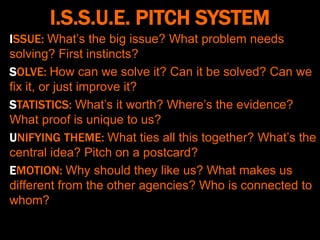
I.S.S.U.E. PITCH SYSTEM
ISSUE: What’s the big issue? What problem needs
solving? First instincts?
SOLVE: How can we solve it? Can it be solved? Can we
fix it, or just improve it?
STATISTICS: What’s it worth? Where’s the evidence?
What proof is unique to us?
UNIFYING THEME: What ties all this together? What’s the
central idea? Pitch on a postcard?
EMOTION: Why should they like us? What makes us
different from the other agencies? Who is connected to
whom?
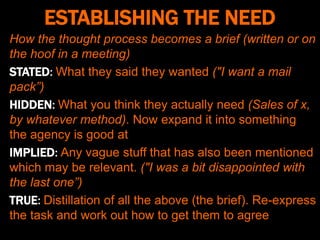
ESTABLISHING THE NEED
How the thought process becomes a brief (written or on
the hoof in a meeting)
STATED: What they said they wanted ("I want a mail
pack”)
HIDDEN: What you think they actually need (Sales of x,
by whatever method). Now expand it into something
the agency is good at
IMPLIED: Any vague stuff that has also been mentioned
which may be relevant. ("I was a bit disappointed with
the last one”)
TRUE: Distillation of all the above (the brief). Re-express
the task and work out how to get them to agree
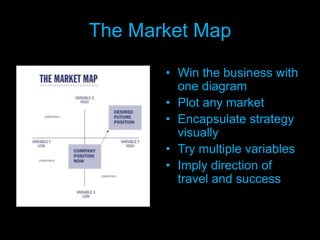
The Market Map
• Win the business with
one diagram
• Plot any market
• Encapsulate strategy
visually
• Try multiple variables
• Imply direction of
travel and success
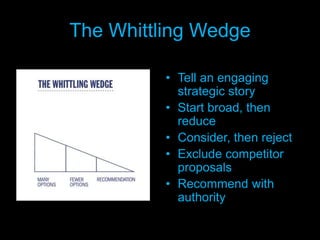
The Whittling Wedge
• Tell an engaging
strategic story
• Start broad, then
reduce
• Consider, then reject
• Exclude competitor
proposals
• Recommend with
authority
Meeting preparation thoughts
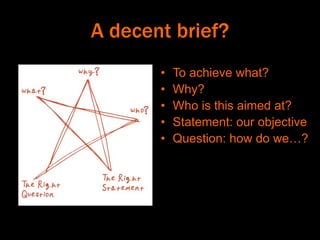
A decent brief?
• To achieve what?
• Why?
• Who is this aimed at?
• Statement: our objective
• Question: how do we…?
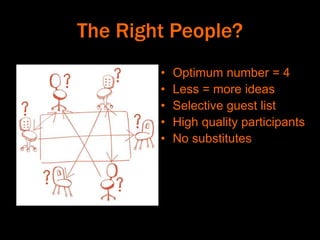
The Right People?
• Optimum number = 4
• Less = more ideas
• Selective guest list
• High quality participants
• No substitutes
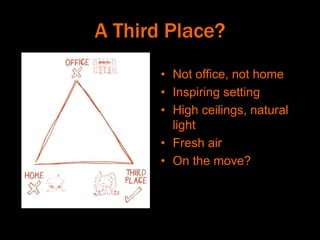
A Third Place?
• Not office, not home
• Inspiring setting
• High ceilings, natural
light
• Fresh air
• On the move?
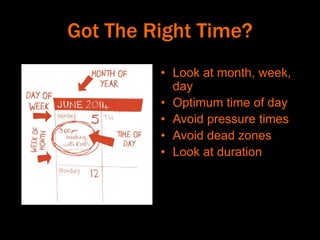
Got The Right Time?
• Look at month, week,
day
• Optimum time of day
• Avoid pressure times
• Avoid dead zones
• Look at duration
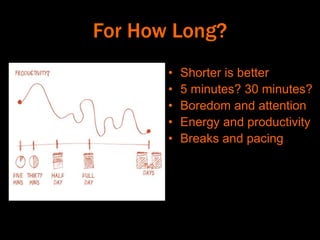
For How Long?
• Shorter is better
• 5 minutes? 30 minutes?
• Boredom and attention
• Energy and productivity
• Breaks and pacing
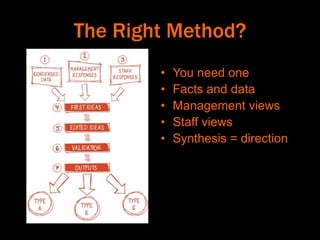
The Right Method?
• You need one
• Facts and data
• Management views
• Staff views
• Synthesis = direction
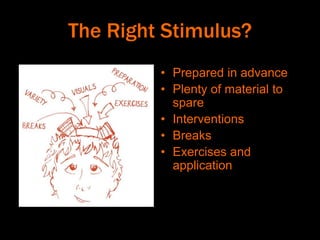
The Right Stimulus?
• Prepared in advance
• Plenty of material to
spare
• Interventions
• Breaks
• Exercises and
application
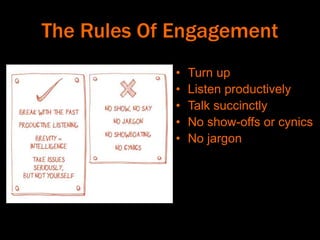
The Rules Of Engagement
• Turn up
• Listen productively
• Talk succinctly
• No show-offs or cynics
• No jargon
YOU’VE WON! NOW WHAT?
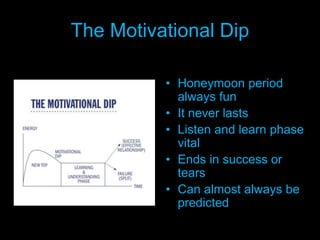
The Motivational Dip
• Honeymoon period
always fun
• It never lasts
• Listen and learn phase
vital
• Ends in success or
tears
• Can almost always be
predicted
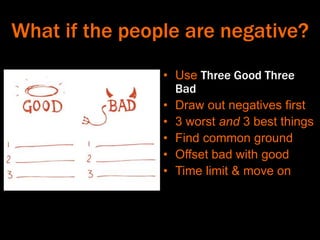
What if the people are negative?
• Use Three Good Three
Bad
• Draw out negatives first
• 3 worst and 3 best things
• Find common ground
• Offset bad with good
• Time limit & move on
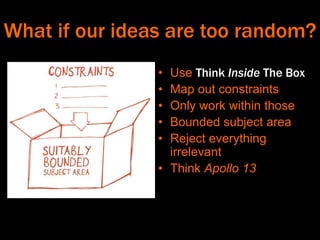
What if our ideas are too random?
• Use Think Inside The Box
• Map out constraints
• Only work within those
• Bounded subject area
• Reject everything
irrelevant
• Think Apollo 13
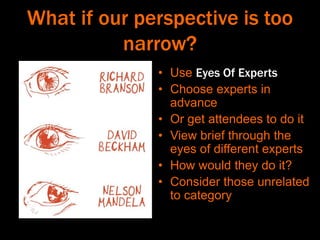
What if our perspective is too
narrow?
• Use Eyes Of Experts
• Choose experts in
advance
• Or get attendees to do it
• View brief through the
eyes of different experts
• How would they do it?
• Consider those unrelated
to category
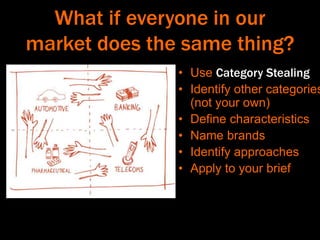
What if everyone in our
market does the same thing?
• Use Category Stealing
• Identify other categories
(not your own)
• Define characteristics
• Name brands
• Identify approaches
• Apply to your brief
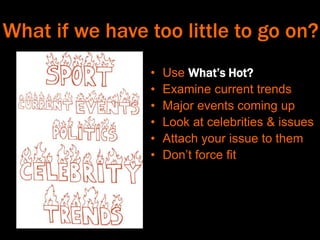
What if we have too little to go on?
• Use What’s Hot?
• Examine current trends
• Major events coming up
• Look at celebrities & issues
• Attach your issue to them
• Don’t force fit
theideasbook.net
expertadviceonline.com
kevinduncanexpertadvice@gmail.com
@kevinduncan

NEW BUSINESS SKILLS BOOTCAMP

  • 1.
  • 2.
    1. THE INITIALCONTACT 2. RESEARCHING THE OPPORTUNITY 3. METHODICAL ANALYSIS 4. CRITERIA FOR PROCEEDING 5. VALUE OF THOROUGH PREPARATION 6. WARMING UP THE PROSPECT 7. GETTING THE TONE RIGHT 8. THE TEAM 9. CREDENTIALS 10. THE PRESENTATION
  • 3.
  • 4.
    Inbound • They knowroughly who you are – or do they? • Need to establish how much they know • Take nothing for granted • What stage are they at in their search for an agency? • What is their style like? • What channel did they use to get in touch? • What is the best channel through which to respond? • How did they hear of the agency? • Can you trace that trail back and piece other interesting information together?
  • 5.
    Outbound • The onusis on you to have something to say • What exactly are you going to say? • Rehearse your approach first • Why should they listen to you? • Why should they take a meeting? • Do you really know anything about them? • What is an issue for them at the moment? • Be able to articulate yourself within thirty seconds
  • 6.
  • 7.
    Inbound • Are theywell known and respected? • Are they viable? • Do they have a history of commissioning good work? • Are they time wasters? • Are you basing your opinion on real information or just hearsay? • Get informed before you recommend a course of action or decide on one
  • 8.
    Outbound • Do thedesk research first • Supplement the facts with qualitative detail – ring round to ask for opinion • Match the potential opportunity to agency experience – what is the common ground? • What do you do if there honestly isn’t much? • Don’t get carried away and fool yourself that there is an opportunity when there isn’t
  • 9.
    Deciding whether toproceed • Remember, at this stage, we are deciding whether to meet and discuss, not whether to pitch • Inspired and informed questions are as interesting to clients as statements about the agency • Discuss with colleagues • Take a little time, if you have that luxury. • The overnight test is desirable for a more balanced response
  • 10.
  • 11.
    Analysis checklist Start withthe sector • Does it suit the agency? • Do we know it? • Could we get to know it? • How quickly? Look at the competition • Is this the best brand in the category or can we do better?
  • 12.
    Analysis checklist Scrutinise thebudget • What have they spent over the last few years? • Is that viable? Visibility • Does this client or project have good potential for the agency? • Will people enjoy working on it? • Could it make an excellent case history? • Does it have the potential to win an award?
  • 13.
    Analysis checklist Look attheir people • Are they our style? • Would we get on well? • What are their backgrounds? Look at our people • Will we gel with the above? • Will our CVs do the trick?
  • 14.
    4. CRITERIA FORPROCEEDING
  • 15.
    Criteria • All newbusiness prospects should be screened for three criteria – good work, viability, and fun. • Good work could mean highly creative, or brand new to the industry, or award winning, or pioneering, or a new subject matter for the agency, or an area that the agency knows a lot about. • Viable means profit making. • Fun means everybody wants to work on it, or somebody specific does.
  • 16.
    The Golden Triangle VIABL E GOOD WORK FUN If you can tick two out of three of these criteria, the business is worth having.  If you can tick all three, then you really want it.
  • 17.
    5. THE VALUEOF THOROUGH PREPARATION
  • 18.
    Preparation • How longhave you got? • Cut your cloth according to timescale • Write the plan now, and stick to it • Allocate tasks: writers, creators, presenters, chasers, advisers • Remember, the pitch leader does not have to be the most senior person • Do we know a lot about this already, or do we need significant fact-finding? • What do we know? • What don’t we know?
  • 19.
    Preparation • Do weneed research? • Do we need outside help? • What is the team? • What are the logistics? • Plan the time • Plan the money • Plan the resource
  • 20.
    Preparation • Assemble therelevant people in the first 24 hours • Get a broad direction early on • Write the logic chain • Keep checking the logic chain • What is their attitude to risk? • What is the core of any product differentiation they may have?
  • 21.
    The Pitch Deadline •Human nature to delay, but don’t • Convene decision makers in first 24 hrs • Set direction, brief experts, course correct if necessary
  • 22.
    The Bravery Scale •How adventurous is company culture? • What standards are expected? • How brave should targets be? • Remind when you present/they reject
  • 23.
    6. WARMING UPTHE PROSPECT
  • 24.
    Warming up prospects •Draw up a proper contact strategy • What will you communicate to whom, and how often, before the day? • Who are the people who will be making the decision? • Are there others that you haven’t been told about? • How can you find out about them? • What can you do to promote the agency before the day? • Convey enthusiasm, without over-pestering
  • 25.
    Warming up prospects •What questions do you have? Get the balance right • Remember that the level of intelligence conveyed in your questions says a lot about the agency’s quality. Do not leave questions to the last minute and collect them as a random selection • What is the culture of the prospect like? • Will they appreciate hospitality or proof of rigorous process? • Who knows who? Can you capitalise on a friendship or acquaintance?
  • 26.
    Warming up prospects •Keep checking back on the contact strategy – are you actually doing it, or are you off course? • Try asking the prospect open-ended questions such as How are we doing? • Consider offering references so that the client can call other clients and discover what it will be like working with your agency • Better still, pretend you have already won the account and create the conditions in which they can tell what it will be like working with you, because they effectively already are
  • 27.
    7. GETTING THETONE RIGHT
  • 28.
    Getting the toneright • What is the agency’s tone or culture? • What is the prospect’s tone or culture? • Are they compatible? Be honest. • If there are significant differences, what steps can you take to make the prospective relationship more successful? • Beware overclaim – they have heard it all before • Work out what is helpful and appealing about the way the agency does things, and capitalise on that • Beware over-pestering – being keen is good, being a pain in the neck isn’t
  • 29.
    Getting the toneright • Be hungry for the business, but do not stray into looking desperate • Beware of sycophancy – they know that you want the business, or else you wouldn’t be pitching • Be candid if you disagree with them or have different opinions. If they had all the answers, they wouldn’t be looking for a new agency. • Remember, you are paid for your opinions and advice, as individuals, and collectively.
  • 30.
    Getting the toneright • Appreciate the value of calmness and maturity – harness an approach that conveys good organisation, and lots of experience • Don’t panic and generate inappropriate reactions and behaviour in the agency that could jeopardise the pitch outcome • Make sure that it appears at all times that the agency knows what it is doing. If this is not true, talk to the people that matter and fix it quickly
  • 31.
  • 32.
    The Team • Whatis it? • The importance of casting • Allocate tasks: writers, creators, presenters, chasers, advisers • Appropriate marking is essential • Find out who is coming from their side and match their needs accordingly • Depth of resource: demonstrate it, but don’t confuse it with who should be in the room on the day
  • 33.
    The Team • Useimaginative ideas to show them the team who will work on the business. Try to get all of this out of the way before the day • Consider a video or CD of all the characters, including the backroom staff • Don’t pack the room with people who won’t say anything • Don’t confuse people who are great at client service with great presenters. The former won’t win the business, and the latter won’t keep it. • Keep a close eye on viability. Don’t go mob-handed or propose a team that will automatically lose the
  • 34.
    The Team • Whoto field and when: think carefully about timing in the run up and on the day. Play in the right people at the right time. • Avoid duplication of effort. Do not have scores of people rushing about chasing the same ball like kids playing football in the playground. • If the team is not working, and you have time, change it. • Pay attention to client comments about the team before the day. Ask open-ended questions. • Don’t pick the nearest people or those who happen not to be busy or on holiday. Give it really careful thought and match the people to the task based on
  • 35.
  • 36.
    Credentials • Look verycarefully at the agency’s credentials and ask yourself a number of questions: • Has the prospect seen all this already? In which case, they should play no part on the day of the pitch – check. • How interesting are they? Freshen them up every time. • How appropriate are they? Don’t just cut and paste from a previous effort – the issues will always be different, so the points relating to the agency and their business will always be slightly different. • Compare with your competitors. Do you know what
  • 37.
    Credentials • Consider drawingup criteria that the prospect can use for appointing an agency, and highlight your rivals’ deficiencies by implication (but never by name). • Delivery before the day. If they really do require credentials as part of the pitch, send them beforehand saying that you want to devote as much time as possible on the day to discussing their business, not yours. • Remember that talking about their business is the main point. You will rarely be criticised for this.
  • 38.
    Credentials • Alternatively, selectthe main points from your credentials (preferably no more than six), and weave them in to your pitch. • For example, choose specific moments to highlight your strengths in a sector, international areas, a case history, resource, and so on, as part of the strategic story that you are telling.
  • 39.
  • 40.
    The presentation • Structuringthis is a whole separate presentation from me, but do consider: • The brief • Keeping it as simple as possible • Suitable brainstorming techniques
  • 41.
    A couple ofsystems that work
  • 42.
    I.S.S.U.E. PITCH SYSTEM ISSUE:What’s the big issue? What problem needs solving? First instincts? SOLVE: How can we solve it? Can it be solved? Can we fix it, or just improve it? STATISTICS: What’s it worth? Where’s the evidence? What proof is unique to us? UNIFYING THEME: What ties all this together? What’s the central idea? Pitch on a postcard? EMOTION: Why should they like us? What makes us different from the other agencies? Who is connected to whom?
  • 43.
    ESTABLISHING THE NEED Howthe thought process becomes a brief (written or on the hoof in a meeting) STATED: What they said they wanted ("I want a mail pack”) HIDDEN: What you think they actually need (Sales of x, by whatever method). Now expand it into something the agency is good at IMPLIED: Any vague stuff that has also been mentioned which may be relevant. ("I was a bit disappointed with the last one”) TRUE: Distillation of all the above (the brief). Re-express the task and work out how to get them to agree
  • 44.
    The Market Map •Win the business with one diagram • Plot any market • Encapsulate strategy visually • Try multiple variables • Imply direction of travel and success
  • 45.
    The Whittling Wedge •Tell an engaging strategic story • Start broad, then reduce • Consider, then reject • Exclude competitor proposals • Recommend with authority
  • 46.
  • 47.
    A decent brief? •To achieve what? • Why? • Who is this aimed at? • Statement: our objective • Question: how do we…?
  • 48.
    The Right People? •Optimum number = 4 • Less = more ideas • Selective guest list • High quality participants • No substitutes
  • 49.
    A Third Place? •Not office, not home • Inspiring setting • High ceilings, natural light • Fresh air • On the move?
  • 50.
    Got The RightTime? • Look at month, week, day • Optimum time of day • Avoid pressure times • Avoid dead zones • Look at duration
  • 51.
    For How Long? •Shorter is better • 5 minutes? 30 minutes? • Boredom and attention • Energy and productivity • Breaks and pacing
  • 52.
    The Right Method? •You need one • Facts and data • Management views • Staff views • Synthesis = direction
  • 53.
    The Right Stimulus? •Prepared in advance • Plenty of material to spare • Interventions • Breaks • Exercises and application
  • 54.
    The Rules OfEngagement • Turn up • Listen productively • Talk succinctly • No show-offs or cynics • No jargon
  • 55.
  • 56.
    The Motivational Dip •Honeymoon period always fun • It never lasts • Listen and learn phase vital • Ends in success or tears • Can almost always be predicted
  • 57.
    What if thepeople are negative? • Use Three Good Three Bad • Draw out negatives first • 3 worst and 3 best things • Find common ground • Offset bad with good • Time limit & move on
  • 58.
    What if ourideas are too random? • Use Think Inside The Box • Map out constraints • Only work within those • Bounded subject area • Reject everything irrelevant • Think Apollo 13
  • 59.
    What if ourperspective is too narrow? • Use Eyes Of Experts • Choose experts in advance • Or get attendees to do it • View brief through the eyes of different experts • How would they do it? • Consider those unrelated to category
  • 60.
    What if everyonein our market does the same thing? • Use Category Stealing • Identify other categories (not your own) • Define characteristics • Name brands • Identify approaches • Apply to your brief
  • 61.
    What if wehave too little to go on? • Use What’s Hot? • Examine current trends • Major events coming up • Look at celebrities & issues • Attach your issue to them • Don’t force fit
  • 62.