TWELVE FROM 2012
WHAT IS IT?


•   A library of 200 books
•   A blog
•   A series of printed books
•   A pair of apps
•   One-page summaries
•   One-sentence summaries
•   A rich source of ideas
THE BIG THEMES
ANTIFRAGILE
                         Nassim Nicholas Taleb


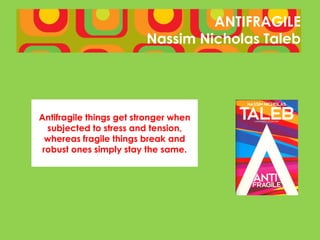
Antifragile things get stronger when
  subjected to stress and tension,
  whereas fragile things break and
 robust ones simply stay the same.
ANTIFRAGILE
                               Nassim Nicholas Taleb


 Procrustean bed: retrofitting causes
 Fragilistas: cause fragility by thinking they
  understand
 Barbell strategy: safe and speculative extremes
 Ludic fallacy: mistake experiments with real world
 Turkeys and inverse turkeys
 Green lumber fallacy: unnecessary knowledge
 Extremistan: impact of a single observation
 Iatrogenics: harm done by the healer
 Agency problem: manager is not true owner
 Black swan errors
BUSINESS STRATEGY
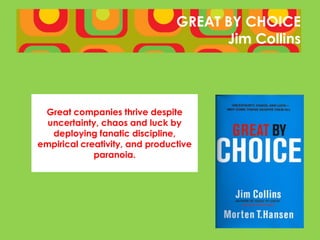
GREAT BY CHOICE
                                      Jim Collins


 Great companies thrive despite
  uncertainty, chaos and luck by
   deploying fanatic discipline,
empirical creativity, and productive
             paranoia.
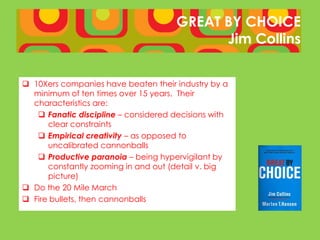
GREAT BY CHOICE
                                            Jim Collins


 10Xers companies have beaten their industry by a
  minimum of ten times over 15 years. Their
  characteristics are:
    Fanatic discipline – considered decisions with
      clear constraints
    Empirical creativity – as opposed to
      uncalibrated cannonballs
    Productive paranoia – being hypervigilant by
      constantly zooming in and out (detail v. big
      picture)
 Do the 20 Mile March
 Fire bullets, then cannonballs
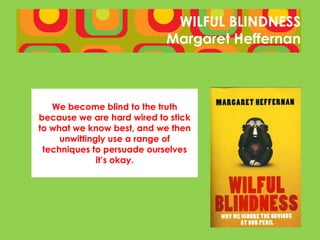
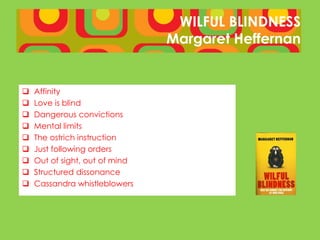
WILFUL BLINDNESS
                            Margaret Heffernan


   We become blind to the truth
because we are hard wired to stick
to what we know best, and we then
     unwittingly use a range of
 techniques to persuade ourselves
              it’s okay.
WILFUL BLINDNESS
                                Margaret Heffernan


   Affinity
   Love is blind
   Dangerous convictions
   Mental limits
   The ostrich instruction
   Just following orders
   Out of sight, out of mind
   Structured dissonance
   Cassandra whistleblowers
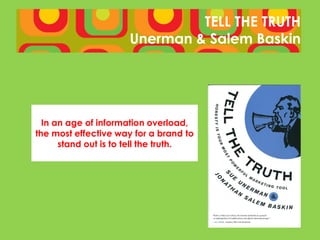
TELL THE TRUTH
                      Unerman & Salem Baskin


  In an age of information overload,
the most effective way for a brand to
      stand out is to tell the truth.
TELL THE TRUTH
                          Unerman & Salem Baskin


Content:
 Acknowledge reality
 Deliver real change to services and company
  structure
 Take consumers on the brand truth journey
 Enlist third-party advocates

Context:
 Be close
 Find a Truth Turning Point
 Use point-of-action media
 Leverage routine
THE ONLINE WORLD
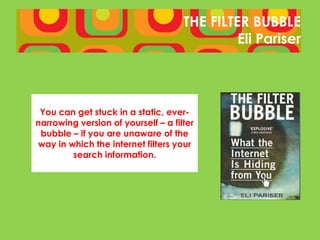
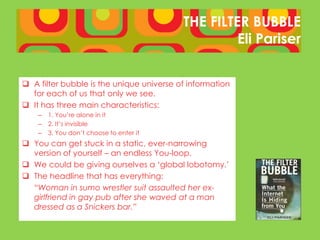
THE FILTER BUBBLE
                                              Eli Pariser


 You can get stuck in a static, ever-
narrowing version of yourself – a filter
 bubble – if you are unaware of the
way in which the internet filters your
        search information.
THE FILTER BUBBLE
                                                   Eli Pariser


 A filter bubble is the unique universe of information
  for each of us that only we see.
 It has three main characteristics:
    –   1. You’re alone in it
    –   2. It’s invisible
    –   3. You don’t choose to enter it
 You can get stuck in a static, ever-narrowing
  version of yourself – an endless You-loop.
 We could be giving ourselves a ‘global lobotomy.’
 The headline that has everything:
  “Woman in sumo wrestler suit assaulted her ex-
  girlfriend in gay pub after she waved at a man
  dressed as a Snickers bar.”
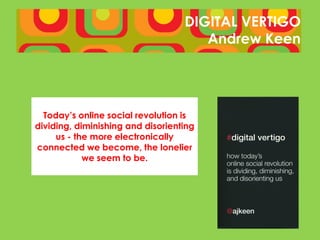
DIGITAL VERTIGO
                                      Andrew Keen


  Today’s online social revolution is
dividing, diminishing and disorienting
     us - the more electronically
connected we become, the lonelier
            we seem to be.
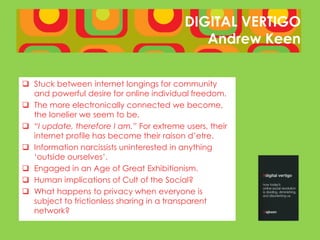
DIGITAL VERTIGO
                                             Andrew Keen


 Stuck between internet longings for community
  and powerful desire for online individual freedom.
 The more electronically connected we become,
  the lonelier we seem to be.
 “I update, therefore I am.” For extreme users, their
  internet profile has become their raison d’etre.
 Information narcissists uninterested in anything
  ‘outside ourselves’.
 Engaged in an Age of Great Exhibitionism.
 Human implications of Cult of the Social?
 What happens to privacy when everyone is
  subject to frictionless sharing in a transparent
  network?
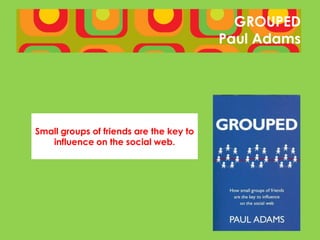
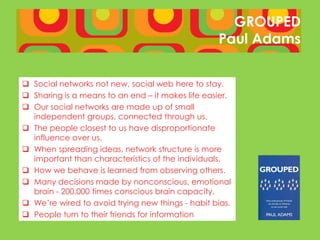
GROUPED
                                         Paul Adams


Small groups of friends are the key to
   influence on the social web.
GROUPED
                                                  Paul Adams


 Social networks not new, social web here to stay.
 Sharing is a means to an end – it makes life easier.
 Our social networks are made up of small
  independent groups, connected through us.
 The people closest to us have disproportionate
  influence over us.
 When spreading ideas, network structure is more
  important than characteristics of the individuals.
 How we behave is learned from observing others.
 Many decisions made by nonconscious, emotional
  brain - 200,000 times conscious brain capacity.
 We’re wired to avoid trying new things - habit bias.
 People turn to their friends for information
BEHAVIOURAL ECONOMICS
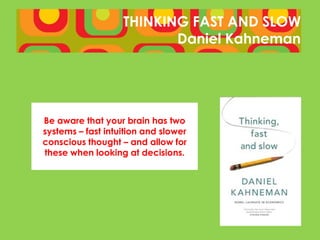
THINKING FAST AND SLOW
                          Daniel Kahneman


Be aware that your brain has two
systems – fast intuition and slower
conscious thought – and allow for
these when looking at decisions.
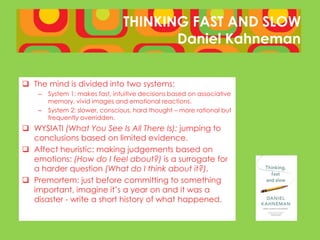
THINKING FAST AND SLOW
                                        Daniel Kahneman


 The mind is divided into two systems:
    –   System 1: makes fast, intuitive decisions based on associative
        memory, vivid images and emotional reactions.
    –   System 2: slower, conscious, hard thought – more rational but
        frequently overridden.
 WYSIATI (What You See Is All There Is): jumping to
  conclusions based on limited evidence.
 Affect heuristic: making judgements based on
  emotions: (How do I feel about?) is a surrogate for
  a harder question (What do I think about it?).
 Premortem: just before committing to something
  important, imagine it’s a year on and it was a
  disaster - write a short history of what happened.
DATA
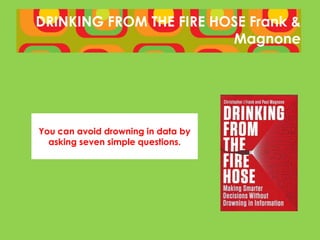
DRINKING FROM THE FIRE HOSE
                      Frank & Magnone


You can avoid drowning in data by
  asking seven simple questions.
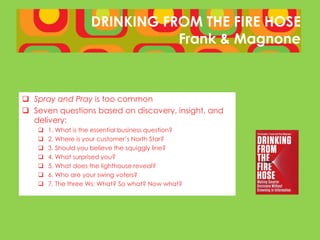
DRINKING FROM THE FIRE HOSE
                               Frank & Magnone


 Spray and Pray is too common
 Seven questions based on discovery, insight, and
  delivery:
      1. What is the essential business question?
      2. Where is your customer’s North Star?
      3. Should you believe the squiggly line?
      4. What surprised you?
      5. What does the lighthouse reveal?
      6. Who are your swing voters?
      7. The three Ws: What? So what? Now what?
CREATIVITY
IMAGINE
                                       Jonah Lehrer


        Ideas come from sheer
persistence, but only when we relax,
   so if you work hard enough on
 something, and focus on not being
focused, there will eventually be an
            unconcealing.
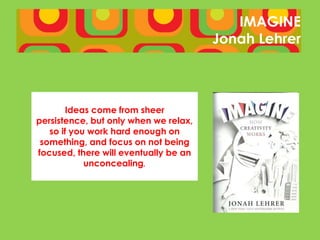
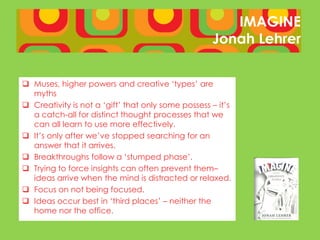
IMAGINE
                                                    Jonah Lehrer


 Muses, higher powers and creative ‘types’ are
  myths
 Creativity is not a ‘gift’ that only some possess – it’s
  a catch-all for distinct thought processes that we
  can all learn to use more effectively.
 It’s only after we’ve stopped searching for an
  answer that it arrives.
 Breakthroughs follow a ‘stumped phase’.
 Trying to force insights can often prevent them–
  ideas arrive when the mind is distracted or relaxed.
 Focus on not being focused.
 Ideas occur best in ‘third places’ – neither the
  home nor the office.
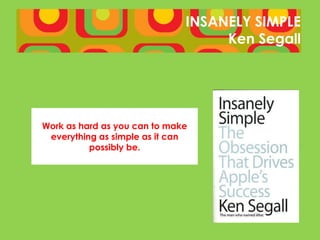
INSANELY SIMPLE
                                   Ken Segall


Work as hard as you can to make
 everything as simple as it can
          possibly be.
INSANELY SIMPLE
                                               Ken Segall


   Think brutal
   Think small: small groups get more done
   Think minimal: just communicate one thing
   Think motion: momentum is crucial to projects
   Think iconic: essence in a conceptual image
   Think phrasal: use short simple words
   Think casual: no big company thinking and process
   Think human: be true to your feelings
   Think sceptic: expect negative first reactions of
   Think war: extreme times call for extreme measures
ORGANISATION
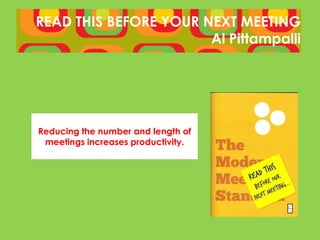
READ THIS BEFORE YOUR NEXT MEETING
                       Al Pittampalli


Reducing the number and length of
 meetings increases productivity.
READ THIS BEFORE YOUR NEXT MEETING
                          Al Pittampalli


 Traditional meetings create a culture of
  compromise and kill our sense of urgency.
    1. Meet only to support a decision that has already been
     made
    2. Move fast and end on schedule
    3. Limit the number of attendees
    4. Reject the unprepared
    5. Produce committed action plans
    6. Refuse to be informational. Reading the memo
     beforehand is mandatory
    7. Work alongside brainstorms, not against them
RULES OF ENGAGEMENT


•   Be inquisitive
•   Make the time
•   Understand the lines of argument
•   Take a view
•   Inform your work
•   Enjoy the debate
KEVIN DUNCAN
                    07979 808770
kevinduncan@expertadvice.co.uk
          Twitter: @kevinduncan

       www.greatesthitsblog.com

Greatest Hits of 2012

  • 1.
  • 2.
    WHAT IS IT? • A library of 200 books • A blog • A series of printed books • A pair of apps • One-page summaries • One-sentence summaries • A rich source of ideas
  • 3.
  • 4.
    ANTIFRAGILE Nassim Nicholas Taleb Antifragile things get stronger when subjected to stress and tension, whereas fragile things break and robust ones simply stay the same.
  • 5.
    ANTIFRAGILE Nassim Nicholas Taleb  Procrustean bed: retrofitting causes  Fragilistas: cause fragility by thinking they understand  Barbell strategy: safe and speculative extremes  Ludic fallacy: mistake experiments with real world  Turkeys and inverse turkeys  Green lumber fallacy: unnecessary knowledge  Extremistan: impact of a single observation  Iatrogenics: harm done by the healer  Agency problem: manager is not true owner  Black swan errors
  • 6.
  • 7.
    GREAT BY CHOICE Jim Collins Great companies thrive despite uncertainty, chaos and luck by deploying fanatic discipline, empirical creativity, and productive paranoia.
  • 8.
    GREAT BY CHOICE Jim Collins  10Xers companies have beaten their industry by a minimum of ten times over 15 years. Their characteristics are:  Fanatic discipline – considered decisions with clear constraints  Empirical creativity – as opposed to uncalibrated cannonballs  Productive paranoia – being hypervigilant by constantly zooming in and out (detail v. big picture)  Do the 20 Mile March  Fire bullets, then cannonballs
  • 9.
    WILFUL BLINDNESS Margaret Heffernan We become blind to the truth because we are hard wired to stick to what we know best, and we then unwittingly use a range of techniques to persuade ourselves it’s okay.
  • 10.
    WILFUL BLINDNESS Margaret Heffernan  Affinity  Love is blind  Dangerous convictions  Mental limits  The ostrich instruction  Just following orders  Out of sight, out of mind  Structured dissonance  Cassandra whistleblowers
  • 11.
    TELL THE TRUTH Unerman & Salem Baskin In an age of information overload, the most effective way for a brand to stand out is to tell the truth.
  • 12.
    TELL THE TRUTH Unerman & Salem Baskin Content:  Acknowledge reality  Deliver real change to services and company structure  Take consumers on the brand truth journey  Enlist third-party advocates Context:  Be close  Find a Truth Turning Point  Use point-of-action media  Leverage routine
  • 13.
  • 14.
    THE FILTER BUBBLE Eli Pariser You can get stuck in a static, ever- narrowing version of yourself – a filter bubble – if you are unaware of the way in which the internet filters your search information.
  • 15.
    THE FILTER BUBBLE Eli Pariser  A filter bubble is the unique universe of information for each of us that only we see.  It has three main characteristics: – 1. You’re alone in it – 2. It’s invisible – 3. You don’t choose to enter it  You can get stuck in a static, ever-narrowing version of yourself – an endless You-loop.  We could be giving ourselves a ‘global lobotomy.’  The headline that has everything: “Woman in sumo wrestler suit assaulted her ex- girlfriend in gay pub after she waved at a man dressed as a Snickers bar.”
  • 16.
    DIGITAL VERTIGO Andrew Keen Today’s online social revolution is dividing, diminishing and disorienting us - the more electronically connected we become, the lonelier we seem to be.
  • 17.
    DIGITAL VERTIGO Andrew Keen  Stuck between internet longings for community and powerful desire for online individual freedom.  The more electronically connected we become, the lonelier we seem to be.  “I update, therefore I am.” For extreme users, their internet profile has become their raison d’etre.  Information narcissists uninterested in anything ‘outside ourselves’.  Engaged in an Age of Great Exhibitionism.  Human implications of Cult of the Social?  What happens to privacy when everyone is subject to frictionless sharing in a transparent network?
  • 18.
    GROUPED Paul Adams Small groups of friends are the key to influence on the social web.
  • 19.
    GROUPED Paul Adams  Social networks not new, social web here to stay.  Sharing is a means to an end – it makes life easier.  Our social networks are made up of small independent groups, connected through us.  The people closest to us have disproportionate influence over us.  When spreading ideas, network structure is more important than characteristics of the individuals.  How we behave is learned from observing others.  Many decisions made by nonconscious, emotional brain - 200,000 times conscious brain capacity.  We’re wired to avoid trying new things - habit bias.  People turn to their friends for information
  • 20.
  • 21.
    THINKING FAST ANDSLOW Daniel Kahneman Be aware that your brain has two systems – fast intuition and slower conscious thought – and allow for these when looking at decisions.
  • 22.
    THINKING FAST ANDSLOW Daniel Kahneman  The mind is divided into two systems: – System 1: makes fast, intuitive decisions based on associative memory, vivid images and emotional reactions. – System 2: slower, conscious, hard thought – more rational but frequently overridden.  WYSIATI (What You See Is All There Is): jumping to conclusions based on limited evidence.  Affect heuristic: making judgements based on emotions: (How do I feel about?) is a surrogate for a harder question (What do I think about it?).  Premortem: just before committing to something important, imagine it’s a year on and it was a disaster - write a short history of what happened.
  • 23.
  • 24.
    DRINKING FROM THEFIRE HOSE Frank & Magnone You can avoid drowning in data by asking seven simple questions.
  • 25.
    DRINKING FROM THEFIRE HOSE Frank & Magnone  Spray and Pray is too common  Seven questions based on discovery, insight, and delivery:  1. What is the essential business question?  2. Where is your customer’s North Star?  3. Should you believe the squiggly line?  4. What surprised you?  5. What does the lighthouse reveal?  6. Who are your swing voters?  7. The three Ws: What? So what? Now what?
  • 26.
  • 27.
    IMAGINE Jonah Lehrer Ideas come from sheer persistence, but only when we relax, so if you work hard enough on something, and focus on not being focused, there will eventually be an unconcealing.
  • 28.
    IMAGINE Jonah Lehrer  Muses, higher powers and creative ‘types’ are myths  Creativity is not a ‘gift’ that only some possess – it’s a catch-all for distinct thought processes that we can all learn to use more effectively.  It’s only after we’ve stopped searching for an answer that it arrives.  Breakthroughs follow a ‘stumped phase’.  Trying to force insights can often prevent them– ideas arrive when the mind is distracted or relaxed.  Focus on not being focused.  Ideas occur best in ‘third places’ – neither the home nor the office.
  • 29.
    INSANELY SIMPLE Ken Segall Work as hard as you can to make everything as simple as it can possibly be.
  • 30.
    INSANELY SIMPLE Ken Segall  Think brutal  Think small: small groups get more done  Think minimal: just communicate one thing  Think motion: momentum is crucial to projects  Think iconic: essence in a conceptual image  Think phrasal: use short simple words  Think casual: no big company thinking and process  Think human: be true to your feelings  Think sceptic: expect negative first reactions of  Think war: extreme times call for extreme measures
  • 31.
  • 32.
    READ THIS BEFOREYOUR NEXT MEETING Al Pittampalli Reducing the number and length of meetings increases productivity.
  • 33.
    READ THIS BEFOREYOUR NEXT MEETING Al Pittampalli  Traditional meetings create a culture of compromise and kill our sense of urgency.  1. Meet only to support a decision that has already been made  2. Move fast and end on schedule  3. Limit the number of attendees  4. Reject the unprepared  5. Produce committed action plans  6. Refuse to be informational. Reading the memo beforehand is mandatory  7. Work alongside brainstorms, not against them
  • 34.
    RULES OF ENGAGEMENT • Be inquisitive • Make the time • Understand the lines of argument • Take a view • Inform your work • Enjoy the debate
  • 35.
    KEVIN DUNCAN 07979 808770 kevinduncan@expertadvice.co.uk Twitter: @kevinduncan www.greatesthitsblog.com