50 WAYS TO BE YOUR BEST
WHAT’S IT ALL ABOUT?
50 WAYS TO SOLVE TRICKY
BUSINESS ISSUES
SEVEN STRATEGY AREAS
1. COMMERCIAL
2. BRAND
3. CUSTOMER
4. SALES
5. PEOPLE
6. INNOVATION
7. COMMUNICATION
WHAT IS STRATEGY?
1. COMMERCIAL: Will this make money?
2. BRAND: Do people like us?
3. CUSTOMER: How do we reach them?
4. SALES: Can we generate enough?
5. PEOPLE: Will our staff make it happen?
6. INNOVATION: Do we have smart new ideas?
7. COMMUNICATION: How do we explain it?
• Winning aspiration?
• Where to play?
• How to win in chosen
markets?
• Capabilities needed?
Smart Strategy Warning
Too many priorities
• What do we want to do?
• What do we need to do?
• What is possible?
• When should we react?
Smart Strategy Warning
Don’t plan before thinking
• A number is not a strategy
• The hard art of standing
apart
• Concrete and aspirational
• How will we know when
we’re done?
Smart Strategy Warning
Avoid wishful thinking
3. PURSUE PRINCIPLES, NOT MONEY
• Who has done this
before?
• Ooch – run small tests
• Range of outcomes?
• Admit if you are wrong
Smart Strategy Warning
Don’t go narrow early
4. WIDEN OPTIONS, ATTAIN DISTANCE
• Ask everyone first
• Find pockets of expertise
• Remove structural fog
• Leave your desk
Smart Strategy Warning
Strategy isn’t just for strategists
5. REMOVE SILOS
• Identify the nonsense
• Find uncommon sense
• Forget the competition
• Ignore the HIPPO
Smart Strategy Warning
Don’t box tick
6. UNCOMMON SENSE V.
COMMON NONSENSE
• Identify your bull’s-eye
• Work out the NEMO
• Remove everything else
Smart Strategy Warning
No multiple objectives
7. FIND YOUR NEMO
2. BRAND STRATEGY
• Map the market
• What are the factors?
• What direction is needed?
• Where is the opportunity?
Smart Strategy Warning
Don’t follow fool’s gold
1. GAP IN THE MARKET V.
MARKET IN THE GAP
• What don’t we know?
• What is the challenge?
• Are we all thinking the
same?
• Reinterpret the brief?
Smart Strategy Warning
Don’t use old assumptions
2. INVESTIGATE THE UNINTERESTING
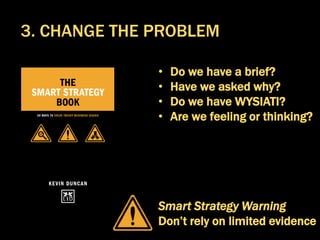
• Do we have a brief?
• Have we asked why?
• Do we have WYSIATI?
• Are we feeling or thinking?
Smart Strategy Warning
Don’t rely on limited evidence
3. CHANGE THE PROBLEM
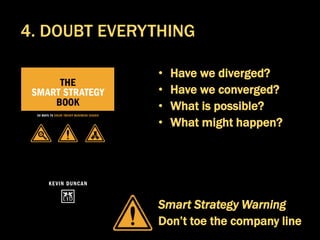
• Have we diverged?
• Have we converged?
• What is possible?
• What might happen?
Smart Strategy Warning
Don’t toe the company line
4. DOUBT EVERYTHING
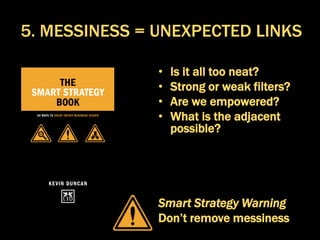
• Is it all too neat?
• Strong or weak filters?
• Are we empowered?
• What is the adjacent
possible?
Smart Strategy Warning
Don’t remove messiness
5. MESSINESS = UNEXPECTED LINKS
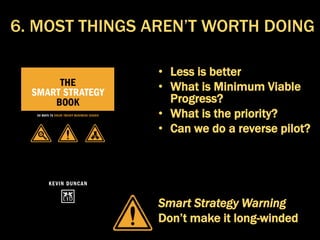
• Less is better
• What is Minimum Viable
Progress?
• What is the priority?
• Can we do a reverse pilot?
Smart Strategy Warning
Don’t make it long-winded
6. MOST THINGS AREN’T WORTH DOING
• What kind of thing?
• What can we copy?
• What might it look like?
• How would we apply it?
Smart Strategy Warning
Don’t just steal blindly
7. COPY SOMETHING
3. CUSTOMER STRATEGY
• What do they really think?
• Have we led the witness?
• Trustworthy data?
• Can we live test?
Smart Strategy Warning
Don’t accept all research
1. MISLEADING RESEARCH
• Is there a gap?
• Are they on autopilot?
• What can we trigger?
• Do we understand this?
Smart Strategy Warning
Don’t assume people will just
do what you want
2. THE THINKING/DOING GAP
• Delighting people doesn’t
work
• Satisfaction = loyalty?
• Are we driving disloyalty?
• What needs to change?
Smart Strategy Warning
Don’t annoy customers
3. DISLOYAL LOYALISTS
• Are customers leaving?
• Who are they telling?
• What behaviour can we
predict?
• What interventions might
help?
Smart Strategy Warning
Don’t assume satisfaction
4. CAN’T GET NO SATISFACTION
• Understand service recovery
• Recovered = stronger
• What often goes wrong?
• What can we do next?
Smart Strategy Warning
Don’t panic when things go
wrong
5. PANIC-FREE SERVICE RECOVERY
• What automatic decisions
do customers make?
• What are their defaults?
• What errors can we
anticipate?
• What can we re-engineer?
Smart Strategy Warning
Don’t assume rational behaviour
6. CUSTOMERS MAKE STRANGE DECISIONS
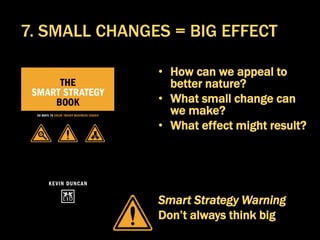
• How can we appeal to
better nature?
• What small change can
we make?
• What effect might result?
Smart Strategy Warning
Don’t always think big
7. SMALL CHANGES = BIG EFFECT
4. SALES STRATEGY
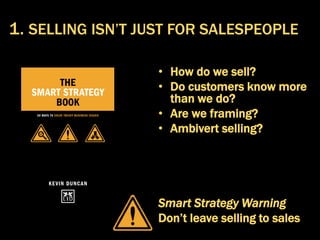
• How do we sell?
• Do customers know more
than we do?
• Are we framing?
• Ambivert selling?
Smart Strategy Warning
Don’t leave selling to sales
1. SELLING ISN’T JUST FOR SALESPEOPLE
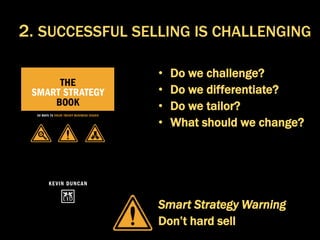
• Do we challenge?
• Do we differentiate?
• Do we tailor?
• What should we change?
Smart Strategy Warning
Don’t hard sell
2. SUCCESSFUL SELLING IS CHALLENGING
• Are we too cheerful?
• What can we reframe?
• What makes it more
difficult?
• What can we solve?
Smart Strategy Warning
Don’t be too optimistic
3. TRY RATIONAL DROWNING
• What’s the grabber?
• Where is the pain?
• What can we prove?
• Remove the bed of nails
Smart Strategy Warning
Don’t tell too long a story
4. THE HAMMOCK
• Are we obsessed with new
business?
• How can we improvise with
existing customers?
• Are we looking after old
business?
Smart Strategy Warning
Don’t just chase new business
5. NEW BUSINESS COULD BE OLD BUSINESS
• Are we mass or niche?
• What is weird about our
product or customers?
• What oddness can we
celebrate?
Smart Strategy Warning
Don’t sell everything to everyone
6. WEIRD IS THE NEW NORMAL
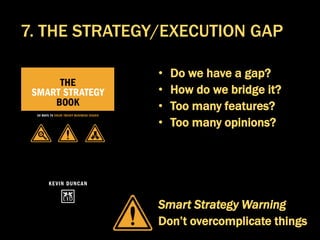
• Do we have a gap?
• How do we bridge it?
• Too many features?
• Too many opinions?
Smart Strategy Warning
Don’t overcomplicate things
7. THE STRATEGY/EXECUTION GAP
5. PEOPLE STRATEGY
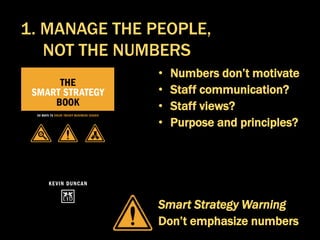
• Numbers don’t motivate
• Staff communication?
• Staff views?
• Purpose and principles?
Smart Strategy Warning
Don’t emphasize numbers
1. MANAGE THE PEOPLE,
NOT THE NUMBERS
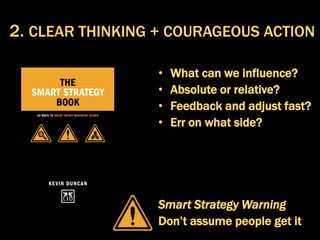
• What can we influence?
• Absolute or relative?
• Feedback and adjust fast?
• Err on what side?
Smart Strategy Warning
Don’t assume people get it
2. CLEAR THINKING + COURAGEOUS ACTION
• Why do we exist?
• How do we behave?
• What is most important?
• Who must do what?
Smart Strategy Warning
Don’t ignore the basics
3. ENSURE ORGANISATIONAL HEALTH
• Clear goals?
• Immersed in activities?
• Enjoying immediate
experience?
• Truly engaged?
Smart Strategy Warning
Don’t interrupt people in flow
4. GET PEOPLE IN FLOW
• Dysfunctional teams?
• Absence of trust?
• Fear of conflict?
• Team analysis?
Smart Strategy Warning
Don’t assume they agree
5. TRUST AND TEAMWORK
• Autonomy?
• Mastery?
• Purpose?
• What can you master?
Smart Strategy Warning
Don’t allow passive
aggression
6. EVERYONE CAN MASTER SOMETHING
• Tell them what not how
• Provide organized space
• Connect with clever peers
• Shelter from
organizational rain
Smart Strategy Warning
Don’t underestimate clevers
7. THE POWER OF CLEVERS
6. INNOVATION STRATEGY
• Must meet a customer
and company need
• Resource constraints?
• Growth goals?
• Multi-disciplinary teams
Smart Strategy Warning
Don’t suspend money
questions
1. THE CREATIVITY + COMMERCE
CROSSROADS
• Systematic Inventive
Thinking
• Subtract, divide, multiply
• Task unification?
• Describe it in 5 words
Smart Strategy Warning
Don’t take anything for
granted
2. SIT AND AUDIT
• Forget products
• How is this a service?
• Customer ideas?
• External ideas?
Smart Strategy Warning
Avoid the commodity trap
3. SEE YOUR BUSINESS AS A SERVICE
• Something different that
has impact
• What if?
• Provoke and prototype
• Who is the protagonist?
Smart Strategy Warning
Don’t stifle provocateurs
4. MAKE YOUR OWN LUCK
• Do everything at once
• How many ideas have we
got?
• How many can we do free?
• How fast can we adjust?
Smart Strategy Warning
Don’t limit effort to one thing
5. COMPETE ON ALL FRONTS AT ONCE
• Is there a true need?
• Do the numbers work?
• Does it matter?
• Learn and adjust fast
Smart Strategy Warning
Don’t spreadsheet dance
6. THE FRAUGHT FIRST MILE
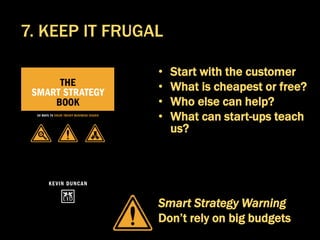
• Start with the customer
• What is cheapest or free?
• Who else can help?
• What can start-ups teach
us?
Smart Strategy Warning
Don’t rely on big budgets
7. KEEP IT FRUGAL
7. COMMUNCATION
STRATEGY
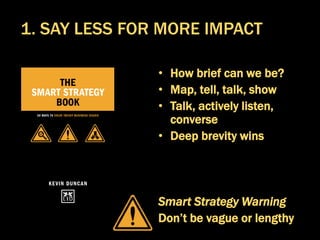
• How brief can we be?
• Map, tell, talk, show
• Talk, actively listen,
converse
• Deep brevity wins
Smart Strategy Warning
Don’t be vague or lengthy
1. SAY LESS FOR MORE IMPACT
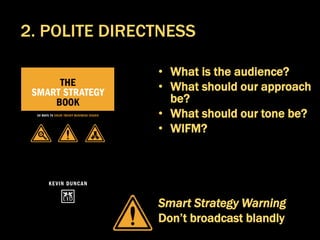
• What is the audience?
• What should our approach
be?
• What should our tone be?
• WIFM?
Smart Strategy Warning
Don’t broadcast blandly
2. POLITE DIRECTNESS
• What social currency do we
have?
• What emotion can we elicit?
• Why should they agree?
• Why should they share?
Smart Strategy Warning
Don’t assume they’ll engage
3. GIVE IT SOCIAL CURRENCY
• Get out of victim stage
• What is possible?
• Use constraint to spur better
thinking
• We can if…
Smart Strategy Warning
Don’t wallow in constraints
4. DISADVANTAGE CAN BE ADVANTAGE
• What have we done?
• What can we tell people?
• What is overclaim?
• Should we change
something before
communicating anything?
Smart Strategy Warning
Don’t claim what isn’t true
5. DO THINGS AND TELL PEOPLE
• What is the audience?
• What is the right language?
• Have we rehearsed?
• What is our message on a
postcard?
Smart Strategy Warning
Don’t use cliché and jargon
6. MIND YOUR LANGUAGE
• What mistakes are we
making?
• What is realistic?
• What do we need to clarify?
• Can we make it simpler?
Smart Strategy Warning
Don’t make fanciful claims
7. LEARN FROM MISTAKES

THE SMART STRATEGY BOOK

  • 1.
    50 WAYS TOBE YOUR BEST
  • 2.
    WHAT’S IT ALLABOUT? 50 WAYS TO SOLVE TRICKY BUSINESS ISSUES
  • 3.
    SEVEN STRATEGY AREAS 1.COMMERCIAL 2. BRAND 3. CUSTOMER 4. SALES 5. PEOPLE 6. INNOVATION 7. COMMUNICATION
  • 4.
    WHAT IS STRATEGY? 1.COMMERCIAL: Will this make money? 2. BRAND: Do people like us? 3. CUSTOMER: How do we reach them? 4. SALES: Can we generate enough? 5. PEOPLE: Will our staff make it happen? 6. INNOVATION: Do we have smart new ideas? 7. COMMUNICATION: How do we explain it?
  • 6.
    • Winning aspiration? •Where to play? • How to win in chosen markets? • Capabilities needed? Smart Strategy Warning Too many priorities
  • 7.
    • What dowe want to do? • What do we need to do? • What is possible? • When should we react? Smart Strategy Warning Don’t plan before thinking
  • 8.
    • A numberis not a strategy • The hard art of standing apart • Concrete and aspirational • How will we know when we’re done? Smart Strategy Warning Avoid wishful thinking 3. PURSUE PRINCIPLES, NOT MONEY
  • 9.
    • Who hasdone this before? • Ooch – run small tests • Range of outcomes? • Admit if you are wrong Smart Strategy Warning Don’t go narrow early 4. WIDEN OPTIONS, ATTAIN DISTANCE
  • 10.
    • Ask everyonefirst • Find pockets of expertise • Remove structural fog • Leave your desk Smart Strategy Warning Strategy isn’t just for strategists 5. REMOVE SILOS
  • 11.
    • Identify thenonsense • Find uncommon sense • Forget the competition • Ignore the HIPPO Smart Strategy Warning Don’t box tick 6. UNCOMMON SENSE V. COMMON NONSENSE
  • 12.
    • Identify yourbull’s-eye • Work out the NEMO • Remove everything else Smart Strategy Warning No multiple objectives 7. FIND YOUR NEMO
  • 13.
  • 14.
    • Map themarket • What are the factors? • What direction is needed? • Where is the opportunity? Smart Strategy Warning Don’t follow fool’s gold 1. GAP IN THE MARKET V. MARKET IN THE GAP
  • 15.
    • What don’twe know? • What is the challenge? • Are we all thinking the same? • Reinterpret the brief? Smart Strategy Warning Don’t use old assumptions 2. INVESTIGATE THE UNINTERESTING
  • 16.
    • Do wehave a brief? • Have we asked why? • Do we have WYSIATI? • Are we feeling or thinking? Smart Strategy Warning Don’t rely on limited evidence 3. CHANGE THE PROBLEM
  • 17.
    • Have wediverged? • Have we converged? • What is possible? • What might happen? Smart Strategy Warning Don’t toe the company line 4. DOUBT EVERYTHING
  • 18.
    • Is itall too neat? • Strong or weak filters? • Are we empowered? • What is the adjacent possible? Smart Strategy Warning Don’t remove messiness 5. MESSINESS = UNEXPECTED LINKS
  • 19.
    • Less isbetter • What is Minimum Viable Progress? • What is the priority? • Can we do a reverse pilot? Smart Strategy Warning Don’t make it long-winded 6. MOST THINGS AREN’T WORTH DOING
  • 20.
    • What kindof thing? • What can we copy? • What might it look like? • How would we apply it? Smart Strategy Warning Don’t just steal blindly 7. COPY SOMETHING
  • 21.
  • 22.
    • What dothey really think? • Have we led the witness? • Trustworthy data? • Can we live test? Smart Strategy Warning Don’t accept all research 1. MISLEADING RESEARCH
  • 23.
    • Is therea gap? • Are they on autopilot? • What can we trigger? • Do we understand this? Smart Strategy Warning Don’t assume people will just do what you want 2. THE THINKING/DOING GAP
  • 24.
    • Delighting peopledoesn’t work • Satisfaction = loyalty? • Are we driving disloyalty? • What needs to change? Smart Strategy Warning Don’t annoy customers 3. DISLOYAL LOYALISTS
  • 25.
    • Are customersleaving? • Who are they telling? • What behaviour can we predict? • What interventions might help? Smart Strategy Warning Don’t assume satisfaction 4. CAN’T GET NO SATISFACTION
  • 26.
    • Understand servicerecovery • Recovered = stronger • What often goes wrong? • What can we do next? Smart Strategy Warning Don’t panic when things go wrong 5. PANIC-FREE SERVICE RECOVERY
  • 27.
    • What automaticdecisions do customers make? • What are their defaults? • What errors can we anticipate? • What can we re-engineer? Smart Strategy Warning Don’t assume rational behaviour 6. CUSTOMERS MAKE STRANGE DECISIONS
  • 28.
    • How canwe appeal to better nature? • What small change can we make? • What effect might result? Smart Strategy Warning Don’t always think big 7. SMALL CHANGES = BIG EFFECT
  • 29.
  • 30.
    • How dowe sell? • Do customers know more than we do? • Are we framing? • Ambivert selling? Smart Strategy Warning Don’t leave selling to sales 1. SELLING ISN’T JUST FOR SALESPEOPLE
  • 31.
    • Do wechallenge? • Do we differentiate? • Do we tailor? • What should we change? Smart Strategy Warning Don’t hard sell 2. SUCCESSFUL SELLING IS CHALLENGING
  • 32.
    • Are wetoo cheerful? • What can we reframe? • What makes it more difficult? • What can we solve? Smart Strategy Warning Don’t be too optimistic 3. TRY RATIONAL DROWNING
  • 33.
    • What’s thegrabber? • Where is the pain? • What can we prove? • Remove the bed of nails Smart Strategy Warning Don’t tell too long a story 4. THE HAMMOCK
  • 34.
    • Are weobsessed with new business? • How can we improvise with existing customers? • Are we looking after old business? Smart Strategy Warning Don’t just chase new business 5. NEW BUSINESS COULD BE OLD BUSINESS
  • 35.
    • Are wemass or niche? • What is weird about our product or customers? • What oddness can we celebrate? Smart Strategy Warning Don’t sell everything to everyone 6. WEIRD IS THE NEW NORMAL
  • 36.
    • Do wehave a gap? • How do we bridge it? • Too many features? • Too many opinions? Smart Strategy Warning Don’t overcomplicate things 7. THE STRATEGY/EXECUTION GAP
  • 37.
  • 38.
    • Numbers don’tmotivate • Staff communication? • Staff views? • Purpose and principles? Smart Strategy Warning Don’t emphasize numbers 1. MANAGE THE PEOPLE, NOT THE NUMBERS
  • 39.
    • What canwe influence? • Absolute or relative? • Feedback and adjust fast? • Err on what side? Smart Strategy Warning Don’t assume people get it 2. CLEAR THINKING + COURAGEOUS ACTION
  • 40.
    • Why dowe exist? • How do we behave? • What is most important? • Who must do what? Smart Strategy Warning Don’t ignore the basics 3. ENSURE ORGANISATIONAL HEALTH
  • 41.
    • Clear goals? •Immersed in activities? • Enjoying immediate experience? • Truly engaged? Smart Strategy Warning Don’t interrupt people in flow 4. GET PEOPLE IN FLOW
  • 42.
    • Dysfunctional teams? •Absence of trust? • Fear of conflict? • Team analysis? Smart Strategy Warning Don’t assume they agree 5. TRUST AND TEAMWORK
  • 43.
    • Autonomy? • Mastery? •Purpose? • What can you master? Smart Strategy Warning Don’t allow passive aggression 6. EVERYONE CAN MASTER SOMETHING
  • 44.
    • Tell themwhat not how • Provide organized space • Connect with clever peers • Shelter from organizational rain Smart Strategy Warning Don’t underestimate clevers 7. THE POWER OF CLEVERS
  • 45.
  • 46.
    • Must meeta customer and company need • Resource constraints? • Growth goals? • Multi-disciplinary teams Smart Strategy Warning Don’t suspend money questions 1. THE CREATIVITY + COMMERCE CROSSROADS
  • 47.
    • Systematic Inventive Thinking •Subtract, divide, multiply • Task unification? • Describe it in 5 words Smart Strategy Warning Don’t take anything for granted 2. SIT AND AUDIT
  • 48.
    • Forget products •How is this a service? • Customer ideas? • External ideas? Smart Strategy Warning Avoid the commodity trap 3. SEE YOUR BUSINESS AS A SERVICE
  • 49.
    • Something differentthat has impact • What if? • Provoke and prototype • Who is the protagonist? Smart Strategy Warning Don’t stifle provocateurs 4. MAKE YOUR OWN LUCK
  • 50.
    • Do everythingat once • How many ideas have we got? • How many can we do free? • How fast can we adjust? Smart Strategy Warning Don’t limit effort to one thing 5. COMPETE ON ALL FRONTS AT ONCE
  • 51.
    • Is therea true need? • Do the numbers work? • Does it matter? • Learn and adjust fast Smart Strategy Warning Don’t spreadsheet dance 6. THE FRAUGHT FIRST MILE
  • 52.
    • Start withthe customer • What is cheapest or free? • Who else can help? • What can start-ups teach us? Smart Strategy Warning Don’t rely on big budgets 7. KEEP IT FRUGAL
  • 53.
  • 54.
    • How briefcan we be? • Map, tell, talk, show • Talk, actively listen, converse • Deep brevity wins Smart Strategy Warning Don’t be vague or lengthy 1. SAY LESS FOR MORE IMPACT
  • 55.
    • What isthe audience? • What should our approach be? • What should our tone be? • WIFM? Smart Strategy Warning Don’t broadcast blandly 2. POLITE DIRECTNESS
  • 56.
    • What socialcurrency do we have? • What emotion can we elicit? • Why should they agree? • Why should they share? Smart Strategy Warning Don’t assume they’ll engage 3. GIVE IT SOCIAL CURRENCY
  • 57.
    • Get outof victim stage • What is possible? • Use constraint to spur better thinking • We can if… Smart Strategy Warning Don’t wallow in constraints 4. DISADVANTAGE CAN BE ADVANTAGE
  • 58.
    • What havewe done? • What can we tell people? • What is overclaim? • Should we change something before communicating anything? Smart Strategy Warning Don’t claim what isn’t true 5. DO THINGS AND TELL PEOPLE
  • 59.
    • What isthe audience? • What is the right language? • Have we rehearsed? • What is our message on a postcard? Smart Strategy Warning Don’t use cliché and jargon 6. MIND YOUR LANGUAGE
  • 60.
    • What mistakesare we making? • What is realistic? • What do we need to clarify? • Can we make it simpler? Smart Strategy Warning Don’t make fanciful claims 7. LEARN FROM MISTAKES