BEING A PRODUCER:
Hints, lessons learned and best
practices
ABOUT MYSELF
• 10 years in GameDev industry
• Producer with big experience in AAA games development
• Shipped multisite collaboration projects with huge international teams and a large number of stakeholders (distributed in France, Canada,
Romania and China)
AGENDA
• Producer role
• Personal efficiency
• Team and people management
PRODUCER ROLE
“The role of all Project Management professionals at Ubisoft is to manage the
whole production process of a game and to build & develop the team that will
deliver it. They bridge the creative, production and business visions, liaising with all
stakeholders, mitigating the risks and ensuring the content quality to deliver
success games…”
• … and many many other variants
• But, generally - Manage the production to deliver the product in line with the
budget, time and quality objectives
BE A MANAGER
Be ready that it’s going to be an incredibly hard job. And forget your
past job.
• Management is the transition from doing black work to delegating
tasks as you mature:
• Control – “All by myself” – Plan
• Monitor – Delegate – Direct
• And it’s all about communication
If the gap between you and this role is big and hurts you – don’t do this
job
YOUR PERSONAL ORGANIZATION
Before organizing others, organize yourself
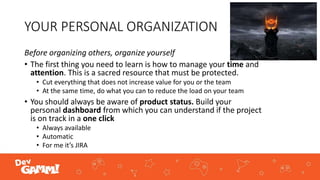
• The first thing you need to learn is how to manage your time and
attention. This is a sacred resource that must be protected.
• Cut everything that does not increase value for you or the team
• At the same time, do what you can to reduce the load on your team
• You should always be aware of product status. Build your
personal dashboard from which you can understand if the project
is on track in a one click
• Always available
• Automatic
• For me it’s JIRA
YOUR PERSONAL ORGANIZATION
Learn how to control the flow of incoming messages. Any incoming
information will be immediately delivered to you. Very soon, it will
overwhelm to you.
Your main helpers:
• Mail filters
• Calendar on your smartphone
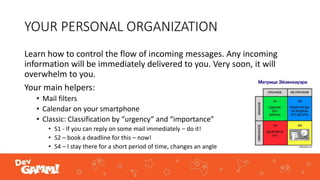
• Classic: Classification by “urgency” and “importance”
• S1 - If you can reply on some mail immediately – do it!
• S2 – book a deadline for this – now!
• S4 – I stay there for a short period of time, changes an angle
DECISION MAKING
You are going to take a lot of decisions. They should be quick and right.
• Do not wait:
• Always think how many persons or things are blocked by you
• Hard fact: 1 day lost in 1 year before the project release is equal to 1 day lost in 1 week
before release
• Support team decisions
• …But not the case with Strategic decisions. They are only yours. When you
need to take a strategic decision:
• Take a pause – always wait until the next day at least
• Think about how future will change if you make this decision
RIGHT DECISIONS
Right decisions are based on three big factors:
• Successful managers make the right decisions not because they have all the information (never happen), but because they have a huge
amount of knowledge and experience.
• And your unexplainable feeling, intuition, plays a big role. Use it, especially when hiring.
Intuition can be developed:
• Live your life:
• Travel
• Take a vacation without any guilt. You need him much more than anyone else in the company.
• Eat local food, speak with locals
• Observe what happened without you. Urgent mails or "Chief, everything is lost" is a very bad signal
• Watch not only blockbusters
• Watch what’s happening around, be in trend
• Speak with elders and children
• Have a hobby and be a profi in it
• Party 
• Never stop to develop yourself:
• Develop critical thinking (ничто не истинно, все дозволено)
• Develop divergent thinking (process or method used to generate creative ideas by exploring many possible solutions)
• Read not management-related books
MEETINGS
Meetings are very important. There are 1-on-1s, general meetings and usual meetings. Cut any
meeting if you do not plan to make a decision, or if you have nothing to say to each other.
• I recommend that you hold 1-on-1s every month with each of your direct subordinates and other
leaders.
• Set goals.
• To be more effective, each employee needs a goal. I set goals for 1 month and for six months.
• Feedback. Criticize and praise.
• It's important to be prepared. Let your criticism is based not on emotions, but on facts. Your duty is to give people advice on
how they can become better
• Recognition. From time to time, recognition is required for everyone
• It’s a two-way feedback! Let the person speak honestly
• Trust:
• Some personal information is shared
• Behavior is natural, relaxed
• Before expecting these things, provide them first
• Both agreed on points
MEETINGS
• General meetings. Regularly talk with the whole
team to inform the team or to explain to
employees why you made this or that decision
• I hold such meetings once per 2-3 month
• Check attendance and react immediately - if someone
did not come, or the general mood is dull - sort out why
• Meetings
• Before any meeting, state meeting topic (goal)
• Invite as few persons as possible
• You do not need to attend each meeting
ULTIMATE MANAGER GOALS
• Ship Product
• You can delegate any other function, but the product quality and vision are sacred
• Go from one milestone to another (focus only the next milestone)
• Stakeholders are the closest people with whom you will discuss the most important decisions:
• It will be great if you communicate closely and be even a friends
• Ask stakeholders for feedback frequently
• Build a team
• Team members are progressing
• Keep the team stable, team is (main?) project deliverable
• Constant improvement (apply lessons learned)
• Culture and processes
• You define what’s allowed and what’s not
• Also values are clearly shown by who gets rewarded, promoted, or let go
• Leadership
• The best way is to lead by own example. In the end, people will copy your behavior, even you don’t want it
• Make sure that your team:
• Understands your decisions
• Trusts you
• Enjoy your project - team (and you) likes what they do!
THANK YOU!
Kirill.bragin@Ubisoft.com

Being a producer: Hints, lessons learned and best practices

  • 1.
    BEING A PRODUCER: Hints,lessons learned and best practices
  • 2.
    ABOUT MYSELF • 10years in GameDev industry • Producer with big experience in AAA games development • Shipped multisite collaboration projects with huge international teams and a large number of stakeholders (distributed in France, Canada, Romania and China)
  • 3.
    AGENDA • Producer role •Personal efficiency • Team and people management
  • 4.
    PRODUCER ROLE “The roleof all Project Management professionals at Ubisoft is to manage the whole production process of a game and to build & develop the team that will deliver it. They bridge the creative, production and business visions, liaising with all stakeholders, mitigating the risks and ensuring the content quality to deliver success games…” • … and many many other variants • But, generally - Manage the production to deliver the product in line with the budget, time and quality objectives
  • 5.
    BE A MANAGER Beready that it’s going to be an incredibly hard job. And forget your past job. • Management is the transition from doing black work to delegating tasks as you mature: • Control – “All by myself” – Plan • Monitor – Delegate – Direct • And it’s all about communication If the gap between you and this role is big and hurts you – don’t do this job
  • 6.
    YOUR PERSONAL ORGANIZATION Beforeorganizing others, organize yourself • The first thing you need to learn is how to manage your time and attention. This is a sacred resource that must be protected. • Cut everything that does not increase value for you or the team • At the same time, do what you can to reduce the load on your team • You should always be aware of product status. Build your personal dashboard from which you can understand if the project is on track in a one click • Always available • Automatic • For me it’s JIRA
  • 7.
    YOUR PERSONAL ORGANIZATION Learnhow to control the flow of incoming messages. Any incoming information will be immediately delivered to you. Very soon, it will overwhelm to you. Your main helpers: • Mail filters • Calendar on your smartphone • Classic: Classification by “urgency” and “importance” • S1 - If you can reply on some mail immediately – do it! • S2 – book a deadline for this – now! • S4 – I stay there for a short period of time, changes an angle
  • 8.
    DECISION MAKING You aregoing to take a lot of decisions. They should be quick and right. • Do not wait: • Always think how many persons or things are blocked by you • Hard fact: 1 day lost in 1 year before the project release is equal to 1 day lost in 1 week before release • Support team decisions • …But not the case with Strategic decisions. They are only yours. When you need to take a strategic decision: • Take a pause – always wait until the next day at least • Think about how future will change if you make this decision
  • 9.
    RIGHT DECISIONS Right decisionsare based on three big factors: • Successful managers make the right decisions not because they have all the information (never happen), but because they have a huge amount of knowledge and experience. • And your unexplainable feeling, intuition, plays a big role. Use it, especially when hiring. Intuition can be developed: • Live your life: • Travel • Take a vacation without any guilt. You need him much more than anyone else in the company. • Eat local food, speak with locals • Observe what happened without you. Urgent mails or "Chief, everything is lost" is a very bad signal • Watch not only blockbusters • Watch what’s happening around, be in trend • Speak with elders and children • Have a hobby and be a profi in it • Party  • Never stop to develop yourself: • Develop critical thinking (ничто не истинно, все дозволено) • Develop divergent thinking (process or method used to generate creative ideas by exploring many possible solutions) • Read not management-related books
  • 10.
    MEETINGS Meetings are veryimportant. There are 1-on-1s, general meetings and usual meetings. Cut any meeting if you do not plan to make a decision, or if you have nothing to say to each other. • I recommend that you hold 1-on-1s every month with each of your direct subordinates and other leaders. • Set goals. • To be more effective, each employee needs a goal. I set goals for 1 month and for six months. • Feedback. Criticize and praise. • It's important to be prepared. Let your criticism is based not on emotions, but on facts. Your duty is to give people advice on how they can become better • Recognition. From time to time, recognition is required for everyone • It’s a two-way feedback! Let the person speak honestly • Trust: • Some personal information is shared • Behavior is natural, relaxed • Before expecting these things, provide them first • Both agreed on points
  • 11.
    MEETINGS • General meetings.Regularly talk with the whole team to inform the team or to explain to employees why you made this or that decision • I hold such meetings once per 2-3 month • Check attendance and react immediately - if someone did not come, or the general mood is dull - sort out why • Meetings • Before any meeting, state meeting topic (goal) • Invite as few persons as possible • You do not need to attend each meeting
  • 12.
    ULTIMATE MANAGER GOALS •Ship Product • You can delegate any other function, but the product quality and vision are sacred • Go from one milestone to another (focus only the next milestone) • Stakeholders are the closest people with whom you will discuss the most important decisions: • It will be great if you communicate closely and be even a friends • Ask stakeholders for feedback frequently • Build a team • Team members are progressing • Keep the team stable, team is (main?) project deliverable • Constant improvement (apply lessons learned) • Culture and processes • You define what’s allowed and what’s not • Also values are clearly shown by who gets rewarded, promoted, or let go • Leadership • The best way is to lead by own example. In the end, people will copy your behavior, even you don’t want it • Make sure that your team: • Understands your decisions • Trusts you • Enjoy your project - team (and you) likes what they do!
  • 13.