PRESENTATION TOPIC
1. NEUTRON FLUX AND REACTOR POWER
2. CRITICALITY AND MULTIPLICATION FACTOR
ASSIGNED BY
PROF DR. AZIZA AFTAB
GROUP MEMBERS
16CH06
16CH20
16CH25
16CH36
16CH57
Neutron flux:
 Neutron flux (φ), defined as the number of neutrons
produced per unit fission, crossing through some arbitrary
cross section unit area in all direction per unit time.
 Its unit is neutron/cm2s.
Mathematical Formula for calculating
Neutron flux
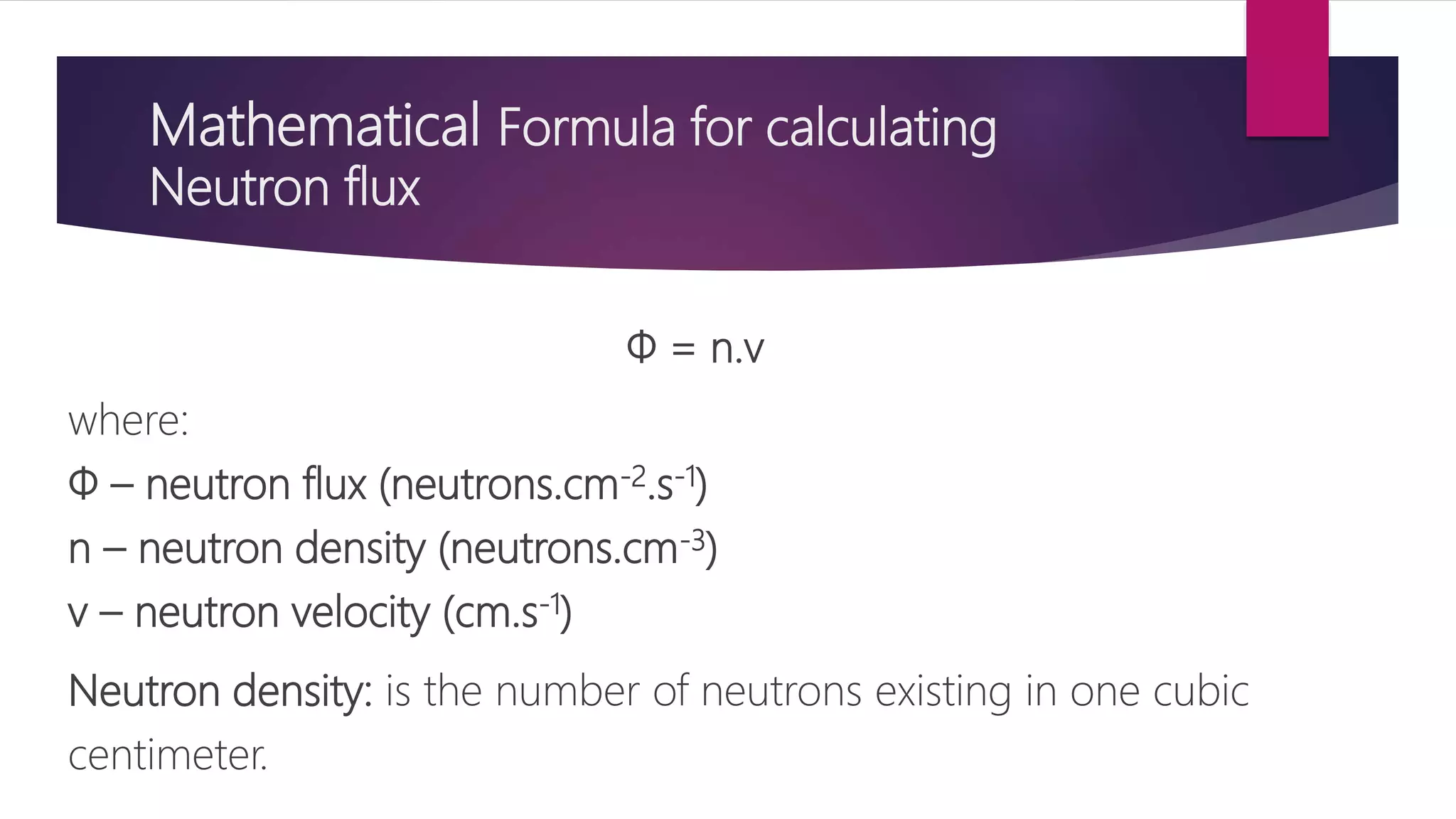
Ф = n.v
where:
Ф – neutron flux (neutrons.cm-2.s-1)
n – neutron density (neutrons.cm-3)
v – neutron velocity (cm.s-1)
Neutron density: is the number of neutrons existing in one cubic
centimeter.
Device for Measurement of the Neutron flux
 The neutron flux is usually measured by excore neutron
detectors, which belong to so called the excore nuclear
instrumentation system (NIS).
 This system monitors the power level of the reactor by
detecting neutron leakage from the reactor core.
Cont….
 The excore nuclear instrumentation system is considered a
safety system, because it provide inputs to the reactor
protection system during startup and power operation.
This system is of the highest importance for reactor
protection system.
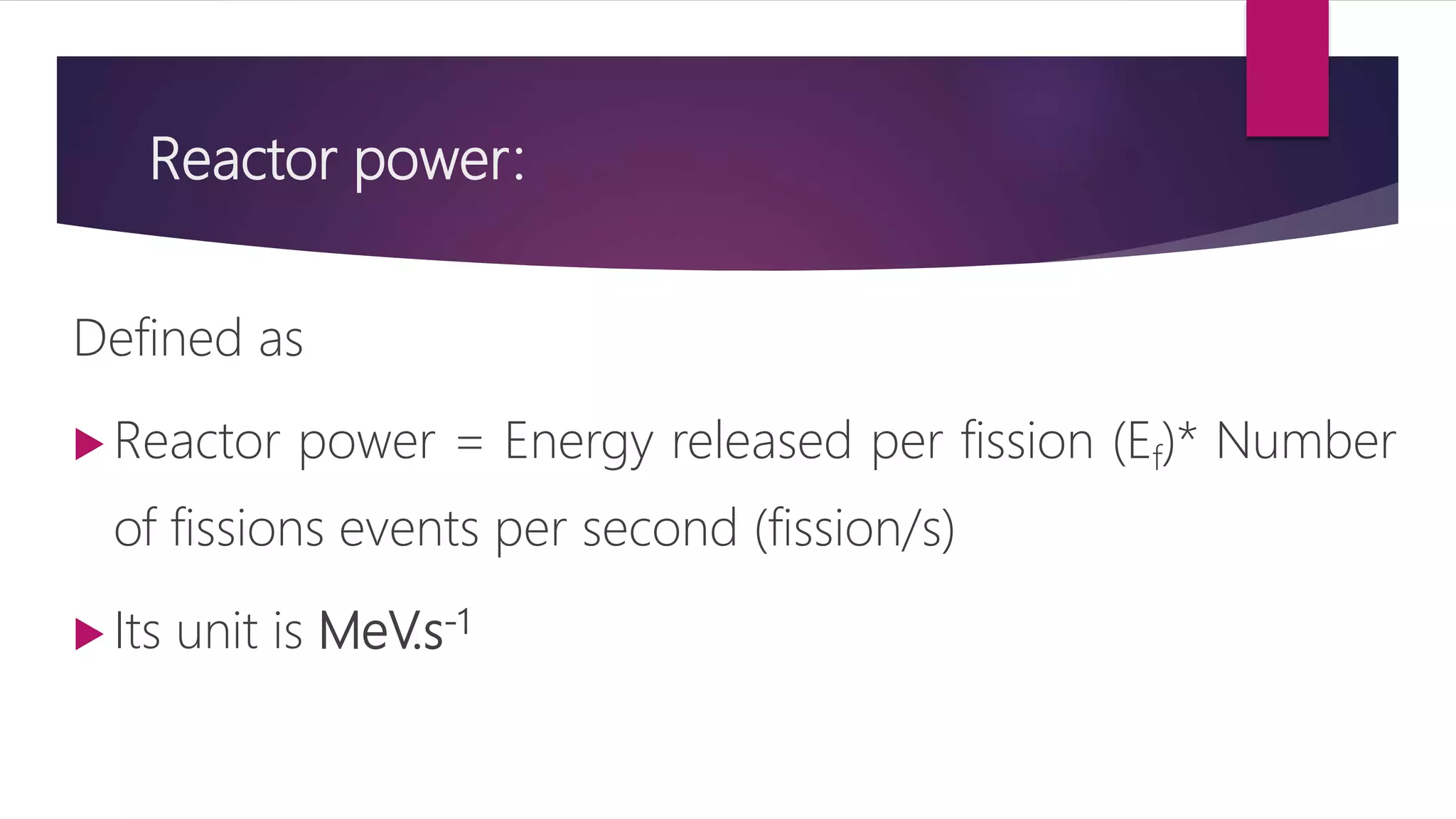
Reactor power:
Defined as
 Reactor power = Energy released per fission (Ef)* Number
of fissions events per second (fission/s)
 Its unit is MeV.s-1
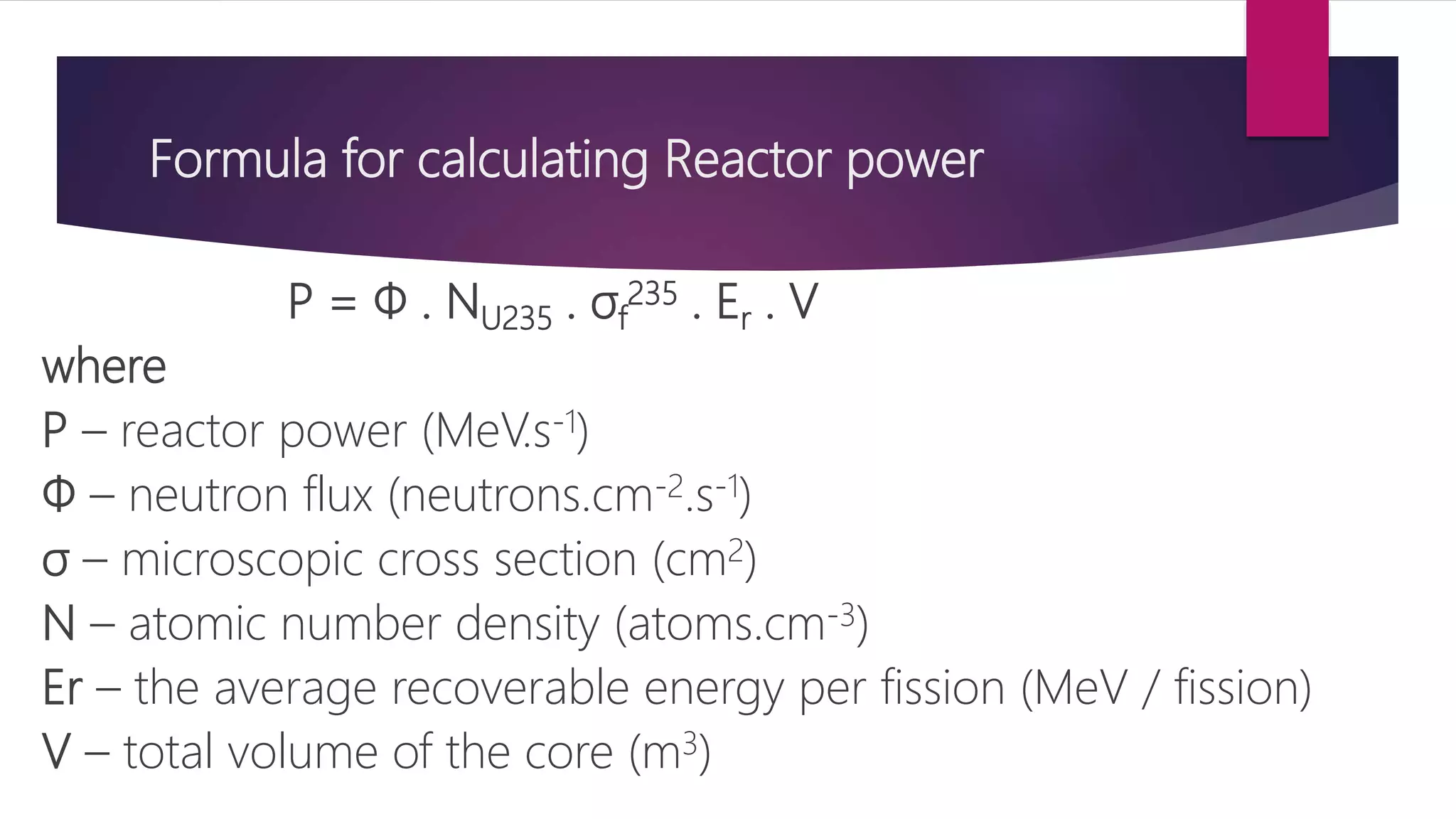
Formula for calculating Reactor power
P = Ф . NU235 . σf
235 . Er . V
where
P – reactor power (MeV.s-1)
Ф – neutron flux (neutrons.cm-2.s-1)
σ – microscopic cross section (cm2)
N – atomic number density (atoms.cm-3)
Er – the average recoverable energy per fission (MeV / fission)
V – total volume of the core (m3)
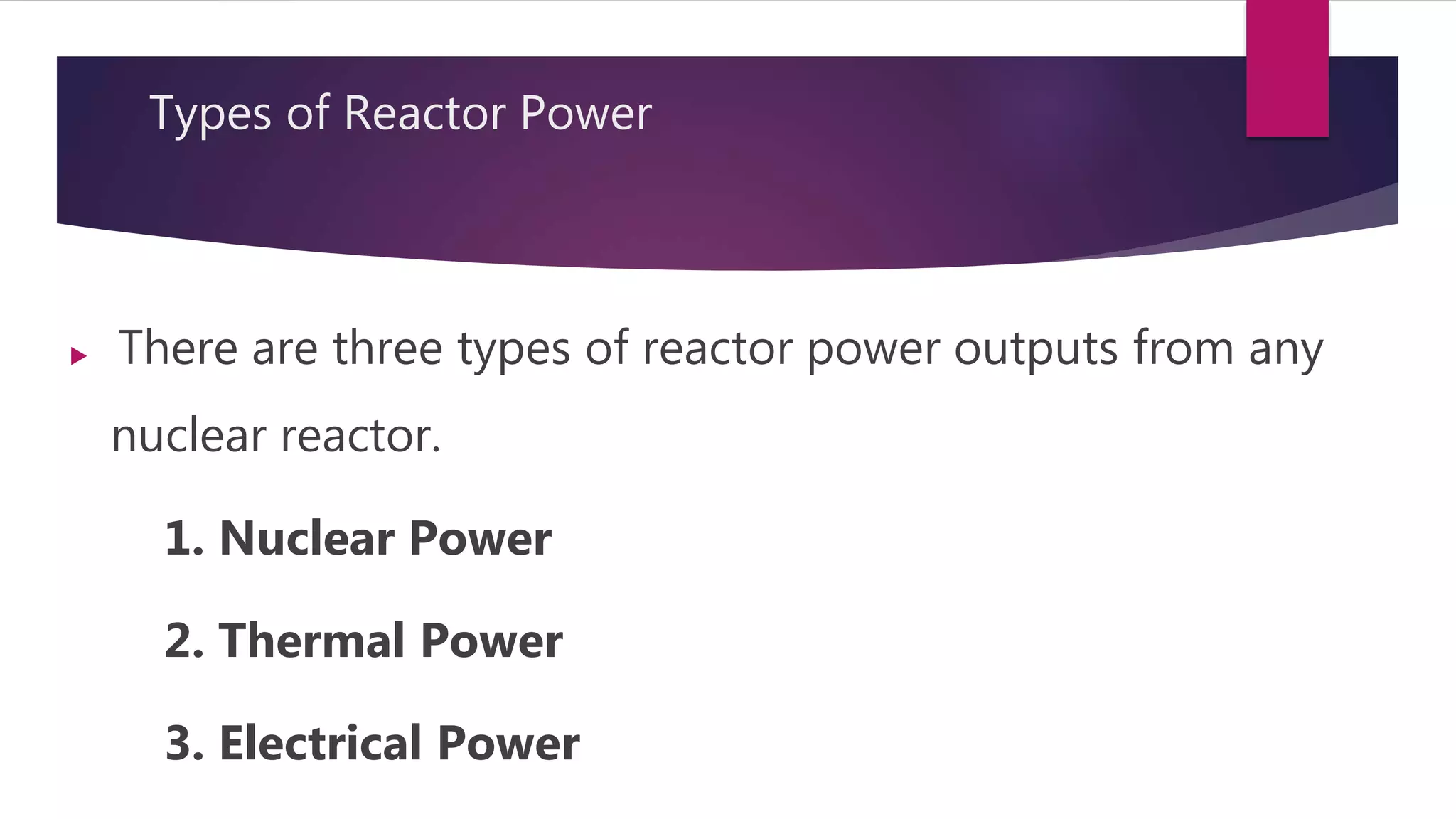
Types of Reactor Power
 There are three types of reactor power outputs from any
nuclear reactor.
1. Nuclear Power
2. Thermal Power
3. Electrical Power
1. Nuclear power:
 The rate at which nuclear reactions release nuclear energy
to generate heat, which most frequently is then used in
steam turbines to produce electricity in a nuclear power
plant.
 Nuclear power can be obtained from nuclear fission,
nuclear decay and nuclear fusion reactions
2. Thermal Power
Defined as
 The rate at which heat is produced in the reactor core as the result
of fissions in the fuel.
 The amount of energy released per one fission reaction about 200 MeV/fission.
 If we want to know the reaction rate or thermal power of the reactor core,
it is necessary to know how many neutrons are traveling through the
material.
3. Electrical Power
 Electric power is the rate at which electrical energy is
generated by the generator.
 For example, for a typical nuclear reactor with a thermal
power of 3000 MWth, about ~1000MWe of electrical
power is generated in the generator.
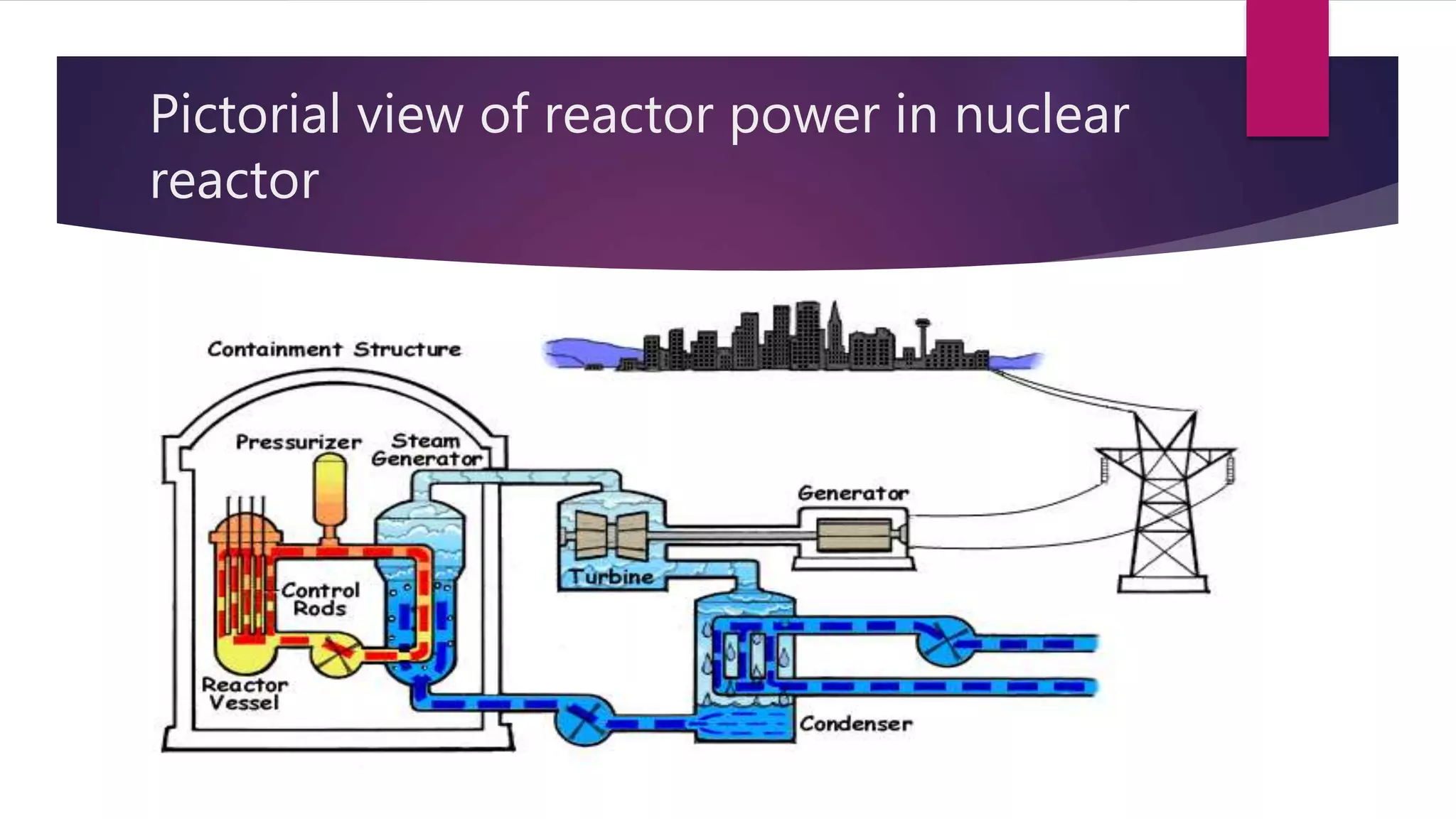
Pictorial view of reactor power in nuclear
reactor
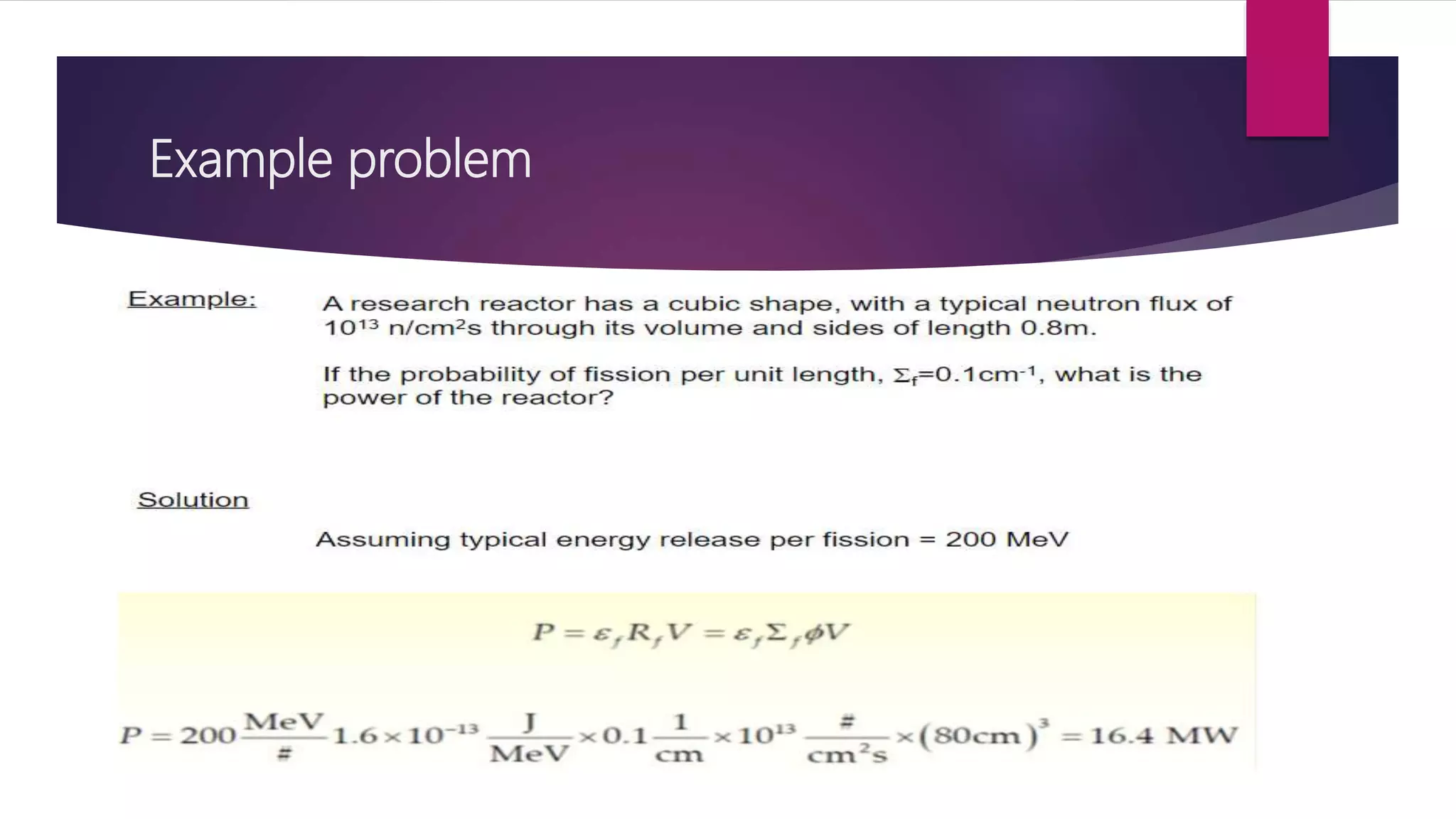
Example problem
Criticality and Multiplication factor
 When a nuclear chain reaction proceeds in a nuclear reactor there are some condition
at which this reaction starts and proceed further,
Condition 1. Criticality factor and multiplication factor
 A criticality factor or effective multiplication factor (k) is defined to denote the relative
number of neutrons produced in successive fission events.
 ‘k’ is the ratio of number of neutrons produced by fission in one generation to the
number of neutrons produced by fission in the preceding generation.
Cont…
 If a system is critical, the multiplication factor is 1.
 Supercritical systems have multiplication factors greater
than 1, while subcritical systems have multiplication
factors lesser than 1.
Condition 2. Critical mass
 Such a mass of uranium in which one neutron out of all the
neutrons produces further fission is called critical mass.
 Note : if the mass of uranium is much greater than the
critical mass then chain reaction proceeds at a rapid speed
and huge explosion is produced. Atom bomb works at this
principle.
Cont…
 If the mass of uranium is less than the critical mass the
chain reaction does not proceed.
 If the mass of uranium is equal to critical mass, the chain
reaction proceeds at its initial speed and in this way we
get a source of energy.
 Energy in atomic reactor is obtained according to this
principle.

neutron flux and reactor power..

  • 1.
    PRESENTATION TOPIC 1. NEUTRONFLUX AND REACTOR POWER 2. CRITICALITY AND MULTIPLICATION FACTOR ASSIGNED BY PROF DR. AZIZA AFTAB GROUP MEMBERS 16CH06 16CH20 16CH25 16CH36 16CH57
  • 2.
    Neutron flux:  Neutronflux (φ), defined as the number of neutrons produced per unit fission, crossing through some arbitrary cross section unit area in all direction per unit time.  Its unit is neutron/cm2s.
  • 3.
    Mathematical Formula forcalculating Neutron flux Ф = n.v where: Ф – neutron flux (neutrons.cm-2.s-1) n – neutron density (neutrons.cm-3) v – neutron velocity (cm.s-1) Neutron density: is the number of neutrons existing in one cubic centimeter.
  • 4.
    Device for Measurementof the Neutron flux  The neutron flux is usually measured by excore neutron detectors, which belong to so called the excore nuclear instrumentation system (NIS).  This system monitors the power level of the reactor by detecting neutron leakage from the reactor core.
  • 5.
    Cont….  The excorenuclear instrumentation system is considered a safety system, because it provide inputs to the reactor protection system during startup and power operation. This system is of the highest importance for reactor protection system.
  • 6.
    Reactor power: Defined as Reactor power = Energy released per fission (Ef)* Number of fissions events per second (fission/s)  Its unit is MeV.s-1
  • 7.
    Formula for calculatingReactor power P = Ф . NU235 . σf 235 . Er . V where P – reactor power (MeV.s-1) Ф – neutron flux (neutrons.cm-2.s-1) σ – microscopic cross section (cm2) N – atomic number density (atoms.cm-3) Er – the average recoverable energy per fission (MeV / fission) V – total volume of the core (m3)
  • 8.
    Types of ReactorPower  There are three types of reactor power outputs from any nuclear reactor. 1. Nuclear Power 2. Thermal Power 3. Electrical Power
  • 9.
    1. Nuclear power: The rate at which nuclear reactions release nuclear energy to generate heat, which most frequently is then used in steam turbines to produce electricity in a nuclear power plant.  Nuclear power can be obtained from nuclear fission, nuclear decay and nuclear fusion reactions
  • 10.
    2. Thermal Power Definedas  The rate at which heat is produced in the reactor core as the result of fissions in the fuel.  The amount of energy released per one fission reaction about 200 MeV/fission.  If we want to know the reaction rate or thermal power of the reactor core, it is necessary to know how many neutrons are traveling through the material.
  • 11.
    3. Electrical Power Electric power is the rate at which electrical energy is generated by the generator.  For example, for a typical nuclear reactor with a thermal power of 3000 MWth, about ~1000MWe of electrical power is generated in the generator.
  • 12.
    Pictorial view ofreactor power in nuclear reactor
  • 13.
  • 14.
    Criticality and Multiplicationfactor  When a nuclear chain reaction proceeds in a nuclear reactor there are some condition at which this reaction starts and proceed further, Condition 1. Criticality factor and multiplication factor  A criticality factor or effective multiplication factor (k) is defined to denote the relative number of neutrons produced in successive fission events.  ‘k’ is the ratio of number of neutrons produced by fission in one generation to the number of neutrons produced by fission in the preceding generation.
  • 15.
    Cont…  If asystem is critical, the multiplication factor is 1.  Supercritical systems have multiplication factors greater than 1, while subcritical systems have multiplication factors lesser than 1.
  • 16.
    Condition 2. Criticalmass  Such a mass of uranium in which one neutron out of all the neutrons produces further fission is called critical mass.  Note : if the mass of uranium is much greater than the critical mass then chain reaction proceeds at a rapid speed and huge explosion is produced. Atom bomb works at this principle.
  • 17.
    Cont…  If themass of uranium is less than the critical mass the chain reaction does not proceed.  If the mass of uranium is equal to critical mass, the chain reaction proceeds at its initial speed and in this way we get a source of energy.  Energy in atomic reactor is obtained according to this principle.