Self-Organized Criticality and Neuronal
Avalanches in Networks
with Dynamical Synapses
Ariadne Costa, Mauro Copelli,
Osame Kinouchi
First Workshop of Young Researchers of NeuroMat, São Paulo, May 2015
University of São Paulo (USP), Ribeirão Preto, Brazil
Federal University of Pernambuco (UFPE), Recife, Brazil
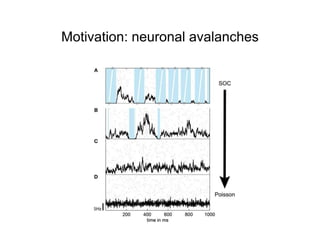
Motivation: neuronal avalanches
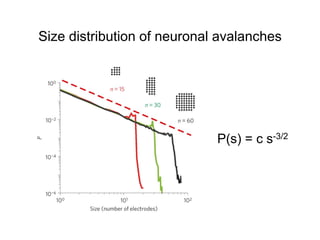
Size distribution of neuronal avalanches
P(s) = c s-3/2
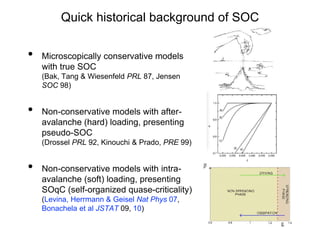
Quick historical background of SOC
• Microscopically conservative models
with true SOC
(Bak, Tang & Wiesenfeld PRL 87, Jensen
SOC 98)
• Non-conservative models with after-
avalanche (hard) loading, presenting
pseudo-SOC
(Drossel PRL 92, Kinouchi & Prado, PRE 99)
• Non-conservative models with intra-
avalanche (soft) loading, presenting
SOqC (self-organized quase-criticality)
(Levina, Herrmann & Geisel Nat Phys 07,
Bonachela et al JSTAT 09, 10)
Self-Organized Criticality and Neuronal
Avalanches in Networks
with Dynamical Synapses
• Microscopically non-conservative model
with “soft” loading, but
• Probabilistic cellular automata
(larger system sizes & easier mean field)
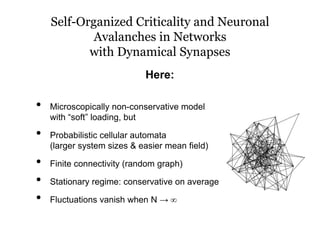
• Finite connectivity (random graph)
• Stationary regime: conservative on average
• Fluctuations vanish when N → ∞
Here:
Random network of excitable cellular automata
Random graph with K outcoming synapses
Kinouchi & Copelli, Nat. Phys. 06
Control parameter:
Branching ratio:
Order parameter:
Mean firing rate:
Mean-field equation: (I)
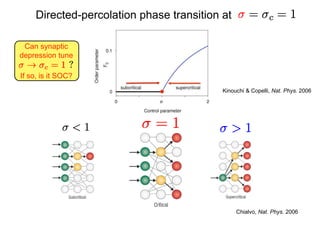
Directed-percolation phase transition at
Kinouchi & Copelli, Nat. Phys. 06
Chialvo, Nat. Phys. 06
Directed-percolation phase transition at
Kinouchi & Copelli, Nat. Phys. 2006
Chialvo, Nat. Phys. 2006
Can synaptic
depression tune
If so, is it SOC?
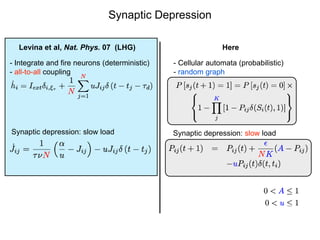
Synaptic Depression
Levina et al, Nat. Phys. 07 (LHG)
- Integrate and fire neurons (deterministic)
- all-to-all coupling
Synaptic depression: slow load
Here
- Cellular automata (probabilistic)
- random graph
Synaptic depression: slow load
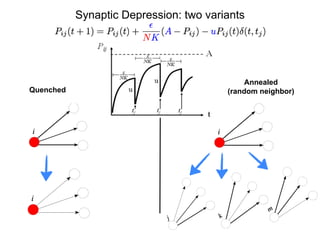
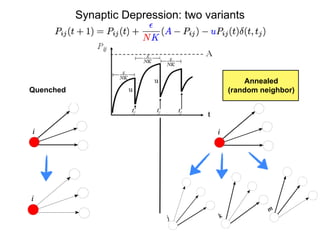
Synaptic Depression: two variants
Quenched
Annealed
(random neighbor)
Synaptic Depression: two variants
Quenched
Annealed
(random neighbor)
Results
• Analytical (mean-field theory)
• Simulations
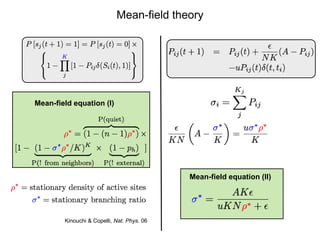
Mean-field theory
Mean-field equation (I)
Mean-field equation (II)
Kinouchi & Copelli, Nat. Phys. 06
Mean-field theory
Mean-field equation (I)
Mean-field equation (II)
Results
• Analytical (mean-field theory)
• Simulations
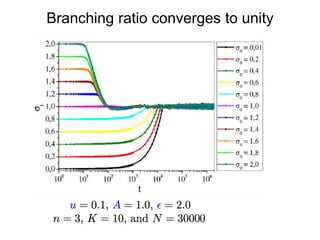
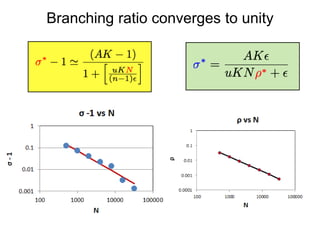
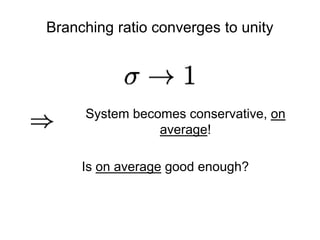
Branching ratio converges to unity
System becomes conservative, on
average!
Is on average good enough?
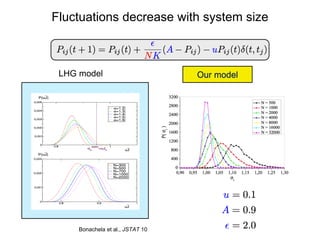
Our model
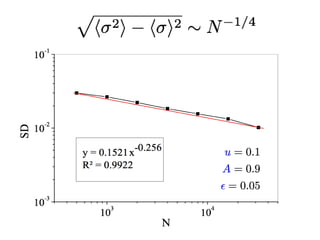
Fluctuations decrease with system size
Bonachela et al., JSTAT 10
LHG model
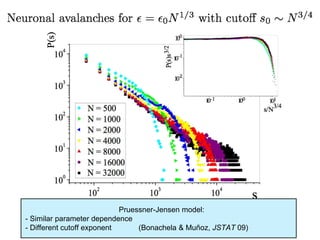
Pruessner-Jensen model:
- Similar parameter dependence
- Different cutoff exponent (Bonachela & Muñoz, JSTAT 09)
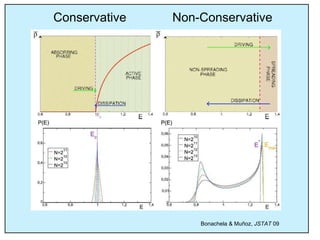
Conservative
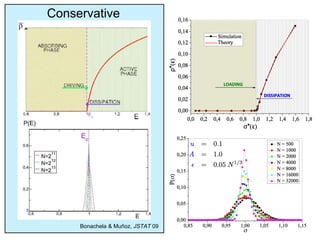
Bonachela & Muñoz, JSTAT 09
Non-Conservative
Bonachela & Muñoz, JSTAT 09
Conservative
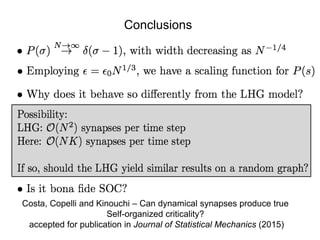
Conclusions
Costa, Copelli and Kinouchi – Can dynamical synapses produce true
Self-organized criticality?
accepted for publication in Journal of Statistical Mechanics (2015)
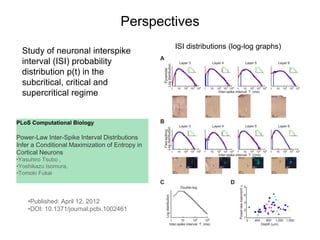
Perspectives
• Study of neuronal
interspike interval (ISI)
probability distribution p(t)
in the subcritical, critical
and supercritical regime
PLoS Computational Biology
Power-Law Inter-Spike Interval Distributions
Infer a Conditional Maximization of Entropy in
Cortical Neurons
•Yasuhiro Tsubo ,
•Yoshikazu Isomura,
•Tomoki Fukai
•Published: April 12, 2012
•DOI: 10.1371/journal.pcbi.1002461
Study of neuronal interspike
interval (ISI) probability
distribution p(t) in the
subcritical, critical and
supercritical regime
Perspectives
ISI distributions (log-log graphs)
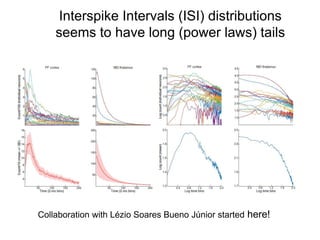
Interspike Intervals (ISI) distributions
seems to have long (power laws) tails
Collaboration with Lézio Soares Bueno Júnior started here!
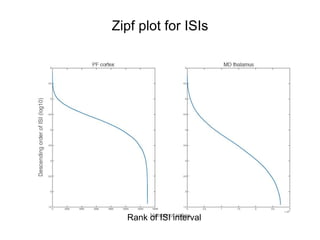
Zipf plot for ISIs
Rank of ISI interval
Thank you
Come visit us in Ribeirão Preto!
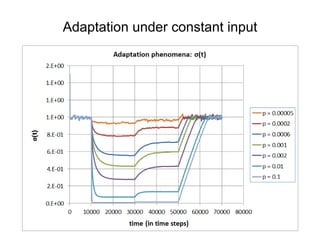
Adaptation under constant input
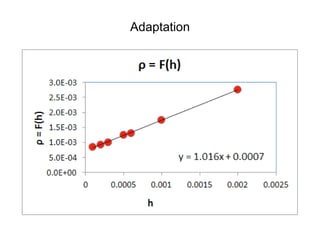
Adaptation
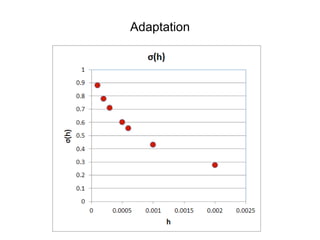
Adaptation
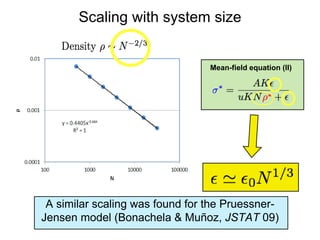
Scaling with system size
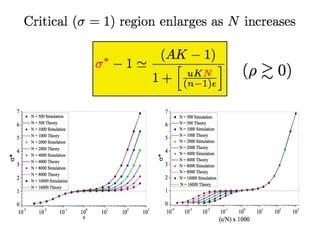
Mean-field equation (II)
A similar scaling was found for the Pruessner-
Jensen model (Bonachela & Muñoz, JSTAT 09)

SOC neunoral networks

Editor's Notes

  • #8 In 2006 Osame Kinouchi and I proposed a simple model an excitable network K random neighbors P_ij = probability that a spike in i causes a spike in j P_ij => control parameter sigma Order parameter F Self-consistent mean-field equation (I)
  • #9 Phase transition from quiescent (subcritical) to active (supercritical)
  • #12 - Cellular automata: allow larger system sizes [ up to O(10^5) ] - Ultra-slow load: dP/dt ~ O(1/N), but for FINITE CONNECTIVITY!
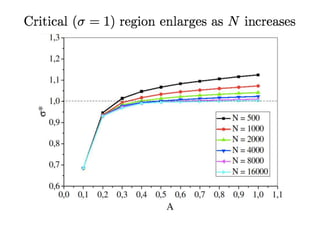
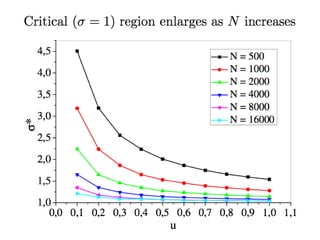
  • #26 Bad side: for fixed epsilon, varying N can take from subcritical, critical and supercritical (sigma = 1 might not necessarily be the critical value for finite N)
  • #48 Pruessner-Jensen model considered non-conservative by Bonachela & Muñoz 10