Vlasov Equation - Trapping, Break Down of Linearization &
                      Nonlinearity

                                           R. Ganesh
                   Institute for Plasma Research, Bhat, INDIA


                                  Major References
                        Intro. to Plasma Physics-F.F.Chen,
            Intro. to Plasma Physics-R. J. Goldston & P.H Rutherford,
                    Fundamentals of Plasma Physics-P.M.Bellan


R. Ganesh            Phd Grad School, 16th March 2012     IPR, INDIA    1
Outline

•   Travelling wave electric field, Trapping-Oscillations


R. Ganesh               Phd Grad School, 16th March 2012   IPR, INDIA   2
Vlasov-Maxwell Eqns


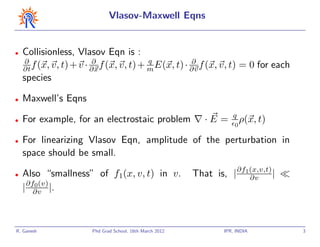
•   Collisionless, Vlasov Eqn is :
     ∂                   ∂                q           ∂
    ∂t f (x, v, t) + v · ∂x f (x, v, t) + m E(x, t) · ∂v f (x, v, t) = 0 for each
    species

•   Maxwell’s Eqns
                                                                      q
•   For example, for an electrostaic problem                  ·E =     0
                                                                           ρ(x, t)

•   For linearizing Vlasov Eqn, amplitude of the perturbation in
    space should be small.

•   Also “smallness” of f1(x, v, t) in v.                  That is, | ∂f1(x,v,t) |
                                                                         ∂v
    | ∂f∂v |.
        0 (v)


R. Ganesh               Phd Grad School, 16th March 2012           IPR, INDIA        3
Trapping


•   In the Initial Value Approach, the solution of Linearized Vlasov
    Eqn was obtained by “following f1” along the “unperturbed
    trajectories of particles”.

•   “Unperturbed trajectories” implies the equilibrium trajectories
    of particles as if the perturbation does not “backreact”on the
    trajectories of particles. This limit is the linear limit.

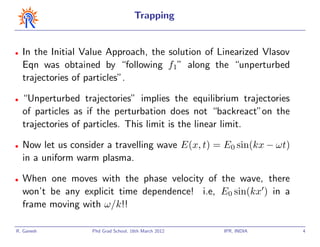
•   Now let us consider a travelling wave E(x, t) = E0 sin(kx − ωt)
    in a uniform warm plasma.

•   When one moves with the phase velocity of the wave, there
    won’t be any explicit time dependence! i.e, E0 sin(kx ) in a
    frame moving with ω/k!!

R. Ganesh           Phd Grad School, 16th March 2012   IPR, INDIA      4
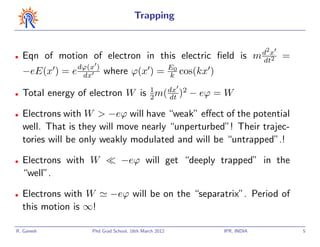
Trapping


                                                                                     d2x
•   Eqn of motion of electron in this electric field is                              m dt2   =
    −eE(x ) = e dϕ(x ) where ϕ(x ) =
                 dx
                                                       E0
                                                       k    cos(kx )

•   Total energy of electron W is 1 m( dx )2 − eϕ = W
                                  2    dt

•   Electrons with W > −eϕ will have “weak” effect of the potential
    well. That is they will move nearly “unperturbed”! Their trajec-
    tories will be only weakly modulated and will be “untrapped”.!

•   Electrons with W            −eϕ will get “deeply trapped” in the
    “well”.

•   Electrons with W       −eϕ will be on the “separatrix”. Period of
    this motion is ∞!

R. Ganesh           Phd Grad School, 16th March 2012                   IPR, INDIA               5
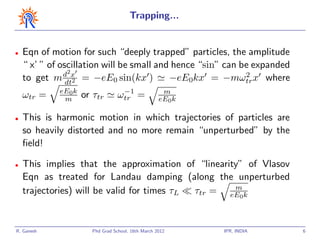
Trapping...


•   Eqn of motion for such “deeply trapped” particles, the amplitude
    “ x’ ” of oscillation will be small and hence “sin” can be expanded
               d2x                                           2
    to get m dt2 = −eE0 sin(kx )           −eE0kx = −mωtr x where
             eE0k                 −1                m
    ωtr =     m     or τtr       ωtr =             eE0k

•   This is harmonic motion in which trajectories of particles are
    so heavily distorted and no more remain “unperturbed” by the
    field!

•   This implies that the approximation of “linearity” of Vlasov
    Eqn as treated for Landau damping (along the unperturbed
                                                    m
    trajectories) will be valid for times τL τtr = eE0k


R. Ganesh             Phd Grad School, 16th March 2012    IPR, INDIA      6
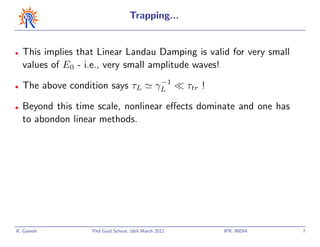
Trapping...


•   This implies that Linear Landau Damping is valid for very small
    values of E0 - i.e., very small amplitude waves!
                                                −1
•   The above condition says τL                γL      τtr !

•   Beyond this time scale, nonlinear effects dominate and one has
    to abondon linear methods.


R. Ganesh           Phd Grad School, 16th March 2012           IPR, INDIA   7
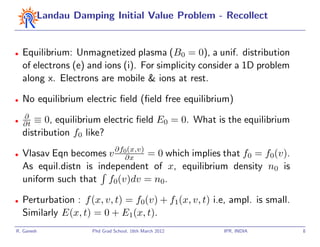
Landau Damping Initial Value Problem - Recollect


•   Equilibrium: Unmagnetized plasma (B0 = 0), a unif. distribution
    of electrons (e) and ions (i). For simplicity consider a 1D problem
    along x. Electrons are mobile & ions at rest.

•   No equilibrium electric field (field free equilibrium)
    ∂
•
    ∂t ≡ 0, equilibrium electric field E0 = 0. What is the equilibrium
    distribution f0 like?

•   Vlasav Eqn becomes v ∂f0∂x = 0 which implies that f0 = f0(v).
                            (x,v)

    As equil.distn is independent of x, equilibrium density n0 is
    uniform such that f0(v)dv = n0.

•   Perturbation : f (x, v, t) = f0(v) + f1(x, v, t) i.e, ampl. is small.
    Similarly E(x, t) = 0 + E1(x, t).
R. Ganesh             Phd Grad School, 16th March 2012   IPR, INDIA         8
Landau Damping I.V. Problem                                contd..


    ∂                        ∂                       e          ∂
•
    ∂t [f0(v)+f1(x, v, t)]+v ∂x [f0(v)+f1(x, v, t)]− m E1(x, t) ∂v [f0(v)+
    f1(x, v, t)] = 0

                   ∂                        e
•   Poisson Eqn:   ∂x E1(x, t)         =     0
                                                  n0 −        dv[f0(v) + f1(x, v, t)]

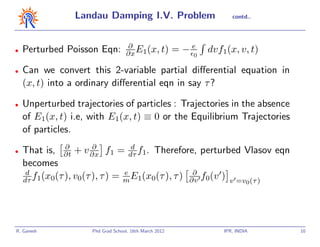
                                           ∂                   ∂
•   Zeroth Order Vlasov Eqn:               ∂t f0(v)        + v ∂x f0(v) = 0

                 ∂         ∂                               e          ∂
•   1st Order:   ∂t    + v ∂x f1(x, v, t) =                m E1(x, t) ∂v f0(v)


R. Ganesh               Phd Grad School, 16th March 2012                 IPR, INDIA     9
Landau Damping I.V. Problem                            contd..


                                   ∂
•   Perturbed Poisson Eqn:         ∂x E1(x, t)          = − e0   dvf1(x, v, t)

•   Can we convert this 2-variable partial differential equation in
    (x, t) into a ordinary differential eqn in say τ ?

•   Unperturbed trajectories of particles : Trajectories in the absence
    of E1(x, t) i.e, with E1(x, t) ≡ 0 or the Equilibrium Trajectories
    of particles.
               ∂       ∂          d
•   That is, ∂t + v ∂x f1 = dτ f1. Therefore, perturbed Vlasov eqn
    becomes
     d                          e                 ∂
    dτ f1(x0(τ ), v0(τ ), τ ) = m E1(x0(τ ), τ ) ∂v f0(v ) v =v (τ )
                                                                              0


R. Ganesh            Phd Grad School, 16th March 2012                IPR, INDIA   10
Landau Damping I.V. Problem                   contd..


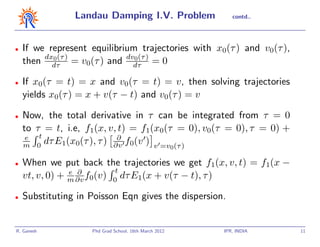
•   If we represent equilibrium trajectories with x0(τ ) and v0(τ ),
    then dxdτ ) = v0(τ ) and dvdτ ) = 0
           0 (τ                0 (τ


•   If x0(τ = t) = x and v0(τ = t) = v, then solving trajectories
    yields x0(τ ) = x + v(τ − t) and v0(τ ) = v

•   Now, the total derivative in τ can be integrated from τ = 0
    to τ = t, i.e, f1(x, v, t) = f1(x0(τ = 0), v0(τ = 0), τ = 0) +
     e t                    ∂
    m 0  dτ E1(x0(τ ), τ ) ∂v f0(v ) v =v (τ )
                                                       0

•   When we put back the trajectories we get f1(x, v, t) = f1(x −
                e ∂        t
    vt, v, 0) + m ∂v f0(v) 0 dτ E1(x + v(τ − t), τ )

•   Substituting in Poisson Eqn gives the dispersion.


R. Ganesh           Phd Grad School, 16th March 2012       IPR, INDIA   11
Break Down of Linear Landau Damping                     contd..


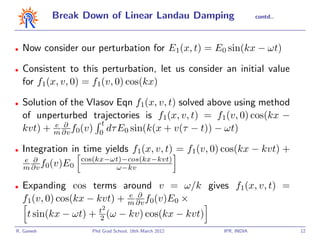
•   Now consider our perturbation for E1(x, t) = E0 sin(kx − ωt)

•   Consistent to this perturbation, let us consider an initial value
    for f1(x, v, 0) = f1(v, 0) cos(kx)

•   Solution of the Vlasov Eqn f1(x, v, t) solved above using method
    of unperturbed trajectories is f1(x, v, t) = f1(v, 0) cos(kx −
            e ∂        t
    kvt) + m ∂v f0(v) 0 dτ E0 sin(k(x + v(τ − t)) − ωt)

•   Integration in time yields f1(x, v, t) = f1(v, 0) cos(kx − kvt) +
     e ∂
    m ∂v f0(v)E0 cos(kx−ωt)−cos(kx−kvt)
                           ω−kv

•   Expanding cos terms around v = ω/k gives f1(x, v, t) =
                             e ∂
    f1(v, 0) cos(kx − kvt) + m ∂v f0(v)E0 ×
                        t2
     t sin(kx − ωt) +   2 (ω   − kv) cos(kx − kvt)
R. Ganesh           Phd Grad School, 16th March 2012   IPR, INDIA             12
Break Down of Linear Landau Damping                       contd..


•   Expanding cos terms around v = ω/k gives f1(x, v, t) =
                             e ∂
    f1(v, 0) cos(kx − kvt) + m ∂v f0(v)E0 ×
                         t2
     t sin(kx − ωt) +    2 (ω     − kv) cos(kx − kvt)

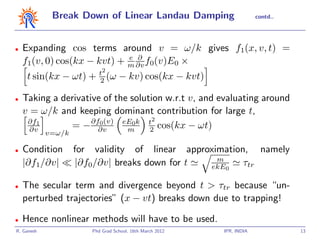
•   Taking a derivative of the solution w.r.t v, and evaluating around
    v = ω/k and keeping dominant contribution for large t,
     ∂f1             ∂f0(v) eE0k t2
      ∂v       = − ∂v         m     2 cos(kx − ωt)
            v=ω/k

•   Condition       for validity of linear approximation, namely
                                                  m
    |∂f1/∂v|        |∂f0/∂v| breaks down for t  ekE0    τtr

•   The secular term and divergence beyond t > τtr because “un-
    perturbed trajectories” (x − vt) breaks down due to trapping!

•   Hence nonlinear methods will have to be used.
R. Ganesh              Phd Grad School, 16th March 2012   IPR, INDIA             13

ZZZZTalk

  • 1.
    Vlasov Equation -Trapping, Break Down of Linearization & Nonlinearity R. Ganesh Institute for Plasma Research, Bhat, INDIA Major References Intro. to Plasma Physics-F.F.Chen, Intro. to Plasma Physics-R. J. Goldston & P.H Rutherford, Fundamentals of Plasma Physics-P.M.Bellan R. Ganesh Phd Grad School, 16th March 2012 IPR, INDIA 1
  • 2.
    Outline • Travelling wave electric field, Trapping-Oscillations R. Ganesh Phd Grad School, 16th March 2012 IPR, INDIA 2
  • 3.
    Vlasov-Maxwell Eqns • Collisionless, Vlasov Eqn is : ∂ ∂ q ∂ ∂t f (x, v, t) + v · ∂x f (x, v, t) + m E(x, t) · ∂v f (x, v, t) = 0 for each species • Maxwell’s Eqns q • For example, for an electrostaic problem ·E = 0 ρ(x, t) • For linearizing Vlasov Eqn, amplitude of the perturbation in space should be small. • Also “smallness” of f1(x, v, t) in v. That is, | ∂f1(x,v,t) | ∂v | ∂f∂v |. 0 (v) R. Ganesh Phd Grad School, 16th March 2012 IPR, INDIA 3
  • 4.
    Trapping • In the Initial Value Approach, the solution of Linearized Vlasov Eqn was obtained by “following f1” along the “unperturbed trajectories of particles”. • “Unperturbed trajectories” implies the equilibrium trajectories of particles as if the perturbation does not “backreact”on the trajectories of particles. This limit is the linear limit. • Now let us consider a travelling wave E(x, t) = E0 sin(kx − ωt) in a uniform warm plasma. • When one moves with the phase velocity of the wave, there won’t be any explicit time dependence! i.e, E0 sin(kx ) in a frame moving with ω/k!! R. Ganesh Phd Grad School, 16th March 2012 IPR, INDIA 4
  • 5.
    Trapping d2x • Eqn of motion of electron in this electric field is m dt2 = −eE(x ) = e dϕ(x ) where ϕ(x ) = dx E0 k cos(kx ) • Total energy of electron W is 1 m( dx )2 − eϕ = W 2 dt • Electrons with W > −eϕ will have “weak” effect of the potential well. That is they will move nearly “unperturbed”! Their trajec- tories will be only weakly modulated and will be “untrapped”.! • Electrons with W −eϕ will get “deeply trapped” in the “well”. • Electrons with W −eϕ will be on the “separatrix”. Period of this motion is ∞! R. Ganesh Phd Grad School, 16th March 2012 IPR, INDIA 5
  • 6.
    Trapping... • Eqn of motion for such “deeply trapped” particles, the amplitude “ x’ ” of oscillation will be small and hence “sin” can be expanded d2x 2 to get m dt2 = −eE0 sin(kx ) −eE0kx = −mωtr x where eE0k −1 m ωtr = m or τtr ωtr = eE0k • This is harmonic motion in which trajectories of particles are so heavily distorted and no more remain “unperturbed” by the field! • This implies that the approximation of “linearity” of Vlasov Eqn as treated for Landau damping (along the unperturbed m trajectories) will be valid for times τL τtr = eE0k R. Ganesh Phd Grad School, 16th March 2012 IPR, INDIA 6
  • 7.
    Trapping... • This implies that Linear Landau Damping is valid for very small values of E0 - i.e., very small amplitude waves! −1 • The above condition says τL γL τtr ! • Beyond this time scale, nonlinear effects dominate and one has to abondon linear methods. R. Ganesh Phd Grad School, 16th March 2012 IPR, INDIA 7
  • 8.
    Landau Damping InitialValue Problem - Recollect • Equilibrium: Unmagnetized plasma (B0 = 0), a unif. distribution of electrons (e) and ions (i). For simplicity consider a 1D problem along x. Electrons are mobile & ions at rest. • No equilibrium electric field (field free equilibrium) ∂ • ∂t ≡ 0, equilibrium electric field E0 = 0. What is the equilibrium distribution f0 like? • Vlasav Eqn becomes v ∂f0∂x = 0 which implies that f0 = f0(v). (x,v) As equil.distn is independent of x, equilibrium density n0 is uniform such that f0(v)dv = n0. • Perturbation : f (x, v, t) = f0(v) + f1(x, v, t) i.e, ampl. is small. Similarly E(x, t) = 0 + E1(x, t). R. Ganesh Phd Grad School, 16th March 2012 IPR, INDIA 8
  • 9.
    Landau Damping I.V.Problem contd.. ∂ ∂ e ∂ • ∂t [f0(v)+f1(x, v, t)]+v ∂x [f0(v)+f1(x, v, t)]− m E1(x, t) ∂v [f0(v)+ f1(x, v, t)] = 0 ∂ e • Poisson Eqn: ∂x E1(x, t) = 0 n0 − dv[f0(v) + f1(x, v, t)] ∂ ∂ • Zeroth Order Vlasov Eqn: ∂t f0(v) + v ∂x f0(v) = 0 ∂ ∂ e ∂ • 1st Order: ∂t + v ∂x f1(x, v, t) = m E1(x, t) ∂v f0(v) R. Ganesh Phd Grad School, 16th March 2012 IPR, INDIA 9
  • 10.
    Landau Damping I.V.Problem contd.. ∂ • Perturbed Poisson Eqn: ∂x E1(x, t) = − e0 dvf1(x, v, t) • Can we convert this 2-variable partial differential equation in (x, t) into a ordinary differential eqn in say τ ? • Unperturbed trajectories of particles : Trajectories in the absence of E1(x, t) i.e, with E1(x, t) ≡ 0 or the Equilibrium Trajectories of particles. ∂ ∂ d • That is, ∂t + v ∂x f1 = dτ f1. Therefore, perturbed Vlasov eqn becomes d e ∂ dτ f1(x0(τ ), v0(τ ), τ ) = m E1(x0(τ ), τ ) ∂v f0(v ) v =v (τ ) 0 R. Ganesh Phd Grad School, 16th March 2012 IPR, INDIA 10
  • 11.
    Landau Damping I.V.Problem contd.. • If we represent equilibrium trajectories with x0(τ ) and v0(τ ), then dxdτ ) = v0(τ ) and dvdτ ) = 0 0 (τ 0 (τ • If x0(τ = t) = x and v0(τ = t) = v, then solving trajectories yields x0(τ ) = x + v(τ − t) and v0(τ ) = v • Now, the total derivative in τ can be integrated from τ = 0 to τ = t, i.e, f1(x, v, t) = f1(x0(τ = 0), v0(τ = 0), τ = 0) + e t ∂ m 0 dτ E1(x0(τ ), τ ) ∂v f0(v ) v =v (τ ) 0 • When we put back the trajectories we get f1(x, v, t) = f1(x − e ∂ t vt, v, 0) + m ∂v f0(v) 0 dτ E1(x + v(τ − t), τ ) • Substituting in Poisson Eqn gives the dispersion. R. Ganesh Phd Grad School, 16th March 2012 IPR, INDIA 11
  • 12.
    Break Down ofLinear Landau Damping contd.. • Now consider our perturbation for E1(x, t) = E0 sin(kx − ωt) • Consistent to this perturbation, let us consider an initial value for f1(x, v, 0) = f1(v, 0) cos(kx) • Solution of the Vlasov Eqn f1(x, v, t) solved above using method of unperturbed trajectories is f1(x, v, t) = f1(v, 0) cos(kx − e ∂ t kvt) + m ∂v f0(v) 0 dτ E0 sin(k(x + v(τ − t)) − ωt) • Integration in time yields f1(x, v, t) = f1(v, 0) cos(kx − kvt) + e ∂ m ∂v f0(v)E0 cos(kx−ωt)−cos(kx−kvt) ω−kv • Expanding cos terms around v = ω/k gives f1(x, v, t) = e ∂ f1(v, 0) cos(kx − kvt) + m ∂v f0(v)E0 × t2 t sin(kx − ωt) + 2 (ω − kv) cos(kx − kvt) R. Ganesh Phd Grad School, 16th March 2012 IPR, INDIA 12
  • 13.
    Break Down ofLinear Landau Damping contd.. • Expanding cos terms around v = ω/k gives f1(x, v, t) = e ∂ f1(v, 0) cos(kx − kvt) + m ∂v f0(v)E0 × t2 t sin(kx − ωt) + 2 (ω − kv) cos(kx − kvt) • Taking a derivative of the solution w.r.t v, and evaluating around v = ω/k and keeping dominant contribution for large t, ∂f1 ∂f0(v) eE0k t2 ∂v = − ∂v m 2 cos(kx − ωt) v=ω/k • Condition for validity of linear approximation, namely m |∂f1/∂v| |∂f0/∂v| breaks down for t ekE0 τtr • The secular term and divergence beyond t > τtr because “un- perturbed trajectories” (x − vt) breaks down due to trapping! • Hence nonlinear methods will have to be used. R. Ganesh Phd Grad School, 16th March 2012 IPR, INDIA 13