Criticalidade Auto-organizada
Osame Kinouchi - Departamento de Física - FFCLRP - USP
Transições de Fase
A analogia da pilha de areia
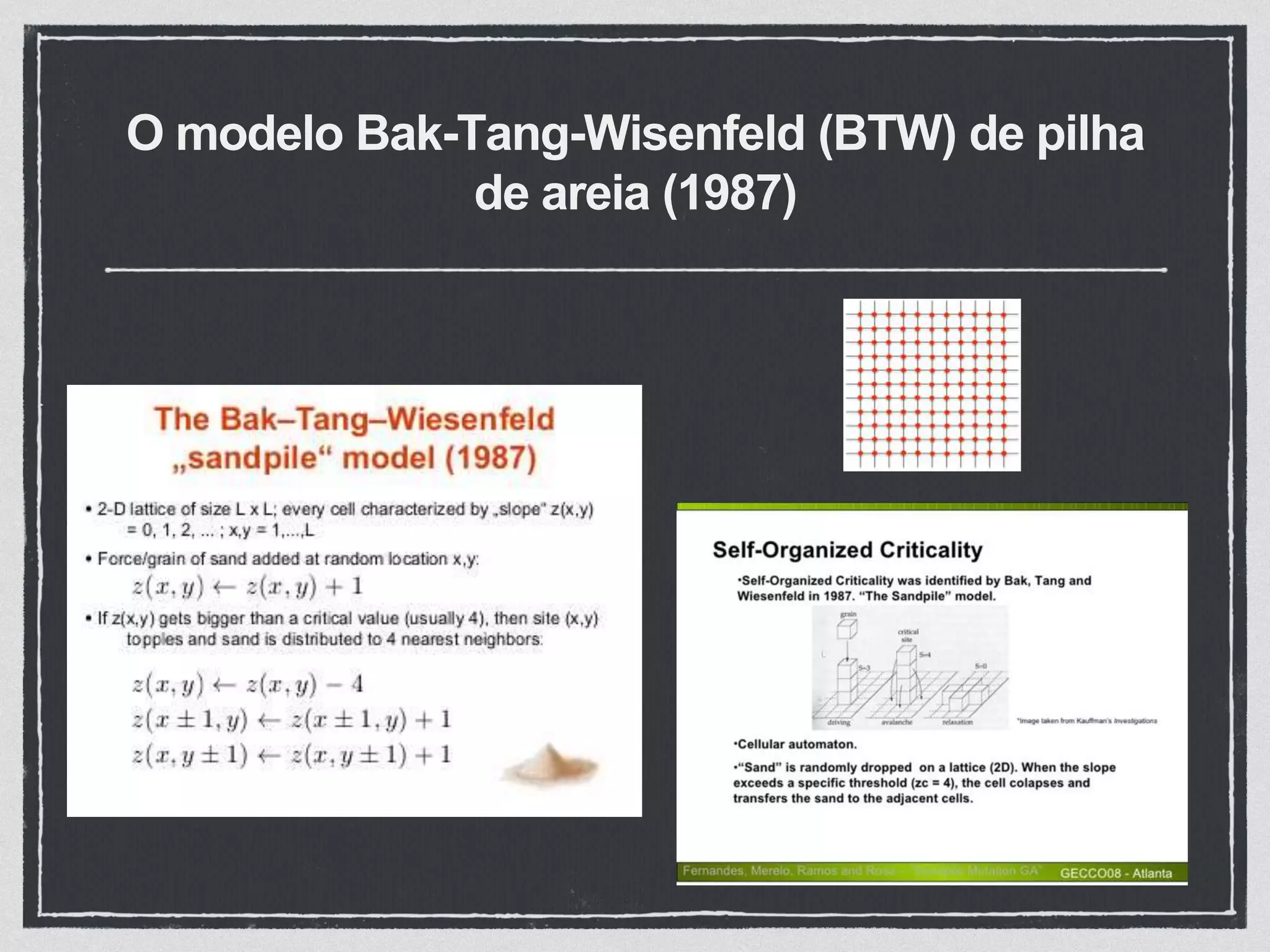
O modelo Bak-Tang-Wisenfeld (BTW) de pilha
de areia (1987)
Distribuições de tamanho de
avalanches
Experimento de Oslo da pilha de arroz
(1996)
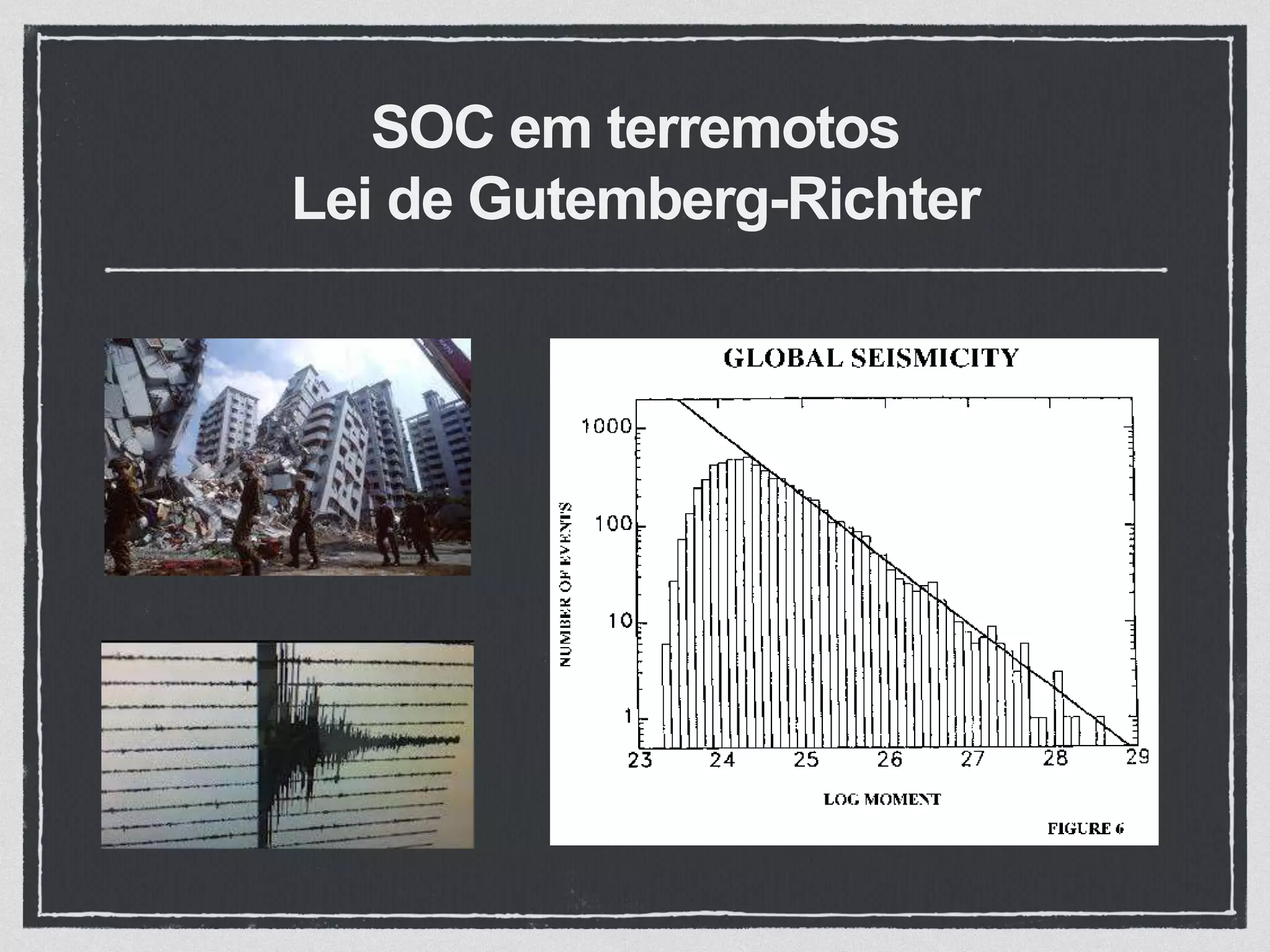
SOC em terremotos
Lei de Gutemberg-Richter
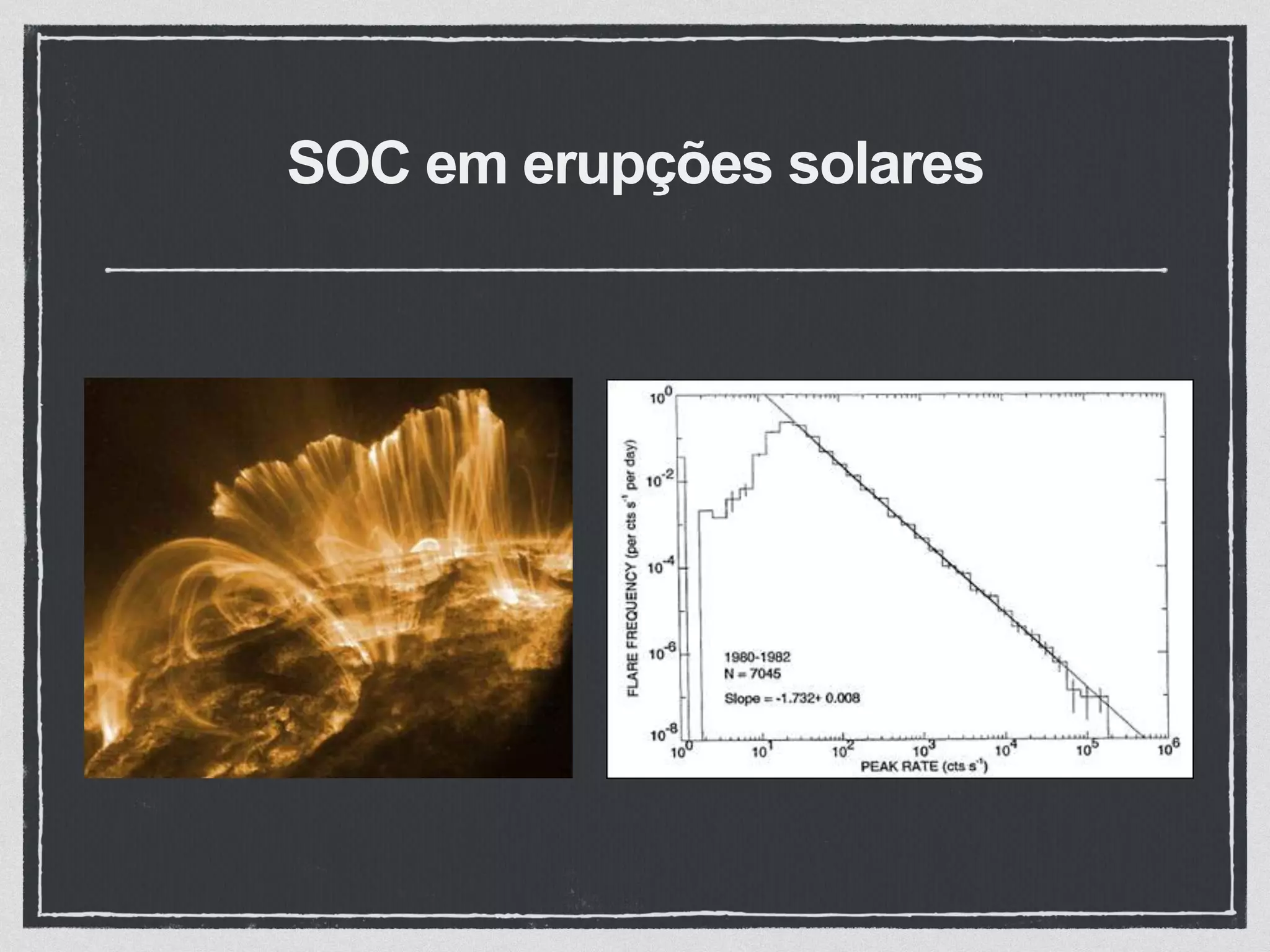
SOC em erupções solares
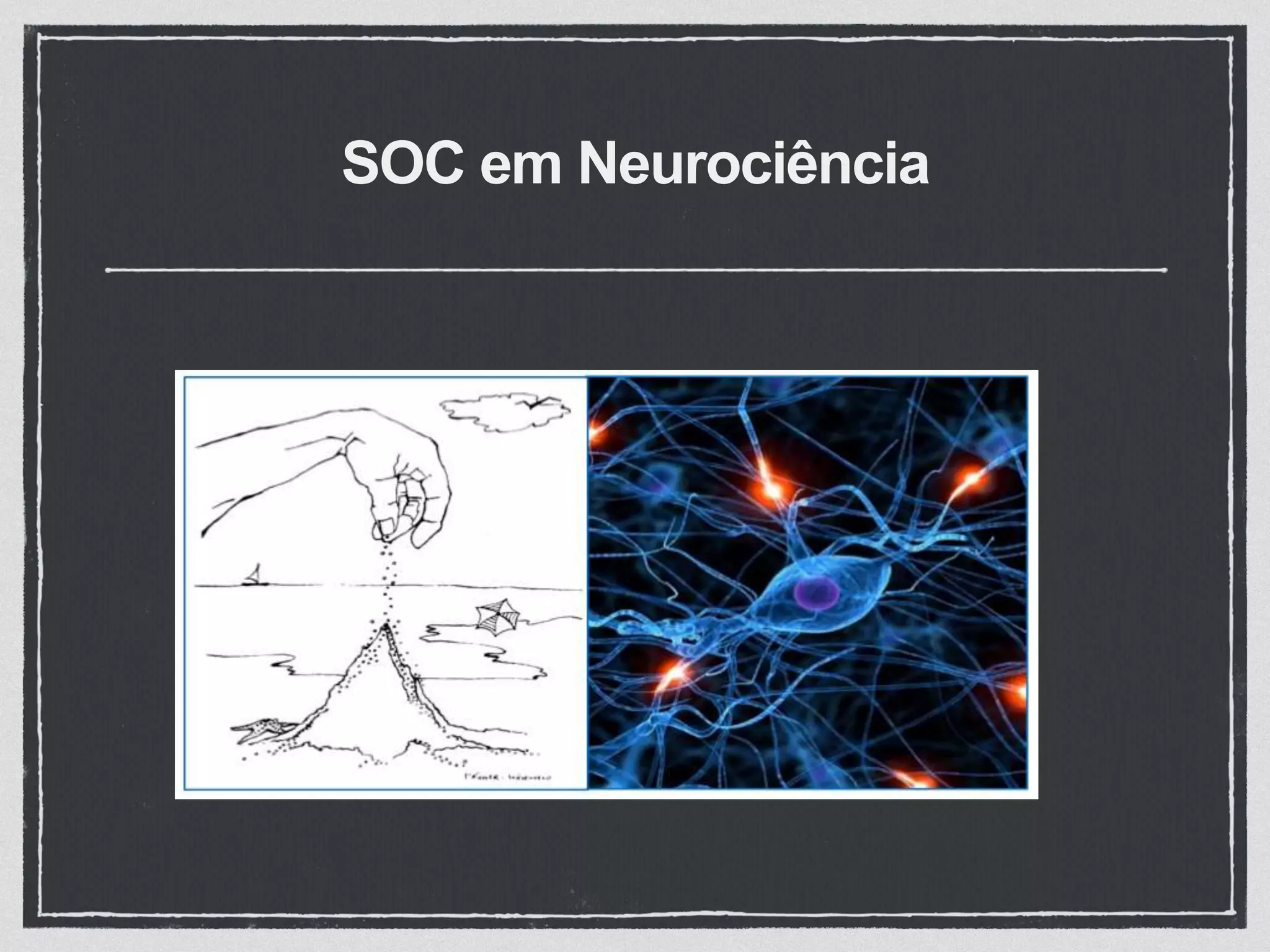
SOC em Neurociência
Allan Turing (1950)
Computing machinery and intelligence. Mind 59: 433-460.
“Another simile would be an atomic pile of less than critical size: an injected
idea is to correspond to a neutron entering the pile from without. Each such
neutron will cause a certain disturbance which eventually dies away. If,
however, the size of the pile is sufficiently increased, the disturbance caused by
such an incoming neutron will very likely go on and on increasing until the
whole pile is destroyed.
Is there a corresponding phenomenon [criticality] for minds, and is there one for
machines? There does seem to be one for the human mind. The majority of them
seems to be subcritical, i.e., to correspond in this analogy to piles of subcritical
size. An idea presented to such a mind will on average give rise to less than one
idea in reply.
A smallish proportion are supercritical. An idea presented to such a mind may
give rise to a whole "theory" consisting of secondary, tertiary and more remote
ideas. (...) Adhering to this analogy we ask, "Can a machine be made to be
supercritical?"
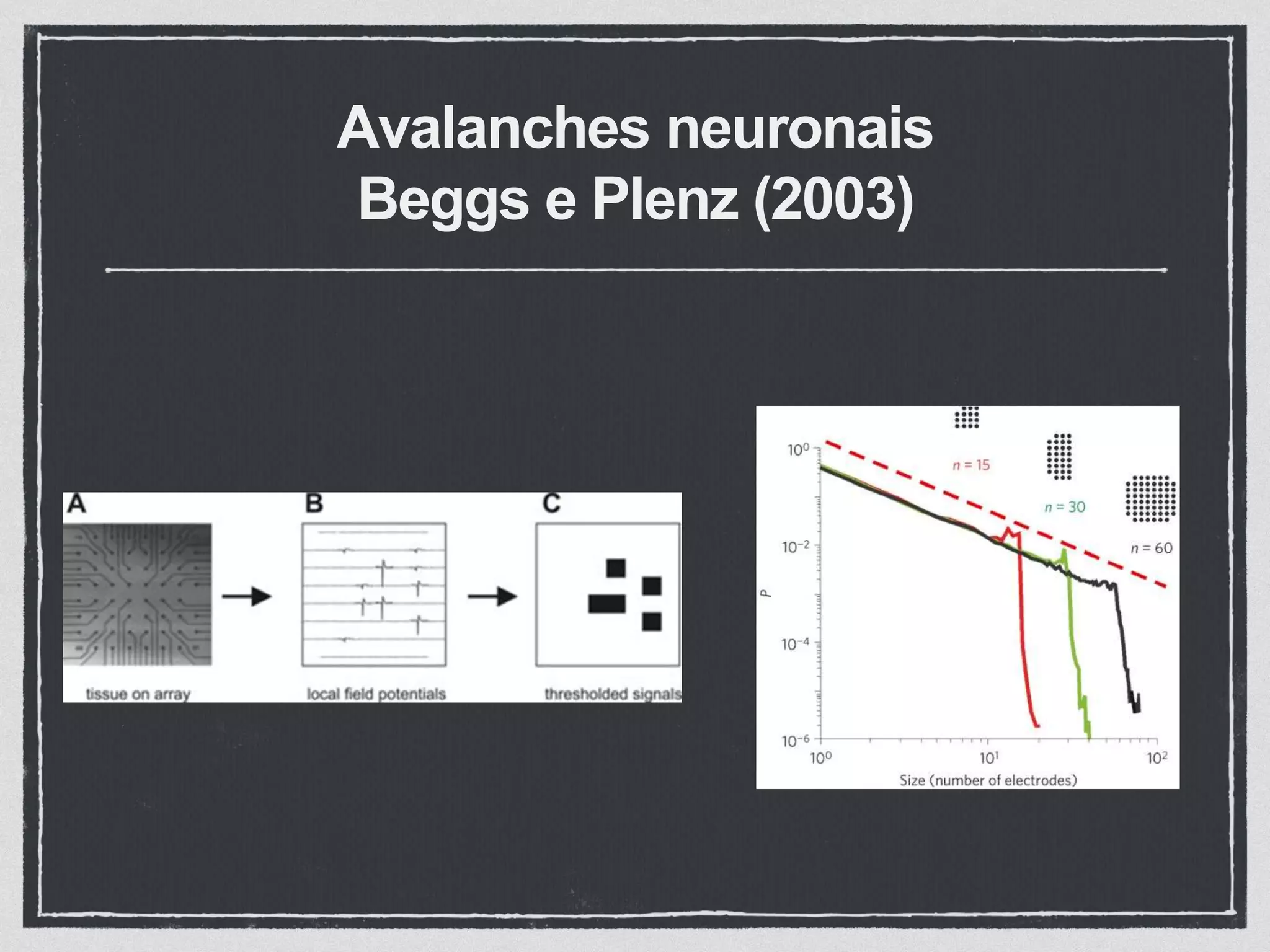
Avalanches neuronais
Beggs e Plenz (2003)
Avalanches neuronais:
dados e modelos
Modelo com neurônios integra-
dispara escolásticos (2016)
Xj = 0 (repouso)
Xj = 1 (disparo)
Vi[t+1] = μ Vi[t] + ∑ Wij Xj[t] se Xj[t] = 0
Vi[t+1] = 0 se Xj[t] = 1
P( Xi[t+1] =1 ) = ɸ(Vi[t])
Função de disparo ɸ(V) com transição de
fase de segunda ordem
μ = 0, linear saturating case r = 1, VT = 0
(Larremore et al., PRL 2014) But they do not report phase transitions
15
• Case r = 1, solve for 0 < ρ <1/2:
ρ = [𝚪(I + Wρ − VT)] (1 − ρ) or:
𝚪W ρ2 + (1 − 𝚪W + 𝚪I − 𝚪VT) ρ + 𝚪VT − 𝚪I = 0
• Solutions:
• Continuous and discontinuous phase transitions here
Φ
V
Avalanches neuronais
Ganhos neuronais 𝚪i(t) dinâmicos se auto-
organizam na região crítica
𝚪i [t+1] = 𝚪i [t] + 1/𝞽 ( A - 𝚪i [t] ) - u 𝚪i [t] Xi [t]
𝚪c
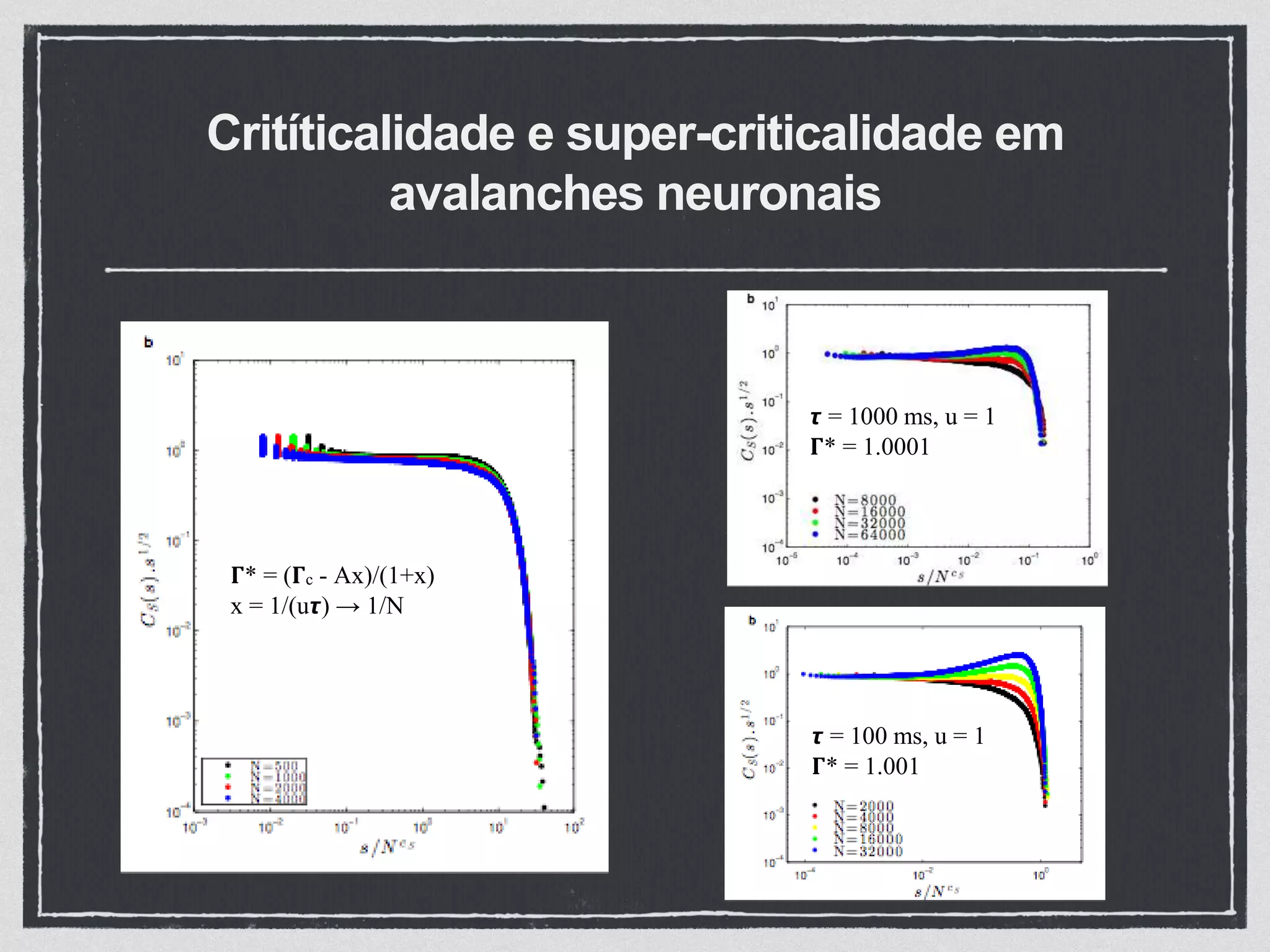
Critíticalidade e super-criticalidade em
avalanches neuronais
𝞽 = 100 ms, u = 1
𝚪* = 1.001
𝞽 = 1000 ms, u = 1
𝚪* = 1.0001
𝚪* = (𝚪c - Ax)/(1+x)
x = 1/(u𝞽) → 1/N
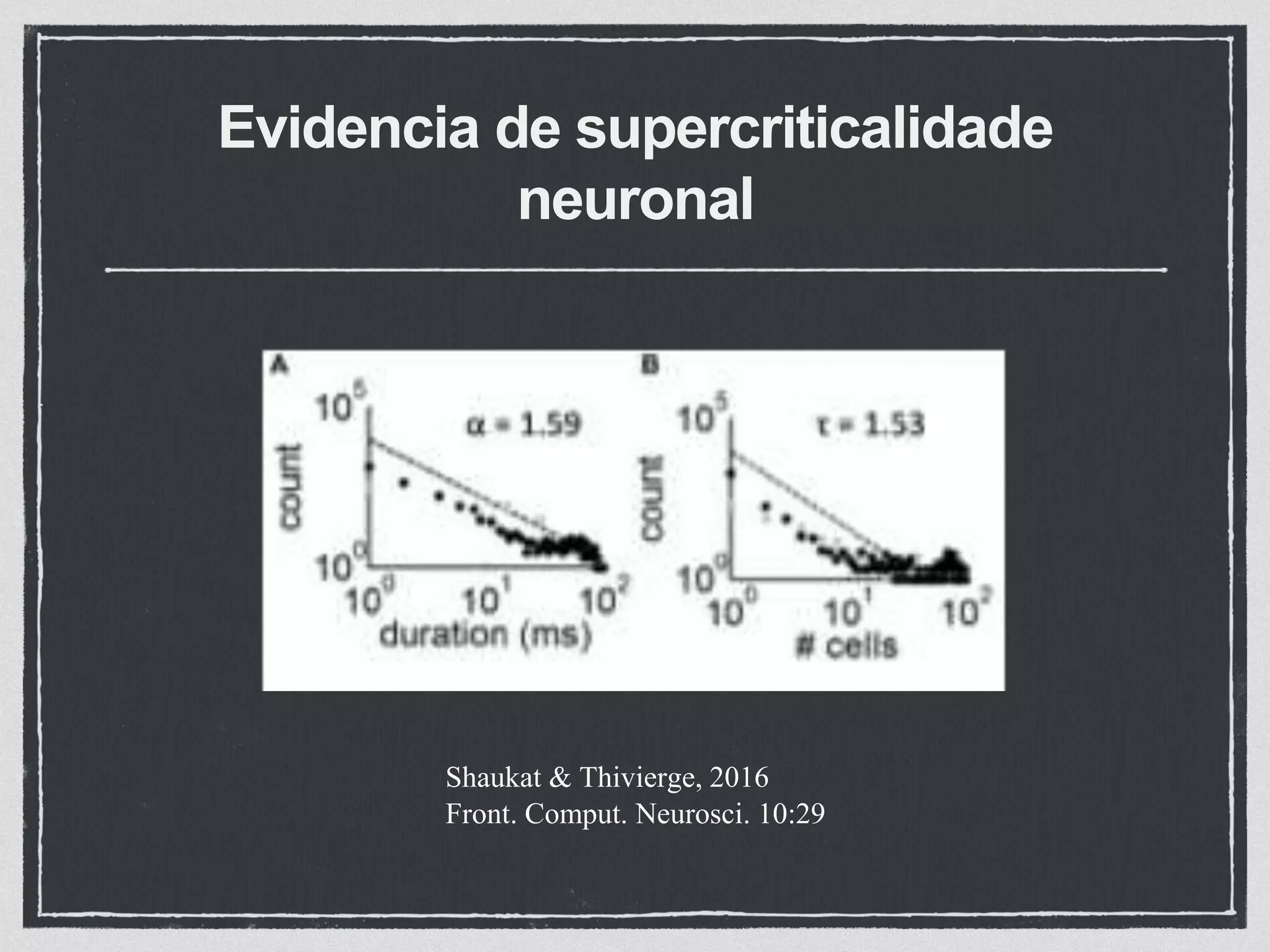
Evidencia de supercriticalidade
neuronal
Shaukat & Thivierge, 2016
Front. Comput. Neurosci. 10:29
Vantagem de redes neuronais críticas:
máxima faixa dinâmica
20
Scientific Reports 6: 35831 (2016)
21
Collaborators at NEUROMAT
22
Ludmila Brochini
Jorge Stolfi
Ariadne A. Costa
Antônio C. Roque Mauro Copellihttp://neuromat.numec.prp.usp.br/team
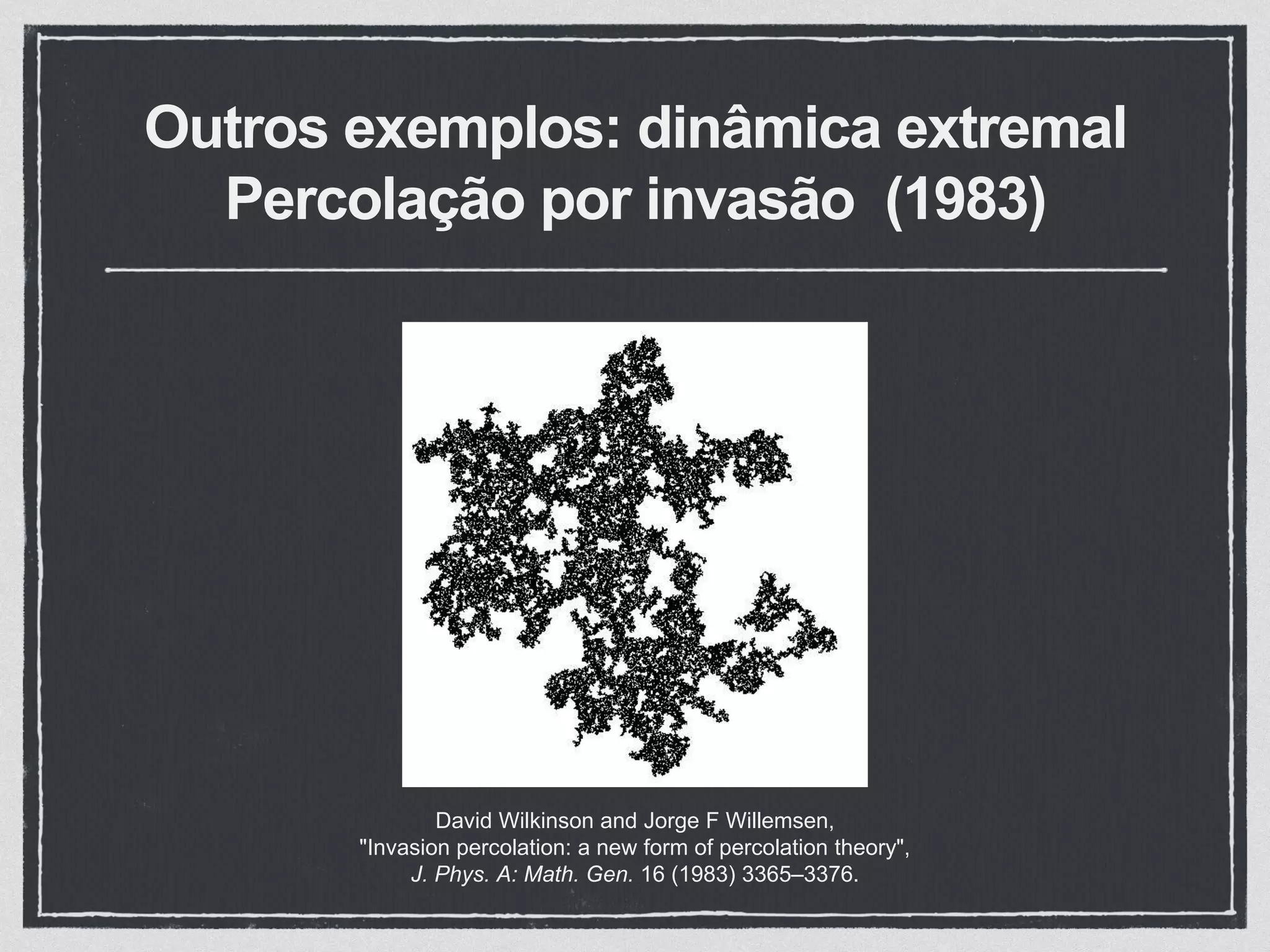
Outros exemplos: dinâmica extremal
Percolação por invasão (1983)
David Wilkinson and Jorge F Willemsen,
"Invasion percolation: a new form of percolation theory",
J. Phys. A: Math. Gen. 16 (1983) 3365–3376.
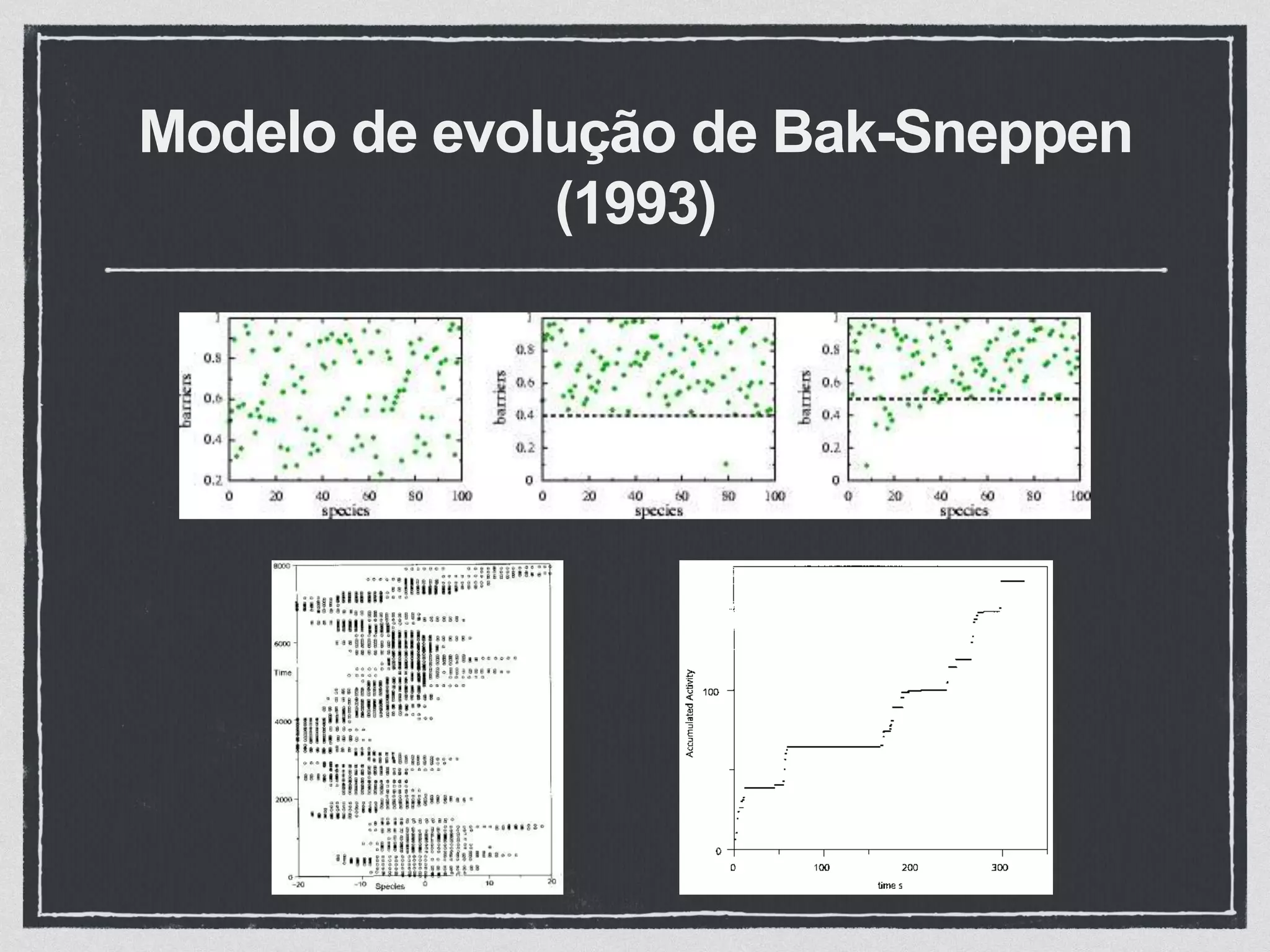
Modelo de evolução de Bak-Sneppen
(1993)

Self-organized criticality

  • 1.
    Criticalidade Auto-organizada Osame Kinouchi- Departamento de Física - FFCLRP - USP
  • 2.
  • 3.
    A analogia dapilha de areia
  • 4.
    O modelo Bak-Tang-Wisenfeld(BTW) de pilha de areia (1987)
  • 5.
  • 6.
    Experimento de Osloda pilha de arroz (1996)
  • 7.
    SOC em terremotos Leide Gutemberg-Richter
  • 8.
  • 9.
  • 10.
    Allan Turing (1950) Computingmachinery and intelligence. Mind 59: 433-460. “Another simile would be an atomic pile of less than critical size: an injected idea is to correspond to a neutron entering the pile from without. Each such neutron will cause a certain disturbance which eventually dies away. If, however, the size of the pile is sufficiently increased, the disturbance caused by such an incoming neutron will very likely go on and on increasing until the whole pile is destroyed. Is there a corresponding phenomenon [criticality] for minds, and is there one for machines? There does seem to be one for the human mind. The majority of them seems to be subcritical, i.e., to correspond in this analogy to piles of subcritical size. An idea presented to such a mind will on average give rise to less than one idea in reply. A smallish proportion are supercritical. An idea presented to such a mind may give rise to a whole "theory" consisting of secondary, tertiary and more remote ideas. (...) Adhering to this analogy we ask, "Can a machine be made to be supercritical?"
  • 11.
  • 12.
  • 13.
    Modelo com neurôniosintegra- dispara escolásticos (2016) Xj = 0 (repouso) Xj = 1 (disparo) Vi[t+1] = μ Vi[t] + ∑ Wij Xj[t] se Xj[t] = 0 Vi[t+1] = 0 se Xj[t] = 1 P( Xi[t+1] =1 ) = ɸ(Vi[t])
  • 14.
    Função de disparoɸ(V) com transição de fase de segunda ordem
  • 15.
    μ = 0,linear saturating case r = 1, VT = 0 (Larremore et al., PRL 2014) But they do not report phase transitions 15 • Case r = 1, solve for 0 < ρ <1/2: ρ = [𝚪(I + Wρ − VT)] (1 − ρ) or: 𝚪W ρ2 + (1 − 𝚪W + 𝚪I − 𝚪VT) ρ + 𝚪VT − 𝚪I = 0 • Solutions: • Continuous and discontinuous phase transitions here Φ V
  • 16.
  • 17.
    Ganhos neuronais 𝚪i(t)dinâmicos se auto- organizam na região crítica 𝚪i [t+1] = 𝚪i [t] + 1/𝞽 ( A - 𝚪i [t] ) - u 𝚪i [t] Xi [t] 𝚪c
  • 18.
    Critíticalidade e super-criticalidadeem avalanches neuronais 𝞽 = 100 ms, u = 1 𝚪* = 1.001 𝞽 = 1000 ms, u = 1 𝚪* = 1.0001 𝚪* = (𝚪c - Ax)/(1+x) x = 1/(u𝞽) → 1/N
  • 19.
    Evidencia de supercriticalidade neuronal Shaukat& Thivierge, 2016 Front. Comput. Neurosci. 10:29
  • 20.
    Vantagem de redesneuronais críticas: máxima faixa dinâmica 20
  • 21.
    Scientific Reports 6:35831 (2016) 21
  • 22.
    Collaborators at NEUROMAT 22 LudmilaBrochini Jorge Stolfi Ariadne A. Costa Antônio C. Roque Mauro Copellihttp://neuromat.numec.prp.usp.br/team
  • 23.
    Outros exemplos: dinâmicaextremal Percolação por invasão (1983) David Wilkinson and Jorge F Willemsen, "Invasion percolation: a new form of percolation theory", J. Phys. A: Math. Gen. 16 (1983) 3365–3376.
  • 24.
    Modelo de evoluçãode Bak-Sneppen (1993)