1
NETWORKING –MEANING AND SCOPE OF
NETWORKING IN SCIENCE LEARNING
Submitted To
Mrs SUSHAMA PRABHA L
Lecturer in Natural Science
Submitted By
Kavitha S Mohan
Natural Science
Submitted on
15-7-2015
Sl.NO Contents Page No
2
INTRODUCTION
A computer network is any set of computers
or devices connected to each other with the ability to exchange data.
The smallest possible computer network can begin with two
1
2
3
4
5
6
7
8
9
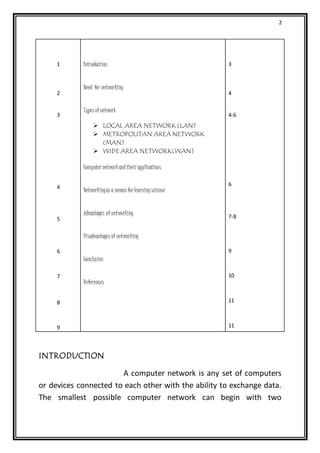
Introduction
Need for networking
Types ofnetwork
 LOCAL AREA NETWORK (LAN)
 METROPOLITAN AREA NETWORK
(MAN)
 WIDE AREA NETWORK(WAN)
Computer networkand their applications
Networkingas a means for learning science
Advantages of networking
Disadvantages of networking
Conclusion
References
3
4
4-6
6
7-8
9
10
11
11
3
computers when linked together .A computer network can also
consist of, and is usually made for more than two computers.
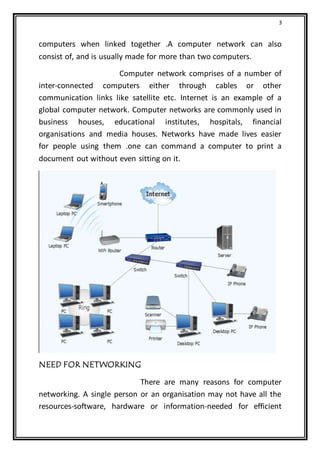
Computer network comprises of a number of
inter-connected computers either through cables or other
communication links like satellite etc. Internet is an example of a
global computer network. Computer networks are commonly used in
business houses, educational institutes, hospitals, financial
organisations and media houses. Networks have made lives easier
for people using them .one can command a computer to print a
document out without even sitting on it.
NEED FOR NETWORKING
There are many reasons for computer
networking. A single person or an organisation may not have all the
resources-software, hardware or information-needed for efficient
4
and productive work. These resources may be available from other
people or organisations. The need to communicate with different
people in different parts of the world is paramount in today’s world.
Computer networks provide a solution to all these problems by
allowing users from all over the world to connect, communicate, and
share information and resources with each other.
TYPES OF NETWORK
Networks may vary depending upon the
number of computers to be interconnected and the area in which
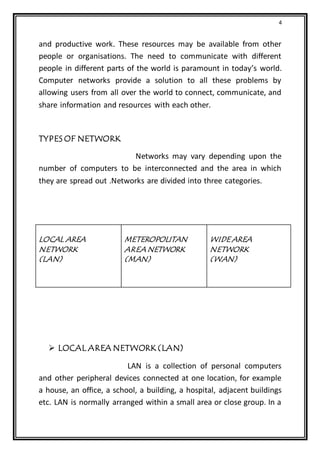
they are spread out .Networks are divided into three categories.
LOCAL AREA
NETWORK
(LAN)
METEROPOLITAN
AREA NETWORK
(MAN)
WIDE AREA
NETWORK
(WAN)
 LOCAL AREA NETWORK (LAN)
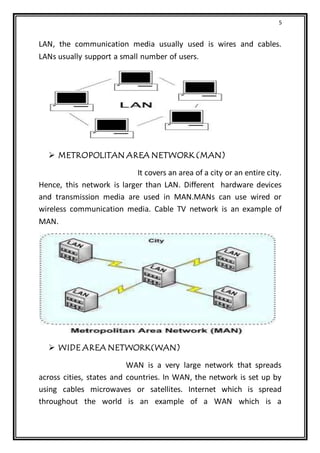
LAN is a collection of personal computers
and other peripheral devices connected at one location, for example
a house, an office, a school, a building, a hospital, adjacent buildings
etc. LAN is normally arranged within a small area or close group. In a
5
LAN, the communication media usually used is wires and cables.
LANs usually support a small number of users.
 METROPOLITAN AREA NETWORK (MAN)
It covers an area of a city or an entire city.
Hence, this network is larger than LAN. Different hardware devices
and transmission media are used in MAN.MANs can use wired or
wireless communication media. Cable TV network is an example of
MAN.
 WIDE AREA NETWORK(WAN)
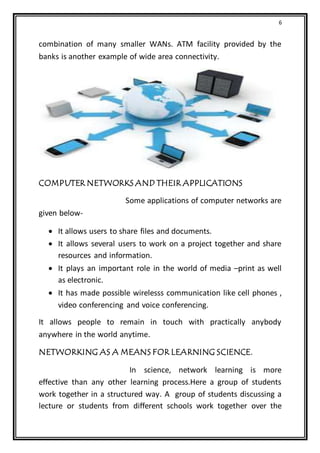
WAN is a very large network that spreads
across cities, states and countries. In WAN, the network is set up by
using cables microwaves or satellites. Internet which is spread
throughout the world is an example of a WAN which is a
6
combination of many smaller WANs. ATM facility provided by the
banks is another example of wide area connectivity.
COMPUTER NETWORKS AND THEIR APPLICATIONS
Some applications of computer networks are
given below-
 It allows users to share files and documents.
 It allows several users to work on a project together and share
resources and information.
 It plays an important role in the world of media –print as well
as electronic.
 It has made possible wirelesss communication like cell phones ,
video conferencing and voice conferencing.
It allows people to remain in touch with practically anybody
anywhere in the world anytime.
NETWORKING AS A MEANS FOR LEARNING SCIENCE.
In science, network learning is more
effective than any other learning process.Here a group of students
work together in a structured way. A group of students discussing a
lecture or students from different schools work together over the
7
internet on a shared assignment. The students are individually
accountable for their work, and the work of the group as a whole is
also assessed. In network learning cooperative groups work face to
face and learn to work as a team. The user is able to take the
information to personalize and customize their learning experience
to meet their own personal needs. The learner is able to increase
connections, interactions and sharing in networking allows for
effective learning. Network learning provide social cohesion and
better achievement among learners and develop deep emotions like
respect and admiration for the expertise of others.
Networking is a spatially diffuse structure
with no rigidly defined boundaries, consisting of several
autonomous nodes sharing common values or interests, linked
together in interdependent exchange relationships. It is a
supportive system of sharing or exchanging information and
services among individuals, group or institutions having a
common interest.
Different types of networking for science learning
1) Technical networking
2) Institutional networking
3) Personal networking
In European countries, this is a part of
their education. Netwoking can provide a lot of benefits in the
field of education.
In the case of technical networking , various tools are used to
exchange the information. They are,
8
1) BSCW (Basic supportforcollaborative work)-
This is a tool designed in Germany. It is free
to use for educational purposes. It enables and supports for
working in groups. Resourses can be uploaded to work with
them.
2) Synergia –
It is a further developed version of
BSCW. It offers logged closed chat operations and tools for
visual communication. This is a combination of a synchronous
map tool and an asynchronous BSCL(Basic support for
cooperative learning)tool.
3) FLE3
FLE3 environment was developed on
pedagogical theory including computer supported collaborative
learning for collaborative knowledge building. It has really good
interactive communication tools. When using within the school,
it does not need the web.
4) Think.com
This is an oracle tool but free for any
registered school world wide.
In addition to these tools, social networks
like twitter, blogs, Linked In, Facebook are also used for
exchanging information. Some social networks such as English
Baby! are explicitly education focused and couple instructional
content with an educational peer environment.
In institutional networking,information
is exchanged between various institutions. By this type of
networking ,the collaboration between different institutions are
possible. This helps in the development of these institutions .In
personal networking, two or more persons can exchange
9
informations among them. E-twinning is an example for personal
networking. Here the resourse persons share their resourses and
practice which leads to the development of the institution. The
knowledge acquired by different individuals becomes an asset to
group work. Indeed some European countries have already
perceived this and have integrated into the national strategic
plans.
ADVANTAGES OF NETWORKING
There are several advantages of having
computer networks. Some of these are –
1)Sharing ofResources
Computer networks allow users to
share hardware devices and resources like printers, hard disks
,memory and optical drives. This reduces the overall cost of these
devices for an organisation or an individual.
2) Sharing ofInformation-
computer networks allow sharing of
data and information among a large no. of users thus benefiting
the whole community. News, latest discoveries and technological
breakthroughs can be shared by users all over the world as soon as
they occur.
3) Centralised Software
Computer Networks allow users to access
and use software applications without the need to install them on
their system.
5) Communication
10
Computer networks allow users to
communicate with each other irrespective of their location,
thus reducing the time and distance barriers that conventional
modes of communication present.
DISADVANTAGES OF NETWORKING
In spite of having so many advantages,
computer networks do have their share of limitations. Some of
these are
1) Degradation in Performance
As hardware devices and resources are
shared among a large no. of users, allocation of resources
becomes difficult and leads in decrease in efficiency as waiting
time increases.
2) Security Issues
As a large number of users can access
information and data stored on networks , it becomes difficult
to ensure privacy and authorized access to data.
3) NetworkFailure
Centralisation of applications and data
means that a failure of a key component of the network like
severs or transmission media can result in failure of entire
network.
4) Cost Factor
Configuration of computer netwoks Involve
specialised devices as well as installation features like cabling that
can increase the overall cost for an organization.
CONCLUSION
11
A network is a group of resources and devices
that can be linked to each other and shared within the group.
Networks are interconnected to allow communication through a
variety of media including twisted-pair cable, coaxial cable, optical
fibre cable and various wireless technologies like satellites,
microwaves ,infrared waves and bluetooth. Different types of
networking provides a lot of benefits in the field of education.
There are also networking systems that does not need the web
while it is used within the school. This shows the technical
advancement in the field of networking. Hence we can conclude
that these networks can play a crucial role in the development of
science and its upliftment to a wider sector.
REFERENCE
 Teaching Science for Biological and Physical Sciences by Dr.
Mariamma Mathew
 Explore Your Computer by M.S Ambika.
 https://en.wikipedia.org/wiki/Computer _network

Networking online assignment

  • 1.
    1 NETWORKING –MEANING ANDSCOPE OF NETWORKING IN SCIENCE LEARNING Submitted To Mrs SUSHAMA PRABHA L Lecturer in Natural Science Submitted By Kavitha S Mohan Natural Science Submitted on 15-7-2015 Sl.NO Contents Page No
  • 2.
    2 INTRODUCTION A computer networkis any set of computers or devices connected to each other with the ability to exchange data. The smallest possible computer network can begin with two 1 2 3 4 5 6 7 8 9 Introduction Need for networking Types ofnetwork  LOCAL AREA NETWORK (LAN)  METROPOLITAN AREA NETWORK (MAN)  WIDE AREA NETWORK(WAN) Computer networkand their applications Networkingas a means for learning science Advantages of networking Disadvantages of networking Conclusion References 3 4 4-6 6 7-8 9 10 11 11
  • 3.
    3 computers when linkedtogether .A computer network can also consist of, and is usually made for more than two computers. Computer network comprises of a number of inter-connected computers either through cables or other communication links like satellite etc. Internet is an example of a global computer network. Computer networks are commonly used in business houses, educational institutes, hospitals, financial organisations and media houses. Networks have made lives easier for people using them .one can command a computer to print a document out without even sitting on it. NEED FOR NETWORKING There are many reasons for computer networking. A single person or an organisation may not have all the resources-software, hardware or information-needed for efficient
  • 4.
    4 and productive work.These resources may be available from other people or organisations. The need to communicate with different people in different parts of the world is paramount in today’s world. Computer networks provide a solution to all these problems by allowing users from all over the world to connect, communicate, and share information and resources with each other. TYPES OF NETWORK Networks may vary depending upon the number of computers to be interconnected and the area in which they are spread out .Networks are divided into three categories. LOCAL AREA NETWORK (LAN) METEROPOLITAN AREA NETWORK (MAN) WIDE AREA NETWORK (WAN)  LOCAL AREA NETWORK (LAN) LAN is a collection of personal computers and other peripheral devices connected at one location, for example a house, an office, a school, a building, a hospital, adjacent buildings etc. LAN is normally arranged within a small area or close group. In a
  • 5.
    5 LAN, the communicationmedia usually used is wires and cables. LANs usually support a small number of users.  METROPOLITAN AREA NETWORK (MAN) It covers an area of a city or an entire city. Hence, this network is larger than LAN. Different hardware devices and transmission media are used in MAN.MANs can use wired or wireless communication media. Cable TV network is an example of MAN.  WIDE AREA NETWORK(WAN) WAN is a very large network that spreads across cities, states and countries. In WAN, the network is set up by using cables microwaves or satellites. Internet which is spread throughout the world is an example of a WAN which is a
  • 6.
    6 combination of manysmaller WANs. ATM facility provided by the banks is another example of wide area connectivity. COMPUTER NETWORKS AND THEIR APPLICATIONS Some applications of computer networks are given below-  It allows users to share files and documents.  It allows several users to work on a project together and share resources and information.  It plays an important role in the world of media –print as well as electronic.  It has made possible wirelesss communication like cell phones , video conferencing and voice conferencing. It allows people to remain in touch with practically anybody anywhere in the world anytime. NETWORKING AS A MEANS FOR LEARNING SCIENCE. In science, network learning is more effective than any other learning process.Here a group of students work together in a structured way. A group of students discussing a lecture or students from different schools work together over the
  • 7.
    7 internet on ashared assignment. The students are individually accountable for their work, and the work of the group as a whole is also assessed. In network learning cooperative groups work face to face and learn to work as a team. The user is able to take the information to personalize and customize their learning experience to meet their own personal needs. The learner is able to increase connections, interactions and sharing in networking allows for effective learning. Network learning provide social cohesion and better achievement among learners and develop deep emotions like respect and admiration for the expertise of others. Networking is a spatially diffuse structure with no rigidly defined boundaries, consisting of several autonomous nodes sharing common values or interests, linked together in interdependent exchange relationships. It is a supportive system of sharing or exchanging information and services among individuals, group or institutions having a common interest. Different types of networking for science learning 1) Technical networking 2) Institutional networking 3) Personal networking In European countries, this is a part of their education. Netwoking can provide a lot of benefits in the field of education. In the case of technical networking , various tools are used to exchange the information. They are,
  • 8.
    8 1) BSCW (Basicsupportforcollaborative work)- This is a tool designed in Germany. It is free to use for educational purposes. It enables and supports for working in groups. Resourses can be uploaded to work with them. 2) Synergia – It is a further developed version of BSCW. It offers logged closed chat operations and tools for visual communication. This is a combination of a synchronous map tool and an asynchronous BSCL(Basic support for cooperative learning)tool. 3) FLE3 FLE3 environment was developed on pedagogical theory including computer supported collaborative learning for collaborative knowledge building. It has really good interactive communication tools. When using within the school, it does not need the web. 4) Think.com This is an oracle tool but free for any registered school world wide. In addition to these tools, social networks like twitter, blogs, Linked In, Facebook are also used for exchanging information. Some social networks such as English Baby! are explicitly education focused and couple instructional content with an educational peer environment. In institutional networking,information is exchanged between various institutions. By this type of networking ,the collaboration between different institutions are possible. This helps in the development of these institutions .In personal networking, two or more persons can exchange
  • 9.
    9 informations among them.E-twinning is an example for personal networking. Here the resourse persons share their resourses and practice which leads to the development of the institution. The knowledge acquired by different individuals becomes an asset to group work. Indeed some European countries have already perceived this and have integrated into the national strategic plans. ADVANTAGES OF NETWORKING There are several advantages of having computer networks. Some of these are – 1)Sharing ofResources Computer networks allow users to share hardware devices and resources like printers, hard disks ,memory and optical drives. This reduces the overall cost of these devices for an organisation or an individual. 2) Sharing ofInformation- computer networks allow sharing of data and information among a large no. of users thus benefiting the whole community. News, latest discoveries and technological breakthroughs can be shared by users all over the world as soon as they occur. 3) Centralised Software Computer Networks allow users to access and use software applications without the need to install them on their system. 5) Communication
  • 10.
    10 Computer networks allowusers to communicate with each other irrespective of their location, thus reducing the time and distance barriers that conventional modes of communication present. DISADVANTAGES OF NETWORKING In spite of having so many advantages, computer networks do have their share of limitations. Some of these are 1) Degradation in Performance As hardware devices and resources are shared among a large no. of users, allocation of resources becomes difficult and leads in decrease in efficiency as waiting time increases. 2) Security Issues As a large number of users can access information and data stored on networks , it becomes difficult to ensure privacy and authorized access to data. 3) NetworkFailure Centralisation of applications and data means that a failure of a key component of the network like severs or transmission media can result in failure of entire network. 4) Cost Factor Configuration of computer netwoks Involve specialised devices as well as installation features like cabling that can increase the overall cost for an organization. CONCLUSION
  • 11.
    11 A network isa group of resources and devices that can be linked to each other and shared within the group. Networks are interconnected to allow communication through a variety of media including twisted-pair cable, coaxial cable, optical fibre cable and various wireless technologies like satellites, microwaves ,infrared waves and bluetooth. Different types of networking provides a lot of benefits in the field of education. There are also networking systems that does not need the web while it is used within the school. This shows the technical advancement in the field of networking. Hence we can conclude that these networks can play a crucial role in the development of science and its upliftment to a wider sector. REFERENCE  Teaching Science for Biological and Physical Sciences by Dr. Mariamma Mathew  Explore Your Computer by M.S Ambika.  https://en.wikipedia.org/wiki/Computer _network