
Increasing Your Visibility and Developing your Career
• How do I increase my visibility and
impact at work and in turn develop
my career?
•
•
•

Networking effectively
Mentoring
Other Mechanisms to develop your career

1
Networking
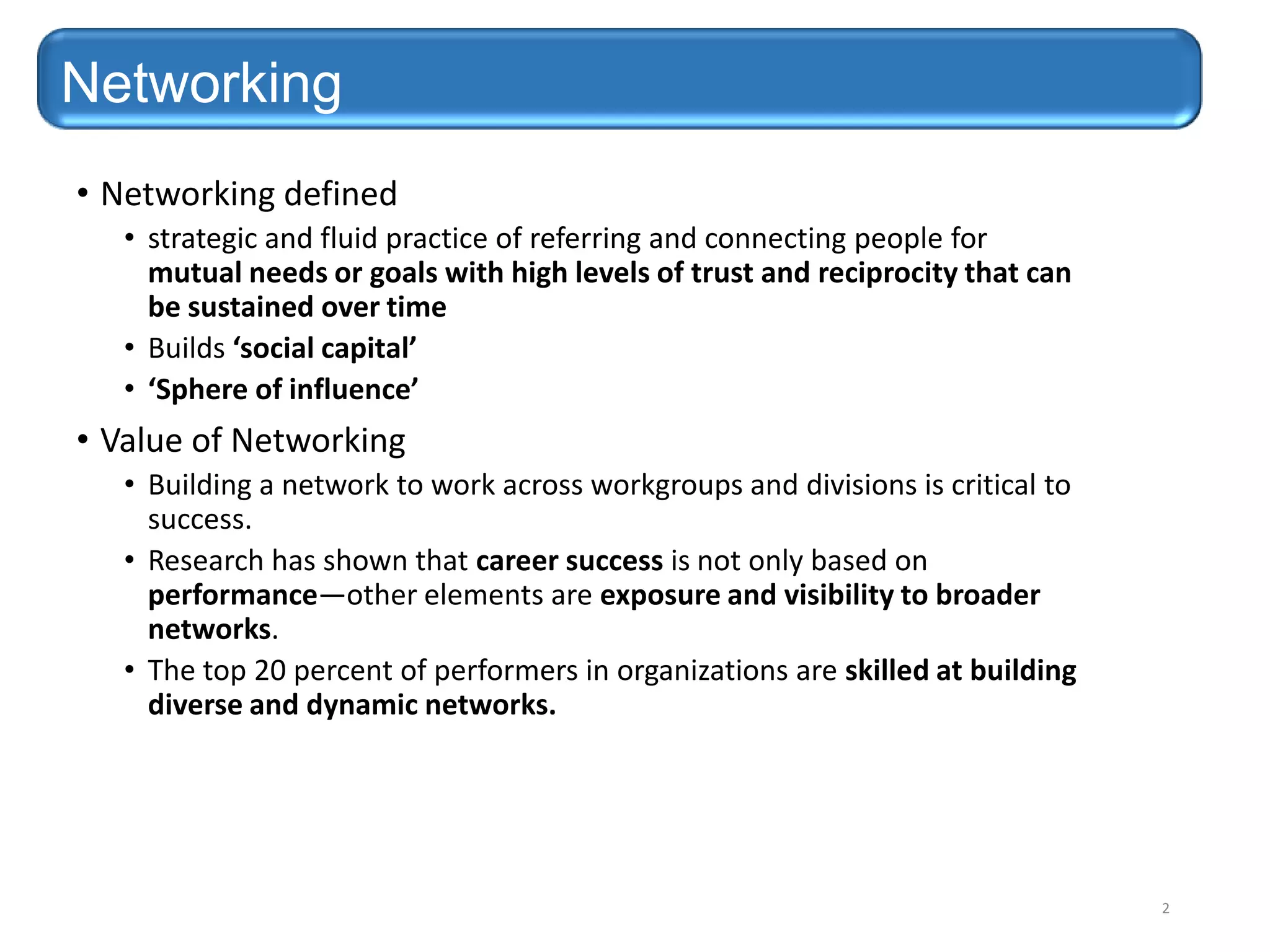
• Networking defined
• strategic and fluid practice of referring and connecting people for
mutual needs or goals with high levels of trust and reciprocity that can
be sustained over time
• Builds ‘social capital’
• ‘Sphere of influence’

• Value of Networking
• Building a network to work across workgroups and divisions is critical to
success.
• Research has shown that career success is not only based on
performance—other elements are exposure and visibility to broader
networks.
• The top 20 percent of performers in organizations are skilled at building
diverse and dynamic networks.

2
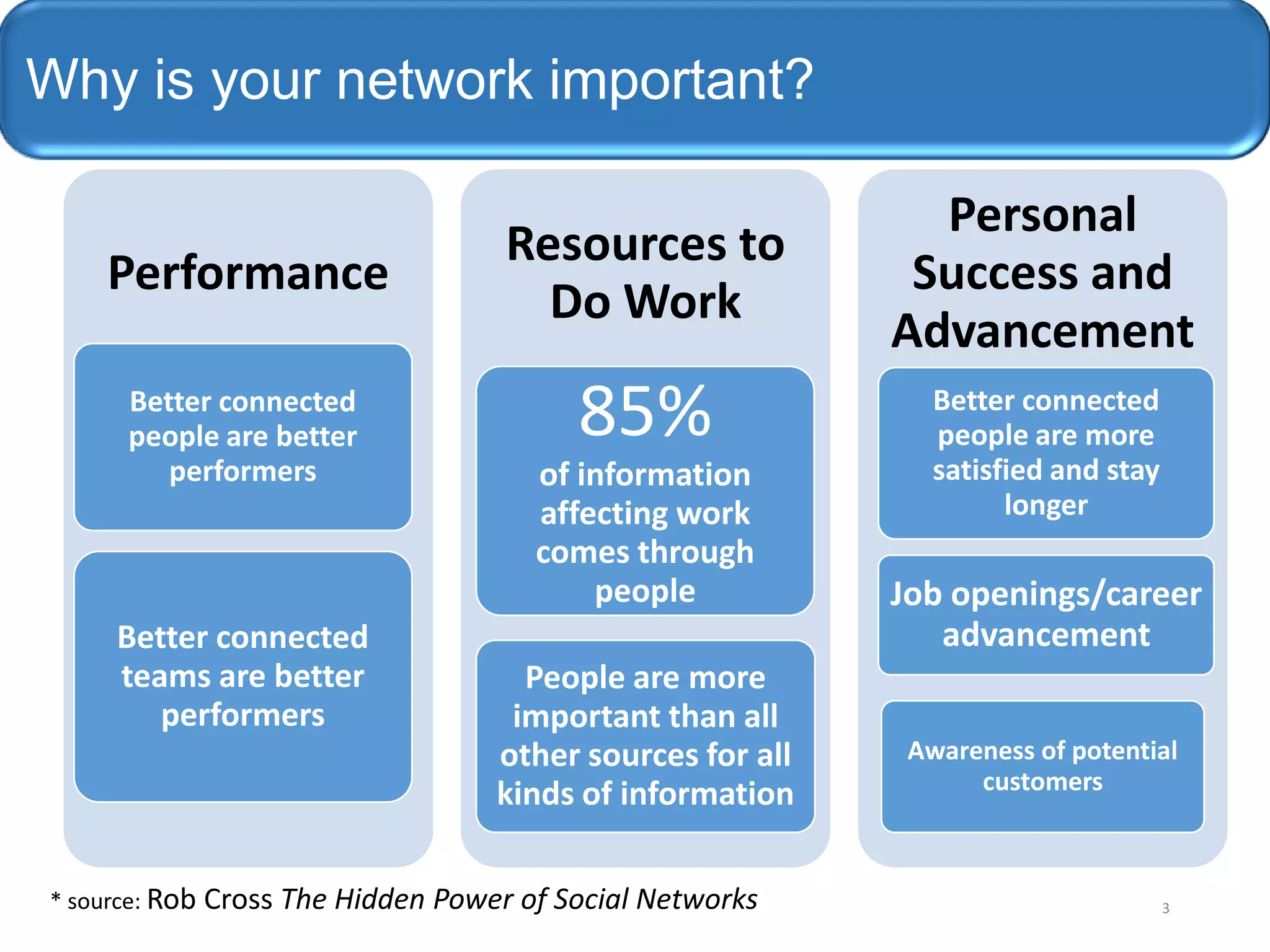
Why is your network important?
Performance
Better connected
people are better
performers

Better connected
teams are better
performers

* source: Rob

Resources to
Do Work

85%
of information
affecting work
comes through
people
People are more
important than all
other sources for all
kinds of information

Cross The Hidden Power of Social Networks

Personal
Success and
Advancement
Better connected
people are more
satisfied and stay
longer

Job openings/career
advancement
Awareness of potential
customers

3
Make Yourself Job
#1. Make Yourself
Job #1. Make
Yourself Job #1.
Make Yourself Job
4
Have You Said Any of These?
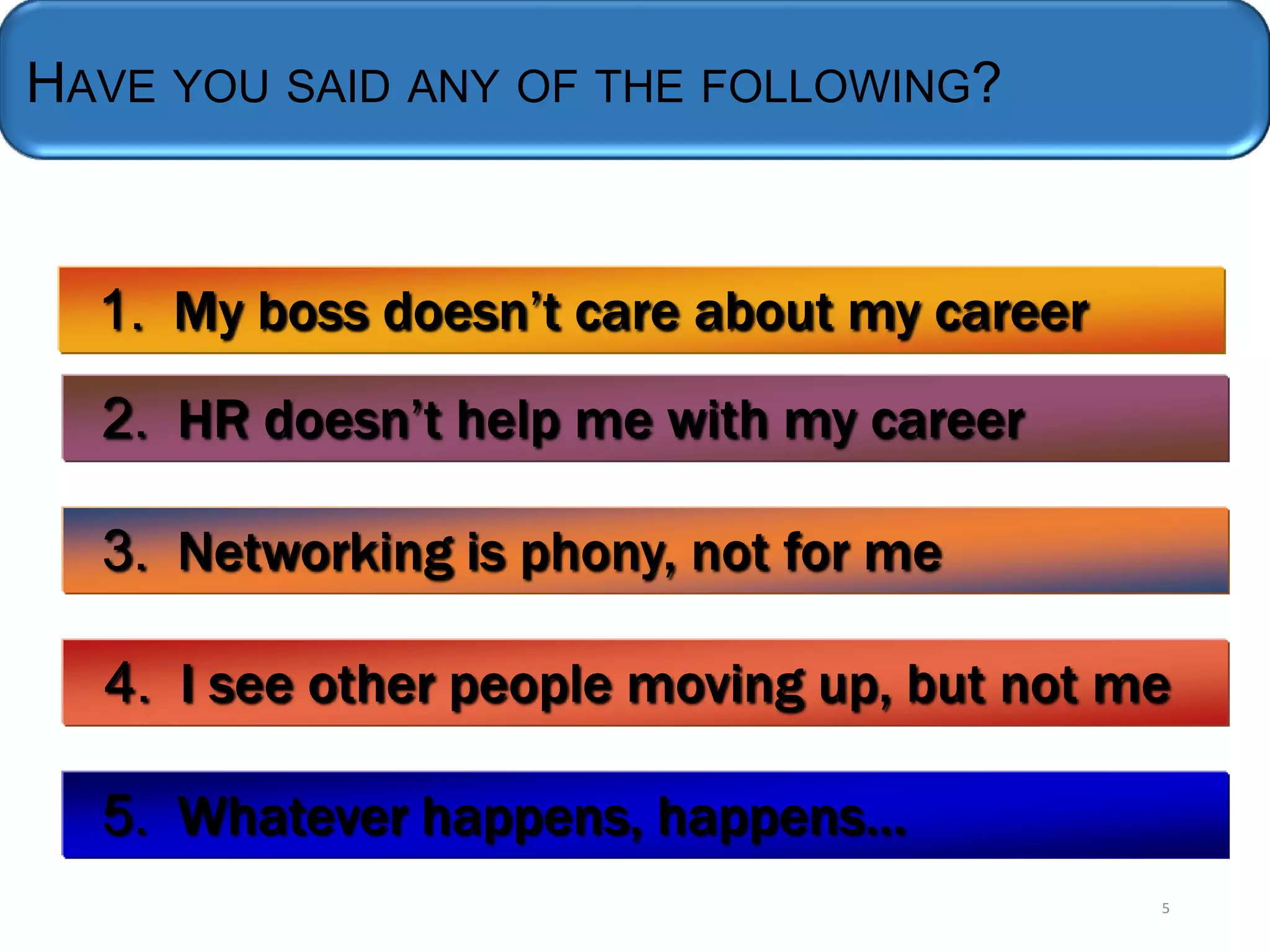
HAVE YOU SAID ANY OF THE FOLLOWING?
1. My boss doesn’t care about my career
2. HR doesn’t help me with my career
3. Networking is phony, not for me

4. I see other people moving up, but not me
5. Whatever happens, happens…
5
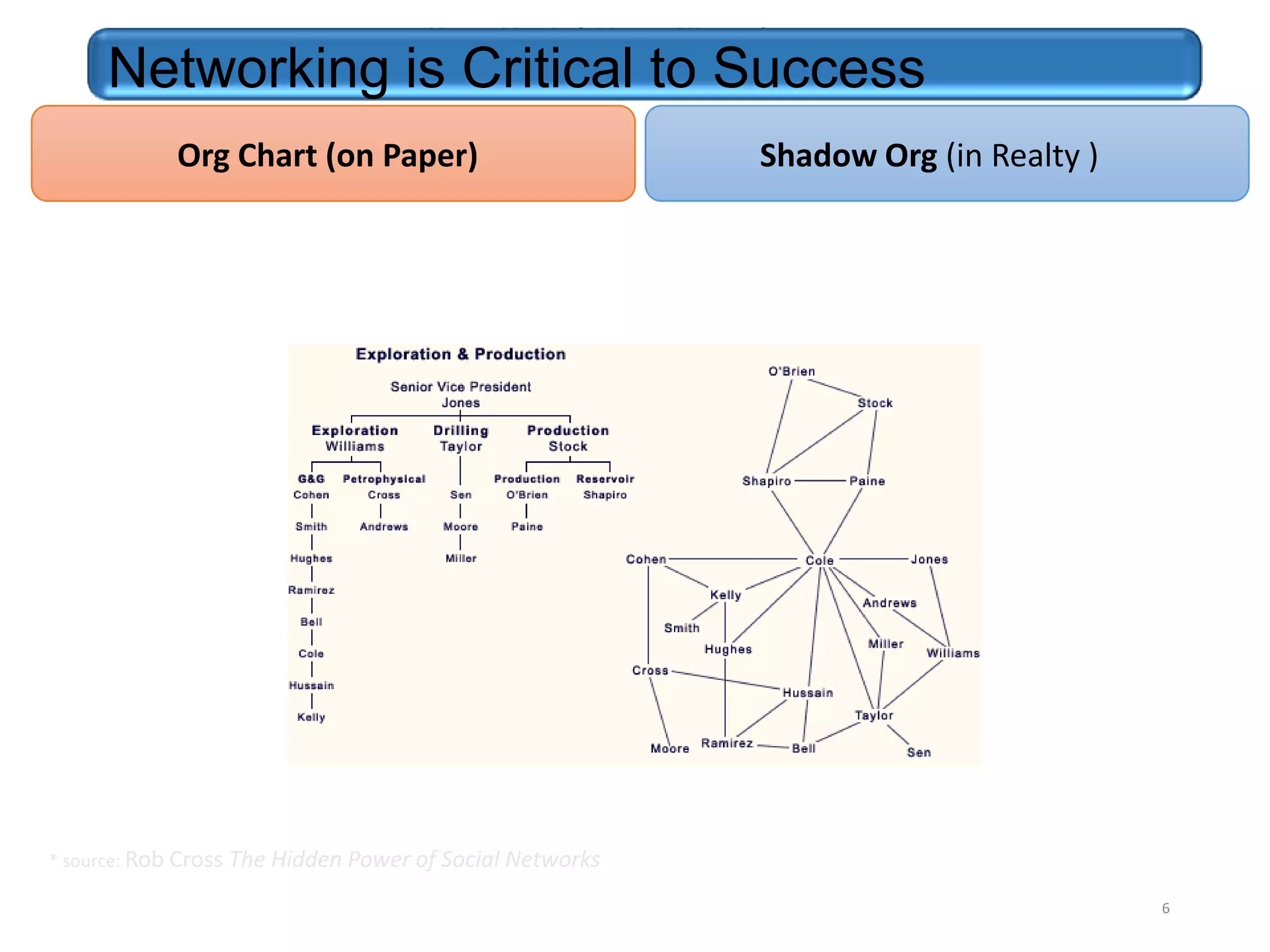
Networking is Critical to Microsoft

Networking is Critical to Success
Org Chart (on Paper)

Shadow Org (in Realty )

* source: Rob Cross The Hidden Power of Social Networks
6
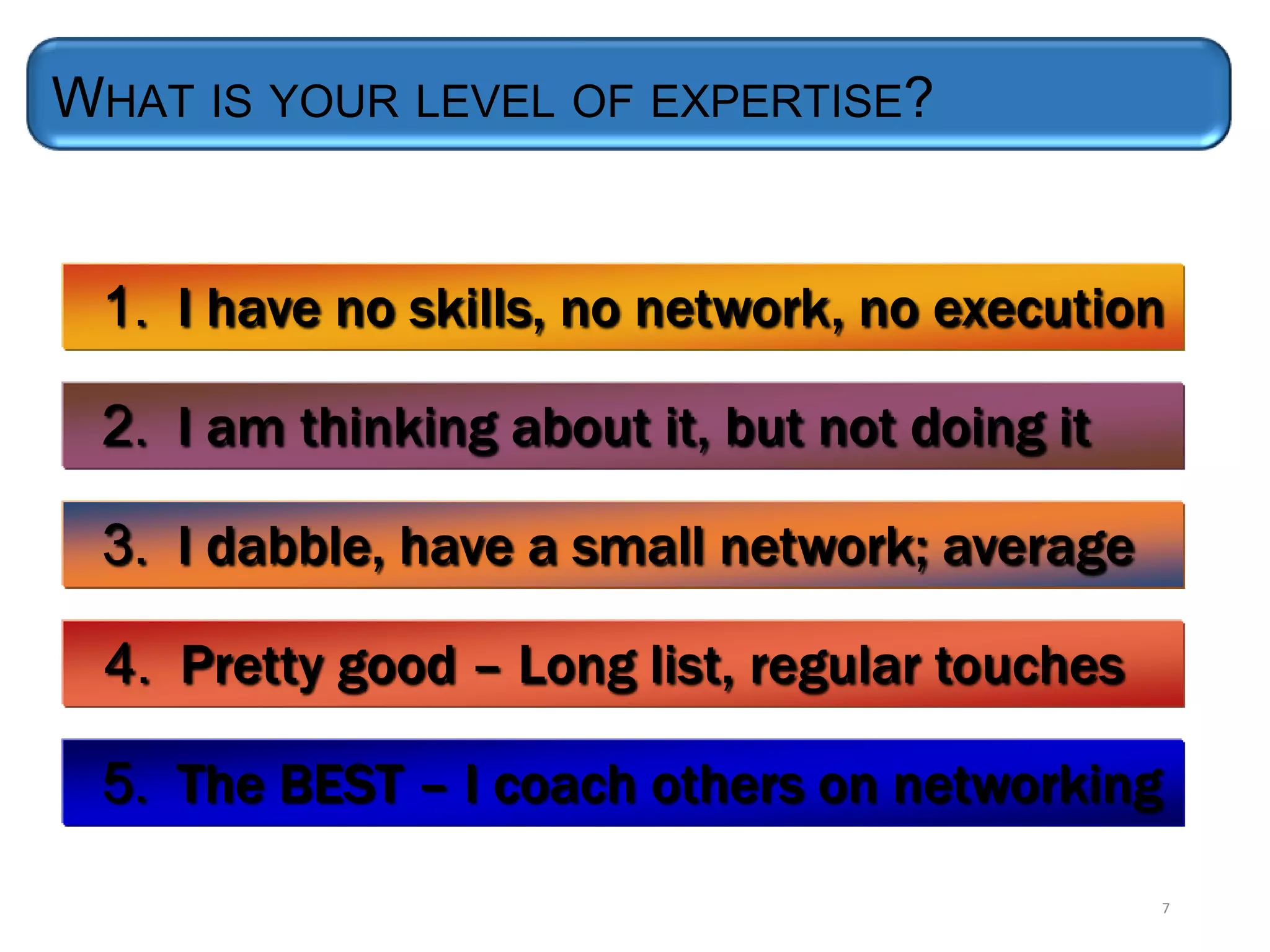
WHAT IS YOUR LEVEL OF EXPERTISE?

1. I have no skills, no network, no execution

2. I am thinking about it, but not doing it
3. I dabble, have a small network; average
4. Pretty good – Long list, regular touches
5. The BEST – I coach others on networking
7
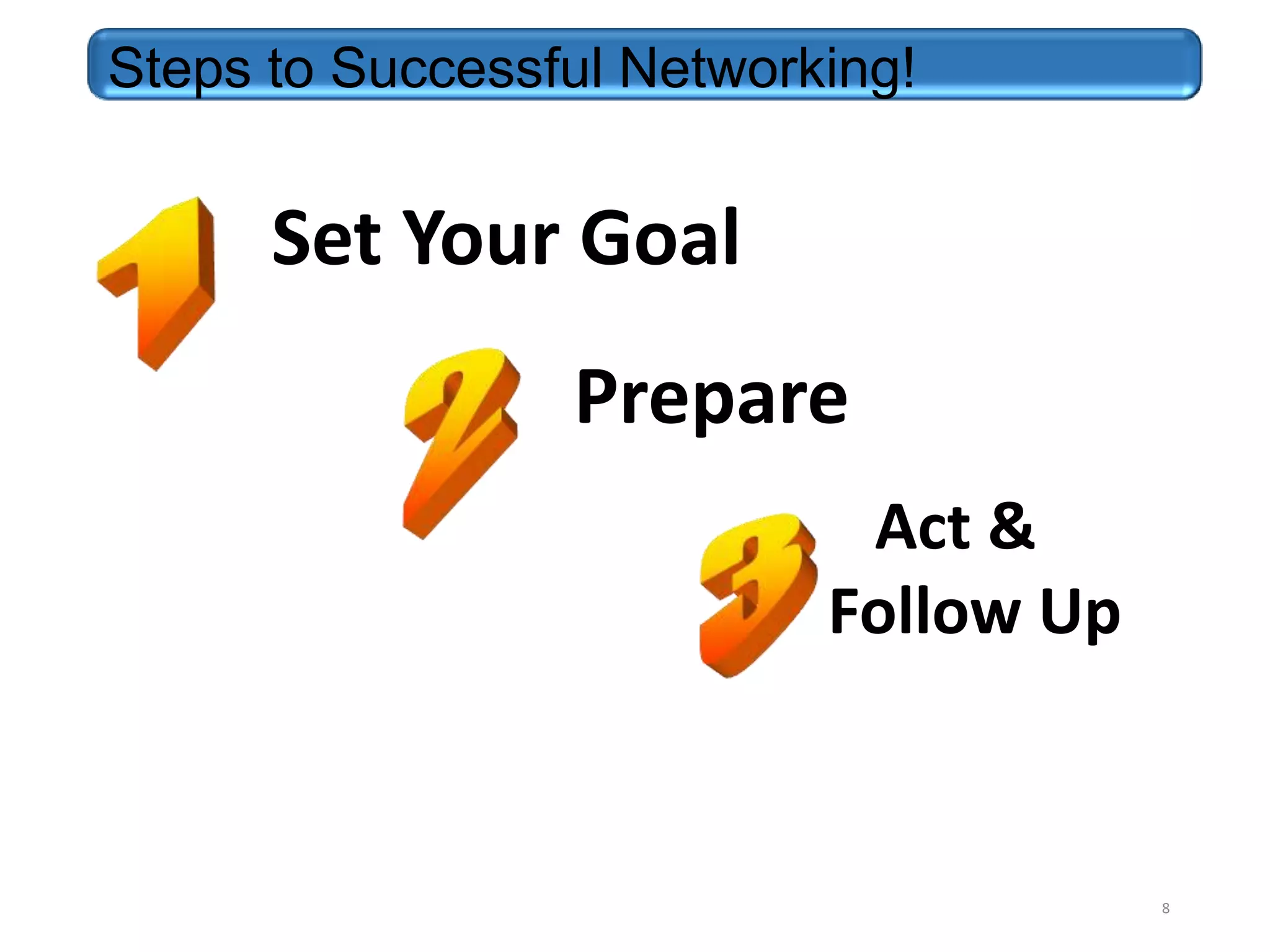
Steps to Successful Networking!

Set Your Goal

Prepare
Act &
Follow Up

8
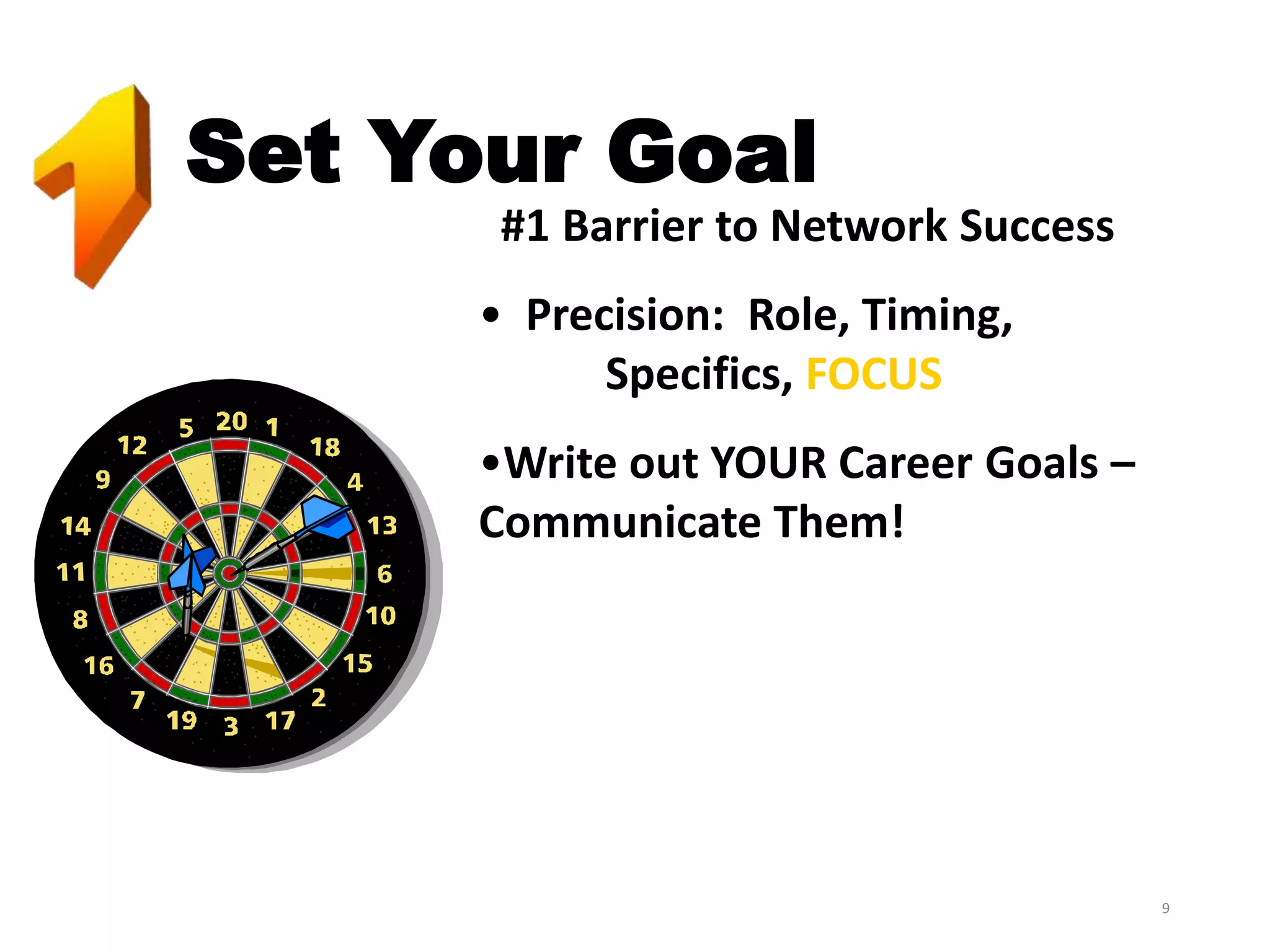
Set Your Goal
#1 Barrier to Network Success
• Precision: Role, Timing,
Specifics, FOCUS
•Write out YOUR Career Goals –
Communicate Them!

9
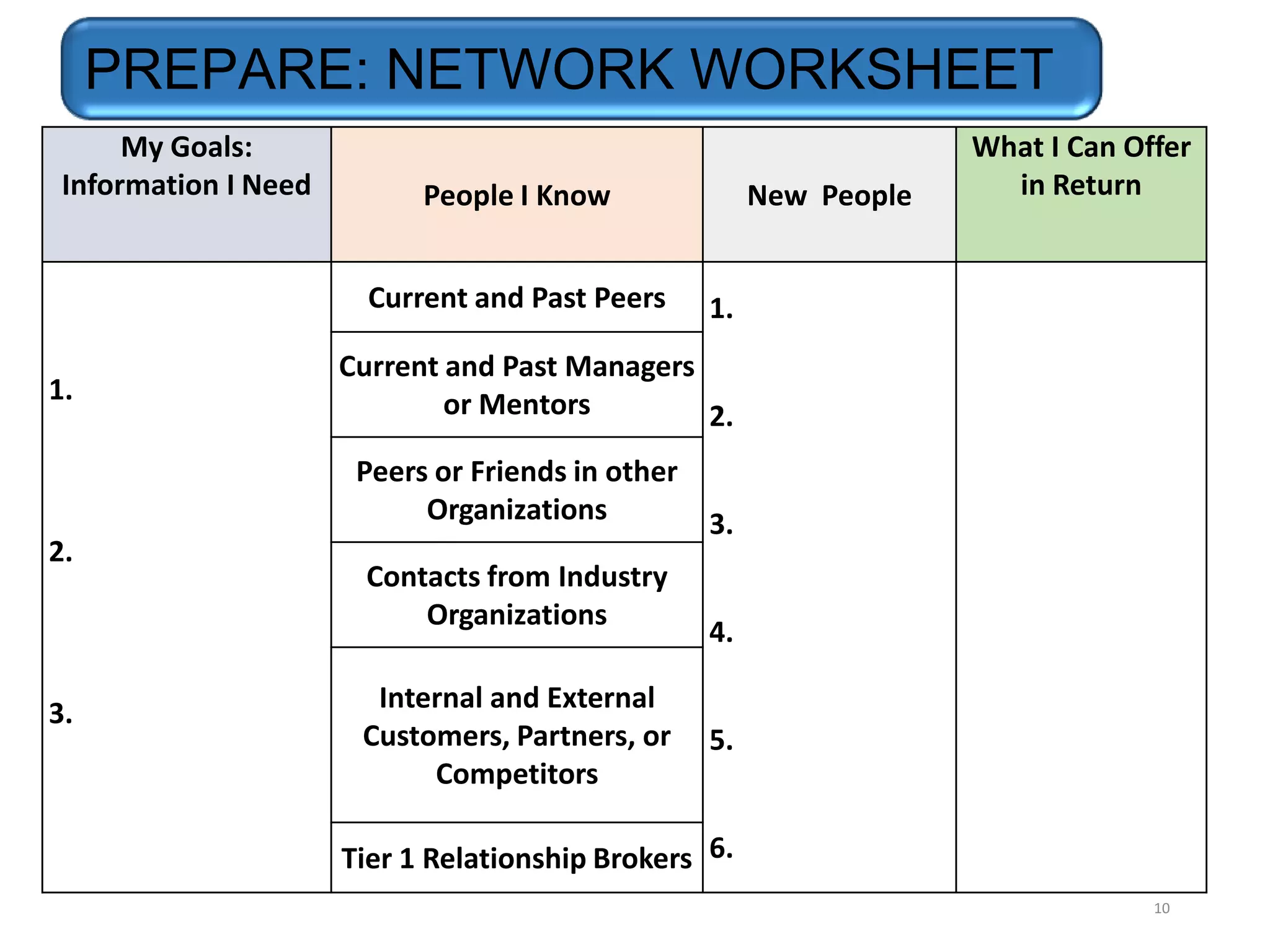
PREPARE: NETWORK WORKSHEET
My Goals:
Information I Need

People I Know
Current and Past Peers

1.

2.

3.

New People

What I Can Offer
in Return

1.

Current and Past Managers
or Mentors
2.
Peers or Friends in other
Organizations
3.
Contacts from Industry
Organizations
Internal and External
Customers, Partners, or
Competitors

4.
5.

Tier 1 Relationship Brokers 6.
10
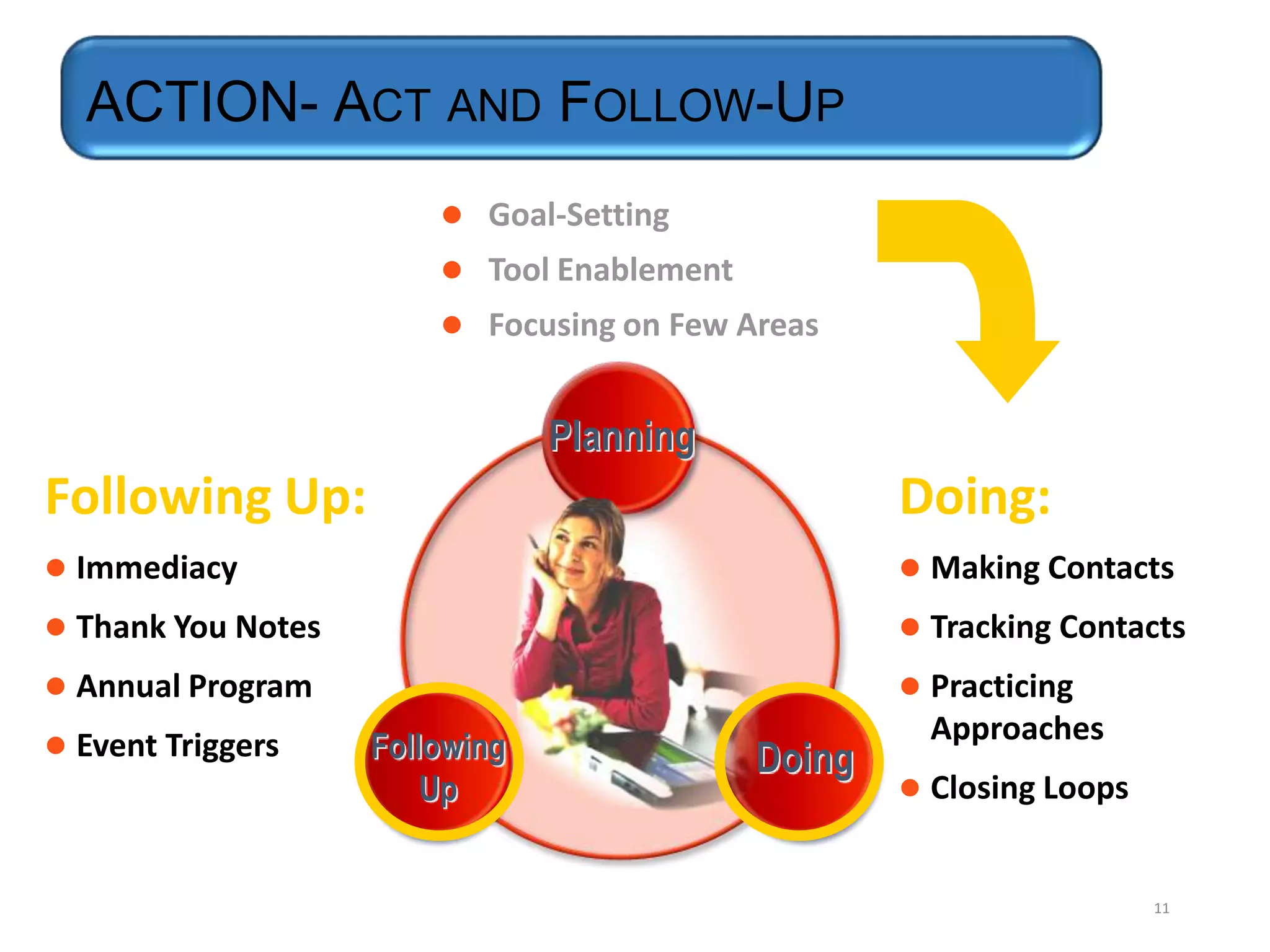
Action: “ActANDFollow Up”
& FOLLOW-UP
ACTION- ACT
 Goal-Setting
 Tool Enablement
 Focusing on Few Areas

Planning

Following Up:

Doing:

 Immediacy

 Making Contacts

 Thank You Notes

 Tracking Contacts

 Annual Program

 Practicing

 Event Triggers

Following
Up

Doing

Approaches
 Closing Loops

11
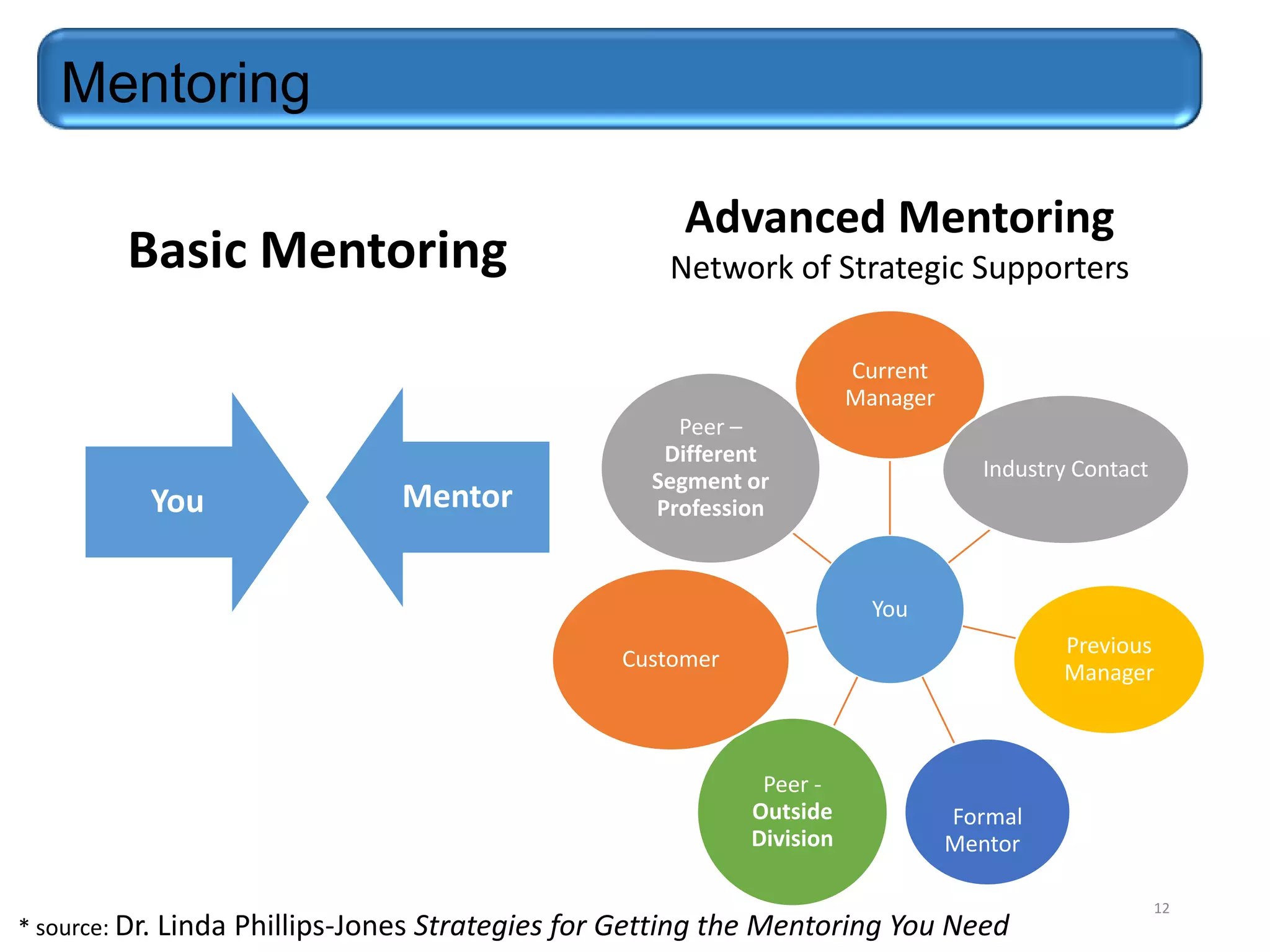
Mentoring
Basic Mentoring

Advanced Mentoring
Network of Strategic Supporters
Current
Manager

You

Mentor

Peer –
Different
Segment or
Profession

Industry Contact

You
Previous
Manager

Customer

Peer Outside
Division
* source: Dr. Linda

Formal
Mentor

Phillips-Jones Strategies for Getting the Mentoring You Need

12
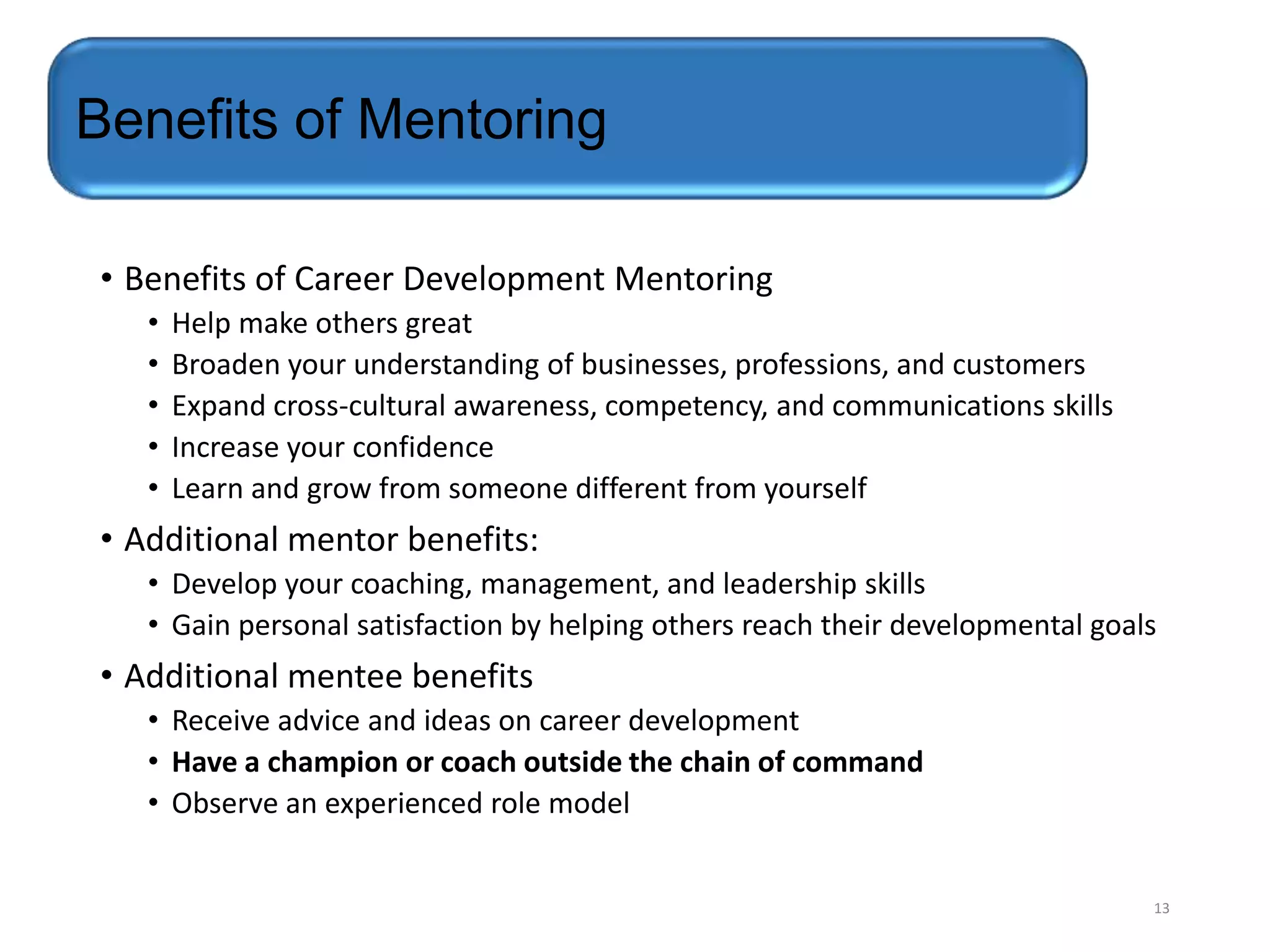
Benefits of Mentoring
• Benefits of Career Development Mentoring
•
•
•
•
•

Help make others great
Broaden your understanding of businesses, professions, and customers
Expand cross-cultural awareness, competency, and communications skills
Increase your confidence
Learn and grow from someone different from yourself

• Additional mentor benefits:
• Develop your coaching, management, and leadership skills
• Gain personal satisfaction by helping others reach their developmental goals

• Additional mentee benefits
• Receive advice and ideas on career development
• Have a champion or coach outside the chain of command
• Observe an experienced role model

13
Other Career Development Opportunities
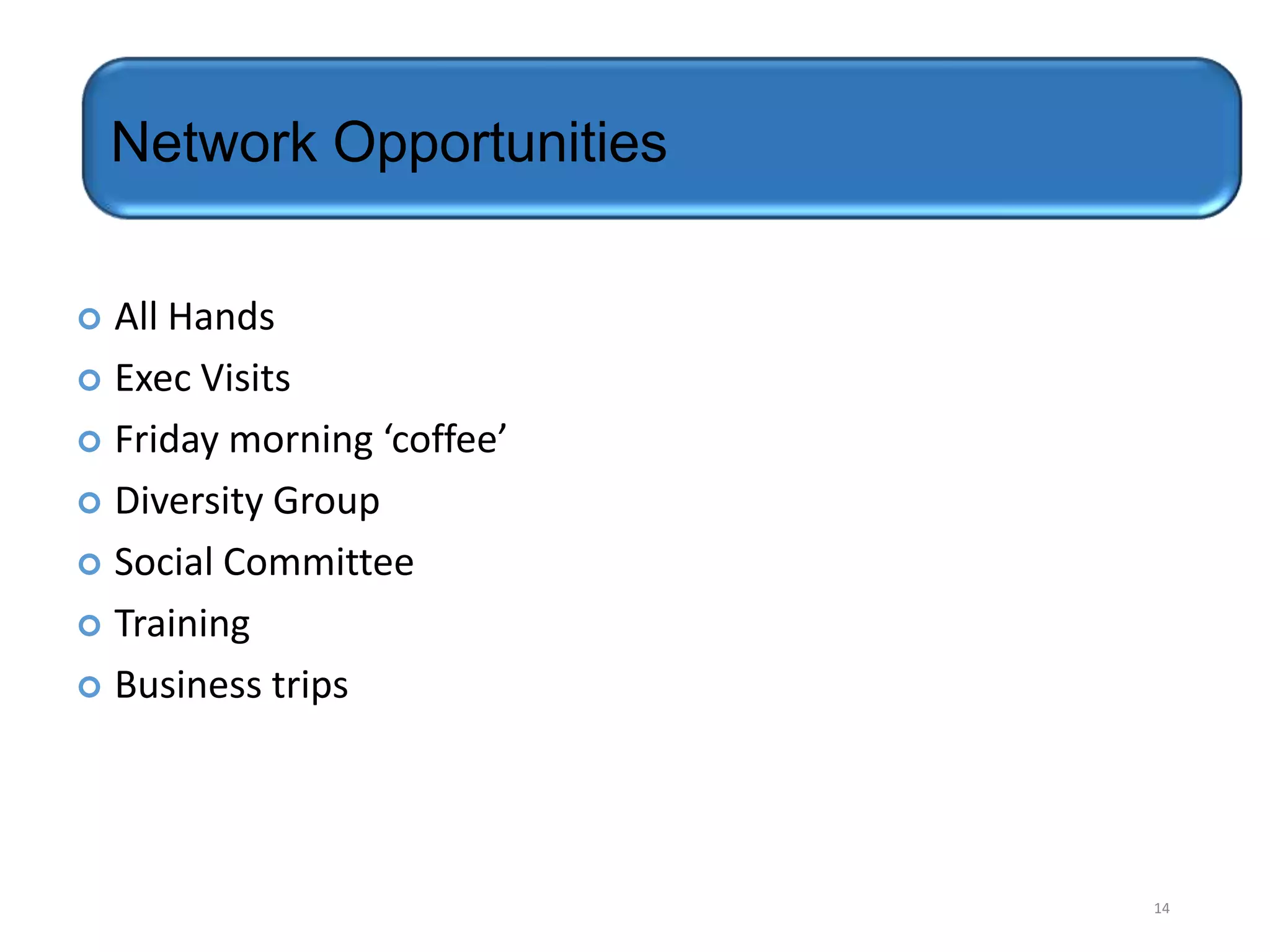
Network Opportunities
All Hands
 Exec Visits
 Friday morning ‘coffee’
 Diversity Group
 Social Committee
 Training
 Business trips


14

Networking & Mentoring for Career Development

  • 1.
    Increasing Your Visibilityand Developing your Career • How do I increase my visibility and impact at work and in turn develop my career? • • • Networking effectively Mentoring Other Mechanisms to develop your career 1
  • 2.
    Networking • Networking defined •strategic and fluid practice of referring and connecting people for mutual needs or goals with high levels of trust and reciprocity that can be sustained over time • Builds ‘social capital’ • ‘Sphere of influence’ • Value of Networking • Building a network to work across workgroups and divisions is critical to success. • Research has shown that career success is not only based on performance—other elements are exposure and visibility to broader networks. • The top 20 percent of performers in organizations are skilled at building diverse and dynamic networks. 2
  • 3.
    Why is yournetwork important? Performance Better connected people are better performers Better connected teams are better performers * source: Rob Resources to Do Work 85% of information affecting work comes through people People are more important than all other sources for all kinds of information Cross The Hidden Power of Social Networks Personal Success and Advancement Better connected people are more satisfied and stay longer Job openings/career advancement Awareness of potential customers 3
  • 4.
    Make Yourself Job #1.Make Yourself Job #1. Make Yourself Job #1. Make Yourself Job 4
  • 5.
    Have You SaidAny of These? HAVE YOU SAID ANY OF THE FOLLOWING? 1. My boss doesn’t care about my career 2. HR doesn’t help me with my career 3. Networking is phony, not for me 4. I see other people moving up, but not me 5. Whatever happens, happens… 5
  • 6.
    Networking is Criticalto Microsoft Networking is Critical to Success Org Chart (on Paper) Shadow Org (in Realty ) * source: Rob Cross The Hidden Power of Social Networks 6
  • 7.
    WHAT IS YOURLEVEL OF EXPERTISE? 1. I have no skills, no network, no execution 2. I am thinking about it, but not doing it 3. I dabble, have a small network; average 4. Pretty good – Long list, regular touches 5. The BEST – I coach others on networking 7
  • 8.
    Steps to SuccessfulNetworking! Set Your Goal Prepare Act & Follow Up 8
  • 9.
    Set Your Goal #1Barrier to Network Success • Precision: Role, Timing, Specifics, FOCUS •Write out YOUR Career Goals – Communicate Them! 9
  • 10.
    PREPARE: NETWORK WORKSHEET MyGoals: Information I Need People I Know Current and Past Peers 1. 2. 3. New People What I Can Offer in Return 1. Current and Past Managers or Mentors 2. Peers or Friends in other Organizations 3. Contacts from Industry Organizations Internal and External Customers, Partners, or Competitors 4. 5. Tier 1 Relationship Brokers 6. 10
  • 11.
    Action: “ActANDFollow Up” &FOLLOW-UP ACTION- ACT  Goal-Setting  Tool Enablement  Focusing on Few Areas Planning Following Up: Doing:  Immediacy  Making Contacts  Thank You Notes  Tracking Contacts  Annual Program  Practicing  Event Triggers Following Up Doing Approaches  Closing Loops 11
  • 12.
    Mentoring Basic Mentoring Advanced Mentoring Networkof Strategic Supporters Current Manager You Mentor Peer – Different Segment or Profession Industry Contact You Previous Manager Customer Peer Outside Division * source: Dr. Linda Formal Mentor Phillips-Jones Strategies for Getting the Mentoring You Need 12
  • 13.
    Benefits of Mentoring •Benefits of Career Development Mentoring • • • • • Help make others great Broaden your understanding of businesses, professions, and customers Expand cross-cultural awareness, competency, and communications skills Increase your confidence Learn and grow from someone different from yourself • Additional mentor benefits: • Develop your coaching, management, and leadership skills • Gain personal satisfaction by helping others reach their developmental goals • Additional mentee benefits • Receive advice and ideas on career development • Have a champion or coach outside the chain of command • Observe an experienced role model 13
  • 14.
    Other Career DevelopmentOpportunities Network Opportunities All Hands  Exec Visits  Friday morning ‘coffee’  Diversity Group  Social Committee  Training  Business trips  14

Editor's Notes

  • #3 Social capital – great in times need something done or ‘favour’ eg get me on so’s schedule; deck on various topic for all hands etc, whats this person like (likes/ dislikes).Networking expands your Sphere of influence –Eg if sit at desk, small. If out offering to present at other’s all hands, attending , bigger.......... Calibrations meetings
  • #4 Networking for Knowledge and Information‘85 percent of knowledge is undocumented, unstructured, and is stored as individual knowledge on individual computers’ - Delphi Consulting Group . Despite large investments in database infrastructures and the people who maintain them, the best way to transfer human knowledge is to connect to the right people.Today, we’d like to focus on the 3rd category: Personal Success and AdvancementResearch tells us that: A high quality, job-focused network of colleagues is one of the key drivers for accelerating the development of high potentials. For leaders, the top 3 success inhibitors rated as “characteristic” or “somewhat characteristic”:Lack of a network (33%) Failing to broaden professionally (24%) Not an attractor of talent (23%)Add personal testimonials Networking is a very personal thing. It can add a huge amount of value in all 3 of these categories: Performance, Resources and Personal Success. Briefly highlight points from Performance and Resources. As individuals, we rely on relationships for more than just information …Task accomplishment: People provide us with a variety of things to help us do our work. Information, resources, decisions/direction, actual help.Career development: People help us learn in ways that advance our careers.Career/political support: Influential people look out for us.Sensemaking: People can help us make sense of events, rumors or trends.Personal support: People sometimes provide support on a personal level.Purpose: For some of us, people provide a sense of purpose in our work Networking for Knowledge and Information‘85 percent of knowledge is undocumented, unstructured, and is stored as individual knowledge on individual computers’ - Delphi Consulting Group . Despite large investments in database infrastructures and the people who maintain them, the best way to transfer human knowledge is to connect to the right people.
  • #5 Spend all our timing doing our day – job – producing reports, posting jes but very rarely spend anytime proactively managing our career...... Its an afterthought.Realise havent really increased our impact, or made progress to next career.
  • #7 Your managers value the connecting you are doing on the job. Make time to do more! The graphic on the left is how many of you see org structures on paper. However, the right is how things really get done” . Reality is incredibly matrixed and challenging to navigate. _____________Connectivity in networks within organizations can have a substantial impact on performance, learning, and innovation, and benefits also accrue from well-connected networks between organizations.
  • #8 Level of expertise2 or 3.Best peopleare 4-5- Marilee exampleHow can we network better – see next slide .......
  • #11 Use My Network of Strategic Supporters to analyze your current network, starting first with your goals, and the people you already know who could helpIdentify gaps, areas where you could use a new person’s perspectives- fill in at least 2 new contact names
  • #13 Today, you can no longer rely on one mentor for all aspects of your career. Relying on one mentor is too risky. He or she can’t be an expert in everything you need. Effective mentoring now involves multiple, partial, short-term,"enhanced informal" strategic supporters in addition to exclusive, intensive, long-term, formal mentoring relationships. In other words, you need to recruit your own Network of Strategic Supporters.Every CEOhas a Board of Directors. You need one too.Each supporter can give you some important degree of mentoring. Reframe your goal from seeking one ideal mentor to looking for multiple effective strategic supporters to help you with particular gaps. Your supporters should have complimentary competencies, knowledge, experiences. Think very strategically about how you might leverage different supporters to help you close your gaps…Draw from:Your immediate manager Past managers - even those in different geographic areas and organizations Colleagues you admire, respect, and trust (Don’t overlook peers!) both inside and outside your organization. Higher-level managers both inside and outside your organization. Contacts from industry organizations and professional associations Partners, customers, competitorsRelatives Some you might leverage for periodic information exchanges or a sounding board for ideas. And, some of these individuals may choose to expand their help into a more formal mentoring relationship once you’ve proven yourself worth the risk, but don’t expect this commitment going into the relationship . Don’t add extra work, just think differently about the networking you already do.Note: WE ARE NOT SUGGESTING THAT YOU WORK WITH 10 FORMAL MENTORS AT ONCE ---Guideline: start with a maximum of 1 formal, full-blown mentoring relationship (investment for mentees is 2-4 hours per month) Only if you try it for awhile and can manage it, add additional formal mentors to your plate. Most mentees have a hard time investing 2-4 hours per month, so don’t over commit.