Aihua Guo
March 2014
Network Virtualization
© 2014 ADVA Optical Networking. All rights reserved. Confidential.22
Network Virtualization
• Using software-based abstraction to enable the
creation of logically isolated virtual network
representations atop physical networks
• Enabling new applications, operation models and
business opportunities
© 2014 ADVA Optical Networking. All rights reserved. Confidential.33
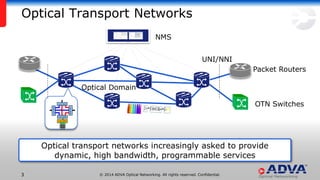
Optical Transport Networks
Optical transport networks increasingly asked to provide
dynamic, high bandwidth, programmable services
Packet Routers
OTN Switches
UNI/NNI
NMS
Optical Domain
1xNWSS
1xNWSS
1xN WSS
1xN WSS
1xN WSS
XPDR
XPDR
XPDR
XPDR
© 2014 ADVA Optical Networking. All rights reserved. Confidential.44
Virtualizing the Optical Transport Networks
• Real challenges of optical networks
• Optical networks are usually built as vendor islands
• Many deployed vendor-proprietary transport technologies
• Element complexity, technology complexity, OA&M complexity ...
• Realities
• Optical networks largely service packet and OTN networks today
• Transport networks are centrally managed, familiar with
managing complexity
• What‘s important to optical transport network virtualization
• Complexity hiding; what happens in optical networks, stays in
optical networks
• Finding the appropriate level of abstraction is key to virtualization
© 2014 ADVA Optical Networking. All rights reserved. Confidential.55
Virtualization Can Start Real Simple...
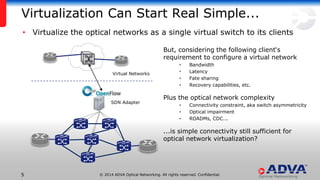
• Virtualize the optical networks as a single virtual switch to its clients
SDN Adapter
Virtual Networks
But, considering the following client‘s
requirement to configure a virtual network
• Bandwidth
• Latency
• Fate sharing
• Recovery capabilities, etc.
Plus the optical network complexity
• Connectivity constraint, aka switch asymmetricity
• Optical impairment
• ROADMs, CDC...
...is simple connectivity still sufficient for
optical network virtualization?
© 2014 ADVA Optical Networking. All rights reserved. Confidential.66
Virtual Overlay Networks
• Simple connectivity no longer enough; richer
model needed
• Endpoints are nodes in a topology; bandwidth and latency
are attributes of links and nodes in a topology; fate
sharing determined by the structure of a topology;
recovery capabilities for a flow determined by the
containing topology ...
© 2014 ADVA Optical Networking. All rights reserved. Confidential.77
Virtual Overlay Networks
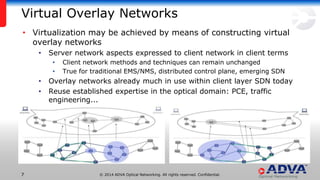
• Virtualization may be achieved by means of constructing virtual
overlay networks
• Server network aspects expressed to client network in client terms
• Client network methods and techniques can remain unchanged
• True for traditional EMS/NMS, distributed control plane, emerging SDN
• Overlay networks already much in use within client layer SDN today
• Reuse established expertise in the optical domain: PCE, traffic
engineering...
© 2014 ADVA Optical Networking. All rights reserved. Confidential.88
Network Scope Virtualization
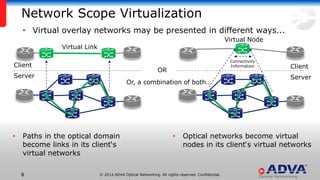
• Virtual overlay networks may be presented in different ways...
Server
Client
Virtual Link
Server
Client
Virtual Node
Connectivity
Information
• Paths in the optical domain
become links in its client‘s
virtual networks
OR
Or, a combination of both…
• Optical networks become virtual
nodes in its client‘s virtual networks
© 2014 ADVA Optical Networking. All rights reserved. Confidential.99
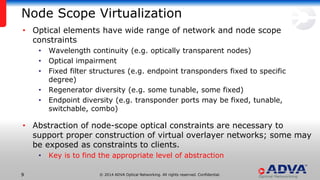
Node Scope Virtualization
• Optical elements have wide range of network and node scope
constraints
• Wavelength continuity (e.g. optically transparent nodes)
• Optical impairment
• Fixed filter structures (e.g. endpoint transponders fixed to specific
degree)
• Regenerator diversity (e.g. some tunable, some fixed)
• Endpoint diversity (e.g. transponder ports may be fixed, tunable,
switchable, combo)
• Abstraction of node-scope optical constraints are necessary to
support proper construction of virtual overlayer networks; some may
be exposed as constraints to clients.
• Key is to find the appropriate level of abstraction
© 2014 ADVA Optical Networking. All rights reserved. Confidential.1010
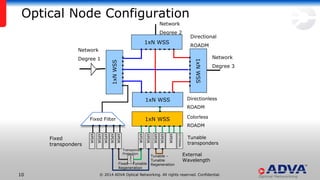
Optical Node Configuration
Network
Degree 2
1xNWSS
1xNWSS
1xN WSS
1xN WSS
1xN WSS
XPDR
XPDR
XPDR
XPDR
XPDR
XPDR
XPDR
XPDR
EXTERNAL
Tunable
transponders
Network
Degree 1 Network
Degree 3
Colorless
ROADM
Directionless
ROADM
Directional
ROADM
Fixed Filter
XPDR
XPDR
PROT
External
Wavelength
Transponder
Protection
Fixed – Tunable
Regeneration
Tunable –
Tunable
Regeneration
Fixed
transponders
© 2014 ADVA Optical Networking. All rights reserved. Confidential.1111
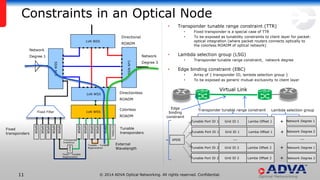
Constraints in an Optical Node
• Transponder tunable range constraint (TTR)
• Fixed transponder is a special case of TTR
• To be exposed as tunability constraints to client layer for packet-
optical integration (where packet routers connects optically to
the colorless ROADM of optical network)
• Lambda selection group (LSG)
• Transponder tunable range constraint, network degree
• Edge binding constraint (EBC)
• Array of { transponder ID, lambda selection group }
• To be exposed as generic mutual exclusivity to client layer
1xNWSS
1xNWSS
1xN WSS
1xN WSS
1xN WSS
XPDR
XPDR
XPDR
XPDR
XPDR
XPDR
XPDR
XPDR
EXTERNAL
Tunable
transponders
Network
Degree 1 Network
Degree 3
Colorless
ROADM
Directionless
ROADM
Directional
ROADM
Fixed Filter
XPDR
XPDR
PROT
External
Wavelength
Transponder
Protection
Fixed – Tunable
Regeneration
Tunable – Tunable
Regeneration
Fixed
transponders
Tunable Port ID 1 Grid ID 1 Lamba Offset 1
Tunable Port ID 2 Grid ID 2 Lamba Offset 2
XPDR
Network Degree 1
Network Degree 2
+
+
Transponder tunable range constraint
Virtual Link
Tunable Port ID 1 Grid ID 1 Lamba Offset 1 Network Degree 2+
Tunable Port ID 2 Grid ID 2 Lamba Offset 2 Network Degree 1+
… …
Lambda selection group
Edge
binding
constraint
© 2014 ADVA Optical Networking. All rights reserved. Confidential.1212
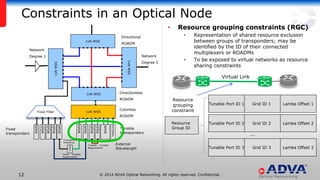
Constraints in an Optical Node
• Resource grouping constraints (RGC)
• Representation of shared resource exclusion
between groups of transponders; may be
identified by the ID of their connected
multiplexers or ROADMs
• To be exposed to virtual networks as resource
sharing constraints
1xNWSS
1xNWSS
1xN WSS
1xN WSS
1xN WSS
XPDR
XPDR
XPDR
XPDR
XPDR
XPDR
XPDR
XPDR
EXTERNAL
Tunable
transponders
Network
Degree 1 Network
Degree 3
Colorless
ROADM
Directionless
ROADM
Directional
ROADM
Fixed Filter
XPDR
XPDR
PROT
External
Wavelength
Transponder
Protection
Fixed – Tunable
Regeneration
Tunable – Tunable
Regeneration
Fixed
transponders
Tunable Port ID 1 Grid ID 1 Lamba Offset 1
Tunable Port ID 2 Grid ID 2 Lamba Offset 2
Tunable Port ID 3 Grid ID 3 Lamba Offset 3
...
Resource
Group ID
Virtual Link
Resource
grouping
constraint
© 2014 ADVA Optical Networking. All rights reserved. Confidential.1313
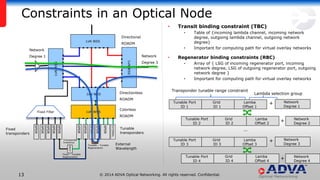
Constraints in an Optical Node
• Transit binding constraint (TBC)
• Table of {incoming lambda channel, incoming network
degree, outgoing lambda channel, outgoing network
degree}
• Important for computing path for virtual overlay networks
• Regenerator binding constraints (RBC)
• Array of { LSG of incoming regenerator port, incoming
network degree, LSG of outgoing regenerator port, outgoing
network degree }
• Important for computing path for virtual overlay networks
1xNWSS
1xNWSS
1xN WSS
1xN WSS
1xN WSS
XPDR
XPDR
XPDR
XPDR
XPDR
XPDR
XPDR
XPDR
EXTERNAL
Tunable
transponders
Network
Degree 1 Network
Degree 3
Colorless
ROADM
Directionless
ROADM
Directional
ROADM
Fixed Filter
XPDR
XPDR
PROT
External
Wavelength
Transponder
Protection
Fixed – Tunable
Regeneration
Tunable – Tunable
Regeneration
Fixed
transponders
Tunable Port
ID 1
Grid
ID 1
Lamba
Offset 1
Network
Degree 1
+
Transponder tunable range constraint
Lambda selection group
Tunable Port
ID 2
Grid
ID 2
Lamba
Offset 2
Network
Degree 2
+
…
Tunable Port
ID 3
Grid
ID 3
Lamba
Offset 3
Network
Degree 3
+
Tunable Port
ID 4
Grid
ID 4
Lamba
Offset 4
Network
Degree 4
+
© 2014 ADVA Optical Networking. All rights reserved. Confidential.1414
Summary
• Optical networks can be virtualized for dynamic, multi-tenant operations
• Optical transport networks have complexities
• A continuum of techniques needed to realize benefits
• Virtualization initially bring transport into SDN
• Providers use virtual overlay networks to enable SDNs for clients
• "Infrastructure-as-a-Service", "Just Enough Topology" models
• Virtualization of optical networks build on top of established expertise
• Optical networks may be exposed as virtual overlay networks consisting
virtual links, virtual nodes, or any combination of both to the clients
• Node scope virtualization requires proper abstractions and exposing of
optical constraints
aguo@advaoptical.com
Thank You
IMPORTANT NOTICE
The content of this presentation is strictly confidential. ADVA Optical Networking is the exclusive owner or licensee of the content, material, and information in this
presentation. Any reproduction, publication or reprint, in whole or in part, is strictly prohibited.
The information in this presentation may not be accurate, complete or up to date, and is provided without warranties or representations of any kind, either express or
implied. ADVA Optical Networking shall not be responsible for and disclaims any liability for any loss or damages, including without limitation, direct, indirect, incidental,
consequential and special damages,
alleged to have been caused by or in connection with using and/or relying on the information contained in this presentation.
Copyright © for the entire content of this presentation: ADVA Optical Networking.

Network Virtualization

  • 1.
  • 2.
    © 2014 ADVAOptical Networking. All rights reserved. Confidential.22 Network Virtualization • Using software-based abstraction to enable the creation of logically isolated virtual network representations atop physical networks • Enabling new applications, operation models and business opportunities
  • 3.
    © 2014 ADVAOptical Networking. All rights reserved. Confidential.33 Optical Transport Networks Optical transport networks increasingly asked to provide dynamic, high bandwidth, programmable services Packet Routers OTN Switches UNI/NNI NMS Optical Domain 1xNWSS 1xNWSS 1xN WSS 1xN WSS 1xN WSS XPDR XPDR XPDR XPDR
  • 4.
    © 2014 ADVAOptical Networking. All rights reserved. Confidential.44 Virtualizing the Optical Transport Networks • Real challenges of optical networks • Optical networks are usually built as vendor islands • Many deployed vendor-proprietary transport technologies • Element complexity, technology complexity, OA&M complexity ... • Realities • Optical networks largely service packet and OTN networks today • Transport networks are centrally managed, familiar with managing complexity • What‘s important to optical transport network virtualization • Complexity hiding; what happens in optical networks, stays in optical networks • Finding the appropriate level of abstraction is key to virtualization
  • 5.
    © 2014 ADVAOptical Networking. All rights reserved. Confidential.55 Virtualization Can Start Real Simple... • Virtualize the optical networks as a single virtual switch to its clients SDN Adapter Virtual Networks But, considering the following client‘s requirement to configure a virtual network • Bandwidth • Latency • Fate sharing • Recovery capabilities, etc. Plus the optical network complexity • Connectivity constraint, aka switch asymmetricity • Optical impairment • ROADMs, CDC... ...is simple connectivity still sufficient for optical network virtualization?
  • 6.
    © 2014 ADVAOptical Networking. All rights reserved. Confidential.66 Virtual Overlay Networks • Simple connectivity no longer enough; richer model needed • Endpoints are nodes in a topology; bandwidth and latency are attributes of links and nodes in a topology; fate sharing determined by the structure of a topology; recovery capabilities for a flow determined by the containing topology ...
  • 7.
    © 2014 ADVAOptical Networking. All rights reserved. Confidential.77 Virtual Overlay Networks • Virtualization may be achieved by means of constructing virtual overlay networks • Server network aspects expressed to client network in client terms • Client network methods and techniques can remain unchanged • True for traditional EMS/NMS, distributed control plane, emerging SDN • Overlay networks already much in use within client layer SDN today • Reuse established expertise in the optical domain: PCE, traffic engineering...
  • 8.
    © 2014 ADVAOptical Networking. All rights reserved. Confidential.88 Network Scope Virtualization • Virtual overlay networks may be presented in different ways... Server Client Virtual Link Server Client Virtual Node Connectivity Information • Paths in the optical domain become links in its client‘s virtual networks OR Or, a combination of both… • Optical networks become virtual nodes in its client‘s virtual networks
  • 9.
    © 2014 ADVAOptical Networking. All rights reserved. Confidential.99 Node Scope Virtualization • Optical elements have wide range of network and node scope constraints • Wavelength continuity (e.g. optically transparent nodes) • Optical impairment • Fixed filter structures (e.g. endpoint transponders fixed to specific degree) • Regenerator diversity (e.g. some tunable, some fixed) • Endpoint diversity (e.g. transponder ports may be fixed, tunable, switchable, combo) • Abstraction of node-scope optical constraints are necessary to support proper construction of virtual overlayer networks; some may be exposed as constraints to clients. • Key is to find the appropriate level of abstraction
  • 10.
    © 2014 ADVAOptical Networking. All rights reserved. Confidential.1010 Optical Node Configuration Network Degree 2 1xNWSS 1xNWSS 1xN WSS 1xN WSS 1xN WSS XPDR XPDR XPDR XPDR XPDR XPDR XPDR XPDR EXTERNAL Tunable transponders Network Degree 1 Network Degree 3 Colorless ROADM Directionless ROADM Directional ROADM Fixed Filter XPDR XPDR PROT External Wavelength Transponder Protection Fixed – Tunable Regeneration Tunable – Tunable Regeneration Fixed transponders
  • 11.
    © 2014 ADVAOptical Networking. All rights reserved. Confidential.1111 Constraints in an Optical Node • Transponder tunable range constraint (TTR) • Fixed transponder is a special case of TTR • To be exposed as tunability constraints to client layer for packet- optical integration (where packet routers connects optically to the colorless ROADM of optical network) • Lambda selection group (LSG) • Transponder tunable range constraint, network degree • Edge binding constraint (EBC) • Array of { transponder ID, lambda selection group } • To be exposed as generic mutual exclusivity to client layer 1xNWSS 1xNWSS 1xN WSS 1xN WSS 1xN WSS XPDR XPDR XPDR XPDR XPDR XPDR XPDR XPDR EXTERNAL Tunable transponders Network Degree 1 Network Degree 3 Colorless ROADM Directionless ROADM Directional ROADM Fixed Filter XPDR XPDR PROT External Wavelength Transponder Protection Fixed – Tunable Regeneration Tunable – Tunable Regeneration Fixed transponders Tunable Port ID 1 Grid ID 1 Lamba Offset 1 Tunable Port ID 2 Grid ID 2 Lamba Offset 2 XPDR Network Degree 1 Network Degree 2 + + Transponder tunable range constraint Virtual Link Tunable Port ID 1 Grid ID 1 Lamba Offset 1 Network Degree 2+ Tunable Port ID 2 Grid ID 2 Lamba Offset 2 Network Degree 1+ … … Lambda selection group Edge binding constraint
  • 12.
    © 2014 ADVAOptical Networking. All rights reserved. Confidential.1212 Constraints in an Optical Node • Resource grouping constraints (RGC) • Representation of shared resource exclusion between groups of transponders; may be identified by the ID of their connected multiplexers or ROADMs • To be exposed to virtual networks as resource sharing constraints 1xNWSS 1xNWSS 1xN WSS 1xN WSS 1xN WSS XPDR XPDR XPDR XPDR XPDR XPDR XPDR XPDR EXTERNAL Tunable transponders Network Degree 1 Network Degree 3 Colorless ROADM Directionless ROADM Directional ROADM Fixed Filter XPDR XPDR PROT External Wavelength Transponder Protection Fixed – Tunable Regeneration Tunable – Tunable Regeneration Fixed transponders Tunable Port ID 1 Grid ID 1 Lamba Offset 1 Tunable Port ID 2 Grid ID 2 Lamba Offset 2 Tunable Port ID 3 Grid ID 3 Lamba Offset 3 ... Resource Group ID Virtual Link Resource grouping constraint
  • 13.
    © 2014 ADVAOptical Networking. All rights reserved. Confidential.1313 Constraints in an Optical Node • Transit binding constraint (TBC) • Table of {incoming lambda channel, incoming network degree, outgoing lambda channel, outgoing network degree} • Important for computing path for virtual overlay networks • Regenerator binding constraints (RBC) • Array of { LSG of incoming regenerator port, incoming network degree, LSG of outgoing regenerator port, outgoing network degree } • Important for computing path for virtual overlay networks 1xNWSS 1xNWSS 1xN WSS 1xN WSS 1xN WSS XPDR XPDR XPDR XPDR XPDR XPDR XPDR XPDR EXTERNAL Tunable transponders Network Degree 1 Network Degree 3 Colorless ROADM Directionless ROADM Directional ROADM Fixed Filter XPDR XPDR PROT External Wavelength Transponder Protection Fixed – Tunable Regeneration Tunable – Tunable Regeneration Fixed transponders Tunable Port ID 1 Grid ID 1 Lamba Offset 1 Network Degree 1 + Transponder tunable range constraint Lambda selection group Tunable Port ID 2 Grid ID 2 Lamba Offset 2 Network Degree 2 + … Tunable Port ID 3 Grid ID 3 Lamba Offset 3 Network Degree 3 + Tunable Port ID 4 Grid ID 4 Lamba Offset 4 Network Degree 4 +
  • 14.
    © 2014 ADVAOptical Networking. All rights reserved. Confidential.1414 Summary • Optical networks can be virtualized for dynamic, multi-tenant operations • Optical transport networks have complexities • A continuum of techniques needed to realize benefits • Virtualization initially bring transport into SDN • Providers use virtual overlay networks to enable SDNs for clients • "Infrastructure-as-a-Service", "Just Enough Topology" models • Virtualization of optical networks build on top of established expertise • Optical networks may be exposed as virtual overlay networks consisting virtual links, virtual nodes, or any combination of both to the clients • Node scope virtualization requires proper abstractions and exposing of optical constraints
  • 15.
    aguo@advaoptical.com Thank You IMPORTANT NOTICE Thecontent of this presentation is strictly confidential. ADVA Optical Networking is the exclusive owner or licensee of the content, material, and information in this presentation. Any reproduction, publication or reprint, in whole or in part, is strictly prohibited. The information in this presentation may not be accurate, complete or up to date, and is provided without warranties or representations of any kind, either express or implied. ADVA Optical Networking shall not be responsible for and disclaims any liability for any loss or damages, including without limitation, direct, indirect, incidental, consequential and special damages, alleged to have been caused by or in connection with using and/or relying on the information contained in this presentation. Copyright © for the entire content of this presentation: ADVA Optical Networking.