TRANSPORT SDN & NFV– WHAT DOES IT
MEAN FOR OPTICAL NETWORKING?
Karl Gass
OIF PLL Vice Chair - Optical Track
NGON 2016
July 1, 2016
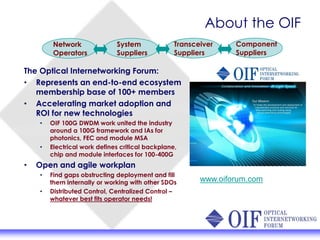
About the OIF
The Optical Internetworking Forum:
• Represents an end-to-end ecosystem
membership base of 100+ members
• Accelerating market adoption and
ROI for new technologies
• OIF 100G DWDM work united the industry
around a 100G framework and IAs for
photonics, FEC and module MSA
• Electrical work defines critical backplane,
chip and module interfaces for 100-400G
• Open and agile workplan
• Find gaps obstructing deployment and fill
them internally or working with other SDOs
• Distributed Control, Centralized Control –
whatever best fits operator needs!
www.oiforum.com
Network
Operators
System
Suppliers
Transceiver
Suppliers
Component
Suppliers
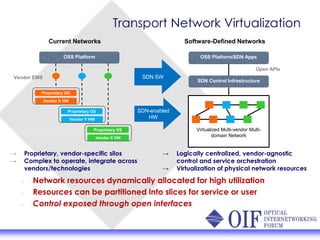
Transport Network Virtualization
Network resources dynamically allocated for high utilization
Resources can be partitioned into slices for service or user
Control exposed through open interfaces
→ Proprietary, vendor-specific silos
→ Complex to operate, integrate across
vendors/technologies
→ Logically centralized, vendor-agnostic
control and service orchestration
→ Virtualization of physical network resources
OSS Platform
Proprietary OS
Vendor X HW
Proprietary OS
Vendor Y HW
Proprietary OS
Vendor Z HW
Current Networks Software-Defined Networks
OSS Platform/SDN Apps
Virtualized Multi-vendor Multi-
domain Network
SDN SW
SDN-enabled
HW
Open APIs
Vendor EMS
SDN Control Infrastructure
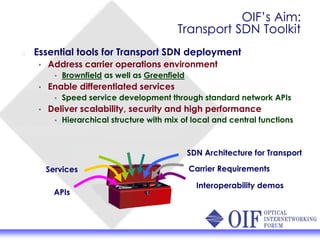
OIF’s Aim:
Transport SDN Toolkit
Essential tools for Transport SDN deployment
• Address carrier operations environment
• Brownfield as well as Greenfield
• Enable differentiated services
• Speed service development through standard network APIs
• Deliver scalability, security and high performance
• Hierarchical structure with mix of local and central functions
APIs
Services
SDN Architecture for Transport
Interoperability demos
Carrier Requirements
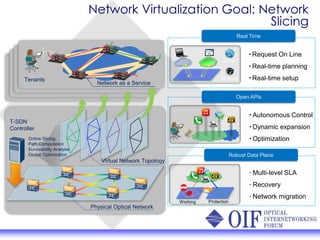
Working Protection
Request On Line
Real-time planning
Real-time setup
Autonomous Control
Dynamic expansion
Optimization
• Multi-level SLA
• Recovery
• Network migration
Seconds
Online
Network Virtualization Goal: Network
Slicing
Real Time
Open APIs
Robust Data Plane
Physical Optical Network
Virtual Network Topology
Network as a Service
Online Slicing
Path Computation
Survivability Analysis
Global Optimization
Tenants
T-SDN
Controller
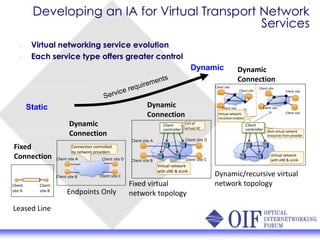
Developing an IA for Virtual Transport Network
Services
Virtual networking service evolution
Each service type offers greater control
Fixed
Connection
Dynamic
Connection
Dynamic
Connection
Client
site A
Client
site B
Client site A
Client site B
Client site D
Client site C
Client site A
Client site B
Client site D
Client site C
Virtual network
with vNE & vLink
Client
controller
Ctrl of
virtual XC
Connection controlled
by network providers
Leased Line
Endpoints Only
Fixed virtual
network topology
Static
Dynamic Dynamic
Connection
Virtual network
with vNE & vLink
Client
controller Rent virtual network
resources from provider
Client site
Virtual network
recursive creation
Client site
Client site
Client site
Client site
Client siteClient site
Dynamic/recursive virtual
network topology
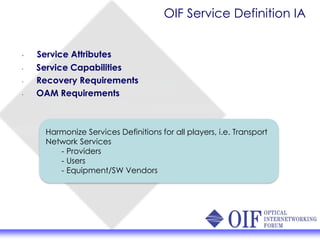
OIF Service Definition IA
• Service Attributes
• Service Capabilities
• Recovery Requirements
• OAM Requirements
Harmonize Services Definitions for all players, i.e. Transport
Network Services
- Providers
- Users
- Equipment/SW Vendors
Application
Layer
Control Layer
Infrastructure Layer
Domain 1
NE NE NE
Domain 2
NE NE NE
Domain 3
NE NE NE
Network
Orchestrator
Domain
Controller
Domain
Controller
Domain
Controller
SBI
NBI
SBI
Cloud
Orchestrator
Compute Storage
NBI
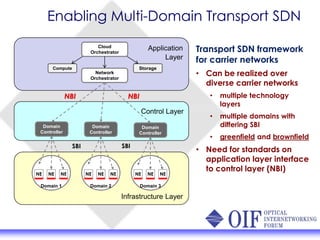
Enabling Multi-Domain Transport SDN
Transport SDN framework
for carrier networks
• Can be realized over
diverse carrier networks
• multiple technology
layers
• multiple domains with
differing SBI
• greenfield and brownfield
• Need for standards on
application layer interface
to control layer (NBI)
Achieving Common APIs
The Tools and Remaining Challenges
Existing Tools
Current API work is being done in fragmented silos
Some linkage of APIs to existing protocol environments
Keys to achieving interoperable common APIs
Define standard model across vendors and technologies
Common Information model is key to interoperability
ONF Common Information Model project – aligning ONF, ITU,
TMF, MEF, OIF
Verify APIs provide the necessary functionality
Use case review and convergent SDO work
Prototype, Demonstrate, Open Source Code!
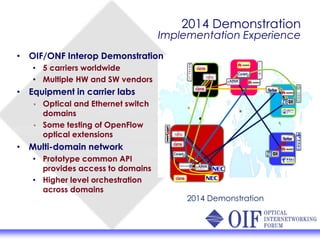
2014 Demonstration
Implementation Experience
• OIF/ONF Interop Demonstration
• 5 carriers worldwide
• Multiple HW and SW vendors
• Equipment in carrier labs
• Optical and Ethernet switch
domains
• Some testing of OpenFlow
optical extensions
• Multi-domain network
• Prototype common API
provides access to domains
• Higher level orchestration
across domains
2014 Demonstration
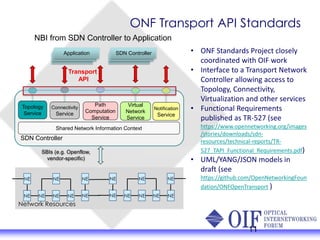
ONF Transport API Standards
11
Network Resources
SDN Controller
NENESDN Controller
NENEApplication
Transport
API
SBIs (e.g. Openflow,
vendor-specific)
NE NE NE
NE
NE
NE NE
NE NENENE
NE
NE
NENE
NE
Topology
Service
Connectivity
Service
Path
Computation
Service
Shared Network Information Context
Virtual
Network
Service
Notification
Service
NBI from SDN Controller to Application
• ONF Standards Project closely
coordinated with OIF work
• Interface to a Transport Network
Controller allowing access to
Topology, Connectivity,
Virtualization and other services
• Functional Requirements
published as TR-527 (see
https://www.opennetworking.org/images
/stories/downloads/sdn-
resources/technical-reports/TR-
527_TAPI_Functional_Requirements.pdf)
• UML/YANG/JSON models in
draft (see
https://github.com/OpenNetworkingFoun
dation/ONFOpenTransport )
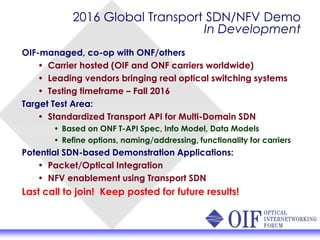
2016 Global Transport SDN/NFV Demo
In Development
OIF-managed, co-op with ONF/others
• Carrier hosted (OIF and ONF carriers worldwide)
• Leading vendors bringing real optical switching systems
• Testing timeframe – Fall 2016
Target Test Area:
• Standardized Transport API for Multi-Domain SDN
• Based on ONF T-API Spec, Info Model, Data Models
• Refine options, naming/addressing, functionality for carriers
Potential SDN-based Demonstration Applications:
• Packet/Optical Integration
• NFV enablement using Transport SDN
Last call to join! Keep posted for future results!
Thank You!

Transport SDN & NFV - What does it mean for Optical Networking?

  • 1.
    TRANSPORT SDN &NFV– WHAT DOES IT MEAN FOR OPTICAL NETWORKING? Karl Gass OIF PLL Vice Chair - Optical Track NGON 2016 July 1, 2016
  • 2.
    About the OIF TheOptical Internetworking Forum: • Represents an end-to-end ecosystem membership base of 100+ members • Accelerating market adoption and ROI for new technologies • OIF 100G DWDM work united the industry around a 100G framework and IAs for photonics, FEC and module MSA • Electrical work defines critical backplane, chip and module interfaces for 100-400G • Open and agile workplan • Find gaps obstructing deployment and fill them internally or working with other SDOs • Distributed Control, Centralized Control – whatever best fits operator needs! www.oiforum.com Network Operators System Suppliers Transceiver Suppliers Component Suppliers
  • 3.
    Transport Network Virtualization Networkresources dynamically allocated for high utilization Resources can be partitioned into slices for service or user Control exposed through open interfaces → Proprietary, vendor-specific silos → Complex to operate, integrate across vendors/technologies → Logically centralized, vendor-agnostic control and service orchestration → Virtualization of physical network resources OSS Platform Proprietary OS Vendor X HW Proprietary OS Vendor Y HW Proprietary OS Vendor Z HW Current Networks Software-Defined Networks OSS Platform/SDN Apps Virtualized Multi-vendor Multi- domain Network SDN SW SDN-enabled HW Open APIs Vendor EMS SDN Control Infrastructure
  • 4.
    OIF’s Aim: Transport SDNToolkit Essential tools for Transport SDN deployment • Address carrier operations environment • Brownfield as well as Greenfield • Enable differentiated services • Speed service development through standard network APIs • Deliver scalability, security and high performance • Hierarchical structure with mix of local and central functions APIs Services SDN Architecture for Transport Interoperability demos Carrier Requirements
  • 5.
    Working Protection Request OnLine Real-time planning Real-time setup Autonomous Control Dynamic expansion Optimization • Multi-level SLA • Recovery • Network migration Seconds Online Network Virtualization Goal: Network Slicing Real Time Open APIs Robust Data Plane Physical Optical Network Virtual Network Topology Network as a Service Online Slicing Path Computation Survivability Analysis Global Optimization Tenants T-SDN Controller
  • 6.
    Developing an IAfor Virtual Transport Network Services Virtual networking service evolution Each service type offers greater control Fixed Connection Dynamic Connection Dynamic Connection Client site A Client site B Client site A Client site B Client site D Client site C Client site A Client site B Client site D Client site C Virtual network with vNE & vLink Client controller Ctrl of virtual XC Connection controlled by network providers Leased Line Endpoints Only Fixed virtual network topology Static Dynamic Dynamic Connection Virtual network with vNE & vLink Client controller Rent virtual network resources from provider Client site Virtual network recursive creation Client site Client site Client site Client site Client siteClient site Dynamic/recursive virtual network topology
  • 7.
    OIF Service DefinitionIA • Service Attributes • Service Capabilities • Recovery Requirements • OAM Requirements Harmonize Services Definitions for all players, i.e. Transport Network Services - Providers - Users - Equipment/SW Vendors
  • 8.
    Application Layer Control Layer Infrastructure Layer Domain1 NE NE NE Domain 2 NE NE NE Domain 3 NE NE NE Network Orchestrator Domain Controller Domain Controller Domain Controller SBI NBI SBI Cloud Orchestrator Compute Storage NBI Enabling Multi-Domain Transport SDN Transport SDN framework for carrier networks • Can be realized over diverse carrier networks • multiple technology layers • multiple domains with differing SBI • greenfield and brownfield • Need for standards on application layer interface to control layer (NBI)
  • 9.
    Achieving Common APIs TheTools and Remaining Challenges Existing Tools Current API work is being done in fragmented silos Some linkage of APIs to existing protocol environments Keys to achieving interoperable common APIs Define standard model across vendors and technologies Common Information model is key to interoperability ONF Common Information Model project – aligning ONF, ITU, TMF, MEF, OIF Verify APIs provide the necessary functionality Use case review and convergent SDO work Prototype, Demonstrate, Open Source Code!
  • 10.
    2014 Demonstration Implementation Experience •OIF/ONF Interop Demonstration • 5 carriers worldwide • Multiple HW and SW vendors • Equipment in carrier labs • Optical and Ethernet switch domains • Some testing of OpenFlow optical extensions • Multi-domain network • Prototype common API provides access to domains • Higher level orchestration across domains 2014 Demonstration
  • 11.
    ONF Transport APIStandards 11 Network Resources SDN Controller NENESDN Controller NENEApplication Transport API SBIs (e.g. Openflow, vendor-specific) NE NE NE NE NE NE NE NE NENENE NE NE NENE NE Topology Service Connectivity Service Path Computation Service Shared Network Information Context Virtual Network Service Notification Service NBI from SDN Controller to Application • ONF Standards Project closely coordinated with OIF work • Interface to a Transport Network Controller allowing access to Topology, Connectivity, Virtualization and other services • Functional Requirements published as TR-527 (see https://www.opennetworking.org/images /stories/downloads/sdn- resources/technical-reports/TR- 527_TAPI_Functional_Requirements.pdf) • UML/YANG/JSON models in draft (see https://github.com/OpenNetworkingFoun dation/ONFOpenTransport )
  • 12.
    2016 Global TransportSDN/NFV Demo In Development OIF-managed, co-op with ONF/others • Carrier hosted (OIF and ONF carriers worldwide) • Leading vendors bringing real optical switching systems • Testing timeframe – Fall 2016 Target Test Area: • Standardized Transport API for Multi-Domain SDN • Based on ONF T-API Spec, Info Model, Data Models • Refine options, naming/addressing, functionality for carriers Potential SDN-based Demonstration Applications: • Packet/Optical Integration • NFV enablement using Transport SDN Last call to join! Keep posted for future results!
  • 13.