How many layers are there in the OSI model? Name them
Ans. There are 7 layers – physical, data link, network, transport, session, presentation,
and application.
What are the two types of transmission technology available?
Ans. The two types of transmission technology are – broadcast and point-to-point.
What is a ‘subnet’?
Ans. A ‘subnet’ is a generic term for a section of a large network, usually separated by a
bridge or a router.
What is DNS?
Ans. The Domain Name System (DNS) is a central part of the Internet, providing a way
to match names (a website you’re seeking) to numbers (the address for the website).
Anything connected to the Internet – laptops, tablets, mobile phones, and websites – has
an Internet Protocol (IP) address made up of numbers.
What is a ‘client’ and ‘server’ in a network?
Ans. Clients and servers are separate logical entities that work together over a network to accomplish
a task.
What are the different ways to exchange data?
Ans.
• Simplex
• Half-duplex
• Full-duplex
What is a ‘frame relay’ and in which layer does it operate?
Ans. A frame relay is a packet-switching technology. It operates in the data link layer.
Explain ‘hidden shares’.
Ans.
A hidden or an administrative share is a network share that is not visible when viewing
another computer’s shares.
•
What is a MAC address?
Ans.
A MAC (Media Access Control) address is the 48-bit hardware address of a LAN card and is
usually stored in the ROM of the network adapter card and is unique.
What are the perquisites to configure a server?
Ans.
LAN card should be connected
Root (partition on which window is installed) should be in NTFS format
Server should be configured with a static IP address
Q10. What is ‘beaconing’?
Ans. Beaconing is the process that allows a network to self-repair networks problems.
Differentiate between ‘attenuation’, ‘distortion’, and ‘noise’.
Ans. When a signal travels through a medium, it loses some of its energy due to the resistance of the
medium. This loss of energy is called attenuation.
When a signal travels through a medium from one point to another, it may change the form or shape
of the signal. This is known as distortion.
Noise is unwanted electrical or electromagnetic energy that degrades the quality of signals and data.
What is an IP address?
Ans. An Internet Protocol address (IP address) is a numerical label assigned to each device (e.g.,
computer, printer) participating in a computer network that uses the Internet Protocol for
communication.
. Differentiate between a ‘bit rate’ and ‘baud rate’.
Ans. A bit rate is the number of bits transmitted during one second, whereas, baud rate refers to the
number of signal units per second that are required to represent those bits.
Baud rate = bit rate / N, where N is the no. of bits represented by each signal shift.
What is ‘bandwidth’?
Ans. The limited range of frequency of signals that a line can carry is called the bandwidth.
What is Project 802?
Ans. It is a project started by IEEE to set standards to enable intercommunication between
equipment from a variety of manufacturers.
What is ICMP?
Ans. ICMP (Internet Control Message Protocol) is a network layer protocol of the TCP/IP suite
used by hosts and gateways to send notification of datagram problems back to the sender.
What are the major types of networks?
Ans.
Server-based network
Peer-to-peer network
What are the important topologies for networks?
Ans. There are three important topologies – Star, Bus and Ring.
Differentiate between static IP addressing and dynamic IP addressing.
Ans. In static IP addressing, a computer (or another device) is configured to always use the same
IP address, whereas in dynamic IP addressing, the IP address can change periodically and is
managed by a centralised network service
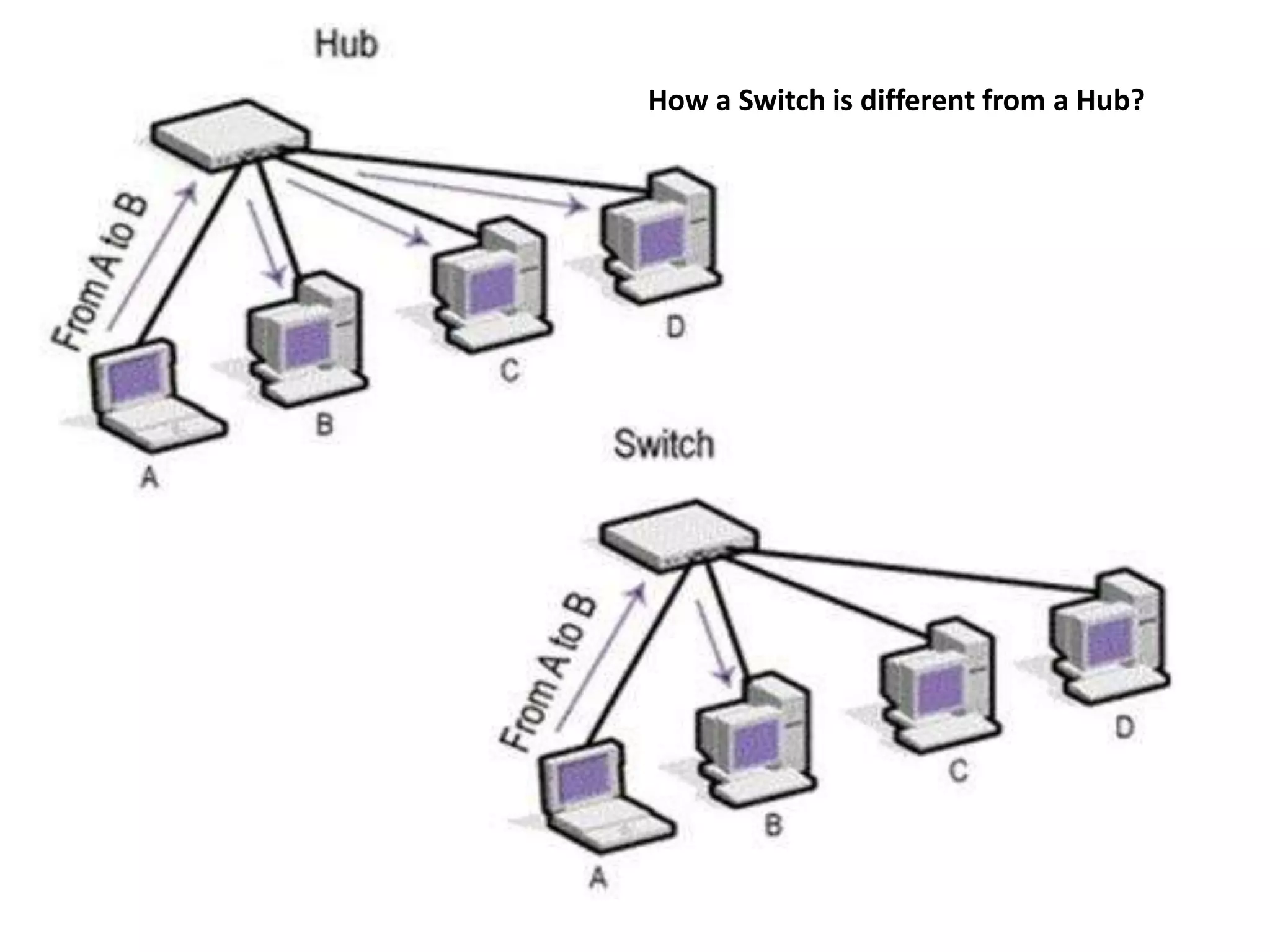
Difference between hub and switch?
Ans. A hub is a networking device that connects multiple computers together, while
switch is a control unit that turns the flow of electricity in a circuit.
Which layers are referred as network support layers?
Ans.
Data link layer
Physical layer
Network layer
Define simplex with an example?
Ans. A type of communication in which data is transmitted in one direction is known as
simplex. Example: Monitor
What is RIP?
Ans. RIP stands for Routing Information Protocol, is a simple protocol used to exchange
information between the routers.
What are the factors that affect the performance of the network?
Ans.
Type of transmission media
Software
Number of users
Hardware
Difference between wired LAN and wireless LAN?
Ans. Wired LAN used Ethernet devices like router, hub and switch, while wireless LAN
uses devices like mifi router and WLAN router.
Name some user support layers?
Ans.
Application layer
Presentation layer
Session layer
What is the use of TCP in the IP packets?
Ans. TCP is an acronym of transmission control protocol. It is used as a communications
protocol in a private network.
Name the types of errors?
Ans. There are two types of errors:
Single bit error
Burst error
What is ALOHA?
Ans. It is used to solve the channel allocation issue. Two types of aloha:
Pure aloha
Slotted aloha
What does VPN stand for?
Ans. VPN stands for virtual private network. It creates a secure network connection
over a public network like the internet.
Which protocols uses application layer?
Ans.
SMTP
DNS
TELNET
FTP
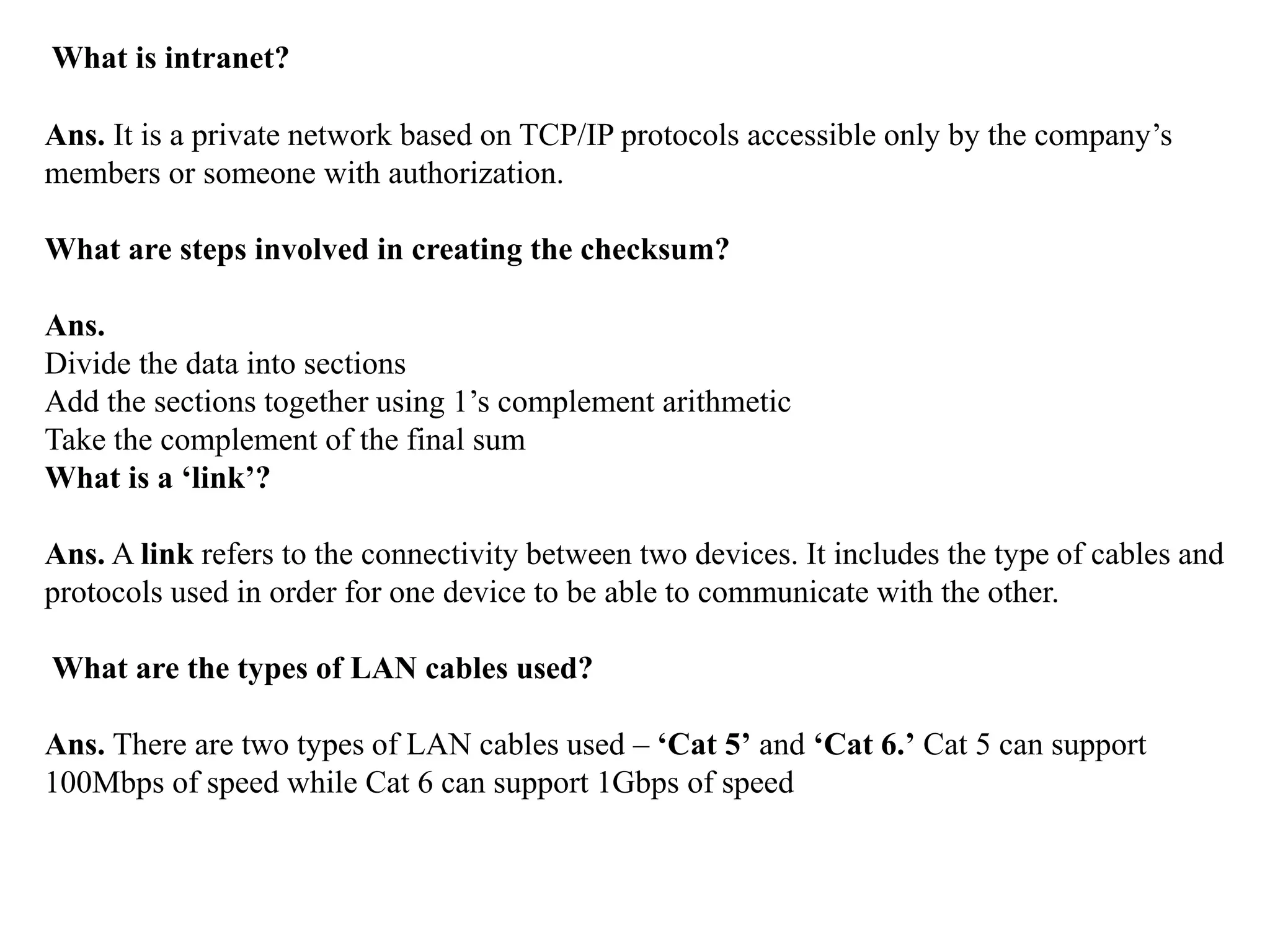
What is intranet?
Ans. It is a private network based on TCP/IP protocols accessible only by the company’s
members or someone with authorization.
What are steps involved in creating the checksum?
Ans.
Divide the data into sections
Add the sections together using 1’s complement arithmetic
Take the complement of the final sum
What is a ‘link’?
Ans. A link refers to the connectivity between two devices. It includes the type of cables and
protocols used in order for one device to be able to communicate with the other.
What are the types of LAN cables used?
Ans. There are two types of LAN cables used – ‘Cat 5’ and ‘Cat 6.’ Cat 5 can support
100Mbps of speed while Cat 6 can support 1Gbps of speed
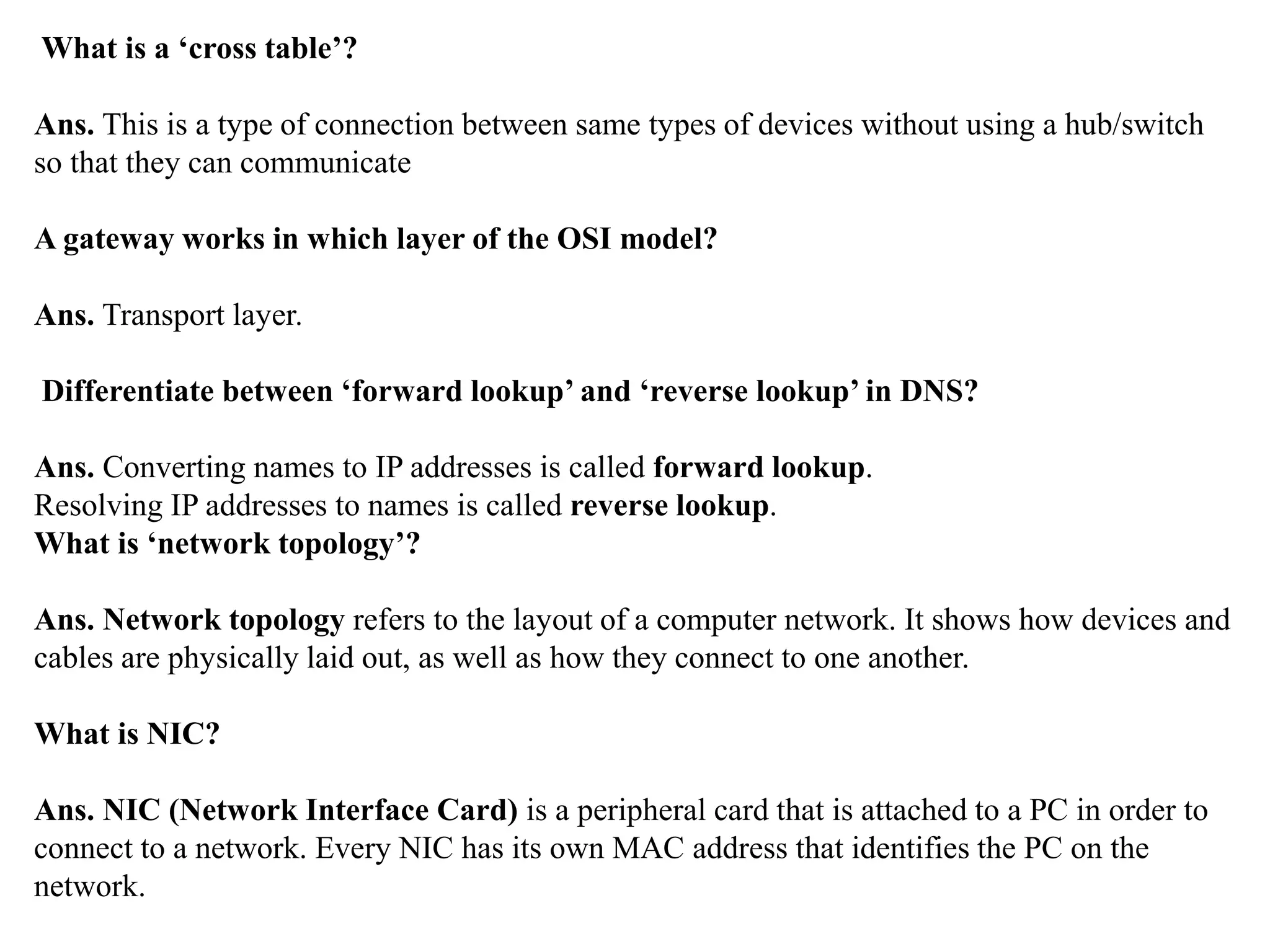
What is a ‘cross table’?
Ans. This is a type of connection between same types of devices without using a hub/switch
so that they can communicate
A gateway works in which layer of the OSI model?
Ans. Transport layer.
Differentiate between ‘forward lookup’ and ‘reverse lookup’ in DNS?
Ans. Converting names to IP addresses is called forward lookup.
Resolving IP addresses to names is called reverse lookup.
What is ‘network topology’?
Ans. Network topology refers to the layout of a computer network. It shows how devices and
cables are physically laid out, as well as how they connect to one another.
What is NIC?
Ans. NIC (Network Interface Card) is a peripheral card that is attached to a PC in order to
connect to a network. Every NIC has its own MAC address that identifies the PC on the
network.
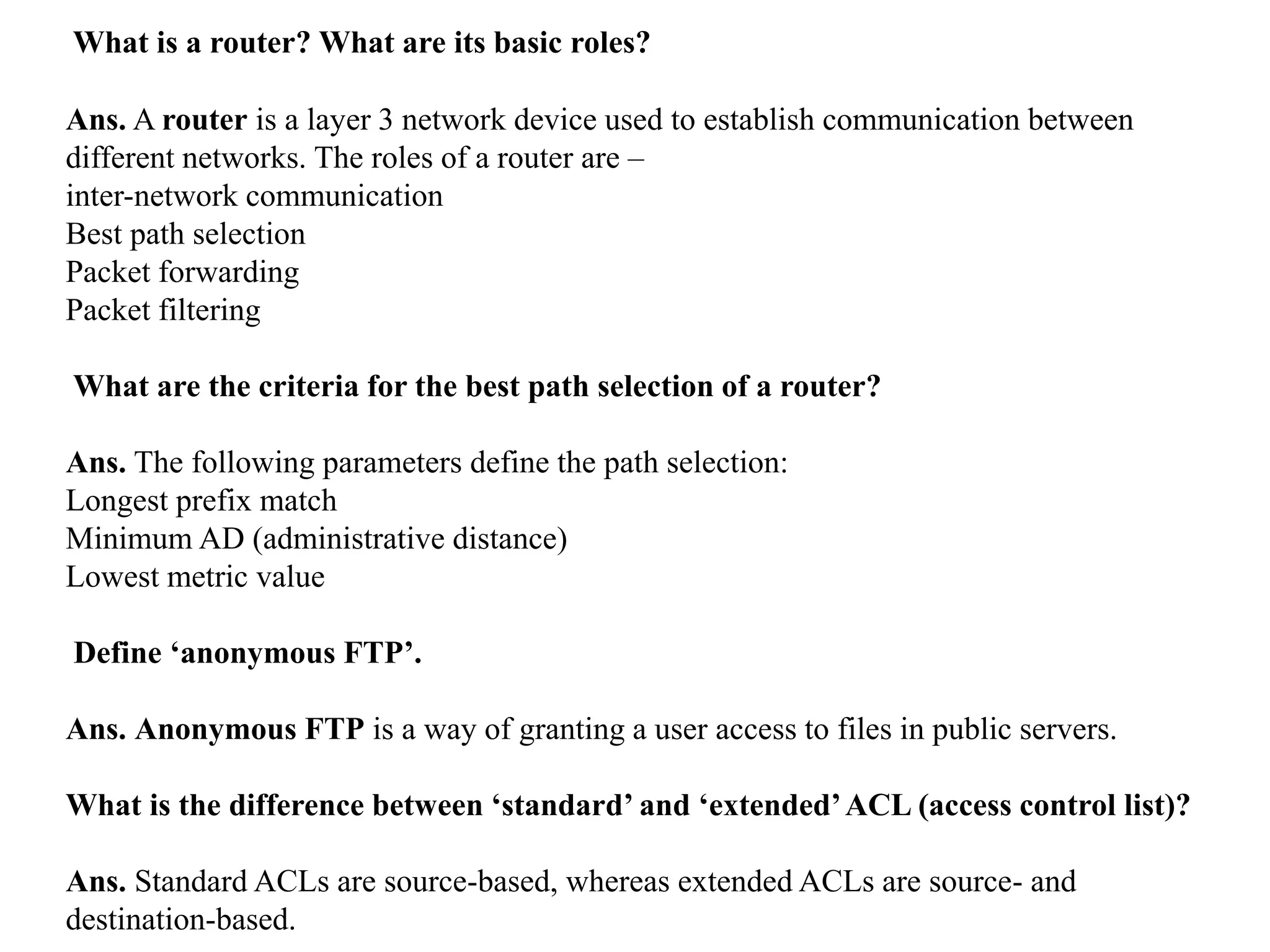
What is a router? What are its basic roles?
Ans. A router is a layer 3 network device used to establish communication between
different networks. The roles of a router are –
inter-network communication
Best path selection
Packet forwarding
Packet filtering
What are the criteria for the best path selection of a router?
Ans. The following parameters define the path selection:
Longest prefix match
Minimum AD (administrative distance)
Lowest metric value
Define ‘anonymous FTP’.
Ans. Anonymous FTP is a way of granting a user access to files in public servers.
What is the difference between ‘standard’ and ‘extended’ACL (access control list)?
Ans. Standard ACLs are source-based, whereas extended ACLs are source- and
destination-based.
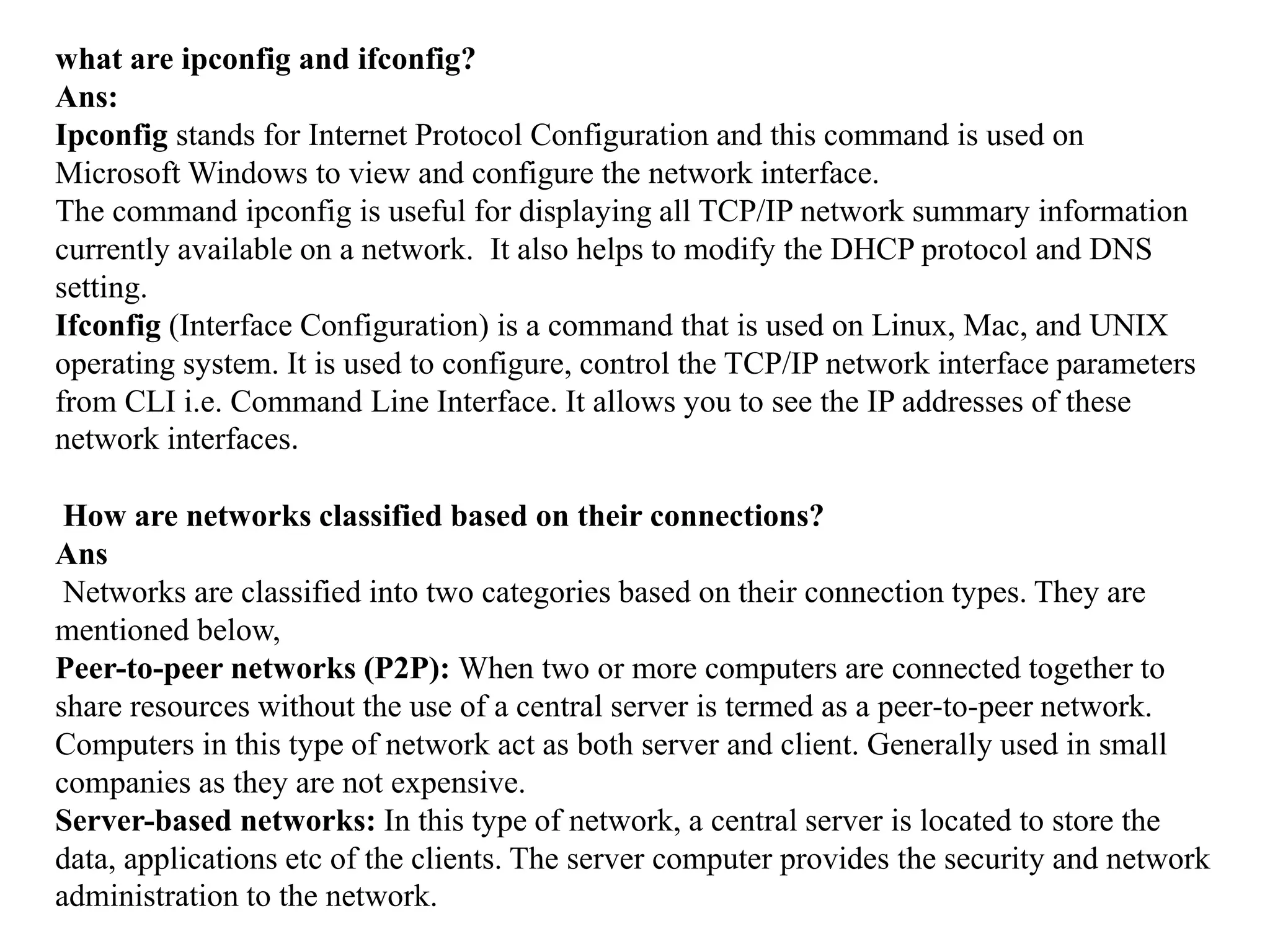
what are ipconfig and ifconfig?
Ans:
Ipconfig stands for Internet Protocol Configuration and this command is used on
Microsoft Windows to view and configure the network interface.
The command ipconfig is useful for displaying all TCP/IP network summary information
currently available on a network. It also helps to modify the DHCP protocol and DNS
setting.
Ifconfig (Interface Configuration) is a command that is used on Linux, Mac, and UNIX
operating system. It is used to configure, control the TCP/IP network interface parameters
from CLI i.e. Command Line Interface. It allows you to see the IP addresses of these
network interfaces.
How are networks classified based on their connections?
Ans
Networks are classified into two categories based on their connection types. They are
mentioned below,
Peer-to-peer networks (P2P): When two or more computers are connected together to
share resources without the use of a central server is termed as a peer-to-peer network.
Computers in this type of network act as both server and client. Generally used in small
companies as they are not expensive.
Server-based networks: In this type of network, a central server is located to store the
data, applications etc of the clients. The server computer provides the security and network
administration to the network.
How a Switch is different from a Hub?
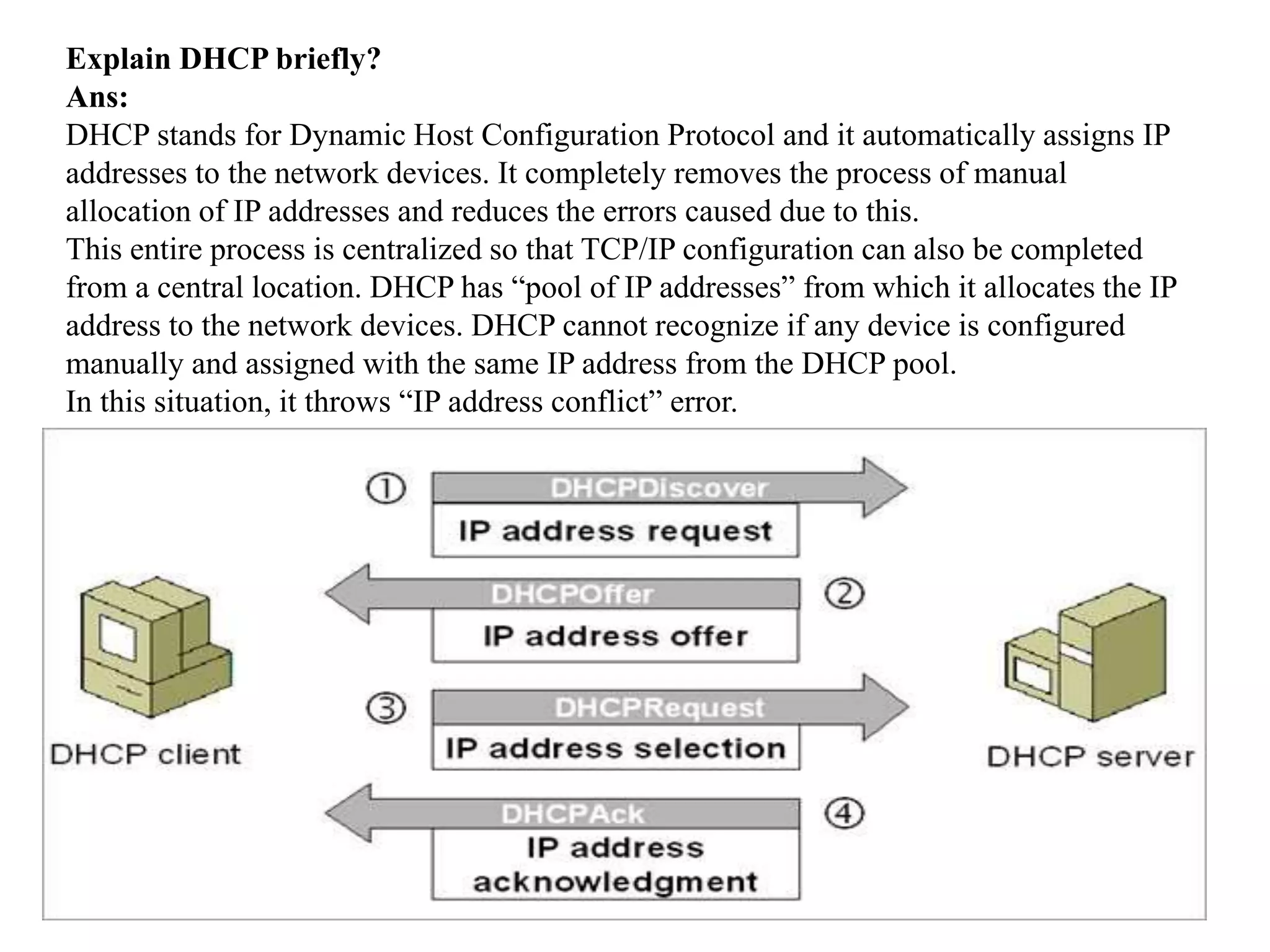
Explain DHCP briefly?
Ans:
DHCP stands for Dynamic Host Configuration Protocol and it automatically assigns IP
addresses to the network devices. It completely removes the process of manual
allocation of IP addresses and reduces the errors caused due to this.
This entire process is centralized so that TCP/IP configuration can also be completed
from a central location. DHCP has “pool of IP addresses” from which it allocates the IP
address to the network devices. DHCP cannot recognize if any device is configured
manually and assigned with the same IP address from the DHCP pool.
In this situation, it throws “IP address conflict” error.
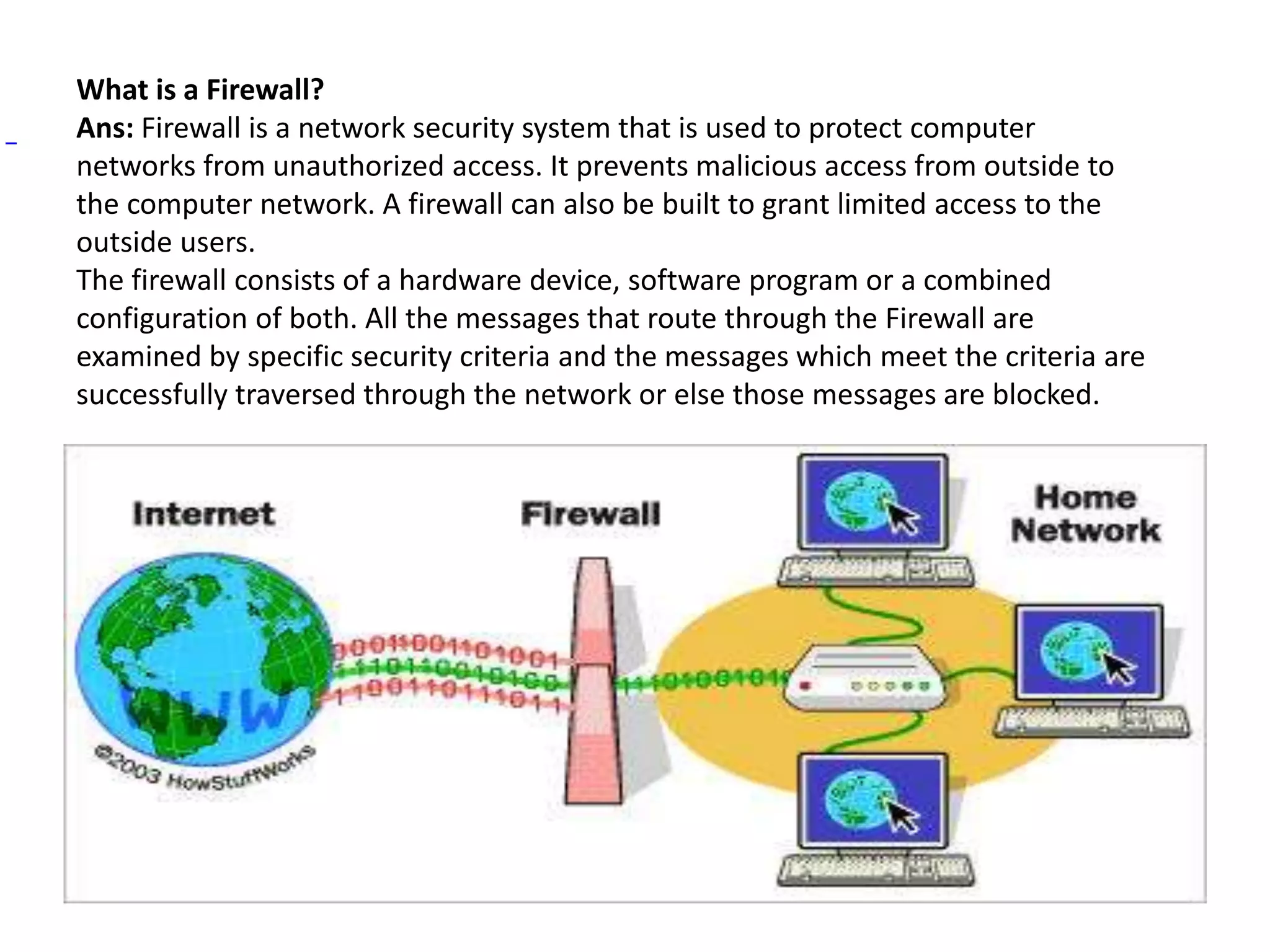
What is a Firewall?
Ans: Firewall is a network security system that is used to protect computer
networks from unauthorized access. It prevents malicious access from outside to
the computer network. A firewall can also be built to grant limited access to the
outside users.
The firewall consists of a hardware device, software program or a combined
configuration of both. All the messages that route through the Firewall are
examined by specific security criteria and the messages which meet the criteria are
successfully traversed through the network or else those messages are blocked.

Network presentation 24 3-18

  • 1.
    How many layersare there in the OSI model? Name them Ans. There are 7 layers – physical, data link, network, transport, session, presentation, and application. What are the two types of transmission technology available? Ans. The two types of transmission technology are – broadcast and point-to-point. What is a ‘subnet’? Ans. A ‘subnet’ is a generic term for a section of a large network, usually separated by a bridge or a router. What is DNS? Ans. The Domain Name System (DNS) is a central part of the Internet, providing a way to match names (a website you’re seeking) to numbers (the address for the website). Anything connected to the Internet – laptops, tablets, mobile phones, and websites – has an Internet Protocol (IP) address made up of numbers.
  • 2.
    What is a‘client’ and ‘server’ in a network? Ans. Clients and servers are separate logical entities that work together over a network to accomplish a task. What are the different ways to exchange data? Ans. • Simplex • Half-duplex • Full-duplex What is a ‘frame relay’ and in which layer does it operate? Ans. A frame relay is a packet-switching technology. It operates in the data link layer. Explain ‘hidden shares’. Ans. A hidden or an administrative share is a network share that is not visible when viewing another computer’s shares. •
  • 3.
    What is aMAC address? Ans. A MAC (Media Access Control) address is the 48-bit hardware address of a LAN card and is usually stored in the ROM of the network adapter card and is unique. What are the perquisites to configure a server? Ans. LAN card should be connected Root (partition on which window is installed) should be in NTFS format Server should be configured with a static IP address Q10. What is ‘beaconing’? Ans. Beaconing is the process that allows a network to self-repair networks problems. Differentiate between ‘attenuation’, ‘distortion’, and ‘noise’. Ans. When a signal travels through a medium, it loses some of its energy due to the resistance of the medium. This loss of energy is called attenuation. When a signal travels through a medium from one point to another, it may change the form or shape of the signal. This is known as distortion. Noise is unwanted electrical or electromagnetic energy that degrades the quality of signals and data.
  • 4.
    What is anIP address? Ans. An Internet Protocol address (IP address) is a numerical label assigned to each device (e.g., computer, printer) participating in a computer network that uses the Internet Protocol for communication. . Differentiate between a ‘bit rate’ and ‘baud rate’. Ans. A bit rate is the number of bits transmitted during one second, whereas, baud rate refers to the number of signal units per second that are required to represent those bits. Baud rate = bit rate / N, where N is the no. of bits represented by each signal shift. What is ‘bandwidth’? Ans. The limited range of frequency of signals that a line can carry is called the bandwidth. What is Project 802? Ans. It is a project started by IEEE to set standards to enable intercommunication between equipment from a variety of manufacturers.
  • 5.
    What is ICMP? Ans.ICMP (Internet Control Message Protocol) is a network layer protocol of the TCP/IP suite used by hosts and gateways to send notification of datagram problems back to the sender. What are the major types of networks? Ans. Server-based network Peer-to-peer network What are the important topologies for networks? Ans. There are three important topologies – Star, Bus and Ring. Differentiate between static IP addressing and dynamic IP addressing. Ans. In static IP addressing, a computer (or another device) is configured to always use the same IP address, whereas in dynamic IP addressing, the IP address can change periodically and is managed by a centralised network service
  • 6.
    Difference between huband switch? Ans. A hub is a networking device that connects multiple computers together, while switch is a control unit that turns the flow of electricity in a circuit. Which layers are referred as network support layers? Ans. Data link layer Physical layer Network layer Define simplex with an example? Ans. A type of communication in which data is transmitted in one direction is known as simplex. Example: Monitor What is RIP? Ans. RIP stands for Routing Information Protocol, is a simple protocol used to exchange information between the routers.
  • 7.
    What are thefactors that affect the performance of the network? Ans. Type of transmission media Software Number of users Hardware Difference between wired LAN and wireless LAN? Ans. Wired LAN used Ethernet devices like router, hub and switch, while wireless LAN uses devices like mifi router and WLAN router. Name some user support layers? Ans. Application layer Presentation layer Session layer What is the use of TCP in the IP packets? Ans. TCP is an acronym of transmission control protocol. It is used as a communications protocol in a private network.
  • 8.
    Name the typesof errors? Ans. There are two types of errors: Single bit error Burst error What is ALOHA? Ans. It is used to solve the channel allocation issue. Two types of aloha: Pure aloha Slotted aloha What does VPN stand for? Ans. VPN stands for virtual private network. It creates a secure network connection over a public network like the internet. Which protocols uses application layer? Ans. SMTP DNS TELNET FTP
  • 9.
    What is intranet? Ans.It is a private network based on TCP/IP protocols accessible only by the company’s members or someone with authorization. What are steps involved in creating the checksum? Ans. Divide the data into sections Add the sections together using 1’s complement arithmetic Take the complement of the final sum What is a ‘link’? Ans. A link refers to the connectivity between two devices. It includes the type of cables and protocols used in order for one device to be able to communicate with the other. What are the types of LAN cables used? Ans. There are two types of LAN cables used – ‘Cat 5’ and ‘Cat 6.’ Cat 5 can support 100Mbps of speed while Cat 6 can support 1Gbps of speed
  • 10.
    What is a‘cross table’? Ans. This is a type of connection between same types of devices without using a hub/switch so that they can communicate A gateway works in which layer of the OSI model? Ans. Transport layer. Differentiate between ‘forward lookup’ and ‘reverse lookup’ in DNS? Ans. Converting names to IP addresses is called forward lookup. Resolving IP addresses to names is called reverse lookup. What is ‘network topology’? Ans. Network topology refers to the layout of a computer network. It shows how devices and cables are physically laid out, as well as how they connect to one another. What is NIC? Ans. NIC (Network Interface Card) is a peripheral card that is attached to a PC in order to connect to a network. Every NIC has its own MAC address that identifies the PC on the network.
  • 11.
    What is arouter? What are its basic roles? Ans. A router is a layer 3 network device used to establish communication between different networks. The roles of a router are – inter-network communication Best path selection Packet forwarding Packet filtering What are the criteria for the best path selection of a router? Ans. The following parameters define the path selection: Longest prefix match Minimum AD (administrative distance) Lowest metric value Define ‘anonymous FTP’. Ans. Anonymous FTP is a way of granting a user access to files in public servers. What is the difference between ‘standard’ and ‘extended’ACL (access control list)? Ans. Standard ACLs are source-based, whereas extended ACLs are source- and destination-based.
  • 12.
    what are ipconfigand ifconfig? Ans: Ipconfig stands for Internet Protocol Configuration and this command is used on Microsoft Windows to view and configure the network interface. The command ipconfig is useful for displaying all TCP/IP network summary information currently available on a network. It also helps to modify the DHCP protocol and DNS setting. Ifconfig (Interface Configuration) is a command that is used on Linux, Mac, and UNIX operating system. It is used to configure, control the TCP/IP network interface parameters from CLI i.e. Command Line Interface. It allows you to see the IP addresses of these network interfaces. How are networks classified based on their connections? Ans Networks are classified into two categories based on their connection types. They are mentioned below, Peer-to-peer networks (P2P): When two or more computers are connected together to share resources without the use of a central server is termed as a peer-to-peer network. Computers in this type of network act as both server and client. Generally used in small companies as they are not expensive. Server-based networks: In this type of network, a central server is located to store the data, applications etc of the clients. The server computer provides the security and network administration to the network.
  • 13.
    How a Switchis different from a Hub?
  • 14.
    Explain DHCP briefly? Ans: DHCPstands for Dynamic Host Configuration Protocol and it automatically assigns IP addresses to the network devices. It completely removes the process of manual allocation of IP addresses and reduces the errors caused due to this. This entire process is centralized so that TCP/IP configuration can also be completed from a central location. DHCP has “pool of IP addresses” from which it allocates the IP address to the network devices. DHCP cannot recognize if any device is configured manually and assigned with the same IP address from the DHCP pool. In this situation, it throws “IP address conflict” error.
  • 15.
    What is aFirewall? Ans: Firewall is a network security system that is used to protect computer networks from unauthorized access. It prevents malicious access from outside to the computer network. A firewall can also be built to grant limited access to the outside users. The firewall consists of a hardware device, software program or a combined configuration of both. All the messages that route through the Firewall are examined by specific security criteria and the messages which meet the criteria are successfully traversed through the network or else those messages are blocked.