Chapter-7A
Networking Basics
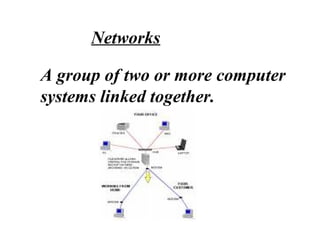
A group of two or more computer
systems linked together.
Networks
In information technology, backup refers
to making copies of data so that these
additional copies may be used to restore
the original after a data loss event. These
additional copies are typically called
"backups." Backups are useful primarily
for two purposes. The first is to restore a
computer to an operational state following
a disaster (called disaster recovery). The
second is to restore small numbers of files
after they have been accidentally deleted
Data Backup
Open file backup
Many backup software packages feature the ability to back up
open files..
Cold database backup
During a cold backup, the database is closed or locked and not
available to users.
Hot database backup
Some database management systems offer a means to generate
a backup image of the database while it is online and usable
("hot").
Data Backup
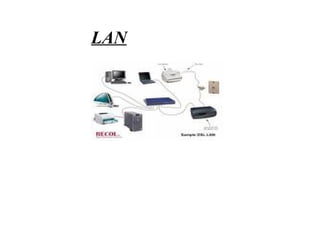
LAN
A computer network that spans a relatively small area.
Most LANs are confined to a single building or group of
buildings. However, one LAN can be connected to other
LANs over any distance via telephone lines and radio
waves.
Most LANs connect workstations and personal
computers. Each node (individual computer ) in a LAN
has its own CPU with which it executes programs, but it
also is able to access data and devices anywhere on the
LAN. This means that many users can share expensive
devices, such as laser printers, as well as data. Users can
also use the LAN to communicate with each other, by
sending e-mail or engaging in chat sessions.
Types Of Network
LAN
A computer network that spans a
relatively large geographical area.
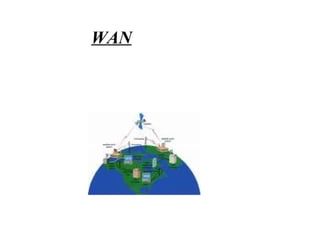
Typically, a WAN consists of two or more
local-area networks (LANs). Computers
connected to a wide-area network are
often connected through public networks,
such as the telephone system. They can
also be connected through leased lines or
satellites. The largest WAN in existence is
the Internet.
WAN
WAN
Acronym for campus-area
network. An interconnection of
local-area networks within a
limited geographical space, such
as a school campus or a military
base.
Campus Area Network(CANs)
Short for Metropolitan Area
Network, a data network designed
for a town or city. In terms of
geographic breadth, MANs are
larger than local-area networks
(LANs), but smaller than wide-
area networks (WANs).
Metropolitan Area Network(MAN)
Short for home area network. A HAN is a
network contained within a user's home
that connects a person's digital devices,
from multiple computers and their
peripheral devices to telephones, VCRs,
televisions, video games, home security
systems, "smart" appliances, fax
machines and other digital devices that
are wired into the network.
Home Area Network(HANs)
Network based on belonging to an
organization, usually a corporation,
accessible only by the organization's
members, employees, or others with
authorization. An intranet's Web sites
look and act just like any other Web
sites, but the firewall surrounding an
intranet fends off unauthorized
access.
Intranet
An intranet that is partially accessible to
authorized outsiders. Whereas an intranet is
accessible only to people who are members of
the same company or organization, an extranet
provides various levels of accessibility to
outsiders. You can access an extranet only if
you have a valid username and password, and
your identity determines which parts of the
extranet you can view. Extranets are becoming a
very popular means for business partners to
exchange information.
Extranet
How Network Are Structured
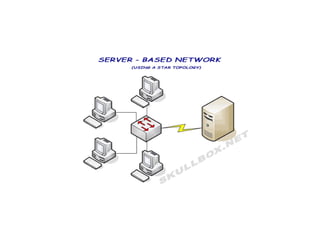
User gain access to files, printers
and other network based objects
by obtaining permission given
through a centrally controlled
server.
Server-Based Network
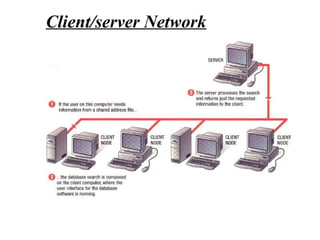
A network architecture in which each
computer or process on the network is
either a client or a server. Servers are
powerful computers or processes
dedicated to managing disk drives (file
servers), printers (print servers), or
network traffic (network server ). Clients
are PCs or workstations on which users
run applications. Clients rely on servers
for resources, such as files, devices, and
even processing power.
Client/server Network
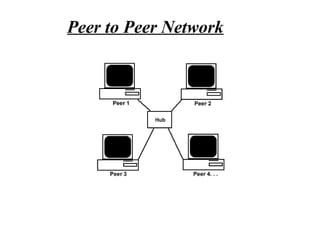
Often referred to simply as peer-
to-peer, or abbreviated P2P, a
type of network in which each
workstation has equivalent
capabilities and responsibilities.
Peer to Peer Network
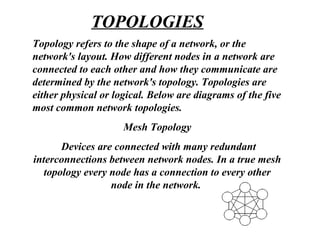
Topology refers to the shape of a network, or the
network's layout. How different nodes in a network are
connected to each other and how they communicate are
determined by the network's topology. Topologies are
either physical or logical. Below are diagrams of the five
most common network topologies.
Mesh Topology
Devices are connected with many redundant
interconnections between network nodes. In a true mesh
topology every node has a connection to every other
node in the network.
TOPOLOGIES
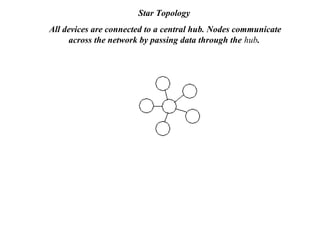
Star Topology
All devices are connected to a central hub. Nodes communicate
across the network by passing data through the hub.
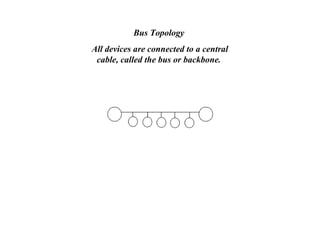
Bus Topology
All devices are connected to a central
cable, called the bus or backbone.
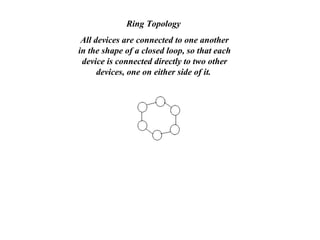
Ring Topology
All devices are connected to one another
in the shape of a closed loop, so that each
device is connected directly to two other
devices, one on either side of it.
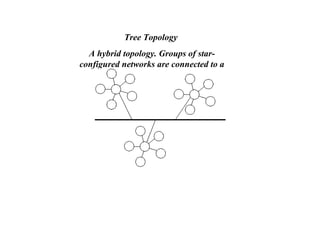
Tree Topology
A hybrid topology. Groups of star-
configured networks are connected to a
linear bus backbone.
An agreed-upon format for transmitting data between two devices. The
protocol determines the following:
the type of error checking to be used
data compression method, if any
how the sending device will indicate that it has finished sending a
message
how the receiving device will indicate that it has received a message
There are a variety of standard protocols from which programmers can
choose. Each has particular advantages and disadvantages; for example,
some are simpler than others, some are more reliable, and some are faster.
From a user's point of view, the only interesting aspect about protocols is
that your computer or device must support the right ones if you want to
communicate with other computers.
Protocol
pronounced as separate letters) Short for
Transmission Control Protocol/Internet
Protocol, the suite of communications protocols
used to connect hosts on the Internet. TCP/IP
uses several protocols, the two main ones being
TCP and IP. TCP/IP is built into the UNIX
operating system and is used by the Internet,
making it the standard (format, language)for
transmitting data over networks.
TCP/IP
Short for Internet work Packet Exchange, a networking
protocol used by the Novell NetWare operating systems.
IPX is datagram protocol used for connectionless
communications.
Short for Sequenced Packet Eexchange, a transport
layer protocol used in Novell Netware networks. The
SPX layer sits on top of the IPX layer and provides
connection-oriented services between two nodes on the
network. SPX is used primarily by client/server
applications.
Whereas the IPX protocol is similar to IP, SPX is
similar to TCP. Together, therefore, IPX/SPX provides
connection services similar to TCP/IP.
IPX/SPX
Pronounced net-booey, NetBEUI is short for
NetBios Extended User Interface. It is an
enhanced version of the NetBIOS protocol
(Network Basic Input Output System)used by
network operating systems such Windows 95
and Windows NT.
Netbeui was originally designed by IBM for
their Lan Manager server and later extended by
Microsoft and Novell.
NetBIOS/NetBEUI
Twisted Pair wire
coaxial Cable
Fiber optic cable
Network Media
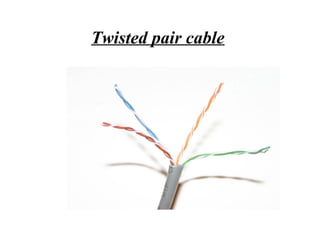
A type of cable that consists of two
independently insulated wires twisted around
one another. The use of two wires twisted
together helps to reduce crosstalk and
electromagnetic induction. While twisted-pair
cable is used by older telephone networks and is
the least expensive type of local-area network
(LAN) cable, most networks contain some
twisted-pair cabling at some point along the
network.
Twisted pair wire
Twisted pair cable
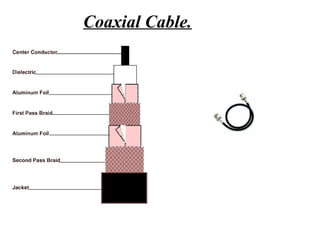
A type of wire that consists of a center
wire surrounded by insulation and then a
grounded shield of braided wire. The
shield minimizes electrical and radio
frequency interference. Coaxial cabling is
the primary type of cabling used by the
cable television industry and is also widely
used for computer networks, such as
Ethernet. Although more expensive than
standard telephone wire, it is much less
susceptible to interference and can carry
Coaxial Cable
Coaxial Cable.
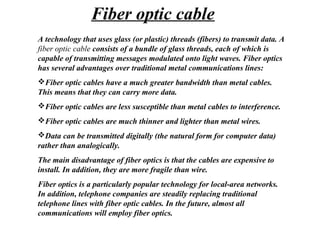
A technology that uses glass (or plastic) threads (fibers) to transmit data. A
fiber optic cable consists of a bundle of glass threads, each of which is
capable of transmitting messages modulated onto light waves. Fiber optics
has several advantages over traditional metal communications lines:
Fiber optic cables have a much greater bandwidth than metal cables.
This means that they can carry more data.
Fiber optic cables are less susceptible than metal cables to interference.
Fiber optic cables are much thinner and lighter than metal wires.
Data can be transmitted digitally (the natural form for computer data)
rather than analogically.
The main disadvantage of fiber optics is that the cables are expensive to
install. In addition, they are more fragile than wire.
Fiber optics is a particularly popular technology for local-area networks.
In addition, telephone companies are steadily replacing traditional
telephone lines with fiber optic cables. In the future, almost all
communications will employ fiber optics.
Fiber optic cable
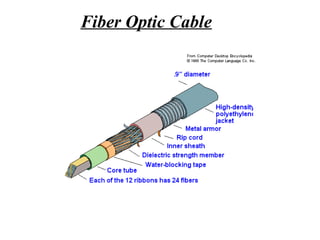
Fiber Optic Cable
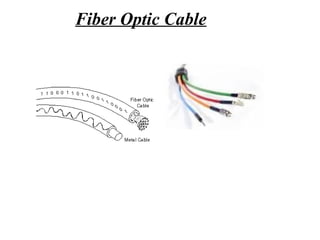
Fiber Optic Cable
The word wireless is dictionary
defined as "having no wires". In
networking terminology, wireless is
the term used to describe any
computer network where there is no
physical wired connection between
sender and receiver, but rather the
network is connected by radio waves
and/or microwaves to maintain
communications.
Wireless Media
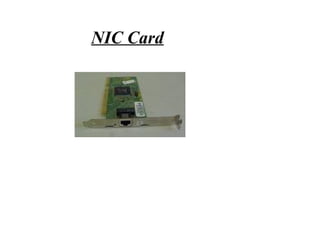
Often abbreviated as NIC, an
expansion board you insert into a
computer so the computer can be
connected to a network. Most
NICs are designed for a
particular type of network,
protocol.
NIC Card
NIC Card
HUB
Bridge
Switches
Router
Network Linking Device
A common connection point for
devices in a network. Hubs are
commonly used to connect
segments of a LAN. A hub
contains multiple ports. When a
packet arrives at one port, it is
copied to the other ports so that
all segments of the LAN can see
all packets
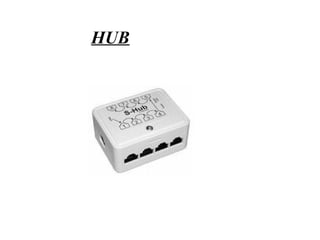
HUB
HUB
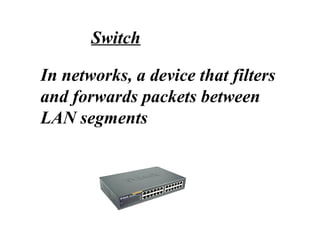
In networks, a device that filters
and forwards packets between
LAN segments
Switch
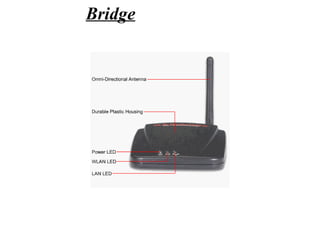
A device that connects two local-
area networks (LANs), or two
segments of the same LAN that
use the same protocol.
Bridge
Bridge
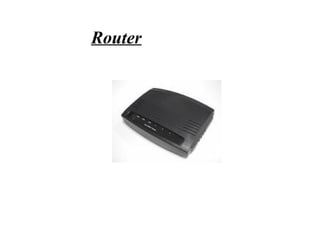
A device that forwards data packets along
networks. A router is connected to at least two
networks, commonly two LANs or WANs or a
LAN and its ISP’s network. Routers are located
at gateways, the places where two or more
networks connect.
Routers use headers and forwarding tables to
determine the best path for forwarding the
packets, and they use protocols to communicate
with each other and configure the best route
between any two hosts.
Very little filtering of data is done through
routers.
Router
Router
Short for unshielded twisted pair, a
popular type of cable that consists of two
unshielded wires twisted around each
other. Due to its low cost, UTP cabling is
used extensively for local-area networks
(LANs) and telephone connections. UTP
cabling does not offer as high bandwidth
or as good protection from interference as
coaxial or fiber optic cables, but it is less
expensive and easier to work with.
Examplke-twisted cable likeCAT5,CAT6
cable
UTP Cable
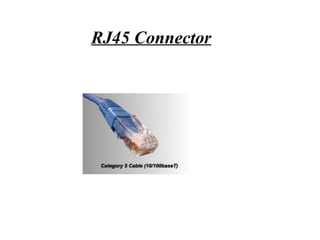
Short for Registered Jack-45, an
eight-wire connector used commonly
to connect computers onto a local-
area networks (LAN), especially
Ethernets. RJ-45 connectors look
similar to the RJ-11 connectors used
for connecting telephone equipment,
but they are somewhat wider.
RJ-45 Connector
RJ45 Connector
A node on a network that serves as an entrance
to another network. In enterprises, the gateway
is the computer that routes the traffic from a
workstation to the outside network that is
serving the Web pages. In homes, the gateway is
the ISP that connects the user to the internet. In
enterprises, the gateway node often acts as a
proxy server and a firewall. The gateway is also
associated with both a router, which use headers
and forwarding tables to determine where
packets are sent, and a switch, which provides
the actual path for the packet in and out of the
gateway.
Gateway

7312334 chapter-7 a-networking-basics

  • 1.
  • 2.
    A group oftwo or more computer systems linked together. Networks
  • 3.
    In information technology,backup refers to making copies of data so that these additional copies may be used to restore the original after a data loss event. These additional copies are typically called "backups." Backups are useful primarily for two purposes. The first is to restore a computer to an operational state following a disaster (called disaster recovery). The second is to restore small numbers of files after they have been accidentally deleted Data Backup
  • 4.
    Open file backup Manybackup software packages feature the ability to back up open files.. Cold database backup During a cold backup, the database is closed or locked and not available to users. Hot database backup Some database management systems offer a means to generate a backup image of the database while it is online and usable ("hot"). Data Backup
  • 5.
    LAN A computer networkthat spans a relatively small area. Most LANs are confined to a single building or group of buildings. However, one LAN can be connected to other LANs over any distance via telephone lines and radio waves. Most LANs connect workstations and personal computers. Each node (individual computer ) in a LAN has its own CPU with which it executes programs, but it also is able to access data and devices anywhere on the LAN. This means that many users can share expensive devices, such as laser printers, as well as data. Users can also use the LAN to communicate with each other, by sending e-mail or engaging in chat sessions. Types Of Network
  • 6.
  • 7.
    A computer networkthat spans a relatively large geographical area. Typically, a WAN consists of two or more local-area networks (LANs). Computers connected to a wide-area network are often connected through public networks, such as the telephone system. They can also be connected through leased lines or satellites. The largest WAN in existence is the Internet. WAN
  • 8.
  • 9.
    Acronym for campus-area network.An interconnection of local-area networks within a limited geographical space, such as a school campus or a military base. Campus Area Network(CANs)
  • 10.
    Short for MetropolitanArea Network, a data network designed for a town or city. In terms of geographic breadth, MANs are larger than local-area networks (LANs), but smaller than wide- area networks (WANs). Metropolitan Area Network(MAN)
  • 11.
    Short for homearea network. A HAN is a network contained within a user's home that connects a person's digital devices, from multiple computers and their peripheral devices to telephones, VCRs, televisions, video games, home security systems, "smart" appliances, fax machines and other digital devices that are wired into the network. Home Area Network(HANs)
  • 12.
    Network based onbelonging to an organization, usually a corporation, accessible only by the organization's members, employees, or others with authorization. An intranet's Web sites look and act just like any other Web sites, but the firewall surrounding an intranet fends off unauthorized access. Intranet
  • 13.
    An intranet thatis partially accessible to authorized outsiders. Whereas an intranet is accessible only to people who are members of the same company or organization, an extranet provides various levels of accessibility to outsiders. You can access an extranet only if you have a valid username and password, and your identity determines which parts of the extranet you can view. Extranets are becoming a very popular means for business partners to exchange information. Extranet
  • 14.
    How Network AreStructured
  • 15.
    User gain accessto files, printers and other network based objects by obtaining permission given through a centrally controlled server. Server-Based Network
  • 17.
    A network architecturein which each computer or process on the network is either a client or a server. Servers are powerful computers or processes dedicated to managing disk drives (file servers), printers (print servers), or network traffic (network server ). Clients are PCs or workstations on which users run applications. Clients rely on servers for resources, such as files, devices, and even processing power. Client/server Network
  • 18.
  • 19.
    Often referred tosimply as peer- to-peer, or abbreviated P2P, a type of network in which each workstation has equivalent capabilities and responsibilities. Peer to Peer Network
  • 20.
    Peer to PeerNetwork
  • 21.
    Topology refers tothe shape of a network, or the network's layout. How different nodes in a network are connected to each other and how they communicate are determined by the network's topology. Topologies are either physical or logical. Below are diagrams of the five most common network topologies. Mesh Topology Devices are connected with many redundant interconnections between network nodes. In a true mesh topology every node has a connection to every other node in the network. TOPOLOGIES
  • 22.
    Star Topology All devicesare connected to a central hub. Nodes communicate across the network by passing data through the hub.
  • 23.
    Bus Topology All devicesare connected to a central cable, called the bus or backbone.
  • 24.
    Ring Topology All devicesare connected to one another in the shape of a closed loop, so that each device is connected directly to two other devices, one on either side of it.
  • 25.
    Tree Topology A hybridtopology. Groups of star- configured networks are connected to a linear bus backbone.
  • 26.
    An agreed-upon formatfor transmitting data between two devices. The protocol determines the following: the type of error checking to be used data compression method, if any how the sending device will indicate that it has finished sending a message how the receiving device will indicate that it has received a message There are a variety of standard protocols from which programmers can choose. Each has particular advantages and disadvantages; for example, some are simpler than others, some are more reliable, and some are faster. From a user's point of view, the only interesting aspect about protocols is that your computer or device must support the right ones if you want to communicate with other computers. Protocol
  • 27.
    pronounced as separateletters) Short for Transmission Control Protocol/Internet Protocol, the suite of communications protocols used to connect hosts on the Internet. TCP/IP uses several protocols, the two main ones being TCP and IP. TCP/IP is built into the UNIX operating system and is used by the Internet, making it the standard (format, language)for transmitting data over networks. TCP/IP
  • 28.
    Short for Internetwork Packet Exchange, a networking protocol used by the Novell NetWare operating systems. IPX is datagram protocol used for connectionless communications. Short for Sequenced Packet Eexchange, a transport layer protocol used in Novell Netware networks. The SPX layer sits on top of the IPX layer and provides connection-oriented services between two nodes on the network. SPX is used primarily by client/server applications. Whereas the IPX protocol is similar to IP, SPX is similar to TCP. Together, therefore, IPX/SPX provides connection services similar to TCP/IP. IPX/SPX
  • 29.
    Pronounced net-booey, NetBEUIis short for NetBios Extended User Interface. It is an enhanced version of the NetBIOS protocol (Network Basic Input Output System)used by network operating systems such Windows 95 and Windows NT. Netbeui was originally designed by IBM for their Lan Manager server and later extended by Microsoft and Novell. NetBIOS/NetBEUI
  • 30.
    Twisted Pair wire coaxialCable Fiber optic cable Network Media
  • 31.
    A type ofcable that consists of two independently insulated wires twisted around one another. The use of two wires twisted together helps to reduce crosstalk and electromagnetic induction. While twisted-pair cable is used by older telephone networks and is the least expensive type of local-area network (LAN) cable, most networks contain some twisted-pair cabling at some point along the network. Twisted pair wire
  • 32.
  • 33.
    A type ofwire that consists of a center wire surrounded by insulation and then a grounded shield of braided wire. The shield minimizes electrical and radio frequency interference. Coaxial cabling is the primary type of cabling used by the cable television industry and is also widely used for computer networks, such as Ethernet. Although more expensive than standard telephone wire, it is much less susceptible to interference and can carry Coaxial Cable
  • 34.
  • 35.
    A technology thatuses glass (or plastic) threads (fibers) to transmit data. A fiber optic cable consists of a bundle of glass threads, each of which is capable of transmitting messages modulated onto light waves. Fiber optics has several advantages over traditional metal communications lines: Fiber optic cables have a much greater bandwidth than metal cables. This means that they can carry more data. Fiber optic cables are less susceptible than metal cables to interference. Fiber optic cables are much thinner and lighter than metal wires. Data can be transmitted digitally (the natural form for computer data) rather than analogically. The main disadvantage of fiber optics is that the cables are expensive to install. In addition, they are more fragile than wire. Fiber optics is a particularly popular technology for local-area networks. In addition, telephone companies are steadily replacing traditional telephone lines with fiber optic cables. In the future, almost all communications will employ fiber optics. Fiber optic cable
  • 36.
  • 37.
  • 38.
    The word wirelessis dictionary defined as "having no wires". In networking terminology, wireless is the term used to describe any computer network where there is no physical wired connection between sender and receiver, but rather the network is connected by radio waves and/or microwaves to maintain communications. Wireless Media
  • 39.
    Often abbreviated asNIC, an expansion board you insert into a computer so the computer can be connected to a network. Most NICs are designed for a particular type of network, protocol. NIC Card
  • 40.
  • 41.
  • 42.
    A common connectionpoint for devices in a network. Hubs are commonly used to connect segments of a LAN. A hub contains multiple ports. When a packet arrives at one port, it is copied to the other ports so that all segments of the LAN can see all packets HUB
  • 43.
  • 44.
    In networks, adevice that filters and forwards packets between LAN segments Switch
  • 45.
    A device thatconnects two local- area networks (LANs), or two segments of the same LAN that use the same protocol. Bridge
  • 46.
  • 47.
    A device thatforwards data packets along networks. A router is connected to at least two networks, commonly two LANs or WANs or a LAN and its ISP’s network. Routers are located at gateways, the places where two or more networks connect. Routers use headers and forwarding tables to determine the best path for forwarding the packets, and they use protocols to communicate with each other and configure the best route between any two hosts. Very little filtering of data is done through routers. Router
  • 48.
  • 49.
    Short for unshieldedtwisted pair, a popular type of cable that consists of two unshielded wires twisted around each other. Due to its low cost, UTP cabling is used extensively for local-area networks (LANs) and telephone connections. UTP cabling does not offer as high bandwidth or as good protection from interference as coaxial or fiber optic cables, but it is less expensive and easier to work with. Examplke-twisted cable likeCAT5,CAT6 cable UTP Cable
  • 50.
    Short for RegisteredJack-45, an eight-wire connector used commonly to connect computers onto a local- area networks (LAN), especially Ethernets. RJ-45 connectors look similar to the RJ-11 connectors used for connecting telephone equipment, but they are somewhat wider. RJ-45 Connector
  • 51.
  • 52.
    A node ona network that serves as an entrance to another network. In enterprises, the gateway is the computer that routes the traffic from a workstation to the outside network that is serving the Web pages. In homes, the gateway is the ISP that connects the user to the internet. In enterprises, the gateway node often acts as a proxy server and a firewall. The gateway is also associated with both a router, which use headers and forwarding tables to determine where packets are sent, and a switch, which provides the actual path for the packet in and out of the gateway. Gateway