1
SEPTEMBER 6
NETFLIX
STRATEGY
FORMULATION
Submitted By: Group 2
Nikhil John Abraham
Mathew Joseph
Mukesh Kanna
Akshay Anil
Riya Aseef
2
NETFLIX
Netflix is an American media-services provider and production company headquartered in
California. Netflix offers a wide variety of award-winning TV programs, films, anime, documentaries
and more – on thousands of internet-connected devices. The company's primary business is its
subscription-based streaming service which offers online streaming of a library of films and television
programs, including those produced in-house. As of April 2019, Netflix had over 148 million paid
subscriptions worldwide, including 60 million in the United States, and over 154 million subscriptions
total including free trials. It is available almost worldwide.
Netflix's initial business model included DVD and rental through mail, but Hastings deserted the
sales about a year after the enterprise's founding to focus on the preliminary DVD business. Netflix
increased its commercial enterprise in 2010 with the advent of streaming media at the same time as
maintaining the DVD and Blu-ray commercial enterprise. The business enterprise extended across the
world in 2010 with streaming in Canada, followed by Latin America and the Caribbean. Netflix entered
the content-production enterprise in 2012, debuting its first series Lilyhammer. Since 2012, Netflix has
taken more of an active role as producer and distributor for each movie and television series, and to that
cease, it offers a variety of "Netflix Original" content through its on-line library. By January 2016,
Netflix services operated in greater than 190 nations. Netflix launched an expected 126 original series
and films in 2016, extra than every other community or cable channel.
As of 2017, Netflix stocks have been held via institutional buyers, consisting of Capital Group
Companies, The Vanguard Group, BlackRock and others. There are three subscription alternatives a
basic one for Rs 500/month which goes with one device and offers SD resolution video. Then there's the
Rs 650/month alternative which goes with two gadgets and offers HD fine video and sooner or later,
there is the top tier plan that is for Rs 800/month and it really works with 4 gadgets and supports up to
Ultra HD resolutions. Now those costs are barely inexpensive than what's being supplied to customers
in the US. Realistically speaking for Indians, the exceptional plan appears to be the Rs 650/month as
there are very few devices within the market that support Ultra HD video.
3
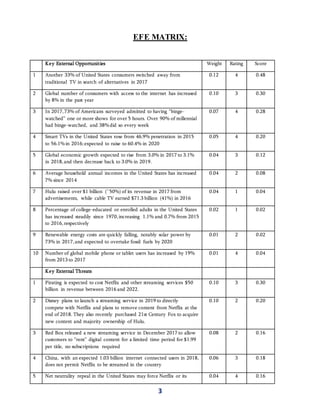
EFE MATRIX:
Key External Opportunities Weight Rating Score
1 Another 33% of United States consumers switched away from
traditional TV in search of alternatives in 2017
0.12 4 0.48
2 Global number of consumers with access to the internet has increased
by 8% in the past year
0.10 3 0.30
3 In 2017,73% of Americans surveyed admitted to having “binge-
watched” one or more shows for over 5 hours. Over 90% of millennial
had binge-watched, and 38% did so every week
0.07 4 0.28
4 Smart TVs in the United States rose from 46.9% penetration in 2015
to 56.1% in 2016;expected to raise to 60.4% in 2020
0.05 4 0.20
5 Global economic growth expected to rise from 3.0% in 2017 to 3.1%
in 2018,and then decrease back to 3.0% in 2019.
0.04 3 0.12
6 Average household annual incomes in the United States has increased
7% since 2014
0.04 2 0.08
7 Hulu raised over $1 billion (~50%) of its revenue in 2017 from
advertisements, while cable TV earned $71.3 billion (41%) in 2016
0.04 1 0.04
8 Percentage of college-educated or enrolled adults in the United States
has increased steadily since 1970,increasing 1.1% and 0.7% from 2015
to 2016,respectively
0.02 1 0.02
9 Renewable energy costs are quickly falling, notably solar power by
73% in 2017,and expected to overtake fossil fuels by 2020
0.01 2 0.02
10 Number of global mobile phone or tablet users has increased by 19%
from 2013 to 2017
0.01 4 0.04
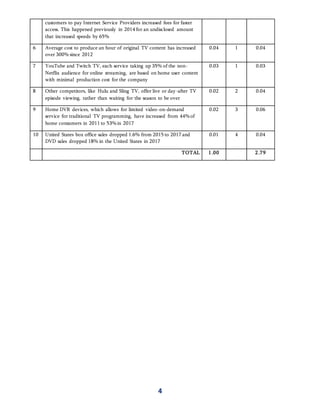
Key External Threats
1 Pirating is expected to cost Netflix and other streaming services $50
billion in revenue between 2016 and 2022.
0.10 3 0.30
2 Disney plans to launch a streaming service in 2019 to directly
compete with Netflix and plans to remove content from Netflix at the
end of 2018. They also recently purchased 21st Century Fox to acquire
new content and majority ownership of Hulu.
0.10 2 0.20
3 Red Box released a new streaming service in December 2017 to allow
customers to “rent” digital content for a limited time period for $1.99
per title, no subscriptions required
0.08 2 0.16
4 China, with an expected 1.03 billion internet connected users in 2018,
does not permit Netflix to be streamed in the country
0.06 3 0.18
5 Net neutrality repeal in the United States may force Netflix or its 0.04 4 0.16
4
customers to pay Internet Service Providers increased fees for faster
access. This happened previously in 2014 for an undisclosed amount
that increased speeds by 65%
6 Average cost to produce an hour of original TV content has increased
over 300% since 2012
0.04 1 0.04
7 YouTube and Twitch TV, each service taking up 35% of the non-
Netflix audience for online streaming, are based on home user content
with minimal production cost for the company
0.03 1 0.03
8 Other competitors, like Hulu and Sling TV, offer live or day-after TV
episode viewing, rather than waiting for the season to be over
0.02 2 0.04
9 Home DVR devices, which allows for limited video-on-demand
service for traditional TV programming, have increased from 44% of
home consumers in 2011 to 53% in 2017
0.02 3 0.06
10 United States box office sales dropped 1.6% from 2015 to 2017 and
DVD sales dropped 18% in the United States in 2017
0.01 4 0.04
TOTAL 1.00 2.79
5
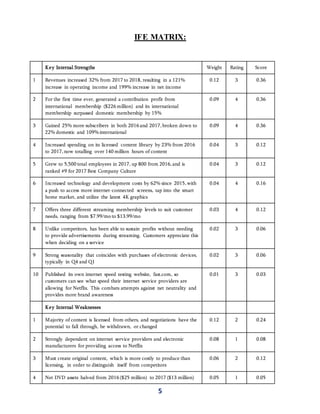
IFE MATRIX:
Key Internal Strengths Weight Rating Score
1 Revenues increased 32% from 2017 to 2018, resulting in a 121%
increase in operating income and 199% increase in net income
0.12 3 0.36
2 For the first time ever, generated a contribution profit from
international membership ($226 million) and its international
membership surpassed domestic membership by 15%
0.09 4 0.36
3 Gained 25% more subscribers in both 2016 and 2017,broken down to
22% domestic and 109% international
0.09 4 0.36
4 Increased spending on its licensed content library by 23% from 2016
to 2017,now totalling over 140 million hours of content
0.04 3 0.12
5 Grew to 5,500 total employees in 2017, up 800 from 2016,and is
ranked #9 for 2017 Best Company Culture
0.04 3 0.12
6 Increased technology and development costs by 62% since 2015,with
a push to access more internet-connected screens, tap into the smart
home market, and utilize the latest 4K graphics
0.04 4 0.16
7 Offers three different streaming membership levels to suit customer
needs, ranging from $7.99/mo to $13.99/mo
0.03 4 0.12
8 Unlike competitors, has been able to sustain profits without needing
to provide advertisements during streaming. Customers appreciate this
when deciding on a service
0.02 3 0.06
9 Strong seasonality that coincides with purchases of electronic devices,
typically in Q4 and Q1
0.02 3 0.06
10 Published its own internet speed testing website, fast.com, so
customers can see what speed their internet service providers are
allowing for Netflix. This combats attempts against net neutrality and
provides more brand awareness
0.01 3 0.03
Key Internal Weaknesses
1 Majority of content is licensed from others, and negotiations have the
potential to fall through, be withdrawn, or changed
0.12 2 0.24
2 Strongly dependent on internet service providers and electronic
manufacturers for providing access to Netflix
0.08 1 0.08
3 Must create original content, which is more costly to produce than
licensing, in order to distinguish itself from competitors
0.06 2 0.12
4 Net DVD assets halved from 2016 ($25 million) to 2017 ($13 million) 0.05 1 0.05
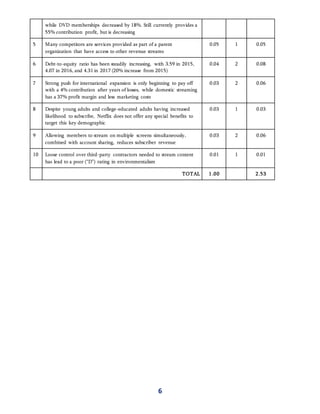
6
while DVD memberships decreased by 18%. Still currently provides a
55% contribution profit, but is decreasing
5 Many competitors are services provided as part of a parent
organization that have access to other revenue streams
0.05 1 0.05
6 Debt-to-equity ratio has been steadily increasing, with 3.59 in 2015,
4.07 in 2016, and 4.31 in 2017 (20% increase from 2015)
0.04 2 0.08
7 Strong push for international expansion is only beginning to pay off
with a 4% contribution after years of losses, while domestic streaming
has a 37% profit margin and less marketing costs
0.03 2 0.06
8 Despite young adults and college-educated adults having increased
likelihood to subscribe, Netflix does not offer any special benefits to
target this key demographic
0.03 1 0.03
9 Allowing members to stream on multiple screens simultaneously,
combined with account sharing, reduces subscriber revenue
0.03 2 0.06
10 Loose control over third-party contractors needed to stream content
has lead to a poor (“D”) rating in environmentalism
0.01 1 0.01
TOTAL 1.00 2.53
7
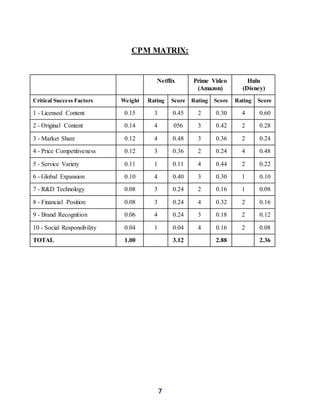
CPM MATRIX:
Netflix Prime Video
(Amazon)
Hulu
(Disney)
Critical Success Factors Weight Rating Score Rating Score Rating Score
1 - Licensed Content 0.15 3 0.45 2 0.30 4 0.60
2 - Original Content 0.14 4 056 3 0.42 2 0.28
3 - Market Share 0.12 4 0.48 3 0.36 2 0.24
4 - Price Competitiveness 0.12 3 0.36 2 0.24 4 0.48
5 - Service Variety 0.11 1 0.11 4 0.44 2 0.22
6 - Global Expansion 0.10 4 0.40 3 0.30 1 0.10
7 - R&D Technology 0.08 3 0.24 2 0.16 1 0.08
8 - Financial Position 0.08 3 0.24 4 0.32 2 0.16
9 - Brand Recognition 0.06 4 0.24 3 0.18 2 0.12
10 - Social Responsibility 0.04 1 0.04 4 0.16 2 0.08
TOTAL 1.00 3.12 2.88 2.36
8
STRATEGIC ALTERNATIVES IDENTIFIED BY THE GROUP
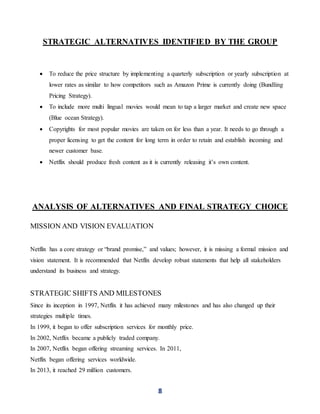
 To reduce the price structure by implementing a quarterly subscription or yearly subscription at
lower rates as similar to how competitors such as Amazon Prime is currently doing (Bundling
Pricing Strategy).
 To include more multi lingual movies would mean to tap a larger market and create new space
(Blue ocean Strategy).
 Copyrights for most popular movies are taken on for less than a year. It needs to go through a
proper licensing to get the content for long term in order to retain and establish incoming and
newer customer base.
 Netflix should produce fresh content as it is currently releasing it’s own content.
ANALYSIS OF ALTERNATIVES AND FINAL STRATEGY CHOICE
MISSION AND VISION EVALUATION
Netflix has a core strategy or “brand promise,” and values; however, it is missing a formal mission and
vision statement. It is recommended that Netflix develop robust statements that help all stakeholders
understand its business and strategy.
STRATEGIC SHIFTS AND MILESTONES
Since its inception in 1997, Netflix it has achieved many milestones and has also changed up their
strategies multiple times.
In 1999, it began to offer subscription services for monthly price.
In 2002, Netflix became a publicly traded company.
In 2007, Netflix began offering streaming services. In 2011,
Netflix began offering services worldwide.
In 2013, it reached 29 million customers.
9
INTERNATIONALIZATION AND LOCALIZATION STRATEGY
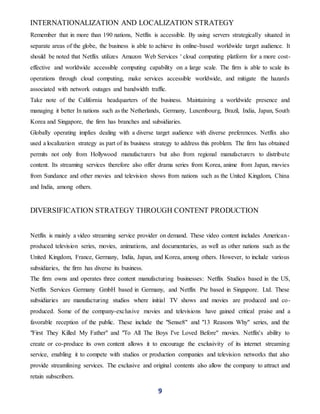
Remember that in more than 190 nations, Netflix is accessible. By using servers strategically situated in
separate areas of the globe, the business is able to achieve its online-based worldwide target audience. It
should be noted that Netflix utilizes Amazon Web Services ' cloud computing platform for a more cost-
effective and worldwide accessible computing capability on a large scale. The firm is able to scale its
operations through cloud computing, make services accessible worldwide, and mitigate the hazards
associated with network outages and bandwidth traffic.
Take note of the California headquarters of the business. Maintaining a worldwide presence and
managing it better In nations such as the Netherlands, Germany, Luxembourg, Brazil, India, Japan, South
Korea and Singapore, the firm has branches and subsidiaries.
Globally operating implies dealing with a diverse target audience with diverse preferences. Netflix also
used a localization strategy as part of its business strategy to address this problem. The firm has obtained
permits not only from Hollywood manufacturers but also from regional manufacturers to distribute
content. Its streaming services therefore also offer drama series from Korea, anime from Japan, movies
from Sundance and other movies and television shows from nations such as the United Kingdom, China
and India, among others.
DIVERSIFICATION STRATEGY THROUGH CONTENT PRODUCTION
Netflix is mainly a video streaming service provider on demand. These video content includes American-
produced television series, movies, animations, and documentaries, as well as other nations such as the
United Kingdom, France, Germany, India, Japan, and Korea, among others. However, to include various
subsidiaries, the firm has diverse its business.
The firm owns and operates three content manufacturing businesses: Netflix Studios based in the US,
Netflix Services Germany GmbH based in Germany, and Netflix Pte based in Singapore. Ltd. These
subsidiaries are manufacturing studios where initial TV shows and movies are produced and co-
produced. Some of the company-exclusive movies and televisions have gained critical praise and a
favorable reception of the public. These include the "Sense8" and "13 Reasons Why" series, and the
"First They Killed My Father" and "To All The Boys I've Loved Before" movies. Netflix's ability to
create or co-produce its own content allows it to encourage the exclusivity of its internet streaming
service, enabling it to compete with studios or production companies and television networks that also
provide streamlining services. The exclusive and original contents also allow the company to attract and
retain subscribers.
10
MARKETING STRATEGY AND MARKETING ACTIVITIES
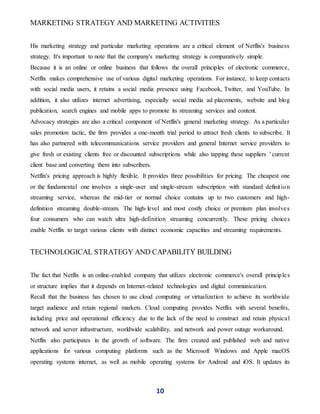
His marketing strategy and particular marketing operations are a critical element of Netflix's business
strategy. It's important to note that the company's marketing strategy is comparatively simple.
Because it is an online or online business that follows the overall principles of electronic commerce,
Netflix makes comprehensive use of various digital marketing operations. For instance, to keep contacts
with social media users, it retains a social media presence using Facebook, Twitter, and YouTube. In
addition, it also utilizes internet advertising, especially social media ad placements, website and blog
publication, search engines and mobile apps to promote its streaming services and content.
Advocacy strategies are also a critical component of Netflix's general marketing strategy. As a particular
sales promotion tactic, the firm provides a one-month trial period to attract fresh clients to subscribe. It
has also partnered with telecommunications service providers and general Internet service providers to
give fresh or existing clients free or discounted subscriptions while also tapping these suppliers ' current
client base and converting them into subscribers.
Netflix's pricing approach is highly flexible. It provides three possibilities for pricing. The cheapest one
or the fundamental one involves a single-user and single-stream subscription with standard definition
streaming service, whereas the mid-tier or normal choice contains up to two customers and high-
definition streaming double-stream. The high-level and most costly choice or premium plan involves
four consumers who can watch ultra high-definition streaming concurrently. These pricing choices
enable Netflix to target various clients with distinct economic capacities and streaming requirements.
TECHNOLOGICAL STRATEGY AND CAPABILITY BUILDING
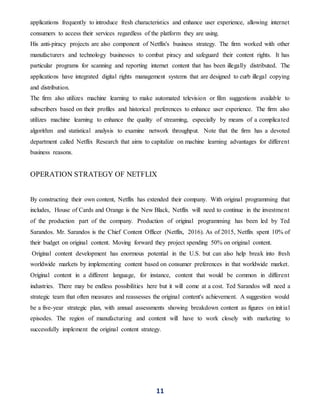
The fact that Netflix is an online-enabled company that utilizes electronic commerce's overall principles
or structure implies that it depends on Internet-related technologies and digital communication.
Recall that the business has chosen to use cloud computing or virtualization to achieve its worldwide
target audience and retain regional markets. Cloud computing provides Netflix with several benefits,
including price and operational efficiency due to the lack of the need to construct and retain physical
network and server infrastructure, worldwide scalability, and network and power outage workaround.
Netflix also participates in the growth of software. The firm created and published web and native
applications for various computing platforms such as the Microsoft Windows and Apple macOS
operating systems internet, as well as mobile operating systems for Android and iOS. It updates its
11
applications frequently to introduce fresh characteristics and enhance user experience, allowing internet
consumers to access their services regardless of the platform they are using.
His anti-piracy projects are also component of Netflix's business strategy. The firm worked with other
manufacturers and technology businesses to combat piracy and safeguard their content rights. It has
particular programs for scanning and reporting internet content that has been illegally distributed. The
applications have integrated digital rights management systems that are designed to curb illegal copying
and distribution.
The firm also utilizes machine learning to make automated television or film suggestions available to
subscribers based on their profiles and historical preferences to enhance user experience. The firm also
utilizes machine learning to enhance the quality of streaming, especially by means of a complicated
algorithm and statistical analysis to examine network throughput. Note that the firm has a devoted
department called Netflix Research that aims to capitalize on machine learning advantages for different
business reasons.
OPERATION STRATEGY OF NETFLIX
By constructing their own content, Netflix has extended their company. With original programming that
includes, House of Cards and Orange is the New Black, Netflix will need to continue in the investment
of the production part of the company. Production of original programming has been led by Ted
Sarandos. Mr. Sarandos is the Chief Content Officer (Netflix, 2016). As of 2015, Netflix spent 10% of
their budget on original content. Moving forward they project spending 50% on original content.
Original content development has enormous potential in the U.S. but can also help break into fresh
worldwide markets by implementing content based on consumer preferences in that worldwide market.
Original content in a different language, for instance, content that would be common in different
industries. There may be endless possibilities here but it will come at a cost. Ted Sarandos will need a
strategic team that often measures and reassesses the original content's achievement. A suggestion would
be a five-year strategic plan, with annual assessments showing breakdown content as figures on initial
episodes. The region of manufacturing and content will have to work closely with marketing to
successfully implement the original content strategy.
12
CONCLUSION
Since its founding as a business in 1997, etflix has developed. Netflix has an innovative future to be
excited about from its distinctive strategy of attracting staff to be the leading worldwide leader in the
demand / live stream video sector. Netflix has a brief and long-term plan for its membership to develop
and provide the best for both domestic and global membership. Netflix has possibilities for expanding
membership through worldwide expansion and original content domestically. With good planning,
Netflix will continue to thrive.
13
REFERENCES
Alisha Cottrell.(n.d). Netflix Strategic Plan Analysis. Retrieved from
https://sites.google.com/site/alishajcottrell/ on 6th September, 2019.
Business Strategy Hub.(n.d). An Overview of Netflix. Retrieved from https://bstrategyhub.com/swot-
analysis-of-netflix-2019-netflix-swot-analysis/ on 4th September, 2019.
fastcompany.com.(n.d).Netflix. Fast Company. Retrieved from
https://www.fastcompany.com/company/netflix on 5th September, 2019.

Netflix - strategy formulation

  • 1.
    1 SEPTEMBER 6 NETFLIX STRATEGY FORMULATION Submitted By:Group 2 Nikhil John Abraham Mathew Joseph Mukesh Kanna Akshay Anil Riya Aseef
  • 2.
    2 NETFLIX Netflix is anAmerican media-services provider and production company headquartered in California. Netflix offers a wide variety of award-winning TV programs, films, anime, documentaries and more – on thousands of internet-connected devices. The company's primary business is its subscription-based streaming service which offers online streaming of a library of films and television programs, including those produced in-house. As of April 2019, Netflix had over 148 million paid subscriptions worldwide, including 60 million in the United States, and over 154 million subscriptions total including free trials. It is available almost worldwide. Netflix's initial business model included DVD and rental through mail, but Hastings deserted the sales about a year after the enterprise's founding to focus on the preliminary DVD business. Netflix increased its commercial enterprise in 2010 with the advent of streaming media at the same time as maintaining the DVD and Blu-ray commercial enterprise. The business enterprise extended across the world in 2010 with streaming in Canada, followed by Latin America and the Caribbean. Netflix entered the content-production enterprise in 2012, debuting its first series Lilyhammer. Since 2012, Netflix has taken more of an active role as producer and distributor for each movie and television series, and to that cease, it offers a variety of "Netflix Original" content through its on-line library. By January 2016, Netflix services operated in greater than 190 nations. Netflix launched an expected 126 original series and films in 2016, extra than every other community or cable channel. As of 2017, Netflix stocks have been held via institutional buyers, consisting of Capital Group Companies, The Vanguard Group, BlackRock and others. There are three subscription alternatives a basic one for Rs 500/month which goes with one device and offers SD resolution video. Then there's the Rs 650/month alternative which goes with two gadgets and offers HD fine video and sooner or later, there is the top tier plan that is for Rs 800/month and it really works with 4 gadgets and supports up to Ultra HD resolutions. Now those costs are barely inexpensive than what's being supplied to customers in the US. Realistically speaking for Indians, the exceptional plan appears to be the Rs 650/month as there are very few devices within the market that support Ultra HD video.
  • 3.
    3 EFE MATRIX: Key ExternalOpportunities Weight Rating Score 1 Another 33% of United States consumers switched away from traditional TV in search of alternatives in 2017 0.12 4 0.48 2 Global number of consumers with access to the internet has increased by 8% in the past year 0.10 3 0.30 3 In 2017,73% of Americans surveyed admitted to having “binge- watched” one or more shows for over 5 hours. Over 90% of millennial had binge-watched, and 38% did so every week 0.07 4 0.28 4 Smart TVs in the United States rose from 46.9% penetration in 2015 to 56.1% in 2016;expected to raise to 60.4% in 2020 0.05 4 0.20 5 Global economic growth expected to rise from 3.0% in 2017 to 3.1% in 2018,and then decrease back to 3.0% in 2019. 0.04 3 0.12 6 Average household annual incomes in the United States has increased 7% since 2014 0.04 2 0.08 7 Hulu raised over $1 billion (~50%) of its revenue in 2017 from advertisements, while cable TV earned $71.3 billion (41%) in 2016 0.04 1 0.04 8 Percentage of college-educated or enrolled adults in the United States has increased steadily since 1970,increasing 1.1% and 0.7% from 2015 to 2016,respectively 0.02 1 0.02 9 Renewable energy costs are quickly falling, notably solar power by 73% in 2017,and expected to overtake fossil fuels by 2020 0.01 2 0.02 10 Number of global mobile phone or tablet users has increased by 19% from 2013 to 2017 0.01 4 0.04 Key External Threats 1 Pirating is expected to cost Netflix and other streaming services $50 billion in revenue between 2016 and 2022. 0.10 3 0.30 2 Disney plans to launch a streaming service in 2019 to directly compete with Netflix and plans to remove content from Netflix at the end of 2018. They also recently purchased 21st Century Fox to acquire new content and majority ownership of Hulu. 0.10 2 0.20 3 Red Box released a new streaming service in December 2017 to allow customers to “rent” digital content for a limited time period for $1.99 per title, no subscriptions required 0.08 2 0.16 4 China, with an expected 1.03 billion internet connected users in 2018, does not permit Netflix to be streamed in the country 0.06 3 0.18 5 Net neutrality repeal in the United States may force Netflix or its 0.04 4 0.16
  • 4.
    4 customers to payInternet Service Providers increased fees for faster access. This happened previously in 2014 for an undisclosed amount that increased speeds by 65% 6 Average cost to produce an hour of original TV content has increased over 300% since 2012 0.04 1 0.04 7 YouTube and Twitch TV, each service taking up 35% of the non- Netflix audience for online streaming, are based on home user content with minimal production cost for the company 0.03 1 0.03 8 Other competitors, like Hulu and Sling TV, offer live or day-after TV episode viewing, rather than waiting for the season to be over 0.02 2 0.04 9 Home DVR devices, which allows for limited video-on-demand service for traditional TV programming, have increased from 44% of home consumers in 2011 to 53% in 2017 0.02 3 0.06 10 United States box office sales dropped 1.6% from 2015 to 2017 and DVD sales dropped 18% in the United States in 2017 0.01 4 0.04 TOTAL 1.00 2.79
  • 5.
    5 IFE MATRIX: Key InternalStrengths Weight Rating Score 1 Revenues increased 32% from 2017 to 2018, resulting in a 121% increase in operating income and 199% increase in net income 0.12 3 0.36 2 For the first time ever, generated a contribution profit from international membership ($226 million) and its international membership surpassed domestic membership by 15% 0.09 4 0.36 3 Gained 25% more subscribers in both 2016 and 2017,broken down to 22% domestic and 109% international 0.09 4 0.36 4 Increased spending on its licensed content library by 23% from 2016 to 2017,now totalling over 140 million hours of content 0.04 3 0.12 5 Grew to 5,500 total employees in 2017, up 800 from 2016,and is ranked #9 for 2017 Best Company Culture 0.04 3 0.12 6 Increased technology and development costs by 62% since 2015,with a push to access more internet-connected screens, tap into the smart home market, and utilize the latest 4K graphics 0.04 4 0.16 7 Offers three different streaming membership levels to suit customer needs, ranging from $7.99/mo to $13.99/mo 0.03 4 0.12 8 Unlike competitors, has been able to sustain profits without needing to provide advertisements during streaming. Customers appreciate this when deciding on a service 0.02 3 0.06 9 Strong seasonality that coincides with purchases of electronic devices, typically in Q4 and Q1 0.02 3 0.06 10 Published its own internet speed testing website, fast.com, so customers can see what speed their internet service providers are allowing for Netflix. This combats attempts against net neutrality and provides more brand awareness 0.01 3 0.03 Key Internal Weaknesses 1 Majority of content is licensed from others, and negotiations have the potential to fall through, be withdrawn, or changed 0.12 2 0.24 2 Strongly dependent on internet service providers and electronic manufacturers for providing access to Netflix 0.08 1 0.08 3 Must create original content, which is more costly to produce than licensing, in order to distinguish itself from competitors 0.06 2 0.12 4 Net DVD assets halved from 2016 ($25 million) to 2017 ($13 million) 0.05 1 0.05
  • 6.
    6 while DVD membershipsdecreased by 18%. Still currently provides a 55% contribution profit, but is decreasing 5 Many competitors are services provided as part of a parent organization that have access to other revenue streams 0.05 1 0.05 6 Debt-to-equity ratio has been steadily increasing, with 3.59 in 2015, 4.07 in 2016, and 4.31 in 2017 (20% increase from 2015) 0.04 2 0.08 7 Strong push for international expansion is only beginning to pay off with a 4% contribution after years of losses, while domestic streaming has a 37% profit margin and less marketing costs 0.03 2 0.06 8 Despite young adults and college-educated adults having increased likelihood to subscribe, Netflix does not offer any special benefits to target this key demographic 0.03 1 0.03 9 Allowing members to stream on multiple screens simultaneously, combined with account sharing, reduces subscriber revenue 0.03 2 0.06 10 Loose control over third-party contractors needed to stream content has lead to a poor (“D”) rating in environmentalism 0.01 1 0.01 TOTAL 1.00 2.53
  • 7.
    7 CPM MATRIX: Netflix PrimeVideo (Amazon) Hulu (Disney) Critical Success Factors Weight Rating Score Rating Score Rating Score 1 - Licensed Content 0.15 3 0.45 2 0.30 4 0.60 2 - Original Content 0.14 4 056 3 0.42 2 0.28 3 - Market Share 0.12 4 0.48 3 0.36 2 0.24 4 - Price Competitiveness 0.12 3 0.36 2 0.24 4 0.48 5 - Service Variety 0.11 1 0.11 4 0.44 2 0.22 6 - Global Expansion 0.10 4 0.40 3 0.30 1 0.10 7 - R&D Technology 0.08 3 0.24 2 0.16 1 0.08 8 - Financial Position 0.08 3 0.24 4 0.32 2 0.16 9 - Brand Recognition 0.06 4 0.24 3 0.18 2 0.12 10 - Social Responsibility 0.04 1 0.04 4 0.16 2 0.08 TOTAL 1.00 3.12 2.88 2.36
  • 8.
    8 STRATEGIC ALTERNATIVES IDENTIFIEDBY THE GROUP  To reduce the price structure by implementing a quarterly subscription or yearly subscription at lower rates as similar to how competitors such as Amazon Prime is currently doing (Bundling Pricing Strategy).  To include more multi lingual movies would mean to tap a larger market and create new space (Blue ocean Strategy).  Copyrights for most popular movies are taken on for less than a year. It needs to go through a proper licensing to get the content for long term in order to retain and establish incoming and newer customer base.  Netflix should produce fresh content as it is currently releasing it’s own content. ANALYSIS OF ALTERNATIVES AND FINAL STRATEGY CHOICE MISSION AND VISION EVALUATION Netflix has a core strategy or “brand promise,” and values; however, it is missing a formal mission and vision statement. It is recommended that Netflix develop robust statements that help all stakeholders understand its business and strategy. STRATEGIC SHIFTS AND MILESTONES Since its inception in 1997, Netflix it has achieved many milestones and has also changed up their strategies multiple times. In 1999, it began to offer subscription services for monthly price. In 2002, Netflix became a publicly traded company. In 2007, Netflix began offering streaming services. In 2011, Netflix began offering services worldwide. In 2013, it reached 29 million customers.
  • 9.
    9 INTERNATIONALIZATION AND LOCALIZATIONSTRATEGY Remember that in more than 190 nations, Netflix is accessible. By using servers strategically situated in separate areas of the globe, the business is able to achieve its online-based worldwide target audience. It should be noted that Netflix utilizes Amazon Web Services ' cloud computing platform for a more cost- effective and worldwide accessible computing capability on a large scale. The firm is able to scale its operations through cloud computing, make services accessible worldwide, and mitigate the hazards associated with network outages and bandwidth traffic. Take note of the California headquarters of the business. Maintaining a worldwide presence and managing it better In nations such as the Netherlands, Germany, Luxembourg, Brazil, India, Japan, South Korea and Singapore, the firm has branches and subsidiaries. Globally operating implies dealing with a diverse target audience with diverse preferences. Netflix also used a localization strategy as part of its business strategy to address this problem. The firm has obtained permits not only from Hollywood manufacturers but also from regional manufacturers to distribute content. Its streaming services therefore also offer drama series from Korea, anime from Japan, movies from Sundance and other movies and television shows from nations such as the United Kingdom, China and India, among others. DIVERSIFICATION STRATEGY THROUGH CONTENT PRODUCTION Netflix is mainly a video streaming service provider on demand. These video content includes American- produced television series, movies, animations, and documentaries, as well as other nations such as the United Kingdom, France, Germany, India, Japan, and Korea, among others. However, to include various subsidiaries, the firm has diverse its business. The firm owns and operates three content manufacturing businesses: Netflix Studios based in the US, Netflix Services Germany GmbH based in Germany, and Netflix Pte based in Singapore. Ltd. These subsidiaries are manufacturing studios where initial TV shows and movies are produced and co- produced. Some of the company-exclusive movies and televisions have gained critical praise and a favorable reception of the public. These include the "Sense8" and "13 Reasons Why" series, and the "First They Killed My Father" and "To All The Boys I've Loved Before" movies. Netflix's ability to create or co-produce its own content allows it to encourage the exclusivity of its internet streaming service, enabling it to compete with studios or production companies and television networks that also provide streamlining services. The exclusive and original contents also allow the company to attract and retain subscribers.
  • 10.
    10 MARKETING STRATEGY ANDMARKETING ACTIVITIES His marketing strategy and particular marketing operations are a critical element of Netflix's business strategy. It's important to note that the company's marketing strategy is comparatively simple. Because it is an online or online business that follows the overall principles of electronic commerce, Netflix makes comprehensive use of various digital marketing operations. For instance, to keep contacts with social media users, it retains a social media presence using Facebook, Twitter, and YouTube. In addition, it also utilizes internet advertising, especially social media ad placements, website and blog publication, search engines and mobile apps to promote its streaming services and content. Advocacy strategies are also a critical component of Netflix's general marketing strategy. As a particular sales promotion tactic, the firm provides a one-month trial period to attract fresh clients to subscribe. It has also partnered with telecommunications service providers and general Internet service providers to give fresh or existing clients free or discounted subscriptions while also tapping these suppliers ' current client base and converting them into subscribers. Netflix's pricing approach is highly flexible. It provides three possibilities for pricing. The cheapest one or the fundamental one involves a single-user and single-stream subscription with standard definition streaming service, whereas the mid-tier or normal choice contains up to two customers and high- definition streaming double-stream. The high-level and most costly choice or premium plan involves four consumers who can watch ultra high-definition streaming concurrently. These pricing choices enable Netflix to target various clients with distinct economic capacities and streaming requirements. TECHNOLOGICAL STRATEGY AND CAPABILITY BUILDING The fact that Netflix is an online-enabled company that utilizes electronic commerce's overall principles or structure implies that it depends on Internet-related technologies and digital communication. Recall that the business has chosen to use cloud computing or virtualization to achieve its worldwide target audience and retain regional markets. Cloud computing provides Netflix with several benefits, including price and operational efficiency due to the lack of the need to construct and retain physical network and server infrastructure, worldwide scalability, and network and power outage workaround. Netflix also participates in the growth of software. The firm created and published web and native applications for various computing platforms such as the Microsoft Windows and Apple macOS operating systems internet, as well as mobile operating systems for Android and iOS. It updates its
  • 11.
    11 applications frequently tointroduce fresh characteristics and enhance user experience, allowing internet consumers to access their services regardless of the platform they are using. His anti-piracy projects are also component of Netflix's business strategy. The firm worked with other manufacturers and technology businesses to combat piracy and safeguard their content rights. It has particular programs for scanning and reporting internet content that has been illegally distributed. The applications have integrated digital rights management systems that are designed to curb illegal copying and distribution. The firm also utilizes machine learning to make automated television or film suggestions available to subscribers based on their profiles and historical preferences to enhance user experience. The firm also utilizes machine learning to enhance the quality of streaming, especially by means of a complicated algorithm and statistical analysis to examine network throughput. Note that the firm has a devoted department called Netflix Research that aims to capitalize on machine learning advantages for different business reasons. OPERATION STRATEGY OF NETFLIX By constructing their own content, Netflix has extended their company. With original programming that includes, House of Cards and Orange is the New Black, Netflix will need to continue in the investment of the production part of the company. Production of original programming has been led by Ted Sarandos. Mr. Sarandos is the Chief Content Officer (Netflix, 2016). As of 2015, Netflix spent 10% of their budget on original content. Moving forward they project spending 50% on original content. Original content development has enormous potential in the U.S. but can also help break into fresh worldwide markets by implementing content based on consumer preferences in that worldwide market. Original content in a different language, for instance, content that would be common in different industries. There may be endless possibilities here but it will come at a cost. Ted Sarandos will need a strategic team that often measures and reassesses the original content's achievement. A suggestion would be a five-year strategic plan, with annual assessments showing breakdown content as figures on initial episodes. The region of manufacturing and content will have to work closely with marketing to successfully implement the original content strategy.
  • 12.
    12 CONCLUSION Since its foundingas a business in 1997, etflix has developed. Netflix has an innovative future to be excited about from its distinctive strategy of attracting staff to be the leading worldwide leader in the demand / live stream video sector. Netflix has a brief and long-term plan for its membership to develop and provide the best for both domestic and global membership. Netflix has possibilities for expanding membership through worldwide expansion and original content domestically. With good planning, Netflix will continue to thrive.
  • 13.
    13 REFERENCES Alisha Cottrell.(n.d). NetflixStrategic Plan Analysis. Retrieved from https://sites.google.com/site/alishajcottrell/ on 6th September, 2019. Business Strategy Hub.(n.d). An Overview of Netflix. Retrieved from https://bstrategyhub.com/swot- analysis-of-netflix-2019-netflix-swot-analysis/ on 4th September, 2019. fastcompany.com.(n.d).Netflix. Fast Company. Retrieved from https://www.fastcompany.com/company/netflix on 5th September, 2019.