The Cola
Conundrum
Riya
Aseef
Robin
Shaji
Ruchir
Dwivedi Sayantan
Shipra
Nigam
COCA - COLA
Country of origin: United States
Introduced 133 years ago.
Came to India in 1993 for the second time (liberalization)
Captured 66% market share
Employs 6000 people ; indirectly- 125,000
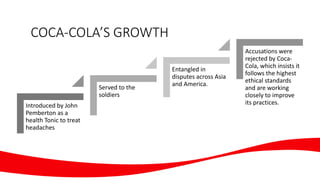
COCA-COLA’S GROWTH
Introduced by John
Pemberton as a
health Tonic to treat
headaches
Served to the
soldiers
Entangled in
disputes across Asia
and America.
Accusations were
rejected by Coca-
Cola, which insists it
follows the highest
ethical standards
and are working
closely to improve
its practices.
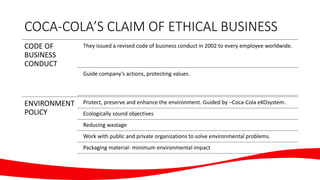
CODE OF
BUSINESS
CONDUCT
They issued a revised code of business conduct in 2002 to every employee worldwide.
Guide company’s actions, protecting values.
ENVIRONMENT
POLICY
Protect, preserve and enhance the environment. Guided by –Coca-Cola eKOsystem.
Ecologically sound objectives
Reducing wastage
Work with public and private organizations to solve environmental problems.
Packaging material- minimum environmental impact
COCA-COLA’S CLAIM OF ETHICAL BUSINESS
Supplier guiding principles
Built on the
Compliance od
Perfection
Workplace
practices
Communication
Work
Environment
Health and
Safety
Child and forced
labor
Collective
Bargaining
Wages and
benefits
Relationships built
on good corporate
citizenship
Shared values, the
Foundation of
Relationships
COMPLIANCE WITH LAW AND REGULATIONS
CHILD LABOUR
Supplier will not use child labor as defined by local law
FORCED LABOUR
Suppliers will not use forced or compulsory labor
COLLECTIVE BARGAINING
Respect employees right to choose whether to be represented by third
parties and to bargain collectively in accordance with local law
WAGES AND BENEFITS
Wages and benefits will comply with local laws
COMPLIANCE WITH LAW AND REGULATIONS( contd..)
WORKING HOURS AND OVERTIME
Working hours and over-time will comply with local law
HEALTH AND SAFETY
Working conditions will comply with local regulations
ENVIRONMENT
Supplier will comply with all applicable environmental laws
ABUSE OF LABOR
Supplier will not physically abuse labor
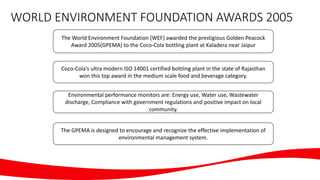
WORLD ENVIRONMENT FOUNDATION AWARDS 2005
The World Environment Foundation (WEF) awarded the prestigious Golden Peacock
Award 2005(GPEMA) to the Coco-Cola bottling plant at Kaladera near Jaipur
Coco-Cola’s ultra modern ISO 14001 certified bottling plant in the state of Rajasthan
won this top award in the medium scale food and beverage category.
Environmental performance monitors are: Energy use, Water use, Wastewater
discharge, Compliance with government regulations and positive impact on local
community.
The GPEMA is designed to encourage and recognize the effective implementation of
environmental management system.
COCA-COLA’S UNETHICAL PRACTICES
Lack of Transparency
and Accountability
Lack of Ethics In
Marketing
Offering products against
the broader interests of
the society
Discriminatory Prices
Making Tall
Claims in
Advertising
Targeting inappropriate
audience such as children
who are gullible and quick
to develop brand loyalty.
Unhealthy Nature of
Colas
Unhealthy Practices
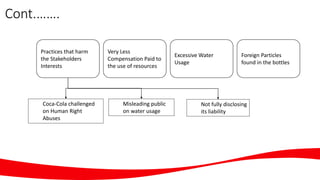
Cont.…….
Practices that harm
the Stakeholders
Interests
Foreign Particles
found in the bottles
Excessive Water
Usage
Very Less
Compensation Paid to
the use of resources
Not fully disclosing
its liability
Misleading public
on water usage
Coca-Cola challenged
on Human Right
Abuses
Pepsico India Holding Private Limited
Pepsico was founded by Don Kendall in 1898.
The company became known as pepsico only after it merged with Frito lay in 1965.
The company sells variety of carbonated and non carbonated beverages.
The company also manufactures Oats, Frito lays and Tropicana.
Pepsico gained entry to india in 1988 by creating a joint venture with the punjab government
owned punjab Agro industrial corporation and voltas india limited.
11
Pesticides Controversy 2003
• In 2003, the centre for science and Environment(CSE), an NGO in New
Delhi,contended that persico and coca cola ,contained toxins
including lindane, DDT, malathion.
• CSE found that pepsi soft drink product had 36 times the level of
pesticide while coca cola has 30 times.
• Coca cola and pepsico angrily denied this.
12
Pesticides Controversy 2006
• Coca cola and Pepsi have continued to sell soft drinks in india with
high levels of pesticides.
• CSE tested 57 samples of coca cola and pepsico carbonated products
from 25 different bottling plants across 12 states and found pesticides
in all samples.
13
Cola Companies Defence
• The companies refused CSE studies as unscientific and biased.
• The cola majors argue that pesticides in other foodstuff like tea and
milk are 20000 times the permissible levels.
• Coca cola has got a clean chit from the Energy and Resource Institute
that they did not find pesticides in the water used for making soft
drinks.
14
Battle Continues……….
• Coca-cola and PepsiCo came together to refuse and reject the
findings of CSE, claiming it to be unscientific and discriminatory.
• ISDMA later confirmed that the soft drinks manufacturers strictly
maintained all the norms.
• American ambassador to India has cautioned that the bad reports
would affect the American investments in India.
• US government started withholding licenses to Indian banks.
• Some newspapers and journals argued about the absence of clear
direction from the Ministry of Health.
• Purity of water, sugar and other ingredients those are locally
manufactured cannot impose strict rules.
• They said that milk, coffee, tea, fruits and vegetables contains
impermissible pesticides. And nobody raises voice against them.
• But they “witch-hunt” American companies.
• As the result, there was 20-21% drop in sales.
• But later, an expert committee reviewed the CSE report and rejected
it on its face value and data provided.
Conclusion
• Cola controversy has surfaced that soft drinks contains pesticides.
• NGOs demanded ban. Banned their sale in educational institutions.
• Kerala government banned production and sale. (Though later turned
down as illegal by court)
• But the indiscriminate use of pesticides and fertilizers in cereals,
veggies and fruits contaminates it.
• Fruits are artificially coloured to improve sales.
• Governments and bureaucrats have failed miserably in their duty of
safeguarding public health.
Thank You!

The Cola Conundrum

  • 1.
  • 2.
    COCA - COLA Countryof origin: United States Introduced 133 years ago. Came to India in 1993 for the second time (liberalization) Captured 66% market share Employs 6000 people ; indirectly- 125,000
  • 3.
    COCA-COLA’S GROWTH Introduced byJohn Pemberton as a health Tonic to treat headaches Served to the soldiers Entangled in disputes across Asia and America. Accusations were rejected by Coca- Cola, which insists it follows the highest ethical standards and are working closely to improve its practices.
  • 4.
    CODE OF BUSINESS CONDUCT They issueda revised code of business conduct in 2002 to every employee worldwide. Guide company’s actions, protecting values. ENVIRONMENT POLICY Protect, preserve and enhance the environment. Guided by –Coca-Cola eKOsystem. Ecologically sound objectives Reducing wastage Work with public and private organizations to solve environmental problems. Packaging material- minimum environmental impact COCA-COLA’S CLAIM OF ETHICAL BUSINESS
  • 5.
    Supplier guiding principles Builton the Compliance od Perfection Workplace practices Communication Work Environment Health and Safety Child and forced labor Collective Bargaining Wages and benefits Relationships built on good corporate citizenship Shared values, the Foundation of Relationships
  • 6.
    COMPLIANCE WITH LAWAND REGULATIONS CHILD LABOUR Supplier will not use child labor as defined by local law FORCED LABOUR Suppliers will not use forced or compulsory labor COLLECTIVE BARGAINING Respect employees right to choose whether to be represented by third parties and to bargain collectively in accordance with local law WAGES AND BENEFITS Wages and benefits will comply with local laws
  • 7.
    COMPLIANCE WITH LAWAND REGULATIONS( contd..) WORKING HOURS AND OVERTIME Working hours and over-time will comply with local law HEALTH AND SAFETY Working conditions will comply with local regulations ENVIRONMENT Supplier will comply with all applicable environmental laws ABUSE OF LABOR Supplier will not physically abuse labor
  • 8.
    WORLD ENVIRONMENT FOUNDATIONAWARDS 2005 The World Environment Foundation (WEF) awarded the prestigious Golden Peacock Award 2005(GPEMA) to the Coco-Cola bottling plant at Kaladera near Jaipur Coco-Cola’s ultra modern ISO 14001 certified bottling plant in the state of Rajasthan won this top award in the medium scale food and beverage category. Environmental performance monitors are: Energy use, Water use, Wastewater discharge, Compliance with government regulations and positive impact on local community. The GPEMA is designed to encourage and recognize the effective implementation of environmental management system.
  • 9.
    COCA-COLA’S UNETHICAL PRACTICES Lackof Transparency and Accountability Lack of Ethics In Marketing Offering products against the broader interests of the society Discriminatory Prices Making Tall Claims in Advertising Targeting inappropriate audience such as children who are gullible and quick to develop brand loyalty. Unhealthy Nature of Colas Unhealthy Practices
  • 10.
    Cont.……. Practices that harm theStakeholders Interests Foreign Particles found in the bottles Excessive Water Usage Very Less Compensation Paid to the use of resources Not fully disclosing its liability Misleading public on water usage Coca-Cola challenged on Human Right Abuses
  • 11.
    Pepsico India HoldingPrivate Limited Pepsico was founded by Don Kendall in 1898. The company became known as pepsico only after it merged with Frito lay in 1965. The company sells variety of carbonated and non carbonated beverages. The company also manufactures Oats, Frito lays and Tropicana. Pepsico gained entry to india in 1988 by creating a joint venture with the punjab government owned punjab Agro industrial corporation and voltas india limited. 11
  • 12.
    Pesticides Controversy 2003 •In 2003, the centre for science and Environment(CSE), an NGO in New Delhi,contended that persico and coca cola ,contained toxins including lindane, DDT, malathion. • CSE found that pepsi soft drink product had 36 times the level of pesticide while coca cola has 30 times. • Coca cola and pepsico angrily denied this. 12
  • 13.
    Pesticides Controversy 2006 •Coca cola and Pepsi have continued to sell soft drinks in india with high levels of pesticides. • CSE tested 57 samples of coca cola and pepsico carbonated products from 25 different bottling plants across 12 states and found pesticides in all samples. 13
  • 14.
    Cola Companies Defence •The companies refused CSE studies as unscientific and biased. • The cola majors argue that pesticides in other foodstuff like tea and milk are 20000 times the permissible levels. • Coca cola has got a clean chit from the Energy and Resource Institute that they did not find pesticides in the water used for making soft drinks. 14
  • 15.
    Battle Continues………. • Coca-colaand PepsiCo came together to refuse and reject the findings of CSE, claiming it to be unscientific and discriminatory. • ISDMA later confirmed that the soft drinks manufacturers strictly maintained all the norms. • American ambassador to India has cautioned that the bad reports would affect the American investments in India. • US government started withholding licenses to Indian banks. • Some newspapers and journals argued about the absence of clear direction from the Ministry of Health.
  • 16.
    • Purity ofwater, sugar and other ingredients those are locally manufactured cannot impose strict rules. • They said that milk, coffee, tea, fruits and vegetables contains impermissible pesticides. And nobody raises voice against them. • But they “witch-hunt” American companies. • As the result, there was 20-21% drop in sales. • But later, an expert committee reviewed the CSE report and rejected it on its face value and data provided.
  • 17.
    Conclusion • Cola controversyhas surfaced that soft drinks contains pesticides. • NGOs demanded ban. Banned their sale in educational institutions. • Kerala government banned production and sale. (Though later turned down as illegal by court) • But the indiscriminate use of pesticides and fertilizers in cereals, veggies and fruits contaminates it. • Fruits are artificially coloured to improve sales. • Governments and bureaucrats have failed miserably in their duty of safeguarding public health.
  • 18.