The industry
• Netflix belongs to the over-the-top (OTT) media industry which is a
subset of the media and entertainment industry
• An over-the-top (OTT) media service is a streaming media service
offered directly to viewers via the Internet
• The OTT industry came into being globally on 5th September 1995,
when ESPN SportsZone broadcasted a live baseball game and
marked the world’s first live streaming event
• Since then, the OTT industry has made remarkable progress in terms
of quality, functionality and value
• It made an entry into India in 2008 with the first OTT platform –
BIGFlix, by Reliance Entertainment
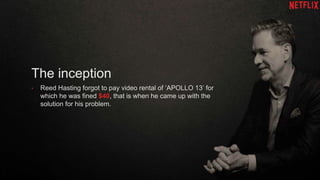
The inception
• Reed Hasting forgot to pay video rental of ‘APOLLO 13’ for
which he was fined $40, that is when he came up with the
solution for his problem.
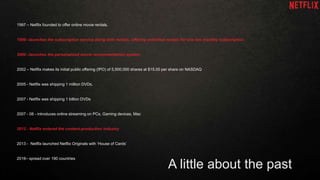
A little about the past
1997 – Netflix founded to offer online movie rentals.
1999 –launches the subscription service along with rentals, offering unlimited rentals for one low monthly subscription.
2000 –launches the personalized movie recommendation system
2002 – Netflix makes its initial public offering (IPO) of 5,500,000 shares at $15.00 per share on NASDAQ
2005 - Netflix was shipping 1 million DVDs.
2007 - Netflix was shipping 1 billion DVDs
2007 - 08 - introduces online streaming on PCs, Gaming devices, Mac
2012 - Netflix entered the content-production industry
2013 - Netflix launched Netflix Originals with ‘House of Cards’
2016– spread over 190 countries
Service
USP
The biggest online streaming
subscription based service in the world
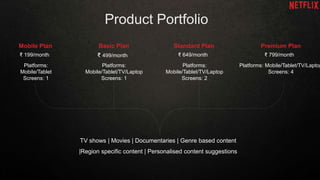
Product Portfolio
Basic Plan Standard Plan Premium PlanMobile Plan
₹ 499/month ₹ 649/month ₹ 799/month₹ 199/month
Platforms:
Mobile/Tablet/TV/Laptop
Screens: 1
Platforms:
Mobile/Tablet/TV/Laptop
Screens: 2
Platforms:
Mobile/Tablet
Screens: 1
Platforms: Mobile/Tablet/TV/Laptop
Screens: 4
TV shows | Movies | Documentaries | Genre based content
|Region specific content | Personalised content suggestions
Business Strategy
• Offer something exclusive
• Move with the times
• Mine Audience Data for Content Marketing
• Create Original Content
• Benefit from the Bingeing Bonanza
• Present a Consistent Brand Identity
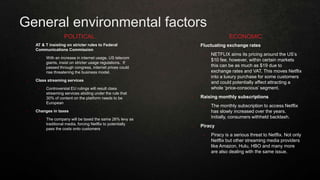
General environmental factors
• AT & T insisting on stricter rules to Federal
Communications Commission
• With an increase in internet usage, US telecom
giants, insist on stricter usage regulations. If
passed through congress, internet prices could
rise threatening the business model.
• Class streaming services
• Controversial EU rulings will result class
streaming services abiding under the rule that
30% of content on the platform needs to be
European
• Changes in taxes
• The company will be taxed the same 26% levy as
traditional media, forcing Netflix to potentially
pass the costs onto customers
POLITICAL
• Fluctuating exchange rates
• NETFLIX aims its pricing around the US’s
$10 fee, however, within certain markets
this can be as much as $19 due to
exchange rates and VAT. This moves Netflix
into a luxury purchase for some customers
and could potentially affect attracting a
whole ‘price-conscious’ segment.
• Raising monthly subscriptions
• The monthly subscription to access Netflix
has slowly increased over the years.
Initially, consumers withheld backlash.
• Piracy
• Piracy is a serious threat to Netflix. Not only
Netflix but other streaming media providers
like Amazon, Hulu, HBO and many more
are also dealing with the same issue.
ECONOMIC
• Busy work schedules
• Social trends are showing that many
customers are moving to watch video
content on their smartphones rather than
traditional larger screens. This trend
shows a demand for content on the move
to fit into customers busy lives.
• Switch from traditional cable media
• Cord-Cutting’ in the US is the act of
customers switching from traditional cable
media to online streaming services. In
2018, US Cable companies saw the
steepest loss with 2.4% on record
switching.
• Regional Sensitivity
• Cultural and regional sensitivities need to
be taken care of during publishing content
SOCIAL
• High-quality content and videos
• Netflix uses a specific system to compress
videos without sacrificing quality. It reduces the
amount of data you need to watch the video. And
for anyone with a monthly or mobile data limit, this
feature is much appreciated.
• UI changes
• Netflix’s shift in UI and algorithms confuses their
customers. Recently, they changed the content
voting system. Basically, how you tell Netflix you
liked or didn’t like their content. Initially, the rating
system was a one to five-star system. Now, it’s a
thumbs up or down system
•
• Data usage
• The technological shift to 4K screen resolutions
have created an issue for streaming services. The
amount of data required to stream is a huge strain
on customers broadband services. Within ‘Netflix
Labs’, the company is aiming to create new
patented technology which will allow for better
compression of their 4K signal
TECHNOLOGICAL
• Currently rated ‘D’ for its carbon footprint
• An independent energy group for their lack
of commitment to offset its carbon
footprint.
• Have to pay if carbon footprints not reduced
• At current usage rate tech companies are
being told by global governments to pay
part of an environmental bill worth
upwards of $11 trillion by 2025.
ENVIRONTMENTAL
• PR misstep over a consumer lawsuit
• At the start of the year the company
announced it would be raising subscription
prices, however it was not clear over how
current users would be affected. As a result,
Netflix was issued a class-action lawsuit
from customers.
• Copyrights on the basis of country-wise
content
• To meet growing demands from televisions
and film studios over copyright access to
content. They introduced blocking
workarounds for users who access content
from other countries.
LEGAL
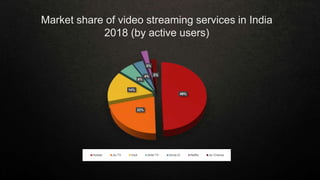
Market share of video streaming services in India
2018 (by active users)
49%
22%
14%
6%
4%
3%
2%
Hotstar Jio TV Voot Airtel TV SonyLIV Netflix Jio Cinema
Competitors
Hotstar
Hotstar is star group's initiative, thus most of the content it provides free is its own. For the content acquired commercially like HBO originals
it is charging users premium. Any television or internet content provider earns by advertisements and affiliation, which is true in Hotstar's
case as well. Thus it is more or less simple business model where it spends on commercial acquisition and content development and earns
by advertisements, affiliations and charging premium to customers.
Hulu
Hulu is a subscription service which specializes in video-on-demand services a joint venture between different entertainment giants like Walt
Disney, Time Warner and 21st Century Fox. Hulu launched its streaming service where Hulu and its sponsors generate revenues that rely
upon what number of views the content gets.
HBO Now
HBO’s only advantage is its large library of original shows. HBO is achieving high profits through a strategy based on differentiation and a
business network built on more than 40 years in operation.
Amazon Prime Videos
Part of the prime membership fee goes to pay for prime video. By adding video streaming to prime services, Amazon get more people to
shop more on Amazon.com. By offering free content the increase the probability of people using Amazon prime video to buy paid movies
and TV shows instead of other places.
YouTube
The actual product that YouTube sells is its users. The company pulls over 1.8 billion users every month. This is an
advertisement-based business model. Youtube Premium offers certain exclusive benefits to the subscribers by charging
a nominal amount for the membership.
Growth and Profitability
• Hotstar is the most subscribed-to OTT platform in India, owned by Star India as of 2018, with around 150 million active users and
over 350 million downloads
• American streaming service Netflix entered India in January 2016. It earned a net profit of ₹2020,000 (₹2.02 million) for fiscal year
2017. In fiscal year 2018, Netflix earned revenues of ₹580 million.
• There are currently about 40 OTT services in India
• In fiscal year 2018, the OTT market in India was worth ₹2,150 crore and its value grew to ₹35 billion in 2019.
• The average time spent by Indian subscribers on various OTT platforms is 30–50 minutes (KPMG)
• The Indian OTT market is expected to grow 45 percent to reach ₹138 billion by the end of fiscal 2023 (KPMG)
• India will become the second-biggest market after U.S.A in 2020 (EY)
• Revenues are expected to reach $158.84 bn by 2024, more than double generated in 2018.
• Revenues have grown exponentially from 6.1 billion U.S. dollars in 2010 to over ten times that amount in 2018.
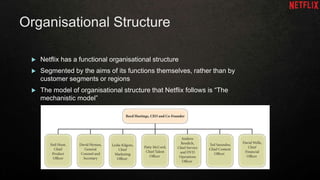
Organisational Structure
 Netflix has a functional organisational structure
 Segmented by the aims of its functions themselves, rather than by
customer segments or regions
 The model of organisational structure that Netflix follows is “The
mechanistic model”
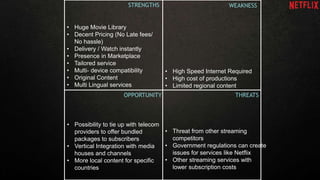
• Huge Movie Library
• Decent Pricing (No Late fees/
No hassle)
• Delivery / Watch instantly
• Presence in Marketplace
• Tailored service
• Multi- device compatibility
• Original Content
• Multi Lingual services
STRENGTHS WEAKNESS
THREATSOPPORTUNITY
• High Speed Internet Required
• High cost of productions
• Limited regional content
• Threat from other streaming
competitors
• Government regulations can create
issues for services like Netflix
• Other streaming services with
lower subscription costs
• Possibility to tie up with telecom
providers to offer bundled
packages to subscribers
• Vertical Integration with media
houses and channels
• More local content for specific
countries
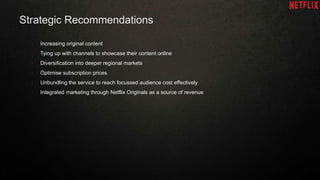
Strategic Recommendations
• Increasing original content
• Tying up with channels to showcase their content online
• Diversification into deeper regional markets
• Optimise subscription prices
• Unbundling the service to reach focussed audience cost effectively
• Integrated marketing through Netflix Originals as a source of revenue

Netflix power point

  • 2.
    The industry • Netflixbelongs to the over-the-top (OTT) media industry which is a subset of the media and entertainment industry • An over-the-top (OTT) media service is a streaming media service offered directly to viewers via the Internet • The OTT industry came into being globally on 5th September 1995, when ESPN SportsZone broadcasted a live baseball game and marked the world’s first live streaming event • Since then, the OTT industry has made remarkable progress in terms of quality, functionality and value • It made an entry into India in 2008 with the first OTT platform – BIGFlix, by Reliance Entertainment
  • 3.
    The inception • ReedHasting forgot to pay video rental of ‘APOLLO 13’ for which he was fined $40, that is when he came up with the solution for his problem.
  • 4.
    A little aboutthe past 1997 – Netflix founded to offer online movie rentals. 1999 –launches the subscription service along with rentals, offering unlimited rentals for one low monthly subscription. 2000 –launches the personalized movie recommendation system 2002 – Netflix makes its initial public offering (IPO) of 5,500,000 shares at $15.00 per share on NASDAQ 2005 - Netflix was shipping 1 million DVDs. 2007 - Netflix was shipping 1 billion DVDs 2007 - 08 - introduces online streaming on PCs, Gaming devices, Mac 2012 - Netflix entered the content-production industry 2013 - Netflix launched Netflix Originals with ‘House of Cards’ 2016– spread over 190 countries
  • 5.
    Service USP The biggest onlinestreaming subscription based service in the world
  • 6.
    Product Portfolio Basic PlanStandard Plan Premium PlanMobile Plan ₹ 499/month ₹ 649/month ₹ 799/month₹ 199/month Platforms: Mobile/Tablet/TV/Laptop Screens: 1 Platforms: Mobile/Tablet/TV/Laptop Screens: 2 Platforms: Mobile/Tablet Screens: 1 Platforms: Mobile/Tablet/TV/Laptop Screens: 4 TV shows | Movies | Documentaries | Genre based content |Region specific content | Personalised content suggestions
  • 7.
    Business Strategy • Offersomething exclusive • Move with the times • Mine Audience Data for Content Marketing • Create Original Content • Benefit from the Bingeing Bonanza • Present a Consistent Brand Identity
  • 8.
    General environmental factors •AT & T insisting on stricter rules to Federal Communications Commission • With an increase in internet usage, US telecom giants, insist on stricter usage regulations. If passed through congress, internet prices could rise threatening the business model. • Class streaming services • Controversial EU rulings will result class streaming services abiding under the rule that 30% of content on the platform needs to be European • Changes in taxes • The company will be taxed the same 26% levy as traditional media, forcing Netflix to potentially pass the costs onto customers POLITICAL • Fluctuating exchange rates • NETFLIX aims its pricing around the US’s $10 fee, however, within certain markets this can be as much as $19 due to exchange rates and VAT. This moves Netflix into a luxury purchase for some customers and could potentially affect attracting a whole ‘price-conscious’ segment. • Raising monthly subscriptions • The monthly subscription to access Netflix has slowly increased over the years. Initially, consumers withheld backlash. • Piracy • Piracy is a serious threat to Netflix. Not only Netflix but other streaming media providers like Amazon, Hulu, HBO and many more are also dealing with the same issue. ECONOMIC
  • 9.
    • Busy workschedules • Social trends are showing that many customers are moving to watch video content on their smartphones rather than traditional larger screens. This trend shows a demand for content on the move to fit into customers busy lives. • Switch from traditional cable media • Cord-Cutting’ in the US is the act of customers switching from traditional cable media to online streaming services. In 2018, US Cable companies saw the steepest loss with 2.4% on record switching. • Regional Sensitivity • Cultural and regional sensitivities need to be taken care of during publishing content SOCIAL • High-quality content and videos • Netflix uses a specific system to compress videos without sacrificing quality. It reduces the amount of data you need to watch the video. And for anyone with a monthly or mobile data limit, this feature is much appreciated. • UI changes • Netflix’s shift in UI and algorithms confuses their customers. Recently, they changed the content voting system. Basically, how you tell Netflix you liked or didn’t like their content. Initially, the rating system was a one to five-star system. Now, it’s a thumbs up or down system • • Data usage • The technological shift to 4K screen resolutions have created an issue for streaming services. The amount of data required to stream is a huge strain on customers broadband services. Within ‘Netflix Labs’, the company is aiming to create new patented technology which will allow for better compression of their 4K signal TECHNOLOGICAL
  • 10.
    • Currently rated‘D’ for its carbon footprint • An independent energy group for their lack of commitment to offset its carbon footprint. • Have to pay if carbon footprints not reduced • At current usage rate tech companies are being told by global governments to pay part of an environmental bill worth upwards of $11 trillion by 2025. ENVIRONTMENTAL • PR misstep over a consumer lawsuit • At the start of the year the company announced it would be raising subscription prices, however it was not clear over how current users would be affected. As a result, Netflix was issued a class-action lawsuit from customers. • Copyrights on the basis of country-wise content • To meet growing demands from televisions and film studios over copyright access to content. They introduced blocking workarounds for users who access content from other countries. LEGAL
  • 11.
    Market share ofvideo streaming services in India 2018 (by active users) 49% 22% 14% 6% 4% 3% 2% Hotstar Jio TV Voot Airtel TV SonyLIV Netflix Jio Cinema
  • 12.
    Competitors Hotstar Hotstar is stargroup's initiative, thus most of the content it provides free is its own. For the content acquired commercially like HBO originals it is charging users premium. Any television or internet content provider earns by advertisements and affiliation, which is true in Hotstar's case as well. Thus it is more or less simple business model where it spends on commercial acquisition and content development and earns by advertisements, affiliations and charging premium to customers. Hulu Hulu is a subscription service which specializes in video-on-demand services a joint venture between different entertainment giants like Walt Disney, Time Warner and 21st Century Fox. Hulu launched its streaming service where Hulu and its sponsors generate revenues that rely upon what number of views the content gets. HBO Now HBO’s only advantage is its large library of original shows. HBO is achieving high profits through a strategy based on differentiation and a business network built on more than 40 years in operation. Amazon Prime Videos Part of the prime membership fee goes to pay for prime video. By adding video streaming to prime services, Amazon get more people to shop more on Amazon.com. By offering free content the increase the probability of people using Amazon prime video to buy paid movies and TV shows instead of other places. YouTube The actual product that YouTube sells is its users. The company pulls over 1.8 billion users every month. This is an advertisement-based business model. Youtube Premium offers certain exclusive benefits to the subscribers by charging a nominal amount for the membership.
  • 13.
    Growth and Profitability •Hotstar is the most subscribed-to OTT platform in India, owned by Star India as of 2018, with around 150 million active users and over 350 million downloads • American streaming service Netflix entered India in January 2016. It earned a net profit of ₹2020,000 (₹2.02 million) for fiscal year 2017. In fiscal year 2018, Netflix earned revenues of ₹580 million. • There are currently about 40 OTT services in India • In fiscal year 2018, the OTT market in India was worth ₹2,150 crore and its value grew to ₹35 billion in 2019. • The average time spent by Indian subscribers on various OTT platforms is 30–50 minutes (KPMG) • The Indian OTT market is expected to grow 45 percent to reach ₹138 billion by the end of fiscal 2023 (KPMG) • India will become the second-biggest market after U.S.A in 2020 (EY) • Revenues are expected to reach $158.84 bn by 2024, more than double generated in 2018. • Revenues have grown exponentially from 6.1 billion U.S. dollars in 2010 to over ten times that amount in 2018.
  • 14.
    Organisational Structure  Netflixhas a functional organisational structure  Segmented by the aims of its functions themselves, rather than by customer segments or regions  The model of organisational structure that Netflix follows is “The mechanistic model”
  • 15.
    • Huge MovieLibrary • Decent Pricing (No Late fees/ No hassle) • Delivery / Watch instantly • Presence in Marketplace • Tailored service • Multi- device compatibility • Original Content • Multi Lingual services STRENGTHS WEAKNESS THREATSOPPORTUNITY • High Speed Internet Required • High cost of productions • Limited regional content • Threat from other streaming competitors • Government regulations can create issues for services like Netflix • Other streaming services with lower subscription costs • Possibility to tie up with telecom providers to offer bundled packages to subscribers • Vertical Integration with media houses and channels • More local content for specific countries
  • 16.
    Strategic Recommendations • Increasingoriginal content • Tying up with channels to showcase their content online • Diversification into deeper regional markets • Optimise subscription prices • Unbundling the service to reach focussed audience cost effectively • Integrated marketing through Netflix Originals as a source of revenue