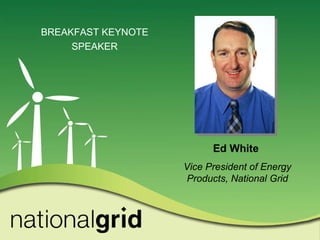
Ed White  Vice President of Energy Products, National Grid BREAKFAST KEYNOTE  SPEAKER
 
PANEL #1 Conservation & Energy Efficiency Programs
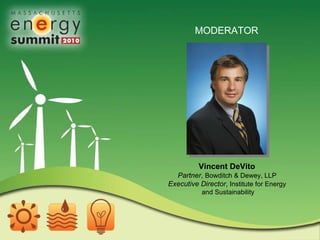
Vincent DeVito  Partner ,  Bowditch & Dewey, LLP  Executive Director ,  Institute for Energy  and Sustainability MODERATOR
Vincent DeVito [email_address] (617) 757-6518 Thursday, October 7, 2010 Federal and State Renewable Project Incentives Opportunities:  Improving Operations and  Decreasing Costs.
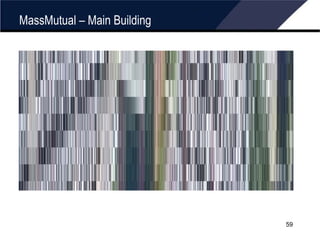
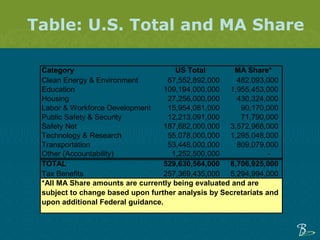
Table: U.S. Total and MA Share
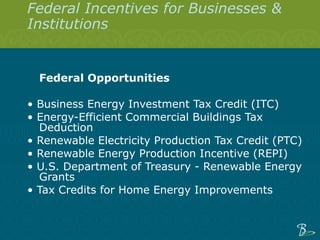
Federal Incentives for Businesses & Institutions  Federal Opportunities    •  Business Energy Investment Tax Credit (ITC)  •  Energy-Efficient Commercial Buildings Tax Deduction  •  Renewable Electricity Production Tax Credit (PTC) •  Renewable Energy Production Incentive (REPI) •  U.S. Department of Treasury - Renewable Energy Grants  •  Tax Credits for Home Energy Improvements   
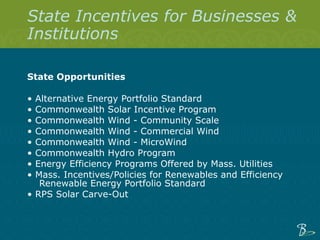
State Incentives for Businesses & Institutions State Opportunities  •  Alternative Energy Portfolio Standard  •  Commonwealth Solar Incentive Program   •  Commonwealth Wind - Community Scale   •  Commonwealth Wind - Commercial Wind  •  Commonwealth Wind - MicroWind   •  Commonwealth Hydro Program   •  Energy Efficiency Programs Offered by Mass. Utilities  •  Mass. Incentives/Policies for Renewables and Efficiency Renewable Energy Portfolio Standard  •  RPS Solar Carve-Out 
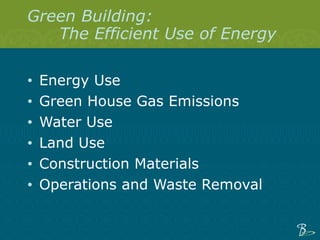
Green Building:  The Efficient Use of Energy Energy Use Green House Gas Emissions Water Use Land Use Construction Materials Operations and Waste Removal
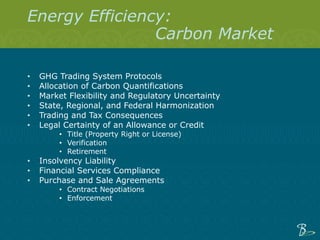
Energy Efficiency: Carbon Market GHG Trading System Protocols  Allocation of Carbon Quantifications Market Flexibility and Regulatory Uncertainty  State, Regional, and Federal Harmonization Trading and Tax Consequences Legal Certainty of an Allowance or Credit Title (Property Right or License) Verification Retirement Insolvency Liability Financial Services Compliance Purchase and Sale Agreements Contract Negotiations Enforcement
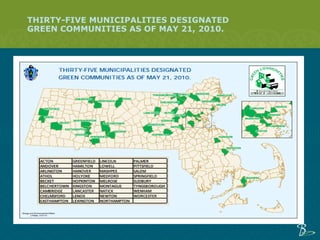
THIRTY-FIVE MUNICIPALITIES DESIGNATED GREEN COMMUNITIES AS OF MAY 21, 2010.
Vincent DeVito [email_address] (617) 757-6518 Thursday, October 7, 2010 Synopsis of Renewable Energy and Energy Efficiency Laws, Programs and Policies Enacted and Implemented in Massachusetts: 2008-2010:  June 16, 2010
Carolyn Sarno  Senior Program Manager for High Performance Buildings   Northeast Energy Efficiency Partnerships (NEEP)
MASS ENERGY SUMMIT  CONSERVATION & ENERGY EFFICIENCY INTEGRATING THE BENEFITS INTO SUPPLY STRATEGY CAROLYN SARNO  October 7,  2010
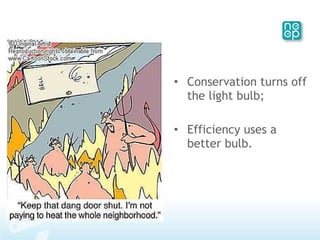
Conservation turns off the light bulb; Efficiency uses a better bulb. Definitions
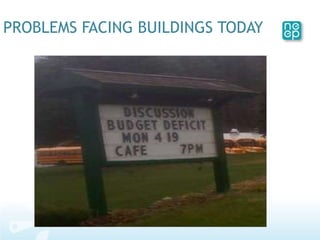
PROBLEMS FACING BUILDINGS TODAY
Track Utility Bills Can’t manage what you haven’t measured Understand how to read the bill Use for utility procurement and budget forecasting Typically yields a  10% utility  savings ENERGY MANAGEMENT
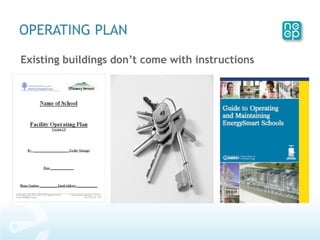
Existing buildings don’t come with instructions OPERATING PLAN
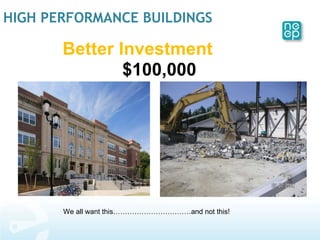
HIGH PERFORMANCE BUILDINGS Better Investment   We all want this……………………………and not this! $100,000
Additional Resources Department of Energy O & M Best Practices  http://www1.eere.energy.gov/femp/program/operations_maintenance.html DSIRE – Database of State Incentives:  http://www.dsireusa.org/ Energy Star:  http://www.energystar.gov/ Energy Smart Schools Guide to O & M  http://www1.eere.energy.gov/buildings/energysmartschools/o-and-m_guide.html EPA LBE Guide  http://www.epa.gov/cleanenergy/documents/epa_lbe.pdf Facilities Operating Plan  http://www.vtvsa.org/files/Facility%20Operating%20Plan%20Template%20Version%201.0.doc Solutions Center http://www1.eere.energy.gov/wip/solutioncenter/default.html Northeast Energy Efficiency Partnerships:  www.neep.org Your local utility & energy efficiency program providers RESOURCES
Rick Mitchell  Vice President   Sustainnovation Consulting
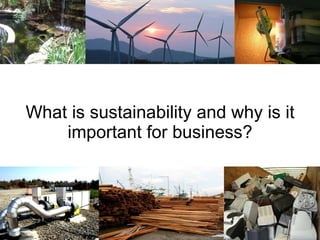
What is sustainability and why is it important for business?
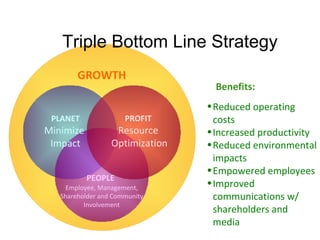
Triple Bottom Line Strategy Reduced operating costs Increased productivity Reduced environmental impacts Empowered employees Improved communications w/ shareholders and media PROFIT Resource Optimization PLANET Minimize  Impact PEOPLE   Employee, Management, Shareholder and Community Involvement GROWTH Benefits:
 
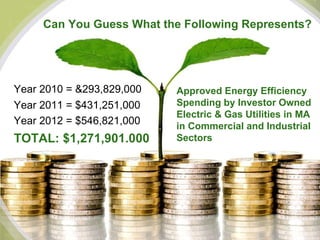
Can You Guess What the Following Represents? Year 2010 = &293,829,000 Year 2011 = $431,251,000 Year 2012 = $546,821,000 TOTAL: $1,271,901.000 Approved Energy Efficiency Spending by Investor Owned Electric & Gas Utilities in MA in Commercial and Industrial Sectors
Sustainnovation Consulting Matching Sustainability with Profit www.meridianassoc.com 978-299-0447 X240
Cynthia Arcate  President & CEO   Power Options, Inc.
2010 Massachusetts Energy Summit  Conservation & Energy Efficiency Integrating the Benefits into Supply Strategy October 7, 2010 Cynthia Arcate, President & CEO PowerOptions Leveraging the power of non-profits
Energy Savings are Not All the Same Kw v. kWhs Peak v. Non-peak Impact on ICAP tags and customer profiles Usage reflected in price Basic service v. competitive supply
Contract Terms Affect Price Different pricing options:  Fixed all-in Capacity pass through Wholesale energy market Change in Use: Bandwidth Notice Penalties
 
PANEL #2 Going Green — Innovative Energy Savings Projects
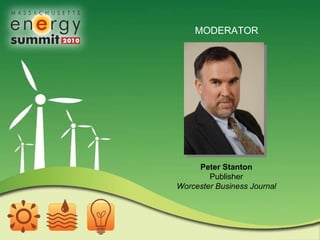
MODERATOR Peter Stanton Publisher Worcester Business Journal
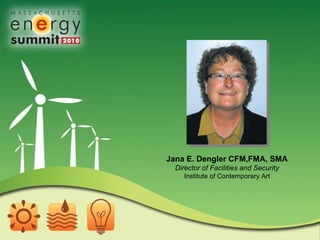
Jana E. Dengler CFM,FMA, SMA  Director of Facilities and Security   Institute of Contemporary Art
Sustainable Facilities Management Initiatives at the Institute of Contemporary Art Boston Jana E Dengler CFM, RPA, FMA, SMA Director of Facilities and Security
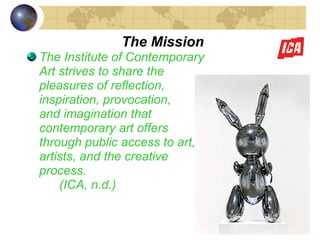
The Mission The Institute of Contemporary  Art strives to share the  pleasures of reflection,  inspiration, provocation, and imagination that  contemporary art offers  through public access to art,  artists, and the creative  process. (ICA, n.d.)
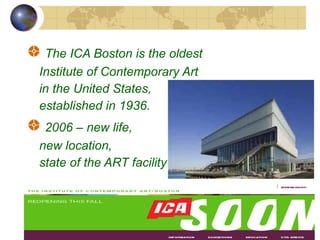
The ICA Boston is the oldest  Institute of Contemporary Art  in the United States,  established in 1936. 2006 – new life,  new location,  state of the ART facility
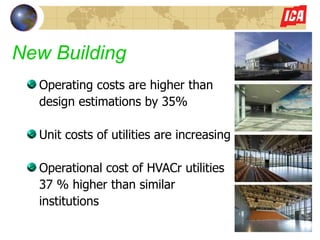
New Building   Operating costs are higher than  design estimations by 35% Unit costs of utilities are increasing  Operational cost of HVACr utilities  37 % higher than similar  institutions
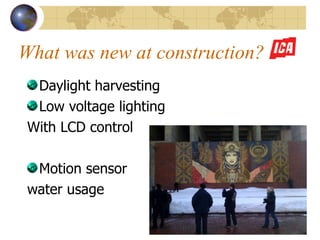
What was new at construction? Daylight harvesting Low voltage lighting With LCD control Motion sensor  water usage
Sustainable  Initiatives   Partnering with Power Options Partnership with Lutron  3M  UV film  Partnership with  Siemens  Controls Operational
What was realized 14% saving with conscious procurement 5% savings with lighting sensors 12% saving with  operational initiatives
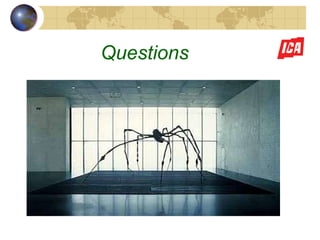
Questions
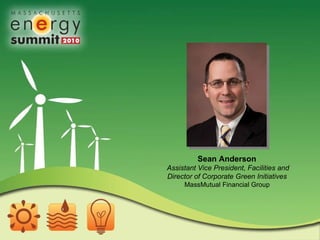
Sean Anderson  Assistant Vice President, Facilities and Director of Corporate Green Initiatives   MassMutual Financial Group
MassMutual Financial Group Sustainability Program From ideas to actions…
Introduction Sean F. Anderson Assistant Vice President – Facility Operations Director of Corporate Green Initiatives About MassMutual Founded in 1851, MassMutual Financial Group is a mutually owned financial protection, accumulation and income management company headquartered in Springfield, MA.  MassMutual's affiliates include Babson Capital, OppenheimerFunds, Baring Asset Management, First Mercantile Trust and Cornerstone Real Estate Advisers.
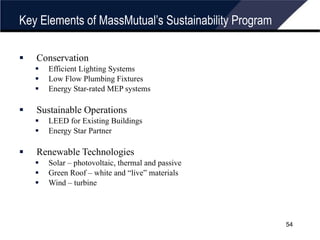
Key Elements of MassMutual’s Sustainability Program Conservation Efficient Lighting Systems Low Flow Plumbing Fixtures Energy Star-rated MEP systems Sustainable Operations LEED for Existing Buildings Energy Star Partner Renewable Technologies Solar – photovoltaic, thermal and passive Green Roof – white and “live” materials Wind – turbine
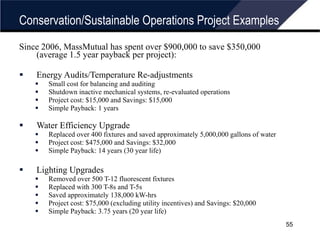
Conservation/Sustainable Operations Project Examples Since 2006, MassMutual has spent over $900,000 to save $350,000 (average 1.5 year payback per project): Energy Audits/Temperature Re-adjustments Small cost for balancing and auditing Shutdown inactive mechanical systems, re-evaluated operations Project cost: $15,000 and Savings: $15,000 Simple Payback: 1 years Water Efficiency Upgrade Replaced over 400 fixtures and saved approximately 5,000,000 gallons of water Project cost: $475,000 and Savings: $32,000 Simple Payback: 14 years (30 year life) Lighting Upgrades Removed over 500 T-12 fluorescent fixtures Replaced with 300 T-8s and T-5s Saved approximately 138,000 kW-hrs Project cost: $75,000 (excluding utility incentives) and Savings: $20,000 Simple Payback: 3.75 years (20 year life)
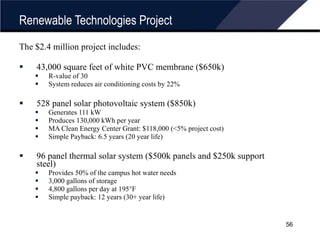
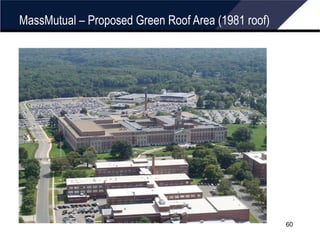
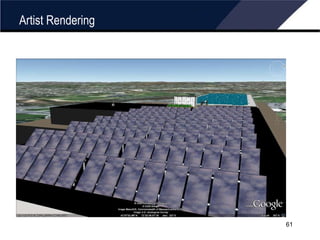
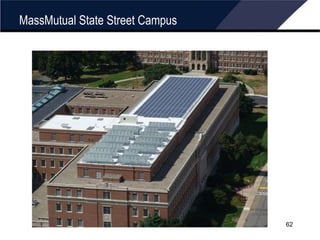
Renewable Technologies Project The $2.4 million project includes: 43,000 square feet of white PVC membrane ($650k) R-value of 30 System reduces air conditioning costs by 22% 528 panel solar photovoltaic system ($850k) Generates 111 kW Produces 130,000 kWh per year MA Clean Energy Center Grant: $118,000 (<5% project cost) Simple Payback: 6.5 years (20 year life) 96 panel thermal solar system ($500k panels and $250k support steel) Provides 50% of the campus hot water needs 3,000 gallons of storage 4,800 gallons per day at 195 °F Simple payback: 12 years (30+ year life)
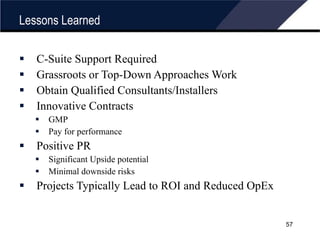
Lessons Learned C-Suite Support Required Grassroots or Top-Down Approaches Work Obtain Qualified Consultants/Installers Innovative Contracts GMP Pay for performance Positive PR Significant Upside potential Minimal downside risks Projects Typically Lead to ROI and Reduced OpEx
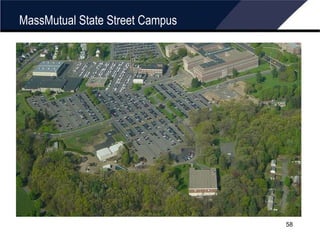
MassMutual State Street Campus
MassMutual – Main Building
MassMutual – Proposed Green Roof Area (1981 roof)
Artist Rendering
MassMutual State Street Campus
Final Thought Start Small or Start Big… Just Start!
© 2010 Massachusetts Mutual Life Insurance Company, Springfield, MA. All rights reserved. www.massmutual.com. MassMutual Financial Group is a marketing name for Massachusetts Mutual Life Insurance Company (MassMutual) and its affiliated companies and sales representatives.
Frank Carlson  President & General Manager   Carlson Orchards


Edward R. Terceiro, Jr.  Resident Engineer   Mount Wachusett Community College
Advancing Carbon Neutrality on Campus  Mount Wachusett Community College Massachusetts Energy Summit 2010 October 7, 2010
Focus of Presentation There is no one clear cut solution to carbon neutrality – every business or institution presents its own challenges and possibilities.  How do you balance operational considerations with your approach to carbon neutrality i.e. demand side management? What are some of the funding options available?
Critical Issues The rising and disproportionate costs of energy in the Northeast The Nation’s continued dependence on foreign oil & its impact on national security The obligation to address the need for increased energy production in consort with environmental protection
MWCC Projects Biomass Conversion Biomass Gasification – Combine Heat & Power Photovoltaics – 100KW Solar Thermal –Domestic Hot Water Energy Conservation Measures (ECMs) Geothermal (Veteran’s Rehabilitation Center) Plug in Hybrid Wind Turbines
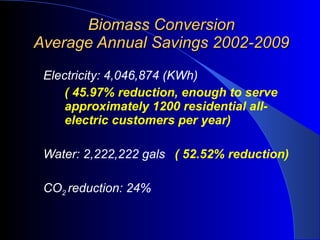
Biomass Conversion Average Annual Savings 2002-2009 Electricity: 4,046,874 (KWh)  ( 45.97% reduction, enough to serve approximately 1200 residential all-electric customers per year) Water: 2,222,222 gals   ( 52.52% reduction) CO 2  reduction:   24%
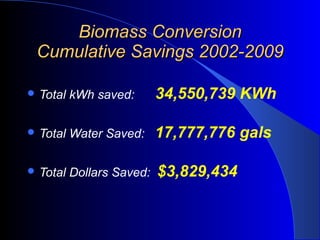
Biomass Conversion Cumulative Savings 2002-2009 Total kWh saved:  34,550,739 KWh Total Water Saved:  17,777,776 gals Total Dollars Saved:  $3,829,434
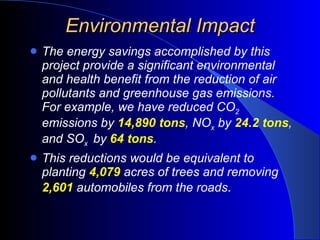
Environmental Impact The energy savings accomplished by this project provide a significant environmental and health benefit from the reduction of air pollutants and greenhouse gas emissions.  For example, we have reduced CO 2  emissions by  14,890 tons , NO x  by  24.2 tons , and SO x  by  64 tons . This reductions would be equivalent to planting  4,079  acres of trees and removing  2,601  automobiles from the roads .
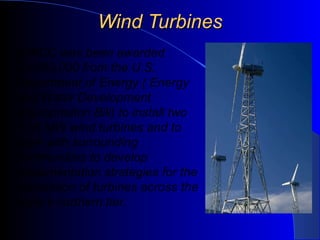
Wind Turbines MWCC was been awarded $3,000,000 from the U.S. Department of Energy ( Energy and Water Development Appropriation Bill) to install two 1.65 MW wind turbines and to work with surrounding communities to develop implementation strategies for the installation of turbines across the state’s northern tier.
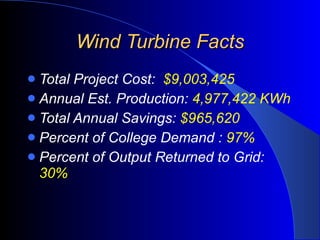
Wind Turbine Facts Total Project Cost:  $9,003,425 Annual Est. Production:  4,977,422 KWh Total Annual Savings:  $965,620 Percent of College Demand :  97% Percent of Output Returned to Grid:  30%
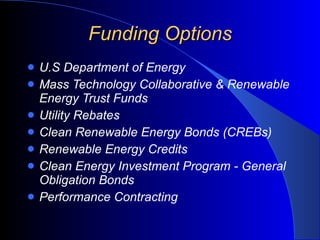
Funding Options U.S Department of Energy Mass Technology Collaborative & Renewable Energy Trust Funds Utility Rebates Clean Renewable Energy Bonds (CREBs) Renewable Energy Credits  Clean Energy Investment Program - General Obligation Bonds Performance Contracting
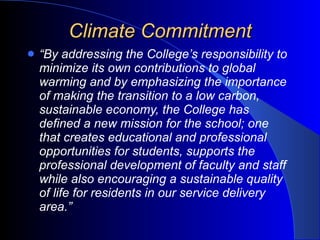
Climate Commitment “ By addressing the College’s responsibility to minimize its own contributions to global warming and by emphasizing the importance of making the transition to a low carbon, sustainable economy, the College has defined a new mission for the school; one that creates educational and professional opportunities for students, supports the professional development of faculty and staff while also encouraging a sustainable quality of life for residents in our service delivery area.”
For Additional Information Ed Terceiro, Resident Engineer, Mount Wachusett Community College  (978-630-9103) [email_address]
 
PANEL #3 Inside the Grid
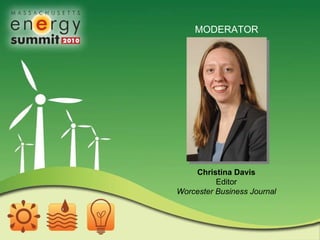
MODERATOR Christina Davis Editor Worcester Business Journal
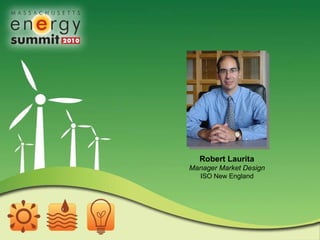
Robert Laurita  Manager Market Design   ISO New England
Robert Sheridan   Director of Distribution Planning   National Grid
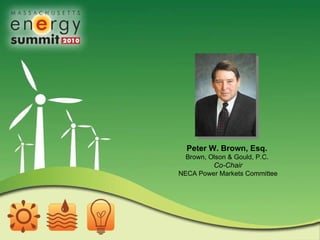
Peter W. Brown, Esq.  Brown, Olson & Gould, P.C.  Co-Chair NECA Power Markets Committee
Robert Laurita Responsibilities include: The design and development of market rules governing the New England wholesale electricity market.  Actively involved in the design and administration of the ISO’s demand response programs and market designs that integrate demand-side resources into the wholesale electricity markets, such as the Forward Capacity Market
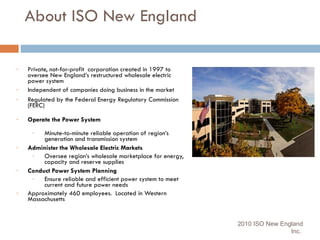
About ISO New England Private, not-for-profit  corporation created in 1997 to oversee New England’s restructured wholesale electric power system  Independent of companies doing business in the market Regulated by the Federal Energy Regulatory Commission (FERC) Operate the Power System Minute-to-minute reliable operation of region’s generation and transmission system Administer the Wholesale Electric Markets  Oversee region’s wholesale marketplace for energy, capacity and reserve supplies Conduct Power System Planning Ensure reliable and efficient power system to meet current and future power needs Approximately 460 employees.  Located in Western Massachusetts 2010 ISO New England Inc.
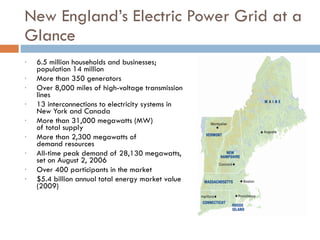
New England’s Electric Power Grid at a Glance 6.5 million households and businesses; population 14 million  More than 350 generators  Over 8,000 miles of high-voltage transmission lines  13 interconnections to electricity systems in New York and Canada  More than 31,000 megawatts (MW)  of total supply  More than 2,300 megawatts of  demand resources All-time peak demand of 28,130 megawatts, set on August 2, 2006  Over 400 participants in the market  $5.4 billion annual total energy market value (2009)
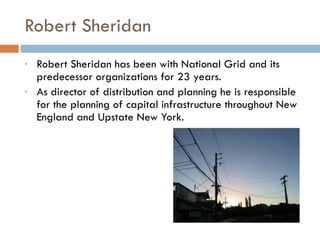
Robert Sheridan Robert Sheridan has been with National Grid and its predecessor organizations for 23 years.  As director of distribution and planning he is responsible for the planning of capital infrastructure throughout New England and Upstate New York.
Peter Brown Partner at Brown Olson and Gould in New Hampshire Member of the Power Markets Committee of NECA Practice is concentrated in energy law, with a considerable part of that practice involving wholesale electric power markets in the United States as regulated by the Federal Energy Regulatory Commission.  
About NECA The Northeast Energy and Commerce Association (NECA) is New England’s oldest and most broadly-based, non-profit trade association serving the competitive electric power industry.  Founded in 1985, NECA’s purpose is to facilitate an open forum among all electric power stakeholders to foster the development and maturation of competitive power markets.
About NECA NECA promotes environmentally sound, reliable and cost-effective wholesale and retail markets for the production and delivery of electric power supply, as well as competing energy services and resource alternatives, including conservation, innovative demand-side and power delivery technologies, renewable energy and distributed generation.
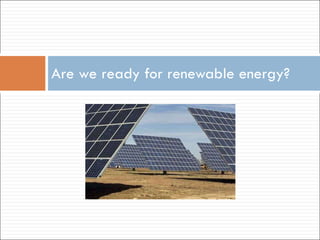
Are we ready for renewable energy?
What about the electric car?
What is Smart Grid?
What can businesses do?
Audience Q&A
Resources ISO-New England www.iso-ne.com NECA www.necanews.org National Grid www.nationalgridus.com U.S. Energy Information Administration www.eia.doe.gov
 
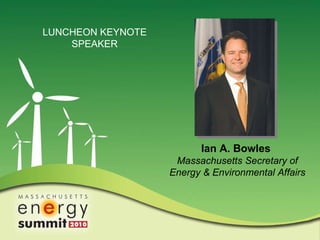
Ian A. Bowles  Massachusetts Secretary of Energy & Environmental Affairs LUNCHEON KEYNOTE  SPEAKER


Mass Energy Summit 2010

  • 1.
  • 2.
  • 3.
  • 4.
  • 5.
  • 6.
  • 7.
  • 8.
  • 9.
    Ed White Vice President of Energy Products, National Grid BREAKFAST KEYNOTE SPEAKER
  • 10.
  • 11.
    PANEL #1 Conservation& Energy Efficiency Programs
  • 12.
    Vincent DeVito Partner , Bowditch & Dewey, LLP Executive Director , Institute for Energy and Sustainability MODERATOR
  • 13.
    Vincent DeVito [email_address](617) 757-6518 Thursday, October 7, 2010 Federal and State Renewable Project Incentives Opportunities: Improving Operations and Decreasing Costs.
  • 14.
    Table: U.S. Totaland MA Share
  • 15.
    Federal Incentives forBusinesses & Institutions Federal Opportunities  • Business Energy Investment Tax Credit (ITC) • Energy-Efficient Commercial Buildings Tax Deduction • Renewable Electricity Production Tax Credit (PTC) • Renewable Energy Production Incentive (REPI) • U.S. Department of Treasury - Renewable Energy Grants • Tax Credits for Home Energy Improvements   
  • 16.
    State Incentives forBusinesses & Institutions State Opportunities • Alternative Energy Portfolio Standard • Commonwealth Solar Incentive Program  • Commonwealth Wind - Community Scale  • Commonwealth Wind - Commercial Wind • Commonwealth Wind - MicroWind  • Commonwealth Hydro Program  • Energy Efficiency Programs Offered by Mass. Utilities • Mass. Incentives/Policies for Renewables and Efficiency Renewable Energy Portfolio Standard • RPS Solar Carve-Out 
  • 17.
    Green Building: The Efficient Use of Energy Energy Use Green House Gas Emissions Water Use Land Use Construction Materials Operations and Waste Removal
  • 18.
    Energy Efficiency: CarbonMarket GHG Trading System Protocols Allocation of Carbon Quantifications Market Flexibility and Regulatory Uncertainty State, Regional, and Federal Harmonization Trading and Tax Consequences Legal Certainty of an Allowance or Credit Title (Property Right or License) Verification Retirement Insolvency Liability Financial Services Compliance Purchase and Sale Agreements Contract Negotiations Enforcement
  • 19.
    THIRTY-FIVE MUNICIPALITIES DESIGNATEDGREEN COMMUNITIES AS OF MAY 21, 2010.
  • 20.
    Vincent DeVito [email_address](617) 757-6518 Thursday, October 7, 2010 Synopsis of Renewable Energy and Energy Efficiency Laws, Programs and Policies Enacted and Implemented in Massachusetts: 2008-2010: June 16, 2010
  • 21.
    Carolyn Sarno Senior Program Manager for High Performance Buildings Northeast Energy Efficiency Partnerships (NEEP)
  • 22.
    MASS ENERGY SUMMIT CONSERVATION & ENERGY EFFICIENCY INTEGRATING THE BENEFITS INTO SUPPLY STRATEGY CAROLYN SARNO October 7, 2010
  • 23.
    Conservation turns offthe light bulb; Efficiency uses a better bulb. Definitions
  • 24.
  • 25.
    Track Utility BillsCan’t manage what you haven’t measured Understand how to read the bill Use for utility procurement and budget forecasting Typically yields a 10% utility savings ENERGY MANAGEMENT
  • 26.
    Existing buildings don’tcome with instructions OPERATING PLAN
  • 27.
    HIGH PERFORMANCE BUILDINGSBetter Investment We all want this……………………………and not this! $100,000
  • 28.
    Additional Resources Departmentof Energy O & M Best Practices http://www1.eere.energy.gov/femp/program/operations_maintenance.html DSIRE – Database of State Incentives: http://www.dsireusa.org/ Energy Star: http://www.energystar.gov/ Energy Smart Schools Guide to O & M http://www1.eere.energy.gov/buildings/energysmartschools/o-and-m_guide.html EPA LBE Guide http://www.epa.gov/cleanenergy/documents/epa_lbe.pdf Facilities Operating Plan http://www.vtvsa.org/files/Facility%20Operating%20Plan%20Template%20Version%201.0.doc Solutions Center http://www1.eere.energy.gov/wip/solutioncenter/default.html Northeast Energy Efficiency Partnerships: www.neep.org Your local utility & energy efficiency program providers RESOURCES
  • 29.
    Rick Mitchell Vice President Sustainnovation Consulting
  • 30.
    What is sustainabilityand why is it important for business?
  • 31.
    Triple Bottom LineStrategy Reduced operating costs Increased productivity Reduced environmental impacts Empowered employees Improved communications w/ shareholders and media PROFIT Resource Optimization PLANET Minimize Impact PEOPLE Employee, Management, Shareholder and Community Involvement GROWTH Benefits:
  • 32.
  • 33.
    Can You GuessWhat the Following Represents? Year 2010 = &293,829,000 Year 2011 = $431,251,000 Year 2012 = $546,821,000 TOTAL: $1,271,901.000 Approved Energy Efficiency Spending by Investor Owned Electric & Gas Utilities in MA in Commercial and Industrial Sectors
  • 34.
    Sustainnovation Consulting MatchingSustainability with Profit www.meridianassoc.com 978-299-0447 X240
  • 35.
    Cynthia Arcate President & CEO Power Options, Inc.
  • 36.
    2010 Massachusetts EnergySummit Conservation & Energy Efficiency Integrating the Benefits into Supply Strategy October 7, 2010 Cynthia Arcate, President & CEO PowerOptions Leveraging the power of non-profits
  • 37.
    Energy Savings areNot All the Same Kw v. kWhs Peak v. Non-peak Impact on ICAP tags and customer profiles Usage reflected in price Basic service v. competitive supply
  • 38.
    Contract Terms AffectPrice Different pricing options: Fixed all-in Capacity pass through Wholesale energy market Change in Use: Bandwidth Notice Penalties
  • 39.
  • 40.
    PANEL #2 GoingGreen — Innovative Energy Savings Projects
  • 41.
    MODERATOR Peter StantonPublisher Worcester Business Journal
  • 42.
    Jana E. DenglerCFM,FMA, SMA Director of Facilities and Security Institute of Contemporary Art
  • 43.
    Sustainable Facilities ManagementInitiatives at the Institute of Contemporary Art Boston Jana E Dengler CFM, RPA, FMA, SMA Director of Facilities and Security
  • 44.
    The Mission TheInstitute of Contemporary Art strives to share the pleasures of reflection, inspiration, provocation, and imagination that contemporary art offers through public access to art, artists, and the creative process. (ICA, n.d.)
  • 45.
    The ICA Bostonis the oldest Institute of Contemporary Art in the United States, established in 1936. 2006 – new life, new location, state of the ART facility
  • 46.
    New Building Operating costs are higher than design estimations by 35% Unit costs of utilities are increasing Operational cost of HVACr utilities 37 % higher than similar institutions
  • 47.
    What was newat construction? Daylight harvesting Low voltage lighting With LCD control Motion sensor water usage
  • 48.
    Sustainable Initiatives Partnering with Power Options Partnership with Lutron 3M UV film Partnership with Siemens Controls Operational
  • 49.
    What was realized14% saving with conscious procurement 5% savings with lighting sensors 12% saving with operational initiatives
  • 50.
  • 51.
    Sean Anderson Assistant Vice President, Facilities and Director of Corporate Green Initiatives MassMutual Financial Group
  • 52.
    MassMutual Financial GroupSustainability Program From ideas to actions…
  • 53.
    Introduction Sean F.Anderson Assistant Vice President – Facility Operations Director of Corporate Green Initiatives About MassMutual Founded in 1851, MassMutual Financial Group is a mutually owned financial protection, accumulation and income management company headquartered in Springfield, MA. MassMutual's affiliates include Babson Capital, OppenheimerFunds, Baring Asset Management, First Mercantile Trust and Cornerstone Real Estate Advisers.
  • 54.
    Key Elements ofMassMutual’s Sustainability Program Conservation Efficient Lighting Systems Low Flow Plumbing Fixtures Energy Star-rated MEP systems Sustainable Operations LEED for Existing Buildings Energy Star Partner Renewable Technologies Solar – photovoltaic, thermal and passive Green Roof – white and “live” materials Wind – turbine
  • 55.
    Conservation/Sustainable Operations ProjectExamples Since 2006, MassMutual has spent over $900,000 to save $350,000 (average 1.5 year payback per project): Energy Audits/Temperature Re-adjustments Small cost for balancing and auditing Shutdown inactive mechanical systems, re-evaluated operations Project cost: $15,000 and Savings: $15,000 Simple Payback: 1 years Water Efficiency Upgrade Replaced over 400 fixtures and saved approximately 5,000,000 gallons of water Project cost: $475,000 and Savings: $32,000 Simple Payback: 14 years (30 year life) Lighting Upgrades Removed over 500 T-12 fluorescent fixtures Replaced with 300 T-8s and T-5s Saved approximately 138,000 kW-hrs Project cost: $75,000 (excluding utility incentives) and Savings: $20,000 Simple Payback: 3.75 years (20 year life)
  • 56.
    Renewable Technologies ProjectThe $2.4 million project includes: 43,000 square feet of white PVC membrane ($650k) R-value of 30 System reduces air conditioning costs by 22% 528 panel solar photovoltaic system ($850k) Generates 111 kW Produces 130,000 kWh per year MA Clean Energy Center Grant: $118,000 (<5% project cost) Simple Payback: 6.5 years (20 year life) 96 panel thermal solar system ($500k panels and $250k support steel) Provides 50% of the campus hot water needs 3,000 gallons of storage 4,800 gallons per day at 195 °F Simple payback: 12 years (30+ year life)
  • 57.
    Lessons Learned C-SuiteSupport Required Grassroots or Top-Down Approaches Work Obtain Qualified Consultants/Installers Innovative Contracts GMP Pay for performance Positive PR Significant Upside potential Minimal downside risks Projects Typically Lead to ROI and Reduced OpEx
  • 58.
  • 59.
  • 60.
    MassMutual – ProposedGreen Roof Area (1981 roof)
  • 61.
  • 62.
  • 63.
    Final Thought StartSmall or Start Big… Just Start!
  • 64.
    © 2010 MassachusettsMutual Life Insurance Company, Springfield, MA. All rights reserved. www.massmutual.com. MassMutual Financial Group is a marketing name for Massachusetts Mutual Life Insurance Company (MassMutual) and its affiliated companies and sales representatives.
  • 65.
    Frank Carlson President & General Manager Carlson Orchards
  • 66.
  • 67.
  • 68.
  • 69.
  • 70.
  • 71.
    Edward R. Terceiro,Jr. Resident Engineer Mount Wachusett Community College
  • 72.
    Advancing Carbon Neutralityon Campus Mount Wachusett Community College Massachusetts Energy Summit 2010 October 7, 2010
  • 73.
    Focus of PresentationThere is no one clear cut solution to carbon neutrality – every business or institution presents its own challenges and possibilities. How do you balance operational considerations with your approach to carbon neutrality i.e. demand side management? What are some of the funding options available?
  • 74.
    Critical Issues Therising and disproportionate costs of energy in the Northeast The Nation’s continued dependence on foreign oil & its impact on national security The obligation to address the need for increased energy production in consort with environmental protection
  • 75.
    MWCC Projects BiomassConversion Biomass Gasification – Combine Heat & Power Photovoltaics – 100KW Solar Thermal –Domestic Hot Water Energy Conservation Measures (ECMs) Geothermal (Veteran’s Rehabilitation Center) Plug in Hybrid Wind Turbines
  • 76.
    Biomass Conversion AverageAnnual Savings 2002-2009 Electricity: 4,046,874 (KWh) ( 45.97% reduction, enough to serve approximately 1200 residential all-electric customers per year) Water: 2,222,222 gals ( 52.52% reduction) CO 2 reduction: 24%
  • 77.
    Biomass Conversion CumulativeSavings 2002-2009 Total kWh saved: 34,550,739 KWh Total Water Saved: 17,777,776 gals Total Dollars Saved: $3,829,434
  • 78.
    Environmental Impact Theenergy savings accomplished by this project provide a significant environmental and health benefit from the reduction of air pollutants and greenhouse gas emissions. For example, we have reduced CO 2 emissions by 14,890 tons , NO x by 24.2 tons , and SO x by 64 tons . This reductions would be equivalent to planting 4,079 acres of trees and removing 2,601 automobiles from the roads .
  • 79.
    Wind Turbines MWCCwas been awarded $3,000,000 from the U.S. Department of Energy ( Energy and Water Development Appropriation Bill) to install two 1.65 MW wind turbines and to work with surrounding communities to develop implementation strategies for the installation of turbines across the state’s northern tier.
  • 80.
    Wind Turbine FactsTotal Project Cost: $9,003,425 Annual Est. Production: 4,977,422 KWh Total Annual Savings: $965,620 Percent of College Demand : 97% Percent of Output Returned to Grid: 30%
  • 81.
    Funding Options U.SDepartment of Energy Mass Technology Collaborative & Renewable Energy Trust Funds Utility Rebates Clean Renewable Energy Bonds (CREBs) Renewable Energy Credits Clean Energy Investment Program - General Obligation Bonds Performance Contracting
  • 82.
    Climate Commitment “By addressing the College’s responsibility to minimize its own contributions to global warming and by emphasizing the importance of making the transition to a low carbon, sustainable economy, the College has defined a new mission for the school; one that creates educational and professional opportunities for students, supports the professional development of faculty and staff while also encouraging a sustainable quality of life for residents in our service delivery area.”
  • 83.
    For Additional InformationEd Terceiro, Resident Engineer, Mount Wachusett Community College (978-630-9103) [email_address]
  • 84.
  • 85.
  • 86.
    MODERATOR Christina DavisEditor Worcester Business Journal
  • 87.
    Robert Laurita Manager Market Design ISO New England
  • 88.
    Robert Sheridan Director of Distribution Planning National Grid
  • 89.
    Peter W. Brown,Esq. Brown, Olson & Gould, P.C. Co-Chair NECA Power Markets Committee
  • 90.
    Robert Laurita Responsibilitiesinclude: The design and development of market rules governing the New England wholesale electricity market. Actively involved in the design and administration of the ISO’s demand response programs and market designs that integrate demand-side resources into the wholesale electricity markets, such as the Forward Capacity Market
  • 91.
    About ISO NewEngland Private, not-for-profit corporation created in 1997 to oversee New England’s restructured wholesale electric power system Independent of companies doing business in the market Regulated by the Federal Energy Regulatory Commission (FERC) Operate the Power System Minute-to-minute reliable operation of region’s generation and transmission system Administer the Wholesale Electric Markets Oversee region’s wholesale marketplace for energy, capacity and reserve supplies Conduct Power System Planning Ensure reliable and efficient power system to meet current and future power needs Approximately 460 employees. Located in Western Massachusetts 2010 ISO New England Inc.
  • 92.
    New England’s ElectricPower Grid at a Glance 6.5 million households and businesses; population 14 million More than 350 generators Over 8,000 miles of high-voltage transmission lines 13 interconnections to electricity systems in New York and Canada More than 31,000 megawatts (MW) of total supply More than 2,300 megawatts of demand resources All-time peak demand of 28,130 megawatts, set on August 2, 2006 Over 400 participants in the market $5.4 billion annual total energy market value (2009)
  • 93.
    Robert Sheridan RobertSheridan has been with National Grid and its predecessor organizations for 23 years. As director of distribution and planning he is responsible for the planning of capital infrastructure throughout New England and Upstate New York.
  • 94.
    Peter Brown Partnerat Brown Olson and Gould in New Hampshire Member of the Power Markets Committee of NECA Practice is concentrated in energy law, with a considerable part of that practice involving wholesale electric power markets in the United States as regulated by the Federal Energy Regulatory Commission.  
  • 95.
    About NECA TheNortheast Energy and Commerce Association (NECA) is New England’s oldest and most broadly-based, non-profit trade association serving the competitive electric power industry. Founded in 1985, NECA’s purpose is to facilitate an open forum among all electric power stakeholders to foster the development and maturation of competitive power markets.
  • 96.
    About NECA NECApromotes environmentally sound, reliable and cost-effective wholesale and retail markets for the production and delivery of electric power supply, as well as competing energy services and resource alternatives, including conservation, innovative demand-side and power delivery technologies, renewable energy and distributed generation.
  • 97.
    Are we readyfor renewable energy?
  • 98.
    What about theelectric car?
  • 99.
  • 100.
  • 101.
  • 102.
    Resources ISO-New Englandwww.iso-ne.com NECA www.necanews.org National Grid www.nationalgridus.com U.S. Energy Information Administration www.eia.doe.gov
  • 103.
  • 104.
    Ian A. Bowles Massachusetts Secretary of Energy & Environmental Affairs LUNCHEON KEYNOTE SPEAKER
  • 105.
  • 106.
  • 107.
  • 108.
  • 109.
  • 110.
  • 111.
  • 112.

Editor's Notes

  • #25 Don’t see this on private sector buildings … buildings could be constructed to use 43 percent less energy through currently available energy-saving building design, practices and technologies, according to the National Renewable Energy Laboratory.
  • #26 Who is looking at your utility bills? Who tracks and manages them? The FM? The bookkeeper? – kWH , Raychet , power factor , watt , demand charge what does it all mean?
  • #27 Develop an operating plan Norm VSA – They have the rights to use this document – trying secure funding to the current template in the future ( two plans) Trained 80 facilities managers on it. starts the basis for a plan add on as you can.
  • #28 2 % initial investment in green construction could yield10 times the initial savings of that investments over the life of the building HMFH study average savings of green schools over 100,000 and energy savings 30% Direct quantifiable – water , maintenance and energy Average benefits 6.43 times greater than costs
  • #45 The primary activities of the ICA are threefold: • To present outstanding contemporary art in all media, including visual art    exhibitions, music, film, video and performance, that is deserving of public    attention and has not been presented in depth to Boston audiences • To provide innovative experiential learning opportunities for people of all ages    through direct encounters with artists and art making • To design interpretative programs that provide context, develop appreciation,    and add meaning to contemporary art and culture
  • #47 global demand basis
  • #49 we can no longer think of environment and economic and social development as isolated fields In a sustainable society, nature is not subject to systematically increasing concentrations of substances being extracted from the earth’s crust or degradation by physical means, while people are not subjected to conditions that systematically undermine their capacity to meet their needs.