PRESENTED BY: H. Arouba Naseem
Roll # 1010
 Founded by Henri Nestlé
 World’s biggest food & beverage Company
 Developed 1st milk product in 1867
 Merger with Anglo-Swiss Condensed Milk
Company
 First expansion in Chocolate activity
 Introduction of Nescafe
 Merger with Maggi Seasoning & Soups
 Acquisition of American Food Giant &
Dreyer’s.
 To create value
 Create trust among Customers
 Ensures that the highest standards
are met throughout the organization
 Recruitment of right people and
ongoing training & development
 Continue to maintain its
Commitment
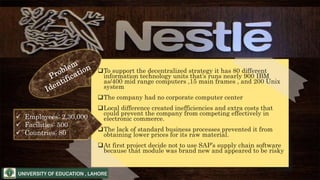
To support the decentralized strategy it has 80 different
information technology units that’s runs nearly 900 IBM
as/400 mid range computers ,15 main frames , and 200 Unix
system
The company had no corporate computer center
Local difference created inefficiencies and extra costs that
could prevent the company from competing effectively in
electronic commerce.
The lack of standard business processes prevented it from
obtaining lower prices for its raw material.
At first project decide not to use SAP’s supply chain software
because that module was brand new and appeared to be risky
 Employees: 2,30,000
 Facilities: 500
 Countries: 80
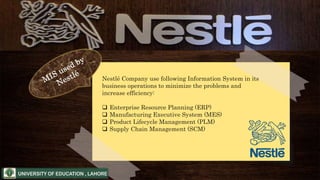
Nestlé Company use following Information System in its
business operations to minimize the problems and
increase efficiency:
 Enterprise Resource Planning (ERP)
 Manufacturing Executive System (MES)
 Product Lifecycle Management (PLM)
 Supply Chain Management (SCM)
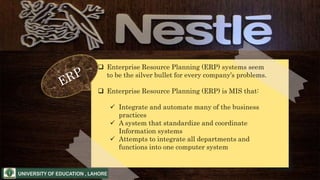
 Enterprise Resource Planning (ERP) systems seem
to be the silver bullet for every company’s problems.
 Enterprise Resource Planning (ERP) is MIS that:
 Integrate and automate many of the business
practices
 A system that standardize and coordinate
Information systems
 Attempts to integrate all departments and
functions into one computer system
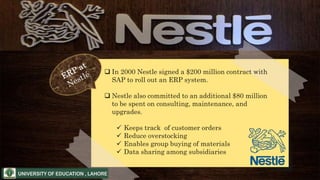
 In 2000 Nestle signed a $200 million contract with
SAP to roll out an ERP system.
 Nestle also committed to an additional $80 million
to be spent on consulting, maintenance, and
upgrades.
 Keeps track of customer orders
 Reduce overstocking
 Enables group buying of materials
 Data sharing among subsidiaries
“Manufacturing execution systems are computerized systems
used in manufacturing, to track and document the
transformation of raw materials to finished goods.”
MES may operate across multiple function areas:
 The product life-cycle
 Resource scheduling
 Order execution and dispatch,
 Production analysis and
 Product Quality,
 Materials track and trace
 Management for Overall Equipment Effectiveness (OEE),
“Product lifecycle management (PLM) is the process of
managing the entire lifecycle of a product from inception,
through engineering design and manufacture, to service
and disposal of manufactured products.”
PLM integrates;
 People
 Data
 Processes
 Business systems
 Provides a product information backbone for
companies and their extended enterprise
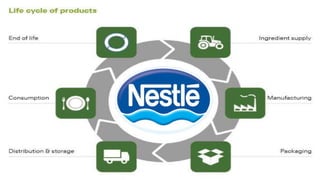
Product Lifecycle of Nestlé:
 Managing Environmental Sustainability
 The Environmental Life Cycle Of Products
 Identifying And Addressing Environmental Hotspots
 Sustainability By Design
 Mandatory Rating System
 Promoting Access To Data
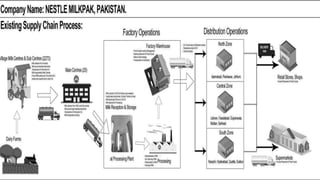
Supply chain management is the combination of art and science
that goes into improving the way a company finds:
 The raw components it needs to make a product or service
 Manufactures that product or service and delivers it
to customers
The most basic supply chain consists of the following parties:
 Suppliers
 Manufacturers
 Warehouses/Storage
 Transporters
 Distributors
 Retailers
 Customers/Consumers
 Producers
Management of Nestlé faces many problems before
having a sound Management Information System:
 Inability to understand the usage of the new
system by the workers
 Failure to integrate various modules
 Delay in the project due to employees’ resistance
to change inefficiency on the part of project co-
leader to handle situations.
 Involvement of right individuals from the beginning
 Avoid heavy customization
 Defining the business goals of the project and then
create a timeline
 Time should be spent evaluating the business process
re-engineering that will be done in conjunction with
an ERP implementation.
 Training to employees throughout the project
 All of Nestlé USA are using the same software and data
 Producing better sales forecasts
 Costs were cut down and had already saved $325
million by spring 2002.
 Nestlé SA has learned from that project and expects to
have an easier success with its project.
 By the end of 2004, about 10% of Nestlé’s global food
and beverage business was operating with standard
processes, data and systems.
Nestle

Nestle

  • 3.
    PRESENTED BY: H.Arouba Naseem Roll # 1010
  • 4.
     Founded byHenri Nestlé  World’s biggest food & beverage Company  Developed 1st milk product in 1867  Merger with Anglo-Swiss Condensed Milk Company  First expansion in Chocolate activity  Introduction of Nescafe  Merger with Maggi Seasoning & Soups  Acquisition of American Food Giant & Dreyer’s.
  • 5.
     To createvalue  Create trust among Customers  Ensures that the highest standards are met throughout the organization  Recruitment of right people and ongoing training & development  Continue to maintain its Commitment
  • 6.
    To support thedecentralized strategy it has 80 different information technology units that’s runs nearly 900 IBM as/400 mid range computers ,15 main frames , and 200 Unix system The company had no corporate computer center Local difference created inefficiencies and extra costs that could prevent the company from competing effectively in electronic commerce. The lack of standard business processes prevented it from obtaining lower prices for its raw material. At first project decide not to use SAP’s supply chain software because that module was brand new and appeared to be risky  Employees: 2,30,000  Facilities: 500  Countries: 80
  • 7.
    Nestlé Company usefollowing Information System in its business operations to minimize the problems and increase efficiency:  Enterprise Resource Planning (ERP)  Manufacturing Executive System (MES)  Product Lifecycle Management (PLM)  Supply Chain Management (SCM)
  • 8.
     Enterprise ResourcePlanning (ERP) systems seem to be the silver bullet for every company’s problems.  Enterprise Resource Planning (ERP) is MIS that:  Integrate and automate many of the business practices  A system that standardize and coordinate Information systems  Attempts to integrate all departments and functions into one computer system
  • 9.
     In 2000Nestle signed a $200 million contract with SAP to roll out an ERP system.  Nestle also committed to an additional $80 million to be spent on consulting, maintenance, and upgrades.  Keeps track of customer orders  Reduce overstocking  Enables group buying of materials  Data sharing among subsidiaries
  • 10.
    “Manufacturing execution systemsare computerized systems used in manufacturing, to track and document the transformation of raw materials to finished goods.” MES may operate across multiple function areas:  The product life-cycle  Resource scheduling  Order execution and dispatch,  Production analysis and  Product Quality,  Materials track and trace  Management for Overall Equipment Effectiveness (OEE),
  • 11.
    “Product lifecycle management(PLM) is the process of managing the entire lifecycle of a product from inception, through engineering design and manufacture, to service and disposal of manufactured products.” PLM integrates;  People  Data  Processes  Business systems  Provides a product information backbone for companies and their extended enterprise
  • 12.
    Product Lifecycle ofNestlé:  Managing Environmental Sustainability  The Environmental Life Cycle Of Products  Identifying And Addressing Environmental Hotspots  Sustainability By Design  Mandatory Rating System  Promoting Access To Data
  • 14.
    Supply chain managementis the combination of art and science that goes into improving the way a company finds:  The raw components it needs to make a product or service  Manufactures that product or service and delivers it to customers The most basic supply chain consists of the following parties:  Suppliers  Manufacturers  Warehouses/Storage  Transporters  Distributors  Retailers  Customers/Consumers  Producers
  • 16.
    Management of Nestléfaces many problems before having a sound Management Information System:  Inability to understand the usage of the new system by the workers  Failure to integrate various modules  Delay in the project due to employees’ resistance to change inefficiency on the part of project co- leader to handle situations.
  • 17.
     Involvement ofright individuals from the beginning  Avoid heavy customization  Defining the business goals of the project and then create a timeline  Time should be spent evaluating the business process re-engineering that will be done in conjunction with an ERP implementation.  Training to employees throughout the project
  • 18.
     All ofNestlé USA are using the same software and data  Producing better sales forecasts  Costs were cut down and had already saved $325 million by spring 2002.  Nestlé SA has learned from that project and expects to have an easier success with its project.  By the end of 2004, about 10% of Nestlé’s global food and beverage business was operating with standard processes, data and systems.