Pesented by:
WINX Club
Introduction:
o Nestle is the largest food company in the world. This
company based in Switzerland-Europe.
o Nestle was first created in Angelo-Swiss.
o In the 1860’s, Henri Nestle, a pharmacist, launched
world’s first prepared infant cereals “Farine Lactee”
in Vevey Switzerland.
o In early 1906, the company was operating factories
in the United States, Britain, Germany and Spain.
o In 1905, nestle merged with the Angelo-Swiss
condensed milk company.
o Six world-wide corporate brands, Nestle, Nescafe,
Nesvita, Maggie, Buitoni, Friskies.
o In 2006 Nestlé's sales, at $80billion, accounted for
1.5% of the total global food market
VISION
“To be a leading, competitive,
Nutrition, Health and Wellness
Company delivering improved
shareholder value by being a
preferred corporate citizen
preferred employer preferred
supplier selling preferred
products”
"Nestlé is the largest food company in the world.
But, more important to them is to be the world's
leading food company”.
GOALS AND OBJCTIVES
 To achieve compatibility with international voluntary
standards on environmental management systems.
 To build mutual trust with consumers, governmental
authorities and business partners.
 To ensure continuous improvement of nestles
environmental performance.
 Conservation of natural resources and minimization of
waste.
 To establish the benchmark for good business practice.
 Employing new technologies and processing.
 Measuring the cost and benefits to business of it’s
activities.
 Monitor progress.
 Audit results.
CULTURE OF NESTLE
o Energetic and collaborative working
environment.
o People influence the business through their
skills and knowledge.
o Nestle want from its employees to bring your
dedication, determination and great ideas to
the table.
o There is enthusiastic team behind ideas.
o Accept challenges.
VALUES
 Integrity coupled with a strong work ethic
 The desire to do quality work
 Friendly, open and honest communication
 A spirit of cooperation and openness to other ideas
and opinions
 A realistic approach to business
 An openness to future trends and new business
opportunities
 Pride in enhancing our company’s reputation and
performance
 A passion for our products and brands
PERFORMANCE CULTURE
 A high performance culture supported by differentiated rewards.
 key to the delivery of individual and business objectives.
 challenging responsibilities and priorities .
 ensuring that employees are aware of how their work impacts
Nestlé.
 most important factor in determining your opportunities within
Nestlé.
 If you’re keen to take on new and bigger responsibilities, you
have to show that you’re able to do so.
 We should stress the words 'strongly' and 'consistently‘.
 At Nestlé, the end and means are equally important.
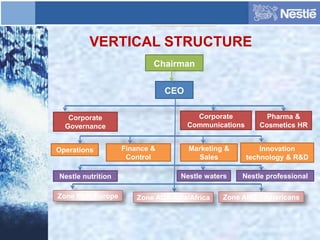
VERTICAL STRUCTURE
Chairman
CEO
Corporate
Governance
Corporate
Communications
Pharma &
Cosmetics HR
Operations Finance &
Control
Marketing &
Sales
Innovation
technology & R&D
Nestle nutrition Nestle waters Nestle professional
Zone EUR:Europe Zone AOA Asia/Africa Zone AMS : Americans
ELEMENTS IN VERTICAL ORGANIZATION
1. Chain of command
 Employees and management are connected
by the chain of command.
 Defines who report to whom.
 In nestle there is a leadership team on top
level management and under the leadership
team middle and junior level management
work under their supervision.
DELEGATION OF AUTHORITIES
Top positions management cannot
personally perform all the tasks needed to
achieve their goals, they must use the chain
of command to distribute authority among
their organizational members to ensure that
the work is completed.
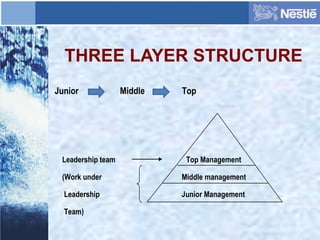
THREE LAYER STRUCTURE
Junior Middle Top
Leadership team Top Management
(Work under Middle management
Leadership Junior Management
Team)
CENTRALIZED
 Extremely centralized organization.
 Nestlé community as a centralized
organization allows its subordinates to enjoy a
relatively high-altitude of autonomy.
 Makes major strategy decisions at the
headquarter level.
 Business with the matrix structure in Nestle.
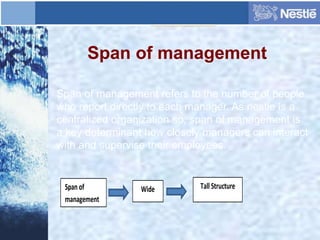
Span of management
Span of management refers to the number of people
who report directly to each manager. As nestle is a
centralized organization so, span of management is
a key determinant how closely managers can interact
with and supervise their employees.
Wide Tall StructureSpan of
management
Formalization
Formalization is the use of written documents
to systematize, link, and control the activities of
organization members. As nestle follow its
policies strictly and there is complete security
system that’s why it is highly formalized.
Work Specialization
 Every product category has its own
infrastructure of management.
 Relevant specialized people are
working in the relevant department so,
there is also exist the principle of work
specialization.
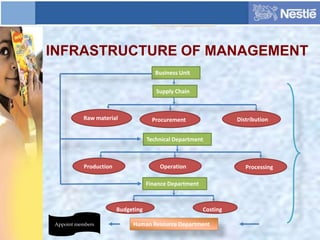
INFRASTRUCTURE OF MANAGEMENT
Business Unit
Supply Chain
Technical Department
Raw material Procurement Distribution
Production Operation Processing
Finance Department
Budgeting Costing
Human Resource DepartmentAppoint members
Nestle Corporate Business Principles
1. Consumers
o Nutrition, Health and Wellness
o Quality assurance and product safety
o Consumer communication
2. Human rights and labour
practices
o Human rights in our business activities
3. Our people
o Leadership and personal responsibility
o Safety and health at work
4. Suppliers and customers
o Supplier and customer relations
o Agriculture and rural development
5. The environment
o Environmental sustainability
o Water
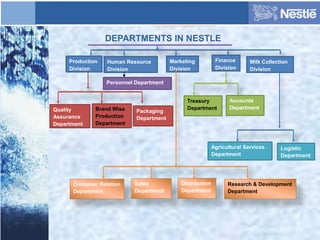
Production
Division
Human Resource
Division
Marketing
Division
Finance
Division
Milk Collection
Division
Quality
Assurance
Department
Brand Wise
Production
Department
Packaging
Department
Personnel Department
Treasury
Department
Accounts
Department
Agricultural Services
Department
Logistic
Department
Customer Relation
Department
Sales
Department
Distribution
Department
Research & Development
Department
DEPARTMENTS IN NESTLE
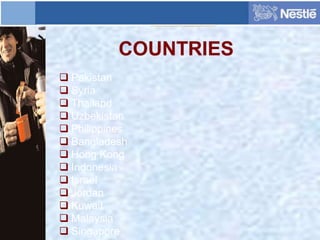
 Pakistan
 Syria
 Thailand
 Uzbekistan
 Philippines
 Bangladesh
 Hong Kong
 Indonesia
 Israel
 Jordan
 Kuwait
 Malaysia
 Singapore
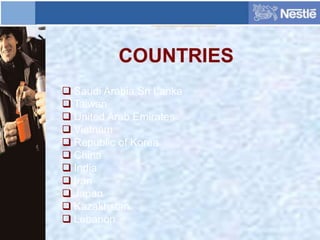
 Saudi Arabia Sri Lanka
 Taiwan
 United Arab Emirates
 Vietnam
 Republic of Korea
 China
 India
 Iran
 Japan
 Kazakhstan
 Lebanon
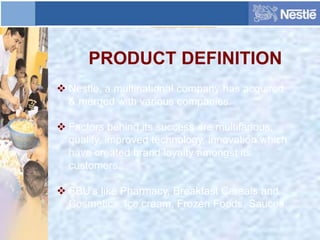
PRODUCT DEFINITION
 Nestle, a multinational company has acquired
& merged with various companies.
 Factors behind its success are multifarious,
quality, improved technology, innovation which
have created brand loyalty amongst its
customers.
 SBU’s like Pharmacy, Breakfast Cereals and
Cosmetics, Ice cream, Frozen Foods, Sauces.
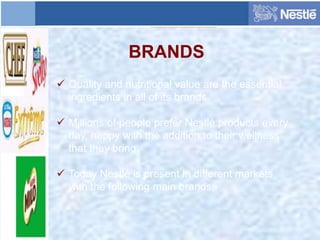
BRANDS
 Quality and nutritional value are the essential
ingredients in all of its brands.
 Millions of people prefer Nestlé products every
day, happy with the addition to their wellness
that they bring.
 Today Nestlé is present in different markets
with the following main brands:-
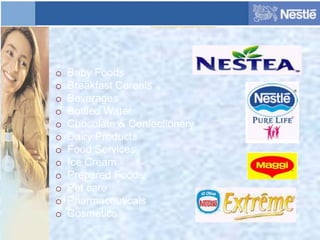
o Baby Foods
o Breakfast Cereals
o Beverages
o Bottled Water
o Chocolate & Confectionery
o Dairy Products
o Food Services
o Ice Cream
o Prepared Foods
o Pet care
o Pharmaceuticals
o Cosmetics
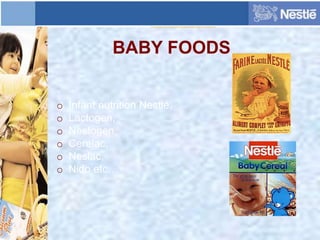
BABY FOODS
o Infant nutrition Nestlé,
o Lactogen,
o Nestogen,
o Cerelac,
o Neslac,
o Nido etc…
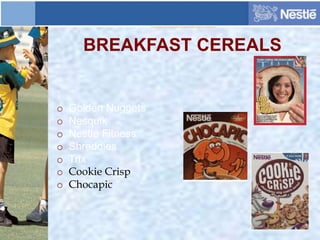
BREAKFAST CEREALS
o Golden Nuggets
o Nesquik
o Nestlé Fitness
o Shreddies
o Trix
o Cookie Crisp
o Chocapic
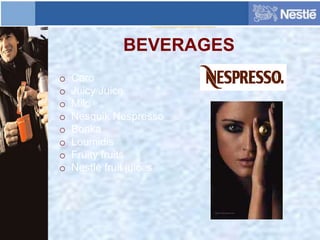
BEVERAGES
o Caro
o Juicy Juice
o Milo
o Nesquik Nespresso
o Bonka
o Loumidis
o Fruity fruits
o Nestlé fruit juices
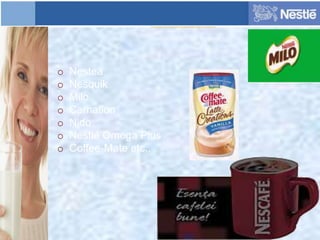
o Nestea
o Nesquik
o Milo
o Carnation
o Nido
o Nestlé Omega Plus
o Coffee-Mate etc..
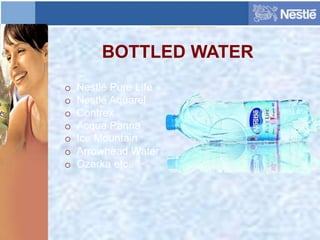
BOTTLED WATER
o Nestlé Pure Life
o Nestlé Aquarel
o Contrex
o Acqua Panna
o Ice Mountain
o Arrowhead Water
o Ozarka etc..
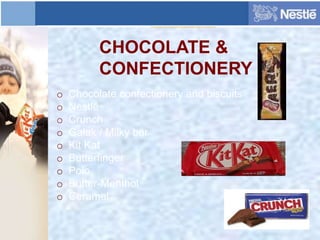
CHOCOLATE &
CONFECTIONERY
o Chocolate confectionery and biscuits
o Nestlé
o Crunch
o Galak / Milky bar
o Kit Kat
o Butterfinger
o Polo
o Butter-Menthol
o Ceramal
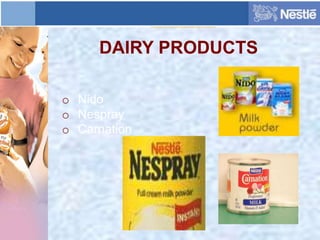
DAIRY PRODUCTS
o Nido
o Nespray
o Carnation
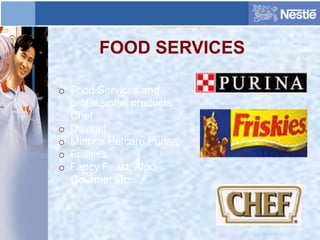
FOOD SERVICES
o Food Services and
professional products
Chef
o Davigel
o Minor’s Petcare Purina
o Friskies
o Fancy Feast, Alpo,
Gourmet etc..
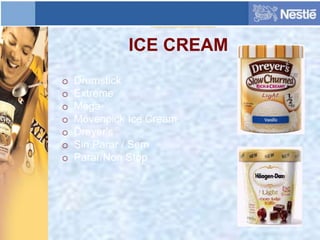
ICE CREAM
o Drumstick
o Extreme
o Mega
o Mövenpick Ice Cream
o Dreyer's
o Sin Parar / Sem
o Parar/Non Stop
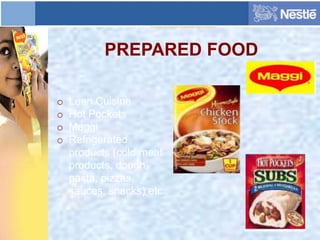
PREPARED FOOD
o Lean Cuisine
o Hot Pockets
o Maggi
o Refrigerated
products (cold meat
products, dough,
pasta, pizzas,
sauces, snacks) etc..
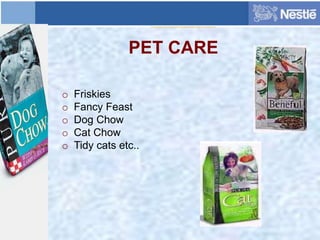
PET CARE
o Friskies
o Fancy Feast
o Dog Chow
o Cat Chow
o Tidy cats etc..
PHARMACEUTICALS
o Alcon
o Pharmaceutical and cosmetic
joint ventures Galderma
o Laboratoires innéov
o Patanol
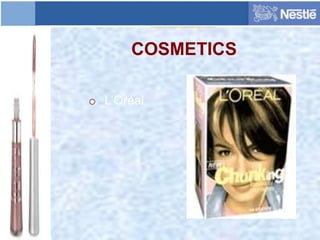
o L’Oréal
COSMETICS
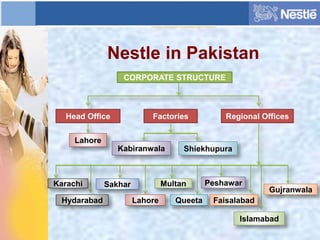
Nestle in Pakistan
CORPORATE STRUCTURE
Head Office Factories Regional Offices
Lahore
Kabiranwala Shiekhupura
Karachi
Hydarabad
Sakhar
Lahore
Multan
Queeta
Peshawar
Faisalabad
Islamabad
Gujranwala
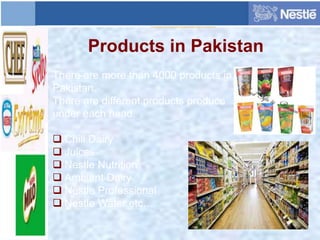
Products in Pakistan
There are more than 4000 products in
Pakistan.
There are different products produce
under each head.
 Chill Dairy
 Juices
 Nestle Nutrition
 Ambient Dairy
 Nestle Professional
 Nestle Water etc…
New product development
activities
In order to get long term success, marketing
division perform following activities for new product
development:
 Primary product
 Quality test
 Market test
 Feed back
 Modification
 Commercialization (launching)
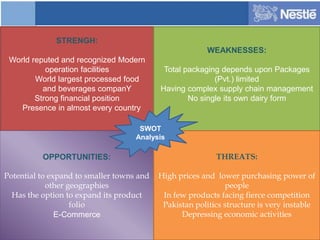
STRENGH:
World reputed and recognized Modern
operation facilities
World largest processed food
and beverages companY
Strong financial position
Presence in almost every country
WEAKNESSES:
Total packaging depends upon Packages
(Pvt.) limited
Having complex supply chain management
No single its own dairy form
OPPORTUNITIES:
Potential to expand to smaller towns and
other geographies
Has the option to expand its product
folio
E-Commerce
THREATS:
High prices and lower purchasing power of
people
In few products facing fierce competition
Pakistan politics structure is very instable
Depressing economic activities
SWOT
Analysis
PROBLEMS
 High market share
 Low growth
 Want to expand
 Don’t have enough resources
 Employees are demotivated due to low
salaries in HR department
 Unstable Govt. policies
SOLUTIONS/SUGGESTIONS
 Bonus packages and increment in salaries
 Staff should be made more responsible
 Long term agreements
 Inventory should be maintained.
 Cut investment budgets, overheads, frills
 Maximizing existing assets, capacity,
distribution
 Target internal growth rate
 Improve supply chain, productivity, optimizing
planning
Nestle is a market leader due to different reasons:
 Its price is high against its competitors but it
matches its quality with its competitors.
 Nestle is using its brand name to promote its
products & it’s very popular as compared to its
competitors.
 Its packaging is good.
 We can easily find Nestle from any retailer shop.
References
• www.nestle.com
• Nestlé centralises expertise in system technology |
Nestlé Global
• Nestlé - Wikipedia, the free encyclopedia
• Customer and Sales | Nestlé Global
• Big Data-Startups | How Nestlé Understands
Brands
NESTLE
NESTLE

NESTLE

  • 3.
  • 4.
    Introduction: o Nestle isthe largest food company in the world. This company based in Switzerland-Europe. o Nestle was first created in Angelo-Swiss. o In the 1860’s, Henri Nestle, a pharmacist, launched world’s first prepared infant cereals “Farine Lactee” in Vevey Switzerland. o In early 1906, the company was operating factories in the United States, Britain, Germany and Spain. o In 1905, nestle merged with the Angelo-Swiss condensed milk company. o Six world-wide corporate brands, Nestle, Nescafe, Nesvita, Maggie, Buitoni, Friskies. o In 2006 Nestlé's sales, at $80billion, accounted for 1.5% of the total global food market
  • 6.
    VISION “To be aleading, competitive, Nutrition, Health and Wellness Company delivering improved shareholder value by being a preferred corporate citizen preferred employer preferred supplier selling preferred products”
  • 7.
    "Nestlé is thelargest food company in the world. But, more important to them is to be the world's leading food company”.
  • 8.
    GOALS AND OBJCTIVES To achieve compatibility with international voluntary standards on environmental management systems.  To build mutual trust with consumers, governmental authorities and business partners.  To ensure continuous improvement of nestles environmental performance.  Conservation of natural resources and minimization of waste.  To establish the benchmark for good business practice.  Employing new technologies and processing.  Measuring the cost and benefits to business of it’s activities.  Monitor progress.  Audit results.
  • 9.
    CULTURE OF NESTLE oEnergetic and collaborative working environment. o People influence the business through their skills and knowledge. o Nestle want from its employees to bring your dedication, determination and great ideas to the table. o There is enthusiastic team behind ideas. o Accept challenges.
  • 10.
    VALUES  Integrity coupledwith a strong work ethic  The desire to do quality work  Friendly, open and honest communication  A spirit of cooperation and openness to other ideas and opinions  A realistic approach to business  An openness to future trends and new business opportunities  Pride in enhancing our company’s reputation and performance  A passion for our products and brands
  • 11.
    PERFORMANCE CULTURE  Ahigh performance culture supported by differentiated rewards.  key to the delivery of individual and business objectives.  challenging responsibilities and priorities .  ensuring that employees are aware of how their work impacts Nestlé.  most important factor in determining your opportunities within Nestlé.  If you’re keen to take on new and bigger responsibilities, you have to show that you’re able to do so.  We should stress the words 'strongly' and 'consistently‘.  At Nestlé, the end and means are equally important.
  • 12.
    VERTICAL STRUCTURE Chairman CEO Corporate Governance Corporate Communications Pharma & CosmeticsHR Operations Finance & Control Marketing & Sales Innovation technology & R&D Nestle nutrition Nestle waters Nestle professional Zone EUR:Europe Zone AOA Asia/Africa Zone AMS : Americans
  • 13.
    ELEMENTS IN VERTICALORGANIZATION 1. Chain of command  Employees and management are connected by the chain of command.  Defines who report to whom.  In nestle there is a leadership team on top level management and under the leadership team middle and junior level management work under their supervision.
  • 14.
    DELEGATION OF AUTHORITIES Toppositions management cannot personally perform all the tasks needed to achieve their goals, they must use the chain of command to distribute authority among their organizational members to ensure that the work is completed.
  • 15.
    THREE LAYER STRUCTURE JuniorMiddle Top Leadership team Top Management (Work under Middle management Leadership Junior Management Team)
  • 16.
    CENTRALIZED  Extremely centralizedorganization.  Nestlé community as a centralized organization allows its subordinates to enjoy a relatively high-altitude of autonomy.  Makes major strategy decisions at the headquarter level.  Business with the matrix structure in Nestle.
  • 17.
    Span of management Spanof management refers to the number of people who report directly to each manager. As nestle is a centralized organization so, span of management is a key determinant how closely managers can interact with and supervise their employees. Wide Tall StructureSpan of management
  • 18.
    Formalization Formalization is theuse of written documents to systematize, link, and control the activities of organization members. As nestle follow its policies strictly and there is complete security system that’s why it is highly formalized.
  • 19.
    Work Specialization  Everyproduct category has its own infrastructure of management.  Relevant specialized people are working in the relevant department so, there is also exist the principle of work specialization.
  • 20.
    INFRASTRUCTURE OF MANAGEMENT BusinessUnit Supply Chain Technical Department Raw material Procurement Distribution Production Operation Processing Finance Department Budgeting Costing Human Resource DepartmentAppoint members
  • 21.
    Nestle Corporate BusinessPrinciples 1. Consumers o Nutrition, Health and Wellness o Quality assurance and product safety o Consumer communication 2. Human rights and labour practices o Human rights in our business activities
  • 22.
    3. Our people oLeadership and personal responsibility o Safety and health at work 4. Suppliers and customers o Supplier and customer relations o Agriculture and rural development 5. The environment o Environmental sustainability o Water
  • 23.
    Production Division Human Resource Division Marketing Division Finance Division Milk Collection Division Quality Assurance Department BrandWise Production Department Packaging Department Personnel Department Treasury Department Accounts Department Agricultural Services Department Logistic Department Customer Relation Department Sales Department Distribution Department Research & Development Department DEPARTMENTS IN NESTLE
  • 25.
     Pakistan  Syria Thailand  Uzbekistan  Philippines  Bangladesh  Hong Kong  Indonesia  Israel  Jordan  Kuwait  Malaysia  Singapore
  • 26.
     Saudi ArabiaSri Lanka  Taiwan  United Arab Emirates  Vietnam  Republic of Korea  China  India  Iran  Japan  Kazakhstan  Lebanon
  • 27.
    PRODUCT DEFINITION  Nestle,a multinational company has acquired & merged with various companies.  Factors behind its success are multifarious, quality, improved technology, innovation which have created brand loyalty amongst its customers.  SBU’s like Pharmacy, Breakfast Cereals and Cosmetics, Ice cream, Frozen Foods, Sauces.
  • 28.
    BRANDS  Quality andnutritional value are the essential ingredients in all of its brands.  Millions of people prefer Nestlé products every day, happy with the addition to their wellness that they bring.  Today Nestlé is present in different markets with the following main brands:-
  • 29.
    o Baby Foods oBreakfast Cereals o Beverages o Bottled Water o Chocolate & Confectionery o Dairy Products o Food Services o Ice Cream o Prepared Foods o Pet care o Pharmaceuticals o Cosmetics
  • 30.
    BABY FOODS o Infantnutrition Nestlé, o Lactogen, o Nestogen, o Cerelac, o Neslac, o Nido etc…
  • 31.
    BREAKFAST CEREALS o GoldenNuggets o Nesquik o Nestlé Fitness o Shreddies o Trix o Cookie Crisp o Chocapic
  • 32.
    BEVERAGES o Caro o JuicyJuice o Milo o Nesquik Nespresso o Bonka o Loumidis o Fruity fruits o Nestlé fruit juices
  • 33.
    o Nestea o Nesquik oMilo o Carnation o Nido o Nestlé Omega Plus o Coffee-Mate etc..
  • 34.
    BOTTLED WATER o NestléPure Life o Nestlé Aquarel o Contrex o Acqua Panna o Ice Mountain o Arrowhead Water o Ozarka etc..
  • 35.
    CHOCOLATE & CONFECTIONERY o Chocolateconfectionery and biscuits o Nestlé o Crunch o Galak / Milky bar o Kit Kat o Butterfinger o Polo o Butter-Menthol o Ceramal
  • 36.
    DAIRY PRODUCTS o Nido oNespray o Carnation
  • 37.
    FOOD SERVICES o FoodServices and professional products Chef o Davigel o Minor’s Petcare Purina o Friskies o Fancy Feast, Alpo, Gourmet etc..
  • 38.
    ICE CREAM o Drumstick oExtreme o Mega o Mövenpick Ice Cream o Dreyer's o Sin Parar / Sem o Parar/Non Stop
  • 39.
    PREPARED FOOD o LeanCuisine o Hot Pockets o Maggi o Refrigerated products (cold meat products, dough, pasta, pizzas, sauces, snacks) etc..
  • 40.
    PET CARE o Friskies oFancy Feast o Dog Chow o Cat Chow o Tidy cats etc..
  • 41.
    PHARMACEUTICALS o Alcon o Pharmaceuticaland cosmetic joint ventures Galderma o Laboratoires innéov o Patanol
  • 42.
  • 43.
    Nestle in Pakistan CORPORATESTRUCTURE Head Office Factories Regional Offices Lahore Kabiranwala Shiekhupura Karachi Hydarabad Sakhar Lahore Multan Queeta Peshawar Faisalabad Islamabad Gujranwala
  • 44.
    Products in Pakistan Thereare more than 4000 products in Pakistan. There are different products produce under each head.  Chill Dairy  Juices  Nestle Nutrition  Ambient Dairy  Nestle Professional  Nestle Water etc…
  • 45.
    New product development activities Inorder to get long term success, marketing division perform following activities for new product development:  Primary product  Quality test  Market test  Feed back  Modification  Commercialization (launching)
  • 48.
    STRENGH: World reputed andrecognized Modern operation facilities World largest processed food and beverages companY Strong financial position Presence in almost every country WEAKNESSES: Total packaging depends upon Packages (Pvt.) limited Having complex supply chain management No single its own dairy form OPPORTUNITIES: Potential to expand to smaller towns and other geographies Has the option to expand its product folio E-Commerce THREATS: High prices and lower purchasing power of people In few products facing fierce competition Pakistan politics structure is very instable Depressing economic activities SWOT Analysis
  • 50.
    PROBLEMS  High marketshare  Low growth  Want to expand  Don’t have enough resources  Employees are demotivated due to low salaries in HR department  Unstable Govt. policies
  • 51.
    SOLUTIONS/SUGGESTIONS  Bonus packagesand increment in salaries  Staff should be made more responsible  Long term agreements  Inventory should be maintained.  Cut investment budgets, overheads, frills  Maximizing existing assets, capacity, distribution  Target internal growth rate  Improve supply chain, productivity, optimizing planning
  • 52.
    Nestle is amarket leader due to different reasons:  Its price is high against its competitors but it matches its quality with its competitors.  Nestle is using its brand name to promote its products & it’s very popular as compared to its competitors.  Its packaging is good.  We can easily find Nestle from any retailer shop.
  • 53.
    References • www.nestle.com • Nestlécentralises expertise in system technology | Nestlé Global • Nestlé - Wikipedia, the free encyclopedia • Customer and Sales | Nestlé Global • Big Data-Startups | How Nestlé Understands Brands