Adaptation in the development
context
Anand Patwardhan
University of Maryland, USA and
Indian Institute of Technology-Bombay, India
NAP Expo
Bonn, August 2014
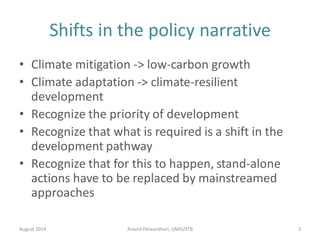
Shifts in the policy narrative
• Climate mitigation -> low-carbon growth
• Climate adaptation -> climate-resilient
development
• Recognize the priority of development
• Recognize that what is required is a shift in the
development pathway
• Recognize that for this to happen, stand-alone
actions have to be replaced by mainstreamed
approaches
August 2014 Anand Patwardhan,UMD/IITB 2
August 2014 3
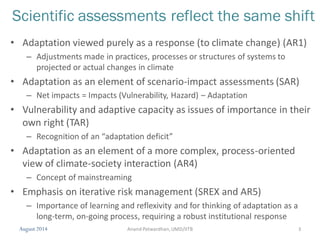
Scientific assessments reflect the same shift
• Adaptation viewed purely as a response (to climate change) (AR1)
– Adjustments made in practices, processes or structures of systems to
projected or actual changes in climate
• Adaptation as an element of scenario-impact assessments (SAR)
– Net impacts = Impacts (Vulnerability, Hazard) – Adaptation
• Vulnerability and adaptive capacity as issues of importance in their
own right (TAR)
– Recognition of an “adaptation deficit”
• Adaptation as an element of a more complex, process-oriented
view of climate-society interaction (AR4)
– Concept of mainstreaming
• Emphasis on iterative risk management (SREX and AR5)
– Importance of learning and reflexivity and for thinking of adaptation as a
long-term, on-going process, requiring a robust institutional response
Anand Patwardhan,UMD/IITB
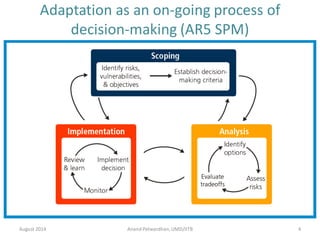
Adaptation as an on-going process of
decision-making (AR5 SPM)
August 2014 Anand Patwardhan,UMD/IITB 4
AR5 emphasizes not only what to do, but what
to try and avoid (maladaptation)
• Lock-in to solutions that may turn out to be sub-optimal, ineffective, or
actually counter-productive. For example, large engineering projects
that may be inadequate for future climates, or which preclude
alternative approaches such as ecosystem-based adaptation; Intensive
use of non-renewable resources (e.g. groundwater) to solve immediate
adaptation problem
• Awaiting more information, or not doing so, and eventually acting
either too early or too late. Awaiting better “projections” rather than
using scenario planning and adaptive management approaches
• Moral hazard – i.e. encouraging inappropriate risk taking based, for
example, on insurance, social security net or aid backup
• Adopting actions that ignore local relationships, traditions, traditional
knowledge or property rights, or which ignore equity and spillover
issues, leading to eventual failure
August 2014 Anand Patwardhan,UMD/IITB 5
This evolution is reflected in the
multilateral process
• Stage-wise approach to adaptation, starting
with enabling activities (assessments &
capacity-building)
• NAPA’s: Urgent & immediate needs and
(additional cost) financing for concrete
adaptation projects in LDC’s
• NAP’s: Mainstreaming adaptation at the
national level and medium to long-term
adaptation
August 2014 6Anand Patwardhan,UMD/IITB
July 22, 2011 Anand Patwardhan,IIT-Bombay 7
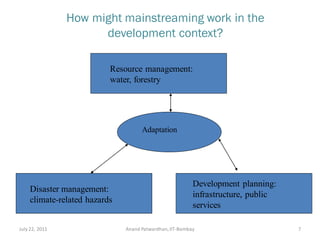
How might mainstreaming work in the
development context?
Disaster management:
climate-related hazards
Development planning:
infrastructure, public
services
Resource management:
water, forestry
Adaptation
Development planning
• Because development planning authority is local,
possibility of mal-adaptation because the climate signal
is at a scale that is not “seen”
– Securing urban water supply
• Outcomes / benefits of development interventions
may be at risk due to climate change
– Energy / coastal infrastructure
• Can a focus on adaptation help catalyze investment to
meet the “adaptation deficit” and thus contribute to
development outcomes?
– Good idea to seek co-benefits, but in the process are we
giving up “new and additional” resources for adaptation?
July 22, 2011 Anand Patwardhan,IIT-Bombay 8
Disaster management
• Short-term coping vs. long-term adaptation
– At what point does coping effectively become
unviable?
• Disaster management often focuses on relief
– In terms of adaptive capacity, what is more
important – ability to reduce immediate impact
vs. ability to restore flow of goods & services?
July 22, 2011 Anand Patwardhan,IIT-Bombay 9
Resource management
• Operational, planning and policy decisions in
key sectors: water, health, conservation &
forest management
– How useful is the 30-year climate normal as the
basis for planning?
• Going from one-time to on-going response
– Does the institutional set-up have the ability to
perceive change, assess it, and formulate
response on an on-going basis?
July 22, 2011 Anand Patwardhan,IIT-Bombay 10
11
Some cautions….
• The adaptation = development conceptualization sounds good,
but could lead to some unfortunate outcomes
• Because adaptation = development, we could assume that
“normal” development actions ought to take care of the
problem, as long as agents (and decisions) are “fully informed”
• If adaptation = development, donor countries could fear that
“normal” development cam get put under adaptation projects,
thus “opening the floodgates” in terms of demand on
resources
August 2014 Anand Patwardhan, UMD/IITB
Moving forward, we should recognize
that climate change……
August 2014 Anand Patwardhan,UMD/IITB 12
• Poses a distinct, additional burden – requiring multilateral
support as per the principles of the Conventions
• The costs of responding to this additional burden would need
to be met through the financial mechanism of the Convention
• That mainstreaming or integration is an approach for putting
adaptation into practice, but does not remove the needs for
funding
• That mainstreaming is neither costless nor automatic
• Our response will need to address both chronic and acute
hazards
Our ongoing work explores these
institutional arrangements
• National Adaptation Plans (NAP’s) are a logical next step
in long-term adaptation and mainstreaming
– Countries want to “do NAP’s” and expect that process to be
supported by the GEF (and other sources)
• There is guidance for doing NAP’s
– But what is likely to come out at the end of a NAP process?
What should come out?
• Goals: Two inter-related questions:
– Where do we want to go?
• The outcomes of a NAP process
– How do we get there?
• The NAP process itself
August 2014 13Anand Patwardhan,UMD/IITB
On-going work
• Identifying the key elements of institutional
arrangements for adaptation
• Comparative analysis of countries to identify
approaches and models being developed for
these institutional arrangements and the
process for getting to them – through case
studies and surveys
• Institutional models – the outcomes of the NAP
process
• Implications for support
August 2014 14Anand Patwardhan,UMD/IITB
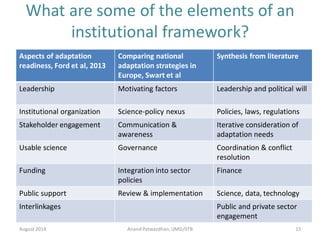
What are some of the elements of an
institutional framework?
Aspects of adaptation
readiness, Ford et al, 2013
Comparing national
adaptation strategies in
Europe, Swart et al
Synthesis from literature
Leadership Motivating factors Leadership and political will
Institutional organization Science-policy nexus Policies, laws, regulations
Stakeholder engagement Communication &
awareness
Iterative consideration of
adaptation needs
Usable science Governance Coordination & conflict
resolution
Funding Integration into sector
policies
Finance
Public support Review & implementation Science, data, technology
Interlinkages Public and private sector
engagement
August 2014 15Anand Patwardhan,UMD/IITB
Comparative Analysis
• Process
– What approaches are countries following as they
seek to mainstream adaptation at the national
level?
• Outcomes
– What is the result of these efforts? What are the
elements of the institutional response?
August 2014 16Anand Patwardhan,UMD/IITB
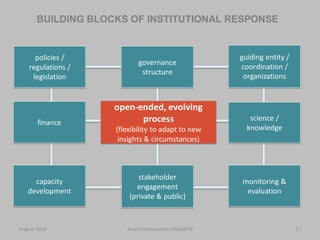
capacity
development
science /
knowledge
guiding entity /
coordination /
organizations
stakeholder
engagement
(private & public)
monitoring &
evaluation
BUILDING BLOCKS OF INSTITUTIONAL RESPONSE
governance
structure
policies /
regulations /
legislation
finance
open-ended, evolving
process
(flexibility to adapt to new
insights & circumstances)
August 2014 17Anand Patwardhan,UMD/IITB
Observations on governance & coordination
• Adaptation is “placed” in different homes – often
environment, but sometimes planning (where this
exists as a separate function)
• Coordination is required both across sectors and
across scale (local – national)
• Need for leadership and political commitment (at
the highest level)
• Need to create interest and incentives for
sustained response and involvement of different
stakeholders
• Link with resource allocation and finance
• Clear identification of authority and power
August 2014 18Anand Patwardhan,UMD/IITB
Observations on finance
• Recognition that a combination of sources will
be required
• Special purpose financing vehicles (trust
funds) vs. general revenues
• Coordination of external resources
(multilateral and bilateral)
• Can private investment provide public co-
benefits in addition to private returns?
August 2014 Anand Patwardhan,UMD/IITB 19
Observations on pathways
• Evolving process, responds to changing circumstances and
priorities
• Assessments and strategies are revisited, on a fairly
consistent ongoing basis
• Linking short-term decisions with long-term strategies
• Developing a strategy is not an overnight process, each
country will follow a different pathway that responds to
the local context, climate risks and the needs of
communities, businesses and the government
• The underlying political economy often determines the
choices that will be made for the process – and the
outcomes
August 2014 20Anand Patwardhan,UMD/IITB
In closing….
• Adaptation is not a one-time activity – requires ongoing action; and
therefore a strong institutional mechanism. Learning and reflexivity need
to be built in to the mechanism
• There is no single model or approach either for the process or the
outcome with regard to institutional arrangements – however, one can
identify a number of building blocks that need to be in place
• The outcome of a ‘NAP process’ ought to be a set of robust and effective
institutional arrangements; and the process itself ought to be a means to
develop a model that is appropriate given the national circumstances and
the political economy
• Challenges
– Supporting an ongoing, somewhat open-ended process, as opposed to
specific, bounded interventions (projects). Process of discovery, rather than a
simple transfer or adoption of “best” practice
– Measurement, monitoring and evaluation – should be a means for learning
that enables planning and design
– Closing thought: But are these arrangements capable of dealing with
transformational response to non-marginal change?
August 2014 21Anand Patwardhan,UMD/IITB
August 2014 Anand Patwardhan,UMD/IITB 22
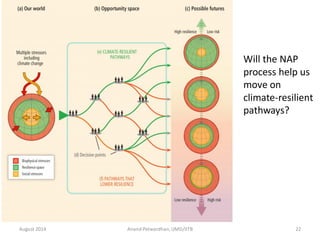
Will the NAP
process help us
move on
climate-resilient
pathways?

Anand Patwardhan, GEF/STAP: Adaptation in the development context

  • 1.
    Adaptation in thedevelopment context Anand Patwardhan University of Maryland, USA and Indian Institute of Technology-Bombay, India NAP Expo Bonn, August 2014
  • 2.
    Shifts in thepolicy narrative • Climate mitigation -> low-carbon growth • Climate adaptation -> climate-resilient development • Recognize the priority of development • Recognize that what is required is a shift in the development pathway • Recognize that for this to happen, stand-alone actions have to be replaced by mainstreamed approaches August 2014 Anand Patwardhan,UMD/IITB 2
  • 3.
    August 2014 3 Scientificassessments reflect the same shift • Adaptation viewed purely as a response (to climate change) (AR1) – Adjustments made in practices, processes or structures of systems to projected or actual changes in climate • Adaptation as an element of scenario-impact assessments (SAR) – Net impacts = Impacts (Vulnerability, Hazard) – Adaptation • Vulnerability and adaptive capacity as issues of importance in their own right (TAR) – Recognition of an “adaptation deficit” • Adaptation as an element of a more complex, process-oriented view of climate-society interaction (AR4) – Concept of mainstreaming • Emphasis on iterative risk management (SREX and AR5) – Importance of learning and reflexivity and for thinking of adaptation as a long-term, on-going process, requiring a robust institutional response Anand Patwardhan,UMD/IITB
  • 4.
    Adaptation as anon-going process of decision-making (AR5 SPM) August 2014 Anand Patwardhan,UMD/IITB 4
  • 5.
    AR5 emphasizes notonly what to do, but what to try and avoid (maladaptation) • Lock-in to solutions that may turn out to be sub-optimal, ineffective, or actually counter-productive. For example, large engineering projects that may be inadequate for future climates, or which preclude alternative approaches such as ecosystem-based adaptation; Intensive use of non-renewable resources (e.g. groundwater) to solve immediate adaptation problem • Awaiting more information, or not doing so, and eventually acting either too early or too late. Awaiting better “projections” rather than using scenario planning and adaptive management approaches • Moral hazard – i.e. encouraging inappropriate risk taking based, for example, on insurance, social security net or aid backup • Adopting actions that ignore local relationships, traditions, traditional knowledge or property rights, or which ignore equity and spillover issues, leading to eventual failure August 2014 Anand Patwardhan,UMD/IITB 5
  • 6.
    This evolution isreflected in the multilateral process • Stage-wise approach to adaptation, starting with enabling activities (assessments & capacity-building) • NAPA’s: Urgent & immediate needs and (additional cost) financing for concrete adaptation projects in LDC’s • NAP’s: Mainstreaming adaptation at the national level and medium to long-term adaptation August 2014 6Anand Patwardhan,UMD/IITB
  • 7.
    July 22, 2011Anand Patwardhan,IIT-Bombay 7 How might mainstreaming work in the development context? Disaster management: climate-related hazards Development planning: infrastructure, public services Resource management: water, forestry Adaptation
  • 8.
    Development planning • Becausedevelopment planning authority is local, possibility of mal-adaptation because the climate signal is at a scale that is not “seen” – Securing urban water supply • Outcomes / benefits of development interventions may be at risk due to climate change – Energy / coastal infrastructure • Can a focus on adaptation help catalyze investment to meet the “adaptation deficit” and thus contribute to development outcomes? – Good idea to seek co-benefits, but in the process are we giving up “new and additional” resources for adaptation? July 22, 2011 Anand Patwardhan,IIT-Bombay 8
  • 9.
    Disaster management • Short-termcoping vs. long-term adaptation – At what point does coping effectively become unviable? • Disaster management often focuses on relief – In terms of adaptive capacity, what is more important – ability to reduce immediate impact vs. ability to restore flow of goods & services? July 22, 2011 Anand Patwardhan,IIT-Bombay 9
  • 10.
    Resource management • Operational,planning and policy decisions in key sectors: water, health, conservation & forest management – How useful is the 30-year climate normal as the basis for planning? • Going from one-time to on-going response – Does the institutional set-up have the ability to perceive change, assess it, and formulate response on an on-going basis? July 22, 2011 Anand Patwardhan,IIT-Bombay 10
  • 11.
    11 Some cautions…. • Theadaptation = development conceptualization sounds good, but could lead to some unfortunate outcomes • Because adaptation = development, we could assume that “normal” development actions ought to take care of the problem, as long as agents (and decisions) are “fully informed” • If adaptation = development, donor countries could fear that “normal” development cam get put under adaptation projects, thus “opening the floodgates” in terms of demand on resources August 2014 Anand Patwardhan, UMD/IITB
  • 12.
    Moving forward, weshould recognize that climate change…… August 2014 Anand Patwardhan,UMD/IITB 12 • Poses a distinct, additional burden – requiring multilateral support as per the principles of the Conventions • The costs of responding to this additional burden would need to be met through the financial mechanism of the Convention • That mainstreaming or integration is an approach for putting adaptation into practice, but does not remove the needs for funding • That mainstreaming is neither costless nor automatic • Our response will need to address both chronic and acute hazards
  • 13.
    Our ongoing workexplores these institutional arrangements • National Adaptation Plans (NAP’s) are a logical next step in long-term adaptation and mainstreaming – Countries want to “do NAP’s” and expect that process to be supported by the GEF (and other sources) • There is guidance for doing NAP’s – But what is likely to come out at the end of a NAP process? What should come out? • Goals: Two inter-related questions: – Where do we want to go? • The outcomes of a NAP process – How do we get there? • The NAP process itself August 2014 13Anand Patwardhan,UMD/IITB
  • 14.
    On-going work • Identifyingthe key elements of institutional arrangements for adaptation • Comparative analysis of countries to identify approaches and models being developed for these institutional arrangements and the process for getting to them – through case studies and surveys • Institutional models – the outcomes of the NAP process • Implications for support August 2014 14Anand Patwardhan,UMD/IITB
  • 15.
    What are someof the elements of an institutional framework? Aspects of adaptation readiness, Ford et al, 2013 Comparing national adaptation strategies in Europe, Swart et al Synthesis from literature Leadership Motivating factors Leadership and political will Institutional organization Science-policy nexus Policies, laws, regulations Stakeholder engagement Communication & awareness Iterative consideration of adaptation needs Usable science Governance Coordination & conflict resolution Funding Integration into sector policies Finance Public support Review & implementation Science, data, technology Interlinkages Public and private sector engagement August 2014 15Anand Patwardhan,UMD/IITB
  • 16.
    Comparative Analysis • Process –What approaches are countries following as they seek to mainstream adaptation at the national level? • Outcomes – What is the result of these efforts? What are the elements of the institutional response? August 2014 16Anand Patwardhan,UMD/IITB
  • 17.
    capacity development science / knowledge guiding entity/ coordination / organizations stakeholder engagement (private & public) monitoring & evaluation BUILDING BLOCKS OF INSTITUTIONAL RESPONSE governance structure policies / regulations / legislation finance open-ended, evolving process (flexibility to adapt to new insights & circumstances) August 2014 17Anand Patwardhan,UMD/IITB
  • 18.
    Observations on governance& coordination • Adaptation is “placed” in different homes – often environment, but sometimes planning (where this exists as a separate function) • Coordination is required both across sectors and across scale (local – national) • Need for leadership and political commitment (at the highest level) • Need to create interest and incentives for sustained response and involvement of different stakeholders • Link with resource allocation and finance • Clear identification of authority and power August 2014 18Anand Patwardhan,UMD/IITB
  • 19.
    Observations on finance •Recognition that a combination of sources will be required • Special purpose financing vehicles (trust funds) vs. general revenues • Coordination of external resources (multilateral and bilateral) • Can private investment provide public co- benefits in addition to private returns? August 2014 Anand Patwardhan,UMD/IITB 19
  • 20.
    Observations on pathways •Evolving process, responds to changing circumstances and priorities • Assessments and strategies are revisited, on a fairly consistent ongoing basis • Linking short-term decisions with long-term strategies • Developing a strategy is not an overnight process, each country will follow a different pathway that responds to the local context, climate risks and the needs of communities, businesses and the government • The underlying political economy often determines the choices that will be made for the process – and the outcomes August 2014 20Anand Patwardhan,UMD/IITB
  • 21.
    In closing…. • Adaptationis not a one-time activity – requires ongoing action; and therefore a strong institutional mechanism. Learning and reflexivity need to be built in to the mechanism • There is no single model or approach either for the process or the outcome with regard to institutional arrangements – however, one can identify a number of building blocks that need to be in place • The outcome of a ‘NAP process’ ought to be a set of robust and effective institutional arrangements; and the process itself ought to be a means to develop a model that is appropriate given the national circumstances and the political economy • Challenges – Supporting an ongoing, somewhat open-ended process, as opposed to specific, bounded interventions (projects). Process of discovery, rather than a simple transfer or adoption of “best” practice – Measurement, monitoring and evaluation – should be a means for learning that enables planning and design – Closing thought: But are these arrangements capable of dealing with transformational response to non-marginal change? August 2014 21Anand Patwardhan,UMD/IITB
  • 22.
    August 2014 AnandPatwardhan,UMD/IITB 22 Will the NAP process help us move on climate-resilient pathways?