SAM HIGGINBOTTOM UNIVERSITY OF AGRICULTURE,
TECHNOLOGY AND SCIENCES
ASSIGNMENT: 1
ON
NATURAL DISASTERS IN INDIA
COURSE CODE: ENVS- 506
SUBMITTED TO : SUBMITTED BY :
DR. EKTA PATHAK MISHRA PRITAM KUMAR BARMAN
ASSISTANT PROFESSOR M.SC. FORESTRY
(Forest Biology & Tree Improvement)
DISASTER
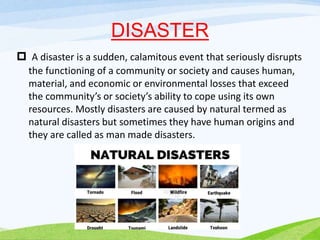
 A disaster is a sudden, calamitous event that seriously disrupts
the functioning of a community or society and causes human,
material, and economic or environmental losses that exceed
the community’s or society’s ability to cope using its own
resources. Mostly disasters are caused by natural termed as
natural disasters but sometimes they have human origins and
they are called as man made disasters.
TYPES OF NATURAL DISASTERS
► Earthquakes
► Cyclones
► Tsunami
► Flood
► Landslide
► Strom(Sand/Wind/Snow)
► Forest fires
► Drought
► Avalanche
► Volcano
DEVELOPMENTS IN DISASTER
MANAGEMENT
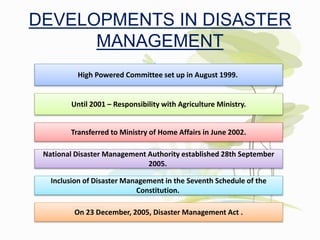
High Powered Committee set up in August 1999.
Until 2001 – Responsibility with Agriculture Ministry.
Transferred to Ministry of Home Affairs in June 2002.
National Disaster Management Authority established 28th September
2005.
Inclusion of Disaster Management in the Seventh Schedule of the
Constitution.
On 23 December, 2005, Disaster Management Act .
CYCLONE AMPHAN
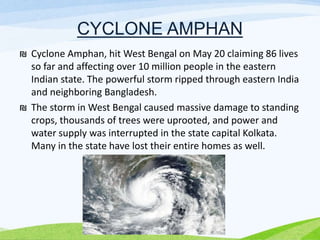
₪ Cyclone Amphan, hit West Bengal on May 20 claiming 86 lives
so far and affecting over 10 million people in the eastern
Indian state. The powerful storm ripped through eastern India
and neighboring Bangladesh.
₪ The storm in West Bengal caused massive damage to standing
crops, thousands of trees were uprooted, and power and
water supply was interrupted in the state capital Kolkata.
Many in the state have lost their entire homes as well.
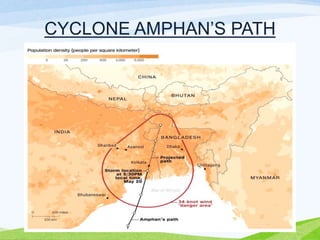
CYCLONE AMPHAN’S PATH
₪ According to the Regional Meteorological Centre at Alipore in
Kolkata, the landfall started at 2.30 p.m. and continued till 7
p.m. The landfall was reported near Sagar Island of the
Sunderbans between Digha in Purba Medinipur and Hatia in
Bangladesh.
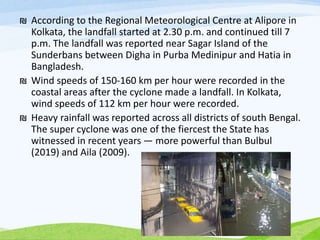
₪ Wind speeds of 150-160 km per hour were recorded in the
coastal areas after the cyclone made a landfall. In Kolkata,
wind speeds of 112 km per hour were recorded.
₪ Heavy rainfall was reported across all districts of south Bengal.
The super cyclone was one of the fiercest the State has
witnessed in recent years — more powerful than Bulbul
(2019) and Aila (2009).
₪ Three persons were killed as super cyclonic storm Amphan
made landfall near Sagar Islands in South 24 Parganas
district of West Bengal on Wednesday, while a baby died in
Bhadrak district of Odisha and a woman drowned in
Kendrapara.
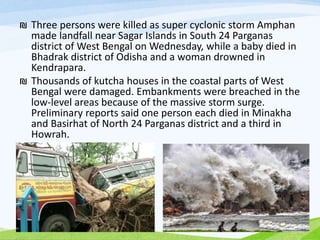
₪ Thousands of kutcha houses in the coastal parts of West
Bengal were damaged. Embankments were breached in the
low-level areas because of the massive storm surge.
Preliminary reports said one person each died in Minakha
and Basirhat of North 24 Parganas district and a third in
Howrah.
ASSAM FLOODS
₪ Heavy rainfall and flooding of the Brahmaputra river in May
came at a heavy cost for Assam with casualties and
widespread destruction of property and agriculture.
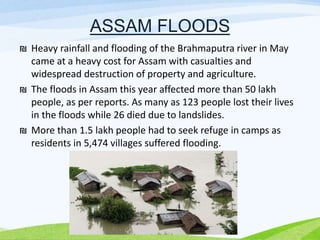
₪ The floods in Assam this year affected more than 50 lakh
people, as per reports. As many as 123 people lost their lives
in the floods while 26 died due to landslides.
₪ More than 1.5 lakh people had to seek refuge in camps as
residents in 5,474 villages suffered flooding.
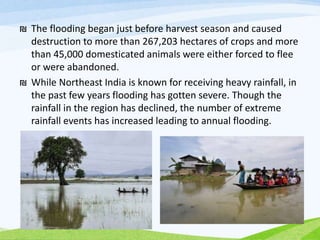
₪ The flooding began just before harvest season and caused
destruction to more than 267,203 hectares of crops and more
than 45,000 domesticated animals were either forced to flee
or were abandoned.
₪ While Northeast India is known for receiving heavy rainfall, in
the past few years flooding has gotten severe. Though the
rainfall in the region has declined, the number of extreme
rainfall events has increased leading to annual flooding.
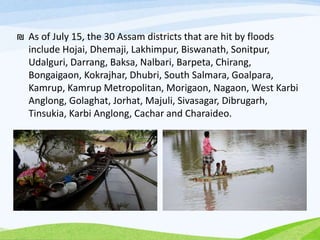
₪ As of July 15, the 30 Assam districts that are hit by floods
include Hojai, Dhemaji, Lakhimpur, Biswanath, Sonitpur,
Udalguri, Darrang, Baksa, Nalbari, Barpeta, Chirang,
Bongaigaon, Kokrajhar, Dhubri, South Salmara, Goalpara,
Kamrup, Kamrup Metropolitan, Morigaon, Nagaon, West Karbi
Anglong, Golaghat, Jorhat, Majuli, Sivasagar, Dibrugarh,
Tinsukia, Karbi Anglong, Cachar and Charaideo.
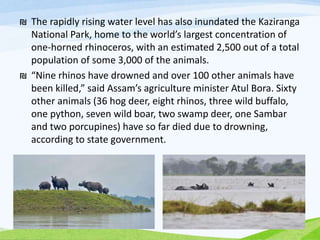
₪ The rapidly rising water level has also inundated the Kaziranga
National Park, home to the world’s largest concentration of
one-horned rhinoceros, with an estimated 2,500 out of a total
population of some 3,000 of the animals.
₪ “Nine rhinos have drowned and over 100 other animals have
been killed,” said Assam’s agriculture minister Atul Bora. Sixty
other animals (36 hog deer, eight rhinos, three wild buffalo,
one python, seven wild boar, two swamp deer, one Sambar
and two porcupines) have so far died due to drowning,
according to state government.
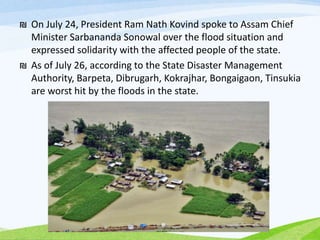
₪ On July 24, President Ram Nath Kovind spoke to Assam Chief
Minister Sarbananda Sonowal over the flood situation and
expressed solidarity with the affected people of the state.
₪ As of July 26, according to the State Disaster Management
Authority, Barpeta, Dibrugarh, Kokrajhar, Bongaigaon, Tinsukia
are worst hit by the floods in the state.
CONCLUSION
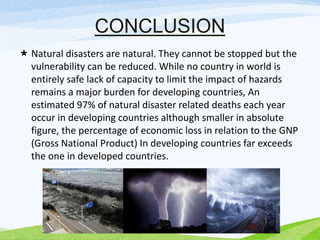
 Natural disasters are natural. They cannot be stopped but the
vulnerability can be reduced. While no country in world is
entirely safe lack of capacity to limit the impact of hazards
remains a major burden for developing countries, An
estimated 97% of natural disaster related deaths each year
occur in developing countries although smaller in absolute
figure, the percentage of economic loss in relation to the GNP
(Gross National Product) In developing countries far exceeds
the one in developed countries.
THANK YOU

Natural disasters in india

  • 1.
    SAM HIGGINBOTTOM UNIVERSITYOF AGRICULTURE, TECHNOLOGY AND SCIENCES ASSIGNMENT: 1 ON NATURAL DISASTERS IN INDIA COURSE CODE: ENVS- 506 SUBMITTED TO : SUBMITTED BY : DR. EKTA PATHAK MISHRA PRITAM KUMAR BARMAN ASSISTANT PROFESSOR M.SC. FORESTRY (Forest Biology & Tree Improvement)
  • 2.
    DISASTER  A disasteris a sudden, calamitous event that seriously disrupts the functioning of a community or society and causes human, material, and economic or environmental losses that exceed the community’s or society’s ability to cope using its own resources. Mostly disasters are caused by natural termed as natural disasters but sometimes they have human origins and they are called as man made disasters.
  • 3.
    TYPES OF NATURALDISASTERS ► Earthquakes ► Cyclones ► Tsunami ► Flood ► Landslide ► Strom(Sand/Wind/Snow) ► Forest fires ► Drought ► Avalanche ► Volcano
  • 4.
    DEVELOPMENTS IN DISASTER MANAGEMENT HighPowered Committee set up in August 1999. Until 2001 – Responsibility with Agriculture Ministry. Transferred to Ministry of Home Affairs in June 2002. National Disaster Management Authority established 28th September 2005. Inclusion of Disaster Management in the Seventh Schedule of the Constitution. On 23 December, 2005, Disaster Management Act .
  • 5.
    CYCLONE AMPHAN ₪ CycloneAmphan, hit West Bengal on May 20 claiming 86 lives so far and affecting over 10 million people in the eastern Indian state. The powerful storm ripped through eastern India and neighboring Bangladesh. ₪ The storm in West Bengal caused massive damage to standing crops, thousands of trees were uprooted, and power and water supply was interrupted in the state capital Kolkata. Many in the state have lost their entire homes as well.
  • 6.
  • 7.
    ₪ According tothe Regional Meteorological Centre at Alipore in Kolkata, the landfall started at 2.30 p.m. and continued till 7 p.m. The landfall was reported near Sagar Island of the Sunderbans between Digha in Purba Medinipur and Hatia in Bangladesh. ₪ Wind speeds of 150-160 km per hour were recorded in the coastal areas after the cyclone made a landfall. In Kolkata, wind speeds of 112 km per hour were recorded. ₪ Heavy rainfall was reported across all districts of south Bengal. The super cyclone was one of the fiercest the State has witnessed in recent years — more powerful than Bulbul (2019) and Aila (2009).
  • 8.
    ₪ Three personswere killed as super cyclonic storm Amphan made landfall near Sagar Islands in South 24 Parganas district of West Bengal on Wednesday, while a baby died in Bhadrak district of Odisha and a woman drowned in Kendrapara. ₪ Thousands of kutcha houses in the coastal parts of West Bengal were damaged. Embankments were breached in the low-level areas because of the massive storm surge. Preliminary reports said one person each died in Minakha and Basirhat of North 24 Parganas district and a third in Howrah.
  • 9.
    ASSAM FLOODS ₪ Heavyrainfall and flooding of the Brahmaputra river in May came at a heavy cost for Assam with casualties and widespread destruction of property and agriculture. ₪ The floods in Assam this year affected more than 50 lakh people, as per reports. As many as 123 people lost their lives in the floods while 26 died due to landslides. ₪ More than 1.5 lakh people had to seek refuge in camps as residents in 5,474 villages suffered flooding.
  • 10.
    ₪ The floodingbegan just before harvest season and caused destruction to more than 267,203 hectares of crops and more than 45,000 domesticated animals were either forced to flee or were abandoned. ₪ While Northeast India is known for receiving heavy rainfall, in the past few years flooding has gotten severe. Though the rainfall in the region has declined, the number of extreme rainfall events has increased leading to annual flooding.
  • 11.
    ₪ As ofJuly 15, the 30 Assam districts that are hit by floods include Hojai, Dhemaji, Lakhimpur, Biswanath, Sonitpur, Udalguri, Darrang, Baksa, Nalbari, Barpeta, Chirang, Bongaigaon, Kokrajhar, Dhubri, South Salmara, Goalpara, Kamrup, Kamrup Metropolitan, Morigaon, Nagaon, West Karbi Anglong, Golaghat, Jorhat, Majuli, Sivasagar, Dibrugarh, Tinsukia, Karbi Anglong, Cachar and Charaideo.
  • 12.
    ₪ The rapidlyrising water level has also inundated the Kaziranga National Park, home to the world’s largest concentration of one-horned rhinoceros, with an estimated 2,500 out of a total population of some 3,000 of the animals. ₪ “Nine rhinos have drowned and over 100 other animals have been killed,” said Assam’s agriculture minister Atul Bora. Sixty other animals (36 hog deer, eight rhinos, three wild buffalo, one python, seven wild boar, two swamp deer, one Sambar and two porcupines) have so far died due to drowning, according to state government.
  • 13.
    ₪ On July24, President Ram Nath Kovind spoke to Assam Chief Minister Sarbananda Sonowal over the flood situation and expressed solidarity with the affected people of the state. ₪ As of July 26, according to the State Disaster Management Authority, Barpeta, Dibrugarh, Kokrajhar, Bongaigaon, Tinsukia are worst hit by the floods in the state.
  • 14.
    CONCLUSION  Natural disastersare natural. They cannot be stopped but the vulnerability can be reduced. While no country in world is entirely safe lack of capacity to limit the impact of hazards remains a major burden for developing countries, An estimated 97% of natural disaster related deaths each year occur in developing countries although smaller in absolute figure, the percentage of economic loss in relation to the GNP (Gross National Product) In developing countries far exceeds the one in developed countries.
  • 15.