The Element Neon
 Atomic Number: 10
 Atomic Weight: 20.1797
 Melting Point: 24.56 K (-248.59°C or -415.46°F)
 Boiling Point: 27.07 K (-246.08°C or -410.94°F)
 Density: 0.0008999 grams per cubic centimeter
 Phase at Room Temperature: Gas
 Element Classification: Non-metal
 Period Number: 2 Group Number: 18 Group Name: Noble
  Gas
 Electronic Configuration: [He]2s22p6
 Number of Stable Isotopes: 3
History
 Neon was discovered by Sir William Ramsay, a
  Scottish chemist, and Morris M. Travers, an English
  chemist, shortly after their discovery of the element
  krypton in 1898. Like krypton, neon was discovered
  through the study of liquefied air. Although neon is the
  fourth most abundant element in the universe, only
  0.0018% of the earth's atmosphere is neon.
Occurence
Neon is widely distributed in the entire Universe. The
 thermonuclear reactions between carbon and oxygen,
 that occur in the stars cores and are responsible for its
 high temperatures, can eventually create neon. Some
 of these stars explode, originating novas or
 supernovas, releasing huge amounts of gas,
 responsible for the existence of neon in clouds of
 interstellar gas. Probably, neon was part of the
 condensing material that originated the Earth, being
 later freed to the atmosphere by the erosion of the
 rocks in the crust. However, most of the neon that
 occurs in the Earth refers to its formation period. It is
 extracted from liquefied by fractional distillation. It is
 found in the atmosphere.
Uses
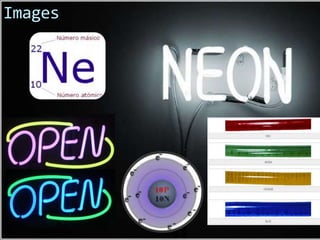
Neon is the gas responsible for the orange-red colour
 discharge seen in the discharge tubes used for
 advertising purposes. A blue or green coloration in the
 discharge can be obtained by adding a little mercury
 to the neon in the discharge tube. The largest use for
 neon gas is in advertising signs. Neon is also used to
 make high voltage indicators and is combined with
 helium to make helium-neon lasers. Liquid neon is
 used as a cryogenic refrigerant. Neon is highly inert
 and forms no known compounds, although there is
 some evidence that it could form a compound with
 fluorine.
Images

Neon

  • 2.
    The Element Neon Atomic Number: 10  Atomic Weight: 20.1797  Melting Point: 24.56 K (-248.59°C or -415.46°F)  Boiling Point: 27.07 K (-246.08°C or -410.94°F)  Density: 0.0008999 grams per cubic centimeter  Phase at Room Temperature: Gas  Element Classification: Non-metal  Period Number: 2 Group Number: 18 Group Name: Noble Gas  Electronic Configuration: [He]2s22p6  Number of Stable Isotopes: 3
  • 3.
    History  Neon wasdiscovered by Sir William Ramsay, a Scottish chemist, and Morris M. Travers, an English chemist, shortly after their discovery of the element krypton in 1898. Like krypton, neon was discovered through the study of liquefied air. Although neon is the fourth most abundant element in the universe, only 0.0018% of the earth's atmosphere is neon.
  • 4.
    Occurence Neon is widelydistributed in the entire Universe. The thermonuclear reactions between carbon and oxygen, that occur in the stars cores and are responsible for its high temperatures, can eventually create neon. Some of these stars explode, originating novas or supernovas, releasing huge amounts of gas, responsible for the existence of neon in clouds of interstellar gas. Probably, neon was part of the condensing material that originated the Earth, being later freed to the atmosphere by the erosion of the rocks in the crust. However, most of the neon that occurs in the Earth refers to its formation period. It is extracted from liquefied by fractional distillation. It is found in the atmosphere.
  • 5.
    Uses Neon is thegas responsible for the orange-red colour discharge seen in the discharge tubes used for advertising purposes. A blue or green coloration in the discharge can be obtained by adding a little mercury to the neon in the discharge tube. The largest use for neon gas is in advertising signs. Neon is also used to make high voltage indicators and is combined with helium to make helium-neon lasers. Liquid neon is used as a cryogenic refrigerant. Neon is highly inert and forms no known compounds, although there is some evidence that it could form a compound with fluorine.
  • 6.