BFSA
Slide by Brian F S Allen
BFSA
BFSA
Ultrasound Probe and Needle
Movements
Brian Allen
07/2014
BFSA
Slide by Brian F S Allen
BFSA
BFSA
Ultrasound Probe Movements
• PARRT Mnemonic
• Pressure
• Alignment
• Rotation
• Rocking
• Tilt
BFSA
Slide by Brian F S Allen
BFSA
BFSA
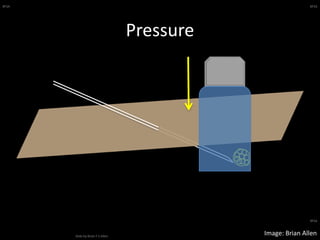
Pressure
Image: Brian Allen
BFSA
Slide by Brian F S Allen
BFSA
BFSA
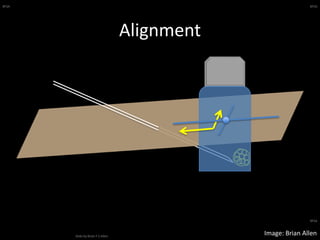
Alignment
Image: Brian Allen
BFSA
Slide by Brian F S Allen
BFSA
BFSA
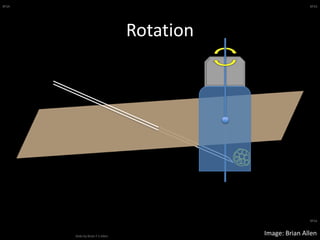
Rotation
Image: Brian Allen
BFSA
Slide by Brian F S Allen
BFSA
BFSA
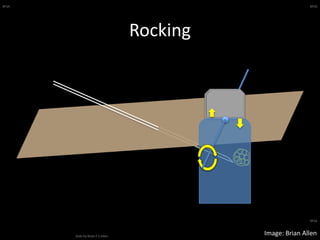
Rocking
Image: Brian Allen
BFSA
Slide by Brian F S Allen
BFSA
BFSA
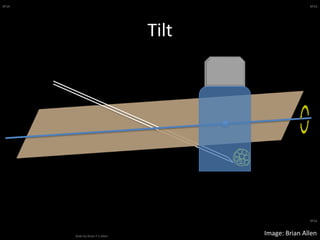
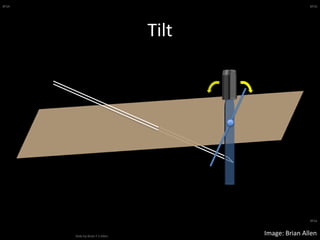
Tilt
Image: Brian Allen
BFSA
Slide by Brian F S Allen
BFSA
BFSA
Tilt
Image: Brian Allen
BFSA
Slide by Brian F S Allen
BFSA
BFSA
Needle Movements
• PACCTT Mnemonic
• Pivot
• Advance/Withdraw
• Cant
• Curve
• Translate
• Tip Superficial or Deep
BFSA
Slide by Brian F S Allen
BFSA
BFSA
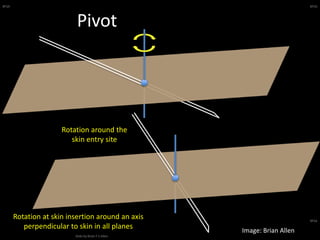
Pivot
Rotation around the
skin entry site
Rotation at skin insertion around an axis
perpendicular to skin in all planes
Image: Brian Allen
BFSA
Slide by Brian F S Allen
BFSA
BFSA
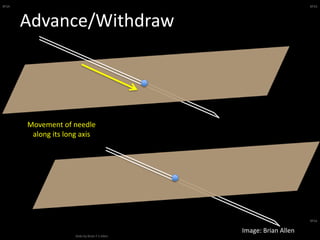
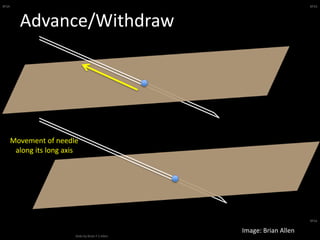
Advance/Withdraw
Movement of needle
along its long axis
Image: Brian Allen
BFSA
Slide by Brian F S Allen
BFSA
BFSA
Advance/Withdraw
Movement of needle
along its long axis
Image: Brian Allen
BFSA
Slide by Brian F S Allen
BFSA
BFSA
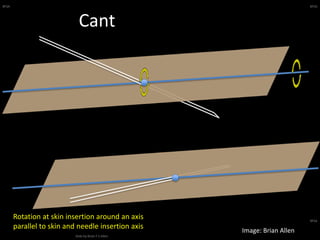
Cant
Rotation at skin insertion around an axis
parallel to skin and needle insertion axis
Image: Brian Allen
BFSA
Slide by Brian F S Allen
BFSA
BFSA
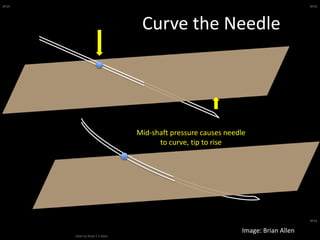
Curve the Needle
Mid-shaft pressure causes needle
to curve, tip to rise
Image: Brian Allen
BFSA
Slide by Brian F S Allen
BFSA
BFSA
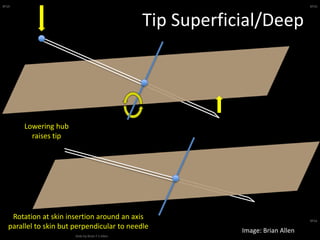
Tip Superficial/Deep
Lowering hub
raises tip
Rotation at skin insertion around an axis
parallel to skin but perpendicular to needle
Image: Brian Allen
BFSA
Slide by Brian F S Allen
BFSA
BFSA
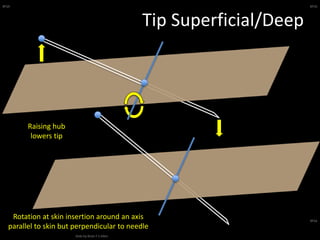
Tip Superficial/Deep
Rotation at skin insertion around an axis
parallel to skin but perpendicular to needle
Raising hub
lowers tip
BFSA
Slide by Brian F S Allen
BFSA
BFSA
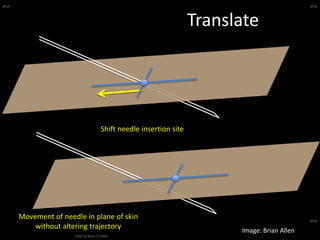
Translate
Shift needle insertion site
Movement of needle in plane of skin
without altering trajectory
Image: Brian Allen

Needle probe movement for regional anesthesia

  • 1.
    BFSA Slide by BrianF S Allen BFSA BFSA Ultrasound Probe and Needle Movements Brian Allen 07/2014
  • 2.
    BFSA Slide by BrianF S Allen BFSA BFSA Ultrasound Probe Movements • PARRT Mnemonic • Pressure • Alignment • Rotation • Rocking • Tilt
  • 3.
    BFSA Slide by BrianF S Allen BFSA BFSA Pressure Image: Brian Allen
  • 4.
    BFSA Slide by BrianF S Allen BFSA BFSA Alignment Image: Brian Allen
  • 5.
    BFSA Slide by BrianF S Allen BFSA BFSA Rotation Image: Brian Allen
  • 6.
    BFSA Slide by BrianF S Allen BFSA BFSA Rocking Image: Brian Allen
  • 7.
    BFSA Slide by BrianF S Allen BFSA BFSA Tilt Image: Brian Allen
  • 8.
    BFSA Slide by BrianF S Allen BFSA BFSA Tilt Image: Brian Allen
  • 9.
    BFSA Slide by BrianF S Allen BFSA BFSA Needle Movements • PACCTT Mnemonic • Pivot • Advance/Withdraw • Cant • Curve • Translate • Tip Superficial or Deep
  • 10.
    BFSA Slide by BrianF S Allen BFSA BFSA Pivot Rotation around the skin entry site Rotation at skin insertion around an axis perpendicular to skin in all planes Image: Brian Allen
  • 11.
    BFSA Slide by BrianF S Allen BFSA BFSA Advance/Withdraw Movement of needle along its long axis Image: Brian Allen
  • 12.
    BFSA Slide by BrianF S Allen BFSA BFSA Advance/Withdraw Movement of needle along its long axis Image: Brian Allen
  • 13.
    BFSA Slide by BrianF S Allen BFSA BFSA Cant Rotation at skin insertion around an axis parallel to skin and needle insertion axis Image: Brian Allen
  • 14.
    BFSA Slide by BrianF S Allen BFSA BFSA Curve the Needle Mid-shaft pressure causes needle to curve, tip to rise Image: Brian Allen
  • 15.
    BFSA Slide by BrianF S Allen BFSA BFSA Tip Superficial/Deep Lowering hub raises tip Rotation at skin insertion around an axis parallel to skin but perpendicular to needle Image: Brian Allen
  • 16.
    BFSA Slide by BrianF S Allen BFSA BFSA Tip Superficial/Deep Rotation at skin insertion around an axis parallel to skin but perpendicular to needle Raising hub lowers tip
  • 17.
    BFSA Slide by BrianF S Allen BFSA BFSA Translate Shift needle insertion site Movement of needle in plane of skin without altering trajectory Image: Brian Allen

Editor's Notes

  • #11 This movement
  • #12 This is the most obvious of needle movements, and the most dangerous, especially if not done under visualization. Advancement should be done carefully, with visualization of the tip and entire shaft of the needle when possible. At steeper angles, visualization becomes necessarily poor and extra care is warranted. Advancement should never be done off-screen except for the first centimeter after needle insertion if the path has been previously well scouted and is free of neural or vascular structures. Withdrawal of the needle does not carry the same risks as advancement, but it should not be done lightly either. Often, if the needle has been advanced in a non-ideal path, the first response will be to pull back and make another pass. However, you should always consider whether you can alter your needle path using other maneuvers such as tipping the needle rather than pulling back the needle and creating another needle track.
  • #13 This is the most obvious of needle movements, and the most dangerous, especially if not done under visualization. Advancement should be done carefully, with visualization of the tip and entire shaft of the needle when possible. At steeper angles, visualization becomes necessarily poor and extra care is warranted. Advancement should never be done off-screen except for the first centimeter after needle insertion if the path has been previously well scouted and is free of neural or vascular structures. Withdrawal of the needle does not carry the same risks as advancement, but it should not be done lightly either. Often, if the needle has been advanced in a non-ideal path, the first response will be to pull back and make another pass. However, you should always consider whether you can alter your needle path using other maneuvers such as tipping the needle rather than pulling back the needle and creating another needle track.
  • #14 This movement
  • #15 This is an advanced technique, usually only possible with flexible needles. It involves using a finger to apply pressure to the shaft of a needle that has already entered the skin. Applying midshaft pressure causes the needle to assume a “C” shape and causes the tip to move in an opposite direction to the pressure applied. For example, pressing down on the shaft causes the tip to rise, and vice versa. This is only possible with flexible needles. It is most useful for passing by and curving around targets, especially when a target is too deep and when enough of the needle has been inserted so that tipping deep or superficial is ineffective. Creative Commons
  • #16 With that advice in mind, tipping the needle either up or down can greatly alter needle course and salvage a non-ideal needle pass. When instructing someone or receiving verbal instructions from someone, this is the hardest command to convey or understand. You could say “tip up” or “tip down,” but often, this causes confusion: when you say “tip up,” the trainee has to resist the urge to lift the hub up, pushing the tip down. Thus, superficial and deep may be more clear. Tip superficial requires the hub to be lowered to raise the tip and “Tip deep” vice versa. This maneuver is most successful when either little of the needle has been inserted thru the skin or the needle is a large bore, stiff needle. If too much of a flexible needle has been inserted and this maneuver is attempted, the needle will actually curve and cause tip deflection opposite to what is desired.
  • #17 With that advice in mind, tipping the needle either up or down can greatly alter needle course and salvage a non-ideal needle pass. When instructing someone or receiving verbal instructions from someone, this is the hardest command to convey or understand. You could say “tip up” or “tip down,” but often, this causes confusion: when you say “tip up,” the trainee has to resist the urge to lift the hub up, pushing the tip down. Thus, superficial and deep may be more clear. Tip superficial requires the hub to be lowered to raise the tip and “Tip deep” vice versa. This maneuver is most successful when either little of the needle has been inserted thru the skin or the needle is a large bore, stiff needle. If too much of a flexible needle has been inserted and this maneuver is attempted, the needle will actually curve and cause tip deflection opposite to what is desired.
  • #18 Translation is needle movement in the same plane as the skin without altering the angle of needle incidence or advancing or withdrawing. It is useful when one is trying to shift the needle insertion site to line up better with the ultrasound probe. It is only effective when very little of the needle has been inserted through the skin (usually < 1 cm). It is a highly underutilized techniques, especially for midline lumbar epidurals where it is my go-to technique for slipping under spinous processes.