Needle Free Injection Technology
Advantages of Needle Free
Injection Systems
2
Needle Free Injection Technology
Audience
Medical & Health Boards
Humanitarian Foundations
and Organizations
I represent manufacturers
and developers of needle
free injection technology.
3
Needle Free Injection Technology
Companies
4
Needle Free Injections
Introduction
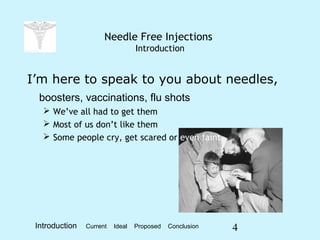
I’m here to speak to you about needles,
boosters, vaccinations, flu shots
 We’ve all had to get them
 Most of us don’t like them
 Some people cry, get scared or even faint
Introduction Current Ideal Proposed Conclusion
5
Needle Free Injections
Introduction
Goal of this presentation:
Present alternative methods of medication
delivery.
Discuss the features and advantages of
needle free injection systems over
traditional hypodermic needles in the
administration of serums, vaccinations and
other medicines.
Introduction Current Ideal Proposed Conclusion
6
Needle Free Injections
Introduction
The Problem
 Vaccinations & inoculations
The Current Method
 Hypodermic needles
The Ideal Solution
 Efficient, cost effective
The Proposed Method
 Needle free injectors
Introduction Current Ideal Proposed Conclusion
7
Needle Free Injections
Contents
1. Current Method
 Hypodermic Needles
 Development
 Description
 Advantages
 Problems
2. Ideal Solution
3. Proposed Solution
 Alternative Delivery
Systems
 Needle Free Injectors
 Development
 Description
 Advantages
 Problems
4. Conclusion
Introduction Current Ideal Proposed Conclusion
8
Needle Free Injections
1. Current
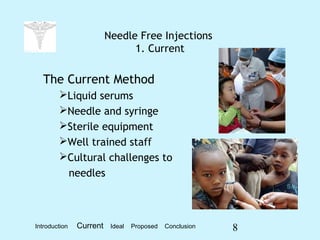
The Current Method
Liquid serums
Needle and syringe
Sterile equipment
Well trained staff
Cultural challenges to
needles
Introduction Current Ideal Proposed Conclusion
9
Needle Free Injections
Development
Hypodermic Needle - a brief history
1844 Irish physician Francis Rynd invented the
hollow needle.
1853 French physician Charles Pravaz &
Edinburgh physician Alexander Wood
independently developed the first practical metal
syringe adding a hollow needle to the end of a
glass syringe.
Introduction Current Ideal Proposed Conclusion
10
Needle Free Injections
Development
An Early Hypodermic Needle
Glass tube
& plunger
Hollow steel
needle
Introduction Current Ideal Proposed Conclusion
11
Needle Free Injections
Description
The Modern Hypodermic Needle
Plastic Syringe &
Plunger
Stainless Steel
Needle in Plastic Tip
Introduction Current Ideal Proposed Conclusion
12
Needle Free Injections
Advantages
Hypodermic Needles are
Inexpensive – needle & syringe
Versatile – wide variety of medicines
Familiar – well known technology
Scaleable – various syringe sizes accommodate different
doses
Introduction Current Ideal Proposed Conclusion
($22.95 for 100 1cc size)
($41.75 for 100 5cc size)
($42.75 for 100 10cc
size)
13
Needle Free Injections
Problems
Hypodermic Needle problems
Needlephobia
Substantial training required
Difficult to insert needle to correct depth
Necessary to aspirate the needle to ensure not
hitting a blood vessel
Keeping the needle steady
Introduction Current Ideal Proposed Conclusion
14
Needle Free Injections
Problems
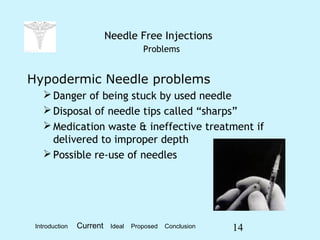
Hypodermic Needle problems
Danger of being stuck by used needle
Disposal of needle tips called “sharps”
Medication waste & ineffective treatment if
delivered to improper depth
Possible re-use of needles
Introduction Current Ideal Proposed Conclusion
15
Needle Free Injections
2. Ideal Solution
Ideal Solution
Inexpensive
Low-level of Training
Powdered medication (refrigeration, transport)
Non invasive (nothing penetrates the skin except the
medicine)
Dispel Needlephobia
Disposable (no reuse or accidental stick injuries)
Introduction Current Ideal Proposed Conclusion
16
Needle Free Injections
3. Proposed Solution
The Proposed Method
Needle Free Injection Technology
Safe, clean, efficient
Easy to use, reliable
Various types of medicines
Introduction Current Ideal Proposed Conclusion
17
Needle Free Injections
Alternates
Alternative medication delivery systems
include:
 nasal sprays and drops
 skin patches such as nitroglycerin patches for heart
patients
 inhalers for asthma which deliver pre-measured doses into
the lungs for rapid absorption into the bloodstream
 edible vaccine-packed vegetables (in 1998 potatoes
developed with genes from the cholera virus to protect
against cholera)
Introduction Current Ideal Proposed Conclusion
18
Needle Free Injections
Development
Needle Free Injector Systems
1940s & 1950s air powered injector systems
Gun shaped used propellant gases to force drugs
into the skin
Multiple inoculations in the
military and developing nations
Reusable – risk of infection
Introduction Current Ideal Proposed Conclusion
19
Needle Free Injections
Development
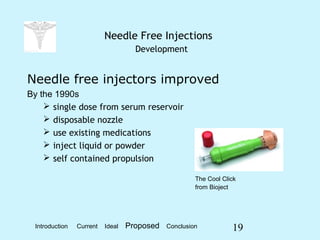
Needle free injectors improved
By the 1990s
 single dose from serum reservoir
 disposable nozzle
 use existing medications
 inject liquid or powder
 self contained propulsion
The Cool Click
from Bioject
Introduction Current Ideal Proposed Conclusion
20
Needle Free Injections
Description
How Needle Free Injectors Work
force medication at high speed through a tiny
hole that is held against the skin
ultra-fine stream of high-pressure fluid or powder
penetrates the skin to various depths
intradermal, subcutaneous, & intramuscular
Introduction Current Ideal Proposed Conclusion
21
Needle Free Injections
Description
Injection modes
Intradermal – very shallow between layers of skin
Subcutaneous – adipose or into the fat layer of the skin
Intramuscular – deepest type, into muscle tissue
Intradermal Subcutaneous Intramuscular
Introduction Current Ideal Proposed Conclusion
22
Needle Free Injections
Description
Injector design: 3 components
Injection device – hand held durable plastic
  Disposable needle free syringe – only part that touches
the skin, sterilized and disposable after injection
  Air cartridge – pressurized metal air cartridge in portable
units
- larger air container hook ups for in-office systems
Introduction Current Ideal Proposed Conclusion
23
Needle Free Injections
Description
Injector design:
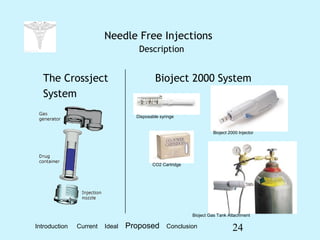
Crossject uses the impact of a spring triggered by the nozzle
touching the skin to activate energetic materials which
produce gas to inject the serum.
Other systems use a re-usable spring to generate the pushing
force instead of air.
Introduction Current Ideal Proposed Conclusion
24
Needle Free Injections
Description
The Crossject Bioject 2000 System
System
Disposable syringe
CO2 Cartridge
Bioject 2000 Injector
Bioject Gas Tank Attachment
Introduction Current Ideal Proposed Conclusion
25
Needle Free Injections
Advantages
Needle Free Injectors
Advantages:
 less drug required to inject the same volume
approximately 8% savings in vaccine
 improved diffusion and more reliable depth of penetration
 reliable penetration means more efficient use of drugs
Introduction Current Ideal Proposed Conclusion
26
Needle Free Injections
Advantages
Needle Free Injectors
Advantages:
 improved safety and protecting against infection
 higher self-treatment rates
 operate with existing formulations which reduces
development and clinical trials, and that equals savings
Introduction Current Ideal Proposed Conclusion
27
Needle Free Injections
Problems
Needle Free Injectors however…
are more expensive, for example:
  
Biojector® 2000 Injector $1200.00
Single use, sterile, disposable needle-free
syringes $200.00 (100 syringes per box)
Box of CO2
power cartridges $8.00
(10 CO2
cartridges per box)
Introduction Current Ideal Proposed Conclusion
28
Needle Free Injections
Conclusion
Recap:
Hypodermic Needles
difficult to master (training)
not always effective
safety issues (stick injuries, reuse)
disposal issues
just not well liked (needlephobia)
inexpensive
Introduction Current Ideal Proposed Conclusion
29
Needle Free Injections
Conclusion
Recap:
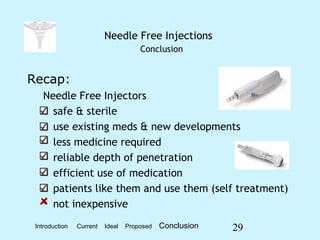
Needle Free Injectors
safe & sterile
use existing meds & new developments
less medicine required
reliable depth of penetration
efficient use of medication
patients like them and use them (self treatment)
not inexpensive
Introduction Current Ideal Proposed Conclusion
30
Needle Free Injections
Conclusion
Conclusion:
Needle Free Injectors are more reliable, easier to
use, more efficient, much safer and have no
disposal problems. Acceptance by patients,
continuing developments and lowering costs all
make needle free systems the best method for
vaccinations, insulin self-treatments, and large or
small scale inoculations.
Introduction Current Ideal Proposed Conclusion
31
Needle Free Injection Technology
Thank you

Needle Free Injectors

  • 1.
    Needle Free InjectionTechnology Advantages of Needle Free Injection Systems
  • 2.
    2 Needle Free InjectionTechnology Audience Medical & Health Boards Humanitarian Foundations and Organizations I represent manufacturers and developers of needle free injection technology.
  • 3.
    3 Needle Free InjectionTechnology Companies
  • 4.
    4 Needle Free Injections Introduction I’mhere to speak to you about needles, boosters, vaccinations, flu shots  We’ve all had to get them  Most of us don’t like them  Some people cry, get scared or even faint Introduction Current Ideal Proposed Conclusion
  • 5.
    5 Needle Free Injections Introduction Goalof this presentation: Present alternative methods of medication delivery. Discuss the features and advantages of needle free injection systems over traditional hypodermic needles in the administration of serums, vaccinations and other medicines. Introduction Current Ideal Proposed Conclusion
  • 6.
    6 Needle Free Injections Introduction TheProblem  Vaccinations & inoculations The Current Method  Hypodermic needles The Ideal Solution  Efficient, cost effective The Proposed Method  Needle free injectors Introduction Current Ideal Proposed Conclusion
  • 7.
    7 Needle Free Injections Contents 1.Current Method  Hypodermic Needles  Development  Description  Advantages  Problems 2. Ideal Solution 3. Proposed Solution  Alternative Delivery Systems  Needle Free Injectors  Development  Description  Advantages  Problems 4. Conclusion Introduction Current Ideal Proposed Conclusion
  • 8.
    8 Needle Free Injections 1.Current The Current Method Liquid serums Needle and syringe Sterile equipment Well trained staff Cultural challenges to needles Introduction Current Ideal Proposed Conclusion
  • 9.
    9 Needle Free Injections Development HypodermicNeedle - a brief history 1844 Irish physician Francis Rynd invented the hollow needle. 1853 French physician Charles Pravaz & Edinburgh physician Alexander Wood independently developed the first practical metal syringe adding a hollow needle to the end of a glass syringe. Introduction Current Ideal Proposed Conclusion
  • 10.
    10 Needle Free Injections Development AnEarly Hypodermic Needle Glass tube & plunger Hollow steel needle Introduction Current Ideal Proposed Conclusion
  • 11.
    11 Needle Free Injections Description TheModern Hypodermic Needle Plastic Syringe & Plunger Stainless Steel Needle in Plastic Tip Introduction Current Ideal Proposed Conclusion
  • 12.
    12 Needle Free Injections Advantages HypodermicNeedles are Inexpensive – needle & syringe Versatile – wide variety of medicines Familiar – well known technology Scaleable – various syringe sizes accommodate different doses Introduction Current Ideal Proposed Conclusion ($22.95 for 100 1cc size) ($41.75 for 100 5cc size) ($42.75 for 100 10cc size)
  • 13.
    13 Needle Free Injections Problems HypodermicNeedle problems Needlephobia Substantial training required Difficult to insert needle to correct depth Necessary to aspirate the needle to ensure not hitting a blood vessel Keeping the needle steady Introduction Current Ideal Proposed Conclusion
  • 14.
    14 Needle Free Injections Problems HypodermicNeedle problems Danger of being stuck by used needle Disposal of needle tips called “sharps” Medication waste & ineffective treatment if delivered to improper depth Possible re-use of needles Introduction Current Ideal Proposed Conclusion
  • 15.
    15 Needle Free Injections 2.Ideal Solution Ideal Solution Inexpensive Low-level of Training Powdered medication (refrigeration, transport) Non invasive (nothing penetrates the skin except the medicine) Dispel Needlephobia Disposable (no reuse or accidental stick injuries) Introduction Current Ideal Proposed Conclusion
  • 16.
    16 Needle Free Injections 3.Proposed Solution The Proposed Method Needle Free Injection Technology Safe, clean, efficient Easy to use, reliable Various types of medicines Introduction Current Ideal Proposed Conclusion
  • 17.
    17 Needle Free Injections Alternates Alternativemedication delivery systems include:  nasal sprays and drops  skin patches such as nitroglycerin patches for heart patients  inhalers for asthma which deliver pre-measured doses into the lungs for rapid absorption into the bloodstream  edible vaccine-packed vegetables (in 1998 potatoes developed with genes from the cholera virus to protect against cholera) Introduction Current Ideal Proposed Conclusion
  • 18.
    18 Needle Free Injections Development NeedleFree Injector Systems 1940s & 1950s air powered injector systems Gun shaped used propellant gases to force drugs into the skin Multiple inoculations in the military and developing nations Reusable – risk of infection Introduction Current Ideal Proposed Conclusion
  • 19.
    19 Needle Free Injections Development Needlefree injectors improved By the 1990s  single dose from serum reservoir  disposable nozzle  use existing medications  inject liquid or powder  self contained propulsion The Cool Click from Bioject Introduction Current Ideal Proposed Conclusion
  • 20.
    20 Needle Free Injections Description HowNeedle Free Injectors Work force medication at high speed through a tiny hole that is held against the skin ultra-fine stream of high-pressure fluid or powder penetrates the skin to various depths intradermal, subcutaneous, & intramuscular Introduction Current Ideal Proposed Conclusion
  • 21.
    21 Needle Free Injections Description Injectionmodes Intradermal – very shallow between layers of skin Subcutaneous – adipose or into the fat layer of the skin Intramuscular – deepest type, into muscle tissue Intradermal Subcutaneous Intramuscular Introduction Current Ideal Proposed Conclusion
  • 22.
    22 Needle Free Injections Description Injectordesign: 3 components Injection device – hand held durable plastic   Disposable needle free syringe – only part that touches the skin, sterilized and disposable after injection   Air cartridge – pressurized metal air cartridge in portable units - larger air container hook ups for in-office systems Introduction Current Ideal Proposed Conclusion
  • 23.
    23 Needle Free Injections Description Injectordesign: Crossject uses the impact of a spring triggered by the nozzle touching the skin to activate energetic materials which produce gas to inject the serum. Other systems use a re-usable spring to generate the pushing force instead of air. Introduction Current Ideal Proposed Conclusion
  • 24.
    24 Needle Free Injections Description TheCrossject Bioject 2000 System System Disposable syringe CO2 Cartridge Bioject 2000 Injector Bioject Gas Tank Attachment Introduction Current Ideal Proposed Conclusion
  • 25.
    25 Needle Free Injections Advantages NeedleFree Injectors Advantages:  less drug required to inject the same volume approximately 8% savings in vaccine  improved diffusion and more reliable depth of penetration  reliable penetration means more efficient use of drugs Introduction Current Ideal Proposed Conclusion
  • 26.
    26 Needle Free Injections Advantages NeedleFree Injectors Advantages:  improved safety and protecting against infection  higher self-treatment rates  operate with existing formulations which reduces development and clinical trials, and that equals savings Introduction Current Ideal Proposed Conclusion
  • 27.
    27 Needle Free Injections Problems NeedleFree Injectors however… are more expensive, for example:    Biojector® 2000 Injector $1200.00 Single use, sterile, disposable needle-free syringes $200.00 (100 syringes per box) Box of CO2 power cartridges $8.00 (10 CO2 cartridges per box) Introduction Current Ideal Proposed Conclusion
  • 28.
    28 Needle Free Injections Conclusion Recap: HypodermicNeedles difficult to master (training) not always effective safety issues (stick injuries, reuse) disposal issues just not well liked (needlephobia) inexpensive Introduction Current Ideal Proposed Conclusion
  • 29.
    29 Needle Free Injections Conclusion Recap: NeedleFree Injectors safe & sterile use existing meds & new developments less medicine required reliable depth of penetration efficient use of medication patients like them and use them (self treatment) not inexpensive Introduction Current Ideal Proposed Conclusion
  • 30.
    30 Needle Free Injections Conclusion Conclusion: NeedleFree Injectors are more reliable, easier to use, more efficient, much safer and have no disposal problems. Acceptance by patients, continuing developments and lowering costs all make needle free systems the best method for vaccinations, insulin self-treatments, and large or small scale inoculations. Introduction Current Ideal Proposed Conclusion
  • 31.
    31 Needle Free InjectionTechnology Thank you