AN SDN BASED APPROACH TO MEASURING AND OPTIMIZING ABR VIDEO
QUALITY OF EXPERIENCE
Sangeeta Ramakrishnan, Xiaoqing Zhu
Cisco Systems
Reprinted with permission of NCTA, from the 2014 Cable Connection Spring Technical Forum Conference Proceedings
Abstract
The volume of video traffic is continuing to
grow rapidly over cable networks. While a
majority of IP video on DOCSIS networks
today is over-the-top video from third
parties, operators are increasing the amount
of programming their subscribers can access
on IP video-capable devices.Additionally
many operators are pursuing IP video
deployments that are at various stages from
planning, testing, trialing to deploying. Most
OTT deployments use Adaptive Bit Rate
(ABR) technology (also known as HTTP
Adaptive Streaming). And ABR has also been
adopted by cable operators as the technology
of choice as they begin their migration to IP
video.
ABR video was primarily developed to work
as well as possible despite the network. This
approach made sense for over-the-top
content providers who have no control or
influence of the network. Such a server-client
method has so far worked well for OTT
providers. Some of the challenges with such
an ABR delivery method are masked because
of end-users’ acceptance of a poorer user-
experience since OTT providers are
perceived to be lower cost options. Also the
amount of ABR video on the cable network
today, while significant, will still be dwarfed
by the amount of ABR video that will come
on to the network when cable operators
migrate to a ABR-based IP video delivery
method. Hence the combination of more ABR
traffic along with higher user-experience
expectations of a cable subscriber, may pose
challenges to cable operators as they deploy
ABR-based IP video.
Another concern with ABR video is that
different segments of the network can have
similar network utilization levels yet there
could be a large difference in end user
Quality-of-Experience (QoE) between these
segments of the network. Currently operators
do not have good visibility to the actual QoE
of subscribers; instead they primarily
monitor network utilization levels to identify
those segments that need to be upgraded.
Operators need better tools to identify where
QoE is below their service objectives so that
they can target their network investments
accordingly.
In this paper, we present a novel SDN-based
solution to solve some of the challenges that
we anticipate will occur with heavy ABR
usage. Our proposal will help operators to
improve their visibility of QoE and optimize
their network investments. We also present a
technique to help operators improve
aggregateQoEof all users on their network.
Alternatively this method can be used to pack
significantly more streams in the given
bandwidth with comparable quality to
conventional ABR. Our studies indicate that
with this approach bandwidth requirements
can be reduced by a third or more, thereby
saving DOCSIS channels and HFC spectrum,
and reducing the cost of the overall solution.
INTRODUCTION
Over the past few years, video streaming
traffic has beengrowing at a rapid pace, and
is anticipated to dominate
nextgenerationnetworks. According to [1]
global consumption of Internet video viewed
through a TV doubled in 2012; video-on-
demand traffic is projected to nearly triple by
2017. Cableoperators, are seeking novel
solutions to fend off the
impendingbandwidth crunch introduced by
video traffic on their existingnetwork
infrastructure.
Additionally, the cable industry is on the
cusp of a migration to IP video. Various
factors are contributing to the desire to
migrate. One of the biggest drivers is the
desire to deliver any content to subscribers,
anywhere and anytime they want it. This
includes the ability to deliver content to
consumer owned devices such as tablets,
smartphones, PCs, laptops, game consoles
and Internet enabled TVs. Delivering video
to such consumer owned devices not only
helps cable operators to meet subscribers’
needs and expectations but has the added
benefit that operators do not have to incur
capital expenditure to deploy and maintain
these devices. STBs deployed in subscribers’
homes are a significant portion of the capex
budget in offering video services. Reducing
that expenditure by either leveraging
consumer owned devices or lower cost IP
STBs could helpoperators to improve
theirbottom-line significantly. Additionally,
operators may be able to charge fees for
making services available on new outlets
such as tablets. So overall IP video provides
an opportunity to both improve top-line and
bottom-line for operators.
Additionally with IP video, operators may be
able to leverage the rapid innovation in the
Internet space to offer newer services, and a
better user experience. It also enables
operators to consolidate the video services
infrastructure.
One of the major challenges faced by
operators as they make this migration to IP
video is the bandwidth required to deliver
this service and the capex requirements
associated with it. As shown in [2] the
bandwidth needs for IP video are highly
dependent on the type of service offered and
can range typically from 20-40 downstream
channels to serve a typical Service Group of
250-300 subscribers. The increasing focus on
Cloud DVR like technology will in fact lead
to higher capacity requirements due to the
unicast nature of the delivery method. Hence
there is likely to be significant increasing
amounts of Adaptive Bit Rate video on the
cable network in the future and operators will
need better ways to manage it.
SOFTWARE DEFINED NETWORKING
Software Defined Networking (SDN) is a
term that began being used widely in the
industry around 2009. SDN is defined as the
separation of Control and Data planes using
an open standard protocol to communicate
between them. This differs from a traditional
network device (such as a Router, Switch, or
CMTS) in which the data and control planes
are vertically integrated. SDN promises
flexibility and rapid innovation by virtue of
the fact that the control software would be
removed from the relatively constrained
network device to a generic server that can
be easily scaled to have more processing and
memory capabilities.
SDN is typically implemented with a
Controller based architecture as shown in
Figure 1, where the Controller interfaces
with network devices via standard interfaces
(for exampleOpenflow [7], PCMM).
Therefore, the controller presents a level of
abstraction of the underlying network.
Applications communicate with the
controller using “controller APIs” and the
controller in turn interacts with the
network.In other words the controller acts as
middleware that provides a higher lever of
abstraction to network application
developers.
Figure 1 SDN Architecture
Another key attribute of SDN is the two-way
communication with the network devices.
The network can be thought of as a large
distributed database of flows and states. In an
SDN architecture, applications can learn
from the Controller the state of various
devices and can also program the devices via
the Controller. An SDN-based architecture
enables Applications to be developed in a
relatively device-agnostic way.
ADAPTIVE BITRATE STREAMING
Recent years have seen a major technology
shift as Internet video delivery solutions are
converging towards the adaptive bit rate
(ABR) streaming paradigm. Since its
inception in 2007 by Move Networks [3],
ABR has been quickly adopted by major
vendors and service providers, including
YouTube, Netflix, Hulu, Akamai, Microsoft
Smooth Streaming [4], Apple HTTP Live
Streaming (HLS) [5], and Adobe HTTP
Dynamic Streaming (HDS).
Figure 1 shows the architecture overview of
an adaptive bitrate streaming (ABR) system.
The media contents are either pre-stored or
captured live at the source. Multiple quality
versions of the same video content are
generated via transcoding. Moreover, each
media file is broken down into many small
fragments. The origin HTTP server keeps
track of these fragments either as a large
collection of separate physical files (e.g., in
Apple HLS), or as logical separations via
indexing (e.g., in Microsoft Smooth
Streaming). Additional content delivery
Figure 2Architecture overview of an adaptive bitrate streaming (ABR) system. Multiple quality versions of the same
video content are generated via transcoding or parallel live encoding. Each media file is broken down into many physical or
logical fragments. The client can adaptively request different quality versions of the media fragments based on its own
estimate of available network bandwidth
networks (CDNs) may also be leveraged at
the edge of the network, so as to assist in
disseminating video contents to awide range
of end users.
In ABR, the client can dynamically change
its video rate and quality on a fragment by
fragment basis. In face of temporary network
congestion, the client can switch to a lower
rate (and hence quality) version of the video
to avoid buffer underflow; when connection
speed recovers, the client can switch back to
higher quality. Such flexibility in rate
adaptation can be advantageous in the
presence of dynamic network conditions,
especially in mobile environments. In 2012,
the Motion Picture Experts Group (MPEG)
has joined forces with 3GPP (3rd Generation
Partnership Project) in defining the recently
standardized Dynamic Adaptive Streaming
over HTTP (DASH) specifications [6].The
MPEG-DASH standard has intentionally left
out of its scope the definition of client
behavior for content fetching, rate adaptation
heuristics, and video playout, thereby
allowing plenty of space for innovation-
based competition in industry.
QoE MEASUREMENTS
Today most operators measure the quality-of-
experience (QoE) of their subscribers in
terms of network utilization levels. Network
utilization is typically averaged across over
few minutes (typically 5~15 mins). Such
average utilization is measured throughout
the day. Most operators consider their
networks to be congested if utilization
exceeds a certain threshold such as 70-80%
during peak hours.
If many such measured samples of utilization
level exceed their pre-determined threshold,
operators typically declare those interfaces to
be congested and plan upgrades of their
network to address the congestion. The
advantage of such a QoE measurement is it is
simplicity – easy to measure and easy to
monitor.
Challenges with ABR QoE Measurements
As the industry moves toward ABR-based
video delivery, this new paradigm poses
some challenges for the aforementioned QoE
measurement mechanism. This is because
with ABR, clients up-shift to higher rate
profiles when bandwidth is available. This is
in contrast to standard Internet browsing,
where higher bandwidth availability simply
causes the file download to finish faster. For
example, downloading a file when plenty of
bandwidth is available does not cause file
size to grow! TCP simply takes advantage of
the bandwidth available, and file download
completes faster.
With ABR, however, clients download larger
and larger files along with growing available
bandwidth, by upshifting to higher profiles.
So bandwidth demand from ABR delivered
video is elastic in nature (up to a certain
point) and can easily use up all available
bandwidth.
As a result, the measured network utilization
level can always look high. But in some
cases, end users may be quite happy because
they are all receiving highest quality streams.
Or,in other cases, end users can be quite
unhappy because they are all putting up
withlowest-profile streams. An operator can
no longer tell whether end users are having a
good quality-of-experience or not by simply
looking at network utilization measurements.
In fact, high utilization on multiple segments
of the network may cause operators to
assume all such network segments need to be
upgraded whereas if they had a better view of
the users’ QoE they may be able to better
determine which segments need to be
upgraded immediately and which can be
deferred. Having better visibility on actual
QoE would enable operators to spend capital
on upgrading segments of the network that
would yield the most improvement in
subscriber QoE.
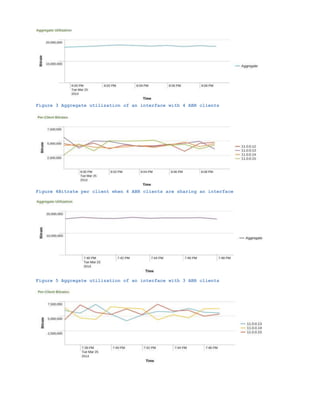
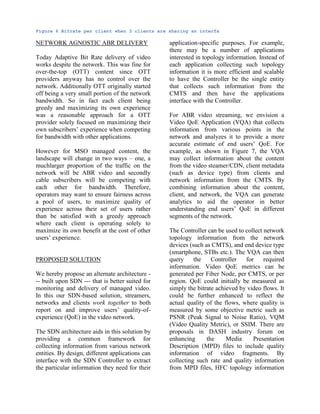
We ran a simple test to illustrate this point
and the results of that test are included in
figures that follow. Two interfaces were
configured with bandwidth just under
20Mbps, however the number of ABR clients
on each interface was varied, 4 in one case
and 3 in the other. As seen inFigure 3 and
Figure 5 below, the utilization levels of the
two interfaces are comparable. However as
seen in Figure 4 and Figure 6 the actual
rate profiles selected by the clients in the two
cases are quite different.
When 4 clients are sharing an interface we
see rate profile selections generally in the
range of 3~5 Mbps. However when 3 clients
are sharing an interface we see rate profile
selections in the range of 4~7Mbps, which
typically result in better QoE than when rate
profiles selected are in the range of 3~5
Mbps.
The above example is obviously overly
simplistic but it does illustrate the point that
higher order data such as interface utilization
may not give a good indication of QoE due
to ABR’s behavior of stepping up or down in
profiles to match bandwidth available.
Additionally the mix of client devices,
content mix, etc., may also be quite different
between two network segments. For example
the network segment where rates were lower,
could in fact be the segment with a larger
mix of premium content/subscribers and/or
big screen devices. Whereas, the network
segment receiving higher rates might have
actually a larger mix of handheld devices. So
a better measure of QoE should also take into
account other characteristics such as device
type, content type, and subscriber type
Figure 3 Aggregate utilization of an interface with 4 ABR clients
Figure 4Bitrate per client when 4 ABR clients are sharing an interface
Figure 5 Aggregate utilization of an interface with 3 ABR clients
Figure 6 Bitrate per client when 3 clients are sharing an interfa
NETWORK AGNOSTIC ABR DELIVERY
Today Adaptive Bit Rate delivery of video
works despite the network. This was fine for
over-the-top (OTT) content since OTT
providers anyway has no control over the
network. Additionally OTT originally started
off being a very small portion of the network
bandwidth. So in fact each client being
greedy and maximizing its own experience
was a reasonable approach for a OTT
provider solely focused on maximizing their
own subscribers’ experience when competing
for bandwidth with other applications.
However for MSO managed content, the
landscape will change in two ways – one, a
muchlarger proportion of the traffic on the
network will be ABR video and secondly
cable subscribers will be competing with
each other for bandwidth. Therefore,
operators may want to ensure fairness across
a pool of users, to maximize quality of
experience across their set of users rather
than be satisfied with a greedy approach
where each client is operating solely to
maximize its own benefit at the cost of other
users’ experience.
PROPOSED SOLUTION
We hereby propose an alternate architecture -
-- built upon SDN --- that is better suited for
monitoring and delivery of managed video.
In this our SDN-based solution, streamers,
networks and clients work together to both
report on and improve users’ quality-of-
experience (QoE) in the video network.
The SDN architecture aids in this solution by
providing a common framework for
collecting information from various network
entities. By design, different applications can
interface with the SDN Controller to extract
the particular information they need for their
application-specific purposes. For example,
there may be a number of applications
interested in topology information. Instead of
each application collecting such topology
information it is more efficient and scalable
to have the Controller be the single entity
that collects such information from the
CMTS and then have the applications
interface with the Controller.
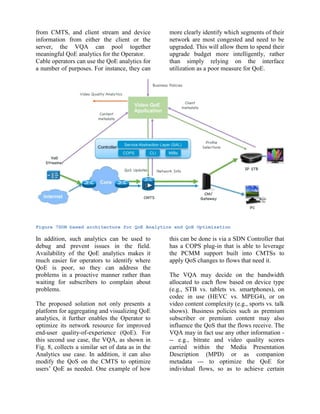
For ABR video streaming, we envision a
Video QoE Application (VQA) that collects
information from various points in the
network and analyzes it to provide a more
accurate estimate of end users’ QoE. For
example, as shown in Figure 7, the VQA
may collect information about the content
from the video steamer/CDN, client metadata
(such as device type) from clients and
network information from the CMTS. By
combining information about the content,
client, and network, the VQA can generate
analytics to aid the operator in better
understanding end users’ QoE in different
segments of the network.
The Controller can be used to collect network
topology information from the network
devices (such as CMTS), and end device type
(smartphone, STBs etc.). The VQA can then
query the Controller for required
information. Video QoE metrics can be
generated per Fiber Node, per CMTS, or per
region. QoE could initially be measured as
simply the bitrate achieved by video flows. It
could be further enhanced to reflect the
actual quality of the flows, where quality is
measured by some objective metric such as
PSNR (Peak Signal to Noise Ratio), VQM
(Video Quality Metric), or SSIM. There are
proposals in DASH industry forum on
enhancing the Media Presentation
Description (MPD) files to include quality
information of video fragments. By
collecting such rate and quality information
from MPD files, HFC topology information
from CMTS, and client stream and device
information from either the client or the
server, the VQA can pool together
meaningful QoE analytics for the Operator.
Cable operators can use the QoE analytics for
a number of purposes. For instance, they can
more clearly identify which segments of their
network are most congested and need to be
upgraded. This will allow them to spend their
upgrade budget more intelligently, rather
than simply relying on the interface
utilization as a poor measure for QoE.
Figure 7SDN based architecture for QoE Analytics and QoE Optimization
In addition, such analytics can be used to
debug and prevent issues in the field.
Availability of the QoE analytics makes it
much easier for operators to identify where
QoE is poor, so they can address the
problems in a proactive manner rather than
waiting for subscribers to complain about
problems.
The proposed solution not only presents a
platform for aggregating and visualizing QoE
analytics, it further enables the Operator to
optimize its network resource for improved
end-user quality-of-experience (QoE). For
this second use case, the VQA, as shown in
Fig. 8, collects a similar set of data as in the
Analytics use case. In addition, it can also
modify the QoS on the CMTS to optimize
users’ QoE as needed. One example of how
this can be done is via a SDN Controller that
has a COPS plug-in that is able to leverage
the PCMM support built into CMTSs to
apply QoS changes to flows that need it.
The VQA may decide on the bandwidth
allocated to each flow based on device type
(e.g., STB vs. tablets vs. smartphones), on
codec in use (HEVC vs. MPEG4), or on
video content complexity (e.g., sports vs. talk
shows). Business policies such as premium
subscriber or premium content may also
influence the QoS that the flows receive. The
VQA may in fact use any other information -
-- e.g., bitrate and video quality scores
carried within the Media Presentation
Description (MPD) or as companion
metadata --- to optimize the QoE for
individual flows, so as to achieve certain
performance objectives (e.g., maximizing the
aggregate quality across all flows, equalizing
the quality across all flows in a given user
group).
Such an approach will ensure that the
bandwidth is available for clients that need it
the most. While any approach that strives for
aggregate fairness across a group of users
will inevitably allocate less bandwidth to
some clients than what they would have
obtained in the absence of such a mechanism,
the intent is that the loss of bandwidth
doesn’t lead to a noticeable reduction in QoE
for that user, whereas the increased
bandwidth for some other users contribute to
their significant QoE improvement.
Benefits to the Operators are two-fold with
this approach: improved aggregate QoE for
subscribers and the ability to support more
video streams that meet a certain QoE criteria
at a given network bandwidth. Indeed,
increased packing efficiency can provide
significant bandwidth savings for Operators,
thereby providing capex savings.
To evaluate the proposed approach we ran
simulations with varying number of clients
sharing a 100Mbps link. Figure 8 shows the
average quality across all the flows
(measured in terms of PSNR) for each test.
As can be observed from the figure, the
proposed quality-optimized approach yields a
significant improvement in average quality
across clients. Another way to view the
results is that the same average PSNR (of
~42 dB in this particular example) can be
attained with our quality-optimized approach
while supporting 25 streams at the same
bandwidth as opposed to only 20 clients via
existing methods. This improvement
translates to a 25% increase in packing
efficiency.
In fact, the packing efficiency improvement
would be even greater if the quality metric in
use is the minimum quality across clients.
This is because the proposed quality-
optimized approach tends to reduce the
variation in quality across clients and over
time, thereby boosting the minimum quality
across all video segments. Using minimum
quality as a metric is analogous to a Service
Level Agreement (SLA) where an operator
would like for the video to stay above a
certain threshold most of the time.
Figure 8Comparison of the proposed
quality-optimized approach against
current QoE-oblivious approach.
Performance results are plotted in terms
of average video quality (PSNR). In this
experiment, the number of competing
clients vary from 15 to 35 over a 100
Mbps bottleneck link.
SUMMARY
In this paper, we have identified the
challenges posed by ABR video for operators
in measuring and managing their Access
networks. We have also proposed a unique
solution to the problem of assessing
subscriber QoE and optimizing it. The
proposed QoE optimization techniques can
be used by operators to either improve QoE
of groups of users or to pack more users in a
given bandwidth while maintaining QoE.
Simulation results have shown that
significant improvements in packing
efficiency can be achieved thereby
25% increase
providingsignificant CAPEX savings to cable
operators. The proposed solution is based on
SDN, and hence can leverage the flexibility
of an SDN infrastructure to build a more
efficient and intelligent video delivery
network.
REFERENCES
1. Cisco White Paper, “Cisco visual
networking index - forecast and
methodology, 2011-2016,”
http://newsroom.cisco.com/dlls/index
.html.
2. “HFC capacity planning for IP
Video”, Sangeeta Ramakrishnan,
Cisco Systems, SCTE 2011.
3. History of Move Networks, Available
Online:
http://www.movenetworks.com/history.h
tml
4. A. Zambelli, “IIS Smooth Streaming
Technical Overview,”
http://www.microsoft.com.
5. Apple Inc., “HTTP Live Streaming
Overview,”
https://developer.apple.com/library/mac/
documentation/networkinginternet/conce
ptual/streamingmediaguide/Introduction/
Introduction.html
6. MPEG, “ISO/IEC 23009-1:2012
Information technology – Dynamic
adaptive streaming over HTTP (DASH)
– Part 1: Media presentation description
and segment formats,” 2012.
7. https://www.opennetworking.org/sdn-
resources/onf-specifications/openflow

An SDN Based Approach To Measuring And Optimizing ABR Video Quality Of Experience

  • 1.
    AN SDN BASEDAPPROACH TO MEASURING AND OPTIMIZING ABR VIDEO QUALITY OF EXPERIENCE Sangeeta Ramakrishnan, Xiaoqing Zhu Cisco Systems Reprinted with permission of NCTA, from the 2014 Cable Connection Spring Technical Forum Conference Proceedings Abstract The volume of video traffic is continuing to grow rapidly over cable networks. While a majority of IP video on DOCSIS networks today is over-the-top video from third parties, operators are increasing the amount of programming their subscribers can access on IP video-capable devices.Additionally many operators are pursuing IP video deployments that are at various stages from planning, testing, trialing to deploying. Most OTT deployments use Adaptive Bit Rate (ABR) technology (also known as HTTP Adaptive Streaming). And ABR has also been adopted by cable operators as the technology of choice as they begin their migration to IP video. ABR video was primarily developed to work as well as possible despite the network. This approach made sense for over-the-top content providers who have no control or influence of the network. Such a server-client method has so far worked well for OTT providers. Some of the challenges with such an ABR delivery method are masked because of end-users’ acceptance of a poorer user- experience since OTT providers are perceived to be lower cost options. Also the amount of ABR video on the cable network today, while significant, will still be dwarfed by the amount of ABR video that will come on to the network when cable operators migrate to a ABR-based IP video delivery method. Hence the combination of more ABR traffic along with higher user-experience expectations of a cable subscriber, may pose challenges to cable operators as they deploy ABR-based IP video. Another concern with ABR video is that different segments of the network can have similar network utilization levels yet there could be a large difference in end user Quality-of-Experience (QoE) between these segments of the network. Currently operators do not have good visibility to the actual QoE of subscribers; instead they primarily monitor network utilization levels to identify those segments that need to be upgraded. Operators need better tools to identify where QoE is below their service objectives so that they can target their network investments accordingly. In this paper, we present a novel SDN-based solution to solve some of the challenges that we anticipate will occur with heavy ABR usage. Our proposal will help operators to improve their visibility of QoE and optimize their network investments. We also present a technique to help operators improve aggregateQoEof all users on their network. Alternatively this method can be used to pack significantly more streams in the given bandwidth with comparable quality to conventional ABR. Our studies indicate that with this approach bandwidth requirements can be reduced by a third or more, thereby saving DOCSIS channels and HFC spectrum, and reducing the cost of the overall solution.
  • 2.
    INTRODUCTION Over the pastfew years, video streaming traffic has beengrowing at a rapid pace, and is anticipated to dominate nextgenerationnetworks. According to [1] global consumption of Internet video viewed through a TV doubled in 2012; video-on- demand traffic is projected to nearly triple by 2017. Cableoperators, are seeking novel solutions to fend off the impendingbandwidth crunch introduced by video traffic on their existingnetwork infrastructure. Additionally, the cable industry is on the cusp of a migration to IP video. Various factors are contributing to the desire to migrate. One of the biggest drivers is the desire to deliver any content to subscribers, anywhere and anytime they want it. This includes the ability to deliver content to consumer owned devices such as tablets, smartphones, PCs, laptops, game consoles and Internet enabled TVs. Delivering video to such consumer owned devices not only helps cable operators to meet subscribers’ needs and expectations but has the added benefit that operators do not have to incur capital expenditure to deploy and maintain these devices. STBs deployed in subscribers’ homes are a significant portion of the capex budget in offering video services. Reducing that expenditure by either leveraging consumer owned devices or lower cost IP STBs could helpoperators to improve theirbottom-line significantly. Additionally, operators may be able to charge fees for making services available on new outlets such as tablets. So overall IP video provides an opportunity to both improve top-line and bottom-line for operators. Additionally with IP video, operators may be able to leverage the rapid innovation in the Internet space to offer newer services, and a better user experience. It also enables operators to consolidate the video services infrastructure. One of the major challenges faced by operators as they make this migration to IP video is the bandwidth required to deliver this service and the capex requirements associated with it. As shown in [2] the bandwidth needs for IP video are highly dependent on the type of service offered and can range typically from 20-40 downstream channels to serve a typical Service Group of 250-300 subscribers. The increasing focus on Cloud DVR like technology will in fact lead to higher capacity requirements due to the unicast nature of the delivery method. Hence there is likely to be significant increasing amounts of Adaptive Bit Rate video on the cable network in the future and operators will need better ways to manage it. SOFTWARE DEFINED NETWORKING Software Defined Networking (SDN) is a term that began being used widely in the industry around 2009. SDN is defined as the separation of Control and Data planes using an open standard protocol to communicate between them. This differs from a traditional network device (such as a Router, Switch, or CMTS) in which the data and control planes are vertically integrated. SDN promises flexibility and rapid innovation by virtue of the fact that the control software would be removed from the relatively constrained network device to a generic server that can be easily scaled to have more processing and memory capabilities. SDN is typically implemented with a Controller based architecture as shown in Figure 1, where the Controller interfaces with network devices via standard interfaces (for exampleOpenflow [7], PCMM). Therefore, the controller presents a level of abstraction of the underlying network.
  • 3.
    Applications communicate withthe controller using “controller APIs” and the controller in turn interacts with the network.In other words the controller acts as middleware that provides a higher lever of abstraction to network application developers. Figure 1 SDN Architecture Another key attribute of SDN is the two-way communication with the network devices. The network can be thought of as a large distributed database of flows and states. In an SDN architecture, applications can learn from the Controller the state of various devices and can also program the devices via the Controller. An SDN-based architecture enables Applications to be developed in a relatively device-agnostic way. ADAPTIVE BITRATE STREAMING Recent years have seen a major technology shift as Internet video delivery solutions are converging towards the adaptive bit rate (ABR) streaming paradigm. Since its inception in 2007 by Move Networks [3], ABR has been quickly adopted by major vendors and service providers, including YouTube, Netflix, Hulu, Akamai, Microsoft Smooth Streaming [4], Apple HTTP Live Streaming (HLS) [5], and Adobe HTTP Dynamic Streaming (HDS). Figure 1 shows the architecture overview of an adaptive bitrate streaming (ABR) system. The media contents are either pre-stored or captured live at the source. Multiple quality versions of the same video content are generated via transcoding. Moreover, each media file is broken down into many small fragments. The origin HTTP server keeps track of these fragments either as a large collection of separate physical files (e.g., in Apple HLS), or as logical separations via indexing (e.g., in Microsoft Smooth Streaming). Additional content delivery
  • 4.
    Figure 2Architecture overviewof an adaptive bitrate streaming (ABR) system. Multiple quality versions of the same video content are generated via transcoding or parallel live encoding. Each media file is broken down into many physical or logical fragments. The client can adaptively request different quality versions of the media fragments based on its own estimate of available network bandwidth networks (CDNs) may also be leveraged at the edge of the network, so as to assist in disseminating video contents to awide range of end users. In ABR, the client can dynamically change its video rate and quality on a fragment by fragment basis. In face of temporary network congestion, the client can switch to a lower rate (and hence quality) version of the video to avoid buffer underflow; when connection speed recovers, the client can switch back to higher quality. Such flexibility in rate adaptation can be advantageous in the presence of dynamic network conditions, especially in mobile environments. In 2012, the Motion Picture Experts Group (MPEG) has joined forces with 3GPP (3rd Generation Partnership Project) in defining the recently standardized Dynamic Adaptive Streaming over HTTP (DASH) specifications [6].The MPEG-DASH standard has intentionally left out of its scope the definition of client behavior for content fetching, rate adaptation heuristics, and video playout, thereby allowing plenty of space for innovation- based competition in industry. QoE MEASUREMENTS Today most operators measure the quality-of- experience (QoE) of their subscribers in terms of network utilization levels. Network utilization is typically averaged across over few minutes (typically 5~15 mins). Such average utilization is measured throughout the day. Most operators consider their networks to be congested if utilization exceeds a certain threshold such as 70-80% during peak hours. If many such measured samples of utilization level exceed their pre-determined threshold, operators typically declare those interfaces to be congested and plan upgrades of their network to address the congestion. The advantage of such a QoE measurement is it is
  • 5.
    simplicity – easyto measure and easy to monitor. Challenges with ABR QoE Measurements As the industry moves toward ABR-based video delivery, this new paradigm poses some challenges for the aforementioned QoE measurement mechanism. This is because with ABR, clients up-shift to higher rate profiles when bandwidth is available. This is in contrast to standard Internet browsing, where higher bandwidth availability simply causes the file download to finish faster. For example, downloading a file when plenty of bandwidth is available does not cause file size to grow! TCP simply takes advantage of the bandwidth available, and file download completes faster. With ABR, however, clients download larger and larger files along with growing available bandwidth, by upshifting to higher profiles. So bandwidth demand from ABR delivered video is elastic in nature (up to a certain point) and can easily use up all available bandwidth. As a result, the measured network utilization level can always look high. But in some cases, end users may be quite happy because they are all receiving highest quality streams. Or,in other cases, end users can be quite unhappy because they are all putting up withlowest-profile streams. An operator can no longer tell whether end users are having a good quality-of-experience or not by simply looking at network utilization measurements. In fact, high utilization on multiple segments of the network may cause operators to assume all such network segments need to be upgraded whereas if they had a better view of the users’ QoE they may be able to better determine which segments need to be upgraded immediately and which can be deferred. Having better visibility on actual QoE would enable operators to spend capital on upgrading segments of the network that would yield the most improvement in subscriber QoE. We ran a simple test to illustrate this point and the results of that test are included in figures that follow. Two interfaces were configured with bandwidth just under 20Mbps, however the number of ABR clients on each interface was varied, 4 in one case and 3 in the other. As seen inFigure 3 and Figure 5 below, the utilization levels of the two interfaces are comparable. However as seen in Figure 4 and Figure 6 the actual rate profiles selected by the clients in the two cases are quite different. When 4 clients are sharing an interface we see rate profile selections generally in the range of 3~5 Mbps. However when 3 clients are sharing an interface we see rate profile selections in the range of 4~7Mbps, which typically result in better QoE than when rate profiles selected are in the range of 3~5 Mbps. The above example is obviously overly simplistic but it does illustrate the point that higher order data such as interface utilization may not give a good indication of QoE due to ABR’s behavior of stepping up or down in profiles to match bandwidth available. Additionally the mix of client devices, content mix, etc., may also be quite different between two network segments. For example the network segment where rates were lower, could in fact be the segment with a larger mix of premium content/subscribers and/or big screen devices. Whereas, the network segment receiving higher rates might have actually a larger mix of handheld devices. So a better measure of QoE should also take into account other characteristics such as device type, content type, and subscriber type
  • 6.
    Figure 3 Aggregateutilization of an interface with 4 ABR clients Figure 4Bitrate per client when 4 ABR clients are sharing an interface Figure 5 Aggregate utilization of an interface with 3 ABR clients
  • 7.
    Figure 6 Bitrateper client when 3 clients are sharing an interfa NETWORK AGNOSTIC ABR DELIVERY Today Adaptive Bit Rate delivery of video works despite the network. This was fine for over-the-top (OTT) content since OTT providers anyway has no control over the network. Additionally OTT originally started off being a very small portion of the network bandwidth. So in fact each client being greedy and maximizing its own experience was a reasonable approach for a OTT provider solely focused on maximizing their own subscribers’ experience when competing for bandwidth with other applications. However for MSO managed content, the landscape will change in two ways – one, a muchlarger proportion of the traffic on the network will be ABR video and secondly cable subscribers will be competing with each other for bandwidth. Therefore, operators may want to ensure fairness across a pool of users, to maximize quality of experience across their set of users rather than be satisfied with a greedy approach where each client is operating solely to maximize its own benefit at the cost of other users’ experience. PROPOSED SOLUTION We hereby propose an alternate architecture - -- built upon SDN --- that is better suited for monitoring and delivery of managed video. In this our SDN-based solution, streamers, networks and clients work together to both report on and improve users’ quality-of- experience (QoE) in the video network. The SDN architecture aids in this solution by providing a common framework for collecting information from various network entities. By design, different applications can interface with the SDN Controller to extract the particular information they need for their application-specific purposes. For example, there may be a number of applications interested in topology information. Instead of each application collecting such topology information it is more efficient and scalable to have the Controller be the single entity that collects such information from the CMTS and then have the applications interface with the Controller. For ABR video streaming, we envision a Video QoE Application (VQA) that collects information from various points in the network and analyzes it to provide a more accurate estimate of end users’ QoE. For example, as shown in Figure 7, the VQA may collect information about the content from the video steamer/CDN, client metadata (such as device type) from clients and network information from the CMTS. By combining information about the content, client, and network, the VQA can generate analytics to aid the operator in better understanding end users’ QoE in different segments of the network. The Controller can be used to collect network topology information from the network devices (such as CMTS), and end device type (smartphone, STBs etc.). The VQA can then query the Controller for required information. Video QoE metrics can be generated per Fiber Node, per CMTS, or per region. QoE could initially be measured as simply the bitrate achieved by video flows. It could be further enhanced to reflect the actual quality of the flows, where quality is measured by some objective metric such as PSNR (Peak Signal to Noise Ratio), VQM (Video Quality Metric), or SSIM. There are proposals in DASH industry forum on enhancing the Media Presentation Description (MPD) files to include quality information of video fragments. By collecting such rate and quality information from MPD files, HFC topology information
  • 8.
    from CMTS, andclient stream and device information from either the client or the server, the VQA can pool together meaningful QoE analytics for the Operator. Cable operators can use the QoE analytics for a number of purposes. For instance, they can more clearly identify which segments of their network are most congested and need to be upgraded. This will allow them to spend their upgrade budget more intelligently, rather than simply relying on the interface utilization as a poor measure for QoE. Figure 7SDN based architecture for QoE Analytics and QoE Optimization In addition, such analytics can be used to debug and prevent issues in the field. Availability of the QoE analytics makes it much easier for operators to identify where QoE is poor, so they can address the problems in a proactive manner rather than waiting for subscribers to complain about problems. The proposed solution not only presents a platform for aggregating and visualizing QoE analytics, it further enables the Operator to optimize its network resource for improved end-user quality-of-experience (QoE). For this second use case, the VQA, as shown in Fig. 8, collects a similar set of data as in the Analytics use case. In addition, it can also modify the QoS on the CMTS to optimize users’ QoE as needed. One example of how this can be done is via a SDN Controller that has a COPS plug-in that is able to leverage the PCMM support built into CMTSs to apply QoS changes to flows that need it. The VQA may decide on the bandwidth allocated to each flow based on device type (e.g., STB vs. tablets vs. smartphones), on codec in use (HEVC vs. MPEG4), or on video content complexity (e.g., sports vs. talk shows). Business policies such as premium subscriber or premium content may also influence the QoS that the flows receive. The VQA may in fact use any other information - -- e.g., bitrate and video quality scores carried within the Media Presentation Description (MPD) or as companion metadata --- to optimize the QoE for individual flows, so as to achieve certain
  • 9.
    performance objectives (e.g.,maximizing the aggregate quality across all flows, equalizing the quality across all flows in a given user group). Such an approach will ensure that the bandwidth is available for clients that need it the most. While any approach that strives for aggregate fairness across a group of users will inevitably allocate less bandwidth to some clients than what they would have obtained in the absence of such a mechanism, the intent is that the loss of bandwidth doesn’t lead to a noticeable reduction in QoE for that user, whereas the increased bandwidth for some other users contribute to their significant QoE improvement. Benefits to the Operators are two-fold with this approach: improved aggregate QoE for subscribers and the ability to support more video streams that meet a certain QoE criteria at a given network bandwidth. Indeed, increased packing efficiency can provide significant bandwidth savings for Operators, thereby providing capex savings. To evaluate the proposed approach we ran simulations with varying number of clients sharing a 100Mbps link. Figure 8 shows the average quality across all the flows (measured in terms of PSNR) for each test. As can be observed from the figure, the proposed quality-optimized approach yields a significant improvement in average quality across clients. Another way to view the results is that the same average PSNR (of ~42 dB in this particular example) can be attained with our quality-optimized approach while supporting 25 streams at the same bandwidth as opposed to only 20 clients via existing methods. This improvement translates to a 25% increase in packing efficiency. In fact, the packing efficiency improvement would be even greater if the quality metric in use is the minimum quality across clients. This is because the proposed quality- optimized approach tends to reduce the variation in quality across clients and over time, thereby boosting the minimum quality across all video segments. Using minimum quality as a metric is analogous to a Service Level Agreement (SLA) where an operator would like for the video to stay above a certain threshold most of the time. Figure 8Comparison of the proposed quality-optimized approach against current QoE-oblivious approach. Performance results are plotted in terms of average video quality (PSNR). In this experiment, the number of competing clients vary from 15 to 35 over a 100 Mbps bottleneck link. SUMMARY In this paper, we have identified the challenges posed by ABR video for operators in measuring and managing their Access networks. We have also proposed a unique solution to the problem of assessing subscriber QoE and optimizing it. The proposed QoE optimization techniques can be used by operators to either improve QoE of groups of users or to pack more users in a given bandwidth while maintaining QoE. Simulation results have shown that significant improvements in packing efficiency can be achieved thereby 25% increase
  • 10.
    providingsignificant CAPEX savingsto cable operators. The proposed solution is based on SDN, and hence can leverage the flexibility of an SDN infrastructure to build a more efficient and intelligent video delivery network. REFERENCES 1. Cisco White Paper, “Cisco visual networking index - forecast and methodology, 2011-2016,” http://newsroom.cisco.com/dlls/index .html. 2. “HFC capacity planning for IP Video”, Sangeeta Ramakrishnan, Cisco Systems, SCTE 2011. 3. History of Move Networks, Available Online: http://www.movenetworks.com/history.h tml 4. A. Zambelli, “IIS Smooth Streaming Technical Overview,” http://www.microsoft.com. 5. Apple Inc., “HTTP Live Streaming Overview,” https://developer.apple.com/library/mac/ documentation/networkinginternet/conce ptual/streamingmediaguide/Introduction/ Introduction.html 6. MPEG, “ISO/IEC 23009-1:2012 Information technology – Dynamic adaptive streaming over HTTP (DASH) – Part 1: Media presentation description and segment formats,” 2012. 7. https://www.opennetworking.org/sdn- resources/onf-specifications/openflow