NCERTSOLUTIONS
BIOLOGY
CLASS – IX
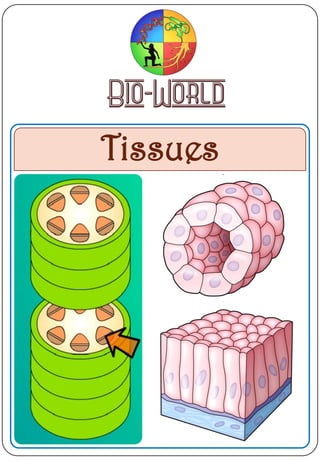
Tissues
In-text Exercise 1
What is a tissue?
What is the utility of tissues in multi-cellular organisms?
Tissue is a group of cells that are similar in structure and are organized
together to perform a specific task.
In unicellular organisms, a single cell performs all the basic functions
such as respiration, movement, excretion, digestion, etc. But in multi-
cellular organisms, cells are grouped to form tissues. These tissues are
specialized to carry out a particular function at a definite place in the
body. For example, the muscle cells form muscular tissues which helps in
movement, nerve cells form the nervous tissue which helps in
transmission of messages. This is known as division of labour in multi-
cellular organisms. It is because of this division of labour that multi-
cellular organisms are able to perform all functions efficiently.
In-text Exercise 2
 Simple permanent tissues are of three types :
 Parenchyma tissue is of further two types :
Biswarup Majumder | Bio-World
Name types of simple tissues.
1.
2.
1.
The homogeneous group of non-meristematic or permanent cells
having similar structure, function and origin is collectively known as
simple tissue.
1. Parenchyma,
2. Collenchyma,
3. Sclerenchyma.
1. Aerenchyma,
2. Chlorenchyma.
Apical meristem is present at the growing tips of stems and roots. Their
main function is to initiate growth in new cells of seedlings, at the tip of
roots, and shoots.
Biswarup Majumder | Bio-World
Where is apical meristem found?2.
In-text Exercise 3
Name the tissue responsible for movement in our body.1.
Which tissue makes up the husk of coconut?3.
The husk of a coconut is made up of sclerenchyma tissue.
What are the constituents of phloem?4.
Phloem is the food conducting tissue in plants. It is made up of four
components :
a) Sieve tubes,
b) Companion cells,
c) Phloem parenchyma,
d) Phloem fibres.
The muscular tissue is responsible for movement in our body.
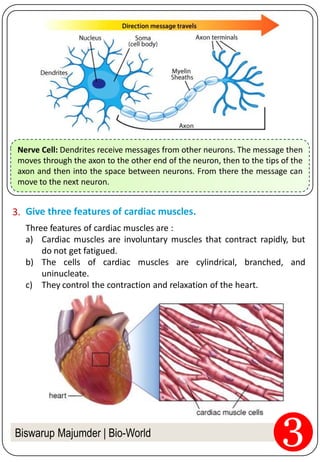
A neuron consists of a cell body with a nucleus and cytoplasm. It has two
important extensions known as the axon and dendrites. An axon is a
long thread-like extension of nerve cells that transmits impulses away
from the cell body. Dendrites, on the other hand, are thread-like
extensions of cell body that receive nerve impulses. Thus, the axon
transmits impulses away from the cell body, whereas the dendrite
receives nerve impulses. This coordinated function helps in transmitting
impulses very quickly.
What does a neuron look like?2.
The human brain alone consists of about a 100 billion neurons. If all
these neurons were to be lined up, it would form a 600 mile long line.
Biswarup Majumder | Bio-World
Give three features of cardiac muscles.3.
Three features of cardiac muscles are :
a) Cardiac muscles are involuntary muscles that contract rapidly, but
do not get fatigued.
b) The cells of cardiac muscles are cylindrical, branched, and
uninucleate.
c) They control the contraction and relaxation of the heart.
Nerve Cell: Dendrites receive messages from other neurons. The message then
moves through the axon to the other end of the neuron, then to the tips of the
axon and then into the space between neurons. From there the message can
move to the next neuron.
Biswarup Majumder | Bio-World
NCERT Exercise
Define the term “tissue”.1.
Tissue is a group of cells that are similar in structure and are organized
together to perform a specific task.
How many types of elements together make up the xylem
tissue? Name them.
2.
There are four different types of cells that make up the xylem tissue.
They are :
a) Tracheids,
b) Vessels,
c) Xylem parenchyma,
d) Xylem fibres.
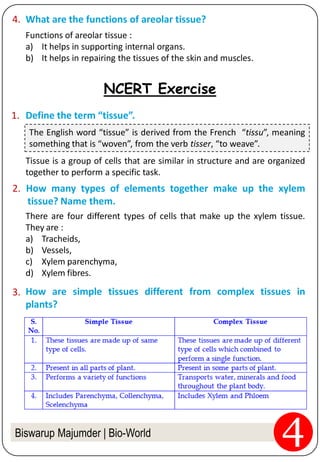
How are simple tissues different from complex tissues in
plants?
3.
What are the functions of areolar tissue?4.
Functions of areolar tissue :
a) It helps in supporting internal organs.
b) It helps in repairing the tissues of the skin and muscles.
The English word “tissue” is derived from the French “tissu”, meaning
something that is “woven”, from the verb tisser, “to weave”.
Biswarup Majumder | Bio-World
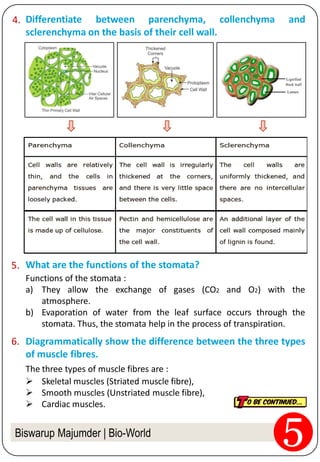
Differentiate between parenchyma, collenchyma and
sclerenchyma on the basis of their cell wall.
4.
What are the functions of the stomata?5.
Functions of the stomata :
a) They allow the exchange of gases (CO2 and O2) with the
atmosphere.
b) Evaporation of water from the leaf surface occurs through the
stomata. Thus, the stomata help in the process of transpiration.
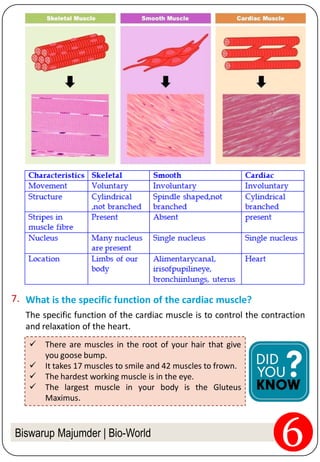
Diagrammatically show the difference between the three types
of muscle fibres.
6.
The three types of muscle fibres are :
 Skeletal muscles (Striated muscle fibre),
 Smooth muscles (Unstriated muscle fibre),
 Cardiac muscles.
Biswarup Majumder | Bio-World
What is the specific function of the cardiac muscle?7.
The specific function of the cardiac muscle is to control the contraction
and relaxation of the heart.
 There are muscles in the root of your hair that give
you goose bump.
 It takes 17 muscles to smile and 42 muscles to frown.
 The hardest working muscle is in the eye.
 The largest muscle in your body is the Gluteus
Maximus.
Biswarup Majumder | Bio-World
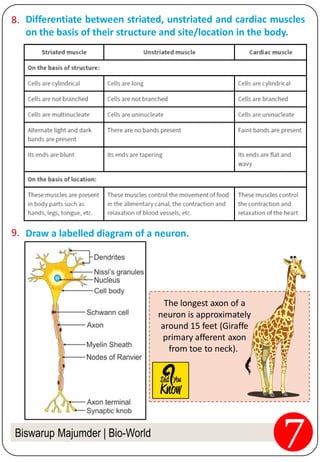
Draw a labelled diagram of a neuron.9.
The longest axon of a
neuron is approximately
around 15 feet (Giraffe
primary afferent axon
from toe to neck).
Differentiate between striated, unstriated and cardiac muscles
on the basis of their structure and site/location in the body.
8.
Biswarup Majumder | Bio-World
Name the following:
a) Tissue that forms the inner lining of our mouth.
b) Tissue that connects muscle to bone in humans.
c) Tissue that transports food in plants.
d) Tissue that stores fat in our body.
e) Connective tissue with a fluid matrix.
f) Tissue present in the brain.
10.
a) Epithelial tissue.
b) Dense regular connective tissue (tendons).
c) Phloem.
d) Adipose tissue.
e) Blood.
f) Nervous tissue.
Identify the type of tissue in the following: skin, bark of tree,
bone, lining of kidney tubule, vascular bundle.
11.
Skin → Stratified squamous epithelial tissue.
Bark of tree → Simple permanent tissue.
Bone → Connective tissue.
Lining of kidney tubule → Cuboidal epithelial tissue.
Vascular bundle → Complex permanent tissue.
Name the regions in which parenchyma tissue is present.12.
Leaves, fruits, and flowers are the regions where the parenchyma
tissue is present.
What is the role of epidermis in plants?13.
Epidermis is present on the outer surface of the entire plant body. The
cells of the epidermal tissue form a continuous layer without any
intercellular space. It performs the following important functions :
a) It is a protective tissue of the plant body,
b) It protects the plant against mechanical injury,
c) It allows exchange of gases through the stomata.
Biswarup Majumder | Bio-World
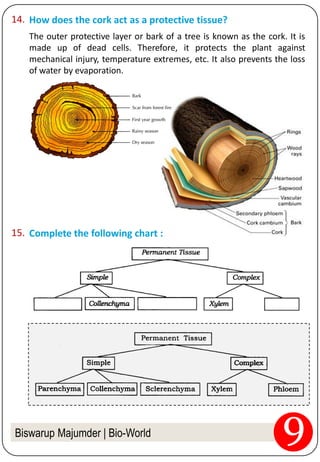
How does the cork act as a protective tissue?14.
The outer protective layer or bark of a tree is known as the cork. It is
made up of dead cells. Therefore, it protects the plant against
mechanical injury, temperature extremes, etc. It also prevents the loss
of water by evaporation.
Complete the following chart :15.
NCERT Solutions | Class IX | Science (Biology) | Chapter 6 | Tissues

NCERT Solutions | Class IX | Science (Biology) | Chapter 6 | Tissues

  • 1.
  • 2.
  • 3.
    In-text Exercise 1 Whatis a tissue? What is the utility of tissues in multi-cellular organisms? Tissue is a group of cells that are similar in structure and are organized together to perform a specific task. In unicellular organisms, a single cell performs all the basic functions such as respiration, movement, excretion, digestion, etc. But in multi- cellular organisms, cells are grouped to form tissues. These tissues are specialized to carry out a particular function at a definite place in the body. For example, the muscle cells form muscular tissues which helps in movement, nerve cells form the nervous tissue which helps in transmission of messages. This is known as division of labour in multi- cellular organisms. It is because of this division of labour that multi- cellular organisms are able to perform all functions efficiently. In-text Exercise 2  Simple permanent tissues are of three types :  Parenchyma tissue is of further two types : Biswarup Majumder | Bio-World Name types of simple tissues. 1. 2. 1. The homogeneous group of non-meristematic or permanent cells having similar structure, function and origin is collectively known as simple tissue. 1. Parenchyma, 2. Collenchyma, 3. Sclerenchyma. 1. Aerenchyma, 2. Chlorenchyma.
  • 4.
    Apical meristem ispresent at the growing tips of stems and roots. Their main function is to initiate growth in new cells of seedlings, at the tip of roots, and shoots. Biswarup Majumder | Bio-World Where is apical meristem found?2. In-text Exercise 3 Name the tissue responsible for movement in our body.1. Which tissue makes up the husk of coconut?3. The husk of a coconut is made up of sclerenchyma tissue. What are the constituents of phloem?4. Phloem is the food conducting tissue in plants. It is made up of four components : a) Sieve tubes, b) Companion cells, c) Phloem parenchyma, d) Phloem fibres. The muscular tissue is responsible for movement in our body. A neuron consists of a cell body with a nucleus and cytoplasm. It has two important extensions known as the axon and dendrites. An axon is a long thread-like extension of nerve cells that transmits impulses away from the cell body. Dendrites, on the other hand, are thread-like extensions of cell body that receive nerve impulses. Thus, the axon transmits impulses away from the cell body, whereas the dendrite receives nerve impulses. This coordinated function helps in transmitting impulses very quickly. What does a neuron look like?2. The human brain alone consists of about a 100 billion neurons. If all these neurons were to be lined up, it would form a 600 mile long line.
  • 5.
    Biswarup Majumder |Bio-World Give three features of cardiac muscles.3. Three features of cardiac muscles are : a) Cardiac muscles are involuntary muscles that contract rapidly, but do not get fatigued. b) The cells of cardiac muscles are cylindrical, branched, and uninucleate. c) They control the contraction and relaxation of the heart. Nerve Cell: Dendrites receive messages from other neurons. The message then moves through the axon to the other end of the neuron, then to the tips of the axon and then into the space between neurons. From there the message can move to the next neuron.
  • 6.
    Biswarup Majumder |Bio-World NCERT Exercise Define the term “tissue”.1. Tissue is a group of cells that are similar in structure and are organized together to perform a specific task. How many types of elements together make up the xylem tissue? Name them. 2. There are four different types of cells that make up the xylem tissue. They are : a) Tracheids, b) Vessels, c) Xylem parenchyma, d) Xylem fibres. How are simple tissues different from complex tissues in plants? 3. What are the functions of areolar tissue?4. Functions of areolar tissue : a) It helps in supporting internal organs. b) It helps in repairing the tissues of the skin and muscles. The English word “tissue” is derived from the French “tissu”, meaning something that is “woven”, from the verb tisser, “to weave”.
  • 7.
    Biswarup Majumder |Bio-World Differentiate between parenchyma, collenchyma and sclerenchyma on the basis of their cell wall. 4. What are the functions of the stomata?5. Functions of the stomata : a) They allow the exchange of gases (CO2 and O2) with the atmosphere. b) Evaporation of water from the leaf surface occurs through the stomata. Thus, the stomata help in the process of transpiration. Diagrammatically show the difference between the three types of muscle fibres. 6. The three types of muscle fibres are :  Skeletal muscles (Striated muscle fibre),  Smooth muscles (Unstriated muscle fibre),  Cardiac muscles.
  • 8.
    Biswarup Majumder |Bio-World What is the specific function of the cardiac muscle?7. The specific function of the cardiac muscle is to control the contraction and relaxation of the heart.  There are muscles in the root of your hair that give you goose bump.  It takes 17 muscles to smile and 42 muscles to frown.  The hardest working muscle is in the eye.  The largest muscle in your body is the Gluteus Maximus.
  • 9.
    Biswarup Majumder |Bio-World Draw a labelled diagram of a neuron.9. The longest axon of a neuron is approximately around 15 feet (Giraffe primary afferent axon from toe to neck). Differentiate between striated, unstriated and cardiac muscles on the basis of their structure and site/location in the body. 8.
  • 10.
    Biswarup Majumder |Bio-World Name the following: a) Tissue that forms the inner lining of our mouth. b) Tissue that connects muscle to bone in humans. c) Tissue that transports food in plants. d) Tissue that stores fat in our body. e) Connective tissue with a fluid matrix. f) Tissue present in the brain. 10. a) Epithelial tissue. b) Dense regular connective tissue (tendons). c) Phloem. d) Adipose tissue. e) Blood. f) Nervous tissue. Identify the type of tissue in the following: skin, bark of tree, bone, lining of kidney tubule, vascular bundle. 11. Skin → Stratified squamous epithelial tissue. Bark of tree → Simple permanent tissue. Bone → Connective tissue. Lining of kidney tubule → Cuboidal epithelial tissue. Vascular bundle → Complex permanent tissue. Name the regions in which parenchyma tissue is present.12. Leaves, fruits, and flowers are the regions where the parenchyma tissue is present. What is the role of epidermis in plants?13. Epidermis is present on the outer surface of the entire plant body. The cells of the epidermal tissue form a continuous layer without any intercellular space. It performs the following important functions : a) It is a protective tissue of the plant body, b) It protects the plant against mechanical injury, c) It allows exchange of gases through the stomata.
  • 11.
    Biswarup Majumder |Bio-World How does the cork act as a protective tissue?14. The outer protective layer or bark of a tree is known as the cork. It is made up of dead cells. Therefore, it protects the plant against mechanical injury, temperature extremes, etc. It also prevents the loss of water by evaporation. Complete the following chart :15.