1 | P a g e 
NCERT_Geo_Indian_Geography 
Everything available in our environment which can be used to satisfy our needs, provided, it is 
technologically accessible, economically feasible and culturally acceptable can be termed as 
‘Resource’. 
 These resources can be classified in the following ways – 
• On the basis of origin – biotic and abiotic 
• On the basis of exhaustibility – renewable and non-renewable 
• On the basis of ownership – individual, community, national and international 
• On the basis of status of development – potential, developed stock and reserves. 
Urban Development Authorities get empowered by the government to acquire land. All the 
minerals, water resources, forests, wildlife, land within the political boundaries and oceanic area 
upto 12 nautical miles (19.2 km) from the coast termed as territorial water and resources therein 
belong to the nation 
 International Resources: The oceanic resources beyond 200 km of the Exclusive Economic 
Zone belong to open ocean and no individual country can utilise these without the 
concurrence of international institutions. 
 India has got the right to mine manganese nodules from the bed of the Indian Ocean from 
that area which lies beyond the exclusive economic zone. 
DEVELOPMENT OF RESOURCES 
 As a result, human beings used them indiscriminately and this has led to the following major 
problems. 
• Depletion of resources for satisfying the greed of few individuals. 
• Accumulation of resources in few hands, which, in turn, divided the society into two 
segments i.e. haves and have nots or rich and poor. 
• Indiscriminate exploitation of resources has led to global ecological crises such as, 
global warming, ozone layer depletion, environmental pollution and land 
degradation 
India Economic Geography
2 | P a g e 
Resource planning is essential for sustainable existence of all forms of life. Sustainable existence is a 
component of sustainable development. 
Sustainable development 
 Sustainable economic development means ‘development should take place without 
damaging the environment, and development in the present should not compromise wi th 
the needs of the future generations. 
Rio de Janeiro Earth Summit, 1992 
 In June 1992, more than 100 heads of states met in Rio de Janeiro in Brazil, for the first 
International Earth Summit. 
 The assembled leaders signed the Declaration on Global Climatic Change and Biological 
Diversity. The Rio Convention endorsed the global Forest Principles and adopted Agenda 21 
for achieving Sustainable Development in the 21st century. 
 Agenda 21 
• It is the declaration signed by world leaders in 1992 at the United Nations 
Conference on Environment and Development (UNCED), which took place at Rio de 
Janeiro, Brazil. 
• It aims at achieving global sustainable development. 
• One major objective of the Agenda 21 is that every local government should draw its 
own local Agenda 21. 
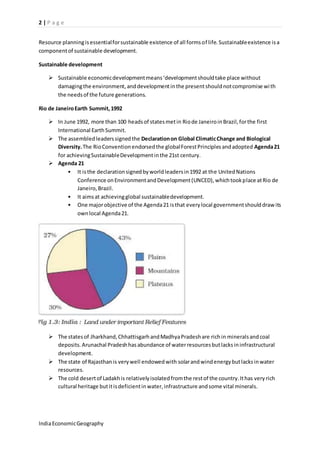
 The states of Jharkhand, Chhattisgarh and Madhya Pradesh are rich in minerals and coal 
deposits. Arunachal Pradesh has abundance of water resources but lacks in infrastructural 
development. 
 The state of Rajasthan is very well endowed with solar and wind energy but lacks in water 
resources. 
 The cold desert of Ladakh is relatively isolated from the rest of the country. It has very rich 
cultural heritage but it is deficient in water, infrastructure and some vital minerals. 
India Economic Geography
3 | P a g e 
Resource planning is a complex process which involves: 
 Identification and inventory of resources across the regions of the country. This involves 
surveying, mapping and qualitative and quantitative estimation and measurement of the 
resources. 
 Evolving a planning structure endowed with appropriate technology, skill and institutional 
set up for implementing resource development plans. 
 Matching the resource development plans with overall national development plans 
India has made concerted efforts for achieving the goals of resource planning right from the First 
Five Year Plan launched after Independence 
Conservation of Resources: 
 Irrational consumption and over-utilisation of resources may lead to socio-economic and 
environmental problems. To overcome these problems, resource conservation at various 
levels is important. 
 Gandhiji was very apt in voicing his concern about resource conservation in these words: 
“There is enough for everybody’s need and not for any body’s greed.” 
At the international level, the Club of Rome advocated resource conservation for the first time in a 
more systematic way in 1968. 
 Subsequently, in 1974, Gandhian philosophy was once again presented by Schumacher in his 
book Small is Beautiful. The seminal contribution with respect to resource conservation at 
the global level was made by the Brundtland Commission Report, 1987. 
 This report introduced the concept of ‘Sustainable Development’ and advocated it as a 
means for resource conservation, which was subsequently published in a book, entitled Our 
Common Future. 
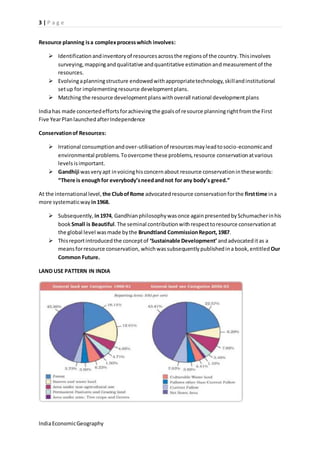
LAND USE PATTERN IN INDIA 
India Economic Geography
4 | P a g e 
 Total geographical area of India is 3.28 million sq. km 
 Land use data, however, is available only for 93 per cent of the total area because the land 
use reporting for most of the north-east states except Assam has not been done fully. 
 It is over 80 per cent of the total area in Punjab and Haryana and less than 10 per cent in 
Arunachal Pradesh, Mizoram, Manipur and Andaman Nicobar Islands 
 Forest area in the country is far lower than the desired 33 per cent of geographical area, as it 
was outlined in the National Forest Policy (1952). It was considered essential for 
maintenance of the ecological balance. 
Land Degradation and Conservation Measures: 
 In states like Jharkhand, Chhattisgarh, Madhya Pradesh and Orissa deforestation due to 
mining have caused severe land degradation. 
 In states like Gujarat, Rajasthan, Madhya Pradesh and Maharashtra overgrazing is one of the 
main reasons for land degradation. 
 In the states of Punjab, Haryana, western Uttar Pradesh, over irrigation is responsible for 
land degradation due to water logging leading to increase in salinity and alkalinity in the soil. 
 The mineral processing like grinding of limestone for cement industry and calcite and 
soapstone for ceramic industry generate huge quantity of dust in the atmosphere. 
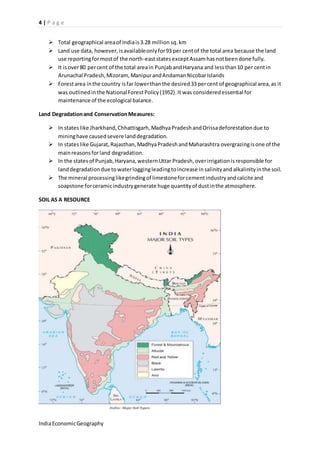
SOIL AS A RESOURCE 
India Economic Geography
5 | P a g e 
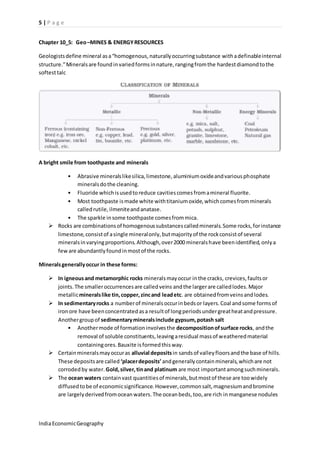
Chapter 10_5: Geo –MINES & ENERGY RESOURCES 
Geologists define mineral as a “homogenous, naturally occurring substance with a definable internal 
structure.” Minerals are found in varied forms in nature, ranging from the hardest diamond to the 
softest talc 
A bright smile from toothpaste and minerals 
• Abrasive minerals like silica, limestone, aluminium oxide and various phosphate 
minerals do the cleaning. 
• Fluoride which is used to reduce cavities comes from a mineral fluorite. 
• Most toothpaste is made white with titanium oxide, which comes from minerals 
called rutile, ilmenite and anatase. 
• The sparkle in some toothpaste comes from mica. 
 Rocks are combinations of homogenous substances called minerals. Some rocks, for instance 
limestone, consist of a single mineral only, but majority of the rock consist of several 
minerals in varying proportions. Although, over 2000 minerals have been identified, only a 
few are abundantly found in most of the rocks. 
Minerals generally occur in these forms: 
 In igneous and metamorphic rocks minerals may occur in the cracks, crevices, faults or 
joints. The smaller occurrences are called veins and the larger are called lodes. Major 
metallic minerals like tin, copper, zinc and lead etc. are obtained from veins and lodes. 
 In sedimentary rocks a number of minerals occur in beds or layers. Coal and some forms of 
iron ore have been concentrated as a result of long periods under great heat and pressure. 
Another group of sedimentary minerals include gypsum, potash salt 
• Another mode of formation involves the decomposition of surface rocks, and the 
removal of soluble constituents, leaving a residual mass of weathered material 
containing ores. Bauxite is formed this way. 
 Certain minerals may occur as alluvial deposits in sands of valley floors and the base of hills. 
These deposits are called ‘placer deposits’ and generally contain minerals, which are not 
corroded by water. Gold, silver, tin and platinum are most important among such minerals. 
 The ocean waters contain vast quantities of minerals, but most of these are too widely 
diffused to be of economic significance. However, common salt, magnesium and bromine 
are largely derived from ocean waters. The ocean beds, too, are rich in manganese nodules 
India Economic Geography
6 | P a g e 
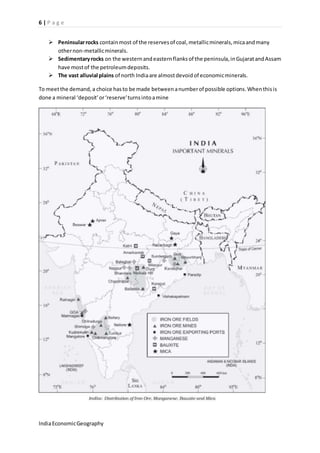
 Peninsular rocks contain most of the reserves of coal, metallic minerals, mica and many 
other non-metallic minerals. 
 Sedimentary rocks on the western and eastern flanks of the peninsula, in Gujarat and Assam 
have most of the petroleum deposits. 
 The vast alluvial plains of north India are almost devoid of economic minerals. 
To meet the demand, a choice has to be made between a number of possible options. When this is 
done a mineral ‘deposit’ or ‘reserve’ turns into a mine 
India Economic Geography
7 | P a g e 
Ferrous Minerals 
 Ferrous minerals account for about three fourths of the total value of the production of 
metallic minerals. They provide a strong base for the development of metallurgical 
industries. India exports substantial quantities of ferrous minerals after meeting her internal 
demands. 
Iron Ore 
 Iron ore is the basic mineral and the backbone of industrial development. 
 India is rich in good quality iron ores. Magnetite is the finest iron ore with a very high 
content of iron up to 70 per cent. 
 It has excellent magnetic qualities, especially valuable in the electrical industry. Hematite ore 
is the most important industrial iron ore in terms of the quantity used, but has slightly lower 
iron content than magnetite. (50-60 per cent). 
• Orissa-Jharkhand belt: In Orissa high grade hematite ore is found in Badampahar 
mines in the Mayurbhanj and Kendujhar districts. In the adjoining Singbhum district 
of Jharkhand haematite iron ore is mined in Gua and Noamundi 
• Bellary-Chitradurga-Chikmaglur-Tumkur belt in Karnataka has large reserves of iron 
ore. The Kudermukh mines located in the Western Ghats of Karnataka are a 100 per 
cent export unit. Kudremukh deposits are known to be one of the largest in the 
world. The ore is transported as slurry through a pipeline to a port near Mangalore. 
• Maharashtra-Goa belt includes the state of Goa and Ratnagiri district of 
Maharashtra. Though, the ores are not of very high quality, yet they are efficiently 
exploited. Iron ore is exported through Marmagao port. 
Manganese 
 Manganese is mainly used in the manufacturing of steel and Ferro-manganese alloy. Nearly 
10 kg of manganese is required to manufacture one tonne of steel. It is also used in 
manufacturing bleaching powder, insecticides and paints. 
 Orissa is the largest producer of manganese ores in India. It accounted for one-third of the 
country’s total production in 2000-01 
 Minerals, which include copper, bauxite, lead, zinc and gold play a vital role in a number of 
metallurgical, engineering and electrical industries. 
Copper 
 India is critically deficient in the reserve and production of copper. Being malleable, ductile 
and a good conductor, copper is mainly used in electrical cables, electronics and chemical 
industries. The Balaghat mines in Madhya Pradesh produce 52 per cent of India’s copper. 
The Singbhum district of Jharkhand is also a leading producer of copper. The Khetri mines in 
Rajasthan are also famous 
India Economic Geography
8 | P a g e 
Bauxite 
 Though, several ores contain aluminium, it is from bauxite, a clay-like substance that 
alumina and later aluminium is obtained. Bauxite deposits are formed by the decomposition 
of a wide variety of rocks rich in aluminium silicates. 
 India’s bauxite deposits are mainly found in the Amarkantak plateau, Maikal hills and the 
plateau region of Bilaspur- Katni. 
Non-Metallic Minerals 
 Mica is a mineral made up of a series of plates or leaves. It splits easily into thin sheets. 
These sheets can be so thin that a thousand can be layered into a mica sheet of a few 
centimetres’ high. 
 Mica can be clear, black, green, red yellow or brown. 
 Mica deposits are found in the northern edge of the Chota Nagpur plateau. Koderma Gaya 
– Hazaribagh belt of Jharkhand is the leading producer. 
 In Rajasthan, the major mica producing area is around Ajmer. Nellore mica belt of Andhra 
Pradesh is also an important producer in the country. 
Rock Minerals 
 Limestone is found in association with rocks composed of calcium carbonates or calcium and 
magnesium carbonates. It is found in sedimentary rocks of most geological formations. 
Limestone is the basic raw material for the cement industry 
CONSERVATION OF MINERALS 
 Mineral resources are, therefore, finite and non-renewable. Rich mineral deposits are our 
country’s extremely valuable but short-lived possessions. Continued extraction of ores leads 
to increasing costs as mineral extraction comes from greater depths along with decrease in 
quality. 
 Improved technologies need to be constantly evolved to allow use of low grade ores at low 
costs. Recycling of metals, using scrap metals and other substitutes are steps in conserving 
our mineral resources for the future. 
 Energy can be generated from fuel minerals like coal, petroleum, natural gas, uranium and 
from electricity. Energy resources can be classified as conventional and nonconventional 
sources. Conventional sources include: firewood, cattle dung cake, coal, petroleum, natural 
gas and electricity (both hydel and thermal). Non-conventional sources include solar, wind, 
tidal, geothermal, biogas and atomic energy. 
 More than 70 per cent energy requirement in rural households 
Conventional Sources of Energy 
India Economic Geography
9 | P a g e 
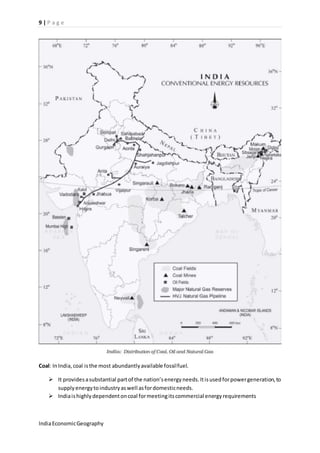
Coal: In India, coal is the most abundantly available fossil fuel. 
 It provides a substantial part of the nation’s energy needs. It is used for power generation, to 
supply energy to industry as well as for domestic needs. 
 India is highly dependent on coal for meeting its commercial energy requirements 
India Economic Geography
10 | P a g e 
 Lignite is a low grade brown coal, which is soft with high moisture content. The principal 
lignite reserves are in Neyveli in Tamil Nadu and are used for generation of electricity. Coal 
that has been buried deep and subjected to increased temperatures is bituminous coal. It is 
the most popular coal in commercial use. Metallurgical coal is high grade bituminous coal 
which has a special value for smelting iron in blast furnaces. Anthracite is the highest quality 
hard coal 
 In India coal occurs in rock series of two main geological ages, namely Gondwana, a little 
over 200 million years in age and in tertiary deposits which are only about 55 million years 
old. 
Petroleum 
 Petroleum or mineral oil is the next major energy source in India after coal. It provides fuel 
for heat and lighting, lubricants for machinery and raw materials for a number of 
manufacturing industries. Petroleum refineries act as a “nodal industry” for synthetic textile, 
fertiliser and numerous chemical industries 
 Most of the petroleum occurrences in India are associated with anticlines and fault traps in 
the rock formations of the tertiary age. 
 Petroleum is also found in fault traps between porous and non-porous rocks. Gas, being 
lighter usually occurs above the oil. 
Natural Gas 
 Natural gas is considered an environment friendly fuel because of low carbon dioxide 
emissions and is, therefore, the fuel for the present century 
 Large reserves of natural gas have been discovered in the Krishna- Godavari basin. 
Electricity 
 Electricity is generated mainly in two ways: by running water which drives hydro turbines to 
generate hydroelectricity; and by burning other fuels such as coal, petroleum and natural 
gas to drive turbines to produce thermal power. Once generated the electricity is exactly the 
same 
• Hydro electricity is generated by fast flowing water, which is a renewable resource. 
India has a number of multi-purpose projects like the Bhakra Nangal, Damodar 
Valley Corporation, the Kopili Hydel Project etc. producing hydroelectric power. 
• Thermal electricity is generated by using coal, petroleum and natural gas. The 
thermal power stations use non-renewable fossil fuels for generating electricity. 
There are over 310 thermal power plants in India 
 Nuclear or Atomic Energy is obtained by altering the structure of atoms. When such an 
alteration is made, much energy is released in the form of heat and this is used to generate 
electric power. Uranium and thorium, which are available in Jharkhand and the Aravalli 
ranges of Rajasthan are used for generating atomic or nuclear power. The Monazite sand of 
Kerala is also rich in thorium. 
India Economic Geography
11 | P a g e 
Non-Conventional Sources of Energy 
 Hence, there is a pressing need to use renewable energy sources like sol ar energy, wind, 
tide, biomass and energy from waste material. These are called nonconventional energy 
sources. 
 India is blessed with an abundance of sunlight, water, wind and biomass. It has the largest 
programmes for the development of these renewable energy resources. 
Solar Energy 
 India is a tropical country. It has enormous possibilities of tapping solar energy. Photovoltaic 
technology converts sunlight directly into electricity. Solar energy is fast becoming popular in 
India Economic Geography
12 | P a g e 
rural and remote areas. The largest solar plant of India is located at Madhapur, near Bhuj, 
where solar energy is used to sterilise milk cans. 
Wind energy 
 India now ranks as a “wind super power” in the world. The largest wind farm cluster is 
located in Tamil Nadu from Nagarcoil to Madurai. 
 Nagarcoil and Jaisalmer are well known for effective use of wind energy in the country 
 Shrubs, farm waste, animal and human waste are used to produce biogas for domestic 
consumption in rural areas. Decomposition of organic matter yields gas, which has higher 
thermal efficiency in comparison to kerosene, dung cake and charcoal. 
 In India, the Gulf of Kuchchh provides ideal conditions for utilising tidal energy. A 900 mw 
tidal energy power plant is set up here by the National Hydropower Corporation 
Geo Thermal Energy 
 Geothermal energy refers to the heat and electricity produced by using the heat from the 
interior of the Earth. Geothermal energy exists because; the Earth grows progressively 
hotter with increasing depth. 
 Two experimental projects have been set up in India to harness geothermal energy. One is 
located in the Parvati valley near Manikarn in Himachal Pradesh and the other is located in 
the Puga Valley, Ladakh. 
Conservation of Energy Resources 
 Every sector of the national economy – agriculture, industry, transport, commercial and 
domestic – needs inputs of energy. 
 Promotion of energy conservation and increased use of renewable energy sources are the 
twin planks of sustainable energy 
 India is presently one of the least energy efficient countries in the world. 
 After all, “energy saved is energy produced”. 
Chapter 3 
 The economic strength of a country is measured by the development of manufacturing 
industries. 
o Manufacturing industries not only help in modernising agriculture, which forms the 
backbone of our economy, they also reduce the heavy dependence of people on 
agricultural income by providing them jobs in secondary and tertiary sectors. 
o Industrial development is a precondition for eradication of unemployment and 
poverty from our country. This was the main philosophy behind public sector 
industries and joint sector ventures in India. It was also aimed at bringing down 
regional disparities by establishing industries in tribal and backward areas 
o Export of manufactured goods expands trade and commerce, and brings in much 
needed foreign exchange 
o Countries that transform their raw materials into a wide variety of furnished goods 
of higher value are prosperous. India’s prosperity lies in increasing and diversifying 
its manufacturing industries as quickly as possible. 
India Economic Geography
13 | P a g e 
Contribution of Industry to National Economy 
 Over the last two decades, the share of manufacturing sector has stagnated at 17 per cent of 
GDP – out of a total of 27 per cent for the industry which includes 10 per cent for mining, 
quarrying, electricity and gas. 
 The National Manufacturing Competitiveness Council (NMCC) has been set up. 
Industrial Location 
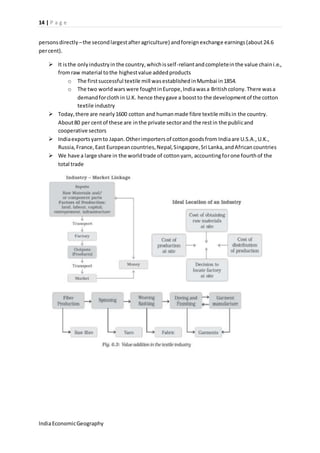
 These are influenced by availability of raw material, labour, capital, power and market, etc. 
It is rarely possible to find all these factors available at one place. 
 Many industries tend to come together to make use of the advantages offered by the urban 
centres known as agglomeration economies. 
 The key to decision of the factory location is the least cost. Government policies and 
specialised labour also influence the location of industry. 
o Agro based: cotton, woollen, jute, silk textile, rubber and sugar, tea, coffee, edible 
oil. 
o Mineral based: iron and steel, cement, aluminium, machine tools, petrochemicals 
On the basis of capital investment: 
o A small scale industry is defined with reference to the maximum investment allowed 
on the assets of a unit. This limit has changed over a period of time. 
 If investment is more than one crore on any industry then it is known as a large scale 
industry. 
On the basis of ownership: 
o Public sector owned and operated by government agencies – BHEL, SAIL etc. 
o Private sector industries owned and operated by individuals or a group of 
individuals –TISCO, Bajaj Auto Ltd., Dabur Industries 
o Joint sector industries which are jointly run by the state and individuals or a group 
of individuals. Oil India Ltd. (OIL) is jointly owned by public and private sector. 
o Cooperative sector industries are owned and operated by the producers or 
suppliers of raw materials, workers or both. They pool in the resources and share 
the profits or losses proportionately such as the sugar industry in Maharashtra, the 
coir industry in Kerala. 
Based on the bulk and weight of raw material and finished goods: 
o Heavy industries such as iron and steel 
o Light industries that use light raw materials and produce light goods such as 
electrical industries. 
Agro Based Industries 
Textile Industry: The textile industry occupies unique position in the Indian economy, because it 
contributes significantly to industrial production (14 per cent), employment generation (35 million 
India Economic Geography
14 | P a g e 
persons directly – the second largest after agriculture) and foreign exchange earnings (about 24.6 
per cent). 
 It is the only industry in the country, which is self -reliant and complete in the value chain i.e., 
from raw material to the highest value added products 
o The first successful textile mill was established in Mumbai in 1854. 
o The two world wars were fought in Europe, India was a British colony. There was a 
demand for cloth in U.K. hence they gave a boost to the development of the cotton 
textile industry 
 Today, there are nearly 1600 cotton and human made fibre textile mills in the country. 
About 80 per cent of these are in the private sector and the rest in the public and 
cooperative sectors 
 India exports yarn to Japan. Other importers of cotton goods from India are U.S.A., U.K., 
Russia, France, East European countries, Nepal, Singapore, Sri Lanka, and African countries 
 We have a large share in the world trade of cotton yarn, accounting for one fourth of the 
total trade 
India Economic Geography
15 | P a g e 
Jute Textiles 
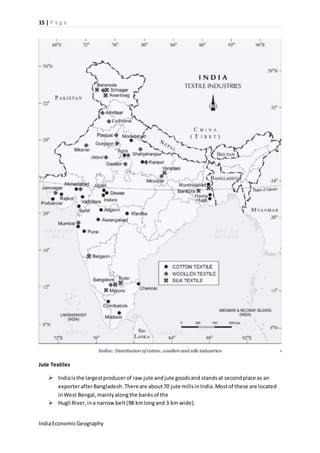
 India is the largest producer of raw jute and jute goods and stands at second place as an 
exporter after Bangladesh. There are about 70 jute mills in India. Most of these are located 
in West Bengal, mainly along the banks of the 
 Hugli River, in a narrow belt (98 km long and 3 km wide). 
India Economic Geography
16 | P a g e 
 The first jute mill was set up near Kolkata in 1859 at Rishra. After Partition in 1947, the jute 
mills remained in India but three-fourth of the jute producing area went to Bangladesh 
(erstwhile East Pakistan) 
 Kolkata as a large urban centre provides banking, insurance and port facilities for export of 
jute goods 
 However, the internal demand has been on the increase due to the Government policy of 
mandatory use of jute packaging. 
 In 2005, National Jute Policy was formulated with the objective of increasing productivity, 
improving quality, ensuring good prices to the jute farmers and enhancing the yield per 
hectare. The main markets are U.S.A., Canada, Russia, United Arab Republic, U.K. and 
Australia. 
Sugar Industry 
 India stands second as a world producer of sugar but occupies the first place in the 
production of gur and khandsari. 
 There are over 460 sugar mills in the country spread over Uttar Pradesh, 
 60%mills are in Uttar Pradesh and Bihar. This industry is seasonal in nature so, it is ideally 
suited to the cooperative sector. 
 Merits: 
 The cane produced here has higher sucrose content 
 The Maximum use of bagasse 
Mineral based Industries 
Industries that use minerals and metals as raw materials are called mineral based industries 
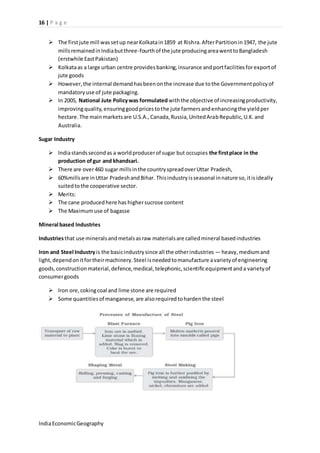
Iron and Steel Industry is the basic industry since all the other industries — heavy, medium and 
light, depend on it for their machinery. Steel is needed to manufacture a variety of engineering 
goods, construction material, defence, medical, telephonic, scientific equipment and a variety of 
consumer goods 
 Iron ore, coking coal and lime stone are required 
 Some quantities of manganese, are also required to harden the steel 
India Economic Geography
17 | P a g e 
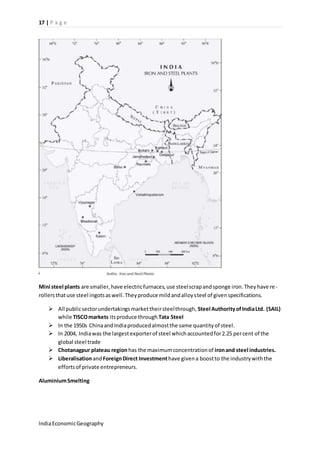
Mini steel plants are smaller, have electric furnaces, use steel scrap and sponge iron. They have re - 
rollers that use steel ingots as well. They produce mild and alloy steel of given specifications. 
 All public sector undertakings market their steel through, Steel Authority of India Ltd. (SAIL) 
while TISCO markets its produce through Tata Steel 
 In the 1950s China and India produced almost the same quantity of steel. 
 In 2004, India was the largest exporter of steel which accounted for 2.25 per cent of the 
global steel trade 
 Chotanagpur plateau region has the maximum concentration of iron and steel industries. 
 Liberalisation and Foreign Direct Investment have given a boost to the industry with the 
efforts of private entrepreneurs. 
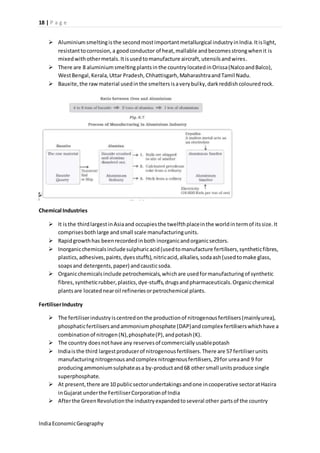
Aluminium Smelting 
India Economic Geography
18 | P a g e 
 Aluminium smelting is the second most important metallurgical industry in India. It is light, 
resistant to corrosion, a good conductor of heat, mallable and becomes strong when it is 
mixed with other metals. It is used to manufacture aircraft, utensils and wires. 
 There are 8 aluminium smelting plants in the country located in Orissa (Nalco and Balco), 
West Bengal, Kerala, Uttar Pradesh, Chhattisgarh, Maharashtra and Tamil Nadu. 
 Bauxite, the raw material used in the smelters is a very bulky, dark reddish coloured rock. 
Chemical Industries 
 It is the third largest in Asia and occupies the twelfth place in the world in term of its size. It 
comprises both large and small scale manufacturing units. 
 Rapid growth has been recorded in both inorganic and organic sectors. 
 Inorganic chemicals include sulphuric acid (used to manufacture fertilisers, synthetic fibres, 
plastics, adhesives, paints, dyes stuffs), nitric acid, alkalies, soda ash (used to make glass, 
soaps and detergents, paper) and caustic soda. 
 Organic chemicals include petrochemicals, which are used for manufacturing of synthetic 
fibres, synthetic rubber, plastics, dye-stuffs, drugs and pharmaceuticals. Organic chemical 
plants are located near oil refineries or petrochemical plants. 
Fertiliser Industry 
 The fertiliser industry is centred on the production of nitrogenous fertilisers (mainly urea), 
phosphatic fertilisers and ammonium phosphate (DAP) and complex fertilisers which have a 
combination of nitrogen (N), phosphate (P), and potash (K). 
 The country does not have any reserves of commercially usable potash 
 India is the third largest producer of nitrogenous fertilisers. There are 57 fertiliser units 
manufacturing nitrogenous and complex nitrogenous fertilisers, 29 for urea and 9 for 
producing ammonium sulphate as a by-product and 68 other small units produce single 
superphosphate. 
 At present, there are 10 public sector undertakings and one in cooperative sector at Hazira 
in Gujarat under the Fertiliser Corporation of India 
 After the Green Revolution the industry expanded to several other parts of the country 
India Economic Geography
19 | P a g e 
Cement Industry 
 This industry requires bulky and heavy raw materials like limestone, silica, alumina and 
gypsum. Coal and electric power are needed apart from rail transportation 
 The industry has strategically located plants in Gujarat that have suitable access to the 
market in the Gulf countries 
 The first cement plant was set up in Chennai in 1904. After Independence the industry 
expanded. Decontrol of price and distribution since 1989 and other policy reforms led the 
cement industry to make rapid strides in capacity, process, technology and production. 
There are 128 large plants and 332 mini cement plants in the country. India produces a 
variety of cement 
Automobile Industry 
 This industry had experienced a quantum jump in less than 15 years. Foreign Direct 
Investment brought in new technology and aligned the industry with global developments. 
 At present, there are 15 manufacturers of passenger cars and multi utility vehicles, 9 of 
commercial vehicles, 14 of the two and three-wheelers. 
Information Technology and Electronics Industry 
 Bangalore has emerged as the electronic capital of India. 
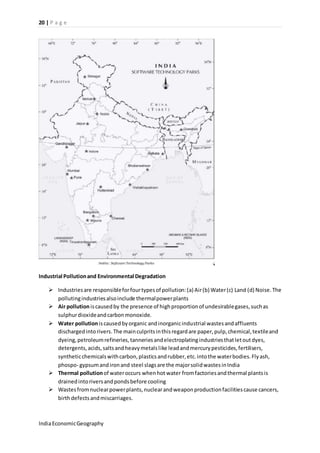
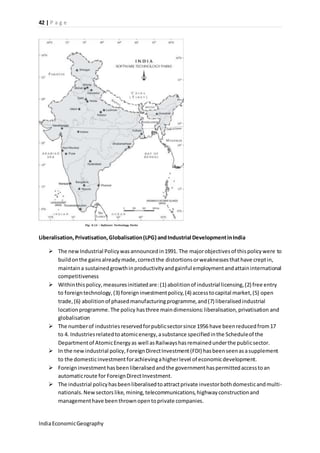
 18 software technology parks provide single window service and high data communication 
facility to software experts. 
 This industry has been a major foreign exchange earner in the last two or three years 
because of its fast growing Business Processes Outsourcing (BPO) sector. 
India Economic Geography
20 | P a g e 
Industrial Pollution and Environmental Degradation 
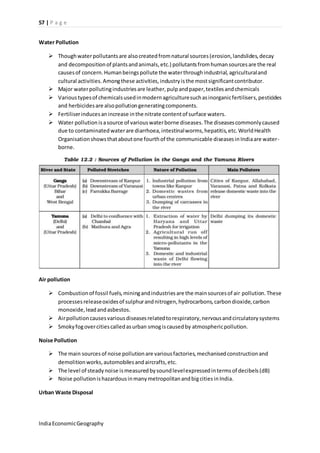
 Industries are responsible for four types of pollution: (a) Air (b) Water (c) Land (d) Noise. The 
polluting industries also include thermal power plants 
 Air pollution is caused by the presence of high proportion of undesirable gases, such as 
sulphur dioxide and carbon monoxide. 
 Water pollution is caused by organic and inorganic industrial wastes and affluents 
discharged into rivers. The main culprits in this regard are paper, pulp, chemical, textile and 
dyeing, petroleum refineries, tanneries and electroplating industries that let out dyes, 
detergents, acids, salts and heavy metals like lead and mercury pesticides, fertilisers, 
synthetic chemicals with carbon, plastics and rubber, etc. into the water bodies. Fly ash, 
phospo- gypsum and iron and steel slags are the major solid wastes in India 
 Thermal pollution of water occurs when hot water from factories and thermal plants is 
drained into rivers and ponds before cooling 
 Wastes from nuclear power plants, nuclear and weapon production facilities cause cancers, 
birth defects and miscarriages. 
India Economic Geography
21 | P a g e 
 Dumping of wastes especially glass, harmful chemicals, industrial effluents, packaging, salts 
and garbage renders the soil useless. 
 Noise pollution not only results in irritation and anger, it can also cause hearing impairment, 
increased heart rate and blood pressure among other physiological effects. 
Control of Environmental Degradation 
 Every litre of waste water discharged by our industry pollutes eight times the quantity of 
freshwater. 
 Some suggestions are- 
 minimising use water for processing by reusing and recycling it in two or more successive 
stages 
 harvesting of rainwater to meet water requirements 
 Treating hot water and effluents before releasing them in rivers and ponds. Treatment of 
industrial effluents can be done in three phases 
o Primary treatment by mechanical means. This involves screening, grinding, 
flocculation and sedimentation. 
o Secondary treatment by biological process 
o Tertiary treatment by biological, chemical and physical processes. This involves 
recycling of wastewater. 
 The challenge of sustainable development requires integration of economic development 
with environmental concerns 
NTPC shows the way NTPC is a major power providing corporation in India. 
 It has ISO certification for EMS (Environment Management System) 14001. 
 The corporation has a pro-active approach for preserving the natural environment and 
resources like water, oil and gas and fuels in places where it is setting up power plants. This 
has been possible through- 
 Optimum utilisation of equipment adopting latest techniques and upgrading existing 
equipment. 
 Minimising waste generation by maximising ash utilisation. 
 Providing green belts for nurturing ecological balance and addressing the question of special 
purpose vehicles for afforestation. 
 Reducing environmental pollution through ash pond management, ash water recycling 
system and liquid waste management. 
 Ecological monitoring, reviews and online database management for all its power stations 
Chapter 5: 
Movement of these goods and services can be over three important domains of our earth i.e. land, 
water and air. Based on these, transport can also be classified into land, water and air transport 
Roadways 
In India, roads are classified in the following six classes according to their capacity. 
India Economic Geography
22 | P a g e 
• Golden Quadrilateral Super Highways: The government has launched a major road development 
project linking Delhi-KolkataChennai-Mumbai and Delhi by six-lane Super Highways. The North- 
South corridors linking Srinagar (Jammu & Kashmir) and Kanyakumari (Tamil Nadu), and East -West 
Corridor connecting Silcher (Assam) and Porbander (Gujarat) are part of this project. The major 
objective of these Super Highways is to reduce the time and distance between the mega cities of 
India. These highway projects are being implemented by the National Highway Authority of India 
(NHAI) 
The historical Sher- 
National Highway-7 is the longest and traverses 2, 369 km between Varanasi and Kanyakumari via 
Jabalpur, Nagpur, Hyderabad, Bangalore and Madurai. Delhi and Mumbai are connected by National 
Highway-8, while National Highway-15 covers most of Rajasthan. 
• State Highways:Roads linking a state capital with different district headquarters are known as State 
Highways. These roads are constructed and maintained by the State Public Works Department 
(PWD) in State and Union Territories 
• Other Roads: Rural roads, which link rural areas and villages with towns, are classified under this 
category. These roads received special impetus under the Pradhan Mantri Grameen Sadak Yojana. 
• Border Roads:Apart from these, Border Roads Organisation a Government of Indi a undertaking 
constructs and maintains roads in the bordering areas of the country. This organisation was 
established in 1960 for the development of the roads of strategic importance in the northern and 
northeastern border areas. 
concrete or even bitumen of coal, therefore, these are all weather roads. Unmetalled roads go out 
of use in the rainy season 
Road Density 
The length of road per 100 sq. km of area is known as density of roads. Distribution of road is not 
uniform in the country. Density of all roads varies from only 10 km in Jammu & Kashmir to 375 km in 
Kerala with the national average of 75 km (1996-97). 
Railways 
The Indian Railways is the largest public sector undertaking in the country. The first train steamed off 
from Mumbai to Thane in 1853, covering a distance of 34 km. 
The Indian Railway is now reorganised into 16 zones 
Pipelines 
Pipeline transport network is a new arrival on the transportation map of India. In the past, these 
were used to transport water to cities and industries. Now, these are used for transporting crude oil, 
petroleum products and natural gas from oil and natural gas fields to refineries, fertilizer factories 
and big thermal power plants. 
India Economic Geography
23 | P a g e 
The far inland locations of refineries like Barauni, Mathura, Panipat and gas based fertilizer plants 
could be thought of only because of pipelines. 
There are three important networks of pipeline transportation in the country. 
• From oil field in upper Assam to Kanpur (Uttar Pradesh), via Guwahati, Barauni and Allahabad. It 
has branches from Barauni to Haldia, via Rajbandh, Rajbandh to Maurigram and Guwahati to Siliguri. 
• Gas pipeline from Hazira in Gujarat connects Jagdishpur in Uttar Pradesh, via Vijaipur in Madhya 
Pradesh. It has branches to Kota in Rajasthan, Shahajahanpur, Babrala and other places in Uttar 
Pradesh 
It is a fuel-efficient and environment friendly mode of transport. India has inland navigation 
waterways of 14,500 km in length. Out of these only 3,700 km are navigable by mechanised boats. 
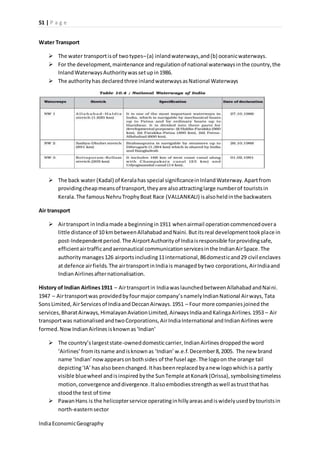
The following waterways have been declared as the National Waterways by the Government 
The other viable inland waterways include the Godavari, Krishna, Barak, Sunderbans, Buckingham 
Canal, Brahmani, East-west Canal and Damodar Valley Corporation Canal. 
95 per cent of the country’s trade volume (68 per cent in terms of value) is moved by sea. 
With a long coastline of 7,516.6 km, India is dotted with 12 major and 181 medium and minor ports. 
These major ports handle 95 per cent of India’s foreign trade 
Kandla in Kuchchh was the first port developed soon after Independence to ease the volume of 
trade on the Mumbai port, in the wake of loss of Karachi port to Pakistan after the Partition. Kandla 
is a tidal port. 
Mumbai is the biggest port with a spacious natural and well -sheltered harbour. The Jawaharlal 
Nehru port was planned with a view to decongest the Mumbai port and serve as a the extreme 
south-eastern port of Tuticorin, in Tamil Nadu. This port has a natural harbour and rich hinterland. 
Chennai is one of the oldest artificial ports of the country. It is ranked next to Mumbai in terms of 
the volume of trade and cargo. 
Vishakhapatnam is the deepest landlocked and well-protected port. This port was, originally, 
conceived as an outlet for iron ore exports. Paradip port located in Orissa, speci alises in the export of 
iron ore. Kolkata is an inland riverine port. This port serves a very large and rich hinterland of Ganga- 
Brahmaputra basin. Being a tidal port, it requires constant dredging of Hoogly. Haldia port was 
developed as a subsidiary port, in order to relieve growing pressure on the Kolkata port. 
Airways 
The air transport was nationalised in 1953. On the operational side, Indian Airlines, Alliance Air 
(subsidiary of Indian Airlines), private scheduled airlines and non- scheduled operators provide 
domestic air services. Air India provides international air services. Pawanhans Helicopters Ltd. 
provides helicopter services to Oil and Natural Gas Commission in its off - shore operations, to 
inaccessible areas and difficult terrains like the north-eastern states and the interior parts of Jammu 
and Kashmir, Himachal Pradesh and Uttaranchal. 
India Economic Geography
24 | P a g e 
Communication 
The Indian postal network is the largest in the world. It handles parcels as well as personal written 
communications. Cards and envelopes are considered first–class mail and are airlifted between 
stations covering both land and air. The second–class mail includes book packets, registered 
newspapers and periodicals. They are carried by surface mail, covering land and water transport. To 
facilitate quick delivery of mails in large towns and cities, six mail channels have been introduced 
recently. They are called Rajdhani Channel, Metro Channel, Green Channel, Business Channel, Bulk 
Mail Channel and Periodical Channel 
India has about 37,565 telephone exchanges spread all over in the country 
All India Radio (Akashwani) broadcasts a variety of programmes in national, regional and local 
languages for various categories of people, spread over different parts of the country. Doordarshan, 
the national television channel of India, is one of the largest terrestrial networks in the world. It 
broadcasts a variety of programmes from entertainment, educational to sports, etc. for people of 
different age groups. 
The exchange of goods among people, states and countries is referred to as trade. The market is the 
place where such exchanges take place. Trade between two countries is called international trade. 
Advancement of international trade of a country is an index to its economic prosperity. It is, 
therefore, considered the economic barometer for a country 
Export and import are the components of trade. The balance of trade of a country is the difference 
between its export and import. When the value of export exceeds the value of imports, it is called a 
favourable balance of trade. On the contrary, if the value of imports exceeds the value of exports, it 
is termed as unfavourable balance of trade 
Tourism as a Trade 
Tourism in India has grown substantially over the last three decades 
Over 2.6 million foreign tourists visit India every year. 
Rajasthan, Goa, Jammu and Kashmir and temple towns of south India are important destinations of 
foregin tourists in India. 
Chapter 12_5 MINERAL AND ENERGY RESOURCES 
A mineral is a natural substance of organic or inorganic origin with definite chemical and physical 
properties (mainly associated with metamorphic and igneous rocks of the peninsular India. The vast 
alluvial plain tract of north India is devoid of minerals of economic use.) 
 On the basis of chemical and physical properties, minerals may be grouped under two main 
categories of metallics and non-metallics 
 Metallic minerals are the sources of metals. Iron ore, copper, gold produce metal 
 Metallic minerals are further divided into ferrous and non-ferrous metallic minerals. 
India Economic Geography
25 | P a g e 
 Ferrous such as iron ore itself and those which do not have iron content are non-ferrous 
such as copper, bauxite, etc 
 Non-metallic minerals are either organic in origin such as fossil fuels also known as mineral 
fuels which are derived from the buried animal and plant life such as coal and petroleum. 
 Other type of non-metallic minerals is inorganic in origin such as mica, limestone and 
graphite, etc. 
Agencies involved in the exploration of minerals In India, systematic surveying, prospecting and 
exploration for minerals is undertaken by the Geological Survey of India (GSI), Oil and Natural Gas 
Commission (ONGC), Mineral Exploration Corporation Ltd. (MECL), National Mineral Development 
Corporation (NMDC), Indian Bureau of Mines (IBM), Bharat Gold Mines Ltd. (BGML), Hindustan 
Copper Ltd. (HCL), National Aluminium Company Ltd. (NALCO) and the Departments of Mining and 
Geology in various states 
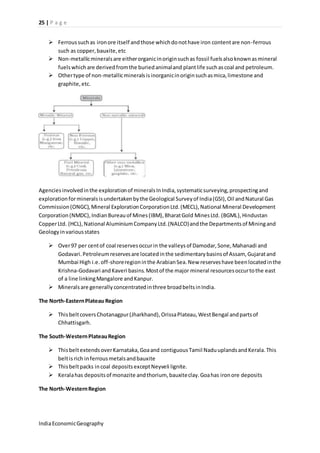
 Over 97 per cent of coal reserves occur in the valleys of Damodar, Sone, Mahanadi and 
Godavari. Petroleum reserves are located in the sedimentary basins of Assam, Gujarat and 
Mumbai High i.e. off-shore region in the Arabian Sea. New reserves have been located in the 
Krishna-Godavari and Kaveri basins. Most of the major mineral resources occur to the east 
of a line linking Mangalore and Kanpur. 
 Minerals are generally concentrated in three broad belts in India. 
The North-Eastern Plateau Region 
 This belt covers Chotanagpur (Jharkhand), Orissa Plateau, West Bengal and parts of 
Chhattisgarh. 
The South-Western Plateau Region 
 This belt extends over Karnataka, Goa and contiguous Tamil Nadu uplands and Kerala. This 
belt is rich in ferrous metals and bauxite 
 This belt packs in coal deposits except Neyveli lignite. 
 Kerala has deposits of monazite and thorium, bauxite clay. Goa has iron ore deposits 
The North-Western Region 
India Economic Geography
26 | P a g e 
 This belt extends along Aravalli in Rajasthan and part of Gujarat and minerals are associated 
with Dharwar system of rocks. Copper, zinc has been major minerals. Rajasthan is rich in 
building stones i.e. sandstone, granite, marble. Gypsum and Fuller’s earth deposits are also 
extensive. Dolomite and limestone provide raw materials for cement industry. 
 Gujarat is known for its petroleum deposits. 
 Ferrous Mineral Ferrous minerals such as iron ore, manganese, chromite, etc., provide a 
strong base for the development of metallurgical industries. 
 The two main types of ore found in our country are haematite and magnetite 
Iron ore 
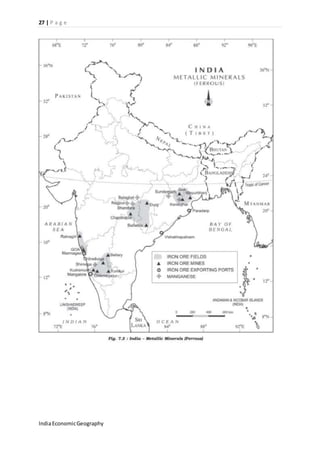
 About 95 per cent of total reserves of iron ore is located in the States of Orissa, Jharkhand, 
Chhattisgarh, Karnataka, Goa, Andhra Pradesh and Tamil Nadu. 
 In Orissa, iron ore occurs in a series of hill ranges in Sundergarh, Mayurbhanj and Jhar. The 
important mines are Gurumahisani, Sulaipet, Badampahar (Mayurbhaj), Kiruburu 
(Kendujhar) and Bonai (Sundergarh). 
 Most of the important mines such as Noamundi and Gua are located in Poorbi and 
Pashchimi Singhbhum districts. This belt further extends to Durg, Dantewara and Bailadila. 
Dalli and Rajhara in Durg are the important mines of iron ore in the country. 
 In Karnataka, iron ore deposits occur in Sandur-Hospet area of Bellary district 
Manganese 
 Orissa is the leading producer of Manganese. 
 Karnataka is another major producer and here the mines are located in Dharwar, Bellary, 
Belgaum, North Canara, Chikmagalur, Shimoga, Chitradurg and Tumkur 
 Non-Ferrous Minerals India is poorly endowed with non-ferrous metallic minerals except 
bauxite 
Bauxite is the ore which is used in manufacturing of aluminium. 
 Orissa happens to be the largest producer of Bauxite. 
 The other two areas which have been increasing their production are Bolangir and Koraput. 
 Tamil Nadu, Karnataka and Goa are minor producers of bauxite. 
 Chhattisgarh has bauxite deposits in Amarkantak plateau while Katni -Jabalpur area and 
Balaghat in M.P. 
Copper 
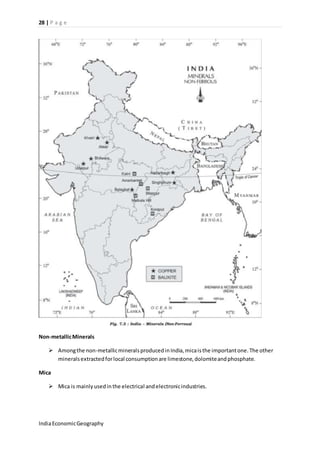
 Copper is an indispensable metal in the electrical industry for making wires, electric motors, 
transformers and generators. It is alloyable, malleable and ductile. It is also mixed with gold 
to provide strength to jewellery. The Copper deposits mainly occur in Singhbhum district in 
Jharkhand, Balaghat district in Madhya Pradesh and Jhunjhunu and Alwar districts in 
Rajasthan. Minor producers of Copper are Agnigundala in Guntur District (Andhra Pradesh), 
Chitradurg and Hasan districts (Karnataka) and South Arcot di strict (Tamil Nadu). 
India Economic Geography
27 | P a g e 
India Economic Geography
28 | P a g e 
Non-metallic Minerals 
 Among the non-metallic minerals produced in India, mica is the important one. The other 
minerals extracted for local consumption are limestone, dolomite and phosphate. 
Mica 
 Mica is mainly used in the electrical and electronic industries. 
India Economic Geography
29 | P a g e 
 In Jharkhand high quality mica is obtained in a belt extending over a distance of about 150 
km, in length and about 22 km, in width in lower Hazaribagh plateau. In Andhra Pradesh, 
Nellore district produces the best quality mica. 
 In Rajasthan mica belt extends for about 320 kms from Jaipur to Bhilwara and around 
Udaipur. 
Energy Resources 
 Mineral fuels like coal, petroleum and natural gas (known as fossil fuels), nuclear energy 
minerals, are the 
Conventional sources of energy. 
India Economic Geography
30 | P a g e 
Coal 
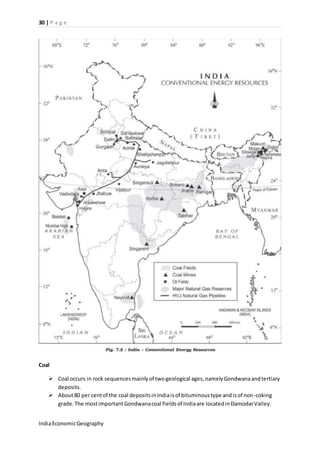
 Coal occurs in rock sequences mainly of two geological ages, namely Gondwana and tertiary 
deposits. 
 About 80 per cent of the coal deposits in India is of bituminous type and is of non-coking 
grade. The most important Gondwana coal fields of India are located in Damodar Valley. 
India Economic Geography
31 | P a g e 
 They lie in Jharkhand-Bengal coal belt and the important coal fields 
 The most important coal mining centres are Singrauli in Madhya Pradesh (part of Singrauli 
coal field lies in Uttar Pradesh), Korba in Chhattisgarh, Talcher and Rampur in Orissa, 
Chanda–Wardha, Kamptee and Bander in Maharashtra and Singareni and Pandur in Andhra 
Pradesh. 
Crude petroleum 
 Crude petroleum consists of hydrocarbons of liquid and gaseous states varying in chemical 
composition, colour and specific gravity. 
 The Oil and Natural Gas Commission has found potential zones of natural gas reserves in 
Ramanathapuram district. 
 Crude petroleum occurs in sedimentary rocks of the tertiary period. Oil exploration and 
production was systematically taken up after the Oi l and Natural Gas Commission was set up 
in 1956. 
 Till then, the Digboi in Assam was the only oil producing region but the scenario has changed 
after 1956. 
 In Assam, Digboi, Naharkatiya and Moran are important oil producing areas. 
 Oil and natural gas have been found in exploratory wells in Krishna-Godavari and Kaveri 
basin on the east coast. 
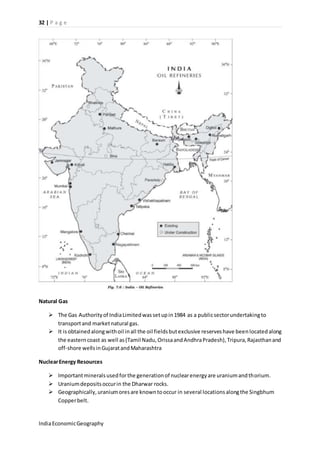
 There are two types of refineries in India: (a) field based and (b) market based. Digboi is an 
example of field based and Barauni is an example of market based refinery. 
 There are 18 refineries in India 
India Economic Geography
32 | P a g e 
Natural Gas 
 The Gas Authority of India Limited was set up in 1984 as a public sector undertaking to 
transport and market natural gas. 
 It is obtained along with oil in all the oil fields but exclusive reserves have been located along 
the eastern coast as well as (Tamil Nadu, Orissa and Andhra Pradesh), Tripura, Rajasthan and 
off-shore wells in Gujarat and Maharashtra 
Nuclear Energy Resources 
 Important minerals used for the generation of nuclear energy are uranium and thorium. 
 Uranium deposits occur in the Dharwar rocks. 
 Geographically, uranium ores are known to occur in several locations along the Singbhum 
Copper belt. 
India Economic Geography
33 | P a g e 
 Thorium is mainly obtained from monazite and ilmenite in the beach sands along the coast 
of Kerala and Tamil Nadu. 
 World’s richest monazite deposits occur in Palakkad and Kollam districts of Kerala, near 
Vishakhapatnam in Andhra Pradesh and Mahanadi river delta in Orissa 
Atomic Energy Commission was established in 1948, progress could be made only after the 
establishment of the Atomic Energy Institute at Trombay in 1954 which was renamed as the Bhabha 
Atomic Research Centre in 1967. 
 The important nuclear power projects are Tarapur (Maharashtra), Rawatbhata near Kota 
(Rajasthan), Kalpakkam (Tamil Nadu), Narora (Uttar Pradesh), Kaiga (Karnataka) and 
Kakarapara (Gujarat). 
Non-Conventional Energy Sources 
 Sustainable energy resources are only the renewable energy sources like solar, wind, hydro-geothermal 
and biomass. 
Solar Energy 
 Sun rays tapped in photovoltaic cells can be converted into energy, known as solar energy 
 The two effective processes considered to be very effective to tap solar energy are 
photovoltaics and solar thermal technology. 
 Solar energy is 7 per cent more effective than coal or oil based plants and 10 per cent more 
effective than nuclear plants. 
 The western part of India has greater potential for the development of solar energy in 
Gujarat and Rajasthan 
Wind Energy 
 The kinetic energy of wind, through turbines is converted into electrical energy 
 The permanent wind systems such the trade winds, westerlies and seasonal wind like 
monsoon have been used as source of energy. 
 India already has started generating wind energy. It has an ambitious programme to install 
250 wind-driven turbines with a total capacity of 45 megawatts, spread over 12 suitable 
locations, especially in coastal areas. 
 According to the estimation by Ministry of Power, India will be able to produce 3,000 
megawatts of electric from this source. The Ministry of non-conventional sources of energy 
is developing wind energy in India to lessen the burden of oil import bill. 
 In Rajasthan, Gujarat, Maharashtra and Karnataka, favourable conditions for wind energy 
exist. Wind power plant at Lamba in Gujarat in Kachchh is the largest in Asia. Another, wind 
power plant is located at Tuticorin in Tamil Nadu. 
Geothermal Energy When the magma from the interior of earth, comes out on the surface, 
tremendous heat is released. This heat energy can successfully be tapped and converted to electrical 
energy. 
India Economic Geography
34 | P a g e 
 Apart from this, the hot water that gushes out through the gyser wells is also used in the 
generation of thermal energy. It is popularly known as Geothermal energy. 
 In India, a geothermal energy plant has been commissioned at Manikaran in Himachal 
Pradesh. 
 The first successful (1890) attempt to tap the underground heat was made in the city of 
Boise, Idaho(U.S.A.),where a hot water pipe network was built to give heat to the 
surrounding buildings. This plant is still working 
Bio-energy 
 Bio-energy refers to energy derived from biological products which includes agricultural 
residues, municipal, industrial and other wastes. 
 This will improve economic life of rural areas in developing countries, reduce environmental 
pollution, enhance self-reliance and reduce pressure on fuel wood. One such project 
converting municipal waste into energy is Okhla in Delhi 
Conservation of Mineral Resources 
 These should be developed to replace the exhaustible resources. In case of metallic 
minerals, use of scrap metals will enable recycling of metals. Use of scrap is especially 
significant in metals like copper, lead and zinc in which India’s reserves are meagre. Use of 
substitutes for scarce metals may also reduce their consumption. Export of strategic and 
scarce minerals must be reduced, so that the existing reserve may be used for a longer 
period 
Chapter 12_7: MANUFACTURING INDUSTRIES 
Types of Industries 
 On the basis of size, capital investment and labour force employed, industries are classified 
as large, medium, small scale, and cottage industries. 
 On the basis of ownership, industries are categorised as : (i) public sector, (ii) private sector, 
and (iii) joint and cooperative sector, 
 Public sector enterprises are government/state controlled companies or corporations 
funded by governments. 
 Industries of strategic and national importance are usually in the public sector. 
 Industries are also classified on the basis of the use of their products such as: (i) basic goods 
industries, (ii) capital goods industries (iii) intermediate goods industries, and (iv) consumer 
goods industries. 
 Another method of classifying industries is on the basis of raw materials used by them. 
Accordingly, these can be : (i) agriculture based industries, (ii) forest-based industries, (iii) 
mineral-based industries, and (iv) industrially processed raw material based industries 
 Another common classification of industries is based on the nature of the manufactured 
products. Eight classes of industries, thus identified are: (1) Metallurgical Industries, (2) 
Mechanical Engineering Industries, (3) Chemical and Allied Industries, (4) Textile Industries, 
(5) Food Processing Industries, (6) Electricity Generation, (7) Electronics and (8) 
Communication Industries. 
India Economic Geography
35 | P a g e 
Location of Industries 
 Location of industries is influenced by several factors like access to raw materials, power, 
market, capital, transport and labour, etc. 
 It is economical to locate the manufacturing industries at a place where cost of production 
and delivery cost of manufactured goods to consumers are the least. 
 Transport costs, to a great extent, depend on the nature of raw materials and manufactured 
products. 
Raw Materials 
 Industries using weight-losing raw materials are located in the regions where raw materials 
are located. 
 Therefore, an optimum location for iron and steel industries should be near raw material 
sources 
 This is why most of the iron and steel industries are located either near coalfields (Bokaro, 
Durgapur, etc.) or near sources of iron ore (Bhadravati, Bhilai, and Rourkela). 
Power 
 Power provides the motive force for machines, and therefore, its supply has to be ensured 
before the location of any industry. However, certain industries, like aluminium and 
synthetic nitrogen manufacturing industries tend to be located near sources of power 
because they are power intensive and require huge quantum of electricity 
Market 
 Markets provide the outlets for manufactured products. 
 Cotton textile industry uses a non-weight-losing raw material and is generally located in 
large urban centre, e.g. Mumbai, Ahmedabad, Surat, etc. 
 Koyali, Mathura and Barauni refineries are typical examples. Ports also play a crucial role in 
the location of oil refineries 
Historical Factors 
 During the initial phase of colonisation, manufacturing activities received new impetus 
provided by the European traders. Places like Murshidabad, Dhaka, Bhadohi, Surat, 
Vadodara, Kozhikode, Coimbatore, Mysore, etc. emerged as important manufacturing 
centres. 
Industrial Policy 
 India, being a democratic country aims at bringing about economic growth with balanced 
regional development. 
 Establishment of iron and steel industry in Bhilai and Rourkela were based on decision to 
develop backward tribal areas of the country. At present, government of India provides lots 
of incentives to industries locating in backward areas. 
Major Industries 
India Economic Geography
36 | P a g e 
 The iron and steel industry is basic to the industrial development of any country. The cotton 
textile Industry is one of our traditional industries. The sugar Industry is based on local raw 
materials which prospered even in the British period. Besides the more recent 
petrochemical Industry and the IT industry 
The Iron and Steel Industry 
 The other raw materials besides iron ore and coking coal, essential for iron and steel 
industry are limestone, dolomite, manganese and fire clay. 
 In India, there is a crescent shaped region comprising parts of Chhattisgarh, Northern Orissa, 
Jharkhand and western West Bengal, which is extremely rich in high grade iron ore, good 
quality coking coal and other supplementing raw materials. 
Integrated Steel Plants 
TISCO 
 The Tata Iron and Steel plant lies very close to the Mumbai -Kolkata railway line and about 
240 km away from Kolkata, which is the nearest port for the export of steel. 
 The rivers Subarnarekha and Kharkai provide water to the plant. 
IISCO 
 The Indian Iron and Steel Company (IISCO) set up its first factory at Hirapur and later on 
another at Kulti. In 1937, the Steel Corporation of Bengal was constituted in association with 
IISCO and set up another iron and steel producing unit at Burnpur (West Bengal). All the 
three plants under IISCO are located very close to Damodar valley coal fields (Raniganj, 
Jharia, and Ramgarh). Iron ore comes from Singhbhum in Jharkhand. Water is obtained from 
the Barakar River, a tributary of the Damodar. 
 Unfortunately, steel production from IISCO fell considerably in 1972-73 and the plants were 
taken over by the government 
Visvesvaraiya Iron and Steel Works Ltd. (VISL) 
 The third integrated steel plant, the Visvesvaraiya Iron and Steel Works, initially called the 
Mysore Iron and Steel Works, is located close to an iron ore producing area of Kemangundi 
in the Bababudan hills. Limestone and manganese are also locally available. 
 Afterwards, electric furnaces were installed which use hydroelectricity from the Jog Falls 
hydel power project. 
 The Bhadravati River supplies water to the plant. This plant produces specialised steels and 
alloys 
 After independence, during the Second Five Year Plan (1956-61), three new integrated steel 
plants were set up with foreign collaboration: Rourkela in Orissa, Bhilai in Chhattisgarh and 
Durgapur in West Bengal. These were public sector plants under Hindustan Steel Limited 
(HSL). In 1973, the Steel Authority of India Limited (SAIL) was created to manage these 
plants 
Rourkela Steel Plant 
India Economic Geography
37 | P a g e 
 The Rourkela Steel plant was set up in 1959 in the Sundargarh district of Orissa in 
collaboration with Germany. 
Bhilai Steel Plant 
 The Bhilai Steel Plant was established with Russian collaboration in Durg District of 
Chhattisgarh and started production in 1959 
Durgapur Steel Plant 
 Durgapur Steel Plant, in West Bengal, was set up in collaboration with the government of 
the United Kingdom and started production in 1962 
Bokaro Steel Plant 
 This steel plant was set up in 1964 at Bokaro with Russian collaboration. 
Other Steel Plants 
 All the three plants are located in South India. The Vizag Steel Plant, in Vishakhapatnam in 
Andhra Pradesh is the first port based plant which started operating in 1992. Its port 
location is of advantage. The Vijaynagar Steel Plant at Hospet in Karnataka was developed 
using indigenous technology. This uses local iron ore and limestone. The Salem Steel Plant in 
Tamil Nadu was commissioned in 1982 
 Apart from these major steel plants, there are more than 206 units located in different parts 
of the country. 
India Economic Geography
38 | P a g e 
India Economic Geography
39 | P a g e 
The Cotton Textile Industry 
 India was famous worldwide for the production of muslin, a very fine variety of cotton cloth, 
calicos, chintz and other different varieties of fine cotton cloth 
 One, it is a tropical country and cotton is the most comfortable fabric for a hot and humid 
climate. Second, large quantity of cotton was grown in India. Abundant skilled labour 
required for this industry was available in this country. 
 In 1854, the first modern cotton mill was established in Mumbai. This city had several 
advantages as a cotton textile manufacturing centre. 
 Subsequently, two more mills, the Shahpur Mill and the Calico Mill were established in 
Ahmedabad. 
 After Independence, this industry gradually recovered and eventually flourished. In 1998, 
India had 1782 mills; of which, 192 mills were in the public sector and 151 mills in the 
cooperative sector. The largest number, that is, 1,439 mills were in the private sector. 
 The cotton textile industry in India can be broadly divided into two sectors, the organised 
sector and the decentralised sector. The decentralised sector includes cloth produced in 
handlooms (including Khadi) and power looms. The production of the organised sector has 
drastically fallen from 81 per cent in the mid-twentieth century to only about 6 per cent in 
2000. At present, the power looms on the decentralised sector produce more than 59 per 
cent and the handloom sector produces about 19 per cent of all cotton cloth produced in 
the country. 
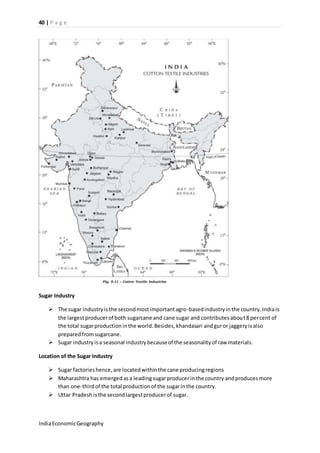
 In southern India, mills were set up at Coimbatore, Madurai and Bangalore. In central India, 
Nagpur, Indore, Solapur and Vadodara became cotton textile centres. 
 Maharashtra, Gujarat and Tamil Nadu are the leading cotton producing states. 
 Tamil Nadu has the largest number of mills and most of them produce yarn rather than 
cloth. Coimbatore has emerged as the most important centre with nearly half the mills 
located there. 
 In Andhra Pradesh, the cotton textile industry is located in the cotton producing Telengana 
region, where most of the mills are spinning mills producing yarn. The important centres are 
Hyderabad, Secunderabad, Warangal and Guntur 
 Production of cotton cloth increased almost five times from 1950-51 to 1999-2000. Cotton 
textile has been facing tough competition from synthetic cloth. 
India Economic Geography
40 | P a g e 
Sugar Industry 
 The sugar industry is the second most important agro-based industry in the country. India is 
the largest producer of both sugarcane and cane sugar and contributes about 8 per cent of 
the total sugar production in the world. Besides, khandasari and gur or jaggery is also 
prepared from sugarcane. 
 Sugar industry is a seasonal industry because of the seasonality of raw materials. 
Location of the Sugar Industry 
 Sugar factories hence, are located within the cane producing regions 
 Maharashtra has emerged as a leading sugar producer in the country and produces more 
than one-third of the total production of the sugar in the country. 
 Uttar Pradesh is the second largest producer of sugar. 
India Economic Geography
41 | P a g e 
 The industry is distributed in the coastal regions i.e. East Godavari, West Godavari, 
Vishakhapatnam districts and Nizamabad, and Medak districts of Telangana along with 
Chittoor district of Rayalseema 
Petrochemical Industries 
 This group of industries is divided into four sub-groups: (i) polymers, (ii) synthetic fibres, (iii) 
elastomers, and (iv) surfactant intermediate. Mumbai is the hub of the petrochemical 
industries. Cracker units are also located in Auraiya (Uttar Pradesh), Jamnagar, Gandhinagar 
and Hajira (Gujarat), Nagothane, Ratnagiri (Maharashtra), Haldia (West Bengal) and 
Vishakhapatnam (Andhra Pradesh) 
 Three organisations are working in the petrochemical sector under the administrative 
control of the Department of Chemicals and Petrochemicals. 
 First is the Indian Petrochemical Corporation Limited (IPCL), a public sector undertaking. It 
is responsible for the manufacture and distribution of the various petrochemicals like 
polymers, chemicals, fibres and fibre intermediates. 
 Second is the Petrofils Cooperative Limited (PCL), a joint venture of the Government of 
India and Weaver’s Cooperative Societies. It produces polyester filament yarn and nylon 
chips at its two plants located at Vadodara and Naldhari in Gujarat. 
 Third is the Central Institute of Plastic Engineering and Technology (CIPET), involved in 
imparting training in petro-chemical industry. 
 Polymers are made from ethylene and propylene. These materials are obtained in the 
process of refining crude oil. 
 The National Organic Chemicals Industries Limited (NOCIL), established in private sector in 
1961, started the first naphtha based chemical industry in Mumbai. 
 The plants located at Mumbai, Barauni, Mettur, Pimpri and Rishra are the major producers 
of plastic materials 
 About 75 per cent of these units are in small scale sector. The industry also uses recycled 
plastics, which constitutes about 30 per cent of the total production 
Knowledge based Industries 
 The Information Technology (IT) revolution opened up new possibilities of economic and 
social transformation. The IT and IT enabled business process outsourcing (ITESBPO) services 
continue to be on a robust growth path. 
 The IT software and services industry account for almost 2 per cent of India’s GDP. 
 A majority of the multinational companies operating in the area of information technology 
have either software development centres or research development centres in India. 
However, in the hardware development sector, India is yet to make any remarkable 
achievements. 
 A major impact of this growth has been on employment creation, which is almost doubled 
every year 
India Economic Geography
42 | P a g e 
Liberalisation, Privatisation, Globalisation (LPG) and Industrial Development in India 
 The new Industrial Policy was announced in 1991. The major objectives of this policy were to 
build on the gains already made, correct the distortions or weaknesses that have crept in, 
maintain a sustained growth in productivity and gainful employment and attain international 
competitiveness 
 Within this policy, measures initiated are: (1) abolition of industrial licensing, (2) free entry 
to foreign technology, (3) foreign investment policy, (4) access to capital market, (5) open 
trade, (6) abolition of phased manufacturing programme, and (7) liberalised industrial 
location programme. The policy has three main dimensions: liberalisation, privatisation and 
globalisation 
 The number of industries reserved for public sector since 1956 have been reduced from 17 
to 4. Industries related to atomic energy, a substance specified in the Schedule of the 
Department of Atomic Energy as well as Railways has remained under the public sector. 
 In the new industrial policy, Foreign Direct Investment (FDI) has been seen as a supplement 
to the domestic investment for achieving a higher level of economic development. 
 Foreign investment has been liberalised and the government has permitted access to an 
automatic route for Foreign Direct Investment. 
 The industrial policy has been liberalised to attract private investor both domestic and multi-nationals. 
New sectors like, mining, telecommunications, highway construction and 
management have been thrown open to private companies. 
India Economic Geography
43 | P a g e 
 Larger parts of this investment have gone to domestic appliances, finance, services, 
electronics and electrical equipment, and food and dairy products 
 Globalisation means integrating the economy of the country with the world economy 
 Under this process, goods and services along with capital, labour and resources can move 
freely from one nation to another. 
 In Indian context, this implies: (1) opening of the economy to foreign direct investment by 
providing facilities to foreign companies to invest in different fields of economies activity in 
India; (2) removing restrictions and obstacles to the entry of multinational companies in 
India; (3) allowing Indian companies to enter into foreign collaboration in India and also 
encouraging them to set up joint ventures abroad; (4) carrying out massive import 
liberalisation programmes by switching over from quantitative restrictions to tariffs in 
 The first place, and then bringing down the level of import duties considerably; and (5) 
instead of a set of export incentives, opting for exchange rate adjustments for promoting 
export 
Industrial Regions in India 
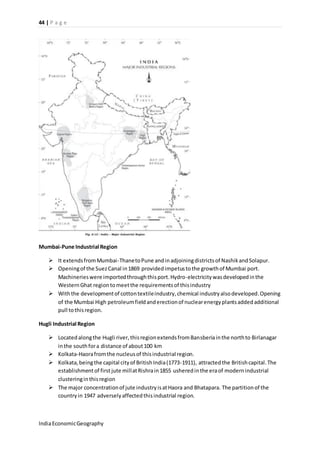
 Industrial Regions and Districts Major Industrial Regions (8) 1. Mumabi-Pune Region, 2. Hugli 
Region, 3. Bangalore- Tamil Nadu Region, 4. Gujarat Region, 5. Chotanagpur Region, 6. 
Vishakhapatnam-Guntur Region, 7. Gurgaon-Delhi-Meerut Region, and 8. Kollam- 
Tiruvantapuram Region. 
 Minor Industrial Regions (13) 1. Ambala-Amritsar ,2.Saharanpur -Muzaffarnagar - 
Bijnor,3.Indore-Dewas-Uijjain,4.Jaipur-Ajmer, 5.Kolhapur -South Kannada, 6. Northern 
Malabar ,7.MiddleMalabar , 8. Adilabad-Nizamabad, 9.Allahabad-V aranasi-Mirzapur 
,10.Bhojpur -Munger ,11.Durg-Raipur,12.Bilaspur-Korba,and 13. Brahmaputra valley . 
 Industrial Districts (15) 
1.Kanpur,2.Hyderabad,3.Agra,4.Nagpur,5.Gwalior,6.Bhopal,7.Lucknow,8.Jalpaiguri, 9. 
Cuttack, 10. Gorakhpur ,11.Aligarh,12.Kota,13.Purnia,14.Jabalpur,and15.Bareilly. 
 Several indices are used to identify the clustering of industries, important among them are : 
(i) the number of industrial units, (ii) number of industrial workers, (iii) quantum of power 
used for industrial purposes, (iv) total industrial output, and (v) value added by 
manufacturing, etc 
India Economic Geography
44 | P a g e 
Mumbai-Pune Industrial Region 
 It extends from Mumbai-Thane to Pune and in adjoining districts of Nashik and Solapur. 
 Opening of the Suez Canal in 1869 provided impetus to the growth of Mumbai port. 
Machineries were imported through this port. Hydro-electricity was developed in the 
Western Ghat region to meet the requirements of this industry 
 With the development of cotton textile industry, chemical industry also developed. Opening 
of the Mumbai High petroleum field and erection of nuclear energy plants added additional 
pull to this region. 
Hugli Industrial Region 
 Located along the Hugli river, this region extends from Bansberia in the north to Birlanagar 
in the south for a distance of about 100 km 
 Kolkata-Haora from the nucleus of this industrial region. 
 Kolkata, being the capital city of British India (1773-1911), attracted the British capital. The 
establishment of first jute mill at Rishra in 1855 ushered in the era of modern industrial 
clustering in this region 
 The major concentration of jute industry is at Haora and Bhatapara. The partition of the 
country in 1947 adversely affected this industrial region. 
India Economic Geography
45 | P a g e 
 Factory of the Hindustan Motors Limited at Konnagar and diesel engine factory at 
Chittaranjan are landmarks of this region. 
 Location of petroleum refinery at Haldia has facilitated the development of a variety of 
industries. 
Bangalore-Chennai Industrial Region 
 This region witnessed most rapid industrial growth in post-Independence period. 
 Till 1960, industries were confined to Bangalore, Salem and Madurai districts but now they 
have spread over all the districts of Tamil Nadu 
 Cotton textile industry was the first to take roots due to the presence of cotton growing 
areas. 
 Several heavy engineering industries converged at Bangalore. Aircraft (HAL), machine tools, 
telephone (HTL) and Bharat Electronics are industrial landmarks of this region. 
Gujarat Industrial Region 
 The nucleus of this region lies between Ahmedabad and Vadodara but this region extends 
upto Valsad and Surat in the south and to Jamnagar in the west. 
 Development of this region is also associated with the location of the cotton textile industry 
since 1860s. This region became an important textile region with the decline of the cotton 
textile industry at Mumbai 
 The port at Kandla helped in the rapid growth of this region. Petroleum refinery at Koyali 
provided raw materials to a host of petrochemical industries. 
 Recently, largest petroleum refinery has been set up at Jamnagar 
Chotanagpur Region 
 This region extends over Jharkhand, northern Orissa and western West Bengal and is known 
for the heavy metallurgical industries. 
 This region owes its development to the discovery of coal in the Damodar Valley and 
metallic and non-metallic minerals in Jharkhand and northern Orissa. 
 Six large integrated iron and steel plants at Jamshedpur, Burnpur Kulti, Durgapur, Bokaro 
and Rourkela are located within this region. 
Vishakhapatnam-Guntur Region 
 This industrial region extends from Vishakhapatnam district to Kurnool and Prakasam 
districts in the south. 
 Coalfields of the Godavari basin provide energy. Ship building industry was started at 
Vishakhapatnam in 1941. Petroleum refinery based on imported petroleum facilitated the 
growth of several petrochemical industries. 
Gurgaon-Delhi-Meerut Region 
 Industries located in this region have shown very fast growth in the recent past. This region 
is located far away from the mineral and power resources, and therefore, the industries are 
light and market-oriented. 
India Economic Geography
46 | P a g e 
Kollam-Tiruvanantapuram Region 
 Plantation agriculture and hydropower provide industrial base to this region. Located far 
away from the mineral belt of the country, agricultural products processing and market 
oriented light industries predominate the region. 
 Location of petroleum refinery at Kochchi has added a vista of new industries to this region. 
Chapter 12_7: PLANNING AND SUSTAINABLE DEVELOPMENT IN INDIAN CONTEXT 
Overview of Planning Perspective in India 
 India has centralised planning and the task of planning in India has been entrusted to the 
Planning Commission. It is a statutory body headed by the Prime Minister and has a Deputy 
Chairman and members. 
 The planning in the country is largely carried out through Five Year Plans. 
 The First Five Year Plan was launched in 1951 and covered the period, 1951-52 to 1955-56. 
Second and Third Five Year Plans covered the period from 1956-57 to 1960-61 and 1961-62 
to 1965-66 respectively. 
 Two successive droughts during mid-sixties (1965-66 and 1966-67) and war with Pakistan in 
1965 forced plan holiday in 1966-67 and 1968-69. This period was covered by annual plans, 
which are also termed as rolling plans. 
 The Fourth Five Year Plan began in 1969-70 and ended in 1973-74. Following this the Fifth 
Five Year Plan began in 1974-75 but it was terminated by the then government one year 
earlier i.e. in 1977-78 
 The Sixth Five Year Plan took off in 1980. The Seventh Five Year Plan covered the period 
between 1985 and 1990. Once again due to the political instability and initiation of 
liberalisation policy, the Eighth Five Year Plan got delayed. It covered the period, 1992 to 
1997. 
 The Ninth Five Year Plan covered the period from 1997 to 2002. The Tenth Plan began in 
2002 and it is still in progress. It will come to an end on 31.3.2007. The approach paper of 
the Eleventh Plan entitled. “Towards Faster and More Inclusive Growth” has already been 
approved 
Generally, there are two approaches to planning, i.e. sectoral planning and regional planning. 
 The sectoral planning means formulation and implementation of the sets of schemes or 
programmes aimed at development of various sectors of the economy such as agriculture, 
irrigation, manufacturing, power, construction, transport, communication, social 
infrastructure and services 
 There is no uniform economic development over space in any country. Some areas are more 
developed and some lag behind. This uneven pattern of development over space 
necessitates that the planners have a spatial perspective and draw the plans to reduce 
regional imbalance in development. This type of planning is termed as regional planning 
Target Area Planning 
 In order to arrest the accentuation of regional and social disparties, the Planning 
Commission introduced the ‘target area’and target group approaches to planning. 
India Economic Geography
47 | P a g e 
 Command Area Development Programme, Drought Prone Area Development Programme, 
Desert Development Programme, Hill Area Development Programme. The Small Farmers 
Development Agency (SFDA) and Marginal Farmers Development Agency (MFDA) which are 
the examples of target group programme 
 In the 8th Five year Plan special area programmes were designed to develop infrastructure 
in hill areas, north-eastern states, tribal areas and backward areas 
Hill Area Development Programme 
 Hill Area Development Programmes were initiated during Fifth Five Year Plan covering 15 
districts 
 The National Committee on the Development of Backward Area in 1981 recommended that 
all the hill areas in the country having height above 600 m and not covered under tribal sub-plan 
be treated as backward hill areas. 
 These programmes aimed at harnessing the indigenous resources of the hill areas through 
development of horticulture, plantation agriculture, animal husbandry, poultry, forestry and 
small-scale and village industry. 
Drought Prone Area Programme 
 This programme was initiated during the Fourth Five Year Plan with the objectives of 
providing employment to the people in drought-prone areas and creating productive assets. 
 National Committee on Development of Backward Areas, reviewed the performance of this 
programme. 
 Planning Commission of India (1967) identified 67 districts (entire or partly) of the country 
prone to drought. Irrigation Commission (1972) introduced the criterion of 30 per cent 
irrigated area and demarcated the drought prone areas. 
Case Study–Integrated Tribal Development Project in Bharmaur Region 
 The process of development of tribal area of Bharmaur started in 1970s when Gaddis were 
included among ‘scheduled tribes’. Under the Fifth Five Year Plan, the tribal sub -plan was 
introduced in 1974 and Bharmaur was designated as one of the five Integrated Tribal 
Development Projects (ITDP) in Himachal Pradesh. 
Sustainable Development 
 The concept of development is dynamic and has evolved during the second half of twentieth 
century. In the post-World War II era, the concept of development was synonymous to 
economic growth which is measured in terms of temporal increase in gross national product 
(GNP) and per capita income/per capita consumption. 
 So, in 1970s, the phrases such as redistribution with growth and growth and equity were 
incorporated in the definition of development. 
 It also includes the issues such as improving the well-being and living standard of people, 
availing of the health, education and equality of opportunity and ensuring political and civil 
rights. By 1980s, development emerged as a concept encapsulating wide-spread 
improvement in social as well as material wellbeing of all in a society. 
India Economic Geography
48 | P a g e 
 The notion of sustainable development emerged in the wake of general rise in the 
awareness of environmental issues in the late 1960s in Western World. 
 The publication of ‘The Population Bomb’ by Ehrlichin 1968 and ‘The Limits to Growth’ by 
Meadows and others in 1972 further raised the level of fear among environmentalists in 
particular and people in general. 
 This sets the scenario for the emergence of new models of development under a broad 
phrase ‘sustainable development’. 
 Concerned with the growing opinion of world community on the environmental issues, the 
United Nations established a World Commission on Environment and Development (WCED) 
headed by the Norwegian Prime Minister Gro Harlem Brundtland. The Commission gave its 
report (also known as Brundtland Report) entitled ‘Our Common Future’ in 1987. The report 
defines sustainable development as a “development that meets the needs of the present 
without compromising the ability of future generations to meet their own needs. 
Indira Gandhi Canal (Nahar) Command Area 
 Indira Gandhi Canal, previously known as the Rajasthan Canal, is one of the largest canal 
systems in India. Conceived by Kanwar Sain in 1948, the canal project was launched on 31 
March, 1958. 
 The canal originates at Harike barrage in Punjab and runs parallel to Pakistan border at an 
average distance of 40 km in Thar Desert (Marusthali) of Rajasthan. 
Chapter 12_10 Geo12_India_10_Transport and Communication 
The use of transport and communication depends upon our need to move things from place of their 
availability to the place of their use. Human-beings use various methods to move goods, 
commodities, ideas from one place to another. 
Road Transport 
 Sher Shah Suri built the Shahi (Royal) road to strengthen and consolidate his empire from 
the Indus Valley to the Sonar Valley in Bengal. This road was renamed the Grand Trunk (GT) 
road during the British period, connecting Calcutta and Peshawar. At present, it extends 
from Amritsar to Kolkata. It is bifurcated into 2 segments : (a) National Highway(NH)-1 from 
Delhi to Amritsar, and (b) NH- 2 from Delhi to Kolk ata. 
India Economic Geography
49 | P a g e 
 Road transport in modern sense was very limited in India before World War-II. The first 
serious attempt was made in 1943 when ‘Nagpur Plan’ was drawn. 
 After Independence, twenty-year road plan (1961) was introduced to improve the conditions 
of roads in India. 
National Highways 
 The main roads which are constructed and maintained by the Central Government are 
known as the National Highways. These roads are meant for inter-state transport and 
movement of defence men and material in strategic areas. 
 The National Highways Authority of India (NHAI) was operationalised in 1995. It is an 
autonomous body under the Ministry of Surface Transport. 
Other Roads 
 Other roads include Border Roads and International Highways. The Border Road 
Organisation (BRO) was established in May 1960 for accelerating economic development 
and strengthening defence preparedness through rapid and coordinated improvement of 
strategically important roads along the northern and north-eastern boundary of the country 
 Nature of terrain and the level of economic development are the main determinants of 
density of roads. Construction of roads is easy and cheaper in the plain areas while it is 
difficult and costly in hilly and plateau areas. Therefore, not only the density but also the 
quality of roads is relatively better in plains as compared to roads in high altitude areas, 
rainy and forested regions. 
Rail Transport 
 On the basis of width of the track of Indian Railways, three categories have been made: 
Broad gauge: The distance between rails in broad gauge is 1.676 metre. The total length of 
broad gauge lines is 46,807 km which accounts for74.14 percent of the total length of rail 
routes in the country. Metre gauge: The distance between rails is one metre. It runs over 
13,290 km covering 21.02 percent of the total route length. Narrow gauge: The distance 
between the rails in this case is 0.762 metre or 0.610 metre. Nearly 4.94 percent of the total 
length of the Indian Railways is narrow gauge, which accounts for 3,124 km of route length. 
It is generally confined to hilly areas 
India Economic Geography
50 | P a g e 
Konkan Railway 
 One of the important achievements of Indian Railways has been the construction of Konkan 
Railway in 1998. It is 760 km long rail route connecting Roha in Maharashtra to Mangalore in 
Karnataka. It is considered an engineering marvel. It crosses 146 rivers, streams, nearly 2000 
bridges and 91 tunnels. Asia’s largest tunnel which is nearly 6.5 km long also lies on this 
route. The states of Maharashtra, Goa and Karnataka are partners in this undertaking. 
India Economic Geography
51 | P a g e 
Water Transport 
 The water transport is of two types– (a) inland waterways, and (b) oceanic waterways. 
 For the development, maintenance and regulation of national waterways in the country, the 
Inland Waterways Authority was set up in 1986. 
 The authority has declared three inland waterways as National Waterways 
 The back water (Kadal) of Kerala has special significance in Inland Waterway. Apart from 
providing cheap means of transport, they are also attracting large number of tourists in 
Kerala. The famous Nehru Trophy Boat Race (VALLANKALI) is also held in the backwaters 
Air transport 
 Air transport in India made a beginning in 1911 when airmail operation commenced over a 
little distance of 10 km between Allahabad and Naini. But its real development took place in 
post-Independent period. The Airport Authority of India is responsible for providing safe, 
efficient air traffic and aeronautical communication services in the Indian Air Space. The 
authority manages 126 airports including 11 international, 86 domestic and 29 civil enclaves 
at defence air fields. The air transport in India is managed by two corporations, Air India and 
Indian Airlines after nationalisation. 
History of Indian Airlines 1911 – Air transport in India was launched between Allahabad and Naini. 
1947 – Air transport was provided by four major company’s namely Indian National Air ways, Tata 
Sons Limited, Air Services of India and Deccan Airways. 1951 – Four more companies joined the 
services, Bharat Airways, Himalayan Aviation Limited, Airways India and Kalinga Airlines. 1953 – Air 
transport was nationalised and two Corporations, Air India International and Indian Airlines were 
formed. Now Indian Airlines is known as ‘Indian’ 
 The country’s largest state-owned domestic carrier, Indian Airlines dropped the word 
‘Airlines’ from its name and is known as ‘Indian’ w.e.f. December 8, 2005. The new brand 
name ‘Indian’ now appears on both sides of the fusel age. The logo on the orange tail 
depicting ‘IA’ has also been changed. It has been replaced by a new logo which is a partly 
visible blue wheel and is inspired by the Sun Temple at Konark (Orissa), symbolising timeless 
motion, convergence and divergence. It also embodies strength as well as trust that has 
stood the test of time 
 Pawan Hans is the helicopter service operating in hilly areas and is widely used by tourists in 
north-eastern sector 
India Economic Geography
52 | P a g e 
Open Sky Policy 
 To help the Indian exporters and make their export more competitive, the government had 
introduced an Open Sky Policy for cargo in April1992.Under this policy, foreign airlines or 
association of exporters can bring any freighters to the country. 
Oil and Gas Pipelines 
 Oil India Limited (OIL) under the administrative set up of the Ministry of Petroleum and 
Natural Gas is engaged in the exploration, production and transportation of crude oil and 
natural gas. It was incorporated in 1959 as a company. Asia’s first cross country pipeline 
covering a distance of 1,157 km was constructed by OIL from Naharkatiya oilfield in Assam 
to Barauni refinery in Bihar. It was further extended up to Kanpur in 1966 
Communication Networks 
 Radio broadcasting started in India in 1923 by the Radio Club of Bombay. 
 Government took this opportunity and brought this popular mode of communication under 
its control in 1930 under the Indian Broadcasting System. It was changed to All India Radio in 
1936 and to Akashwani in 1957 
 Initially, the T.V. services were limited only to the National Capital where it began in 1959. 
After 1972, several other centres became operational. In 1976, TV was delinked from All 
India Radio (AIR) and got a separate identity as Doordarshan (DD). After INSAT-IA (National 
Television-DD1) became operational, Common National Programmes (CNP) were started for 
the entire network and its services were extended to the backward and remote rural areas 
 Satellite Communication 
 On the basis of configuration and purposes, satellite system in India can be grouped into 
two: Indian National Satellite System (INSAT) and Indian Remote Sensing Satellite System 
(IRS). The INSAT, which was established in 1983,is a multipurpose satellite system for 
telecommunication, meteorological observation and for various other data and programmes 
 The IRS satellite system became operational with the launching of IRS-IA in March 1988 from 
Vaikanour in Russia. India has also developed her own Launching Vehicle PSLV (Polar 
Satellite Launch Vehicle). These satellites collect data in several spectral bands and transmit 
them to the ground stations for various uses. The National Remote Sensing Agency (NRSA) at 
Hyderabad provides facilities for acquisition of data and its processing. These are very useful 
in the management of natural resources. 
India Economic Geography
53 | P a g e 
Chapter 12_11 Geo12_India_11_International Trade 
The changing pattern of India’s International trade. In 1950-51, India’s external trade was worth 
Rs.1, 2140 million, which rose to Rs.8, 37, 1330 million in 2004-05 
 The balance of payment was adverse as imports were more than export in spite of all the 
efforts of import substitution. After 1970s, food grain import was discontinued due to the 
success of green revolution but the energy crisis of 1973 pushed the prices of petroleum, 
and import budget was also pushed up. Food grain import was replaced by fertilisers and 
petroleum. 
India Economic Geography
54 | P a g e 
India Economic Geography
55 | P a g e 
Direction of Trade 
 India aims to double its share in the international trade within the next five years. It has 
already started adopting suitable measures such as import liberalisation, reduction in import 
duties, de-licensing and change from process to product patents. 
 The U.S.A. is India’s largest trading partner and the most important destination of India’s 
export. Other countries in order of significance include the U.K., Belgium, Germany, Japan, 
Switzerland, Hong Kong, the U.A.E., China, Singapore and Malaysia 
Sea Ports as Gateways of International Trade 
 The capacity of Indian ports increased from 20 million tonnes of cargo handling in 1951 to 
more than 500 million tonnes at present. 
 Kandla Port situated at the head of Gulf of Kuchchh has been developed as a major port to 
cater to the needs of western and north western parts of the country and also to reduce the 
pressure at Mumbai port. 
India Economic Geography
56 | P a g e 
 Mumbai is a natural harbour and the biggest port of the country. The port is situated closer 
to the general routes from the countries of Middle East, Mediterranean countries, North 
Africa, North America and Europe where the major share of country’s overseas trade i s 
carried out. 
 Jawaharlal Nehru Port at Nhava Sheva was developed as a satellite port to relieve the 
pressure at the Mumbai port. It is the largest container port in India 
 Marmagao Port, situated at the entrance of the Zuari estuary, is a natural harbour in Goa. It 
gained significance after its remodelling in 1961 to handle iron-ore exports to Japan. 
 New Mangalore Port is located in the state of Karnataka and caters to the needs of the 
export of iron-ore and iron-concentrates. 
 Kolkata Port is located on the Hugli River, 128 km inland from the Bay of Bengal. Like the 
Mumbai port, this port was also developed by the British. 
 Haldia Port is located 105 km downstream from Kolkata. It has been constructed to reduce 
the congestion at Kolkata port. 
 Paradwip Portis situated in the Mahanadi delta, about 100 km from Cuttack. 
 Visakhapatnam Port in Andhra Pradesh is a land-locked harbour 
 Ennore, a newly developed port in Tamil Nadu, has been constructed 25 km north of 
Chennai to relieve the pressure at Chennai port. 
Airports 
 At present, there are 12 international airports and 112 domestic airports functioning in the 
country. They are– Ahmedabad, Amritsar, Bangalore, Chennai, Delhi, Goa, Guwahati, 
Hyderabad, Kochchi, Kolkata, Mumbai and Tiruvanantapuram. 
Chapter 12_12 Geo12_India_12_Geographical Perspective on Selected Issues and Problems 
Environmental Pollution 
 Pollution can be classified into (i) air pollution, (ii) water pollution, (iii) land pollution and (iv) 
noise pollution. 
India Economic Geography
57 | P a g e 
Water Pollution 
 Though water pollutants are also created from natural sources (erosion, landslides, decay 
and decomposition of plants and animals, etc.) pollutants from human sources are the real 
causes of concern. Human beings pollute the water through industrial, agricultural and 
cultural activities. Among these activities, industry is the most significant contributor. 
 Major water polluting industries are leather, pulp and paper, textiles and chemicals 
 Various types of chemicals used in modern agriculture such as inorganic fertilisers, pesticides 
and herbicides are also pollution generating components. 
 Fertiliser induces an increase in the nitrate content of surface waters. 
 Water pollution is a source of various water borne diseases. The diseases commonly caused 
due to contaminated water are diarrhoea, intestinal worms, hepatitis, etc. World Health 
Organisation shows that about one fourth of the communicable diseases in India are water-borne. 
Air pollution 
 Combustion of fossil fuels, mining and industries are the main sources of air pollution. These 
processes release oxides of sulphur and nitrogen, hydrocarbons, carbon dioxide, carbon 
monoxide, lead and asbestos. 
 Air pollution causes various diseases related to respiratory, nervous and circulatory systems 
 Smoky fog over cities called as urban smog is caused by atmospheric pollution. 
Noise Pollution 
 The main sources of noise pollution are various factories, mechanised construction and 
demolition works, automobiles and aircrafts, etc. 
 The level of steady noise is measured by sound level expressed in terms of decibels (dB) 
 Noise pollution is hazardous in many metropolitan and big cities in India. 
Urban Waste Disposal 
India Economic Geography
58 | P a g e 
 These discarded materials are also termed as refuse, garbage and rubbish, etc. and are 
disposed of from two source: (i) household or domestic establishments, and (ii) industrial or 
commercial establishments. The household wastes is disposed of either on public lands or 
on private contractors’ sites, whereas the solid wastes of industrial units are collected and 
disposed of through public (municipal) facilities at low lying public grounds (landfill areas). 
 Solid wastes cause health hazard through creation of obnoxious smell, and harbouring of 
flies and rodents, which act as carriers of diseases like typhoid, diphtheria, diarrhoea, 
malaria and cholera, etc. 
 At present, 47 percent of the world’s six billion population lives in cities and more will join 
them in near future. This proportion is estimated to go up to 50 per cent by 2008. That will 
put pressure on governments to make urban areas better places to live with optimum 
infrastructure facilities for desirable quality of life. By 2050, an estimated two-thirds of the 
world’s population will live in urban areas, imposing even more pressure on the space 
infrastructure and resources of cities, which are manifested in terms of sanitary, health, 
crime problems and urban poverty. 
Rural-Urban Migration 
 In developing countries, poor, semi-illiterate and the unskilled like Ramesh migrating from 
rural areas frequently end up performing menial jobs at low wages in informal sector in 
urban areas. Since wages are very low to support the family at the place of destination, the 
spouses are left behind in rural areas to look after children and elderly people. Thus, th e 
rural-urban migration stream is dominated by the male 
Problems of Slums 
 Slums are residential areas of the least choice, dillapidated houses, poor hygienic conditions, 
poor ventilation, lack of basic amenities like drinking water, light and toilet facili ties, etc. 
These areas are overcrowded having narrow street pattern prone to serious hazards from 
fire. Moreover, most of the slum population works in low paid, high risk-prone, unorganised 
sectors of the urban economy. Consequently, they are the undernourished, prone to 
different types of diseases and illness and can ill afford to give proper education to their 
children. The poverty makes them vulnerable to drug abuse, alcoholism, crime, vandalism, 
escapism, apathy and ultimately social exclusion 
Land Degradation 
 There are two processes that induce land degradation. These are natural and created by 
human beings. National Remote Sensing Agency (NRSA) has classified wastelands by using 
remote sensing techniques and it is possible to categorise these wastelands according to the 
processes that have created them. There are a few types of wastelands such as gullied 
/ravinous land, desertic or coastal sands, barren rocky areas, steep sloping land, and glacial 
areas, which are primarily caused by natural agents. There are other types of degraded lands 
such as waterlogged and marshy areas, land affected by salinity and alkalinity and land with 
or without scrub, which have largely been caused by natural as well as human factors. There 
are some other types of wastelands such as degraded shifting cultivation area, degraded 
India Economic Geography
59 | P a g e 
land under plantation crops, degraded forests, degraded pastures, and mining and industrial 
wastelands, are caused by human action. 
India Economic Geography

Ncert geo indian_geography

  • 1.
    1 | Pa g e NCERT_Geo_Indian_Geography Everything available in our environment which can be used to satisfy our needs, provided, it is technologically accessible, economically feasible and culturally acceptable can be termed as ‘Resource’.  These resources can be classified in the following ways – • On the basis of origin – biotic and abiotic • On the basis of exhaustibility – renewable and non-renewable • On the basis of ownership – individual, community, national and international • On the basis of status of development – potential, developed stock and reserves. Urban Development Authorities get empowered by the government to acquire land. All the minerals, water resources, forests, wildlife, land within the political boundaries and oceanic area upto 12 nautical miles (19.2 km) from the coast termed as territorial water and resources therein belong to the nation  International Resources: The oceanic resources beyond 200 km of the Exclusive Economic Zone belong to open ocean and no individual country can utilise these without the concurrence of international institutions.  India has got the right to mine manganese nodules from the bed of the Indian Ocean from that area which lies beyond the exclusive economic zone. DEVELOPMENT OF RESOURCES  As a result, human beings used them indiscriminately and this has led to the following major problems. • Depletion of resources for satisfying the greed of few individuals. • Accumulation of resources in few hands, which, in turn, divided the society into two segments i.e. haves and have nots or rich and poor. • Indiscriminate exploitation of resources has led to global ecological crises such as, global warming, ozone layer depletion, environmental pollution and land degradation India Economic Geography
  • 2.
    2 | Pa g e Resource planning is essential for sustainable existence of all forms of life. Sustainable existence is a component of sustainable development. Sustainable development  Sustainable economic development means ‘development should take place without damaging the environment, and development in the present should not compromise wi th the needs of the future generations. Rio de Janeiro Earth Summit, 1992  In June 1992, more than 100 heads of states met in Rio de Janeiro in Brazil, for the first International Earth Summit.  The assembled leaders signed the Declaration on Global Climatic Change and Biological Diversity. The Rio Convention endorsed the global Forest Principles and adopted Agenda 21 for achieving Sustainable Development in the 21st century.  Agenda 21 • It is the declaration signed by world leaders in 1992 at the United Nations Conference on Environment and Development (UNCED), which took place at Rio de Janeiro, Brazil. • It aims at achieving global sustainable development. • One major objective of the Agenda 21 is that every local government should draw its own local Agenda 21.  The states of Jharkhand, Chhattisgarh and Madhya Pradesh are rich in minerals and coal deposits. Arunachal Pradesh has abundance of water resources but lacks in infrastructural development.  The state of Rajasthan is very well endowed with solar and wind energy but lacks in water resources.  The cold desert of Ladakh is relatively isolated from the rest of the country. It has very rich cultural heritage but it is deficient in water, infrastructure and some vital minerals. India Economic Geography
  • 3.
    3 | Pa g e Resource planning is a complex process which involves:  Identification and inventory of resources across the regions of the country. This involves surveying, mapping and qualitative and quantitative estimation and measurement of the resources.  Evolving a planning structure endowed with appropriate technology, skill and institutional set up for implementing resource development plans.  Matching the resource development plans with overall national development plans India has made concerted efforts for achieving the goals of resource planning right from the First Five Year Plan launched after Independence Conservation of Resources:  Irrational consumption and over-utilisation of resources may lead to socio-economic and environmental problems. To overcome these problems, resource conservation at various levels is important.  Gandhiji was very apt in voicing his concern about resource conservation in these words: “There is enough for everybody’s need and not for any body’s greed.” At the international level, the Club of Rome advocated resource conservation for the first time in a more systematic way in 1968.  Subsequently, in 1974, Gandhian philosophy was once again presented by Schumacher in his book Small is Beautiful. The seminal contribution with respect to resource conservation at the global level was made by the Brundtland Commission Report, 1987.  This report introduced the concept of ‘Sustainable Development’ and advocated it as a means for resource conservation, which was subsequently published in a book, entitled Our Common Future. LAND USE PATTERN IN INDIA India Economic Geography
  • 4.
    4 | Pa g e  Total geographical area of India is 3.28 million sq. km  Land use data, however, is available only for 93 per cent of the total area because the land use reporting for most of the north-east states except Assam has not been done fully.  It is over 80 per cent of the total area in Punjab and Haryana and less than 10 per cent in Arunachal Pradesh, Mizoram, Manipur and Andaman Nicobar Islands  Forest area in the country is far lower than the desired 33 per cent of geographical area, as it was outlined in the National Forest Policy (1952). It was considered essential for maintenance of the ecological balance. Land Degradation and Conservation Measures:  In states like Jharkhand, Chhattisgarh, Madhya Pradesh and Orissa deforestation due to mining have caused severe land degradation.  In states like Gujarat, Rajasthan, Madhya Pradesh and Maharashtra overgrazing is one of the main reasons for land degradation.  In the states of Punjab, Haryana, western Uttar Pradesh, over irrigation is responsible for land degradation due to water logging leading to increase in salinity and alkalinity in the soil.  The mineral processing like grinding of limestone for cement industry and calcite and soapstone for ceramic industry generate huge quantity of dust in the atmosphere. SOIL AS A RESOURCE India Economic Geography
  • 5.
    5 | Pa g e Chapter 10_5: Geo –MINES & ENERGY RESOURCES Geologists define mineral as a “homogenous, naturally occurring substance with a definable internal structure.” Minerals are found in varied forms in nature, ranging from the hardest diamond to the softest talc A bright smile from toothpaste and minerals • Abrasive minerals like silica, limestone, aluminium oxide and various phosphate minerals do the cleaning. • Fluoride which is used to reduce cavities comes from a mineral fluorite. • Most toothpaste is made white with titanium oxide, which comes from minerals called rutile, ilmenite and anatase. • The sparkle in some toothpaste comes from mica.  Rocks are combinations of homogenous substances called minerals. Some rocks, for instance limestone, consist of a single mineral only, but majority of the rock consist of several minerals in varying proportions. Although, over 2000 minerals have been identified, only a few are abundantly found in most of the rocks. Minerals generally occur in these forms:  In igneous and metamorphic rocks minerals may occur in the cracks, crevices, faults or joints. The smaller occurrences are called veins and the larger are called lodes. Major metallic minerals like tin, copper, zinc and lead etc. are obtained from veins and lodes.  In sedimentary rocks a number of minerals occur in beds or layers. Coal and some forms of iron ore have been concentrated as a result of long periods under great heat and pressure. Another group of sedimentary minerals include gypsum, potash salt • Another mode of formation involves the decomposition of surface rocks, and the removal of soluble constituents, leaving a residual mass of weathered material containing ores. Bauxite is formed this way.  Certain minerals may occur as alluvial deposits in sands of valley floors and the base of hills. These deposits are called ‘placer deposits’ and generally contain minerals, which are not corroded by water. Gold, silver, tin and platinum are most important among such minerals.  The ocean waters contain vast quantities of minerals, but most of these are too widely diffused to be of economic significance. However, common salt, magnesium and bromine are largely derived from ocean waters. The ocean beds, too, are rich in manganese nodules India Economic Geography
  • 6.
    6 | Pa g e  Peninsular rocks contain most of the reserves of coal, metallic minerals, mica and many other non-metallic minerals.  Sedimentary rocks on the western and eastern flanks of the peninsula, in Gujarat and Assam have most of the petroleum deposits.  The vast alluvial plains of north India are almost devoid of economic minerals. To meet the demand, a choice has to be made between a number of possible options. When this is done a mineral ‘deposit’ or ‘reserve’ turns into a mine India Economic Geography
  • 7.
    7 | Pa g e Ferrous Minerals  Ferrous minerals account for about three fourths of the total value of the production of metallic minerals. They provide a strong base for the development of metallurgical industries. India exports substantial quantities of ferrous minerals after meeting her internal demands. Iron Ore  Iron ore is the basic mineral and the backbone of industrial development.  India is rich in good quality iron ores. Magnetite is the finest iron ore with a very high content of iron up to 70 per cent.  It has excellent magnetic qualities, especially valuable in the electrical industry. Hematite ore is the most important industrial iron ore in terms of the quantity used, but has slightly lower iron content than magnetite. (50-60 per cent). • Orissa-Jharkhand belt: In Orissa high grade hematite ore is found in Badampahar mines in the Mayurbhanj and Kendujhar districts. In the adjoining Singbhum district of Jharkhand haematite iron ore is mined in Gua and Noamundi • Bellary-Chitradurga-Chikmaglur-Tumkur belt in Karnataka has large reserves of iron ore. The Kudermukh mines located in the Western Ghats of Karnataka are a 100 per cent export unit. Kudremukh deposits are known to be one of the largest in the world. The ore is transported as slurry through a pipeline to a port near Mangalore. • Maharashtra-Goa belt includes the state of Goa and Ratnagiri district of Maharashtra. Though, the ores are not of very high quality, yet they are efficiently exploited. Iron ore is exported through Marmagao port. Manganese  Manganese is mainly used in the manufacturing of steel and Ferro-manganese alloy. Nearly 10 kg of manganese is required to manufacture one tonne of steel. It is also used in manufacturing bleaching powder, insecticides and paints.  Orissa is the largest producer of manganese ores in India. It accounted for one-third of the country’s total production in 2000-01  Minerals, which include copper, bauxite, lead, zinc and gold play a vital role in a number of metallurgical, engineering and electrical industries. Copper  India is critically deficient in the reserve and production of copper. Being malleable, ductile and a good conductor, copper is mainly used in electrical cables, electronics and chemical industries. The Balaghat mines in Madhya Pradesh produce 52 per cent of India’s copper. The Singbhum district of Jharkhand is also a leading producer of copper. The Khetri mines in Rajasthan are also famous India Economic Geography
  • 8.
    8 | Pa g e Bauxite  Though, several ores contain aluminium, it is from bauxite, a clay-like substance that alumina and later aluminium is obtained. Bauxite deposits are formed by the decomposition of a wide variety of rocks rich in aluminium silicates.  India’s bauxite deposits are mainly found in the Amarkantak plateau, Maikal hills and the plateau region of Bilaspur- Katni. Non-Metallic Minerals  Mica is a mineral made up of a series of plates or leaves. It splits easily into thin sheets. These sheets can be so thin that a thousand can be layered into a mica sheet of a few centimetres’ high.  Mica can be clear, black, green, red yellow or brown.  Mica deposits are found in the northern edge of the Chota Nagpur plateau. Koderma Gaya – Hazaribagh belt of Jharkhand is the leading producer.  In Rajasthan, the major mica producing area is around Ajmer. Nellore mica belt of Andhra Pradesh is also an important producer in the country. Rock Minerals  Limestone is found in association with rocks composed of calcium carbonates or calcium and magnesium carbonates. It is found in sedimentary rocks of most geological formations. Limestone is the basic raw material for the cement industry CONSERVATION OF MINERALS  Mineral resources are, therefore, finite and non-renewable. Rich mineral deposits are our country’s extremely valuable but short-lived possessions. Continued extraction of ores leads to increasing costs as mineral extraction comes from greater depths along with decrease in quality.  Improved technologies need to be constantly evolved to allow use of low grade ores at low costs. Recycling of metals, using scrap metals and other substitutes are steps in conserving our mineral resources for the future.  Energy can be generated from fuel minerals like coal, petroleum, natural gas, uranium and from electricity. Energy resources can be classified as conventional and nonconventional sources. Conventional sources include: firewood, cattle dung cake, coal, petroleum, natural gas and electricity (both hydel and thermal). Non-conventional sources include solar, wind, tidal, geothermal, biogas and atomic energy.  More than 70 per cent energy requirement in rural households Conventional Sources of Energy India Economic Geography
  • 9.
    9 | Pa g e Coal: In India, coal is the most abundantly available fossil fuel.  It provides a substantial part of the nation’s energy needs. It is used for power generation, to supply energy to industry as well as for domestic needs.  India is highly dependent on coal for meeting its commercial energy requirements India Economic Geography
  • 10.
    10 | Pa g e  Lignite is a low grade brown coal, which is soft with high moisture content. The principal lignite reserves are in Neyveli in Tamil Nadu and are used for generation of electricity. Coal that has been buried deep and subjected to increased temperatures is bituminous coal. It is the most popular coal in commercial use. Metallurgical coal is high grade bituminous coal which has a special value for smelting iron in blast furnaces. Anthracite is the highest quality hard coal  In India coal occurs in rock series of two main geological ages, namely Gondwana, a little over 200 million years in age and in tertiary deposits which are only about 55 million years old. Petroleum  Petroleum or mineral oil is the next major energy source in India after coal. It provides fuel for heat and lighting, lubricants for machinery and raw materials for a number of manufacturing industries. Petroleum refineries act as a “nodal industry” for synthetic textile, fertiliser and numerous chemical industries  Most of the petroleum occurrences in India are associated with anticlines and fault traps in the rock formations of the tertiary age.  Petroleum is also found in fault traps between porous and non-porous rocks. Gas, being lighter usually occurs above the oil. Natural Gas  Natural gas is considered an environment friendly fuel because of low carbon dioxide emissions and is, therefore, the fuel for the present century  Large reserves of natural gas have been discovered in the Krishna- Godavari basin. Electricity  Electricity is generated mainly in two ways: by running water which drives hydro turbines to generate hydroelectricity; and by burning other fuels such as coal, petroleum and natural gas to drive turbines to produce thermal power. Once generated the electricity is exactly the same • Hydro electricity is generated by fast flowing water, which is a renewable resource. India has a number of multi-purpose projects like the Bhakra Nangal, Damodar Valley Corporation, the Kopili Hydel Project etc. producing hydroelectric power. • Thermal electricity is generated by using coal, petroleum and natural gas. The thermal power stations use non-renewable fossil fuels for generating electricity. There are over 310 thermal power plants in India  Nuclear or Atomic Energy is obtained by altering the structure of atoms. When such an alteration is made, much energy is released in the form of heat and this is used to generate electric power. Uranium and thorium, which are available in Jharkhand and the Aravalli ranges of Rajasthan are used for generating atomic or nuclear power. The Monazite sand of Kerala is also rich in thorium. India Economic Geography
  • 11.
    11 | Pa g e Non-Conventional Sources of Energy  Hence, there is a pressing need to use renewable energy sources like sol ar energy, wind, tide, biomass and energy from waste material. These are called nonconventional energy sources.  India is blessed with an abundance of sunlight, water, wind and biomass. It has the largest programmes for the development of these renewable energy resources. Solar Energy  India is a tropical country. It has enormous possibilities of tapping solar energy. Photovoltaic technology converts sunlight directly into electricity. Solar energy is fast becoming popular in India Economic Geography
  • 12.
    12 | Pa g e rural and remote areas. The largest solar plant of India is located at Madhapur, near Bhuj, where solar energy is used to sterilise milk cans. Wind energy  India now ranks as a “wind super power” in the world. The largest wind farm cluster is located in Tamil Nadu from Nagarcoil to Madurai.  Nagarcoil and Jaisalmer are well known for effective use of wind energy in the country  Shrubs, farm waste, animal and human waste are used to produce biogas for domestic consumption in rural areas. Decomposition of organic matter yields gas, which has higher thermal efficiency in comparison to kerosene, dung cake and charcoal.  In India, the Gulf of Kuchchh provides ideal conditions for utilising tidal energy. A 900 mw tidal energy power plant is set up here by the National Hydropower Corporation Geo Thermal Energy  Geothermal energy refers to the heat and electricity produced by using the heat from the interior of the Earth. Geothermal energy exists because; the Earth grows progressively hotter with increasing depth.  Two experimental projects have been set up in India to harness geothermal energy. One is located in the Parvati valley near Manikarn in Himachal Pradesh and the other is located in the Puga Valley, Ladakh. Conservation of Energy Resources  Every sector of the national economy – agriculture, industry, transport, commercial and domestic – needs inputs of energy.  Promotion of energy conservation and increased use of renewable energy sources are the twin planks of sustainable energy  India is presently one of the least energy efficient countries in the world.  After all, “energy saved is energy produced”. Chapter 3  The economic strength of a country is measured by the development of manufacturing industries. o Manufacturing industries not only help in modernising agriculture, which forms the backbone of our economy, they also reduce the heavy dependence of people on agricultural income by providing them jobs in secondary and tertiary sectors. o Industrial development is a precondition for eradication of unemployment and poverty from our country. This was the main philosophy behind public sector industries and joint sector ventures in India. It was also aimed at bringing down regional disparities by establishing industries in tribal and backward areas o Export of manufactured goods expands trade and commerce, and brings in much needed foreign exchange o Countries that transform their raw materials into a wide variety of furnished goods of higher value are prosperous. India’s prosperity lies in increasing and diversifying its manufacturing industries as quickly as possible. India Economic Geography
  • 13.
    13 | Pa g e Contribution of Industry to National Economy  Over the last two decades, the share of manufacturing sector has stagnated at 17 per cent of GDP – out of a total of 27 per cent for the industry which includes 10 per cent for mining, quarrying, electricity and gas.  The National Manufacturing Competitiveness Council (NMCC) has been set up. Industrial Location  These are influenced by availability of raw material, labour, capital, power and market, etc. It is rarely possible to find all these factors available at one place.  Many industries tend to come together to make use of the advantages offered by the urban centres known as agglomeration economies.  The key to decision of the factory location is the least cost. Government policies and specialised labour also influence the location of industry. o Agro based: cotton, woollen, jute, silk textile, rubber and sugar, tea, coffee, edible oil. o Mineral based: iron and steel, cement, aluminium, machine tools, petrochemicals On the basis of capital investment: o A small scale industry is defined with reference to the maximum investment allowed on the assets of a unit. This limit has changed over a period of time.  If investment is more than one crore on any industry then it is known as a large scale industry. On the basis of ownership: o Public sector owned and operated by government agencies – BHEL, SAIL etc. o Private sector industries owned and operated by individuals or a group of individuals –TISCO, Bajaj Auto Ltd., Dabur Industries o Joint sector industries which are jointly run by the state and individuals or a group of individuals. Oil India Ltd. (OIL) is jointly owned by public and private sector. o Cooperative sector industries are owned and operated by the producers or suppliers of raw materials, workers or both. They pool in the resources and share the profits or losses proportionately such as the sugar industry in Maharashtra, the coir industry in Kerala. Based on the bulk and weight of raw material and finished goods: o Heavy industries such as iron and steel o Light industries that use light raw materials and produce light goods such as electrical industries. Agro Based Industries Textile Industry: The textile industry occupies unique position in the Indian economy, because it contributes significantly to industrial production (14 per cent), employment generation (35 million India Economic Geography
  • 14.
    14 | Pa g e persons directly – the second largest after agriculture) and foreign exchange earnings (about 24.6 per cent).  It is the only industry in the country, which is self -reliant and complete in the value chain i.e., from raw material to the highest value added products o The first successful textile mill was established in Mumbai in 1854. o The two world wars were fought in Europe, India was a British colony. There was a demand for cloth in U.K. hence they gave a boost to the development of the cotton textile industry  Today, there are nearly 1600 cotton and human made fibre textile mills in the country. About 80 per cent of these are in the private sector and the rest in the public and cooperative sectors  India exports yarn to Japan. Other importers of cotton goods from India are U.S.A., U.K., Russia, France, East European countries, Nepal, Singapore, Sri Lanka, and African countries  We have a large share in the world trade of cotton yarn, accounting for one fourth of the total trade India Economic Geography
  • 15.
    15 | Pa g e Jute Textiles  India is the largest producer of raw jute and jute goods and stands at second place as an exporter after Bangladesh. There are about 70 jute mills in India. Most of these are located in West Bengal, mainly along the banks of the  Hugli River, in a narrow belt (98 km long and 3 km wide). India Economic Geography
  • 16.
    16 | Pa g e  The first jute mill was set up near Kolkata in 1859 at Rishra. After Partition in 1947, the jute mills remained in India but three-fourth of the jute producing area went to Bangladesh (erstwhile East Pakistan)  Kolkata as a large urban centre provides banking, insurance and port facilities for export of jute goods  However, the internal demand has been on the increase due to the Government policy of mandatory use of jute packaging.  In 2005, National Jute Policy was formulated with the objective of increasing productivity, improving quality, ensuring good prices to the jute farmers and enhancing the yield per hectare. The main markets are U.S.A., Canada, Russia, United Arab Republic, U.K. and Australia. Sugar Industry  India stands second as a world producer of sugar but occupies the first place in the production of gur and khandsari.  There are over 460 sugar mills in the country spread over Uttar Pradesh,  60%mills are in Uttar Pradesh and Bihar. This industry is seasonal in nature so, it is ideally suited to the cooperative sector.  Merits:  The cane produced here has higher sucrose content  The Maximum use of bagasse Mineral based Industries Industries that use minerals and metals as raw materials are called mineral based industries Iron and Steel Industry is the basic industry since all the other industries — heavy, medium and light, depend on it for their machinery. Steel is needed to manufacture a variety of engineering goods, construction material, defence, medical, telephonic, scientific equipment and a variety of consumer goods  Iron ore, coking coal and lime stone are required  Some quantities of manganese, are also required to harden the steel India Economic Geography
  • 17.
    17 | Pa g e Mini steel plants are smaller, have electric furnaces, use steel scrap and sponge iron. They have re - rollers that use steel ingots as well. They produce mild and alloy steel of given specifications.  All public sector undertakings market their steel through, Steel Authority of India Ltd. (SAIL) while TISCO markets its produce through Tata Steel  In the 1950s China and India produced almost the same quantity of steel.  In 2004, India was the largest exporter of steel which accounted for 2.25 per cent of the global steel trade  Chotanagpur plateau region has the maximum concentration of iron and steel industries.  Liberalisation and Foreign Direct Investment have given a boost to the industry with the efforts of private entrepreneurs. Aluminium Smelting India Economic Geography
  • 18.
    18 | Pa g e  Aluminium smelting is the second most important metallurgical industry in India. It is light, resistant to corrosion, a good conductor of heat, mallable and becomes strong when it is mixed with other metals. It is used to manufacture aircraft, utensils and wires.  There are 8 aluminium smelting plants in the country located in Orissa (Nalco and Balco), West Bengal, Kerala, Uttar Pradesh, Chhattisgarh, Maharashtra and Tamil Nadu.  Bauxite, the raw material used in the smelters is a very bulky, dark reddish coloured rock. Chemical Industries  It is the third largest in Asia and occupies the twelfth place in the world in term of its size. It comprises both large and small scale manufacturing units.  Rapid growth has been recorded in both inorganic and organic sectors.  Inorganic chemicals include sulphuric acid (used to manufacture fertilisers, synthetic fibres, plastics, adhesives, paints, dyes stuffs), nitric acid, alkalies, soda ash (used to make glass, soaps and detergents, paper) and caustic soda.  Organic chemicals include petrochemicals, which are used for manufacturing of synthetic fibres, synthetic rubber, plastics, dye-stuffs, drugs and pharmaceuticals. Organic chemical plants are located near oil refineries or petrochemical plants. Fertiliser Industry  The fertiliser industry is centred on the production of nitrogenous fertilisers (mainly urea), phosphatic fertilisers and ammonium phosphate (DAP) and complex fertilisers which have a combination of nitrogen (N), phosphate (P), and potash (K).  The country does not have any reserves of commercially usable potash  India is the third largest producer of nitrogenous fertilisers. There are 57 fertiliser units manufacturing nitrogenous and complex nitrogenous fertilisers, 29 for urea and 9 for producing ammonium sulphate as a by-product and 68 other small units produce single superphosphate.  At present, there are 10 public sector undertakings and one in cooperative sector at Hazira in Gujarat under the Fertiliser Corporation of India  After the Green Revolution the industry expanded to several other parts of the country India Economic Geography
  • 19.
    19 | Pa g e Cement Industry  This industry requires bulky and heavy raw materials like limestone, silica, alumina and gypsum. Coal and electric power are needed apart from rail transportation  The industry has strategically located plants in Gujarat that have suitable access to the market in the Gulf countries  The first cement plant was set up in Chennai in 1904. After Independence the industry expanded. Decontrol of price and distribution since 1989 and other policy reforms led the cement industry to make rapid strides in capacity, process, technology and production. There are 128 large plants and 332 mini cement plants in the country. India produces a variety of cement Automobile Industry  This industry had experienced a quantum jump in less than 15 years. Foreign Direct Investment brought in new technology and aligned the industry with global developments.  At present, there are 15 manufacturers of passenger cars and multi utility vehicles, 9 of commercial vehicles, 14 of the two and three-wheelers. Information Technology and Electronics Industry  Bangalore has emerged as the electronic capital of India.  18 software technology parks provide single window service and high data communication facility to software experts.  This industry has been a major foreign exchange earner in the last two or three years because of its fast growing Business Processes Outsourcing (BPO) sector. India Economic Geography
  • 20.
    20 | Pa g e Industrial Pollution and Environmental Degradation  Industries are responsible for four types of pollution: (a) Air (b) Water (c) Land (d) Noise. The polluting industries also include thermal power plants  Air pollution is caused by the presence of high proportion of undesirable gases, such as sulphur dioxide and carbon monoxide.  Water pollution is caused by organic and inorganic industrial wastes and affluents discharged into rivers. The main culprits in this regard are paper, pulp, chemical, textile and dyeing, petroleum refineries, tanneries and electroplating industries that let out dyes, detergents, acids, salts and heavy metals like lead and mercury pesticides, fertilisers, synthetic chemicals with carbon, plastics and rubber, etc. into the water bodies. Fly ash, phospo- gypsum and iron and steel slags are the major solid wastes in India  Thermal pollution of water occurs when hot water from factories and thermal plants is drained into rivers and ponds before cooling  Wastes from nuclear power plants, nuclear and weapon production facilities cause cancers, birth defects and miscarriages. India Economic Geography
  • 21.
    21 | Pa g e  Dumping of wastes especially glass, harmful chemicals, industrial effluents, packaging, salts and garbage renders the soil useless.  Noise pollution not only results in irritation and anger, it can also cause hearing impairment, increased heart rate and blood pressure among other physiological effects. Control of Environmental Degradation  Every litre of waste water discharged by our industry pollutes eight times the quantity of freshwater.  Some suggestions are-  minimising use water for processing by reusing and recycling it in two or more successive stages  harvesting of rainwater to meet water requirements  Treating hot water and effluents before releasing them in rivers and ponds. Treatment of industrial effluents can be done in three phases o Primary treatment by mechanical means. This involves screening, grinding, flocculation and sedimentation. o Secondary treatment by biological process o Tertiary treatment by biological, chemical and physical processes. This involves recycling of wastewater.  The challenge of sustainable development requires integration of economic development with environmental concerns NTPC shows the way NTPC is a major power providing corporation in India.  It has ISO certification for EMS (Environment Management System) 14001.  The corporation has a pro-active approach for preserving the natural environment and resources like water, oil and gas and fuels in places where it is setting up power plants. This has been possible through-  Optimum utilisation of equipment adopting latest techniques and upgrading existing equipment.  Minimising waste generation by maximising ash utilisation.  Providing green belts for nurturing ecological balance and addressing the question of special purpose vehicles for afforestation.  Reducing environmental pollution through ash pond management, ash water recycling system and liquid waste management.  Ecological monitoring, reviews and online database management for all its power stations Chapter 5: Movement of these goods and services can be over three important domains of our earth i.e. land, water and air. Based on these, transport can also be classified into land, water and air transport Roadways In India, roads are classified in the following six classes according to their capacity. India Economic Geography
  • 22.
    22 | Pa g e • Golden Quadrilateral Super Highways: The government has launched a major road development project linking Delhi-KolkataChennai-Mumbai and Delhi by six-lane Super Highways. The North- South corridors linking Srinagar (Jammu & Kashmir) and Kanyakumari (Tamil Nadu), and East -West Corridor connecting Silcher (Assam) and Porbander (Gujarat) are part of this project. The major objective of these Super Highways is to reduce the time and distance between the mega cities of India. These highway projects are being implemented by the National Highway Authority of India (NHAI) The historical Sher- National Highway-7 is the longest and traverses 2, 369 km between Varanasi and Kanyakumari via Jabalpur, Nagpur, Hyderabad, Bangalore and Madurai. Delhi and Mumbai are connected by National Highway-8, while National Highway-15 covers most of Rajasthan. • State Highways:Roads linking a state capital with different district headquarters are known as State Highways. These roads are constructed and maintained by the State Public Works Department (PWD) in State and Union Territories • Other Roads: Rural roads, which link rural areas and villages with towns, are classified under this category. These roads received special impetus under the Pradhan Mantri Grameen Sadak Yojana. • Border Roads:Apart from these, Border Roads Organisation a Government of Indi a undertaking constructs and maintains roads in the bordering areas of the country. This organisation was established in 1960 for the development of the roads of strategic importance in the northern and northeastern border areas. concrete or even bitumen of coal, therefore, these are all weather roads. Unmetalled roads go out of use in the rainy season Road Density The length of road per 100 sq. km of area is known as density of roads. Distribution of road is not uniform in the country. Density of all roads varies from only 10 km in Jammu & Kashmir to 375 km in Kerala with the national average of 75 km (1996-97). Railways The Indian Railways is the largest public sector undertaking in the country. The first train steamed off from Mumbai to Thane in 1853, covering a distance of 34 km. The Indian Railway is now reorganised into 16 zones Pipelines Pipeline transport network is a new arrival on the transportation map of India. In the past, these were used to transport water to cities and industries. Now, these are used for transporting crude oil, petroleum products and natural gas from oil and natural gas fields to refineries, fertilizer factories and big thermal power plants. India Economic Geography
  • 23.
    23 | Pa g e The far inland locations of refineries like Barauni, Mathura, Panipat and gas based fertilizer plants could be thought of only because of pipelines. There are three important networks of pipeline transportation in the country. • From oil field in upper Assam to Kanpur (Uttar Pradesh), via Guwahati, Barauni and Allahabad. It has branches from Barauni to Haldia, via Rajbandh, Rajbandh to Maurigram and Guwahati to Siliguri. • Gas pipeline from Hazira in Gujarat connects Jagdishpur in Uttar Pradesh, via Vijaipur in Madhya Pradesh. It has branches to Kota in Rajasthan, Shahajahanpur, Babrala and other places in Uttar Pradesh It is a fuel-efficient and environment friendly mode of transport. India has inland navigation waterways of 14,500 km in length. Out of these only 3,700 km are navigable by mechanised boats. The following waterways have been declared as the National Waterways by the Government The other viable inland waterways include the Godavari, Krishna, Barak, Sunderbans, Buckingham Canal, Brahmani, East-west Canal and Damodar Valley Corporation Canal. 95 per cent of the country’s trade volume (68 per cent in terms of value) is moved by sea. With a long coastline of 7,516.6 km, India is dotted with 12 major and 181 medium and minor ports. These major ports handle 95 per cent of India’s foreign trade Kandla in Kuchchh was the first port developed soon after Independence to ease the volume of trade on the Mumbai port, in the wake of loss of Karachi port to Pakistan after the Partition. Kandla is a tidal port. Mumbai is the biggest port with a spacious natural and well -sheltered harbour. The Jawaharlal Nehru port was planned with a view to decongest the Mumbai port and serve as a the extreme south-eastern port of Tuticorin, in Tamil Nadu. This port has a natural harbour and rich hinterland. Chennai is one of the oldest artificial ports of the country. It is ranked next to Mumbai in terms of the volume of trade and cargo. Vishakhapatnam is the deepest landlocked and well-protected port. This port was, originally, conceived as an outlet for iron ore exports. Paradip port located in Orissa, speci alises in the export of iron ore. Kolkata is an inland riverine port. This port serves a very large and rich hinterland of Ganga- Brahmaputra basin. Being a tidal port, it requires constant dredging of Hoogly. Haldia port was developed as a subsidiary port, in order to relieve growing pressure on the Kolkata port. Airways The air transport was nationalised in 1953. On the operational side, Indian Airlines, Alliance Air (subsidiary of Indian Airlines), private scheduled airlines and non- scheduled operators provide domestic air services. Air India provides international air services. Pawanhans Helicopters Ltd. provides helicopter services to Oil and Natural Gas Commission in its off - shore operations, to inaccessible areas and difficult terrains like the north-eastern states and the interior parts of Jammu and Kashmir, Himachal Pradesh and Uttaranchal. India Economic Geography
  • 24.
    24 | Pa g e Communication The Indian postal network is the largest in the world. It handles parcels as well as personal written communications. Cards and envelopes are considered first–class mail and are airlifted between stations covering both land and air. The second–class mail includes book packets, registered newspapers and periodicals. They are carried by surface mail, covering land and water transport. To facilitate quick delivery of mails in large towns and cities, six mail channels have been introduced recently. They are called Rajdhani Channel, Metro Channel, Green Channel, Business Channel, Bulk Mail Channel and Periodical Channel India has about 37,565 telephone exchanges spread all over in the country All India Radio (Akashwani) broadcasts a variety of programmes in national, regional and local languages for various categories of people, spread over different parts of the country. Doordarshan, the national television channel of India, is one of the largest terrestrial networks in the world. It broadcasts a variety of programmes from entertainment, educational to sports, etc. for people of different age groups. The exchange of goods among people, states and countries is referred to as trade. The market is the place where such exchanges take place. Trade between two countries is called international trade. Advancement of international trade of a country is an index to its economic prosperity. It is, therefore, considered the economic barometer for a country Export and import are the components of trade. The balance of trade of a country is the difference between its export and import. When the value of export exceeds the value of imports, it is called a favourable balance of trade. On the contrary, if the value of imports exceeds the value of exports, it is termed as unfavourable balance of trade Tourism as a Trade Tourism in India has grown substantially over the last three decades Over 2.6 million foreign tourists visit India every year. Rajasthan, Goa, Jammu and Kashmir and temple towns of south India are important destinations of foregin tourists in India. Chapter 12_5 MINERAL AND ENERGY RESOURCES A mineral is a natural substance of organic or inorganic origin with definite chemical and physical properties (mainly associated with metamorphic and igneous rocks of the peninsular India. The vast alluvial plain tract of north India is devoid of minerals of economic use.)  On the basis of chemical and physical properties, minerals may be grouped under two main categories of metallics and non-metallics  Metallic minerals are the sources of metals. Iron ore, copper, gold produce metal  Metallic minerals are further divided into ferrous and non-ferrous metallic minerals. India Economic Geography
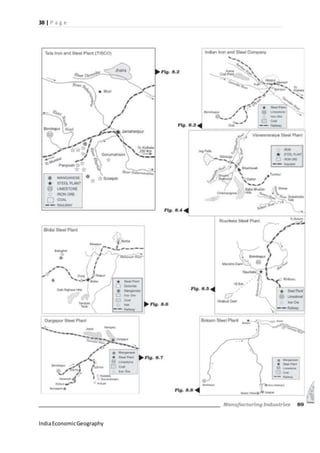
  • 25.
    25 | Pa g e  Ferrous such as iron ore itself and those which do not have iron content are non-ferrous such as copper, bauxite, etc  Non-metallic minerals are either organic in origin such as fossil fuels also known as mineral fuels which are derived from the buried animal and plant life such as coal and petroleum.  Other type of non-metallic minerals is inorganic in origin such as mica, limestone and graphite, etc. Agencies involved in the exploration of minerals In India, systematic surveying, prospecting and exploration for minerals is undertaken by the Geological Survey of India (GSI), Oil and Natural Gas Commission (ONGC), Mineral Exploration Corporation Ltd. (MECL), National Mineral Development Corporation (NMDC), Indian Bureau of Mines (IBM), Bharat Gold Mines Ltd. (BGML), Hindustan Copper Ltd. (HCL), National Aluminium Company Ltd. (NALCO) and the Departments of Mining and Geology in various states  Over 97 per cent of coal reserves occur in the valleys of Damodar, Sone, Mahanadi and Godavari. Petroleum reserves are located in the sedimentary basins of Assam, Gujarat and Mumbai High i.e. off-shore region in the Arabian Sea. New reserves have been located in the Krishna-Godavari and Kaveri basins. Most of the major mineral resources occur to the east of a line linking Mangalore and Kanpur.  Minerals are generally concentrated in three broad belts in India. The North-Eastern Plateau Region  This belt covers Chotanagpur (Jharkhand), Orissa Plateau, West Bengal and parts of Chhattisgarh. The South-Western Plateau Region  This belt extends over Karnataka, Goa and contiguous Tamil Nadu uplands and Kerala. This belt is rich in ferrous metals and bauxite  This belt packs in coal deposits except Neyveli lignite.  Kerala has deposits of monazite and thorium, bauxite clay. Goa has iron ore deposits The North-Western Region India Economic Geography
  • 26.
    26 | Pa g e  This belt extends along Aravalli in Rajasthan and part of Gujarat and minerals are associated with Dharwar system of rocks. Copper, zinc has been major minerals. Rajasthan is rich in building stones i.e. sandstone, granite, marble. Gypsum and Fuller’s earth deposits are also extensive. Dolomite and limestone provide raw materials for cement industry.  Gujarat is known for its petroleum deposits.  Ferrous Mineral Ferrous minerals such as iron ore, manganese, chromite, etc., provide a strong base for the development of metallurgical industries.  The two main types of ore found in our country are haematite and magnetite Iron ore  About 95 per cent of total reserves of iron ore is located in the States of Orissa, Jharkhand, Chhattisgarh, Karnataka, Goa, Andhra Pradesh and Tamil Nadu.  In Orissa, iron ore occurs in a series of hill ranges in Sundergarh, Mayurbhanj and Jhar. The important mines are Gurumahisani, Sulaipet, Badampahar (Mayurbhaj), Kiruburu (Kendujhar) and Bonai (Sundergarh).  Most of the important mines such as Noamundi and Gua are located in Poorbi and Pashchimi Singhbhum districts. This belt further extends to Durg, Dantewara and Bailadila. Dalli and Rajhara in Durg are the important mines of iron ore in the country.  In Karnataka, iron ore deposits occur in Sandur-Hospet area of Bellary district Manganese  Orissa is the leading producer of Manganese.  Karnataka is another major producer and here the mines are located in Dharwar, Bellary, Belgaum, North Canara, Chikmagalur, Shimoga, Chitradurg and Tumkur  Non-Ferrous Minerals India is poorly endowed with non-ferrous metallic minerals except bauxite Bauxite is the ore which is used in manufacturing of aluminium.  Orissa happens to be the largest producer of Bauxite.  The other two areas which have been increasing their production are Bolangir and Koraput.  Tamil Nadu, Karnataka and Goa are minor producers of bauxite.  Chhattisgarh has bauxite deposits in Amarkantak plateau while Katni -Jabalpur area and Balaghat in M.P. Copper  Copper is an indispensable metal in the electrical industry for making wires, electric motors, transformers and generators. It is alloyable, malleable and ductile. It is also mixed with gold to provide strength to jewellery. The Copper deposits mainly occur in Singhbhum district in Jharkhand, Balaghat district in Madhya Pradesh and Jhunjhunu and Alwar districts in Rajasthan. Minor producers of Copper are Agnigundala in Guntur District (Andhra Pradesh), Chitradurg and Hasan districts (Karnataka) and South Arcot di strict (Tamil Nadu). India Economic Geography
  • 27.
    27 | Pa g e India Economic Geography
  • 28.
    28 | Pa g e Non-metallic Minerals  Among the non-metallic minerals produced in India, mica is the important one. The other minerals extracted for local consumption are limestone, dolomite and phosphate. Mica  Mica is mainly used in the electrical and electronic industries. India Economic Geography
  • 29.
    29 | Pa g e  In Jharkhand high quality mica is obtained in a belt extending over a distance of about 150 km, in length and about 22 km, in width in lower Hazaribagh plateau. In Andhra Pradesh, Nellore district produces the best quality mica.  In Rajasthan mica belt extends for about 320 kms from Jaipur to Bhilwara and around Udaipur. Energy Resources  Mineral fuels like coal, petroleum and natural gas (known as fossil fuels), nuclear energy minerals, are the Conventional sources of energy. India Economic Geography
  • 30.
    30 | Pa g e Coal  Coal occurs in rock sequences mainly of two geological ages, namely Gondwana and tertiary deposits.  About 80 per cent of the coal deposits in India is of bituminous type and is of non-coking grade. The most important Gondwana coal fields of India are located in Damodar Valley. India Economic Geography
  • 31.
    31 | Pa g e  They lie in Jharkhand-Bengal coal belt and the important coal fields  The most important coal mining centres are Singrauli in Madhya Pradesh (part of Singrauli coal field lies in Uttar Pradesh), Korba in Chhattisgarh, Talcher and Rampur in Orissa, Chanda–Wardha, Kamptee and Bander in Maharashtra and Singareni and Pandur in Andhra Pradesh. Crude petroleum  Crude petroleum consists of hydrocarbons of liquid and gaseous states varying in chemical composition, colour and specific gravity.  The Oil and Natural Gas Commission has found potential zones of natural gas reserves in Ramanathapuram district.  Crude petroleum occurs in sedimentary rocks of the tertiary period. Oil exploration and production was systematically taken up after the Oi l and Natural Gas Commission was set up in 1956.  Till then, the Digboi in Assam was the only oil producing region but the scenario has changed after 1956.  In Assam, Digboi, Naharkatiya and Moran are important oil producing areas.  Oil and natural gas have been found in exploratory wells in Krishna-Godavari and Kaveri basin on the east coast.  There are two types of refineries in India: (a) field based and (b) market based. Digboi is an example of field based and Barauni is an example of market based refinery.  There are 18 refineries in India India Economic Geography
  • 32.
    32 | Pa g e Natural Gas  The Gas Authority of India Limited was set up in 1984 as a public sector undertaking to transport and market natural gas.  It is obtained along with oil in all the oil fields but exclusive reserves have been located along the eastern coast as well as (Tamil Nadu, Orissa and Andhra Pradesh), Tripura, Rajasthan and off-shore wells in Gujarat and Maharashtra Nuclear Energy Resources  Important minerals used for the generation of nuclear energy are uranium and thorium.  Uranium deposits occur in the Dharwar rocks.  Geographically, uranium ores are known to occur in several locations along the Singbhum Copper belt. India Economic Geography
  • 33.
    33 | Pa g e  Thorium is mainly obtained from monazite and ilmenite in the beach sands along the coast of Kerala and Tamil Nadu.  World’s richest monazite deposits occur in Palakkad and Kollam districts of Kerala, near Vishakhapatnam in Andhra Pradesh and Mahanadi river delta in Orissa Atomic Energy Commission was established in 1948, progress could be made only after the establishment of the Atomic Energy Institute at Trombay in 1954 which was renamed as the Bhabha Atomic Research Centre in 1967.  The important nuclear power projects are Tarapur (Maharashtra), Rawatbhata near Kota (Rajasthan), Kalpakkam (Tamil Nadu), Narora (Uttar Pradesh), Kaiga (Karnataka) and Kakarapara (Gujarat). Non-Conventional Energy Sources  Sustainable energy resources are only the renewable energy sources like solar, wind, hydro-geothermal and biomass. Solar Energy  Sun rays tapped in photovoltaic cells can be converted into energy, known as solar energy  The two effective processes considered to be very effective to tap solar energy are photovoltaics and solar thermal technology.  Solar energy is 7 per cent more effective than coal or oil based plants and 10 per cent more effective than nuclear plants.  The western part of India has greater potential for the development of solar energy in Gujarat and Rajasthan Wind Energy  The kinetic energy of wind, through turbines is converted into electrical energy  The permanent wind systems such the trade winds, westerlies and seasonal wind like monsoon have been used as source of energy.  India already has started generating wind energy. It has an ambitious programme to install 250 wind-driven turbines with a total capacity of 45 megawatts, spread over 12 suitable locations, especially in coastal areas.  According to the estimation by Ministry of Power, India will be able to produce 3,000 megawatts of electric from this source. The Ministry of non-conventional sources of energy is developing wind energy in India to lessen the burden of oil import bill.  In Rajasthan, Gujarat, Maharashtra and Karnataka, favourable conditions for wind energy exist. Wind power plant at Lamba in Gujarat in Kachchh is the largest in Asia. Another, wind power plant is located at Tuticorin in Tamil Nadu. Geothermal Energy When the magma from the interior of earth, comes out on the surface, tremendous heat is released. This heat energy can successfully be tapped and converted to electrical energy. India Economic Geography
  • 34.
    34 | Pa g e  Apart from this, the hot water that gushes out through the gyser wells is also used in the generation of thermal energy. It is popularly known as Geothermal energy.  In India, a geothermal energy plant has been commissioned at Manikaran in Himachal Pradesh.  The first successful (1890) attempt to tap the underground heat was made in the city of Boise, Idaho(U.S.A.),where a hot water pipe network was built to give heat to the surrounding buildings. This plant is still working Bio-energy  Bio-energy refers to energy derived from biological products which includes agricultural residues, municipal, industrial and other wastes.  This will improve economic life of rural areas in developing countries, reduce environmental pollution, enhance self-reliance and reduce pressure on fuel wood. One such project converting municipal waste into energy is Okhla in Delhi Conservation of Mineral Resources  These should be developed to replace the exhaustible resources. In case of metallic minerals, use of scrap metals will enable recycling of metals. Use of scrap is especially significant in metals like copper, lead and zinc in which India’s reserves are meagre. Use of substitutes for scarce metals may also reduce their consumption. Export of strategic and scarce minerals must be reduced, so that the existing reserve may be used for a longer period Chapter 12_7: MANUFACTURING INDUSTRIES Types of Industries  On the basis of size, capital investment and labour force employed, industries are classified as large, medium, small scale, and cottage industries.  On the basis of ownership, industries are categorised as : (i) public sector, (ii) private sector, and (iii) joint and cooperative sector,  Public sector enterprises are government/state controlled companies or corporations funded by governments.  Industries of strategic and national importance are usually in the public sector.  Industries are also classified on the basis of the use of their products such as: (i) basic goods industries, (ii) capital goods industries (iii) intermediate goods industries, and (iv) consumer goods industries.  Another method of classifying industries is on the basis of raw materials used by them. Accordingly, these can be : (i) agriculture based industries, (ii) forest-based industries, (iii) mineral-based industries, and (iv) industrially processed raw material based industries  Another common classification of industries is based on the nature of the manufactured products. Eight classes of industries, thus identified are: (1) Metallurgical Industries, (2) Mechanical Engineering Industries, (3) Chemical and Allied Industries, (4) Textile Industries, (5) Food Processing Industries, (6) Electricity Generation, (7) Electronics and (8) Communication Industries. India Economic Geography
  • 35.
    35 | Pa g e Location of Industries  Location of industries is influenced by several factors like access to raw materials, power, market, capital, transport and labour, etc.  It is economical to locate the manufacturing industries at a place where cost of production and delivery cost of manufactured goods to consumers are the least.  Transport costs, to a great extent, depend on the nature of raw materials and manufactured products. Raw Materials  Industries using weight-losing raw materials are located in the regions where raw materials are located.  Therefore, an optimum location for iron and steel industries should be near raw material sources  This is why most of the iron and steel industries are located either near coalfields (Bokaro, Durgapur, etc.) or near sources of iron ore (Bhadravati, Bhilai, and Rourkela). Power  Power provides the motive force for machines, and therefore, its supply has to be ensured before the location of any industry. However, certain industries, like aluminium and synthetic nitrogen manufacturing industries tend to be located near sources of power because they are power intensive and require huge quantum of electricity Market  Markets provide the outlets for manufactured products.  Cotton textile industry uses a non-weight-losing raw material and is generally located in large urban centre, e.g. Mumbai, Ahmedabad, Surat, etc.  Koyali, Mathura and Barauni refineries are typical examples. Ports also play a crucial role in the location of oil refineries Historical Factors  During the initial phase of colonisation, manufacturing activities received new impetus provided by the European traders. Places like Murshidabad, Dhaka, Bhadohi, Surat, Vadodara, Kozhikode, Coimbatore, Mysore, etc. emerged as important manufacturing centres. Industrial Policy  India, being a democratic country aims at bringing about economic growth with balanced regional development.  Establishment of iron and steel industry in Bhilai and Rourkela were based on decision to develop backward tribal areas of the country. At present, government of India provides lots of incentives to industries locating in backward areas. Major Industries India Economic Geography
  • 36.
    36 | Pa g e  The iron and steel industry is basic to the industrial development of any country. The cotton textile Industry is one of our traditional industries. The sugar Industry is based on local raw materials which prospered even in the British period. Besides the more recent petrochemical Industry and the IT industry The Iron and Steel Industry  The other raw materials besides iron ore and coking coal, essential for iron and steel industry are limestone, dolomite, manganese and fire clay.  In India, there is a crescent shaped region comprising parts of Chhattisgarh, Northern Orissa, Jharkhand and western West Bengal, which is extremely rich in high grade iron ore, good quality coking coal and other supplementing raw materials. Integrated Steel Plants TISCO  The Tata Iron and Steel plant lies very close to the Mumbai -Kolkata railway line and about 240 km away from Kolkata, which is the nearest port for the export of steel.  The rivers Subarnarekha and Kharkai provide water to the plant. IISCO  The Indian Iron and Steel Company (IISCO) set up its first factory at Hirapur and later on another at Kulti. In 1937, the Steel Corporation of Bengal was constituted in association with IISCO and set up another iron and steel producing unit at Burnpur (West Bengal). All the three plants under IISCO are located very close to Damodar valley coal fields (Raniganj, Jharia, and Ramgarh). Iron ore comes from Singhbhum in Jharkhand. Water is obtained from the Barakar River, a tributary of the Damodar.  Unfortunately, steel production from IISCO fell considerably in 1972-73 and the plants were taken over by the government Visvesvaraiya Iron and Steel Works Ltd. (VISL)  The third integrated steel plant, the Visvesvaraiya Iron and Steel Works, initially called the Mysore Iron and Steel Works, is located close to an iron ore producing area of Kemangundi in the Bababudan hills. Limestone and manganese are also locally available.  Afterwards, electric furnaces were installed which use hydroelectricity from the Jog Falls hydel power project.  The Bhadravati River supplies water to the plant. This plant produces specialised steels and alloys  After independence, during the Second Five Year Plan (1956-61), three new integrated steel plants were set up with foreign collaboration: Rourkela in Orissa, Bhilai in Chhattisgarh and Durgapur in West Bengal. These were public sector plants under Hindustan Steel Limited (HSL). In 1973, the Steel Authority of India Limited (SAIL) was created to manage these plants Rourkela Steel Plant India Economic Geography
  • 37.
    37 | Pa g e  The Rourkela Steel plant was set up in 1959 in the Sundargarh district of Orissa in collaboration with Germany. Bhilai Steel Plant  The Bhilai Steel Plant was established with Russian collaboration in Durg District of Chhattisgarh and started production in 1959 Durgapur Steel Plant  Durgapur Steel Plant, in West Bengal, was set up in collaboration with the government of the United Kingdom and started production in 1962 Bokaro Steel Plant  This steel plant was set up in 1964 at Bokaro with Russian collaboration. Other Steel Plants  All the three plants are located in South India. The Vizag Steel Plant, in Vishakhapatnam in Andhra Pradesh is the first port based plant which started operating in 1992. Its port location is of advantage. The Vijaynagar Steel Plant at Hospet in Karnataka was developed using indigenous technology. This uses local iron ore and limestone. The Salem Steel Plant in Tamil Nadu was commissioned in 1982  Apart from these major steel plants, there are more than 206 units located in different parts of the country. India Economic Geography
  • 38.
    38 | Pa g e India Economic Geography
  • 39.
    39 | Pa g e The Cotton Textile Industry  India was famous worldwide for the production of muslin, a very fine variety of cotton cloth, calicos, chintz and other different varieties of fine cotton cloth  One, it is a tropical country and cotton is the most comfortable fabric for a hot and humid climate. Second, large quantity of cotton was grown in India. Abundant skilled labour required for this industry was available in this country.  In 1854, the first modern cotton mill was established in Mumbai. This city had several advantages as a cotton textile manufacturing centre.  Subsequently, two more mills, the Shahpur Mill and the Calico Mill were established in Ahmedabad.  After Independence, this industry gradually recovered and eventually flourished. In 1998, India had 1782 mills; of which, 192 mills were in the public sector and 151 mills in the cooperative sector. The largest number, that is, 1,439 mills were in the private sector.  The cotton textile industry in India can be broadly divided into two sectors, the organised sector and the decentralised sector. The decentralised sector includes cloth produced in handlooms (including Khadi) and power looms. The production of the organised sector has drastically fallen from 81 per cent in the mid-twentieth century to only about 6 per cent in 2000. At present, the power looms on the decentralised sector produce more than 59 per cent and the handloom sector produces about 19 per cent of all cotton cloth produced in the country.  In southern India, mills were set up at Coimbatore, Madurai and Bangalore. In central India, Nagpur, Indore, Solapur and Vadodara became cotton textile centres.  Maharashtra, Gujarat and Tamil Nadu are the leading cotton producing states.  Tamil Nadu has the largest number of mills and most of them produce yarn rather than cloth. Coimbatore has emerged as the most important centre with nearly half the mills located there.  In Andhra Pradesh, the cotton textile industry is located in the cotton producing Telengana region, where most of the mills are spinning mills producing yarn. The important centres are Hyderabad, Secunderabad, Warangal and Guntur  Production of cotton cloth increased almost five times from 1950-51 to 1999-2000. Cotton textile has been facing tough competition from synthetic cloth. India Economic Geography
  • 40.
    40 | Pa g e Sugar Industry  The sugar industry is the second most important agro-based industry in the country. India is the largest producer of both sugarcane and cane sugar and contributes about 8 per cent of the total sugar production in the world. Besides, khandasari and gur or jaggery is also prepared from sugarcane.  Sugar industry is a seasonal industry because of the seasonality of raw materials. Location of the Sugar Industry  Sugar factories hence, are located within the cane producing regions  Maharashtra has emerged as a leading sugar producer in the country and produces more than one-third of the total production of the sugar in the country.  Uttar Pradesh is the second largest producer of sugar. India Economic Geography
  • 41.
    41 | Pa g e  The industry is distributed in the coastal regions i.e. East Godavari, West Godavari, Vishakhapatnam districts and Nizamabad, and Medak districts of Telangana along with Chittoor district of Rayalseema Petrochemical Industries  This group of industries is divided into four sub-groups: (i) polymers, (ii) synthetic fibres, (iii) elastomers, and (iv) surfactant intermediate. Mumbai is the hub of the petrochemical industries. Cracker units are also located in Auraiya (Uttar Pradesh), Jamnagar, Gandhinagar and Hajira (Gujarat), Nagothane, Ratnagiri (Maharashtra), Haldia (West Bengal) and Vishakhapatnam (Andhra Pradesh)  Three organisations are working in the petrochemical sector under the administrative control of the Department of Chemicals and Petrochemicals.  First is the Indian Petrochemical Corporation Limited (IPCL), a public sector undertaking. It is responsible for the manufacture and distribution of the various petrochemicals like polymers, chemicals, fibres and fibre intermediates.  Second is the Petrofils Cooperative Limited (PCL), a joint venture of the Government of India and Weaver’s Cooperative Societies. It produces polyester filament yarn and nylon chips at its two plants located at Vadodara and Naldhari in Gujarat.  Third is the Central Institute of Plastic Engineering and Technology (CIPET), involved in imparting training in petro-chemical industry.  Polymers are made from ethylene and propylene. These materials are obtained in the process of refining crude oil.  The National Organic Chemicals Industries Limited (NOCIL), established in private sector in 1961, started the first naphtha based chemical industry in Mumbai.  The plants located at Mumbai, Barauni, Mettur, Pimpri and Rishra are the major producers of plastic materials  About 75 per cent of these units are in small scale sector. The industry also uses recycled plastics, which constitutes about 30 per cent of the total production Knowledge based Industries  The Information Technology (IT) revolution opened up new possibilities of economic and social transformation. The IT and IT enabled business process outsourcing (ITESBPO) services continue to be on a robust growth path.  The IT software and services industry account for almost 2 per cent of India’s GDP.  A majority of the multinational companies operating in the area of information technology have either software development centres or research development centres in India. However, in the hardware development sector, India is yet to make any remarkable achievements.  A major impact of this growth has been on employment creation, which is almost doubled every year India Economic Geography
  • 42.
    42 | Pa g e Liberalisation, Privatisation, Globalisation (LPG) and Industrial Development in India  The new Industrial Policy was announced in 1991. The major objectives of this policy were to build on the gains already made, correct the distortions or weaknesses that have crept in, maintain a sustained growth in productivity and gainful employment and attain international competitiveness  Within this policy, measures initiated are: (1) abolition of industrial licensing, (2) free entry to foreign technology, (3) foreign investment policy, (4) access to capital market, (5) open trade, (6) abolition of phased manufacturing programme, and (7) liberalised industrial location programme. The policy has three main dimensions: liberalisation, privatisation and globalisation  The number of industries reserved for public sector since 1956 have been reduced from 17 to 4. Industries related to atomic energy, a substance specified in the Schedule of the Department of Atomic Energy as well as Railways has remained under the public sector.  In the new industrial policy, Foreign Direct Investment (FDI) has been seen as a supplement to the domestic investment for achieving a higher level of economic development.  Foreign investment has been liberalised and the government has permitted access to an automatic route for Foreign Direct Investment.  The industrial policy has been liberalised to attract private investor both domestic and multi-nationals. New sectors like, mining, telecommunications, highway construction and management have been thrown open to private companies. India Economic Geography
  • 43.
    43 | Pa g e  Larger parts of this investment have gone to domestic appliances, finance, services, electronics and electrical equipment, and food and dairy products  Globalisation means integrating the economy of the country with the world economy  Under this process, goods and services along with capital, labour and resources can move freely from one nation to another.  In Indian context, this implies: (1) opening of the economy to foreign direct investment by providing facilities to foreign companies to invest in different fields of economies activity in India; (2) removing restrictions and obstacles to the entry of multinational companies in India; (3) allowing Indian companies to enter into foreign collaboration in India and also encouraging them to set up joint ventures abroad; (4) carrying out massive import liberalisation programmes by switching over from quantitative restrictions to tariffs in  The first place, and then bringing down the level of import duties considerably; and (5) instead of a set of export incentives, opting for exchange rate adjustments for promoting export Industrial Regions in India  Industrial Regions and Districts Major Industrial Regions (8) 1. Mumabi-Pune Region, 2. Hugli Region, 3. Bangalore- Tamil Nadu Region, 4. Gujarat Region, 5. Chotanagpur Region, 6. Vishakhapatnam-Guntur Region, 7. Gurgaon-Delhi-Meerut Region, and 8. Kollam- Tiruvantapuram Region.  Minor Industrial Regions (13) 1. Ambala-Amritsar ,2.Saharanpur -Muzaffarnagar - Bijnor,3.Indore-Dewas-Uijjain,4.Jaipur-Ajmer, 5.Kolhapur -South Kannada, 6. Northern Malabar ,7.MiddleMalabar , 8. Adilabad-Nizamabad, 9.Allahabad-V aranasi-Mirzapur ,10.Bhojpur -Munger ,11.Durg-Raipur,12.Bilaspur-Korba,and 13. Brahmaputra valley .  Industrial Districts (15) 1.Kanpur,2.Hyderabad,3.Agra,4.Nagpur,5.Gwalior,6.Bhopal,7.Lucknow,8.Jalpaiguri, 9. Cuttack, 10. Gorakhpur ,11.Aligarh,12.Kota,13.Purnia,14.Jabalpur,and15.Bareilly.  Several indices are used to identify the clustering of industries, important among them are : (i) the number of industrial units, (ii) number of industrial workers, (iii) quantum of power used for industrial purposes, (iv) total industrial output, and (v) value added by manufacturing, etc India Economic Geography
  • 44.
    44 | Pa g e Mumbai-Pune Industrial Region  It extends from Mumbai-Thane to Pune and in adjoining districts of Nashik and Solapur.  Opening of the Suez Canal in 1869 provided impetus to the growth of Mumbai port. Machineries were imported through this port. Hydro-electricity was developed in the Western Ghat region to meet the requirements of this industry  With the development of cotton textile industry, chemical industry also developed. Opening of the Mumbai High petroleum field and erection of nuclear energy plants added additional pull to this region. Hugli Industrial Region  Located along the Hugli river, this region extends from Bansberia in the north to Birlanagar in the south for a distance of about 100 km  Kolkata-Haora from the nucleus of this industrial region.  Kolkata, being the capital city of British India (1773-1911), attracted the British capital. The establishment of first jute mill at Rishra in 1855 ushered in the era of modern industrial clustering in this region  The major concentration of jute industry is at Haora and Bhatapara. The partition of the country in 1947 adversely affected this industrial region. India Economic Geography
  • 45.
    45 | Pa g e  Factory of the Hindustan Motors Limited at Konnagar and diesel engine factory at Chittaranjan are landmarks of this region.  Location of petroleum refinery at Haldia has facilitated the development of a variety of industries. Bangalore-Chennai Industrial Region  This region witnessed most rapid industrial growth in post-Independence period.  Till 1960, industries were confined to Bangalore, Salem and Madurai districts but now they have spread over all the districts of Tamil Nadu  Cotton textile industry was the first to take roots due to the presence of cotton growing areas.  Several heavy engineering industries converged at Bangalore. Aircraft (HAL), machine tools, telephone (HTL) and Bharat Electronics are industrial landmarks of this region. Gujarat Industrial Region  The nucleus of this region lies between Ahmedabad and Vadodara but this region extends upto Valsad and Surat in the south and to Jamnagar in the west.  Development of this region is also associated with the location of the cotton textile industry since 1860s. This region became an important textile region with the decline of the cotton textile industry at Mumbai  The port at Kandla helped in the rapid growth of this region. Petroleum refinery at Koyali provided raw materials to a host of petrochemical industries.  Recently, largest petroleum refinery has been set up at Jamnagar Chotanagpur Region  This region extends over Jharkhand, northern Orissa and western West Bengal and is known for the heavy metallurgical industries.  This region owes its development to the discovery of coal in the Damodar Valley and metallic and non-metallic minerals in Jharkhand and northern Orissa.  Six large integrated iron and steel plants at Jamshedpur, Burnpur Kulti, Durgapur, Bokaro and Rourkela are located within this region. Vishakhapatnam-Guntur Region  This industrial region extends from Vishakhapatnam district to Kurnool and Prakasam districts in the south.  Coalfields of the Godavari basin provide energy. Ship building industry was started at Vishakhapatnam in 1941. Petroleum refinery based on imported petroleum facilitated the growth of several petrochemical industries. Gurgaon-Delhi-Meerut Region  Industries located in this region have shown very fast growth in the recent past. This region is located far away from the mineral and power resources, and therefore, the industries are light and market-oriented. India Economic Geography
  • 46.
    46 | Pa g e Kollam-Tiruvanantapuram Region  Plantation agriculture and hydropower provide industrial base to this region. Located far away from the mineral belt of the country, agricultural products processing and market oriented light industries predominate the region.  Location of petroleum refinery at Kochchi has added a vista of new industries to this region. Chapter 12_7: PLANNING AND SUSTAINABLE DEVELOPMENT IN INDIAN CONTEXT Overview of Planning Perspective in India  India has centralised planning and the task of planning in India has been entrusted to the Planning Commission. It is a statutory body headed by the Prime Minister and has a Deputy Chairman and members.  The planning in the country is largely carried out through Five Year Plans.  The First Five Year Plan was launched in 1951 and covered the period, 1951-52 to 1955-56. Second and Third Five Year Plans covered the period from 1956-57 to 1960-61 and 1961-62 to 1965-66 respectively.  Two successive droughts during mid-sixties (1965-66 and 1966-67) and war with Pakistan in 1965 forced plan holiday in 1966-67 and 1968-69. This period was covered by annual plans, which are also termed as rolling plans.  The Fourth Five Year Plan began in 1969-70 and ended in 1973-74. Following this the Fifth Five Year Plan began in 1974-75 but it was terminated by the then government one year earlier i.e. in 1977-78  The Sixth Five Year Plan took off in 1980. The Seventh Five Year Plan covered the period between 1985 and 1990. Once again due to the political instability and initiation of liberalisation policy, the Eighth Five Year Plan got delayed. It covered the period, 1992 to 1997.  The Ninth Five Year Plan covered the period from 1997 to 2002. The Tenth Plan began in 2002 and it is still in progress. It will come to an end on 31.3.2007. The approach paper of the Eleventh Plan entitled. “Towards Faster and More Inclusive Growth” has already been approved Generally, there are two approaches to planning, i.e. sectoral planning and regional planning.  The sectoral planning means formulation and implementation of the sets of schemes or programmes aimed at development of various sectors of the economy such as agriculture, irrigation, manufacturing, power, construction, transport, communication, social infrastructure and services  There is no uniform economic development over space in any country. Some areas are more developed and some lag behind. This uneven pattern of development over space necessitates that the planners have a spatial perspective and draw the plans to reduce regional imbalance in development. This type of planning is termed as regional planning Target Area Planning  In order to arrest the accentuation of regional and social disparties, the Planning Commission introduced the ‘target area’and target group approaches to planning. India Economic Geography
  • 47.
    47 | Pa g e  Command Area Development Programme, Drought Prone Area Development Programme, Desert Development Programme, Hill Area Development Programme. The Small Farmers Development Agency (SFDA) and Marginal Farmers Development Agency (MFDA) which are the examples of target group programme  In the 8th Five year Plan special area programmes were designed to develop infrastructure in hill areas, north-eastern states, tribal areas and backward areas Hill Area Development Programme  Hill Area Development Programmes were initiated during Fifth Five Year Plan covering 15 districts  The National Committee on the Development of Backward Area in 1981 recommended that all the hill areas in the country having height above 600 m and not covered under tribal sub-plan be treated as backward hill areas.  These programmes aimed at harnessing the indigenous resources of the hill areas through development of horticulture, plantation agriculture, animal husbandry, poultry, forestry and small-scale and village industry. Drought Prone Area Programme  This programme was initiated during the Fourth Five Year Plan with the objectives of providing employment to the people in drought-prone areas and creating productive assets.  National Committee on Development of Backward Areas, reviewed the performance of this programme.  Planning Commission of India (1967) identified 67 districts (entire or partly) of the country prone to drought. Irrigation Commission (1972) introduced the criterion of 30 per cent irrigated area and demarcated the drought prone areas. Case Study–Integrated Tribal Development Project in Bharmaur Region  The process of development of tribal area of Bharmaur started in 1970s when Gaddis were included among ‘scheduled tribes’. Under the Fifth Five Year Plan, the tribal sub -plan was introduced in 1974 and Bharmaur was designated as one of the five Integrated Tribal Development Projects (ITDP) in Himachal Pradesh. Sustainable Development  The concept of development is dynamic and has evolved during the second half of twentieth century. In the post-World War II era, the concept of development was synonymous to economic growth which is measured in terms of temporal increase in gross national product (GNP) and per capita income/per capita consumption.  So, in 1970s, the phrases such as redistribution with growth and growth and equity were incorporated in the definition of development.  It also includes the issues such as improving the well-being and living standard of people, availing of the health, education and equality of opportunity and ensuring political and civil rights. By 1980s, development emerged as a concept encapsulating wide-spread improvement in social as well as material wellbeing of all in a society. India Economic Geography
  • 48.
    48 | Pa g e  The notion of sustainable development emerged in the wake of general rise in the awareness of environmental issues in the late 1960s in Western World.  The publication of ‘The Population Bomb’ by Ehrlichin 1968 and ‘The Limits to Growth’ by Meadows and others in 1972 further raised the level of fear among environmentalists in particular and people in general.  This sets the scenario for the emergence of new models of development under a broad phrase ‘sustainable development’.  Concerned with the growing opinion of world community on the environmental issues, the United Nations established a World Commission on Environment and Development (WCED) headed by the Norwegian Prime Minister Gro Harlem Brundtland. The Commission gave its report (also known as Brundtland Report) entitled ‘Our Common Future’ in 1987. The report defines sustainable development as a “development that meets the needs of the present without compromising the ability of future generations to meet their own needs. Indira Gandhi Canal (Nahar) Command Area  Indira Gandhi Canal, previously known as the Rajasthan Canal, is one of the largest canal systems in India. Conceived by Kanwar Sain in 1948, the canal project was launched on 31 March, 1958.  The canal originates at Harike barrage in Punjab and runs parallel to Pakistan border at an average distance of 40 km in Thar Desert (Marusthali) of Rajasthan. Chapter 12_10 Geo12_India_10_Transport and Communication The use of transport and communication depends upon our need to move things from place of their availability to the place of their use. Human-beings use various methods to move goods, commodities, ideas from one place to another. Road Transport  Sher Shah Suri built the Shahi (Royal) road to strengthen and consolidate his empire from the Indus Valley to the Sonar Valley in Bengal. This road was renamed the Grand Trunk (GT) road during the British period, connecting Calcutta and Peshawar. At present, it extends from Amritsar to Kolkata. It is bifurcated into 2 segments : (a) National Highway(NH)-1 from Delhi to Amritsar, and (b) NH- 2 from Delhi to Kolk ata. India Economic Geography
  • 49.
    49 | Pa g e  Road transport in modern sense was very limited in India before World War-II. The first serious attempt was made in 1943 when ‘Nagpur Plan’ was drawn.  After Independence, twenty-year road plan (1961) was introduced to improve the conditions of roads in India. National Highways  The main roads which are constructed and maintained by the Central Government are known as the National Highways. These roads are meant for inter-state transport and movement of defence men and material in strategic areas.  The National Highways Authority of India (NHAI) was operationalised in 1995. It is an autonomous body under the Ministry of Surface Transport. Other Roads  Other roads include Border Roads and International Highways. The Border Road Organisation (BRO) was established in May 1960 for accelerating economic development and strengthening defence preparedness through rapid and coordinated improvement of strategically important roads along the northern and north-eastern boundary of the country  Nature of terrain and the level of economic development are the main determinants of density of roads. Construction of roads is easy and cheaper in the plain areas while it is difficult and costly in hilly and plateau areas. Therefore, not only the density but also the quality of roads is relatively better in plains as compared to roads in high altitude areas, rainy and forested regions. Rail Transport  On the basis of width of the track of Indian Railways, three categories have been made: Broad gauge: The distance between rails in broad gauge is 1.676 metre. The total length of broad gauge lines is 46,807 km which accounts for74.14 percent of the total length of rail routes in the country. Metre gauge: The distance between rails is one metre. It runs over 13,290 km covering 21.02 percent of the total route length. Narrow gauge: The distance between the rails in this case is 0.762 metre or 0.610 metre. Nearly 4.94 percent of the total length of the Indian Railways is narrow gauge, which accounts for 3,124 km of route length. It is generally confined to hilly areas India Economic Geography
  • 50.
    50 | Pa g e Konkan Railway  One of the important achievements of Indian Railways has been the construction of Konkan Railway in 1998. It is 760 km long rail route connecting Roha in Maharashtra to Mangalore in Karnataka. It is considered an engineering marvel. It crosses 146 rivers, streams, nearly 2000 bridges and 91 tunnels. Asia’s largest tunnel which is nearly 6.5 km long also lies on this route. The states of Maharashtra, Goa and Karnataka are partners in this undertaking. India Economic Geography
  • 51.
    51 | Pa g e Water Transport  The water transport is of two types– (a) inland waterways, and (b) oceanic waterways.  For the development, maintenance and regulation of national waterways in the country, the Inland Waterways Authority was set up in 1986.  The authority has declared three inland waterways as National Waterways  The back water (Kadal) of Kerala has special significance in Inland Waterway. Apart from providing cheap means of transport, they are also attracting large number of tourists in Kerala. The famous Nehru Trophy Boat Race (VALLANKALI) is also held in the backwaters Air transport  Air transport in India made a beginning in 1911 when airmail operation commenced over a little distance of 10 km between Allahabad and Naini. But its real development took place in post-Independent period. The Airport Authority of India is responsible for providing safe, efficient air traffic and aeronautical communication services in the Indian Air Space. The authority manages 126 airports including 11 international, 86 domestic and 29 civil enclaves at defence air fields. The air transport in India is managed by two corporations, Air India and Indian Airlines after nationalisation. History of Indian Airlines 1911 – Air transport in India was launched between Allahabad and Naini. 1947 – Air transport was provided by four major company’s namely Indian National Air ways, Tata Sons Limited, Air Services of India and Deccan Airways. 1951 – Four more companies joined the services, Bharat Airways, Himalayan Aviation Limited, Airways India and Kalinga Airlines. 1953 – Air transport was nationalised and two Corporations, Air India International and Indian Airlines were formed. Now Indian Airlines is known as ‘Indian’  The country’s largest state-owned domestic carrier, Indian Airlines dropped the word ‘Airlines’ from its name and is known as ‘Indian’ w.e.f. December 8, 2005. The new brand name ‘Indian’ now appears on both sides of the fusel age. The logo on the orange tail depicting ‘IA’ has also been changed. It has been replaced by a new logo which is a partly visible blue wheel and is inspired by the Sun Temple at Konark (Orissa), symbolising timeless motion, convergence and divergence. It also embodies strength as well as trust that has stood the test of time  Pawan Hans is the helicopter service operating in hilly areas and is widely used by tourists in north-eastern sector India Economic Geography
  • 52.
    52 | Pa g e Open Sky Policy  To help the Indian exporters and make their export more competitive, the government had introduced an Open Sky Policy for cargo in April1992.Under this policy, foreign airlines or association of exporters can bring any freighters to the country. Oil and Gas Pipelines  Oil India Limited (OIL) under the administrative set up of the Ministry of Petroleum and Natural Gas is engaged in the exploration, production and transportation of crude oil and natural gas. It was incorporated in 1959 as a company. Asia’s first cross country pipeline covering a distance of 1,157 km was constructed by OIL from Naharkatiya oilfield in Assam to Barauni refinery in Bihar. It was further extended up to Kanpur in 1966 Communication Networks  Radio broadcasting started in India in 1923 by the Radio Club of Bombay.  Government took this opportunity and brought this popular mode of communication under its control in 1930 under the Indian Broadcasting System. It was changed to All India Radio in 1936 and to Akashwani in 1957  Initially, the T.V. services were limited only to the National Capital where it began in 1959. After 1972, several other centres became operational. In 1976, TV was delinked from All India Radio (AIR) and got a separate identity as Doordarshan (DD). After INSAT-IA (National Television-DD1) became operational, Common National Programmes (CNP) were started for the entire network and its services were extended to the backward and remote rural areas  Satellite Communication  On the basis of configuration and purposes, satellite system in India can be grouped into two: Indian National Satellite System (INSAT) and Indian Remote Sensing Satellite System (IRS). The INSAT, which was established in 1983,is a multipurpose satellite system for telecommunication, meteorological observation and for various other data and programmes  The IRS satellite system became operational with the launching of IRS-IA in March 1988 from Vaikanour in Russia. India has also developed her own Launching Vehicle PSLV (Polar Satellite Launch Vehicle). These satellites collect data in several spectral bands and transmit them to the ground stations for various uses. The National Remote Sensing Agency (NRSA) at Hyderabad provides facilities for acquisition of data and its processing. These are very useful in the management of natural resources. India Economic Geography
  • 53.
    53 | Pa g e Chapter 12_11 Geo12_India_11_International Trade The changing pattern of India’s International trade. In 1950-51, India’s external trade was worth Rs.1, 2140 million, which rose to Rs.8, 37, 1330 million in 2004-05  The balance of payment was adverse as imports were more than export in spite of all the efforts of import substitution. After 1970s, food grain import was discontinued due to the success of green revolution but the energy crisis of 1973 pushed the prices of petroleum, and import budget was also pushed up. Food grain import was replaced by fertilisers and petroleum. India Economic Geography
  • 54.
    54 | Pa g e India Economic Geography
  • 55.
    55 | Pa g e Direction of Trade  India aims to double its share in the international trade within the next five years. It has already started adopting suitable measures such as import liberalisation, reduction in import duties, de-licensing and change from process to product patents.  The U.S.A. is India’s largest trading partner and the most important destination of India’s export. Other countries in order of significance include the U.K., Belgium, Germany, Japan, Switzerland, Hong Kong, the U.A.E., China, Singapore and Malaysia Sea Ports as Gateways of International Trade  The capacity of Indian ports increased from 20 million tonnes of cargo handling in 1951 to more than 500 million tonnes at present.  Kandla Port situated at the head of Gulf of Kuchchh has been developed as a major port to cater to the needs of western and north western parts of the country and also to reduce the pressure at Mumbai port. India Economic Geography
  • 56.
    56 | Pa g e  Mumbai is a natural harbour and the biggest port of the country. The port is situated closer to the general routes from the countries of Middle East, Mediterranean countries, North Africa, North America and Europe where the major share of country’s overseas trade i s carried out.  Jawaharlal Nehru Port at Nhava Sheva was developed as a satellite port to relieve the pressure at the Mumbai port. It is the largest container port in India  Marmagao Port, situated at the entrance of the Zuari estuary, is a natural harbour in Goa. It gained significance after its remodelling in 1961 to handle iron-ore exports to Japan.  New Mangalore Port is located in the state of Karnataka and caters to the needs of the export of iron-ore and iron-concentrates.  Kolkata Port is located on the Hugli River, 128 km inland from the Bay of Bengal. Like the Mumbai port, this port was also developed by the British.  Haldia Port is located 105 km downstream from Kolkata. It has been constructed to reduce the congestion at Kolkata port.  Paradwip Portis situated in the Mahanadi delta, about 100 km from Cuttack.  Visakhapatnam Port in Andhra Pradesh is a land-locked harbour  Ennore, a newly developed port in Tamil Nadu, has been constructed 25 km north of Chennai to relieve the pressure at Chennai port. Airports  At present, there are 12 international airports and 112 domestic airports functioning in the country. They are– Ahmedabad, Amritsar, Bangalore, Chennai, Delhi, Goa, Guwahati, Hyderabad, Kochchi, Kolkata, Mumbai and Tiruvanantapuram. Chapter 12_12 Geo12_India_12_Geographical Perspective on Selected Issues and Problems Environmental Pollution  Pollution can be classified into (i) air pollution, (ii) water pollution, (iii) land pollution and (iv) noise pollution. India Economic Geography
  • 57.
    57 | Pa g e Water Pollution  Though water pollutants are also created from natural sources (erosion, landslides, decay and decomposition of plants and animals, etc.) pollutants from human sources are the real causes of concern. Human beings pollute the water through industrial, agricultural and cultural activities. Among these activities, industry is the most significant contributor.  Major water polluting industries are leather, pulp and paper, textiles and chemicals  Various types of chemicals used in modern agriculture such as inorganic fertilisers, pesticides and herbicides are also pollution generating components.  Fertiliser induces an increase in the nitrate content of surface waters.  Water pollution is a source of various water borne diseases. The diseases commonly caused due to contaminated water are diarrhoea, intestinal worms, hepatitis, etc. World Health Organisation shows that about one fourth of the communicable diseases in India are water-borne. Air pollution  Combustion of fossil fuels, mining and industries are the main sources of air pollution. These processes release oxides of sulphur and nitrogen, hydrocarbons, carbon dioxide, carbon monoxide, lead and asbestos.  Air pollution causes various diseases related to respiratory, nervous and circulatory systems  Smoky fog over cities called as urban smog is caused by atmospheric pollution. Noise Pollution  The main sources of noise pollution are various factories, mechanised construction and demolition works, automobiles and aircrafts, etc.  The level of steady noise is measured by sound level expressed in terms of decibels (dB)  Noise pollution is hazardous in many metropolitan and big cities in India. Urban Waste Disposal India Economic Geography
  • 58.
    58 | Pa g e  These discarded materials are also termed as refuse, garbage and rubbish, etc. and are disposed of from two source: (i) household or domestic establishments, and (ii) industrial or commercial establishments. The household wastes is disposed of either on public lands or on private contractors’ sites, whereas the solid wastes of industrial units are collected and disposed of through public (municipal) facilities at low lying public grounds (landfill areas).  Solid wastes cause health hazard through creation of obnoxious smell, and harbouring of flies and rodents, which act as carriers of diseases like typhoid, diphtheria, diarrhoea, malaria and cholera, etc.  At present, 47 percent of the world’s six billion population lives in cities and more will join them in near future. This proportion is estimated to go up to 50 per cent by 2008. That will put pressure on governments to make urban areas better places to live with optimum infrastructure facilities for desirable quality of life. By 2050, an estimated two-thirds of the world’s population will live in urban areas, imposing even more pressure on the space infrastructure and resources of cities, which are manifested in terms of sanitary, health, crime problems and urban poverty. Rural-Urban Migration  In developing countries, poor, semi-illiterate and the unskilled like Ramesh migrating from rural areas frequently end up performing menial jobs at low wages in informal sector in urban areas. Since wages are very low to support the family at the place of destination, the spouses are left behind in rural areas to look after children and elderly people. Thus, th e rural-urban migration stream is dominated by the male Problems of Slums  Slums are residential areas of the least choice, dillapidated houses, poor hygienic conditions, poor ventilation, lack of basic amenities like drinking water, light and toilet facili ties, etc. These areas are overcrowded having narrow street pattern prone to serious hazards from fire. Moreover, most of the slum population works in low paid, high risk-prone, unorganised sectors of the urban economy. Consequently, they are the undernourished, prone to different types of diseases and illness and can ill afford to give proper education to their children. The poverty makes them vulnerable to drug abuse, alcoholism, crime, vandalism, escapism, apathy and ultimately social exclusion Land Degradation  There are two processes that induce land degradation. These are natural and created by human beings. National Remote Sensing Agency (NRSA) has classified wastelands by using remote sensing techniques and it is possible to categorise these wastelands according to the processes that have created them. There are a few types of wastelands such as gullied /ravinous land, desertic or coastal sands, barren rocky areas, steep sloping land, and glacial areas, which are primarily caused by natural agents. There are other types of degraded lands such as waterlogged and marshy areas, land affected by salinity and alkalinity and land with or without scrub, which have largely been caused by natural as well as human factors. There are some other types of wastelands such as degraded shifting cultivation area, degraded India Economic Geography
  • 59.
    59 | Pa g e land under plantation crops, degraded forests, degraded pastures, and mining and industrial wastelands, are caused by human action. India Economic Geography