Land Resources Suryaveer Singh PGT Geography S D Public School, Pitampura
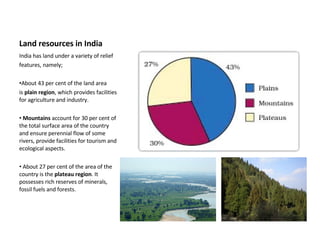
Land resources in India India has land under a variety of relief features, namely;  About 43 per cent of the land area is  plain region , which provides facilities for agriculture and industry.  Mountains  account for 30 per cent of the total surface area of the country and ensure perennial flow of some rivers, provide facilities for tourism and ecological aspects.  About 27 per cent of the area of the country is the  plateau region . It possesses rich reserves of minerals, fossil fuels and forests.
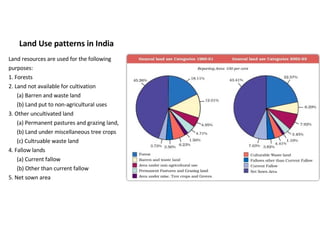
Land Use patterns in India Land resources are used for the following purposes: 1. Forests 2. Land not available for cultivation (a) Barren and waste land (b) Land put to non-agricultural uses 3. Other uncultivated land  (a) Permanent pastures and grazing land, (b) Land under miscellaneous tree crops (c) Cultruable waste land  4. Fallow lands (a) Current fallow (b) Other than current fallow 5. Net sown area
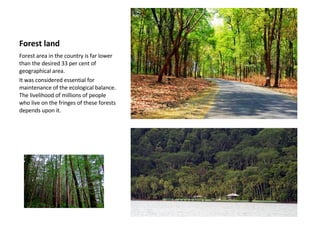
Forest land Forest area in the country is far lower than the desired 33 per cent of geographical area. It was considered essential for maintenance of the ecological balance. The livelihood of millions of people who live on the fringes of these forests depends upon it.
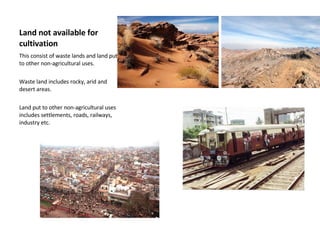
Land not available for cultivation This consist of waste lands and land put to other non-agricultural uses. Waste land includes rocky, arid and desert areas. Land put to other non-agricultural uses includes settlements, roads, railways, industry etc.
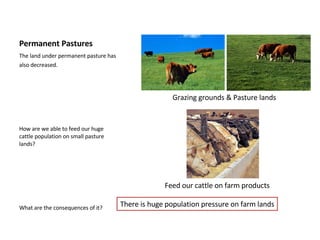
Permanent Pastures The land under permanent pasture has also decreased.  How are we able to feed our huge cattle population on small pasture lands? What are the consequences of it?  Grazing grounds & Pasture lands Feed our cattle on farm products  There is huge population pressure on farm lands
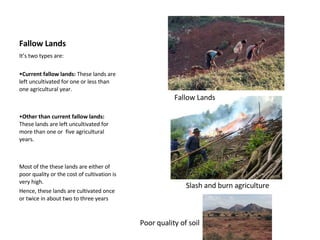
Fallow Lands It’s two types are: Current fallow lands:  These lands are left uncultivated for one or less than one agricultural year. Other than current fallow lands:  These lands are left uncultivated for more than one or  five agricultural years. Most of the these lands are either of poor quality or the cost of cultivation is very high. Hence, these lands are cultivated once or twice in about two to three years Fallow Lands Slash and burn agriculture Poor quality of soil
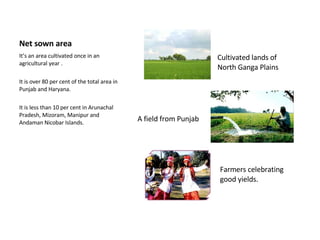
Net sown area It’s an area cultivated once in an agricultural year . It is over 80 per cent of the total area in Punjab and Haryana. It is less than 10 per cent in Arunachal Pradesh, Mizoram, Manipur and Andaman Nicobar Islands. Cultivated lands of  North Ganga Plains A field from Punjab Farmers celebrating  good yields.
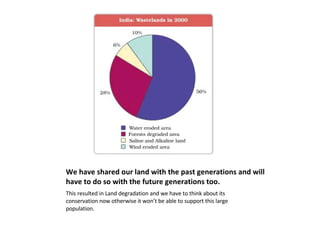
We have shared our land with the past generations and will have to do so with the future generations too. This resulted in Land degradation and we have to think about its conservation now otherwise it won’t be able to support this large population.

Land Resources

  • 1.
    Land Resources SuryaveerSingh PGT Geography S D Public School, Pitampura
  • 2.
    Land resources inIndia India has land under a variety of relief features, namely; About 43 per cent of the land area is plain region , which provides facilities for agriculture and industry. Mountains account for 30 per cent of the total surface area of the country and ensure perennial flow of some rivers, provide facilities for tourism and ecological aspects. About 27 per cent of the area of the country is the plateau region . It possesses rich reserves of minerals, fossil fuels and forests.
  • 3.
    Land Use patternsin India Land resources are used for the following purposes: 1. Forests 2. Land not available for cultivation (a) Barren and waste land (b) Land put to non-agricultural uses 3. Other uncultivated land (a) Permanent pastures and grazing land, (b) Land under miscellaneous tree crops (c) Cultruable waste land 4. Fallow lands (a) Current fallow (b) Other than current fallow 5. Net sown area
  • 4.
    Forest land Forestarea in the country is far lower than the desired 33 per cent of geographical area. It was considered essential for maintenance of the ecological balance. The livelihood of millions of people who live on the fringes of these forests depends upon it.
  • 5.
    Land not availablefor cultivation This consist of waste lands and land put to other non-agricultural uses. Waste land includes rocky, arid and desert areas. Land put to other non-agricultural uses includes settlements, roads, railways, industry etc.
  • 6.
    Permanent Pastures Theland under permanent pasture has also decreased. How are we able to feed our huge cattle population on small pasture lands? What are the consequences of it? Grazing grounds & Pasture lands Feed our cattle on farm products There is huge population pressure on farm lands
  • 7.
    Fallow Lands It’stwo types are: Current fallow lands: These lands are left uncultivated for one or less than one agricultural year. Other than current fallow lands: These lands are left uncultivated for more than one or five agricultural years. Most of the these lands are either of poor quality or the cost of cultivation is very high. Hence, these lands are cultivated once or twice in about two to three years Fallow Lands Slash and burn agriculture Poor quality of soil
  • 8.
    Net sown areaIt’s an area cultivated once in an agricultural year . It is over 80 per cent of the total area in Punjab and Haryana. It is less than 10 per cent in Arunachal Pradesh, Mizoram, Manipur and Andaman Nicobar Islands. Cultivated lands of North Ganga Plains A field from Punjab Farmers celebrating good yields.
  • 9.
    We have sharedour land with the past generations and will have to do so with the future generations too. This resulted in Land degradation and we have to think about its conservation now otherwise it won’t be able to support this large population.