MentoringThe Mentor-Protégé Relationship
Step One:  Learn Mentoring Defined What is the Navy policy on mentoring?What it takes to be a mentorWhat does the mentor get out of it?What are the protégé's responsibilities?What does the protégé get out of it?What are the different types of mentoring?What are the steps to getting started?
Mentoring Defined“Mentoring is a relationship in which a person with greater experience and wisdom guides another person to develop both personally and professionally.” (NAVPERSCOMINST 1500.1) Why bother?….Mentoring has consistently proven to be a top factor affecting an employee’s… Success
 Career satisfaction,
 RetentionNavy Policy on MentoringCNO Guidance 2004	“2003 Accomplishments…we increased the availability of vital leadership references, including a Mentoring Handbook, through the Navy Knowledge Online website.  Using multiple approaches, we took steps to ensure every Sailor has a mentor to maximize their talents and improve their contribution to combat excellence.”CNO Guidance 2005	“We built a mentoring culture”…..CNO Guidance 2006“Develop and implement a total force mentoring culture.”CNO Guidance 2007-2008	“Developing 21st Century Leaders…focusing on root cause analysis, training, outreach and mentoring.”OPNAVINST 1500 / 78 	“Everyone in a leadership role must make a point of reaching out to their subordinates and ensure that all members of the command have access to mentors. “
What It Takes to Be a MentorPossess a sincere desireCommitment and time  Ability to provide open and honest feedbackHelp build an Individual Career Development Plan
How Mentoring Benefits The Protégé Experienced guidance and supportInsight into the pros and cons of various career options and pathsIncreased self-awareness and self-disciplineAn expanded personal networkSupport in the transition to a new role or locationA sounding board for testing ideas and plansConstructive feedback on personal and professional development areas
How Mentoring Benefits The MentorShare their expertise with anotherProve themselves as valuable leadersExpand their professional networkHelp the CNO and the MCPON build the desired Navy Mentoring cultureObtain a fresh perspective on the development processEnhance experience in their areas of expertiseExtend their role as subject matter expertsInvest in the careers of others
How Mentoring Benefits The Navy An environment that fosters personal and professional growth through the sharing of information, skills, attitudes and aligning behaviorsIncreased job satisfaction for mentees and mentorsSharing and leveraging Navy-relevant knowledge and skill throughout the organizationA means for leaders to align with one another on command directionEnhanced learning and diversity in the organization
Types of Development  RelationshipsSupervisor / subordinate coaching relationshipLeadership courses cover helping development from the supervisor to subordinate perspectiveMentor and protégé mentoring relationshipTraditional career progression and individual growth and development guidance Tools available on NKO
Different Types of MentoringNatural mentoringSituational mentoringSupervisory mentoringFormal facilitated mentoring (Navy Model)
Natural MentoringNatural mentoring occur all the time and always hasIt happens when one person (usually senior) reaches out to another, and a career-helping relationship develops Research shows this type of mentoring most often occurs between people who have a lot in commonWe are usually more comfortable with those who are most like ourselves
Situational MentoringSituational mentoring is usually short-lived and happens for a specific purposeAn example would be when one worker helps another with a new office computer system, or when someone goes on an “informational interview” with someone who is in a career they are considering
Supervisory MentoringVery importantAll good supervisors mentor their subordinatesDrawbacksMay not be a “subject matter expert”
Heavily tasked
Comfort levelsFormal Facilitated MentoringDesigned to build an entire culture of internal mentoring, support and developmentFormal facilitated mentoring programs are structured programs in which an organization facilitates a mentors – protégé relationshipThey may target one special segment of the organization where career development may be lagging behind that of others (for example, women) to help that group advance furtherThey may assign mentors to protégés and monitor the progress of the mentoring connection
Step Two: Make a MatchYou may be looking for a mentor, a protégé, or bothSeek and yea shall find!
Looking for a MentorLook outside the chain of commandTry for a two grade level differenceLook for someone at or near your commandIdentify Sailors / Officers you admireTalk with your Career Counselor / Division Officer or your Chief
Looking For a ProtégéLook at your location and situationSenior people should reach out to junior peopleConsider those who are quiet, not likely to ask for help, or feel excludedVolunteer as a mentor
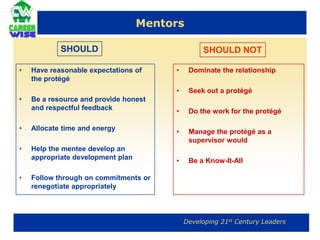
MentorsSHOULDSHOULD NOTHave reasonable expectations of the protégéBe a resource and provide honest and respectful feedbackAllocate time and energyHelp the mentee develop an appropriate development planFollow through on commitments or renegotiate appropriatelyDominate the relationshipSeek out a protégéDo the work for the protégéManage the protégé as a supervisor wouldBe a Know-It-All
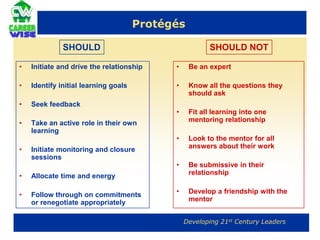
ProtégésSHOULDSHOULD NOTInitiate and drive the relationshipIdentify initial learning goalsSeek feedbackTake an active role in their own learningInitiate monitoring and closure sessionsAllocate time and energy Follow through on commitments or renegotiate appropriatelyBe an expertKnow all the questions they should askFit all learning into one mentoring relationshipLook to the mentor for all answers about their workBe submissive in their relationshipDevelop a friendship with the mentor
What to Talk AboutQuestions to consider asking your mentee to help generate discussion:How can we define the limits and boundaries of our relationship?How can we come to closure or terminate our relationship?What should we do if we discover we are not compatible?The feedback provided to a protégé from any formal or informal assessments and their associated Individual Development Plan (IDP) is a great place to start.How are you perceived by your coworkers? Boss? Peers?
Things to Discuss With Protégé During Goal-Setting How do you feel about the goals you’ve set?Are these your goals because you want them to be or because someone else wants them to be?How might you accomplish your goals?What is the most important/least important and why?How can I (as the mentor) help them achieve their goals?
Step Three: Enter Into a Mentor – Protégé AgreementCommit to one-year partnershipDiscuss “no-fault” terminationHave a periodic check-up – every six months or less
Mentoring Feedback  GuidelinesNarrow – Break large, general goals into smaller, more specific Attainable – Guidance needs to be realistic and achievableValue-Added – Ensure the protégé guidance is appropriately presented and in the protégé’s best interestYears / months / days? – A timeline and development plan needs to be in place to frame the approach and track progress
Characteristics of Effective FeedbackClear purposeSpecific and descriptiveRelevantActionableTimely Balanced  (equal parts of listening and talking)
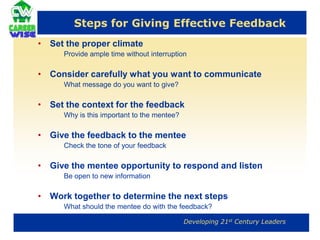
Steps for Giving Effective FeedbackSet the proper climate	Provide ample time without interruptionConsider carefully what you want to communicate	What message do you want to give?Set the context for the feedback	Why is this important to the mentee?Give the feedback to the mentee	Check the tone of your feedbackGive the mentee opportunity to respond and listen	Be open to new informationWork together to determine the next steps	What should the mentee do with the feedback?
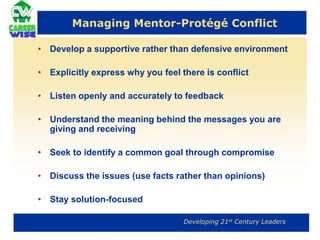
Managing Mentor-Protégé ConflictDevelop a supportive rather than defensive environmentExplicitly express why you feel there is conflictListen openly and accurately to feedbackUnderstand the meaning behind the messages you are giving and receivingSeek to identify a common goal through compromiseDiscuss the issues (use facts rather than opinions)Stay solution-focused
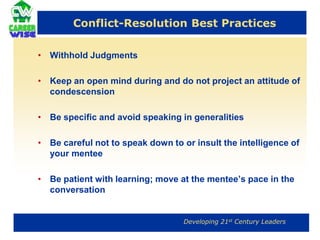
Conflict-Resolution Best PracticesWithhold JudgmentsKeep an open mind during and do not project an attitude of condescensionBe specific and avoid speaking in generalitiesBe careful not to speak down to or insult the intelligence of your menteeBe patient with learning; move at the mentee’s pace in the conversation
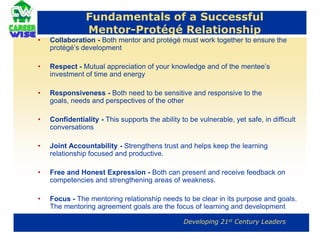
Fundamentals of a Successful Mentor-Protégé RelationshipCollaboration - Both mentor and protégé must work together to ensure the protégé’s developmentRespect - Mutual appreciation of your knowledge and of the mentee’s investment of time and energyResponsiveness - Both need to be sensitive and responsive to the goals, needs and perspectives of the otherConfidentiality - This supports the ability to be vulnerable, yet safe, in difficult conversationsJoint Accountability - Strengthens trust and helps keep the learning relationship focused and productive.Free and Honest Expression - Both can present and receive feedback on competencies and strengthening areas of weakness.Focus - The mentoring relationship needs to be clear in its purpose and goals. The mentoring agreement goals are the focus of learning and development
Some Final Thoughts For a Successful Mentor-Protégé RelationshipMentoring is a relationshipEqual participation in the mentoring relationship is a mustThere needs to be an understanding from both parties about what is to be learned, how the transfer of learning will take place, and how the learning will be monitored and evaluatedThrough the sharing of resources and time, both mentor and protégé should benefit

Navy Mentorship

  • 1.
  • 2.
    Step One: Learn Mentoring Defined What is the Navy policy on mentoring?What it takes to be a mentorWhat does the mentor get out of it?What are the protégé's responsibilities?What does the protégé get out of it?What are the different types of mentoring?What are the steps to getting started?
  • 3.
    Mentoring Defined“Mentoring isa relationship in which a person with greater experience and wisdom guides another person to develop both personally and professionally.” (NAVPERSCOMINST 1500.1) Why bother?….Mentoring has consistently proven to be a top factor affecting an employee’s… Success
  • 4.
  • 5.
    RetentionNavy Policyon MentoringCNO Guidance 2004 “2003 Accomplishments…we increased the availability of vital leadership references, including a Mentoring Handbook, through the Navy Knowledge Online website. Using multiple approaches, we took steps to ensure every Sailor has a mentor to maximize their talents and improve their contribution to combat excellence.”CNO Guidance 2005 “We built a mentoring culture”…..CNO Guidance 2006“Develop and implement a total force mentoring culture.”CNO Guidance 2007-2008 “Developing 21st Century Leaders…focusing on root cause analysis, training, outreach and mentoring.”OPNAVINST 1500 / 78 “Everyone in a leadership role must make a point of reaching out to their subordinates and ensure that all members of the command have access to mentors. “
  • 6.
    What It Takesto Be a MentorPossess a sincere desireCommitment and time Ability to provide open and honest feedbackHelp build an Individual Career Development Plan
  • 7.
    How Mentoring BenefitsThe Protégé Experienced guidance and supportInsight into the pros and cons of various career options and pathsIncreased self-awareness and self-disciplineAn expanded personal networkSupport in the transition to a new role or locationA sounding board for testing ideas and plansConstructive feedback on personal and professional development areas
  • 8.
    How Mentoring BenefitsThe MentorShare their expertise with anotherProve themselves as valuable leadersExpand their professional networkHelp the CNO and the MCPON build the desired Navy Mentoring cultureObtain a fresh perspective on the development processEnhance experience in their areas of expertiseExtend their role as subject matter expertsInvest in the careers of others
  • 9.
    How Mentoring BenefitsThe Navy An environment that fosters personal and professional growth through the sharing of information, skills, attitudes and aligning behaviorsIncreased job satisfaction for mentees and mentorsSharing and leveraging Navy-relevant knowledge and skill throughout the organizationA means for leaders to align with one another on command directionEnhanced learning and diversity in the organization
  • 10.
    Types of Development RelationshipsSupervisor / subordinate coaching relationshipLeadership courses cover helping development from the supervisor to subordinate perspectiveMentor and protégé mentoring relationshipTraditional career progression and individual growth and development guidance Tools available on NKO
  • 11.
    Different Types ofMentoringNatural mentoringSituational mentoringSupervisory mentoringFormal facilitated mentoring (Navy Model)
  • 12.
    Natural MentoringNatural mentoringoccur all the time and always hasIt happens when one person (usually senior) reaches out to another, and a career-helping relationship develops Research shows this type of mentoring most often occurs between people who have a lot in commonWe are usually more comfortable with those who are most like ourselves
  • 13.
    Situational MentoringSituational mentoringis usually short-lived and happens for a specific purposeAn example would be when one worker helps another with a new office computer system, or when someone goes on an “informational interview” with someone who is in a career they are considering
  • 14.
    Supervisory MentoringVery importantAllgood supervisors mentor their subordinatesDrawbacksMay not be a “subject matter expert”
  • 15.
  • 16.
    Comfort levelsFormal FacilitatedMentoringDesigned to build an entire culture of internal mentoring, support and developmentFormal facilitated mentoring programs are structured programs in which an organization facilitates a mentors – protégé relationshipThey may target one special segment of the organization where career development may be lagging behind that of others (for example, women) to help that group advance furtherThey may assign mentors to protégés and monitor the progress of the mentoring connection
  • 17.
    Step Two: Makea MatchYou may be looking for a mentor, a protégé, or bothSeek and yea shall find!
  • 18.
    Looking for aMentorLook outside the chain of commandTry for a two grade level differenceLook for someone at or near your commandIdentify Sailors / Officers you admireTalk with your Career Counselor / Division Officer or your Chief
  • 19.
    Looking For aProtégéLook at your location and situationSenior people should reach out to junior peopleConsider those who are quiet, not likely to ask for help, or feel excludedVolunteer as a mentor
  • 20.
    MentorsSHOULDSHOULD NOTHave reasonableexpectations of the protégéBe a resource and provide honest and respectful feedbackAllocate time and energyHelp the mentee develop an appropriate development planFollow through on commitments or renegotiate appropriatelyDominate the relationshipSeek out a protégéDo the work for the protégéManage the protégé as a supervisor wouldBe a Know-It-All
  • 21.
    ProtégésSHOULDSHOULD NOTInitiate anddrive the relationshipIdentify initial learning goalsSeek feedbackTake an active role in their own learningInitiate monitoring and closure sessionsAllocate time and energy Follow through on commitments or renegotiate appropriatelyBe an expertKnow all the questions they should askFit all learning into one mentoring relationshipLook to the mentor for all answers about their workBe submissive in their relationshipDevelop a friendship with the mentor
  • 22.
    What to TalkAboutQuestions to consider asking your mentee to help generate discussion:How can we define the limits and boundaries of our relationship?How can we come to closure or terminate our relationship?What should we do if we discover we are not compatible?The feedback provided to a protégé from any formal or informal assessments and their associated Individual Development Plan (IDP) is a great place to start.How are you perceived by your coworkers? Boss? Peers?
  • 23.
    Things to DiscussWith Protégé During Goal-Setting How do you feel about the goals you’ve set?Are these your goals because you want them to be or because someone else wants them to be?How might you accomplish your goals?What is the most important/least important and why?How can I (as the mentor) help them achieve their goals?
  • 24.
    Step Three: EnterInto a Mentor – Protégé AgreementCommit to one-year partnershipDiscuss “no-fault” terminationHave a periodic check-up – every six months or less
  • 25.
    Mentoring Feedback GuidelinesNarrow – Break large, general goals into smaller, more specific Attainable – Guidance needs to be realistic and achievableValue-Added – Ensure the protégé guidance is appropriately presented and in the protégé’s best interestYears / months / days? – A timeline and development plan needs to be in place to frame the approach and track progress
  • 26.
    Characteristics of EffectiveFeedbackClear purposeSpecific and descriptiveRelevantActionableTimely Balanced (equal parts of listening and talking)
  • 27.
    Steps for GivingEffective FeedbackSet the proper climate Provide ample time without interruptionConsider carefully what you want to communicate What message do you want to give?Set the context for the feedback Why is this important to the mentee?Give the feedback to the mentee Check the tone of your feedbackGive the mentee opportunity to respond and listen Be open to new informationWork together to determine the next steps What should the mentee do with the feedback?
  • 28.
    Managing Mentor-Protégé ConflictDevelopa supportive rather than defensive environmentExplicitly express why you feel there is conflictListen openly and accurately to feedbackUnderstand the meaning behind the messages you are giving and receivingSeek to identify a common goal through compromiseDiscuss the issues (use facts rather than opinions)Stay solution-focused
  • 29.
    Conflict-Resolution Best PracticesWithholdJudgmentsKeep an open mind during and do not project an attitude of condescensionBe specific and avoid speaking in generalitiesBe careful not to speak down to or insult the intelligence of your menteeBe patient with learning; move at the mentee’s pace in the conversation
  • 30.
    Fundamentals of aSuccessful Mentor-Protégé RelationshipCollaboration - Both mentor and protégé must work together to ensure the protégé’s developmentRespect - Mutual appreciation of your knowledge and of the mentee’s investment of time and energyResponsiveness - Both need to be sensitive and responsive to the goals, needs and perspectives of the otherConfidentiality - This supports the ability to be vulnerable, yet safe, in difficult conversationsJoint Accountability - Strengthens trust and helps keep the learning relationship focused and productive.Free and Honest Expression - Both can present and receive feedback on competencies and strengthening areas of weakness.Focus - The mentoring relationship needs to be clear in its purpose and goals. The mentoring agreement goals are the focus of learning and development
  • 31.
    Some Final ThoughtsFor a Successful Mentor-Protégé RelationshipMentoring is a relationshipEqual participation in the mentoring relationship is a mustThere needs to be an understanding from both parties about what is to be learned, how the transfer of learning will take place, and how the learning will be monitored and evaluatedThrough the sharing of resources and time, both mentor and protégé should benefit