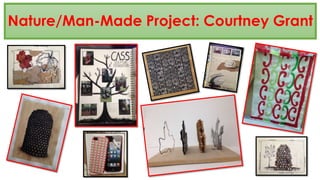
Nature/Man-Made Project: Courtney Grant
Primary Resources:
SecondaryResources:
Primary Resource: original materials that have not been altered or distorted in
any way. A document or physical object which was written or created during the time
under study. The sources were present during the time of study.
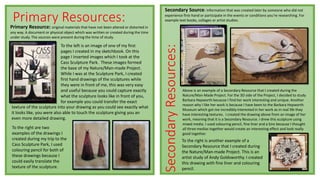
To the left is an image of one of my first
pages I created in my sketchbook. On this
page I inserted images which I took at the
Cass Sculpture Park. These images formed
the base of my Nature/Man-made Project.
While I was at the Sculpture Park, I created
first hand drawings of the sculptures while
they were in front of me, this was very easy
and useful because you could capture exactly
what the sculpture looks like in front of you,
for example you could transfer the exact
texture of the sculpture into your drawing as you could see exactly what
it looks like, you were also able to touch the sculpture giving you an
even more detailed drawing.
To the right are two
examples of the drawings I
created during my trip to the
Cass Sculpture Park, I used
colouring pencil for both of
these drawings because I
could easily translate the
texture of the sculpture.
Secondary Source: information that was created later by someone who did not
experience first-hand or participate in the events or conditions you’re researching. For
example text books, collages or artist studies.
Above is an example of a Secondary Resource that I created during the
Nature/Man-Made Project. For the 3D side of the Project, I decided to study
Barbara Hepworth because I find her work interesting and unique. Another
reason why I like her work is because I have been to the Barbara Hepworth
Museum which got me incredibly interested in her work as in real life they
have interesting textures. I created the drawing above from an image of her
work, meaning that it is a Secondary Resource. I drew this sculpture using
mixed media. I used colouring pencil, fine liner and a biro because I thought
all three medias together would create an interesting effect and look really
good together.
To the right is another example of a
Secondary Resource that I created during
the Nature/Man-made Project. This is an
artist study of Andy Goldsworthy. I created
this drawing with fine liner and colouring
pencil.
Formal Elements: Mark-Making and Object Making
to develop ideas and intentions.
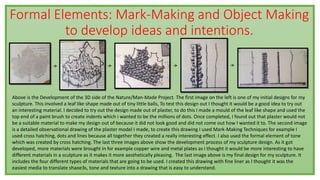
Above is the Development of the 3D side of the Nature/Man-Made Project. The first image on the left is one of my initial designs for my
sculpture. This involved a leaf like shape made out of tiny little balls, To test this design out I thought it would be a good idea to try out
an interesting material. I decided to try out the design made out of plaster, to do this I made a mould of the leaf like shape and used the
top end of a paint brush to create indents which i wanted to be the millions of dots. Once completed, I found out that plaster would not
be a suitable material to make my design out of because it did not look good and did not come out how I wanted it to. The second image
is a detailed observational drawing of the plaster model I made, to create this drawing I used Mark-Making Techniques for example I
used cross hatching, dots and lines because all together they created a really interesting effect. I also used the formal element of tone
which was created by cross hatching. The last three images above show the development process of my sculpture design. As it got
developed, more materials were brought in for example copper wire and metal plates as I thought it would be more interesting to have
different materials in a sculpture as it makes it more aesthetically pleasing. The last image above is my final design for my sculpture. It
includes the four different types of materials that are going to be used. I created this drawing with fine liner as I thought it was the
easiest media to translate shaoe3s, tone and texture into a drawing that is easy to understand.
Others Work I Have Investigated:
Barbara Hepworth:
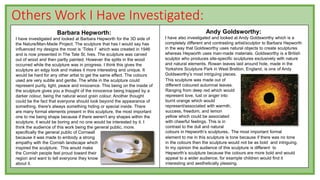
I have investigated and looked at Barbara Hepworth for the 3D side of
the Nature/Man-Made Project. The sculpture that has I would say has
influenced my designs the most is ‘Tides I’ which was created in 1946
and is now presented in The Tate St. Ives. The sculpture was carved
out of wood and then partly painted. However the splits in the wood
occurred while the sculpture was in progress. I think this gives the
sculpture an edgy look and makes it more interesting and unique. It
would be hard for any other artist to get the same effect. The colours
used are very subtle and gentle. The white in the sculpture could
represent purity, light, peace and innocence. This being on the inside of
the sculpture gives you a thought of the innocence being trapped by a
darker colour, being the natural wood grain colour. Another thought
could be the fact that everyone should look beyond the appearance of
something, there's always something hiding or special inside. There
are many formal elements present in this sculpture, the most important
one to me being shape because if there weren't any shapes within the
sculpture, it would be boring and no one would be interested by it. I
think the audience of this work being the general public, more.
specifically the general public of Cornwall
because it was made to embody a strong
empathy with the Cornish landscape which
inspired the sculpture. This would make
the Cornish people feel proud toward their
region and want to tell everyone they know
about it.
Andy Goldsworthy:
I have also investigated and looked at Andy Goldsworthy which is a
completely different and contrasting artist/sculptor to Barbara Hepworth
in the way that Goldsworthy uses natural objects to create sculptures
whereas Hepworth uses man-made materials. Goldsworthy is a British
sculptor who produces site-specific sculptures exclusively with nature
and natural elements. Rowan leaves laid around hole, made in the
Yorkshire Sculpture Park in West Bretton, England, is one of Andy
Goldsworthy’s most intriguing pieces.
This sculpture was made out of
different coloured autumnal leaves.
Ranging from deep red which would
represent love, lust or anger into
burnt orange which would
represent/associated with warmth,
success, freedom, and lemon
yellow which could be associated
with cheerful feelings. This is in
contrast to the dull and natural
colours in Hepworth’s sculptures. The most important formal
element to me in this sculpture is tone because if there was no tone
in the colours then the sculpture would not be as bold and intriguing.
In my opinion the audience of this sculpture is different to
Hepworth’s sculpture because the colours are more bold and would
appeal to a wider audience, for example children would find it
interesting and aesthetically pleasing.
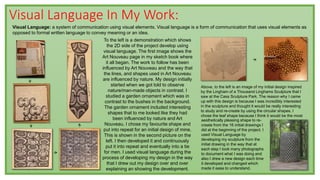
Visual Language In My Work:
Visual Language: a system of communication using visual elements. Visual language is a form of communication that uses visual elements as
opposed to formal written language to convey meaning or an idea.
To the left is a demonstration which shows
the 2D side of the project develop using
visual language. The first image shows the
Art Nouveau page in my sketch book where
it all began. The work to follow has been
influenced by Art Nouveau and the way that
the lines, and shapes used in Art Nouveau
are influenced by nature. My design initially
started when we got told to observe
nature/man-made objects in contrast. I
studied a garden ornament which was in
contrast to the bushes in the background.
The garden ornament included interesting
shapes that to me looked like they had
been influenced by nature and Art
Nouveau. I chose my favourite shape and
put into repeat for an initial design of mine.
This is shown in the second picture on the
left. I then developed it and continuously
put it into repeat and eventually into a tie
for men. I used visual language during the
process of developing my design in the way
that I drew out my design over and over
explaining an showing the development.
Above, to the left is an image of my initial design inspired
by the Lingham of a Thousand Linghams Sculpture that I
saw at the Cass Sculpture Park. The reason why I came
up with this design is because I was incredibly interested
in the sculpture and thought it would be really interesting
to study and re-create by using the circular shapes. I
chose the leaf shape because I think it would be the most
aesthetically pleasing shape to re-
create from the 16 initial drawings I
did at the beginning of the project. I
used Visual Language by
developing my sculpture from the
initial drawing in the way that at
each step I took many photographs
to document what I was doing and
also I drew a new design each time
it developed and changed which
made it ease to understand.
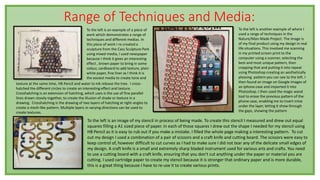
Range of Techniques and Media:
To the left is an example of a piece of
work which demonstrates a range of
techniques and different medias. In
this piece of work I re-created a
sculpture from the Cass Sculpture Park
using mixed media, I used newspaper
because I think it gives an interesting
effect , brown paper to bring in some
colour, cardboard to add texture, plain
white paper, fine liner as I think it is
the easiest media to create tone and
texture at the same time, HB Pencil and water to ink release the tree. I cross-
hatched the different circles to create an interesting effect and texture.
Crosshatching is an extension of hatching, which uses is the use of fine parallel
lines drawn closely together, to create the illusion of shade or texture in a
drawing. Crosshatching is the drawing of two layers of hatching at right-angles to
create a mesh-like pattern. Multiple layers in varying directions can be used to
create textures.
To the left is an image of my stencil in process of being made. To create this stencil I measured and drew out equal
squares filling a A1 sized piece of paper. In each of those squares I drew out the shape I needed for my stencil using
HB Pencil as it is easy to rub out if you make a mistake. I filled the whole page making a interesting pattern. To cut
out my design I used a combination of a pair of scissors and a craft knife and cutting board. The scissors were easy to
keep control of, however difficult to cut curves as I had to make sure I did not tear any of the delicate small edges of
my design. A craft knife is a small and extremely sharp bladed instrument used for various arts and crafts. You need
to use a cutting board with a craft knife, ensuring that you don't cut anything under the paper or material you are
cutting. I used cartridge paper to create my stencil because it is stronger that ordinary paper and is more durable,
this is a great thing because I have to re-use it to create various prints.
To the left is another example of where I
used a range of techniques in the
Nature/Man-Made Project. The image is
of my final product using my design in real
life situations. This involved me scanning
in my printed screen print to the
computer using a scanner, selecting the
best and most unique pattern, then
cropping that and putting it into repeat
using Photoshop creating an aesthetically
pleasing pattern you can see to the left. I
then found an image on Google images of
an iphone case and imported it into
Photoshop. I then used the magic wand
tool to erase the previous pattern of the
phone case, enabling me to insert mine
under the layer, letting it show through
the gaps, showing the pattern
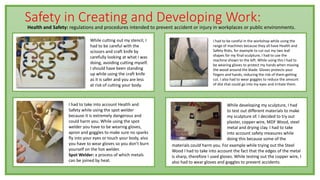
Safety in Creating and Developing Work:
Health and Safety: regulations and procedures intended to prevent accident or injury in workplaces or public environments.
While cutting out my stencil, I
had to be careful with the
scissors and craft knife by
carefully looking at what I was
doing, avoiding cutting myself.
I should have been standing
up while using the craft knife
as it is safer and you are less
at risk of cutting your body.
I had to take into account Health and
Safety while using the spot welder
because it is extremely dangerous and
could harm you. While using the spot
welder you have to be wearing gloves,
apron and goggles to make sure no sparks
fly into your eyes or touch your body, also
you have to wear gloves so you don't burn
yourself on the hot welder.
Spot Welder: a process of which metals
can be joined by heat.
I had to be careful in the workshop while using the
range of machines because they all have Health and
Safety Risks, for example to cut out my two leaf
shapes for my final sculpture, I had to use the
machine shown to the left. While using this I had to
be wearing gloves to protect my hands when moving
the wood around the blade. Gloves protects your
fingers and hands, reducing the risk of them getting
cut. I also had to wear goggles to reduce the amount
of dist that could go into my eyes and irritate them.
While developing my sculpture, I had
to test out different materials to make
my sculpture of. I decided to try out
plaster, copper wire, MDF Wood, steel
metal and drying clay. I had to take
into account safety measures while
doing this because some of the
materials could harm you. For example while trying out the Steel
Wood I had to take into account the fact that the edges of the metal
is sharp, therefore I used gloves. While testing out the copper wire, I
also had to wear gloves and goggles to prevent accidents.
EvaluationSummary: •Time Management - The Nature/Man-Made Project involved a lot of time management and planning, for
example it involved a lot of deadlines for homework and finished class work to be completed In my opinion I could have
managed my time better in the way that I could have completed all the homework’s fully on time, not leaving and small
pieces to complete at another stage.
•Research – The Nature/Man-Made Project involved researching various different aspects of the project and
processes to go with it. Project I researched into a few different things, for example I researched into possible sculpture
artists which could interest me and influence the development of my sculpture. I also researched into the process of Screen
Printing and ways to use Screen Prints.
•Development - The Nature/Man-Made Project included many stages which involved you in developing your
ideas/designs and taking them further. In my opinion, I developed my ideas well. I believe I could have done more
development in the way that I could have done pieces of work which were in the style of certain artists, for example I could
have designed a sculpture in the style of Barbara Hepworth. This would have inspired me to create interesting and
meaningful sculpture designs and help me design my own sculpture
•Final Outcomes - The Screen Print came out just how I wanted, the contrasting colours blending into each
other beautifully, creating an eye-catching contrast. The pattern also came out perfect, to smudges or rips. My sculpture also
came out just how I wanted, the contrasting materials creating an interesting effect that would be really interesting to walk
around. The different shapes of the leaves also create an interesting effect because when you look at it from the front you
can see the different shapes which looks unique. However, If I was to make this sculpture again I would make the sharp
corners on the steel metal leaf rounded as it can be dangerous and could harm you.
•What I have learnt -During the course of the Nature/Man-Made project I have learnt new skills and ways of
drawing. I have learnt the process of Screen Printing and the different ways of doing it and the range of outcomes.

Nature man made powerpoint print

  • 1.
  • 2.
    Primary Resources: SecondaryResources: Primary Resource:original materials that have not been altered or distorted in any way. A document or physical object which was written or created during the time under study. The sources were present during the time of study. To the left is an image of one of my first pages I created in my sketchbook. On this page I inserted images which I took at the Cass Sculpture Park. These images formed the base of my Nature/Man-made Project. While I was at the Sculpture Park, I created first hand drawings of the sculptures while they were in front of me, this was very easy and useful because you could capture exactly what the sculpture looks like in front of you, for example you could transfer the exact texture of the sculpture into your drawing as you could see exactly what it looks like, you were also able to touch the sculpture giving you an even more detailed drawing. To the right are two examples of the drawings I created during my trip to the Cass Sculpture Park, I used colouring pencil for both of these drawings because I could easily translate the texture of the sculpture. Secondary Source: information that was created later by someone who did not experience first-hand or participate in the events or conditions you’re researching. For example text books, collages or artist studies. Above is an example of a Secondary Resource that I created during the Nature/Man-Made Project. For the 3D side of the Project, I decided to study Barbara Hepworth because I find her work interesting and unique. Another reason why I like her work is because I have been to the Barbara Hepworth Museum which got me incredibly interested in her work as in real life they have interesting textures. I created the drawing above from an image of her work, meaning that it is a Secondary Resource. I drew this sculpture using mixed media. I used colouring pencil, fine liner and a biro because I thought all three medias together would create an interesting effect and look really good together. To the right is another example of a Secondary Resource that I created during the Nature/Man-made Project. This is an artist study of Andy Goldsworthy. I created this drawing with fine liner and colouring pencil.
  • 3.
    Formal Elements: Mark-Makingand Object Making to develop ideas and intentions. Above is the Development of the 3D side of the Nature/Man-Made Project. The first image on the left is one of my initial designs for my sculpture. This involved a leaf like shape made out of tiny little balls, To test this design out I thought it would be a good idea to try out an interesting material. I decided to try out the design made out of plaster, to do this I made a mould of the leaf like shape and used the top end of a paint brush to create indents which i wanted to be the millions of dots. Once completed, I found out that plaster would not be a suitable material to make my design out of because it did not look good and did not come out how I wanted it to. The second image is a detailed observational drawing of the plaster model I made, to create this drawing I used Mark-Making Techniques for example I used cross hatching, dots and lines because all together they created a really interesting effect. I also used the formal element of tone which was created by cross hatching. The last three images above show the development process of my sculpture design. As it got developed, more materials were brought in for example copper wire and metal plates as I thought it would be more interesting to have different materials in a sculpture as it makes it more aesthetically pleasing. The last image above is my final design for my sculpture. It includes the four different types of materials that are going to be used. I created this drawing with fine liner as I thought it was the easiest media to translate shaoe3s, tone and texture into a drawing that is easy to understand.
  • 4.
    Others Work IHave Investigated: Barbara Hepworth: I have investigated and looked at Barbara Hepworth for the 3D side of the Nature/Man-Made Project. The sculpture that has I would say has influenced my designs the most is ‘Tides I’ which was created in 1946 and is now presented in The Tate St. Ives. The sculpture was carved out of wood and then partly painted. However the splits in the wood occurred while the sculpture was in progress. I think this gives the sculpture an edgy look and makes it more interesting and unique. It would be hard for any other artist to get the same effect. The colours used are very subtle and gentle. The white in the sculpture could represent purity, light, peace and innocence. This being on the inside of the sculpture gives you a thought of the innocence being trapped by a darker colour, being the natural wood grain colour. Another thought could be the fact that everyone should look beyond the appearance of something, there's always something hiding or special inside. There are many formal elements present in this sculpture, the most important one to me being shape because if there weren't any shapes within the sculpture, it would be boring and no one would be interested by it. I think the audience of this work being the general public, more. specifically the general public of Cornwall because it was made to embody a strong empathy with the Cornish landscape which inspired the sculpture. This would make the Cornish people feel proud toward their region and want to tell everyone they know about it. Andy Goldsworthy: I have also investigated and looked at Andy Goldsworthy which is a completely different and contrasting artist/sculptor to Barbara Hepworth in the way that Goldsworthy uses natural objects to create sculptures whereas Hepworth uses man-made materials. Goldsworthy is a British sculptor who produces site-specific sculptures exclusively with nature and natural elements. Rowan leaves laid around hole, made in the Yorkshire Sculpture Park in West Bretton, England, is one of Andy Goldsworthy’s most intriguing pieces. This sculpture was made out of different coloured autumnal leaves. Ranging from deep red which would represent love, lust or anger into burnt orange which would represent/associated with warmth, success, freedom, and lemon yellow which could be associated with cheerful feelings. This is in contrast to the dull and natural colours in Hepworth’s sculptures. The most important formal element to me in this sculpture is tone because if there was no tone in the colours then the sculpture would not be as bold and intriguing. In my opinion the audience of this sculpture is different to Hepworth’s sculpture because the colours are more bold and would appeal to a wider audience, for example children would find it interesting and aesthetically pleasing.
  • 5.
    Visual Language InMy Work: Visual Language: a system of communication using visual elements. Visual language is a form of communication that uses visual elements as opposed to formal written language to convey meaning or an idea. To the left is a demonstration which shows the 2D side of the project develop using visual language. The first image shows the Art Nouveau page in my sketch book where it all began. The work to follow has been influenced by Art Nouveau and the way that the lines, and shapes used in Art Nouveau are influenced by nature. My design initially started when we got told to observe nature/man-made objects in contrast. I studied a garden ornament which was in contrast to the bushes in the background. The garden ornament included interesting shapes that to me looked like they had been influenced by nature and Art Nouveau. I chose my favourite shape and put into repeat for an initial design of mine. This is shown in the second picture on the left. I then developed it and continuously put it into repeat and eventually into a tie for men. I used visual language during the process of developing my design in the way that I drew out my design over and over explaining an showing the development. Above, to the left is an image of my initial design inspired by the Lingham of a Thousand Linghams Sculpture that I saw at the Cass Sculpture Park. The reason why I came up with this design is because I was incredibly interested in the sculpture and thought it would be really interesting to study and re-create by using the circular shapes. I chose the leaf shape because I think it would be the most aesthetically pleasing shape to re- create from the 16 initial drawings I did at the beginning of the project. I used Visual Language by developing my sculpture from the initial drawing in the way that at each step I took many photographs to document what I was doing and also I drew a new design each time it developed and changed which made it ease to understand.
  • 6.
    Range of Techniquesand Media: To the left is an example of a piece of work which demonstrates a range of techniques and different medias. In this piece of work I re-created a sculpture from the Cass Sculpture Park using mixed media, I used newspaper because I think it gives an interesting effect , brown paper to bring in some colour, cardboard to add texture, plain white paper, fine liner as I think it is the easiest media to create tone and texture at the same time, HB Pencil and water to ink release the tree. I cross- hatched the different circles to create an interesting effect and texture. Crosshatching is an extension of hatching, which uses is the use of fine parallel lines drawn closely together, to create the illusion of shade or texture in a drawing. Crosshatching is the drawing of two layers of hatching at right-angles to create a mesh-like pattern. Multiple layers in varying directions can be used to create textures. To the left is an image of my stencil in process of being made. To create this stencil I measured and drew out equal squares filling a A1 sized piece of paper. In each of those squares I drew out the shape I needed for my stencil using HB Pencil as it is easy to rub out if you make a mistake. I filled the whole page making a interesting pattern. To cut out my design I used a combination of a pair of scissors and a craft knife and cutting board. The scissors were easy to keep control of, however difficult to cut curves as I had to make sure I did not tear any of the delicate small edges of my design. A craft knife is a small and extremely sharp bladed instrument used for various arts and crafts. You need to use a cutting board with a craft knife, ensuring that you don't cut anything under the paper or material you are cutting. I used cartridge paper to create my stencil because it is stronger that ordinary paper and is more durable, this is a great thing because I have to re-use it to create various prints. To the left is another example of where I used a range of techniques in the Nature/Man-Made Project. The image is of my final product using my design in real life situations. This involved me scanning in my printed screen print to the computer using a scanner, selecting the best and most unique pattern, then cropping that and putting it into repeat using Photoshop creating an aesthetically pleasing pattern you can see to the left. I then found an image on Google images of an iphone case and imported it into Photoshop. I then used the magic wand tool to erase the previous pattern of the phone case, enabling me to insert mine under the layer, letting it show through the gaps, showing the pattern
  • 7.
    Safety in Creatingand Developing Work: Health and Safety: regulations and procedures intended to prevent accident or injury in workplaces or public environments. While cutting out my stencil, I had to be careful with the scissors and craft knife by carefully looking at what I was doing, avoiding cutting myself. I should have been standing up while using the craft knife as it is safer and you are less at risk of cutting your body. I had to take into account Health and Safety while using the spot welder because it is extremely dangerous and could harm you. While using the spot welder you have to be wearing gloves, apron and goggles to make sure no sparks fly into your eyes or touch your body, also you have to wear gloves so you don't burn yourself on the hot welder. Spot Welder: a process of which metals can be joined by heat. I had to be careful in the workshop while using the range of machines because they all have Health and Safety Risks, for example to cut out my two leaf shapes for my final sculpture, I had to use the machine shown to the left. While using this I had to be wearing gloves to protect my hands when moving the wood around the blade. Gloves protects your fingers and hands, reducing the risk of them getting cut. I also had to wear goggles to reduce the amount of dist that could go into my eyes and irritate them. While developing my sculpture, I had to test out different materials to make my sculpture of. I decided to try out plaster, copper wire, MDF Wood, steel metal and drying clay. I had to take into account safety measures while doing this because some of the materials could harm you. For example while trying out the Steel Wood I had to take into account the fact that the edges of the metal is sharp, therefore I used gloves. While testing out the copper wire, I also had to wear gloves and goggles to prevent accidents.
  • 8.
    EvaluationSummary: •Time Management- The Nature/Man-Made Project involved a lot of time management and planning, for example it involved a lot of deadlines for homework and finished class work to be completed In my opinion I could have managed my time better in the way that I could have completed all the homework’s fully on time, not leaving and small pieces to complete at another stage. •Research – The Nature/Man-Made Project involved researching various different aspects of the project and processes to go with it. Project I researched into a few different things, for example I researched into possible sculpture artists which could interest me and influence the development of my sculpture. I also researched into the process of Screen Printing and ways to use Screen Prints. •Development - The Nature/Man-Made Project included many stages which involved you in developing your ideas/designs and taking them further. In my opinion, I developed my ideas well. I believe I could have done more development in the way that I could have done pieces of work which were in the style of certain artists, for example I could have designed a sculpture in the style of Barbara Hepworth. This would have inspired me to create interesting and meaningful sculpture designs and help me design my own sculpture •Final Outcomes - The Screen Print came out just how I wanted, the contrasting colours blending into each other beautifully, creating an eye-catching contrast. The pattern also came out perfect, to smudges or rips. My sculpture also came out just how I wanted, the contrasting materials creating an interesting effect that would be really interesting to walk around. The different shapes of the leaves also create an interesting effect because when you look at it from the front you can see the different shapes which looks unique. However, If I was to make this sculpture again I would make the sharp corners on the steel metal leaf rounded as it can be dangerous and could harm you. •What I have learnt -During the course of the Nature/Man-Made project I have learnt new skills and ways of drawing. I have learnt the process of Screen Printing and the different ways of doing it and the range of outcomes.