Chapter 16
MECHANISMS OF HEAT
TRANSFER
Mehmet Kanoglu
Copyright © The McGraw-Hill Companies, Inc. Permission required for reproduction or display.
Fundamentals of Thermal-Fluid Sciences, 3rd Edition
Yunus A. Cengel, Robert H. Turner, John M. Cimbala
McGraw-Hill, 2008
2
Objectives
 Understand how thermodynamics and heat transfer are related to each other
 Distinguish thermal energy from other forms of energy, and heat transfer from
other forms of energy transfer
 Perform general energy balances as well as surface energy balances
 Understand the basic mechanisms of heat transfer, which are conduction,
convection, and radiation, and Fourier's law of heat conduction, Newton's law of
cooling, and the Stefan–Boltzmann law of radiation
 Identify the mechanisms of heat transfer that occur simultaneously in practice
 Develop an awareness of the cost associated with heat losses
 Solve various heat transfer problems encountered in practice
3
INTRODUCTION
• Heat: The form of energy that can be transferred from one system to
another as a result of temperature difference.
• Thermodynamics concerned with the amount of heat transfer as a
system undergoes a process from one equilibrium state to another.
• Heat Transfer deals with the determination of the rates of such energy
transfers as well as variation of temperature.
• The transfer of energy as heat is always from the higher-temperature
medium to the lower-temperature one.
• Heat transfer stops when the two mediums reach the same temperature.
• Heat can be transferred in three different modes:
conduction, convection, radiation
4
Applications
5
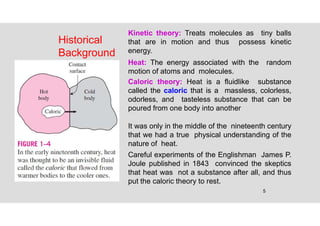
Historical
Background
Kinetic theory: Treats molecules as tiny balls
that are in motion and thus possess kinetic
energy.
Heat: The energy associated with the random
motion of atoms and molecules.
Caloric theory: Heat is a fluidlike substance
called the caloric that is a massless, colorless,
odorless, and tasteless substance that can be
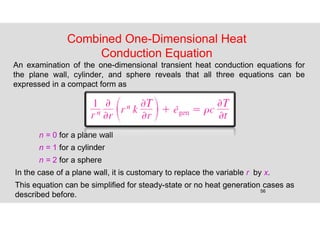
poured from one body into another
It was only in the middle of the nineteenth century
that we had a true physical understanding of the
nature of heat.
Careful experiments of the Englishman James P.
Joule published in 1843 convinced the skeptics
that heat was not a substance after all, and thus
put the caloric theory to rest.
6
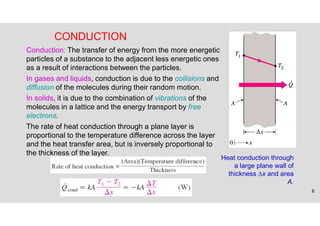
Heat conduction through
a large plane wall of
thickness x and area
A.
CONDUCTION
Conduction: The transfer of energy from the more energetic
particles of a substance to the adjacent less energetic ones
as a result of interactions between the particles.
In gases and liquids, conduction is due to the collisions and
diffusion of the molecules during their random motion.
In solids, it is due to the combination of vibrations of the
molecules in a lattice and the energy transport by free
electrons.
The rate of heat conduction through a plane layer is
proportional to the temperature difference across the layer
and the heat transfer area, but is inversely proportional to
the thickness of the layer.
7
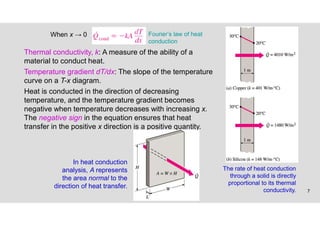
When x → 0 Fourier’s law of heat
conduction
Thermal conductivity, k: A measure of the ability of a
material to conduct heat.
Temperature gradient dT/dx: The slope of the temperature
curve on a T-x diagram.
Heat is conducted in the direction of decreasing
temperature, and the temperature gradient becomes
negative when temperature decreases with increasing x.
The negative sign in the equation ensures that heat
transfer in the positive x direction is a positive quantity.
The rate of heat conduction
through a solid is directly
proportional to its thermal
conductivity.
In heat conduction
analysis, A represents
the area normal to the
direction of heat transfer.
8
Thermal
Conductivity
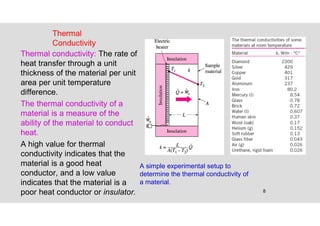
Thermal conductivity: The rate of
heat transfer through a unit
thickness of the material per unit
area per unit temperature
difference.
The thermal conductivity of a
material is a measure of the
ability of the material to conduct
heat.
A high value for thermal
conductivity indicates that the
material is a good heat
conductor, and a low value
indicates that the material is a
poor heat conductor or insulator.
A simple experimental setup to
determine the thermal conductivity of
a material.
9
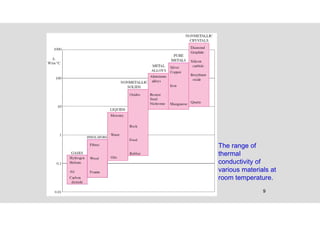
The range of
thermal
conductivity of
various materials at
room temperature.
10
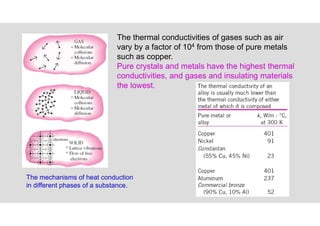
The mechanisms of heat conduction
in different phases of a substance.
The thermal conductivities of gases such as air
vary by a factor of 104 from those of pure metals
such as copper.
Pure crystals and metals have the highest thermal
conductivities, and gases and insulating materials
the lowest.
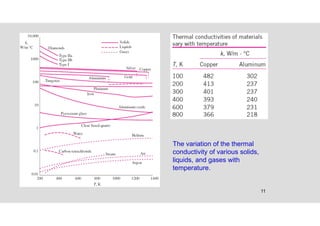
11
The variation of the thermal
conductivity of various solids,
liquids, and gases with
temperature.
12
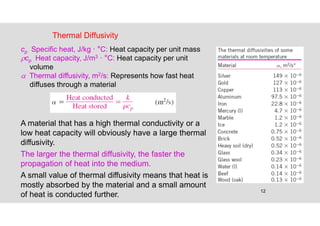
Thermal Diffusivity
cp Specific heat, J/kg · °C: Heat capacity per unit mass
cp Heat capacity, J/m3 · °C: Heat capacity per unit
volume
 Thermal diffusivity, m2/s: Represents how fast heat
diffuses through a material
A material that has a high thermal conductivity or a
low heat capacity will obviously have a large thermal
diffusivity.
The larger the thermal diffusivity, the faster the
propagation of heat into the medium.
A small value of thermal diffusivity means that heat is
mostly absorbed by the material and a small amount
of heat is conducted further.
13
CONVECTION
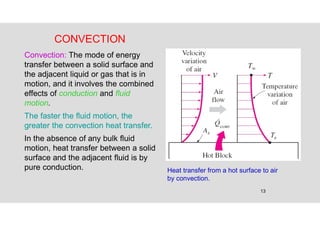
Convection: The mode of energy
transfer between a solid surface and
the adjacent liquid or gas that is in
motion, and it involves the combined
effects of conduction and fluid
motion.
The faster the fluid motion, the
greater the convection heat transfer.
In the absence of any bulk fluid
motion, heat transfer between a solid
surface and the adjacent fluid is by
pure conduction. Heat transfer from a hot surface to air
by convection.
14
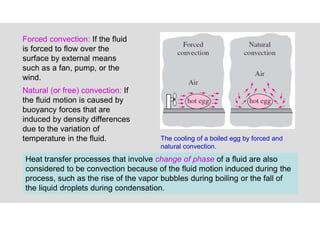
Forced convection: If the fluid
is forced to flow over the
surface by external means
such as a fan, pump, or the
wind.
Natural (or free) convection: If
the fluid motion is caused by
buoyancy forces that are
induced by density differences
due to the variation of
temperature in the fluid. The cooling of a boiled egg by forced and
natural convection.
Heat transfer processes that involve change of phase of a fluid are also
considered to be convection because of the fluid motion induced during the
process, such as the rise of the vapor bubbles during boiling or the fall of
the liquid droplets during condensation.
15
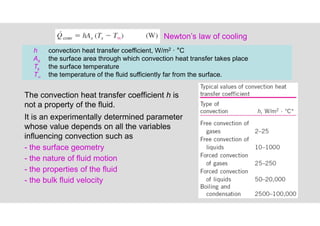
Newton’s law of cooling
h convection heat transfer coefficient, W/m2 · °C
As the surface area through which convection heat transfer takes place
Ts the surface temperature
T the temperature of the fluid sufficiently far from the surface.
The convection heat transfer coefficient h is
not a property of the fluid.
It is an experimentally determined parameter
whose value depends on all the variables
influencing convection such as
- the surface geometry
- the nature of fluid motion
- the properties of the fluid
- the bulk fluid velocity
16
RADIATION
• Radiation: The energy emitted by matter in the form of electromagnetic waves (or
photons) as a result of the changes in the electronic configurations of the atoms or
molecules.
• Unlike conduction and convection, the transfer of heat by radiation does not require
the presence of an intervening medium.
• In fact, heat transfer by radiation is fastest (at the speed of light) and it suffers no
attenuation in a vacuum. This is how the energy of the sun reaches the earth.
• In heat transfer studies we are interested in thermal radiation, which is the form of
radiation emitted by bodies because of their temperature.
• All bodies at a temperature above absolute zero emit thermal radiation.
• Radiation is a volumetric phenomenon, and all solids, liquids, and gases emit,
absorb, or transmit radiation to varying degrees.
• However, radiation is usually considered to be a surface phenomenon for solids.
17
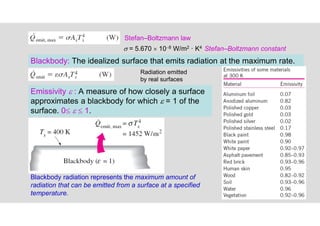
Stefan–Boltzmann law
 = 5.670  108 W/m2 · K4 Stefan–Boltzmann constant
Blackbody: The idealized surface that emits radiation at the maximum rate.
Blackbody radiation represents the maximum amount of
radiation that can be emitted from a surface at a specified
temperature.
Emissivity  : A measure of how closely a surface
approximates a blackbody for which  = 1 of the
surface. 0   1.
Radiation emitted
by real surfaces
18
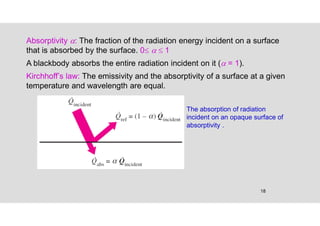
Absorptivity : The fraction of the radiation energy incident on a surface
that is absorbed by the surface. 0   1
A blackbody absorbs the entire radiation incident on it ( = 1).
Kirchhoff’s law: The emissivity and the absorptivity of a surface at a given
temperature and wavelength are equal.
The absorption of radiation
incident on an opaque surface of
absorptivity .
19
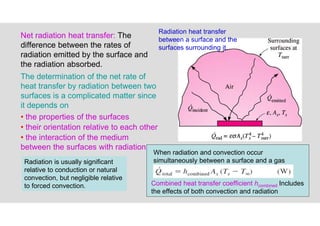
Radiation heat transfer
between a surface and the
surfaces surrounding it.
Net radiation heat transfer: The
difference between the rates of
radiation emitted by the surface and
the radiation absorbed.
The determination of the net rate of
heat transfer by radiation between two
surfaces is a complicated matter since
it depends on
• the properties of the surfaces
• their orientation relative to each other
• the interaction of the medium
between the surfaces with radiation
Combined heat transfer coefficient hcombined Includes
the effects of both convection and radiation
When radiation and convection occur
simultaneously between a surface and a gas
Radiation is usually significant
relative to conduction or natural
convection, but negligible relative
to forced convection.
20
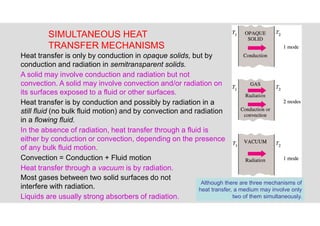
SIMULTANEOUS HEAT
TRANSFER MECHANISMS
Although there are three mechanisms of
heat transfer, a medium may involve only
two of them simultaneously.
Heat transfer is only by conduction in opaque solids, but by
conduction and radiation in semitransparent solids.
A solid may involve conduction and radiation but not
convection. A solid may involve convection and/or radiation on
its surfaces exposed to a fluid or other surfaces.
Heat transfer is by conduction and possibly by radiation in a
still fluid (no bulk fluid motion) and by convection and radiation
in a flowing fluid.
In the absence of radiation, heat transfer through a fluid is
either by conduction or convection, depending on the presence
of any bulk fluid motion.
Convection = Conduction + Fluid motion
Heat transfer through a vacuum is by radiation.
Most gases between two solid surfaces do not
interfere with radiation.
Liquids are usually strong absorbers of radiation.
21
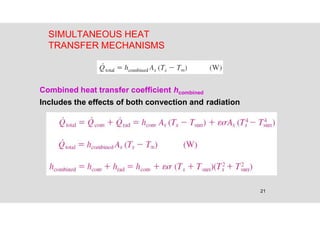
SIMULTANEOUS HEAT
TRANSFER MECHANISMS
Combined heat transfer coefficient hcombined
Includes the effects of both convection and radiation
22
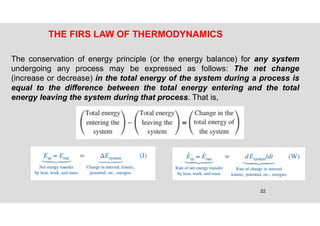
THE FIRS LAW OF THERMODYNAMICS
The conservation of energy principle (or the energy balance) for any system
undergoing any process may be expressed as follows: The net change
(increase or decrease) in the total energy of the system during a process is
equal to the difference between the total energy entering and the total
energy leaving the system during that process. That is,
23
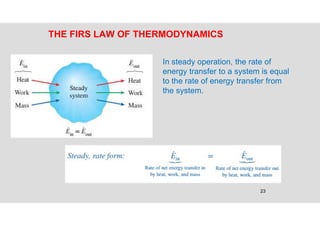
THE FIRS LAW OF THERMODYNAMICS
In steady operation, the rate of
energy transfer to a system is equal
to the rate of energy transfer from
the system.
24
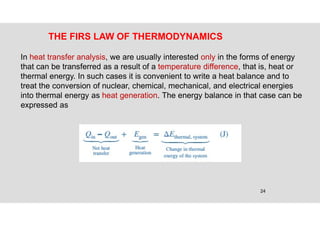
THE FIRS LAW OF THERMODYNAMICS
In heat transfer analysis, we are usually interested only in the forms of energy
that can be transferred as a result of a temperature difference, that is, heat or
thermal energy. In such cases it is convenient to write a heat balance and to
treat the conversion of nuclear, chemical, mechanical, and electrical energies
into thermal energy as heat generation. The energy balance in that case can be
expressed as
25
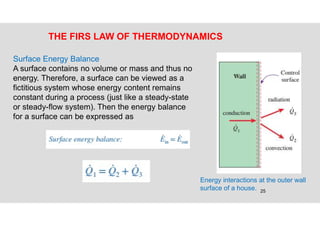
THE FIRS LAW OF THERMODYNAMICS
Surface Energy Balance
A surface contains no volume or mass and thus no
energy. Therefore, a surface can be viewed as a
fictitious system whose energy content remains
constant during a process (just like a steady-state
or steady-flow system). Then the energy balance
for a surface can be expressed as
Energy interactions at the outer wall
surface of a house.
28
Summary
• Conduction
 Fourier’s law of heat conduction
 Thermal Conductivity
 Thermal Diffusivity
• Convection
 Newton’s law of cooling
• Radiation
 Stefan–Boltzmann law
• Simultaneous Heat Transfer
Mechanisms
29
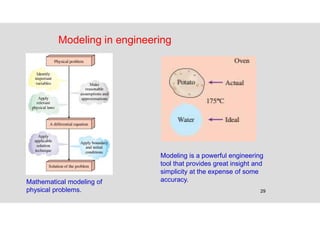
Modeling in engineering
Mathematical modeling of
physical problems.
Modeling is a powerful engineering
tool that provides great insight and
simplicity at the expense of some
accuracy.
30
Heat transfer, Modeling in engineering
Heat transfer equipment such as heat exchangers, boilers, condensers, radiators, heaters, furnaces,
refrigerators, and solar collectors are designed primarily on the basis of heat transfer analysis.
The heat transfer problems encountered in practice can be considered in two groups:
(1) rating and (2) sizing problems.
The rating problems deal with the determination of the heat transfer rate for an existing system at a
specified temperature difference.
The sizing problems deal with the determination of the size of a system in order to transfer heat at a
specified rate for a specified temperature difference.
An engineering device or process can be studied either experimentally (testing and taking
measurements) or analytically (by analysis or calculations).
The experimental approach has the advantage that we deal with the actual physical system, and the
desired quantity is determined by measurement, within the limits of experimental error. However, this
approach is expensive, timeconsuming, and often impractical.
The analytical approach (including the numerical approach) has the advantage that it is fast and
inexpensive, but the results obtained are subject to the accuracy of the assumptions, approximations,
and idealizations made in the analysis.
31
Heat transfer, Modeling in engineering
• Step 1: Problem Statement
• Step 2: Schematic
• Step 3: Assumptions and Approximations
• Step 4: Physical Laws
• Step 5: Properties
• Step 6: Calculations
• Step 7: Reasoning, Verification, and Discussion
HEAT CONDUCTION EQUATION
•Mehmet Kanoglu
Copyright © The McGraw-Hill Companies, Inc. Permission required for reproduction or display.
Fundamentals of Thermal-Fluid Sciences, 3rd Edition
Yunus A. Cengel, Robert H. Turner, John M. Cimbala
McGraw-Hill, 2008
41
Objectives
• Understand multidimensionality and time dependence of heat transfer, and
the conditions under which a heat transfer problem can be approximated as
being one-dimensional.
• Obtain the differential equation of heat conduction in various coordinate
systems, and simplify it for steady one-dimensional case.
• Identify the thermal conditions on surfaces, and express them
mathematically as boundary and initial conditions.
• Solve one-dimensional heat conduction problems and obtain the
temperature distributions within a medium and the heat flux.
• Analyze one-dimensional heat conduction in solids that involve heat
generation.
• Evaluate heat conduction in solids with temperature-dependent thermal
conductivity.
42
Introduction
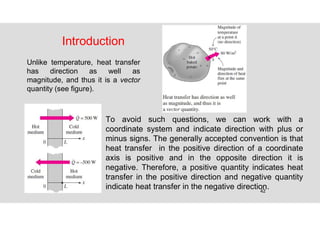
Unlike temperature, heat transfer
has direction as well as
magnitude, and thus it is a vector
quantity (see figure).
To avoid such questions, we can work with a
coordinate system and indicate direction with plus or
minus signs. The generally accepted convention is that
heat transfer in the positive direction of a coordinate
axis is positive and in the opposite direction it is
negative. Therefore, a positive quantity indicates heat
transfer in the positive direction and negative quantity
indicate heat transfer in the negative direction.
43
Introduction
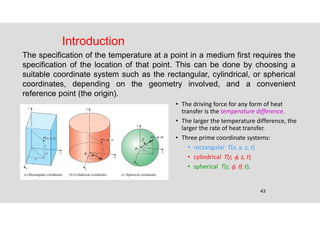
The specification of the temperature at a point in a medium first requires the
specification of the location of that point. This can be done by choosing a
suitable coordinate system such as the rectangular, cylindrical, or spherical
coordinates, depending on the geometry involved, and a convenient
reference point (the origin).
• The driving force for any form of heat
transfer is the temperature difference.
• The larger the temperature difference, the
larger the rate of heat transfer.
• Three prime coordinate systems:
• rectangular T(x, y, z, t)
• cylindrical T(r, , z, t)
• spherical T(r, , , t).
44
Steady versus Transient Heat Transfer
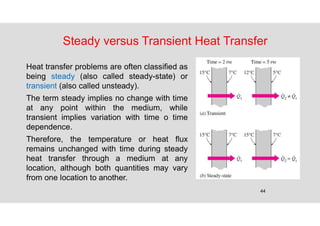
Heat transfer problems are often classified as
being steady (also called steady-state) or
transient (also called unsteady).
The term steady implies no change with time
at any point within the medium, while
transient implies variation with time o time
dependence.
Therefore, the temperature or heat flux
remains unchanged with time during steady
heat transfer through a medium at any
location, although both quantities may vary
from one location to another.
45
Multidimensional Heat Transfer
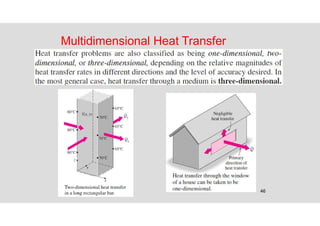
• Heat transfer problems are also classified as being:
• one-dimensional
• two dimensional
• three-dimensional
• In the most general case, heat transfer through a medium is three-dimensional.
However, some problems can be classified as two- or one-dimensional depending on
the relative magnitudes of heat transfer rates in different directions and the level of
accuracy desired.
• One-dimensional if the temperature in the medium varies in one direction only and
thus heat is transferred in one direction, and the variation of temperature and thus
heat transfer in other directions are negligible or zero.
• Two-dimensional if the temperature in a medium, in some cases, varies mainly in
two primary directions, and the variation of temperature in the third direction (and
thus heat transfer in that direction) is negligible.
46
Multidimensional Heat Transfer
47
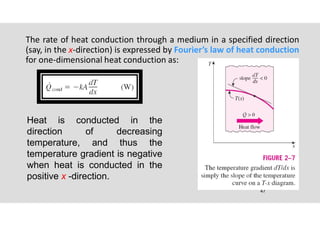
The rate of heat conduction through a medium in a specified direction
(say, in the x-direction) is expressed by Fourier’s law of heat conduction
for one-dimensional heat conduction as:
Heat is conducted in the
direction of decreasing
temperature, and thus the
temperature gradient is negative
when heat is conducted in the
positive x -direction.
48
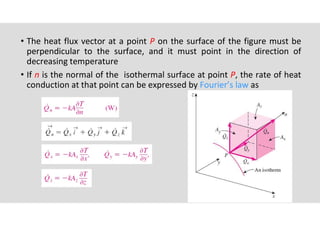
• The heat flux vector at a point P on the surface of the figure must be
perpendicular to the surface, and it must point in the direction of
decreasing temperature
• If n is the normal of the isothermal surface at point P, the rate of heat
conduction at that point can be expressed by Fourier’s law as
49
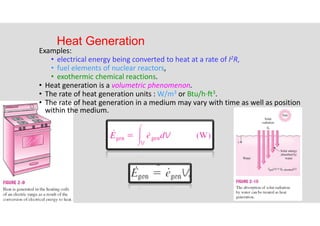
Heat Generation
Examples:
• electrical energy being converted to heat at a rate of I2R,
• fuel elements of nuclear reactors,
• exothermic chemical reactions.
• Heat generation is a volumetric phenomenon.
• The rate of heat generation units : W/m3 or Btu/h·ft3.
• The rate of heat generation in a medium may vary with time as well as position
within the medium.
50
One Dimensional Heat Conduction Equation
Consider heat conduction through a large plane wall such as the wall of a
house, the glass of a single pane window, the metal plate at the bottom of a
pressing iron, a cast-iron steam pipe, a cylindrical nuclear fuel element, an
electrical resistance wire, the wall of a spherical container, or a spherical
metal ball that is being quenched or tempered.
Heat conduction in these and many other geometries can be approximated
as being one-dimensional since heat conduction through these geometries
is dominant in one direction and negligible in other directions.
Next we develop the onedimensional heat conduction equation in
rectangular, cylindrical, and spherical coordinates.
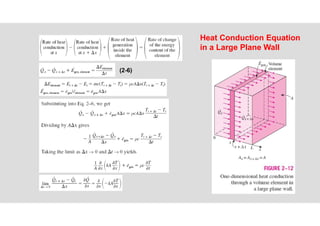
51
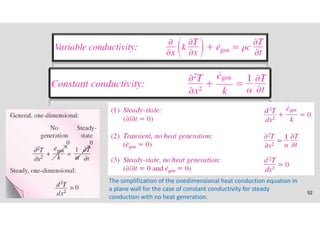
(2-6)
Heat Conduction Equation
in a Large Plane Wall
52
The simplification of the onedimensional heat conduction equation in
a plane wall for the case of constant conductivity for steady
conduction with no heat generation.
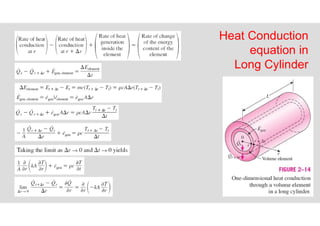
53
Heat Conduction
equation in
Long Cylinder
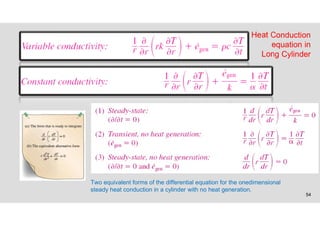
54
Heat Conduction
equation in
Long Cylinder
Two equivalent forms of the differential equation for the onedimensional
steady heat conduction in a cylinder with no heat generation.
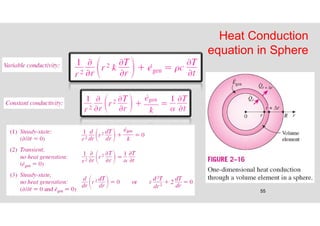
55
Heat Conduction
equation in Sphere
56
Combined One-Dimensional Heat
Conduction Equation
An examination of the one-dimensional transient heat conduction equations for
the plane wall, cylinder, and sphere reveals that all three equations can be
expressed in a compact form as
n = 0 for a plane wall
n = 1 for a cylinder
n = 2 for a sphere
In the case of a plane wall, it is customary to replace the variable r by x.
This equation can be simplified for steady-state or no heat generation cases as
described before.
57
General Heat Conduction Equation
In the last section we considered one-dimensional heat conduction
and assumed heat conduction in other directions to be negligible.
Most heat transfer problems encountered in practice can be
approximated as being one-dimensional, and we mostly deal with
such problems in this text.
However, this is not always the case, and sometimes we need to
consider heat transfer in other directions as well.
In such cases heat conduction is said to be multidimensional, and in
this section we develop the governing differential equation in such
systems in rectangular, cylindrical, and spherical coordinate systems.
58
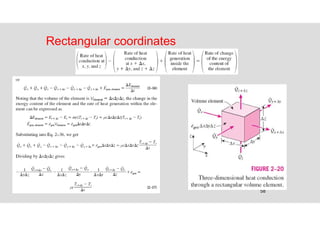
Rectangular coordinates
59
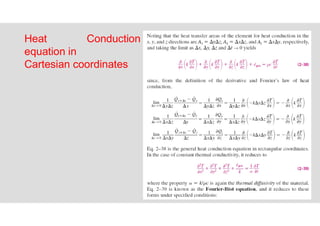
Heat Conduction
equation in
Cartesian coordinates
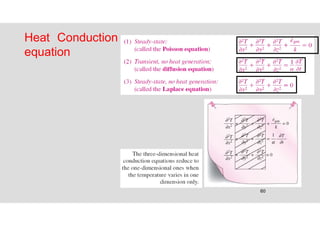
60
Heat Conduction
equation
61
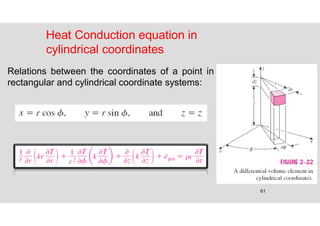
Heat Conduction equation in
cylindrical coordinates
Relations between the coordinates of a point in
rectangular and cylindrical coordinate systems:
62
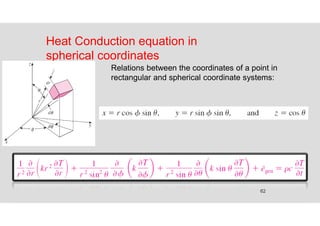
Heat Conduction equation in
spherical coordinates
Relations between the coordinates of a point in
rectangular and spherical coordinate systems:
63
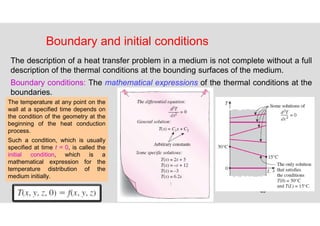
Boundary and initial conditions
The description of a heat transfer problem in a medium is not complete without a full
description of the thermal conditions at the bounding surfaces of the medium.
Boundary conditions: The mathematical expressions of the thermal conditions at the
boundaries.
The temperature at any point on the
wall at a specified time depends on
the condition of the geometry at the
beginning of the heat conduction
process.
Such a condition, which is usually
specified at time t = 0, is called the
initial condition, which is a
mathematical expression for the
temperature distribution of the
medium initially.
64
Boundary and initial conditions
• Specified Temperature Boundary Condition
• Specified Heat Flux Boundary Condition
• Convection Boundary Condition
• Radiation Boundary Condition
• Interface Boundary Conditions
• Generalized Boundary Conditions
65
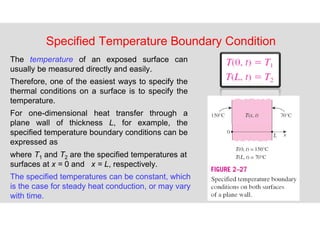
Specified Temperature Boundary Condition
The temperature of an exposed surface can
usually be measured directly and easily.
Therefore, one of the easiest ways to specify the
thermal conditions on a surface is to specify the
temperature.
For one-dimensional heat transfer through a
plane wall of thickness L, for example, the
specified temperature boundary conditions can be
expressed as
where T1 and T2 are the specified temperatures at
surfaces at x = 0 and x = L, respectively.
The specified temperatures can be constant, which
is the case for steady heat conduction, or may vary
with time.
66
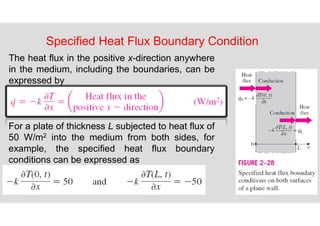
Specified Heat Flux Boundary Condition
For a plate of thickness L subjected to heat flux of
50 W/m2 into the medium from both sides, for
example, the specified heat flux boundary
conditions can be expressed as
The heat flux in the positive x-direction anywhere
in the medium, including the boundaries, can be
expressed by
67
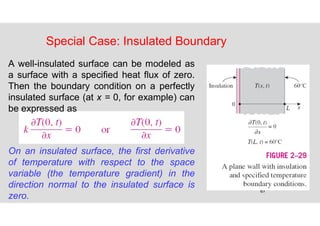
Special Case: Insulated Boundary
A well-insulated surface can be modeled as
a surface with a specified heat flux of zero.
Then the boundary condition on a perfectly
insulated surface (at x = 0, for example) can
be expressed as
On an insulated surface, the first derivative
of temperature with respect to the space
variable (the temperature gradient) in the
direction normal to the insulated surface is
zero.
68
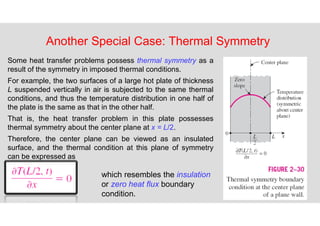
Another Special Case: Thermal Symmetry
Some heat transfer problems possess thermal symmetry as a
result of the symmetry in imposed thermal conditions.
For example, the two surfaces of a large hot plate of thickness
L suspended vertically in air is subjected to the same thermal
conditions, and thus the temperature distribution in one half of
the plate is the same as that in the other half.
That is, the heat transfer problem in this plate possesses
thermal symmetry about the center plane at x = L/2.
Therefore, the center plane can be viewed as an insulated
surface, and the thermal condition at this plane of symmetry
can be expressed as
which resembles the insulation
or zero heat flux boundary
condition.
69
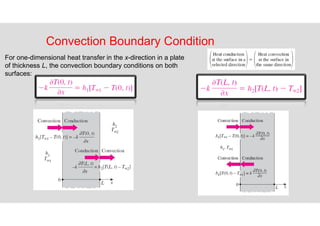
Convection Boundary Condition
For one-dimensional heat transfer in the x-direction in a plate
of thickness L, the convection boundary conditions on both
surfaces:
70
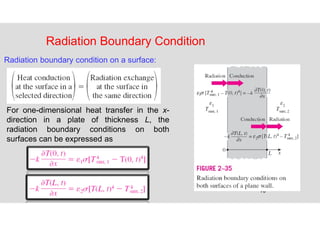
Radiation Boundary Condition
For one-dimensional heat transfer in the x-
direction in a plate of thickness L, the
radiation boundary conditions on both
surfaces can be expressed as
Radiation boundary condition on a surface:
71
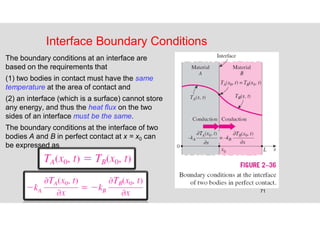
Interface Boundary Conditions
The boundary conditions at an interface are
based on the requirements that
(1) two bodies in contact must have the same
temperature at the area of contact and
(2) an interface (which is a surface) cannot store
any energy, and thus the heat flux on the two
sides of an interface must be the same.
The boundary conditions at the interface of two
bodies A and B in perfect contact at x = x0 can
be expressed as
72
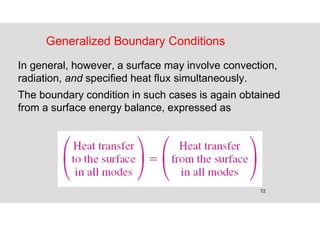
Generalized Boundary Conditions
In general, however, a surface may involve convection,
radiation, and specified heat flux simultaneously.
The boundary condition in such cases is again obtained
from a surface energy balance, expressed as
73
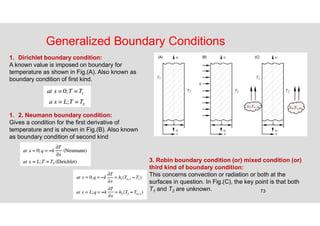
Generalized Boundary Conditions
1. Dirichlet boundary condition:
A known value is imposed on boundary for
temperature as shown in Fig.(A). Also known as
boundary condition of first kind.
1. 2. Neumann boundary condition:
Gives a condition for the first derivative of
temperature and is shown in Fig.(B). Also known
as boundary condition of second kind
3. Robin boundary condition (or) mixed condition (or)
third kind of boundary condition:
This concerns convection or radiation or both at the
surfaces in question. In Fig.(C), the key point is that both
T1 and T2 are unknown.
74
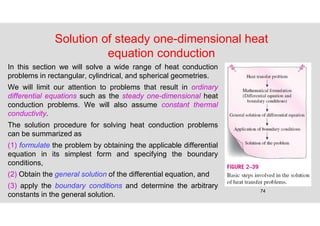
Solution of steady one-dimensional heat
equation conduction
In this section we will solve a wide range of heat conduction
problems in rectangular, cylindrical, and spherical geometries.
We will limit our attention to problems that result in ordinary
differential equations such as the steady one-dimensional heat
conduction problems. We will also assume constant thermal
conductivity.
The solution procedure for solving heat conduction problems
can be summarized as
(1) formulate the problem by obtaining the applicable differential
equation in its simplest form and specifying the boundary
conditions,
(2) Obtain the general solution of the differential equation, and
(3) apply the boundary conditions and determine the arbitrary
constants in the general solution.
75
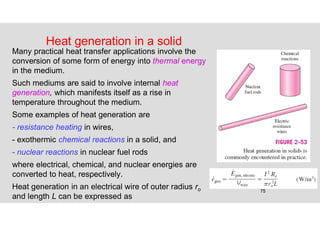
Heat generation in a solid
Many practical heat transfer applications involve the
conversion of some form of energy into thermal energy
in the medium.
Such mediums are said to involve internal heat
generation, which manifests itself as a rise in
temperature throughout the medium.
Some examples of heat generation are
- resistance heating in wires,
- exothermic chemical reactions in a solid, and
- nuclear reactions in nuclear fuel rods
where electrical, chemical, and nuclear energies are
converted to heat, respectively.
Heat generation in an electrical wire of outer radius ro
and length L can be expressed as
76
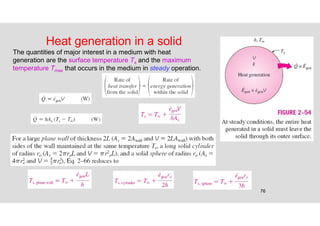
Heat generation in a solid
The quantities of major interest in a medium with heat
generation are the surface temperature Ts and the maximum
temperature Tmax that occurs in the medium in steady operation.
77
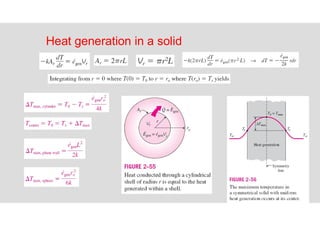
Heat generation in a solid
78
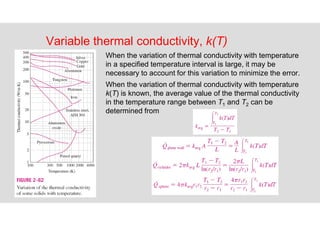
Variable thermal conductivity, k(T)
When the variation of thermal conductivity with temperature
in a specified temperature interval is large, it may be
necessary to account for this variation to minimize the error.
When the variation of thermal conductivity with temperature
k(T) is known, the average value of the thermal conductivity
in the temperature range between T1 and T2 can be
determined from
79
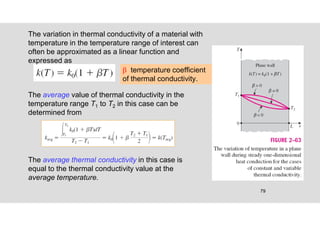
 temperature coefficient
of thermal conductivity.
The average value of thermal conductivity in the
temperature range T1 to T2 in this case can be
determined from
The average thermal conductivity in this case is
equal to the thermal conductivity value at the
average temperature.
The variation in thermal conductivity of a material with
temperature in the temperature range of interest can
often be approximated as a linear function and
expressed as
80
Summary
• Introduction
• Steady versus Transient Heat Transfer
• Multidimensional Heat Transfer
• Heat Generation
• One-Dimensional Heat Conduction Equation
• Heat Conduction Equation in a Large Plane Wall
• Heat Conduction Equation in a Long Cylinder
• Heat Conduction Equation in a Sphere
• Combined One-Dimensional Heat Conduction Equation
• General Heat Conduction Equation
• Rectangular Coordinates
• Cylindrical Coordinates
• Spherical Coordinates
• Boundary and Initial Conditions
• Solution of Steady One-Dimensional Heat Conduction Problems
• Heat Generation in a Solid
• Variable Thermal Conductivity k (T )
81
Examples
Steady, 1-D
Heat Conduction in a Plane Wall
A Wall with Various Sets of Boundary Conditions
Heat Conduction in the Base Plate of an Iron
Fire Hazard Prevention of Oil Leakage on Hot Engine Surface
Heat Conduction in a Solar Heated Wall
Heat Loss Through a Steam Pipe
Heat Conduction Through a Spherical Shell
Variation of Temperature in a Resistance Heater
Heat Conduction in a Two-Layer Medium
Heat Conduction in a Plane Wall with Heat Generation

1- Apuntes sobre laIntroduccionConducción.pdf

  • 1.
    Chapter 16 MECHANISMS OFHEAT TRANSFER Mehmet Kanoglu Copyright © The McGraw-Hill Companies, Inc. Permission required for reproduction or display. Fundamentals of Thermal-Fluid Sciences, 3rd Edition Yunus A. Cengel, Robert H. Turner, John M. Cimbala McGraw-Hill, 2008
  • 2.
    2 Objectives  Understand howthermodynamics and heat transfer are related to each other  Distinguish thermal energy from other forms of energy, and heat transfer from other forms of energy transfer  Perform general energy balances as well as surface energy balances  Understand the basic mechanisms of heat transfer, which are conduction, convection, and radiation, and Fourier's law of heat conduction, Newton's law of cooling, and the Stefan–Boltzmann law of radiation  Identify the mechanisms of heat transfer that occur simultaneously in practice  Develop an awareness of the cost associated with heat losses  Solve various heat transfer problems encountered in practice
  • 3.
    3 INTRODUCTION • Heat: Theform of energy that can be transferred from one system to another as a result of temperature difference. • Thermodynamics concerned with the amount of heat transfer as a system undergoes a process from one equilibrium state to another. • Heat Transfer deals with the determination of the rates of such energy transfers as well as variation of temperature. • The transfer of energy as heat is always from the higher-temperature medium to the lower-temperature one. • Heat transfer stops when the two mediums reach the same temperature. • Heat can be transferred in three different modes: conduction, convection, radiation
  • 4.
  • 5.
    5 Historical Background Kinetic theory: Treatsmolecules as tiny balls that are in motion and thus possess kinetic energy. Heat: The energy associated with the random motion of atoms and molecules. Caloric theory: Heat is a fluidlike substance called the caloric that is a massless, colorless, odorless, and tasteless substance that can be poured from one body into another It was only in the middle of the nineteenth century that we had a true physical understanding of the nature of heat. Careful experiments of the Englishman James P. Joule published in 1843 convinced the skeptics that heat was not a substance after all, and thus put the caloric theory to rest.
  • 6.
    6 Heat conduction through alarge plane wall of thickness x and area A. CONDUCTION Conduction: The transfer of energy from the more energetic particles of a substance to the adjacent less energetic ones as a result of interactions between the particles. In gases and liquids, conduction is due to the collisions and diffusion of the molecules during their random motion. In solids, it is due to the combination of vibrations of the molecules in a lattice and the energy transport by free electrons. The rate of heat conduction through a plane layer is proportional to the temperature difference across the layer and the heat transfer area, but is inversely proportional to the thickness of the layer.
  • 7.
    7 When x →0 Fourier’s law of heat conduction Thermal conductivity, k: A measure of the ability of a material to conduct heat. Temperature gradient dT/dx: The slope of the temperature curve on a T-x diagram. Heat is conducted in the direction of decreasing temperature, and the temperature gradient becomes negative when temperature decreases with increasing x. The negative sign in the equation ensures that heat transfer in the positive x direction is a positive quantity. The rate of heat conduction through a solid is directly proportional to its thermal conductivity. In heat conduction analysis, A represents the area normal to the direction of heat transfer.
  • 8.
    8 Thermal Conductivity Thermal conductivity: Therate of heat transfer through a unit thickness of the material per unit area per unit temperature difference. The thermal conductivity of a material is a measure of the ability of the material to conduct heat. A high value for thermal conductivity indicates that the material is a good heat conductor, and a low value indicates that the material is a poor heat conductor or insulator. A simple experimental setup to determine the thermal conductivity of a material.
  • 9.
    9 The range of thermal conductivityof various materials at room temperature.
  • 10.
    10 The mechanisms ofheat conduction in different phases of a substance. The thermal conductivities of gases such as air vary by a factor of 104 from those of pure metals such as copper. Pure crystals and metals have the highest thermal conductivities, and gases and insulating materials the lowest.
  • 11.
    11 The variation ofthe thermal conductivity of various solids, liquids, and gases with temperature.
  • 12.
    12 Thermal Diffusivity cp Specificheat, J/kg · °C: Heat capacity per unit mass cp Heat capacity, J/m3 · °C: Heat capacity per unit volume  Thermal diffusivity, m2/s: Represents how fast heat diffuses through a material A material that has a high thermal conductivity or a low heat capacity will obviously have a large thermal diffusivity. The larger the thermal diffusivity, the faster the propagation of heat into the medium. A small value of thermal diffusivity means that heat is mostly absorbed by the material and a small amount of heat is conducted further.
  • 13.
    13 CONVECTION Convection: The modeof energy transfer between a solid surface and the adjacent liquid or gas that is in motion, and it involves the combined effects of conduction and fluid motion. The faster the fluid motion, the greater the convection heat transfer. In the absence of any bulk fluid motion, heat transfer between a solid surface and the adjacent fluid is by pure conduction. Heat transfer from a hot surface to air by convection.
  • 14.
    14 Forced convection: Ifthe fluid is forced to flow over the surface by external means such as a fan, pump, or the wind. Natural (or free) convection: If the fluid motion is caused by buoyancy forces that are induced by density differences due to the variation of temperature in the fluid. The cooling of a boiled egg by forced and natural convection. Heat transfer processes that involve change of phase of a fluid are also considered to be convection because of the fluid motion induced during the process, such as the rise of the vapor bubbles during boiling or the fall of the liquid droplets during condensation.
  • 15.
    15 Newton’s law ofcooling h convection heat transfer coefficient, W/m2 · °C As the surface area through which convection heat transfer takes place Ts the surface temperature T the temperature of the fluid sufficiently far from the surface. The convection heat transfer coefficient h is not a property of the fluid. It is an experimentally determined parameter whose value depends on all the variables influencing convection such as - the surface geometry - the nature of fluid motion - the properties of the fluid - the bulk fluid velocity
  • 16.
    16 RADIATION • Radiation: Theenergy emitted by matter in the form of electromagnetic waves (or photons) as a result of the changes in the electronic configurations of the atoms or molecules. • Unlike conduction and convection, the transfer of heat by radiation does not require the presence of an intervening medium. • In fact, heat transfer by radiation is fastest (at the speed of light) and it suffers no attenuation in a vacuum. This is how the energy of the sun reaches the earth. • In heat transfer studies we are interested in thermal radiation, which is the form of radiation emitted by bodies because of their temperature. • All bodies at a temperature above absolute zero emit thermal radiation. • Radiation is a volumetric phenomenon, and all solids, liquids, and gases emit, absorb, or transmit radiation to varying degrees. • However, radiation is usually considered to be a surface phenomenon for solids.
  • 17.
    17 Stefan–Boltzmann law  =5.670  108 W/m2 · K4 Stefan–Boltzmann constant Blackbody: The idealized surface that emits radiation at the maximum rate. Blackbody radiation represents the maximum amount of radiation that can be emitted from a surface at a specified temperature. Emissivity  : A measure of how closely a surface approximates a blackbody for which  = 1 of the surface. 0   1. Radiation emitted by real surfaces
  • 18.
    18 Absorptivity : Thefraction of the radiation energy incident on a surface that is absorbed by the surface. 0   1 A blackbody absorbs the entire radiation incident on it ( = 1). Kirchhoff’s law: The emissivity and the absorptivity of a surface at a given temperature and wavelength are equal. The absorption of radiation incident on an opaque surface of absorptivity .
  • 19.
    19 Radiation heat transfer betweena surface and the surfaces surrounding it. Net radiation heat transfer: The difference between the rates of radiation emitted by the surface and the radiation absorbed. The determination of the net rate of heat transfer by radiation between two surfaces is a complicated matter since it depends on • the properties of the surfaces • their orientation relative to each other • the interaction of the medium between the surfaces with radiation Combined heat transfer coefficient hcombined Includes the effects of both convection and radiation When radiation and convection occur simultaneously between a surface and a gas Radiation is usually significant relative to conduction or natural convection, but negligible relative to forced convection.
  • 20.
    20 SIMULTANEOUS HEAT TRANSFER MECHANISMS Althoughthere are three mechanisms of heat transfer, a medium may involve only two of them simultaneously. Heat transfer is only by conduction in opaque solids, but by conduction and radiation in semitransparent solids. A solid may involve conduction and radiation but not convection. A solid may involve convection and/or radiation on its surfaces exposed to a fluid or other surfaces. Heat transfer is by conduction and possibly by radiation in a still fluid (no bulk fluid motion) and by convection and radiation in a flowing fluid. In the absence of radiation, heat transfer through a fluid is either by conduction or convection, depending on the presence of any bulk fluid motion. Convection = Conduction + Fluid motion Heat transfer through a vacuum is by radiation. Most gases between two solid surfaces do not interfere with radiation. Liquids are usually strong absorbers of radiation.
  • 21.
    21 SIMULTANEOUS HEAT TRANSFER MECHANISMS Combinedheat transfer coefficient hcombined Includes the effects of both convection and radiation
  • 22.
    22 THE FIRS LAWOF THERMODYNAMICS The conservation of energy principle (or the energy balance) for any system undergoing any process may be expressed as follows: The net change (increase or decrease) in the total energy of the system during a process is equal to the difference between the total energy entering and the total energy leaving the system during that process. That is,
  • 23.
    23 THE FIRS LAWOF THERMODYNAMICS In steady operation, the rate of energy transfer to a system is equal to the rate of energy transfer from the system.
  • 24.
    24 THE FIRS LAWOF THERMODYNAMICS In heat transfer analysis, we are usually interested only in the forms of energy that can be transferred as a result of a temperature difference, that is, heat or thermal energy. In such cases it is convenient to write a heat balance and to treat the conversion of nuclear, chemical, mechanical, and electrical energies into thermal energy as heat generation. The energy balance in that case can be expressed as
  • 25.
    25 THE FIRS LAWOF THERMODYNAMICS Surface Energy Balance A surface contains no volume or mass and thus no energy. Therefore, a surface can be viewed as a fictitious system whose energy content remains constant during a process (just like a steady-state or steady-flow system). Then the energy balance for a surface can be expressed as Energy interactions at the outer wall surface of a house.
  • 26.
    28 Summary • Conduction  Fourier’slaw of heat conduction  Thermal Conductivity  Thermal Diffusivity • Convection  Newton’s law of cooling • Radiation  Stefan–Boltzmann law • Simultaneous Heat Transfer Mechanisms
  • 27.
    29 Modeling in engineering Mathematicalmodeling of physical problems. Modeling is a powerful engineering tool that provides great insight and simplicity at the expense of some accuracy.
  • 28.
    30 Heat transfer, Modelingin engineering Heat transfer equipment such as heat exchangers, boilers, condensers, radiators, heaters, furnaces, refrigerators, and solar collectors are designed primarily on the basis of heat transfer analysis. The heat transfer problems encountered in practice can be considered in two groups: (1) rating and (2) sizing problems. The rating problems deal with the determination of the heat transfer rate for an existing system at a specified temperature difference. The sizing problems deal with the determination of the size of a system in order to transfer heat at a specified rate for a specified temperature difference. An engineering device or process can be studied either experimentally (testing and taking measurements) or analytically (by analysis or calculations). The experimental approach has the advantage that we deal with the actual physical system, and the desired quantity is determined by measurement, within the limits of experimental error. However, this approach is expensive, timeconsuming, and often impractical. The analytical approach (including the numerical approach) has the advantage that it is fast and inexpensive, but the results obtained are subject to the accuracy of the assumptions, approximations, and idealizations made in the analysis.
  • 29.
    31 Heat transfer, Modelingin engineering • Step 1: Problem Statement • Step 2: Schematic • Step 3: Assumptions and Approximations • Step 4: Physical Laws • Step 5: Properties • Step 6: Calculations • Step 7: Reasoning, Verification, and Discussion
  • 30.
    HEAT CONDUCTION EQUATION •MehmetKanoglu Copyright © The McGraw-Hill Companies, Inc. Permission required for reproduction or display. Fundamentals of Thermal-Fluid Sciences, 3rd Edition Yunus A. Cengel, Robert H. Turner, John M. Cimbala McGraw-Hill, 2008
  • 31.
    41 Objectives • Understand multidimensionalityand time dependence of heat transfer, and the conditions under which a heat transfer problem can be approximated as being one-dimensional. • Obtain the differential equation of heat conduction in various coordinate systems, and simplify it for steady one-dimensional case. • Identify the thermal conditions on surfaces, and express them mathematically as boundary and initial conditions. • Solve one-dimensional heat conduction problems and obtain the temperature distributions within a medium and the heat flux. • Analyze one-dimensional heat conduction in solids that involve heat generation. • Evaluate heat conduction in solids with temperature-dependent thermal conductivity.
  • 32.
    42 Introduction Unlike temperature, heattransfer has direction as well as magnitude, and thus it is a vector quantity (see figure). To avoid such questions, we can work with a coordinate system and indicate direction with plus or minus signs. The generally accepted convention is that heat transfer in the positive direction of a coordinate axis is positive and in the opposite direction it is negative. Therefore, a positive quantity indicates heat transfer in the positive direction and negative quantity indicate heat transfer in the negative direction.
  • 33.
    43 Introduction The specification ofthe temperature at a point in a medium first requires the specification of the location of that point. This can be done by choosing a suitable coordinate system such as the rectangular, cylindrical, or spherical coordinates, depending on the geometry involved, and a convenient reference point (the origin). • The driving force for any form of heat transfer is the temperature difference. • The larger the temperature difference, the larger the rate of heat transfer. • Three prime coordinate systems: • rectangular T(x, y, z, t) • cylindrical T(r, , z, t) • spherical T(r, , , t).
  • 34.
    44 Steady versus TransientHeat Transfer Heat transfer problems are often classified as being steady (also called steady-state) or transient (also called unsteady). The term steady implies no change with time at any point within the medium, while transient implies variation with time o time dependence. Therefore, the temperature or heat flux remains unchanged with time during steady heat transfer through a medium at any location, although both quantities may vary from one location to another.
  • 35.
    45 Multidimensional Heat Transfer •Heat transfer problems are also classified as being: • one-dimensional • two dimensional • three-dimensional • In the most general case, heat transfer through a medium is three-dimensional. However, some problems can be classified as two- or one-dimensional depending on the relative magnitudes of heat transfer rates in different directions and the level of accuracy desired. • One-dimensional if the temperature in the medium varies in one direction only and thus heat is transferred in one direction, and the variation of temperature and thus heat transfer in other directions are negligible or zero. • Two-dimensional if the temperature in a medium, in some cases, varies mainly in two primary directions, and the variation of temperature in the third direction (and thus heat transfer in that direction) is negligible.
  • 36.
  • 37.
    47 The rate ofheat conduction through a medium in a specified direction (say, in the x-direction) is expressed by Fourier’s law of heat conduction for one-dimensional heat conduction as: Heat is conducted in the direction of decreasing temperature, and thus the temperature gradient is negative when heat is conducted in the positive x -direction.
  • 38.
    48 • The heatflux vector at a point P on the surface of the figure must be perpendicular to the surface, and it must point in the direction of decreasing temperature • If n is the normal of the isothermal surface at point P, the rate of heat conduction at that point can be expressed by Fourier’s law as
  • 39.
    49 Heat Generation Examples: • electricalenergy being converted to heat at a rate of I2R, • fuel elements of nuclear reactors, • exothermic chemical reactions. • Heat generation is a volumetric phenomenon. • The rate of heat generation units : W/m3 or Btu/h·ft3. • The rate of heat generation in a medium may vary with time as well as position within the medium.
  • 40.
    50 One Dimensional HeatConduction Equation Consider heat conduction through a large plane wall such as the wall of a house, the glass of a single pane window, the metal plate at the bottom of a pressing iron, a cast-iron steam pipe, a cylindrical nuclear fuel element, an electrical resistance wire, the wall of a spherical container, or a spherical metal ball that is being quenched or tempered. Heat conduction in these and many other geometries can be approximated as being one-dimensional since heat conduction through these geometries is dominant in one direction and negligible in other directions. Next we develop the onedimensional heat conduction equation in rectangular, cylindrical, and spherical coordinates.
  • 41.
  • 42.
    52 The simplification ofthe onedimensional heat conduction equation in a plane wall for the case of constant conductivity for steady conduction with no heat generation.
  • 43.
  • 44.
    54 Heat Conduction equation in LongCylinder Two equivalent forms of the differential equation for the onedimensional steady heat conduction in a cylinder with no heat generation.
  • 45.
  • 46.
    56 Combined One-Dimensional Heat ConductionEquation An examination of the one-dimensional transient heat conduction equations for the plane wall, cylinder, and sphere reveals that all three equations can be expressed in a compact form as n = 0 for a plane wall n = 1 for a cylinder n = 2 for a sphere In the case of a plane wall, it is customary to replace the variable r by x. This equation can be simplified for steady-state or no heat generation cases as described before.
  • 47.
    57 General Heat ConductionEquation In the last section we considered one-dimensional heat conduction and assumed heat conduction in other directions to be negligible. Most heat transfer problems encountered in practice can be approximated as being one-dimensional, and we mostly deal with such problems in this text. However, this is not always the case, and sometimes we need to consider heat transfer in other directions as well. In such cases heat conduction is said to be multidimensional, and in this section we develop the governing differential equation in such systems in rectangular, cylindrical, and spherical coordinate systems.
  • 48.
  • 49.
  • 50.
  • 51.
    61 Heat Conduction equationin cylindrical coordinates Relations between the coordinates of a point in rectangular and cylindrical coordinate systems:
  • 52.
    62 Heat Conduction equationin spherical coordinates Relations between the coordinates of a point in rectangular and spherical coordinate systems:
  • 53.
    63 Boundary and initialconditions The description of a heat transfer problem in a medium is not complete without a full description of the thermal conditions at the bounding surfaces of the medium. Boundary conditions: The mathematical expressions of the thermal conditions at the boundaries. The temperature at any point on the wall at a specified time depends on the condition of the geometry at the beginning of the heat conduction process. Such a condition, which is usually specified at time t = 0, is called the initial condition, which is a mathematical expression for the temperature distribution of the medium initially.
  • 54.
    64 Boundary and initialconditions • Specified Temperature Boundary Condition • Specified Heat Flux Boundary Condition • Convection Boundary Condition • Radiation Boundary Condition • Interface Boundary Conditions • Generalized Boundary Conditions
  • 55.
    65 Specified Temperature BoundaryCondition The temperature of an exposed surface can usually be measured directly and easily. Therefore, one of the easiest ways to specify the thermal conditions on a surface is to specify the temperature. For one-dimensional heat transfer through a plane wall of thickness L, for example, the specified temperature boundary conditions can be expressed as where T1 and T2 are the specified temperatures at surfaces at x = 0 and x = L, respectively. The specified temperatures can be constant, which is the case for steady heat conduction, or may vary with time.
  • 56.
    66 Specified Heat FluxBoundary Condition For a plate of thickness L subjected to heat flux of 50 W/m2 into the medium from both sides, for example, the specified heat flux boundary conditions can be expressed as The heat flux in the positive x-direction anywhere in the medium, including the boundaries, can be expressed by
  • 57.
    67 Special Case: InsulatedBoundary A well-insulated surface can be modeled as a surface with a specified heat flux of zero. Then the boundary condition on a perfectly insulated surface (at x = 0, for example) can be expressed as On an insulated surface, the first derivative of temperature with respect to the space variable (the temperature gradient) in the direction normal to the insulated surface is zero.
  • 58.
    68 Another Special Case:Thermal Symmetry Some heat transfer problems possess thermal symmetry as a result of the symmetry in imposed thermal conditions. For example, the two surfaces of a large hot plate of thickness L suspended vertically in air is subjected to the same thermal conditions, and thus the temperature distribution in one half of the plate is the same as that in the other half. That is, the heat transfer problem in this plate possesses thermal symmetry about the center plane at x = L/2. Therefore, the center plane can be viewed as an insulated surface, and the thermal condition at this plane of symmetry can be expressed as which resembles the insulation or zero heat flux boundary condition.
  • 59.
    69 Convection Boundary Condition Forone-dimensional heat transfer in the x-direction in a plate of thickness L, the convection boundary conditions on both surfaces:
  • 60.
    70 Radiation Boundary Condition Forone-dimensional heat transfer in the x- direction in a plate of thickness L, the radiation boundary conditions on both surfaces can be expressed as Radiation boundary condition on a surface:
  • 61.
    71 Interface Boundary Conditions Theboundary conditions at an interface are based on the requirements that (1) two bodies in contact must have the same temperature at the area of contact and (2) an interface (which is a surface) cannot store any energy, and thus the heat flux on the two sides of an interface must be the same. The boundary conditions at the interface of two bodies A and B in perfect contact at x = x0 can be expressed as
  • 62.
    72 Generalized Boundary Conditions Ingeneral, however, a surface may involve convection, radiation, and specified heat flux simultaneously. The boundary condition in such cases is again obtained from a surface energy balance, expressed as
  • 63.
    73 Generalized Boundary Conditions 1.Dirichlet boundary condition: A known value is imposed on boundary for temperature as shown in Fig.(A). Also known as boundary condition of first kind. 1. 2. Neumann boundary condition: Gives a condition for the first derivative of temperature and is shown in Fig.(B). Also known as boundary condition of second kind 3. Robin boundary condition (or) mixed condition (or) third kind of boundary condition: This concerns convection or radiation or both at the surfaces in question. In Fig.(C), the key point is that both T1 and T2 are unknown.
  • 64.
    74 Solution of steadyone-dimensional heat equation conduction In this section we will solve a wide range of heat conduction problems in rectangular, cylindrical, and spherical geometries. We will limit our attention to problems that result in ordinary differential equations such as the steady one-dimensional heat conduction problems. We will also assume constant thermal conductivity. The solution procedure for solving heat conduction problems can be summarized as (1) formulate the problem by obtaining the applicable differential equation in its simplest form and specifying the boundary conditions, (2) Obtain the general solution of the differential equation, and (3) apply the boundary conditions and determine the arbitrary constants in the general solution.
  • 65.
    75 Heat generation ina solid Many practical heat transfer applications involve the conversion of some form of energy into thermal energy in the medium. Such mediums are said to involve internal heat generation, which manifests itself as a rise in temperature throughout the medium. Some examples of heat generation are - resistance heating in wires, - exothermic chemical reactions in a solid, and - nuclear reactions in nuclear fuel rods where electrical, chemical, and nuclear energies are converted to heat, respectively. Heat generation in an electrical wire of outer radius ro and length L can be expressed as
  • 66.
    76 Heat generation ina solid The quantities of major interest in a medium with heat generation are the surface temperature Ts and the maximum temperature Tmax that occurs in the medium in steady operation.
  • 67.
  • 68.
    78 Variable thermal conductivity,k(T) When the variation of thermal conductivity with temperature in a specified temperature interval is large, it may be necessary to account for this variation to minimize the error. When the variation of thermal conductivity with temperature k(T) is known, the average value of the thermal conductivity in the temperature range between T1 and T2 can be determined from
  • 69.
    79  temperature coefficient ofthermal conductivity. The average value of thermal conductivity in the temperature range T1 to T2 in this case can be determined from The average thermal conductivity in this case is equal to the thermal conductivity value at the average temperature. The variation in thermal conductivity of a material with temperature in the temperature range of interest can often be approximated as a linear function and expressed as
  • 70.
    80 Summary • Introduction • Steadyversus Transient Heat Transfer • Multidimensional Heat Transfer • Heat Generation • One-Dimensional Heat Conduction Equation • Heat Conduction Equation in a Large Plane Wall • Heat Conduction Equation in a Long Cylinder • Heat Conduction Equation in a Sphere • Combined One-Dimensional Heat Conduction Equation • General Heat Conduction Equation • Rectangular Coordinates • Cylindrical Coordinates • Spherical Coordinates • Boundary and Initial Conditions • Solution of Steady One-Dimensional Heat Conduction Problems • Heat Generation in a Solid • Variable Thermal Conductivity k (T )
  • 71.
    81 Examples Steady, 1-D Heat Conductionin a Plane Wall A Wall with Various Sets of Boundary Conditions Heat Conduction in the Base Plate of an Iron Fire Hazard Prevention of Oil Leakage on Hot Engine Surface Heat Conduction in a Solar Heated Wall Heat Loss Through a Steam Pipe Heat Conduction Through a Spherical Shell Variation of Temperature in a Resistance Heater Heat Conduction in a Two-Layer Medium Heat Conduction in a Plane Wall with Heat Generation