NATURAL SCIENCE EXPERIMENT Nº1 (UNIT 9)
‘FLYING LITTLE PAPER MEN’
Electricity consists of a balanced amount of positive and negative charges. We can
get electrons with friction. Fly little paper men with this experiment. How can you get
them to fly over a table without touching or blowing on them? For this experiment,
we just have to rub a balloon.
What do you need?
• A balloon
• A sheet of paper
• Silk paper
• Scissors
• A wool scarf or your head
What is there to do?
1. Draw the silhouette of a little man on a slightly thick plain paper. Help your child to cut it and use it
as a model to cut a bunch of little men on tissue paper of different colors.
2. Put the paper little men on a table. Inflate a balloon and close it with a knot.
3. Rub the balloon over a wool scarf, over your hair or your child's.
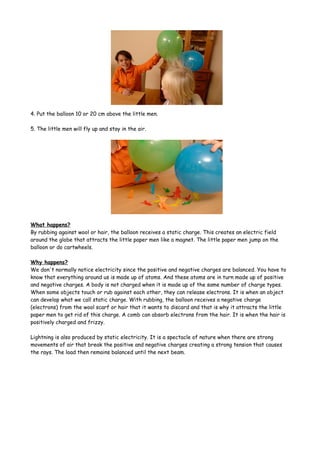
4. Put the balloon 10 or 20 cm above the little men.
5. The little men will fly up and stay in the air.
What happens?
By rubbing against wool or hair, the balloon receives a static charge. This creates an electric field
around the globe that attracts the little paper men like a magnet. The little paper men jump on the
balloon or do cartwheels.
Why happens?
We don't normally notice electricity since the positive and negative charges are balanced. You have to
know that everything around us is made up of atoms. And these atoms are in turn made up of positive
and negative charges. A body is not charged when it is made up of the same number of charge types.
When some objects touch or rub against each other, they can release electrons. It is when an object
can develop what we call static charge. With rubbing, the balloon receives a negative charge
(electrons) from the wool scarf or hair that it wants to discard and that is why it attracts the little
paper men to get rid of this charge. A comb can absorb electrons from the hair. It is when the hair is
positively charged and frizzy.
Lightning is also produced by static electricity. It is a spectacle of nature when there are strong
movements of air that break the positive and negative charges creating a strong tension that causes
the rays. The load then remains balanced until the next beam.

Natural science experiment 1 u9

  • 1.
    NATURAL SCIENCE EXPERIMENTNº1 (UNIT 9) ‘FLYING LITTLE PAPER MEN’ Electricity consists of a balanced amount of positive and negative charges. We can get electrons with friction. Fly little paper men with this experiment. How can you get them to fly over a table without touching or blowing on them? For this experiment, we just have to rub a balloon. What do you need? • A balloon • A sheet of paper • Silk paper • Scissors • A wool scarf or your head What is there to do? 1. Draw the silhouette of a little man on a slightly thick plain paper. Help your child to cut it and use it as a model to cut a bunch of little men on tissue paper of different colors. 2. Put the paper little men on a table. Inflate a balloon and close it with a knot. 3. Rub the balloon over a wool scarf, over your hair or your child's.
  • 2.
    4. Put theballoon 10 or 20 cm above the little men. 5. The little men will fly up and stay in the air. What happens? By rubbing against wool or hair, the balloon receives a static charge. This creates an electric field around the globe that attracts the little paper men like a magnet. The little paper men jump on the balloon or do cartwheels. Why happens? We don't normally notice electricity since the positive and negative charges are balanced. You have to know that everything around us is made up of atoms. And these atoms are in turn made up of positive and negative charges. A body is not charged when it is made up of the same number of charge types. When some objects touch or rub against each other, they can release electrons. It is when an object can develop what we call static charge. With rubbing, the balloon receives a negative charge (electrons) from the wool scarf or hair that it wants to discard and that is why it attracts the little paper men to get rid of this charge. A comb can absorb electrons from the hair. It is when the hair is positively charged and frizzy. Lightning is also produced by static electricity. It is a spectacle of nature when there are strong movements of air that break the positive and negative charges creating a strong tension that causes the rays. The load then remains balanced until the next beam.