Natural Science and “pseudo-science”Presenter: NanaseIsakaResearch Assistant: Manaka Yamaguchi
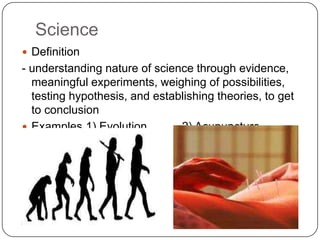
ScienceDefinition- understanding nature of science through evidence, meaningful experiments, weighing of possibilities, testing hypothesis, and establishing theories, to get to conclusionExamples 	1) Evolution		2) Acupuncture
Example of Science -EvolutionEvidence- fossil, Galapagos IslandsWell researched by biologistsIt can be changed when proven wrong
Example of Science -AcupunctureEvidence / research- Skin release adenosine when puncturedExperiment- Using leukemic rats
Pseudo-scienceDefinitionlack of experiment. rely on myth, or religion.
subjective validation- look at the evidence that supports their belief to rationalize it and miss out the contradicting ones
no progressExampleFlat Earth
CreationismExample of Pseudo-Science –Flat EarthSupporters: the International Flat Earth Research Society Beliefs: the earth is flat and plane and that it does not spin and whirl at 1000 miles/hour. Belief that earth is sphere is prejudice-nothing to support it, and that pictures prove nothing. The explanation they give is: Earth is circle. North Pole in center and South Pole is spread around edge. When go around the world you travel around the circle. Objects seem to disappear when they go away because of the laws of perspective. The further the object is the smaller it gets.
Example of Pseudo-Science –CreationismThe belief that the universe and living organisms originate from specific acts of divine creation, as in the biblical account, rather than by natural processes such as evolution.Creationists are strongly opposed to a world brought on by evolution  e.g.) Charles Darwin’s Origin of SpeciesThe experiment haven’t been conducted and no prooftherefore, it is not science, but pseudo scienceDifference Whether scientific hypotheses are testable or not.Vagueness 	-if a statement is sufficiently vague, it will be impossible to verify or falsify it. e.g.) ‘Quartz crystals can restore the balance and energy of your life’Need some kind of criteria (preferably measurable ones) Ad hoc exceptions	‘All swans are white’ showing a black one’All swans are white except that mutation’Good hypothesis is one that is general in nature and does not keep making exceptions every time it meets counter-examples.
DifferenceIndicators- importance of evidence, meaningful experiments, hypothesis, theories as result.Scienceconstantly updated ex) textbookPseudo-science- no updating
Ways of KnowingPseudoScienceScienceBothPerception- Language- Reason- Emotion

Natural science and pseudoscience

  • 1.
    Natural Science and“pseudo-science”Presenter: NanaseIsakaResearch Assistant: Manaka Yamaguchi
  • 2.
    ScienceDefinition- understanding natureof science through evidence, meaningful experiments, weighing of possibilities, testing hypothesis, and establishing theories, to get to conclusionExamples 1) Evolution 2) Acupuncture
  • 3.
    Example of Science-EvolutionEvidence- fossil, Galapagos IslandsWell researched by biologistsIt can be changed when proven wrong
  • 4.
    Example of Science-AcupunctureEvidence / research- Skin release adenosine when puncturedExperiment- Using leukemic rats
  • 5.
  • 6.
    subjective validation- lookat the evidence that supports their belief to rationalize it and miss out the contradicting ones
  • 7.
  • 8.
    CreationismExample of Pseudo-Science–Flat EarthSupporters: the International Flat Earth Research Society Beliefs: the earth is flat and plane and that it does not spin and whirl at 1000 miles/hour. Belief that earth is sphere is prejudice-nothing to support it, and that pictures prove nothing. The explanation they give is: Earth is circle. North Pole in center and South Pole is spread around edge. When go around the world you travel around the circle. Objects seem to disappear when they go away because of the laws of perspective. The further the object is the smaller it gets.
  • 9.
    Example of Pseudo-Science–CreationismThe belief that the universe and living organisms originate from specific acts of divine creation, as in the biblical account, rather than by natural processes such as evolution.Creationists are strongly opposed to a world brought on by evolution e.g.) Charles Darwin’s Origin of SpeciesThe experiment haven’t been conducted and no prooftherefore, it is not science, but pseudo scienceDifference Whether scientific hypotheses are testable or not.Vagueness -if a statement is sufficiently vague, it will be impossible to verify or falsify it. e.g.) ‘Quartz crystals can restore the balance and energy of your life’Need some kind of criteria (preferably measurable ones) Ad hoc exceptions ‘All swans are white’ showing a black one’All swans are white except that mutation’Good hypothesis is one that is general in nature and does not keep making exceptions every time it meets counter-examples.
  • 10.
    DifferenceIndicators- importance ofevidence, meaningful experiments, hypothesis, theories as result.Scienceconstantly updated ex) textbookPseudo-science- no updating
  • 11.

Editor's Notes

  • #4 http://www.galapagoscruises.be/tag/finches
  • #5 http://www.bukisa.com/articles/295264_acupuncture-scientifically-proven-effectivehttp://newsbythesecond.com/acupuncture-pain-killing-chemical-discovered/1987/
  • #6 http://www.csj.org/studyindex/studycrthk/study_pseddoscience/study_factpseudo.htm
  • #7 http://faculty.stedwards.edu/davidw/scie/pseudo/examples.html
  • #8 http://plato.stanford.edu/entries/creationism/
  • #9 textbook
  • #10 http://www.differencebetween.net/science/difference-between-science-and-pseudo-science/http://www.techpin.com/very-cool-science-experiments/http://www.quickandeasyscienceexperimentsblog.com/category/science-experiments/for-kids/